
Founder CEO @Timecounts • creator of Twestival
Joined February 2008
- Tweets 124
- Following 397
- Followers 26,635
- Likes 11,159
3 Photos and videos

Pinned Tweet

Jan 14
“Unpopular ideas can be silenced, and inconvenient facts kept dark, without the need for any official ban.”
- George Orwell, 1945, The Freedom of the Press
15
5,683
Amanda Rose retweeted

Apr 20
Stop taking advice from people who've never built anything. If they haven't put something on the line, their opinion on your risk isn't worth hearing.
The people who judge the attempt are never the ones making one.
146
342
2,463
181,219
Amanda Rose retweeted

Apr 17
When simulation becomes the norm, it weakens the human capacity for discernment. As a result, our social bonds close in upon themselves, forming self-referential circuits that no longer expose us to reality. We thus come to live within bubbles, impermeable to one another. Feeling threatened by anyone who is different, we grow unaccustomed to encounter and dialogue. In this way, polarization, conflict, fear and violence spread. What is at stake is not merely the risk of error, but a transformation in our very relationship with truth.
1,574
13,928
81,920
8,847,187
Amanda Rose retweeted

Apr 11
"We are a mirror, reflecting you."
Artemis II mission specialist Jeremy Hansen discusses ways that the crew worked together and supported each other throughout their lunar mission.
192
2,108
12,493
634,048
Amanda Rose retweeted

Mar 10
This has to be one of the best/coolest sports quotes ever. Incredible player.

SGA on his mindset in the clutch:
"I have answers to the test… but I gotta see the questions first." 🧠
219
670
10,757
1,076,283
Amanda Rose retweeted

Feb 15
. @profgalloway speaks facts about the Canada - US trade relationship.
“If there’s a trade imbalance, or an asymmetry, it benefits us (the USA) full stop.”
His point is that the tariffs, threats, and attacks on Canada make no sense, and are contrary to the commercial interests of the USA.
72
163
764
40,039
Amanda Rose retweeted

Jan 30
34
111
555
312,742
Amanda Rose retweeted

Jan 26
The crux of propaganda: Repetition is treated as Proof.
The message is repeated across channels until it feels familiar, then treated as true.
2
8
44
3,051
Amanda Rose retweeted

Jan 26
One of my most deeply held beliefs is that refusing to name truth makes you stupid--literally degrades your intellect.
Engaging in mental gymnastics to justify what's convenient but unevidenced, unjust but personally beneficial, 'rewires your neural map' in ways that degrade your overall ability to understand and analyze the world around you, which is a precondition for intelligence and creativity.
91
702
3,400
191,753
Amanda Rose retweeted

Jan 25
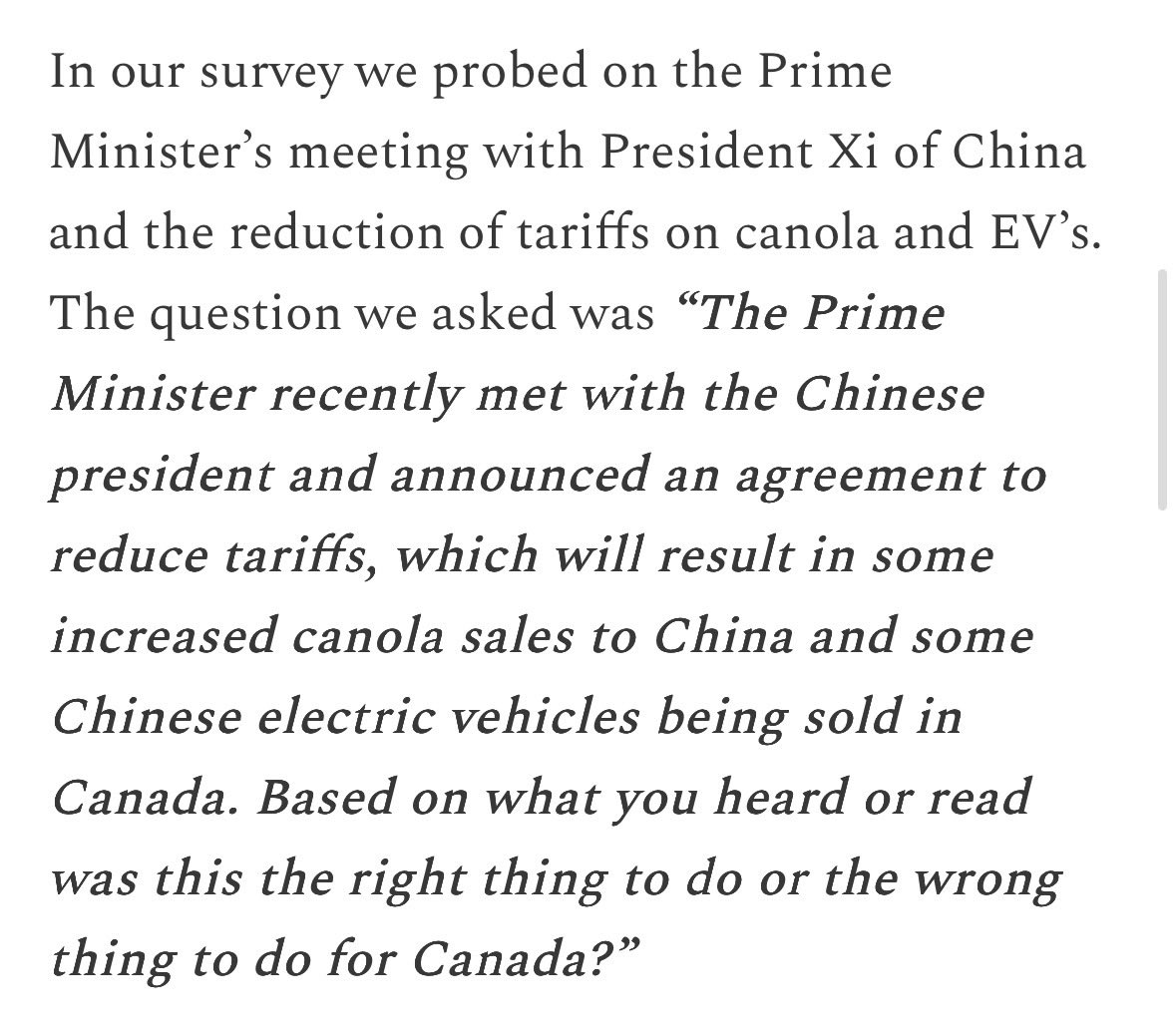
New polling suggests 78% of Canadians feel the China canola/EV deal was the right thing to do including 77% in the prairies and 75% in Ontario.
A majority (56%) of those who voted Conservative last year also support, as do 84% of NDP and 85% of BQ voters.
bruce728.substack.com/p/appr…
482
571
2,254
160,235
Amanda Rose retweeted

Jan 21
"If Carney’s speech becomes the intellectual foundation for a new wave of indiscriminate economic nationalism—or for a naïve re-embrace of Chinese trade under a different vocabulary—it will age poorly. But if it’s taken for what it appears to be—a clear-eyed description of a world Canada did not choose but must now navigate—it may prove to be one of the most consequential foreign-policy speeches delivered by a Canadian prime minister in some time."
Jan 21

39
26
225
31,851
Jan 19
Apparently the millions Canadians spent on ads saying "tariffs are a tax" wasn’t enough of a warning.
Jan 19

By analyzing $4 trillion of shipments between January 2024 and November 2025, researchers found that foreign exporters absorbed only about 4% of the burden of last year’s U.S. tariff increases by lowering their prices, while American consumers and importers absorbed 96%.
The tariffs had a significant effect on trade volumes: Facing higher U.S. tariffs, Indian exporters maintained their prices but reduced the volume of shipments to the U.S. by 18%-24% relative to the European Union, Canada and Australia, the report found.
Rather than acting as a tax on foreign producers, the tariffs functioned as a consumption tax on Americans. The $200 billion in additional U.S. tariff revenue last year “was paid almost exclusively by Americans.”
wsj.com/economy/trade/americ…
4
947
Jan 16
I wish someone would curate the 100 tweets I actually need to read each day so I can stay on top of what matters without logging in and sifting through ragebait. I’d sign up for that.
2
1
361
Amanda Rose retweeted

For me the Carney doctrine of arch-pragmatism is encapsulated in this succinct, memorable and quietly devastating quote he delivered to us today at a park in Beijing in the freezing cold:
“We take the world as it is, not as we wish it to be.”
nytimes.com/2026/01/16/world… #cdnpoli
139
614
2,388
149,137
Amanda Rose retweeted

Jan 13
“They are in their final days. It’s unlike anything I’ve ever seen,” says Iranian activist @NazaninBoniadi, as the regime cracks down violently.
“A govt that thinks of itself as legitimate doesn’t take away its citizens’ rights to communicate w/ each other & the outside world.”
460
872
3,216
148,815
Jan 12
The bravery of Iranian protesters is extraordinary. Standing up when the cost is so high is a level of courage most of us can barely imagine.
280
31 Dec 2025
Every Canadian should feel safe. Over the last couple of years, my Jewish friends haven’t, and I’ll be honest, I haven’t always known how to help. We need to talk honestly about what’s happening.
31 Dec 2025

I wrote an op ed for the @nationalpost today to say this plainly: Jewish Canadians are being targeted simply because they are Jewish. That is antisemitism. And it is getting worse.
nationalpost.com/opinion/can…
1
1,304
12 Dec 2025
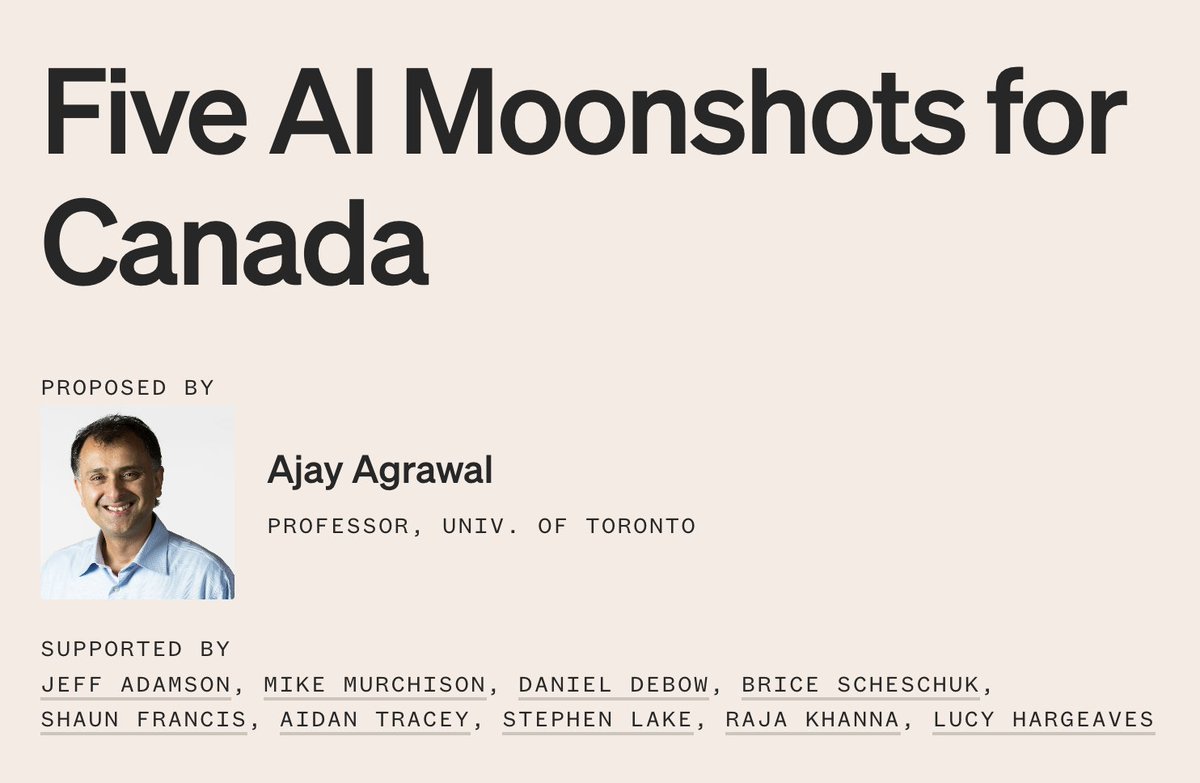
One of my favourite @build_canada memos so far. I can imagine Canadians sitting down over the holidays and using this as the basis for some really good conversations.
12 Dec 2025

Setting a target to become the "Best AI country in the world" is meaningless.
AI is a tool — successful adoption will be defined not by quantity of use but by applying that tool to problems with measurable outcomes. The questions around the roll out of AI are not whether Canada leads in AI per se, but whether Canadians get faster healthcare, better education, and stronger defence.
The way to approach this is by setting aspirational, measurable, high impact goals i.e. moonshots. Moonshots work because they force system-wide change. A single bold target—like cutting healthcare wait times by 90%—requires redesigning every part of the system with the latest technology to reduce redundancy and increase productivity. Governments are uniquely positioned to lead these efforts because they can coordinate across agencies, provinces, and sectors in ways the private sector cannot.
Successful moonshots have five qualities: they are ambitious, benefit many Canadians, require AI to succeed, build infrastructure other projects can use, and cannot be delivered by the private sector alone.
If Canada were to achieve the five moonshots, we would become a world leader in these services and transform our infrastructure for adopting AI:
1. Healthcare: Cut referral-to-treatment time by 90% using AI for triage, scheduling, and early detection.
2. Education: Reduce Grade 3 reading failure by 90% through adaptive screening, personalized tutoring, and teacher support tools.
3. Natural Resources: Shrink wildfire and oil spill response time by 90% using sensor networks, drone verification, and AI dispatch.
4. Defence: Reduce time to detect and classify airspace or maritime incursions by 90% through multi-sensor fusion and automated tracking.
5. Homelessness: Cut the time from first contact to stable housing by 90% by integrating shelter data, benefits systems, and housing matching.
Read the full memo: buildcanada.com/memos/moonsh…
1
1
3
1,854
Amanda Rose retweeted

5 Dec 2025
Can't think of another example of a global power so demonstratively burning its assets and destroying its influence, in a single document
5 Dec 2025

1/ The new US National Security Strategy blames 'undemocratic' European governments for failing to make peace with Russia, takes a pro-Russian position on NATO, reflects white nationalist views on European demographics, and pledges overt support for far-right parties. ⬇️
895
5,858
16,747
1,594,880
Amanda Rose retweeted

26 Nov 2025
Australia just recorded zero cervical cancer cases in women under 25 - for the first time since records began in 1982.
This is what happens when a country commits to HPV vaccination and screening. We protect our girls and save lives.
715
10,111
58,735
2,048,416