
Joined November 2016
- Tweets 11,823
- Following 787
- Followers 21,121
- Likes 13,012
1,966 Photos and videos





Did you miss our latest (and best) Aventus Community Town Hall for June 2026?
Watch it in full below 👇
1
2
70
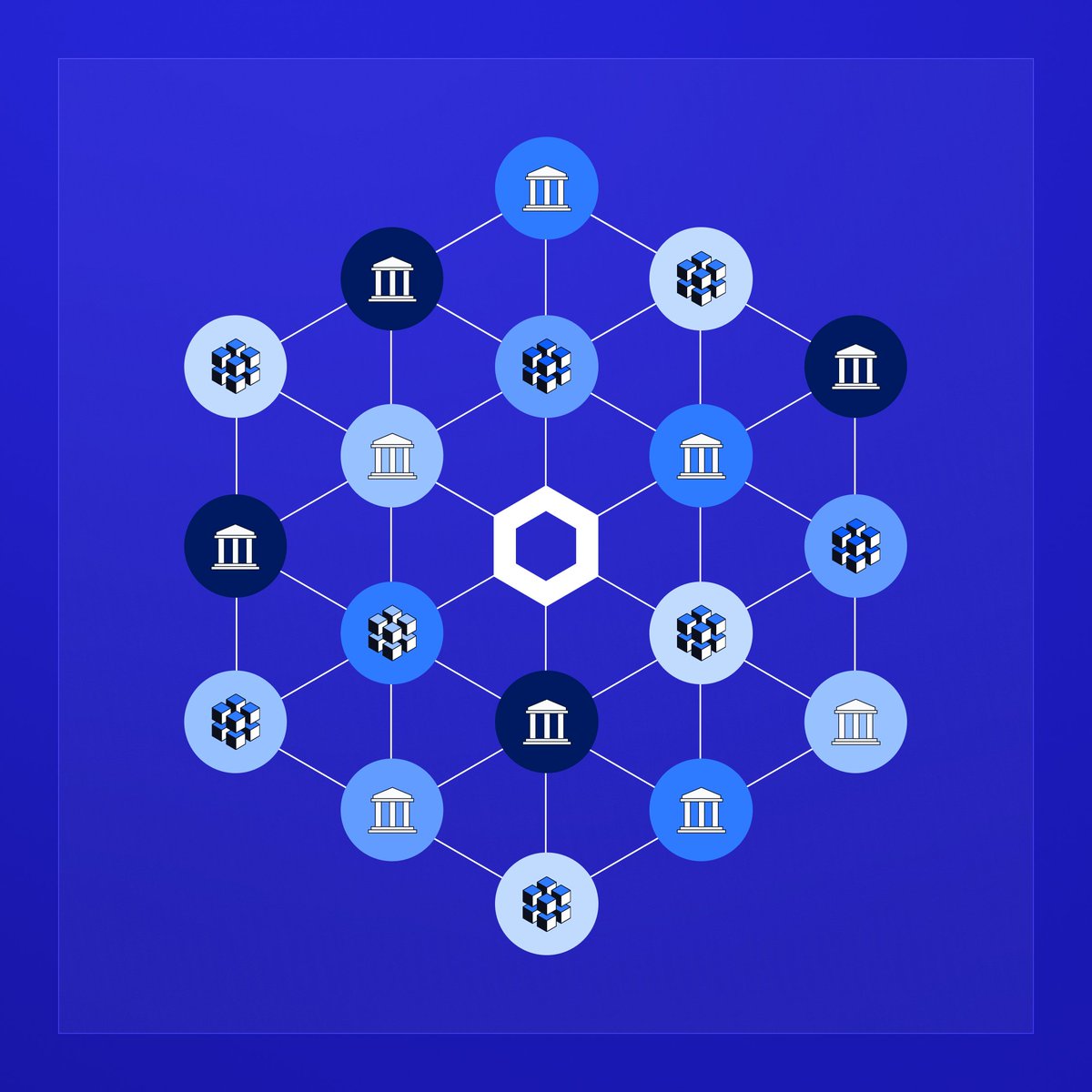
Enterprises ⇄ Aventus ⇄ Appchains

1
3
210
Staking $AVT on an Aventus Cloud node means to 'lock' your tokens, which now effectively doubles the incentives you could get for compute work contributed.
Each additional 10,000 AVT staked on a node adds another "point" of weight, giving you a 'virtual' node while the AVT is staked.
💭 How do you stake?
You can stake AVT on any eligible node through the AVN Node Dashboard app.
💭 Are these incentives guaranteed?
Rewards are gated on availability. Nodes must submit eight heartbeats per day to qualify for that day's distribution. Missing heartbeats reduce rewards pro-rata.
To get started:
1️⃣ Get a node licence from an authorised seller
2️⃣ Set up your wallet and install the dashboard app
3️⃣ Stake your AVT through the dashboard app
The more you contribute to the network, the more the network gives back.
🌐 Learn more: aventus.io/cloud
👉 Run a node: aventus.io/node
Note: Node licence purchases are not financial products, and are subject to KYC and eligibility restrictions by node sellers.
1
6
193
AVT isn't an ordinary token, it exists both as an ERC-20 token on Ethereum and also the Aventus Network parachain to help run the whole Aventus ecosystem.
1️⃣ AVT is used to pay for work done on Aventus Network and Aventus Cloud
AVT is used to pay for transactions on the Aventus Network. It's also used to incentivise Aventus Cloud node operators - 14,625 AVT shared daily in Year 1, with the amount halving each year.
2️⃣ AVT helps secure the network
Node operators stake AVT to qualify for network incentives. While staked, that AVT is locked and out of circulation. The more staked nodes running, the more secure and robust the network becomes.
3️⃣ AVT gives the community a voice
AVT holders propose and vote on decisions that shape the network, how distributions are structured, and how to build the ecosystem.
Learn more about AVT here:
👉 aventus.io/avt
Note: This post describes the utility and mechanics of AVT. It is not a recommendation to acquire, hold, or transact in AVT. AVT is not a financial product.
1
8
134
⚽️🏆


1
2
236
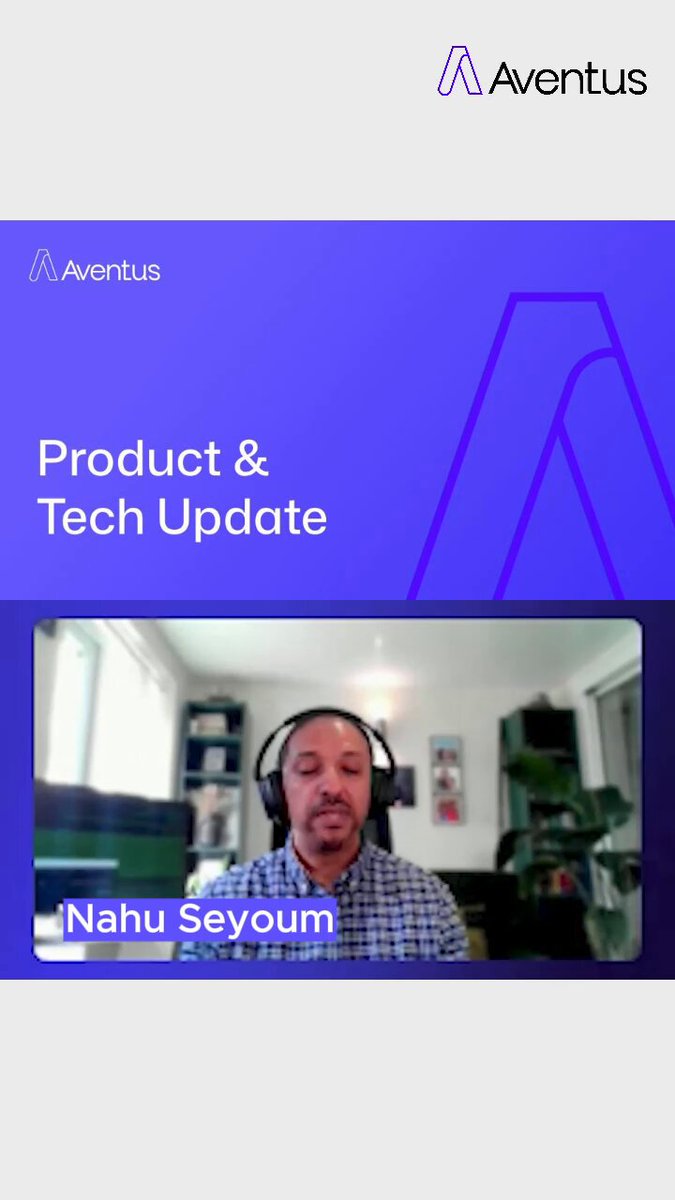
There are some major upgrades coming soon to the Aventus Network parachain, Aventus Cloud, and Enterprise Appchain infrastructure.
Our Chief Product and Technology Officer, Nahu, explains it all…
1
4
7
219
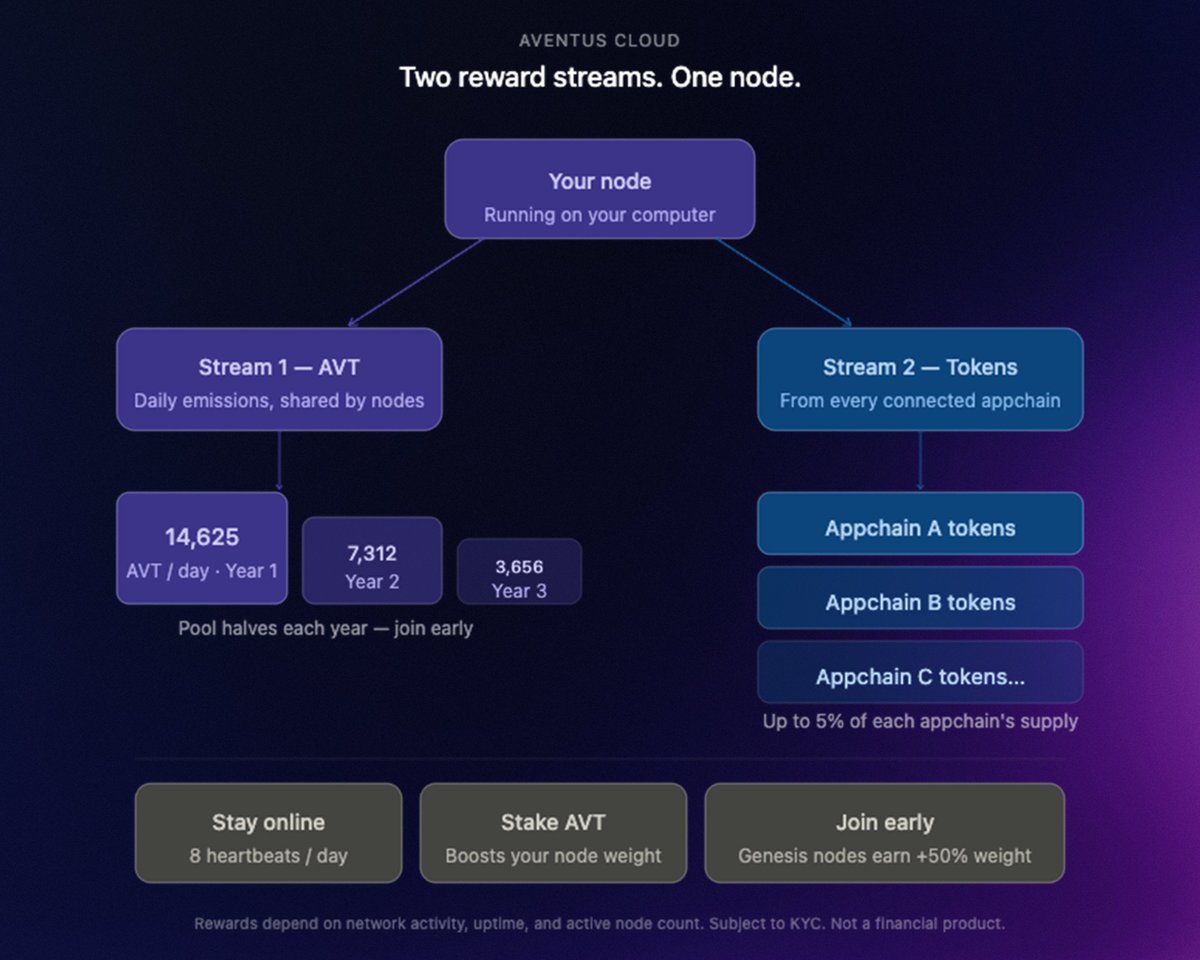
💻 Run an Aventus Cloud node. Earn rewards in two streams...
💧 Stream 1: AVT, every day.
14,625 AVT is split every day among everyone running a node in Year 1. The longer you stay online, the more you earn.
The pot gets smaller each year, so joining early means a bigger share.
💧 Stream 2: Appchain tokens, as the network grows.
Every business that plugs into Aventus Cloud sets aside up to 5% of their tokens for node operators.
The more businesses that join the network, the more token streams flow to you.
Your computer is already on. It might as well be working for you.
🤗 Get started with an Aventus Cloud node >
aventus.io/node
🤔 Learn more about how nodes work >
aventus.io/cloud
Note: Node licence purchase is not a financial product. Rewards depend on network activity, uptime, and active node count. Subject to KYC and eligibility restrictions
1
3
5
239
Community Town Hall #3: June 2026 x.com/i/broadcasts/1PKqrrAdz…
3
281
Today's live stream starts here in 30 minutes ⏰
1
3
161
appchain infrastructure

I could talk about ____________ for hours.
2
3
415
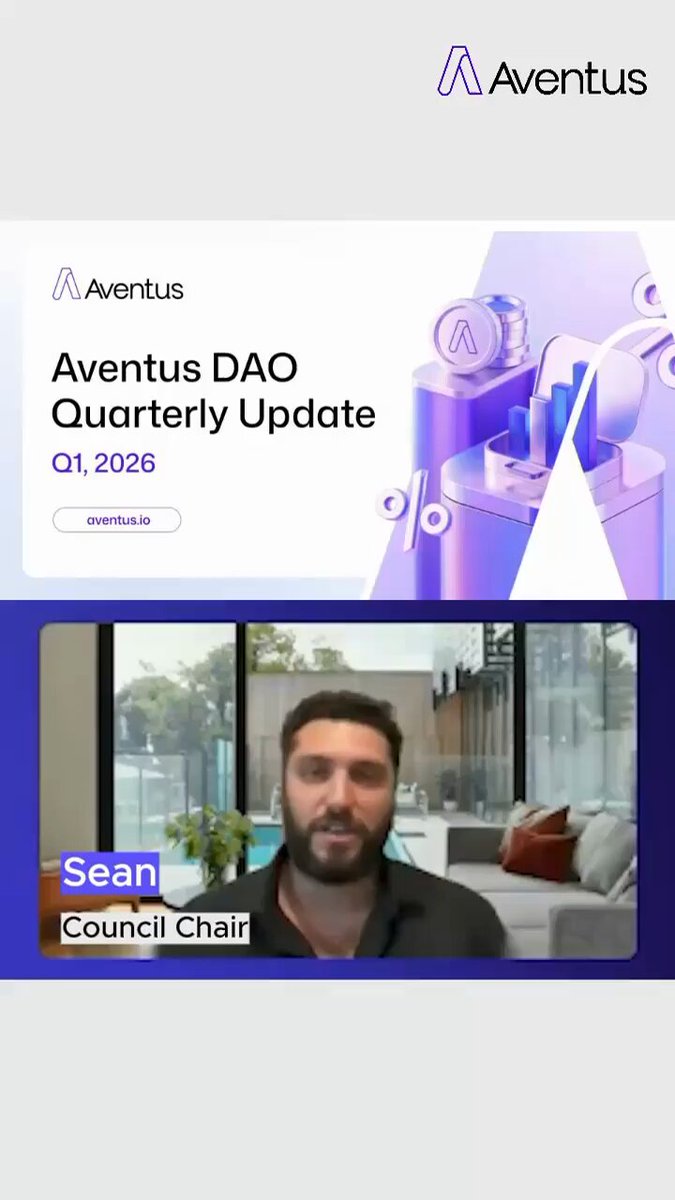
Back in April, Sean shared the Aventus Cloud launch during the DAO's quarterly update.
In today's Community Town Hall, we’ll be diving much deeper into the DAO's operations and future plans.
Don't miss it! 👇

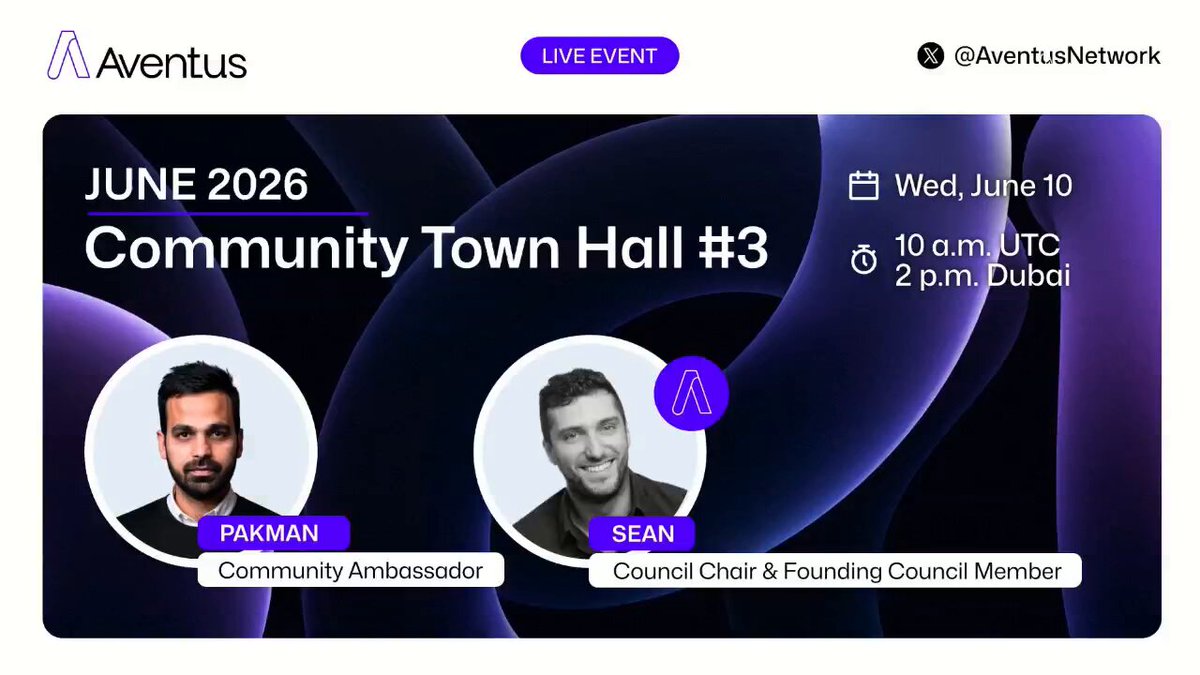
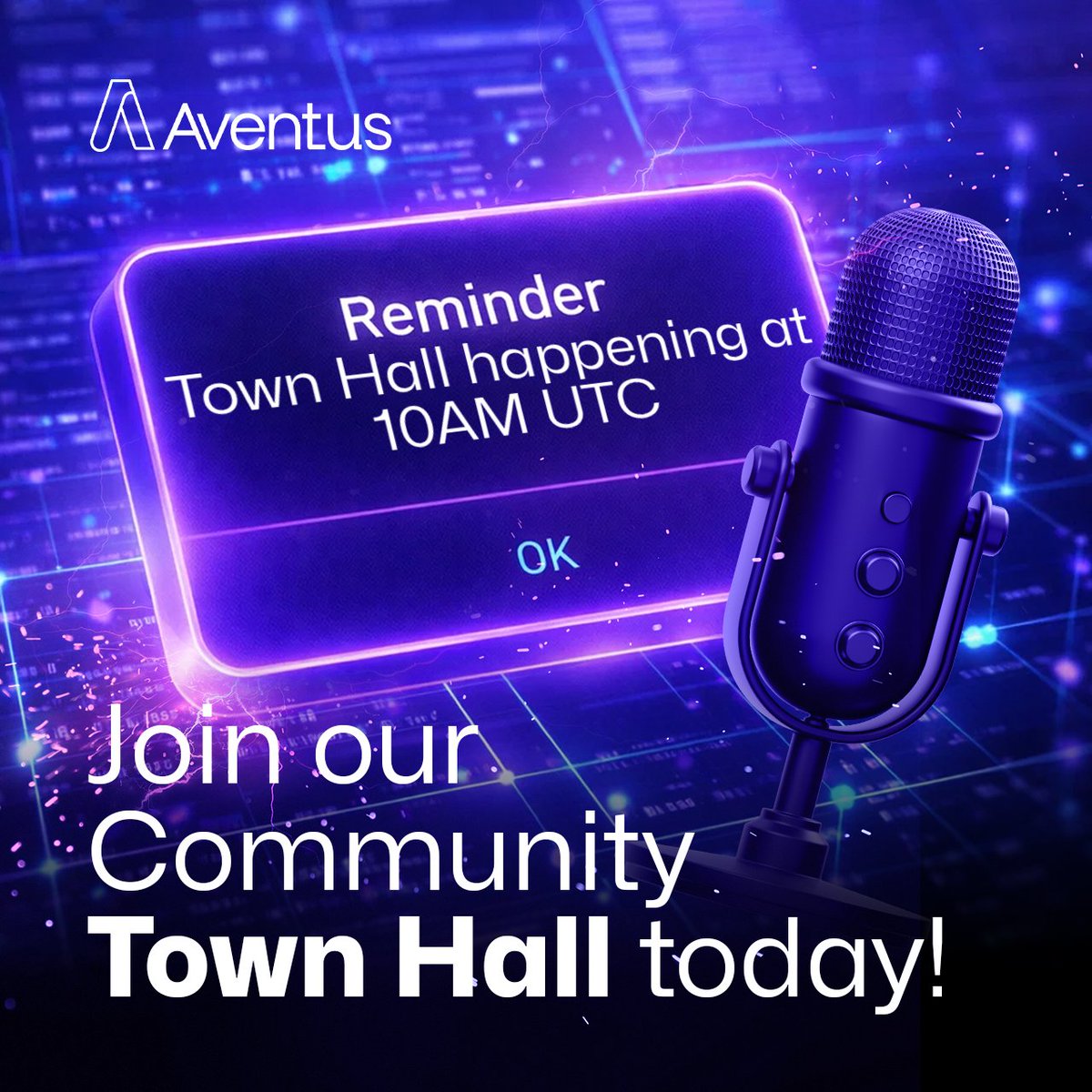
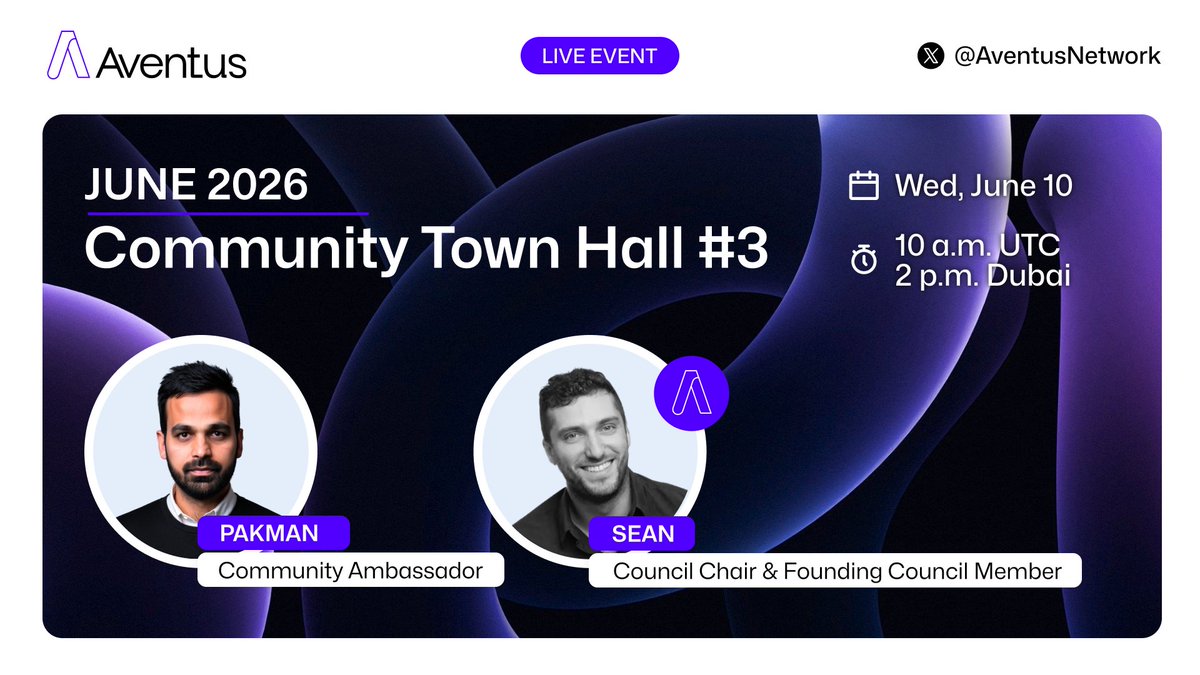
The third Aventus Community Town Hall takes place on Wednesday, June 10, at 10 a.m. UTC.
Join Head Ambassador Pakman for an in-depth conversation with Sean Naderi, the Council Chair and a Founding Council Member of Aventus DAO.
Listen to the live broadcast on:
X/Twitter: @AventusNetwork
Telegram: t.me/AventusAnnouncements
LinkedIn: linkedin.com/company/aventus…
If you have questions or requests you want asked during the town hall, please submit them here:
forms.gle/xJWzDtrFLyqUyPoi8
1
3
9
418
What if your computer could earn rewards just by staying online?
...here's how, with Aventus Cloud nodes 💫
A node is an lightweight app running on your computer. It quietly does compute work for the Aventus Cloud network, and earns rewards for it.
Setup takes a few minutes. No technical expertise needed.
Here's how to get started:
1️⃣ Get your licence
Purchase your licence from an authorised node seller.
2️⃣ Complete a quick background check
Most countries around the world are eligible to run nodes.
3️⃣ Set up a compatible crypto wallet
SubWallet or Polkadot.js wallets both work.
4️⃣ Install the Aventus Cloud Dashboard app
Available for Windows, macOS, and Linux
5️⃣ Go live!
Use your activation link, and your node starts running.
👉 Run a node today. Start earning >
aventus.io/node
✨ Learn more about rewards >
aventus.io/cloud
Note:
Node licence purchase is not a financial product. Rewards depend on network activity, uptime, and active node count. Subject to KYC and eligibility restrictions.
2
3
274
The third Aventus Community Town Hall takes place on Wednesday, June 10, at 10 a.m. UTC.
Join Head Ambassador Pakman for an in-depth conversation with Sean Naderi, the Council Chair and a Founding Council Member of Aventus DAO.
Listen to the live broadcast on:
X/Twitter: @AventusNetwork
Telegram: t.me/AventusAnnouncements
LinkedIn: linkedin.com/company/aventus…
If you have questions or requests you want asked during the town hall, please submit them here:
forms.gle/xJWzDtrFLyqUyPoi8
1
2
751
This week, there has been a great deal of discussion about a new piece from Anthropic on how AI systems are starting to build the next generation of AI systems themselves. More than 80% of code merged into Anthropic's codebase is now written by Claude itself.
Taken to its conclusion, this points to a world where AI systems can fully design and train their own successors. The technical term is recursive self-improvement. The honest description is harder to absorb.
Anthropic's authors are clear-eyed about what this means. The pace of AI development is accelerating beyond what any single organisation, government, or treaty body is prepared for.
They argue, reasonably, that the world should have the option to coordinate a slowdown. But they also acknowledge the hard part: any slowdown only works if you can verify that other labs have actually slowed. And training runs, unlike missile silos, are remarkably easy to conceal.
This makes the problem a coordination problem, and it is worth re-reading the AI 2027 forecast in light of it - ai-2027.com.
AI 2027 paints two endings to the same starting conditions:
- In one, well-coordinated actors keep the technology aligned with human interests.
- In the other, a race dynamic between bad actors and cautious ones produces a future none of us would choose.
The difference, in large part, is whether mutual verification was ever possible.
Verification at this scale cannot be entrusted to a single party. If the body that monitors compute usage at AI labs is controlled by one government, or built on one company's cloud, then it can be coerced, captured, or quietly switched off. The infrastructure for AI safety has to be at least as decentralised as the threat it is trying to constrain.
This is where Aventus Cloud comes in.
While we did not build it for AI safety, we did build it as a decentralised compute layer for situations where you must trust as little as possible and verify as much as you can. A network of thousands of independent nodes, with no single party able to turn it off, could host the verification layer for agreed compute thresholds without any single body holding the underlying data. The watchtower mechanism we already use to verify Merkle roots between chains is structurally the same problem as verifying that a frontier lab has not exceeded an agreed training threshold.
A decentralised cloud built to be contestable by design will not solve AI safety on its own. But verification has to live somewhere, and the place it lives matters.
That choice might be the difference between the two endings of AI 2027.
Jun 4

Our internal data shows Claude is accelerating AI development—a possible path to recursive self-improvement, or AI autonomously building a more capable successor.
It’s happening faster than we thought, and the implications deserve greater attention. anthropic.com/institute/recu…
1
3
7
518
If you see this tweet, this is your sign to keep building.
Jun 5

If you see this tweet, this is your sign to remember why you got into crypto.
5
368
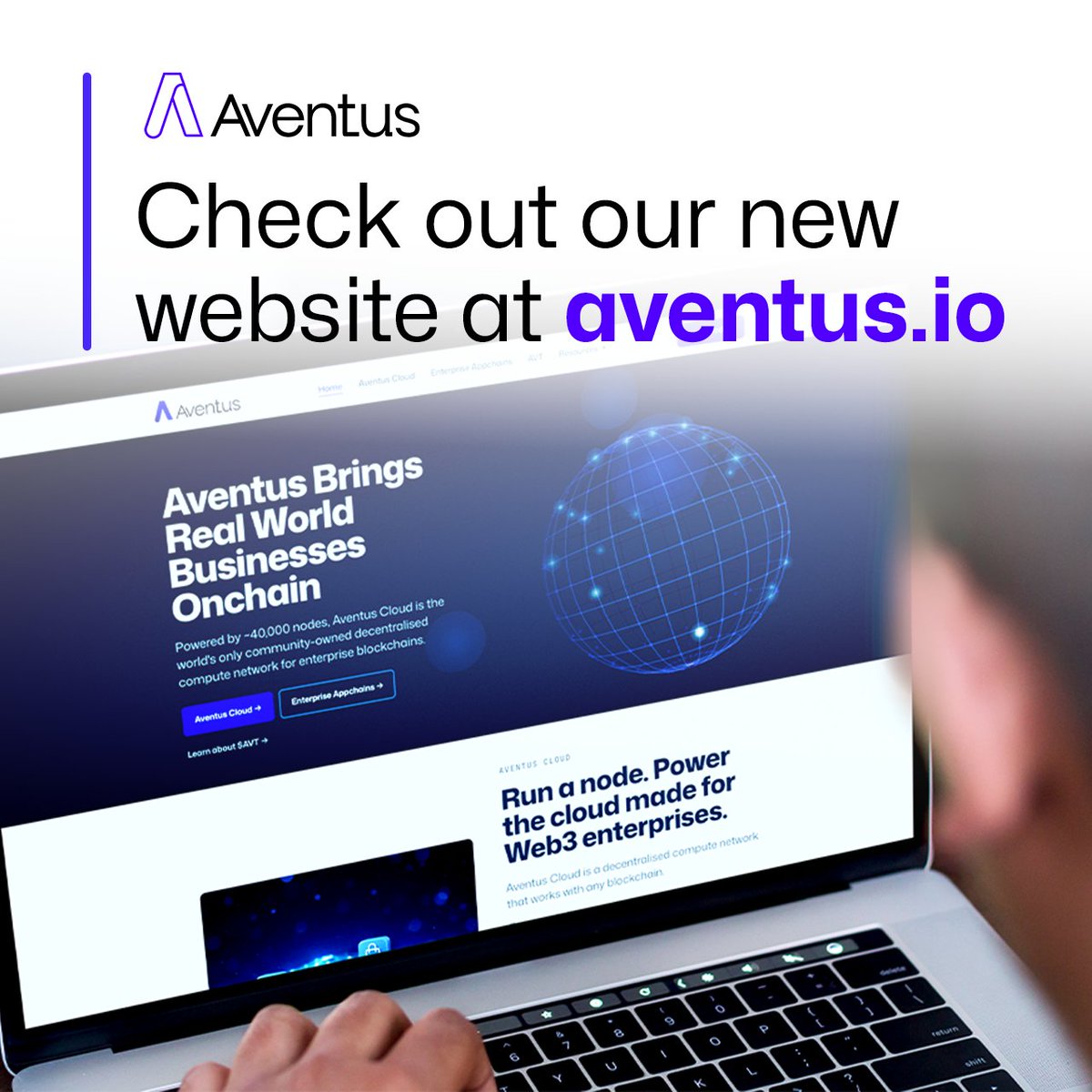
The new Aventus DAO website just launched!
Check it out at ➡️ aventus.io
If you have any suggestions or feedback, or spot a bug, please drop a comment and we'll fix it.
3
5
357
Thinking of bringing your business onchain? Here are three questions you would've likely asked already:
1⃣ “How do I move value in and out without trapping it on my chain?”
Aventus appchains plug into existing bridge architecture and AVT liquidity from day one.
2⃣ “How do I reach users who already transact onchain?”
Aventus already supports real enterprise-scale networks and user bases across energy, retail, and prediction markets.
3⃣ “How do I encode my actual business, not approximate it in smart contracts?”
With Substrate, you can write rules directly into the runtime as pallets, and build on open, reusable code.
Find out more about Enterprise Appchains:
👉 aventus.io/appchains
1
5
323
thinking about appchain infrastructure

1
5
520