
Thinker, strategist, enterprise architect, keynote speaker, analyst, book author, futurist on #IT, #CIO, #cloud, #AI. @TheFuturumGroup @SDABocconi
Joined July 2006
- Tweets 73,853
- Following 7,096
- Followers 55,785
- Likes 67,784
11,648 Photos and videos

Pinned Tweet

27 Oct 2025
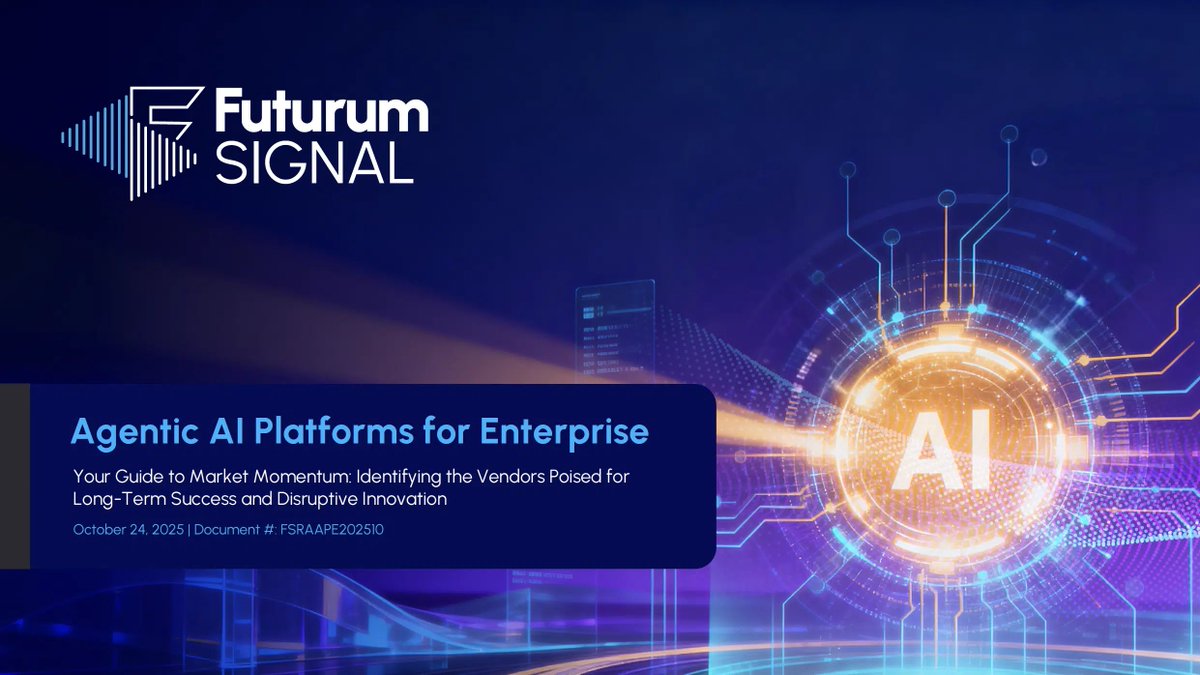
1️⃣ Big news today: After two months of deep analysis, @nickpatience and I are releasing @TheFuturumGroup's new Agentic AI Signal.
It's a definitive evaluation of the platforms powering the next era of enterprise AI.
The space is young, explosive, and moving at lightning speed.
7
4
25
7,030
Jun 13
This is the most consequential AI policy event we’ve seen so far, and I think many people are reading it as an Anthropic story when it’s actually a geopolitical technology sovereignty story.
The most important part of today’s Anthropic news is not that Fable 5 and Mythos 5 were shut down.
It’s that the U.S. government appears to have crossed a new line: Treating frontier AI models themselves as export-controlled strategic assets. Not chips. Not GPUs. Not semiconductors.
The models.
If this interpretation holds, we may have just witnessed the AI equivalent of moving from exporting computers to exporting cryptography, or even nuclear technology.
My current theory of the case:
The government is no longer evaluating frontier AI primarily as software. It is increasingly evaluating the most capable models as dual-use strategic infrastructure.
The reported concern centers on advanced cybersecurity capabilities and the possibility that sufficiently capable models could dramatically accelerate vulnerability discovery, exploitation, or cyber operations. Anthropic says the government believes a jailbreak exists that could bypass safeguards related to software vulnerability identification.
But the broader signal is much larger.
The moment governments believe a model can materially shift offensive cyber capability, intelligence collection, military planning, biotech, or strategic competition, access becomes a national security issue rather than a commercial issue.
For CIOs, several implications follow:
AI supply chains are now geopolitical supply chains.
Model availability can no longer be assumed. A model you standardize on today could become restricted tomorrow.
Multi-model architecture is now a strategic requirement, not an optimization exercise.
Sovereignty requirements will likely expand. Expect more regional models, national models, and restricted capability tiers.
Vendor concentration risk has entered the boardroom. AI providers are becoming critical infrastructure providers.
My recommendation:
Treat frontier models the same way you treat cloud providers, identity platforms, or network infrastructure.
Build portability.
Abstract model dependencies.
Maintain fallback providers.
Avoid embedding business-critical workflows into a single frontier model.
The big story here isn’t that Anthropic lost access to two models today.
It’s that governments may have started treating frontier AI as a strategic national asset whose distribution must be controlled.
If that’s true, the AI industry just entered a new era. Not the era of AI competition.
The era of AI sovereignty.
There are many other geopolitical and industry implications too, that I’ll explore later.
Jun 13

The US government, citing national security authorities, has issued an export control directive to suspend all access to Fable 5 and Mythos 5 by any foreign national, whether inside or outside the United States, including foreign national Anthropic employees.
The net effect of this order is that we must abruptly disable Fable 5 and Mythos 5 for all our customers to ensure compliance.
Access to all other Claude models is not affected.
We apologize for this disruption to our customers. We believe this is a misunderstanding and are working to restore access as soon as possible.
Read our full statement: anthropic.com/news/fable-myt…
6
882
Jun 12
New OpenSharing approach by @Databricks targets the ‘integration tax’ of enterprise AI
infoworld.com/article/418407…
I contribute my thoughts to @InfoWorld on this approach, which has some real merits.
1
1
4
202
Dion Hinchcliffe retweeted

#CIOChat A4 - There has been some progress in the tools but at the moment AI isn't helping it is enabling. If we are moving toward agentic workforces the tools will have to carry the load since an agent will not likely engage in meetings.
2
2
174
Dion Hinchcliffe retweeted
#CIOChat A1 - Meeting culture expanded when we all went home and hasn't changed much since. We do question standing meetings as to purpose and provide agendas. There are still some days that you wouldn't know that.
1
2
783

Dion Hinchcliffe retweeted

Jun 11
There are those who love manipulating the organizational dynamics of meetings for power, visibility, and a sense of importance. AI doesn't fix that, alas!
#CIOChat
1
2
3
150
Dion Hinchcliffe retweeted
Jun 11
IMO, this is one of the more significant issues with traditional meetings. It can still be hard to get the right people in the room for decisions/acts of witness. Of course, any system will have people who learn how to avoid them. But you can design for that. #CIOChat
2
1
3
119
Dion Hinchcliffe retweeted

Jun 11
And the "total diconnect" meeting as well.
Business: Well, why didn't you fail over the cluster during this incident?
IT: Ummm... My predecessors got rid of that. We haven't had that option for years.
#ciochat
1
3
144
Jun 11
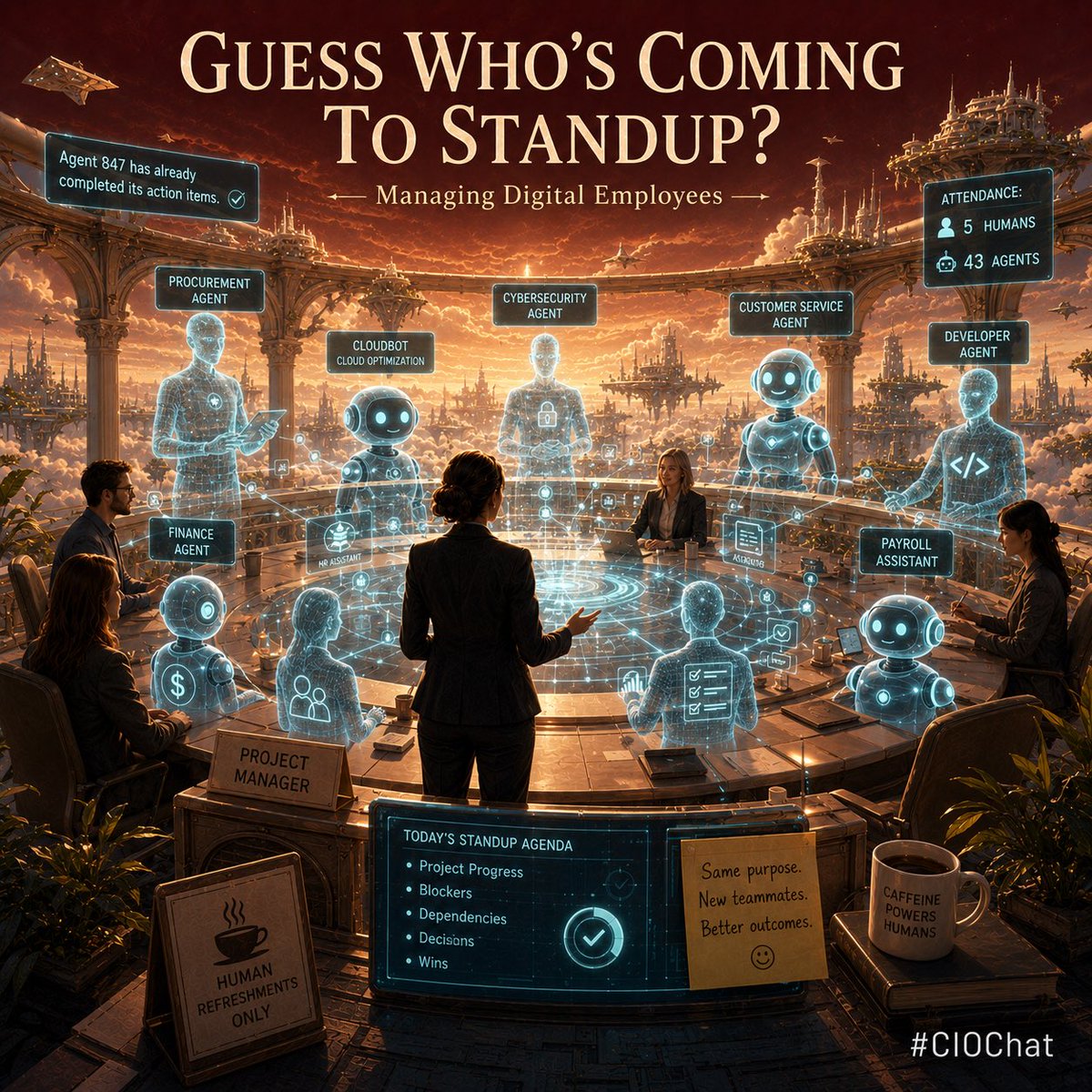
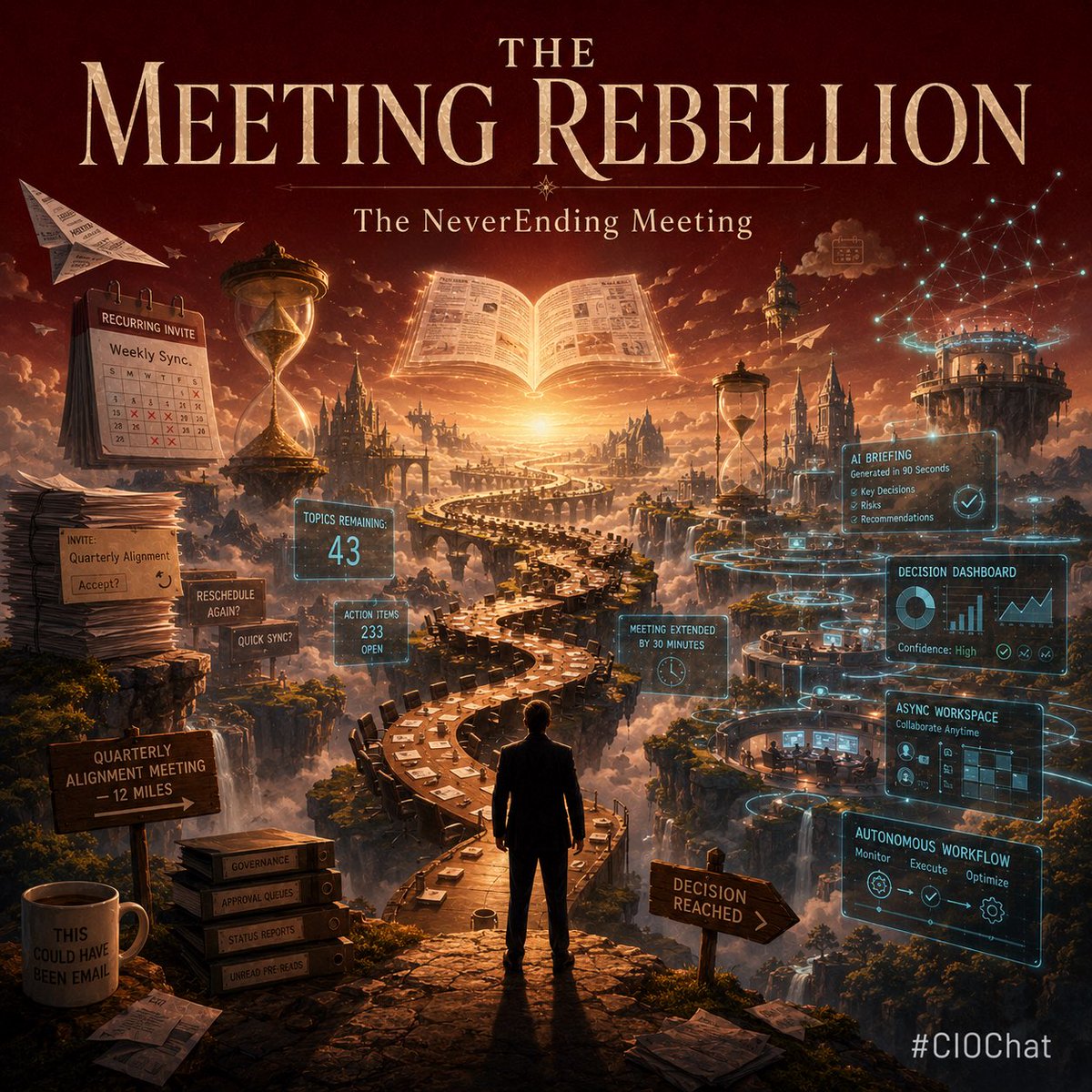
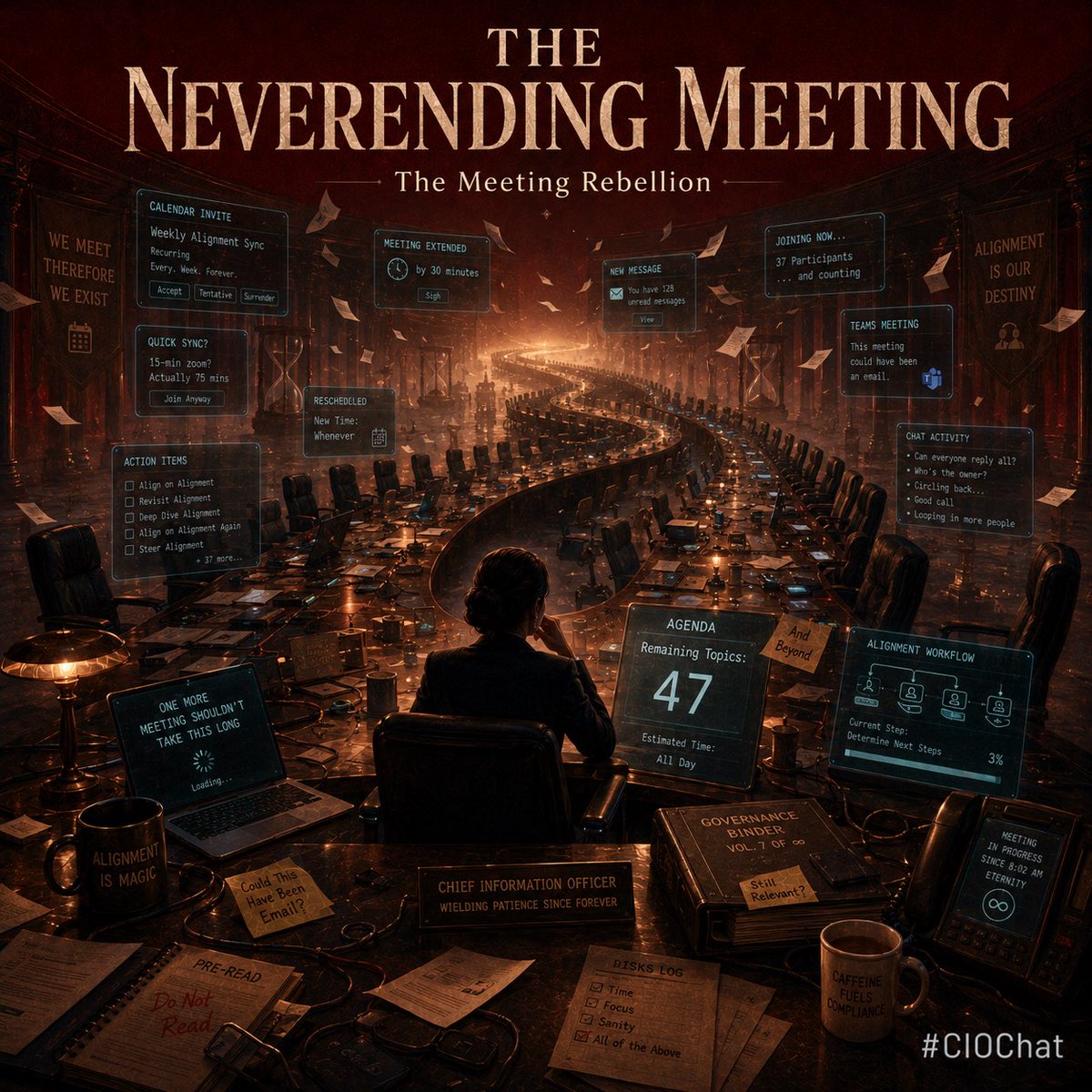
#CIOChat Great chat today. Join us at 2pm ET next Thursday. Topic (hot my from latest CIO roundtable): Managing Digital Employees
Hope you enjoy our movie tie-ins to intro next week’s topic.
Please suggest topics and invite your IT colleagues. Every Thursday at 2pm ET.
2
5
278
Dion Hinchcliffe retweeted
Jun 11
A4. I keep hoping we'll deploy better real-time status reporting tools (e.g., dashboards) to eliminate "read everyone the slides" meetings. And better workflow engines to facilitate asynchronous decision-making. And AI to pull together the data each stakeholder wants to see.
I'll settle for shorter, more focused meetings that reinforce culture and socialization as much as they perform routine/clerical functions.
#CIOChat
Jun 11

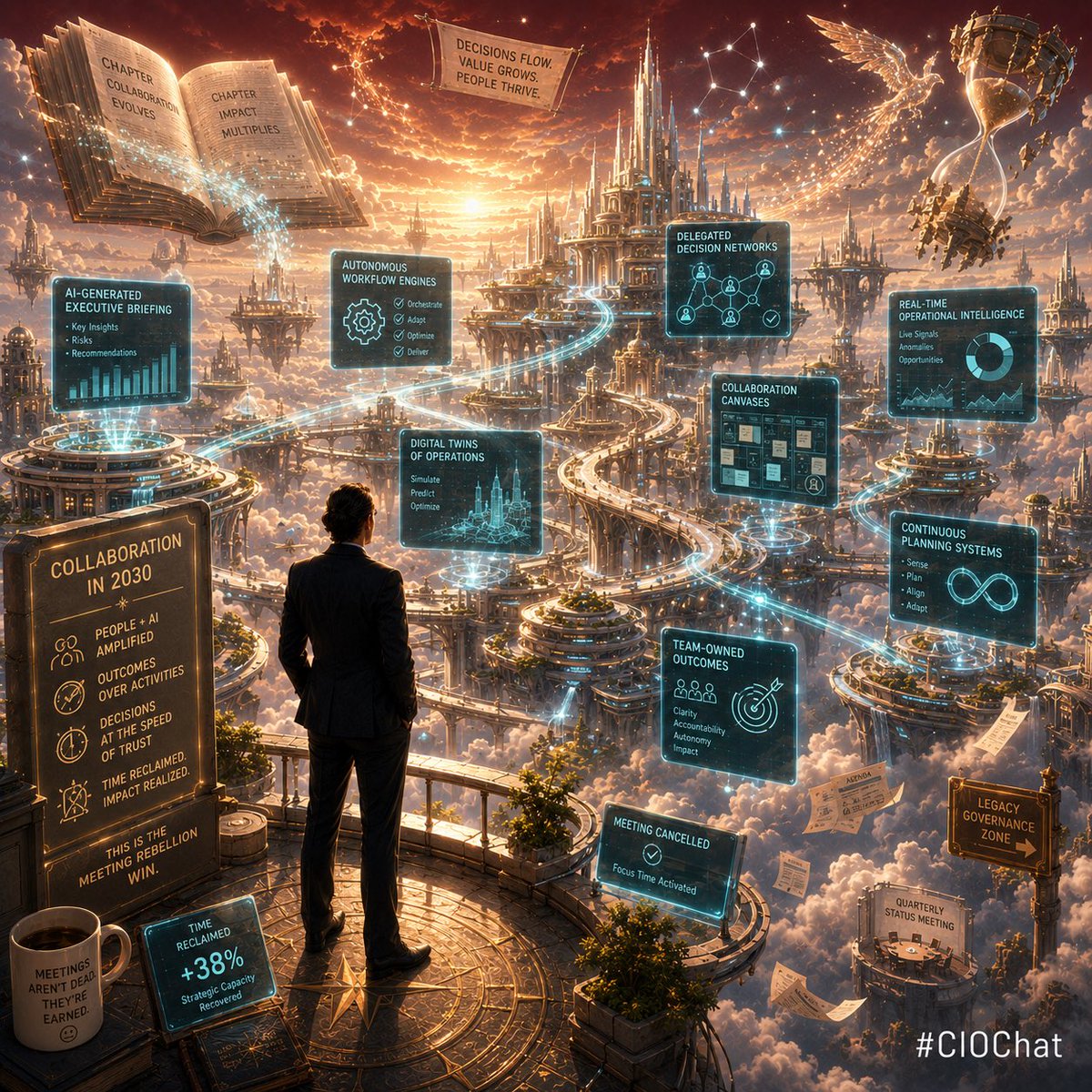
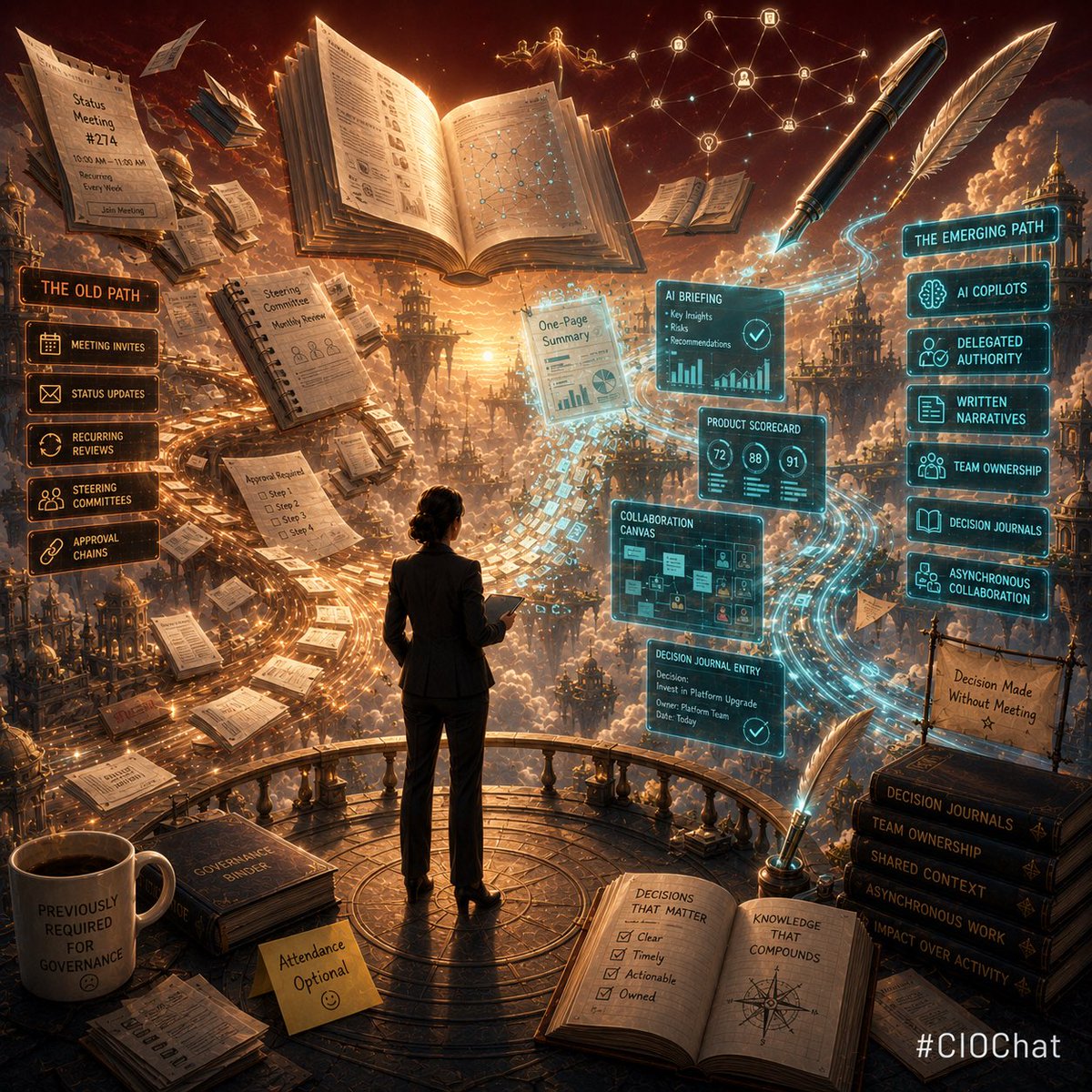
#CIOChat Q4: By 2030, will modern high-performing IT orgs still run on meetings, steering committees, and status calls?
Or will the leading orgs lead a shift to async evidence, autonomous workflows, digital twins, AI summaries, and continuous decision systems? What else?
3
3
228
Dion Hinchcliffe retweeted
Jun 11
It’s interesting. The rise of AI ensures that humans will largely have to address the unusual edge cases, exception scenarios, and new situations. These will lead people to collaborate to determine ways to address these novel events, and hopefully not more meetings. #CIOChat
1
2
4
114
Dion Hinchcliffe retweeted
Jun 11
A3) Yes. 😀 Baking as much into the process and tooling as possible to avoid unnecessary hand-offs. Bringing in the right frameworks and mindsets for the areas where they fit (and never one size fits all). @waynesadin beat me to visible, self-service dashboards. #CIOChat
1
1
5
135
Dion Hinchcliffe retweeted
Jun 11
Agree!! The information content of an audio/video discussion allows non-verbal objections to be recognized and cultural differences to come out in a free-form discussion. Maybe we should all run real-time sentiment analyzers during meetings?
#CIOChat
1
2
3
129
Jun 11
#CIOChat Q4: By 2030, will modern high-performing IT orgs still run on meetings, steering committees, and status calls?
Or will the leading orgs lead a shift to async evidence, autonomous workflows, digital twins, AI summaries, and continuous decision systems? What else?
2
2
5
364
Dion Hinchcliffe retweeted
#CIOChat A2 - Meetings are a part of culture that goes beyond IT. When too many people need to be involved in decisions, meetings become the default. In IT, meetings can be a result of complexity or sometimes people wearing too many hats.
1
4
118
Dion Hinchcliffe retweeted
Jun 11
A3. Horses for courses
If to inform: newsletters/status reports/dashboards
If to persuade: take the decision-makers to lunch
If to celebrate: send them project t-shirts
etc...
#CIOChat
1
3
4
124
Dion Hinchcliffe retweeted
Jun 11
Personally, I think tech complexity is only part of it. Business is so much more sophisticated nuanced these days, with more moving parts, stakeholders, rules. Bureaucracy/red tape at an all time high. Meetings at least allow rapid triage to address all the barriers. #CIOChat
1
1
5
131
Dion Hinchcliffe retweeted
Jun 11
A2. I think technical complexity per se has very little to do with meeting overload, except insofar as ANY misalignments amongst stakeholders need a venue for "airing out" and resolving differences. As a species, we communicate--and focus--much better when we can see and hear one another (sidebands).
#CIOChat
Jun 11
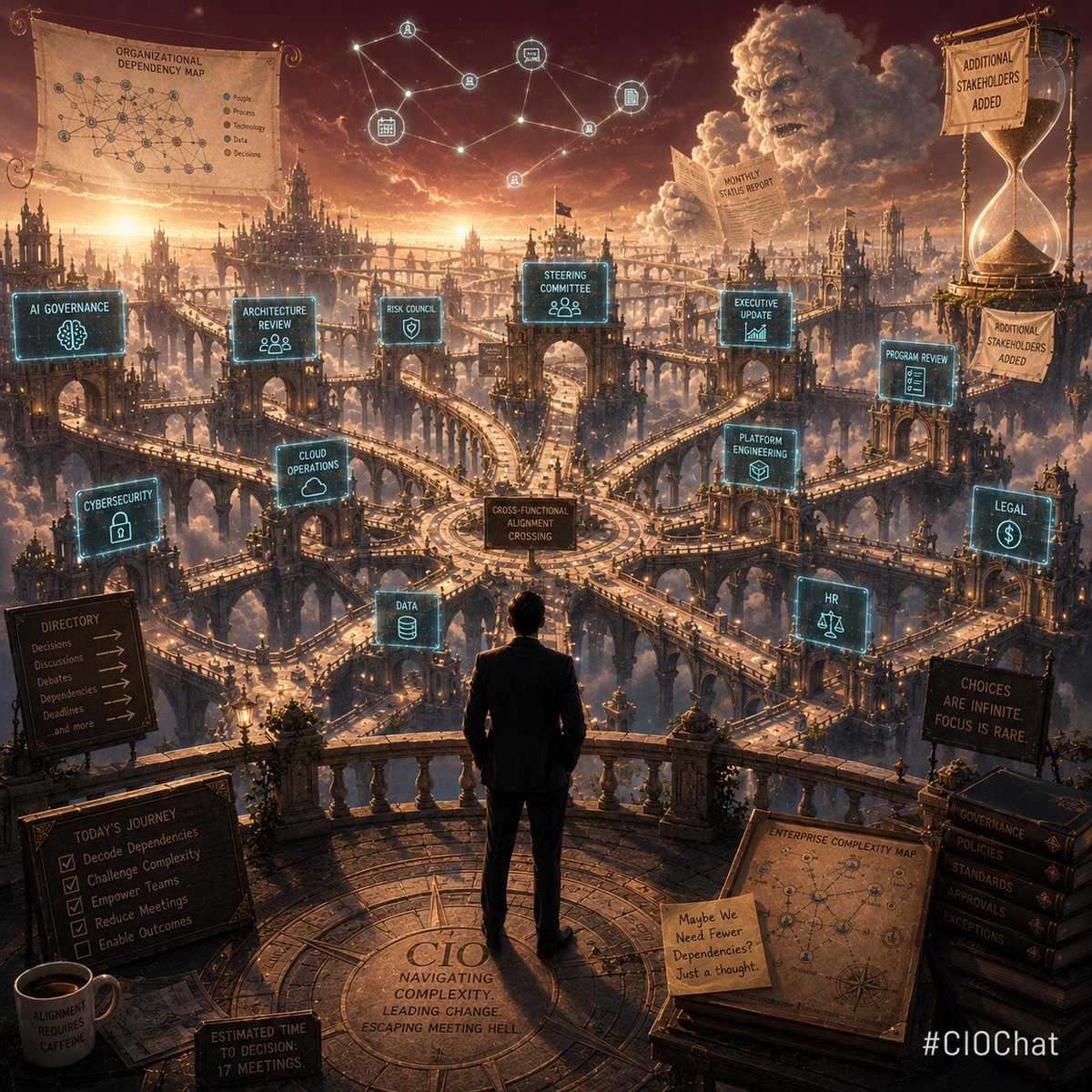
#CIOChat Q2: Is meeting overload actually a symptom of too much complexity, such as AI, cyber, cloud, agile, compliance, matrixed teams, remote work? Or culture?
What root causes must CIOs fix before they can reduce meetings or replace them with something better/more hybrid?
1
1
1
201