
Building the future of capital markets through Bitcoin.
Joined November 2022
- Tweets 54
- Following 5
- Followers 256
- Likes 63
20 Photos and videos


Finpeers retweeted

Apr 13
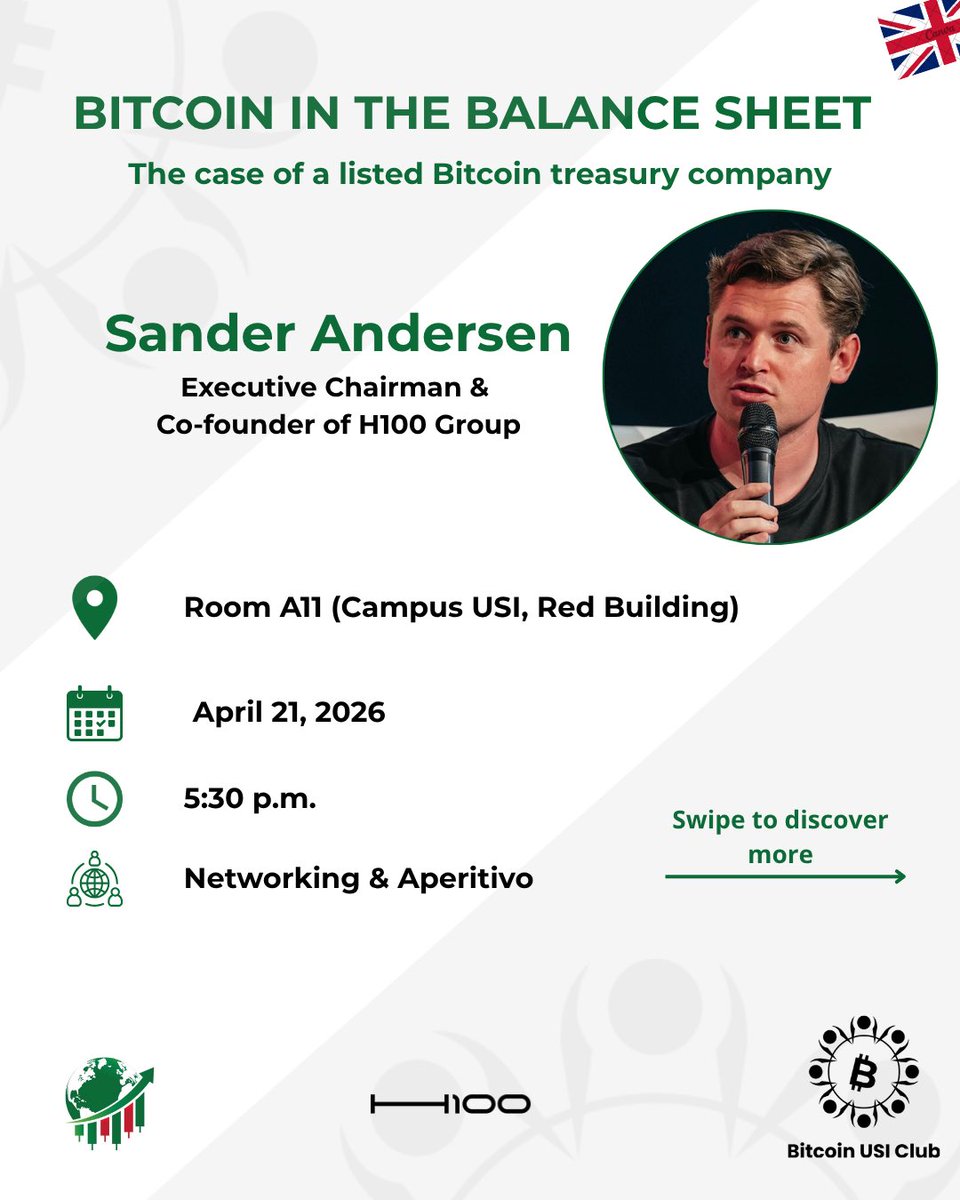
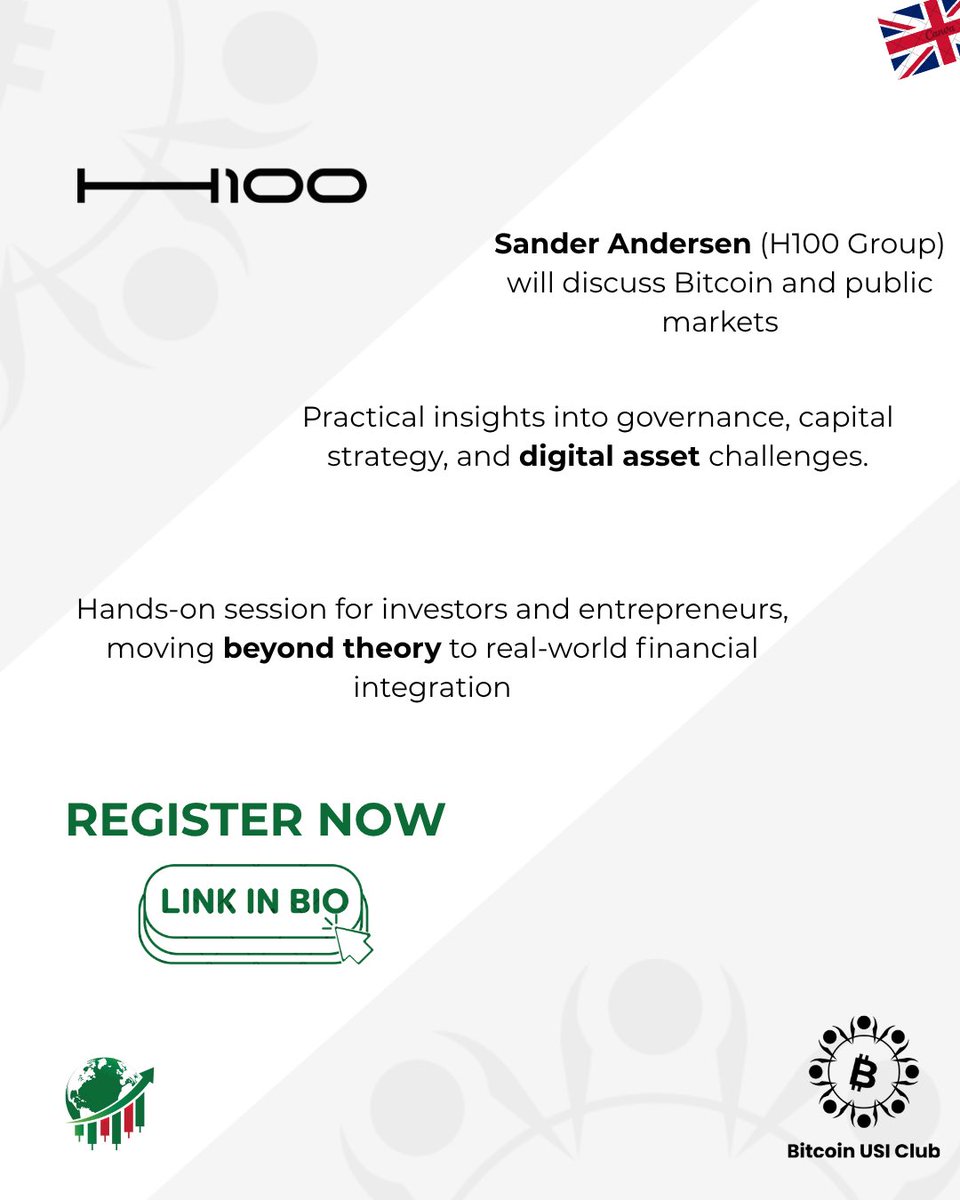
Join Bitcoin USI Club and World of Finance
🎤 Sander Andersen, CEO of H100 Group and founder of Finpeers.
Building & scaling Bitcoin companies in public markets
📅 Apr 21 | 🕠 17:30 | 📍 Lugano 🥂 Aperitivo after
👉 Register here: luma.com/o55rhufd
#Bitcoin #Lugano
1
8
14
1,272
Finpeers retweeted

Mar 23
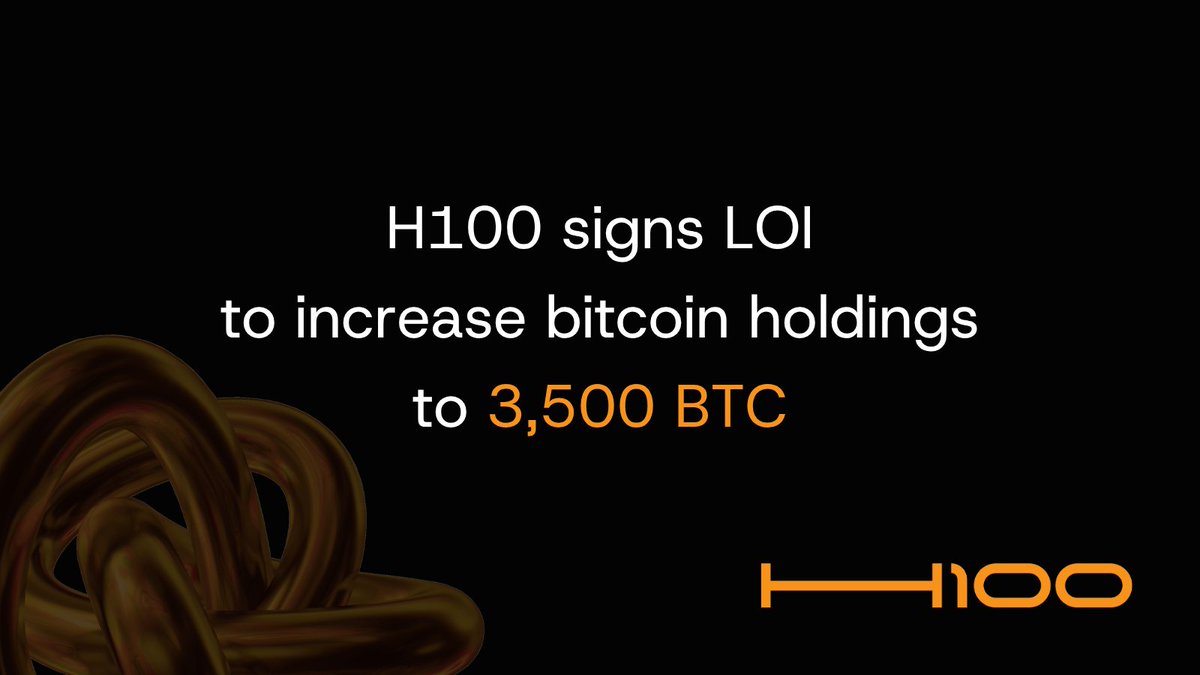
H100 has signed an LOI for a strategic acquisition expected to increase its bitcoin holdings to 3,500 BTC.
The transaction would position H100 as one of Europe’s largest publicly listed bitcoin treasury companies.
12
29
232
53,517

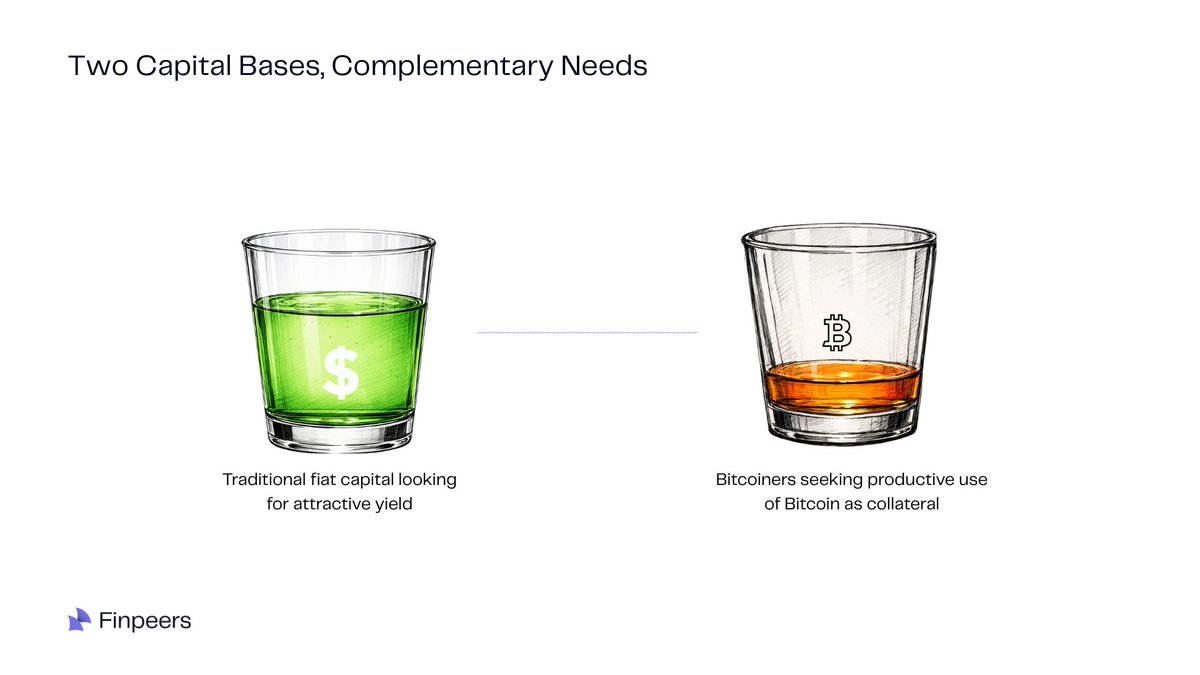
Two Capital Bases, Complementary Needs 🟢🟠

Bitcoin-backed credit serves two different capital bases with complementary needs.
On one side, you have large public and private Bitcoin balance sheets seeking productive use of Bitcoin as collateral. On the other side, you have trillions of dollars in traditional fiat capital seeking attractive yield and exposure to Bitcoin-linked yield, with control that aligns with existing risk profiles and mandates.
By structuring dual-collateralization, Bitcoin will serve as the primary liquid collateral. The cash-flow asset is the component that serves the debt.
@Sanderandersenn and @GrafYves on @OneChairPod
1
2
309
Bitcoin-backed credit serves two different capital bases with complementary needs.
On one side, you have large public and private Bitcoin balance sheets seeking productive use of Bitcoin as collateral. On the other side, you have trillions of dollars in traditional fiat capital seeking attractive yield and exposure to Bitcoin-linked yield, with control that aligns with existing risk profiles and mandates.
By structuring dual-collateralization, Bitcoin will serve as the primary liquid collateral. The cash-flow asset is the component that serves the debt.
@Sanderandersenn and @GrafYves on @OneChairPod
5
9
1,017
Finpeers retweeted

Feb 18
Bitcoin is energy harvested from the universe.
441
245
2,702
144,780

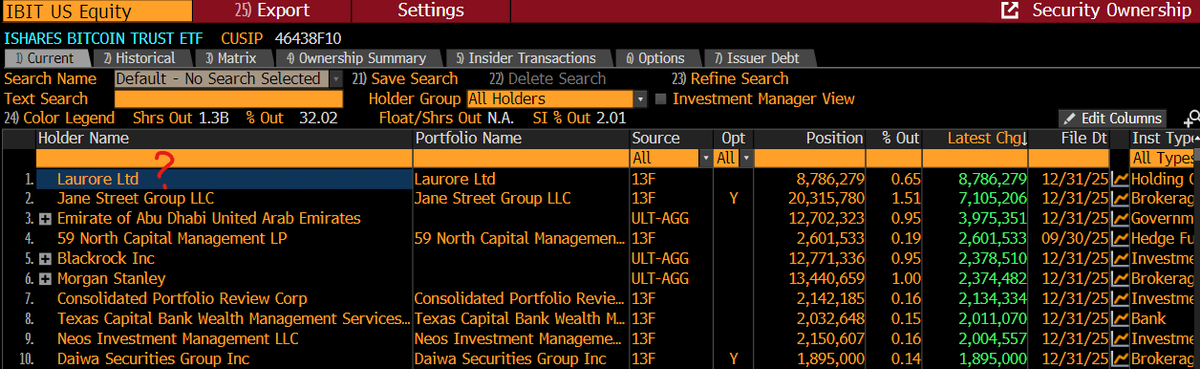
Something caught my eye in the latest 13F filings.
The biggest new entrant into IBIT, from a brand new entity, is something called Laurore Ltd. No website. No press. No footprint. The only public information is that the filer's name is Zhang Hui and it's HK based.
Let's double click on that for a second.
Zhang Hui is the Chinese equivalent of John Smith. It's what I like to call it a "non-anonymous anonymous" name, something hiding in plain sight buried under the statistical weight of millions to make it untraceable. The "Ltd" suffix suggests a Cayman or BVI structure, the classic offshore wrapper for accessing US markets. And the portfolio? A single holding. Nothing but IBIT. This isn't a diversified fund. It's a $436 million Bitcoin access vehicle dressed in institutional clothing.
Why would you do this?
Because Chinese investors can't hold Bitcoin.
If this is what it looks like, it might be an early sign of institutional Chinese capital moving into Bitcoin, not through crypto exchanges or gray market channels, but through a BlackRock ETF, filed with the SEC in a regulated jurisdiction hiding in the most "transparent non-transparent" place imaginable.
Funny that the name Laurore likely derives from the French l'aurore: the dawn.
Smells like capital flight to me.
247
676
5,448
973,131
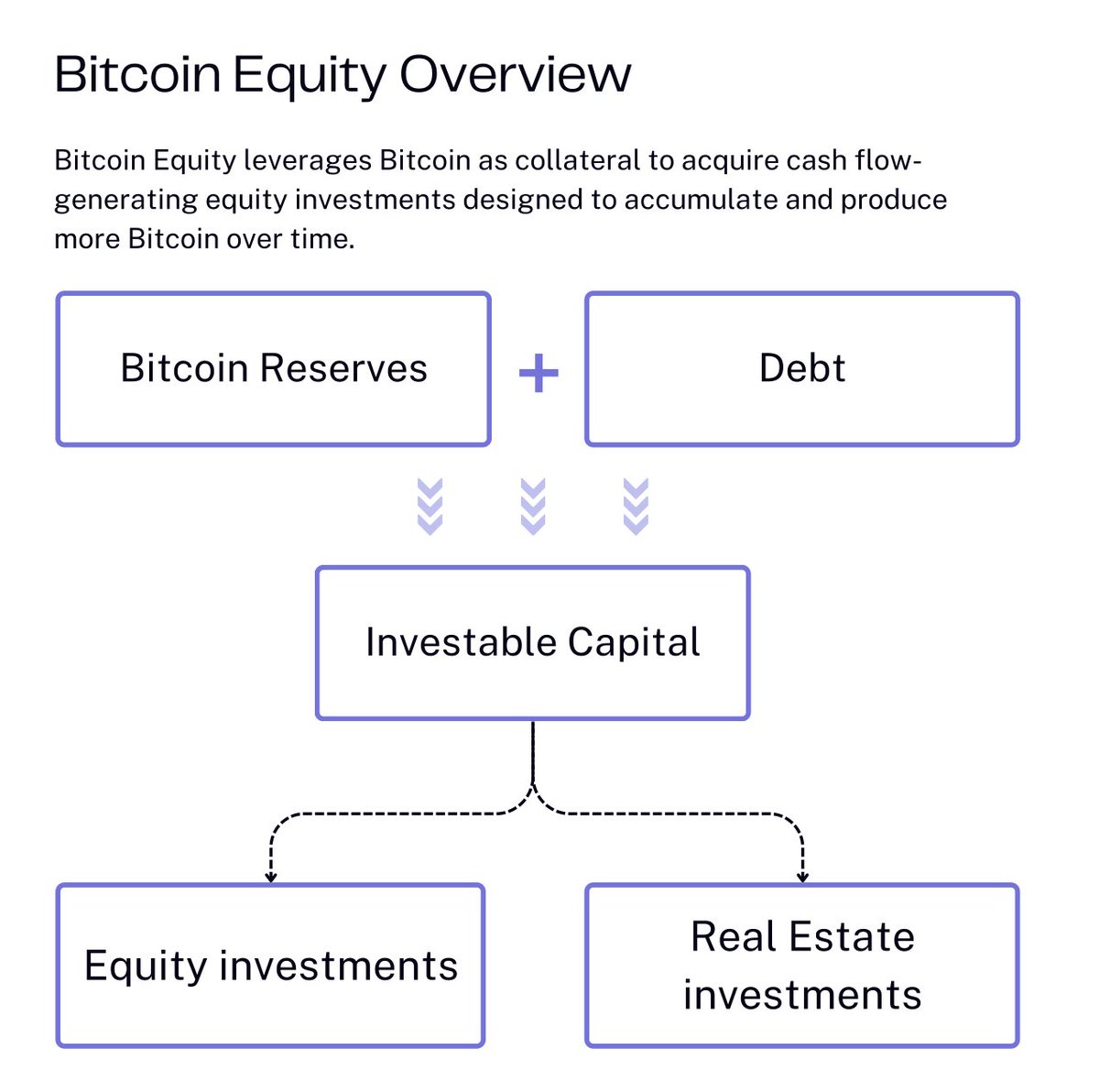
Over $1T of Bitcoin sits outside traditional banking and long-term financing. Today, most holders are limited to short-term, margin call-driven loans.
The opportunity is clear: use Bitcoin as institutional-grade collateral for long-duration private credit.
Bitcoin secures the structure.
Cash-flowing real-world assets service the debt.
Lenders earn 8–12% with strong downside protection through overcollateralization.
This turns Bitcoin from a passive store of value into productive financial infrastructure.
Conversation between @Sanderandersenn and @GrafYves on @OneChairPod
2
3
17
1,495
Finpeers retweeted

Jan 12
Looking forward to being in London for Digital Assets Forum on 5–6 February.
Bitcoin treasury strategies and disciplined Bitcoin equity structures are reshaping capital markets and this forum brings together the allocators and operators driving that shift.
See you there!
Jan 12

Sander Andersen, Executive Chairman and Founder of @H100Group, joins Digital Assets Forum 3.
He leads one of the Nordics’ most visible Bitcoin treasury platforms, working with capital allocators to structure BTC exposure through disciplined equity models.
🎟️Secure your seat: eblockchainconvention.com/di…
1
1
19
1,152
Finpeers retweeted
29 Dec 2025
Gold and silver have delivered strong returns this year.
Institutional investors and central banks are increasing gold holdings, debt levels continue to rise, and capital is gradually moving away from risk and high-growth assets toward more traditional inflation hedges and monetary assets.
In this weeks episode of H100DL, we discuss why we believe Bitcoin is lagging in this cycle, and what asset performance can teach us about how capital and investors are positioning in today’s market environment.
Listen to the episode to better understand where capital is moving and why. ⚡️
@Sanderandersenn & @Wiik_Johannes
2
6
23
4,826
Finpeers retweeted
21 Dec 2025
This week I spoke with a commodity industrialist.
One thing he said stayed with me:
“Volatility isn’t risk. Misalignment is.”
He explained it simply.
Traders fear volatility because they’re anchored to price.
Industrialists welcome volatility because they’re anchored to structure.
In commodity markets, cycles aren’t problems to solve —
they’re the raw material you build on.
Once your narrative matches your strategy:
- Short-term price becomes noise
- Cycles become positioning windows
- Downturns become accumulation phases
He wasn’t talking about Bitcoin.
But the lesson applies perfectly.
If volatility shakes you, you’re probably playing a trading game in an industrial world.
He finished with this:
“We are not building for quarters.
We are building balance sheets, infrastructure, and ownership that compound through cycles.”
Different game.
Different mindset.
4
9
43
6,406
Finpeers retweeted
22 Dec 2025
The future of capital markets will run on top of Bitcoin. I'm looking forward to building with @stokr_io with both @H100Group and @finpeers ⚡
21 Dec 2025

At STOKR, our journey has been defined by the people who believe in the future of capital markets. As we look toward 2026, we wanted to share a quick preview of a larger project are working on that captures our evolution, our challenges, and our wins.
This is just a taste of what’s to come.
Couldn’t have captured the essence of STOKR and tokenization on bitcoin without the voices of: @TobiasSeidl, @adam3us, Raul Oliveira, @keidunm, @KnutsonJesse, @Sanderandersenn, @allenf32, @JonasKrstic, Maria Kovaleva, Egor Sukhanov, Lukas Cremer, Davide Rovelli, Tizian Rotermund and many more.
Thank you all for your time, your insight, and for being part of this milestone.
6
21
2,364
Volatility combined with long-term capital is not a risk, but an opportunity. Outcomes are defined not by short-term price movements, but by positioning, capital structure, and time horizon.
17 Dec 2025

#Bitcoin is too risky.
This sentence is repeated so often that it has ended up replacing analysis.
In this note: https://www.linkedin.com/feed/update/urn…,
I revisit this claim strictly from the perspective of investment discipline.
Yes, Bitcoin is extraordinarily volatile — probably the most volatile large-scale asset ever accessible to investors. This is beyond dispute. But volatility is not a verdict; it is a parameter.
In asset management, risk should never be a reason to exclude an asset. It is a reason to #Size the exposure. An asset is never “too risky” in itself; it is simply held in a size that is inconsistent with its volatility.
Investment follows a simple sequence:
first, decide whether an asset makes sense (the Investment Thesis),
then decide how much to hold (Risk Management).
Reversing this sequence — excluding an asset before even examining the thesis, solely on the grounds of risk — is not prudence. It is a reasoning error.
Even highly volatile assets can, at very small allocations, reduce overall portfolio risk through diversification. Danger is a matter of dosage, not of nature.
Excluding Bitcoin “because it is risky” reflects a misunderstanding of the elementary principles of portfolio construction — and the expression “speculative asset”, often used in this debate, corresponds to no concept in academic finance.
1
4
105
Finpeers retweeted
19 Dec 2025
2026 will mark the rise of the Bitcoin industrialist.
The first era of Bitcoin was about belief.
The second was about trading.
The next will be about industrialization.
By 2026, Bitcoin will no longer be defined by who predicts price best, but by who controls balance sheets, capital, and time.
This shift mirrors what happened in shipping.
Freight volatility attracted traders.
But the real wealth was built by industrialists who:
- Bought assets in downturns
- Raised capital in upcycles
- Designed structures that survived every cycle
Bitcoin is entering the same phase — faster.
The opportunity in 2026 won’t be trading Bitcoin.
It will be building on top of it.
What changes:
- Bitcoin becomes pristine collateral
- Credit markets deepen
- Balance-sheet strategies outperform price speculation
- Volatility gets monetized structurally, not emotionally
- Weak hands finance strong ones
For those who adopt an industrialist mindset, new opportunities open:
- Compounding BTC per share, not chasing fiat returns
- Acquiring distressed assets and companies using Bitcoin-backed capital
- Designing public vehicles that survive bear markets
- Using cycles as allocation engines, not threats
- Becoming permanent capital, not temporary liquidity
Traders will still exist. They’re necessary.
But they won’t set the direction.
2026 belongs to those who think like owners, not speculators.
Who treat Bitcoin as infrastructure, not a trade.
Bitcoin isn’t just maturing.
It’s industrializing.
And that’s where the real opportunity begins.
1
3
20
881
For an asset to become a core commodity in the global financial system, it must be integrated across a wide range of participants and adopted for different purposes: store of value, payment, treasury reserve, collateral, settlement, and credit.
Bitcoin is slowly finding its place in the global financial system.
This week alone, Vanguard has started offering Bitcoin ETF access to its 50M clients, and Bank of America will, from January, allow advisors to recommend 1–4% digital asset allocations to their clients.
This is how a new global commodity is formed:
- One mandate at a time.
- One use case at a time.
- One investor at a time.
2
5
847
Finpeers retweeted
2 Dec 2025
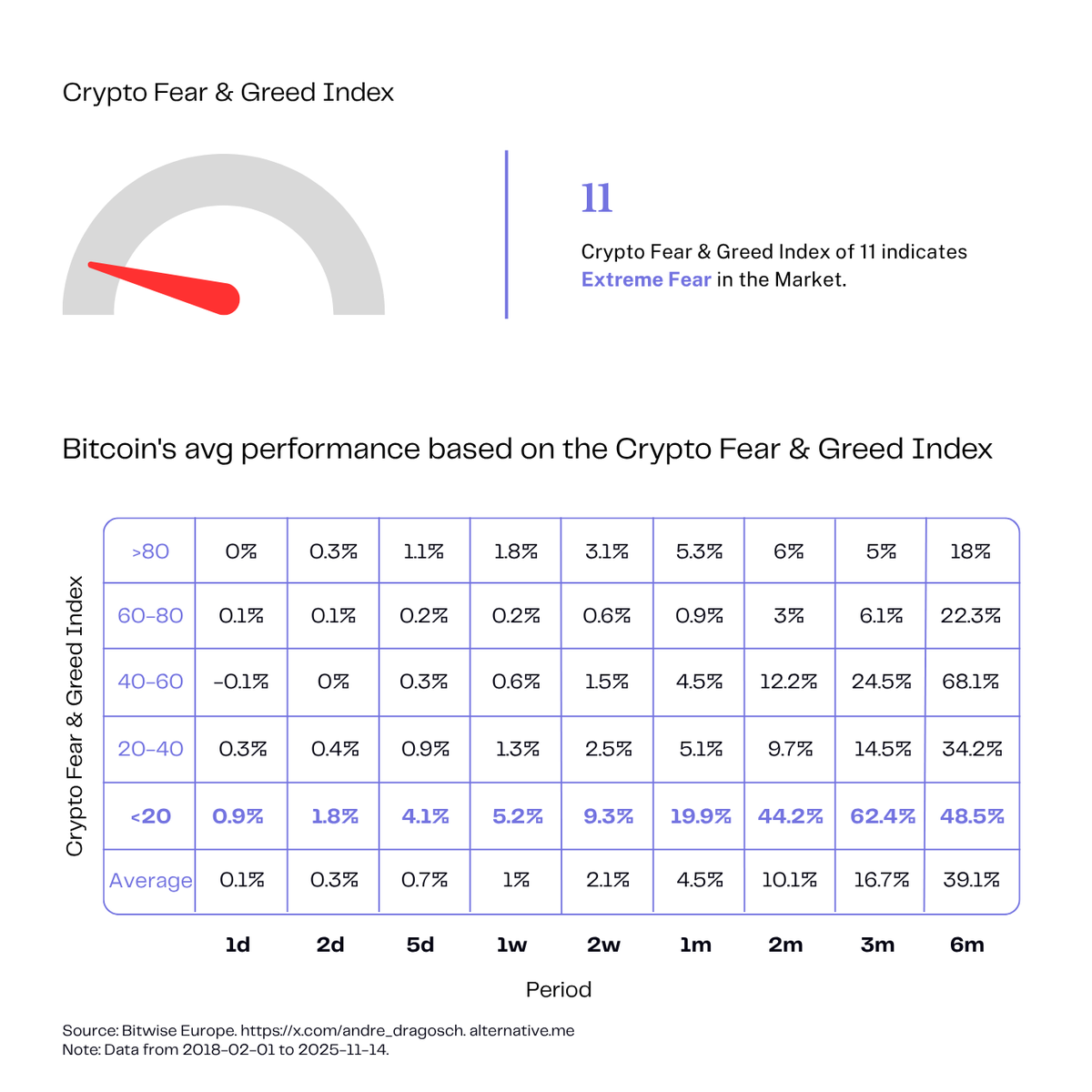
“When fear is high, Bitcoin has historically offered great buying opportunities.” — @Sanderandersenn to E24, commenting on the recent volatility.
Despite the market’s “extreme fear”, we see strong fundamentals and opportunity.
Sander highlights growing institutional participation, a healthy market structure, and the long-term perspective that guides H100’s strategy.
H100 remains focused on long-term strategy, not short-term noise.
For our Nordic followers - read the full story here: e24.no/boers-og-finans/i/gka…
6
3
38
3,372
Bitcoin is emerging as a core commodity in the global financial system.
It is a fixed-supply, non-sovereign, energy-secured asset with global settlement finality, independent of politics and monetary manipulation.
No other asset can offer this combination.
For any asset to become a core commodity in the global financial system, it must serve multiple independent use cases. Oil and shipping didn’t dominate because of a single function; they became critical because they integrated across energy, industry, transportation, and global trade.
Bitcoin is now following the same pattern.
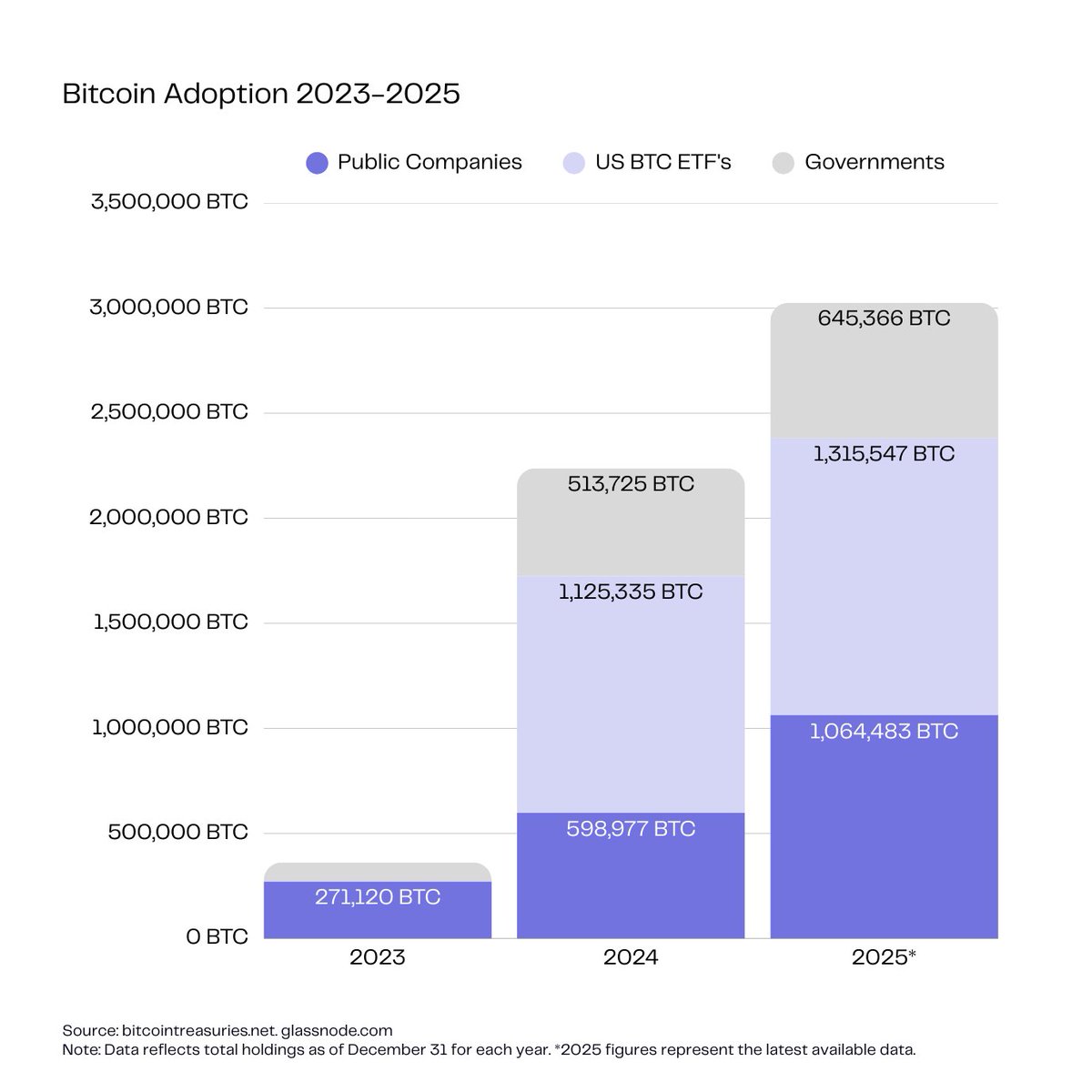
Public companies adopting Bitcoin as a treasury asset are creating a new listed market segment and new corporate finance models. Bitcoin ETFs offer traditional investors regulated access at scale. Governments are beginning to explore Bitcoin as an alternative reserve asset.
Together, these three groups now hold more than 3M BTC, compared to just ~360K BTC in 2023, an 8× increase in two years.
The strength of any commodity market comes from its diversity of use cases. Bitcoin is not a single strategy or a single narrative, it adapts to the objectives of each participant: treasuries, institutions, governments, long-term holders, credit markets, or corporate finance.
This is what turns an asset into a global system.
2
6
883
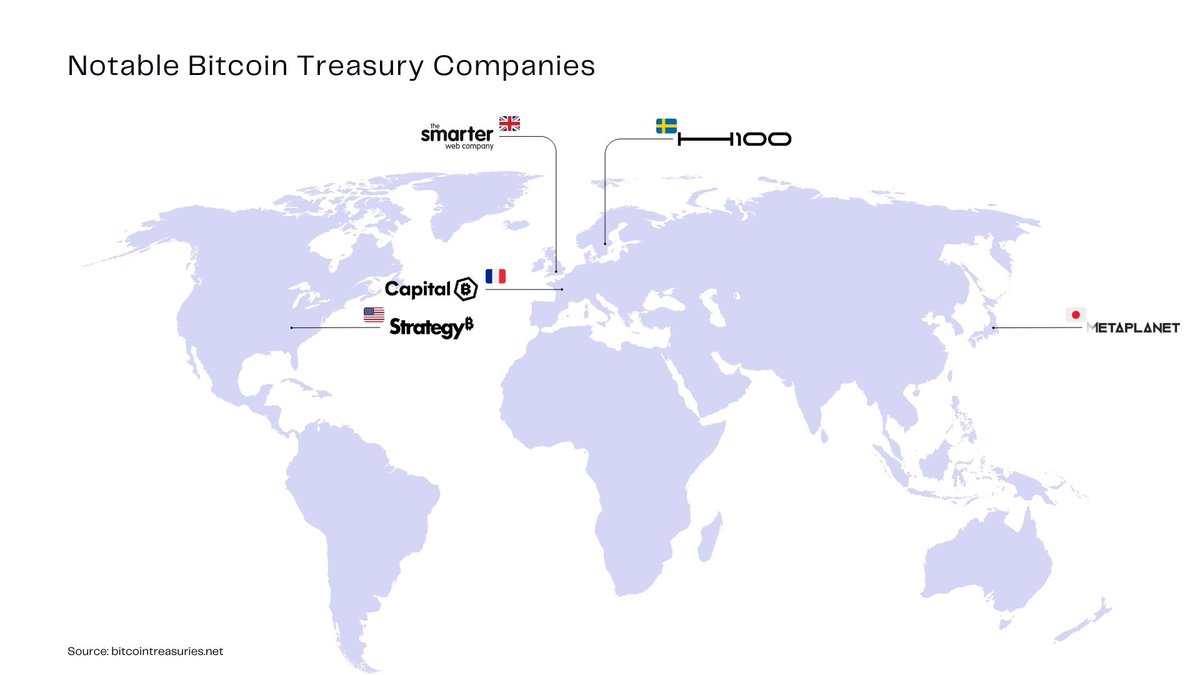
Bitcoin Treasury Companies are emerging globally and across local markets, each with its own strengths.
The phase we are in now is no longer about simply adding Bitcoin to the balance sheet and expecting a mNAV premium. The market will reward companies that:
- Have a local advantage in their home capital markets
- Grow BTC per share through disciplined capital structuring
- Has a healthy balance between assets and liabilities
- Execute consistently across cycles
- Broaden investor access to Bitcoin-backed equity and credit strategies
The leaders who prove their model in this environment will earn a premium, not because of hype, but because they enable investors to increase their BTC per share over time.
A phase that will separate the companies with a true strategy, governance, and capital discipline from those simply riding the asset.
3
12
1,577
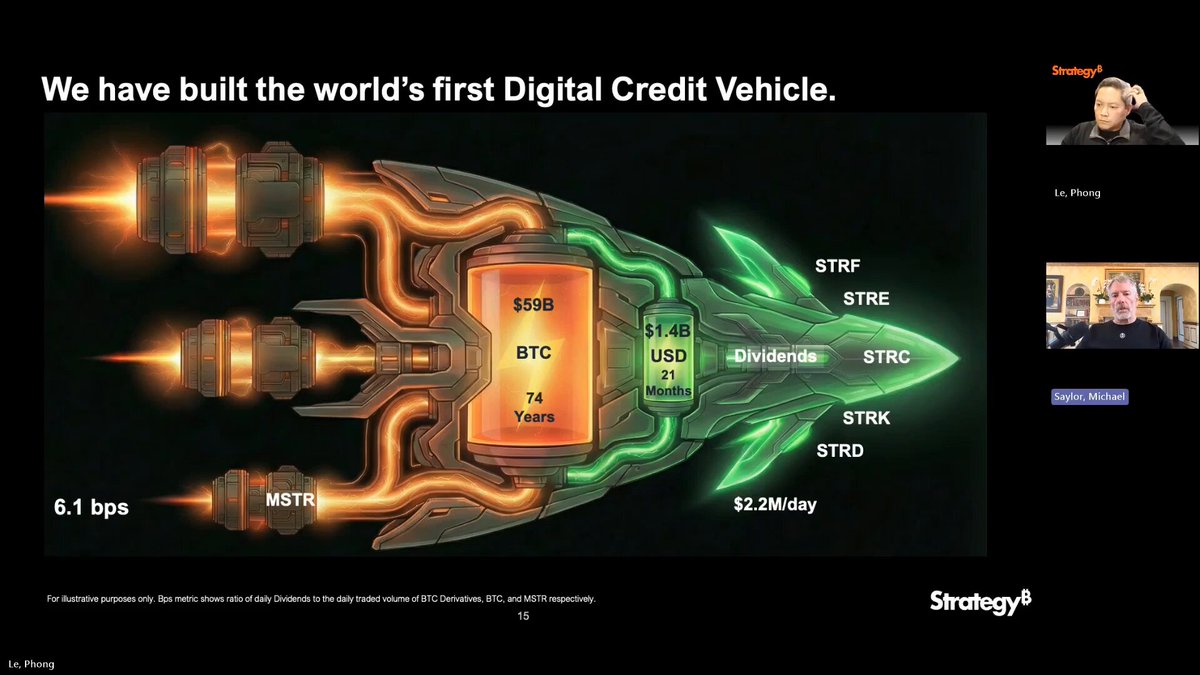
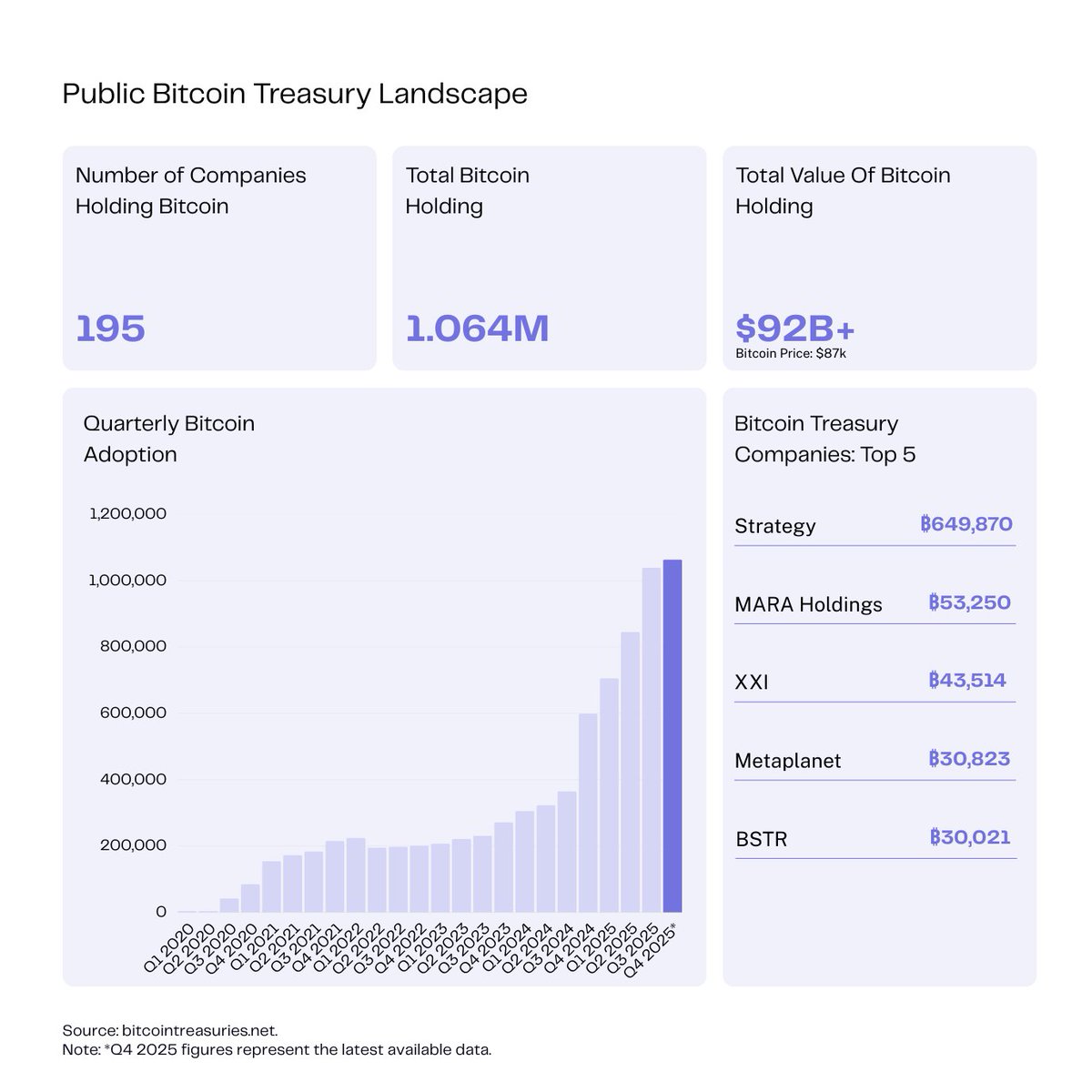
Since August 11, 2020, when Strategy made its first BTC purchase of 21,454 BTC, the company has accumulated 649,870 BTC worth $56B and effectively created a new listed market segment with entirely new corporate-finance models built on Bitcoin.
Since then, nearly 200 public companies have added more than 1M BTC to their balance sheets. 2025 alone has seen an unprecedented wave of Bitcoin treasury adoption, with ~465K BTC added year to date.
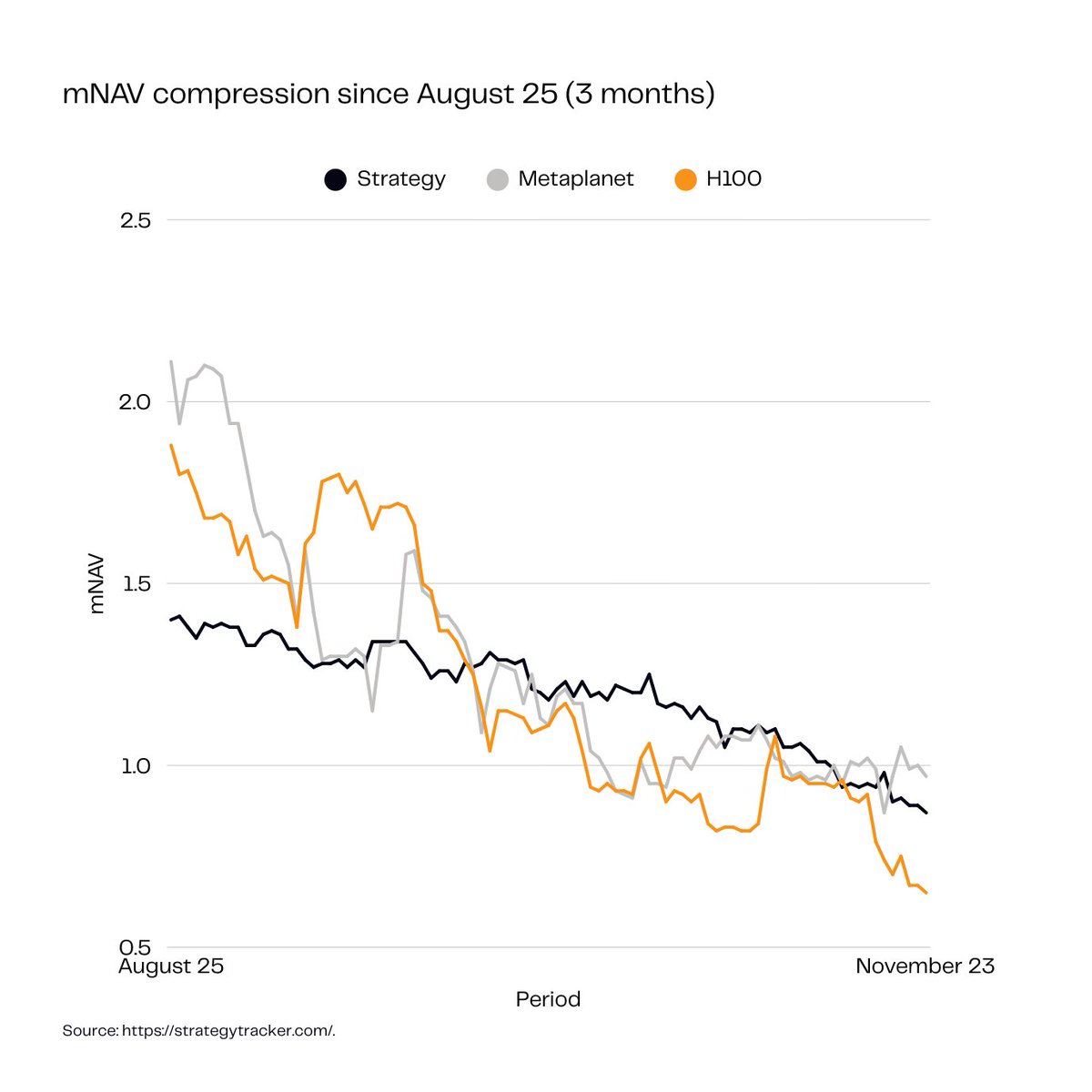
But the last quarter has been a reset. Several Bitcoin treasury companies are down 60% from their highs, with mNAVs compressing toward 1, and a handful now trading below their Bitcoin NAV.
For long-term allocators, these periods are often where opportunity emerges. Not all companies will survive this phase, and that is exactly the point. Just like in every commodity cycle, the leaders who step out of this challenging market will define the future financial system built on top of Bitcoin.
Bitcoin treasury companies are not simply “holding BTC.” They are engineering new financial structures with equity, credit, preferreds, convertibles, giving investors differentiated ways to gain exposure to Bitcoin through different local markets like the US, Sweden, France, or Japan.
What we’re witnessing now is the sorting phase.
The next phase is growth — driven by the winners.
2
10
224
Finpeers retweeted

24 Nov 2025
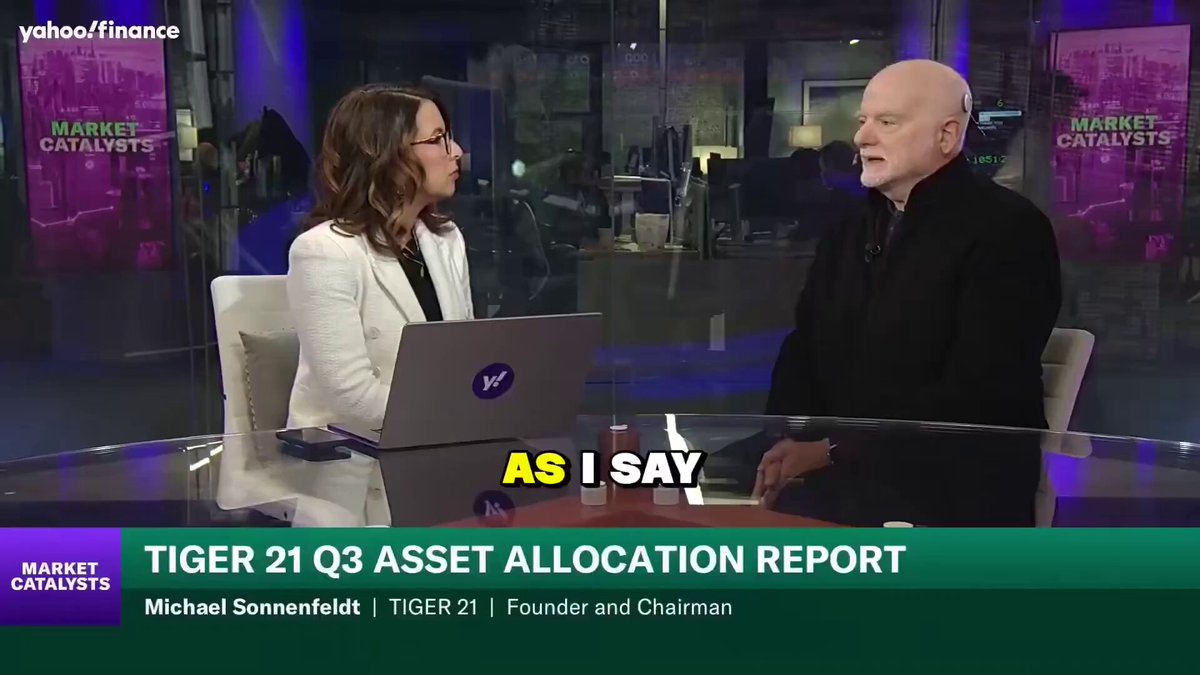
NEW: Tiger21’s founder says the ultra-wealthy are doubling their crypto allocation from 1% to 2% in a $250B fund, taking total BTC holdings to $5B.
Bitcoin is the “big kahuna and the most talked about asset right now.”
8
32
166
18,637