
Physician | KevinMD.com | The Podcast by KevinMD
Joined December 2007
- Tweets 71,055
- Following 18,359
- Followers 150,428
- Likes 18
17,683 Photos and videos
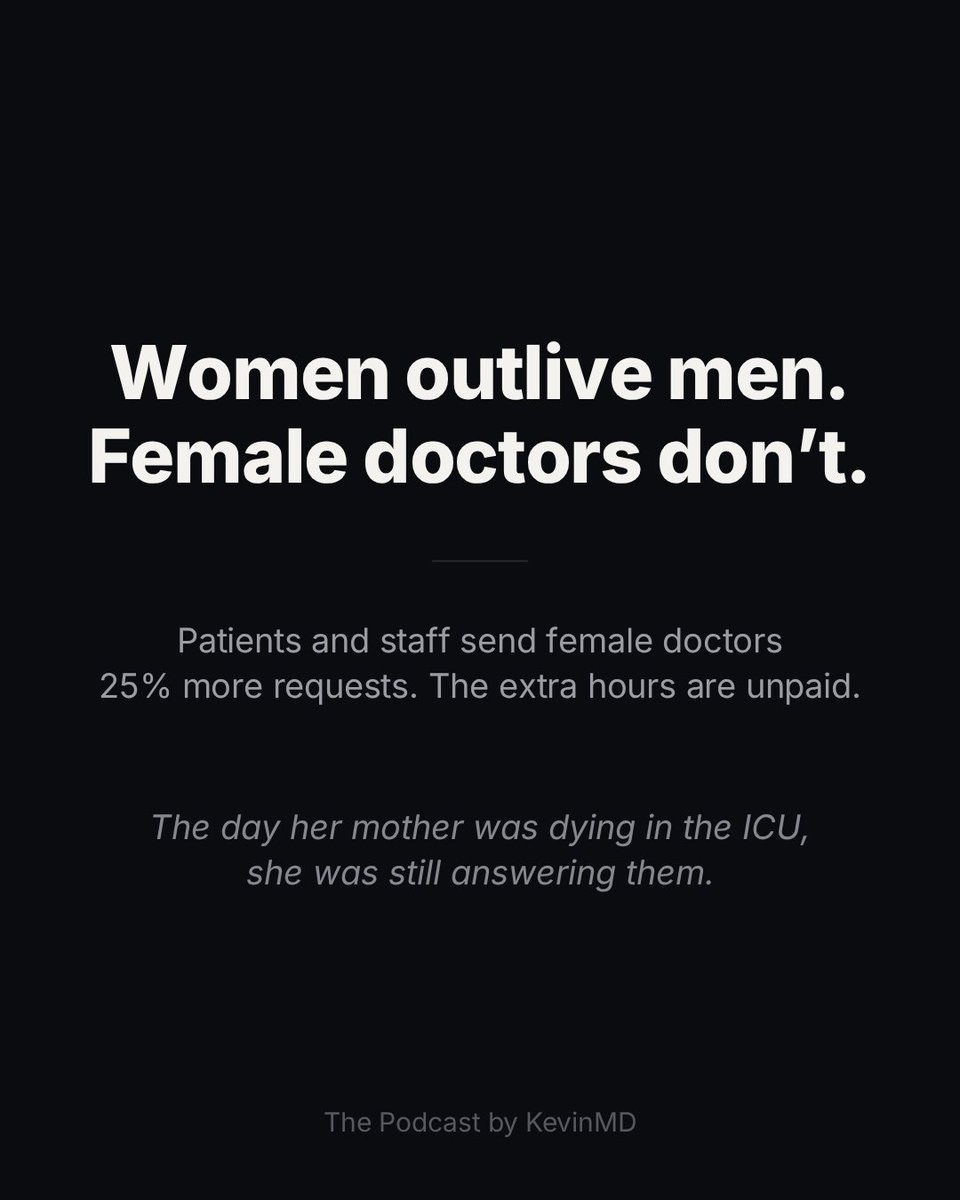
The strangest finding in physician health: generally, women outlive men. Among doctors, that advantage disappears.
A recent JAMA study ran the numbers. The longevity benefit women carry in nearly every other population does not hold for women in medicine. Something about the job erases it.
Pediatrician Noemi Adame, MD, who has practiced for more than twenty years, has a theory about what.
For years she watched her male colleagues leave clinic at 5 or 5:30 while she stayed hours later. She assumed she was inefficient. So she asked her own employer to run a time-flow study on her. The result: she was highly efficient, typed fast, and wrote notes so thorough the reviewer said a scribe would be a downgrade.
The problem was never her speed. It was the load.
Portal data shows patients and staff make 25 percent more requests of female primary care doctors than male ones. More messages, more refills, more forms. None of it compensated. None of it counted.
It is worth sitting with how mundane that work is. Not heroic saves. Refills. Forms. Messages answered after the last patient has gone home. The kind of labor that is easy to dismiss precisely because it looks like nothing, and it accumulates into hours that no productivity dashboard will ever register.
The research consistently finds female physicians deliver better outcomes, lower mortality, fewer readmissions, across multiple fields. They also carry an invisible second job inside the same workday, and a compensation system built on volume cannot see it.
That is the paradox. The doctors with the best outcomes may be paying for them with the longevity advantage every other woman gets to keep.
To be clear, this is not an argument against male physicians. It is an argument against a payment model that counts patients per day and never counts the 25 percent.
Listen to the full conversation on The Podcast by KevinMD. Link in the replies.
What is one task your inbox demands of you that no one has ever measured or paid you for?
#PhysicianBurnout #ThePodcastbyKevinMD
1
3
9
937

Jun 13
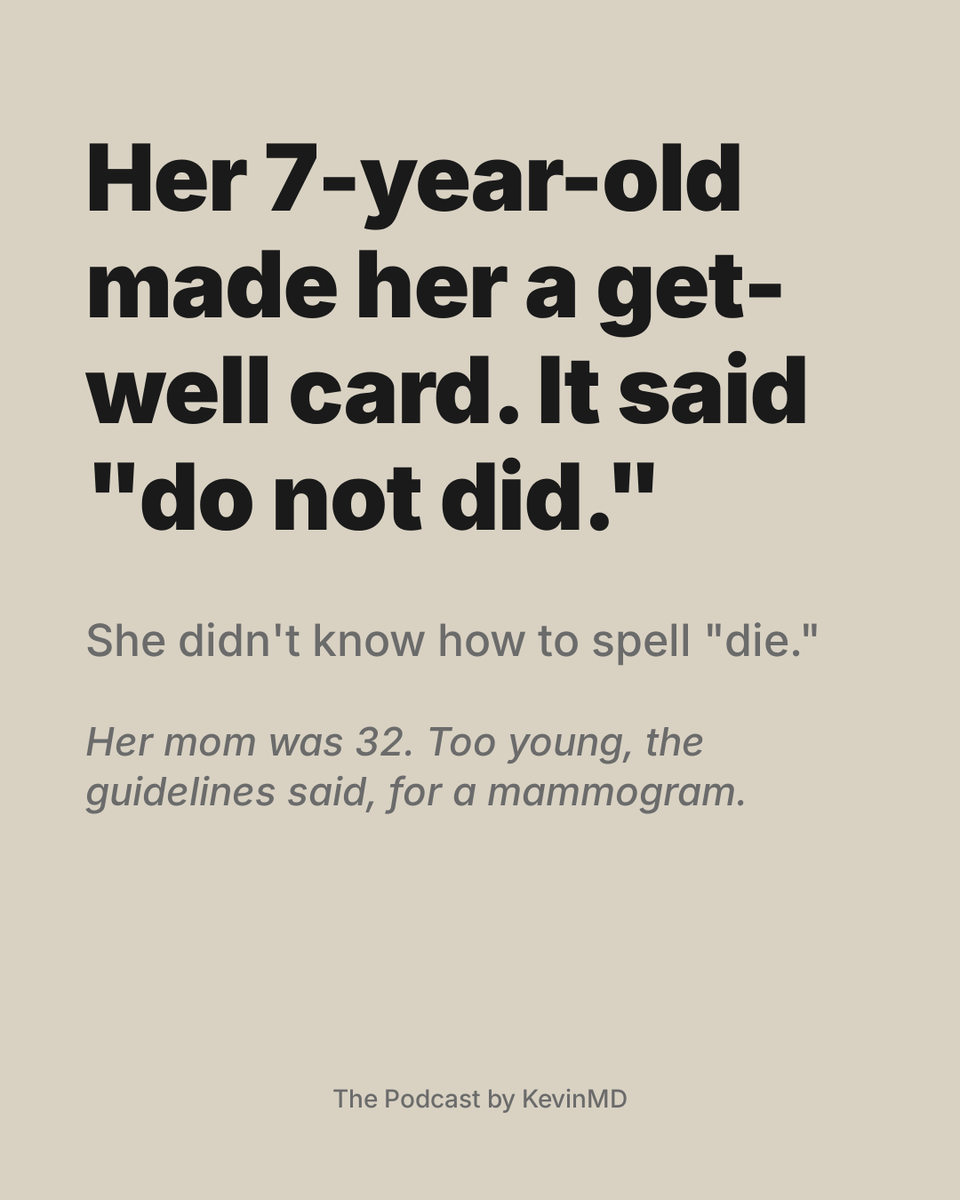
A cancer that hits about 1 in 200 women in their thirties, and we have no effective way to screen for it. Not because it's rare. Because the tool we use can't see it.
Sara Rands, a psychotherapist and patient advocate, found her own lump at 32. No family history. By the time it was caught, it was stage 3C with 14 positive lymph nodes.
Here is the part worth saving. She had no family history, and neither do 80 percent of women under 40 who are diagnosed. They find it themselves, because the standard screening tool was never built for the bodies they have.
The mechanism is physical, not statistical. Dense young breast tissue reads white on a mammogram. So does a tumor. She heard it described as finding a polar bear in a snowstorm. The instrument cannot resolve the thing it is meant to detect.
So young women are not screened at all. A blind spot in the tool quietly became a gap in the policy, and the absence of a better tool became the absence of any screening. Sara described it with an old image: a man loses his keys at home but searches under the streetlamp, because that is where the light is. We look for this cancer where the tool works, not where it actually is.
The argument is not fewer mammograms. It is better tools for the bodies a mammogram can't see into. And it is a case about stakes, not just incidence. Younger patients face more aggressive tumors and far more years of life on the line.
She survived the surgery, the chemo, the radiation. She said the hardest part came after. After the last treatment, after the bell, after the parties, when the whole care team had gone quiet and she was finally home alone. Her oncologist had asked if she wanted to know her numbers. A 50 percent chance of recurrence. The fight had something to push against. The silence afterward did not.
Twenty years later she raised all three of her kids to adulthood. The one thing she walked all those treatment miles praying for, she got.
She just doesn't think it should have come down to luck.
Listen to the full conversation on The Podcast by KevinMD. Link in the replies.
#BreastCancerAwareness #ThePodcastbyKevinMD
2
1
946
Jun 12
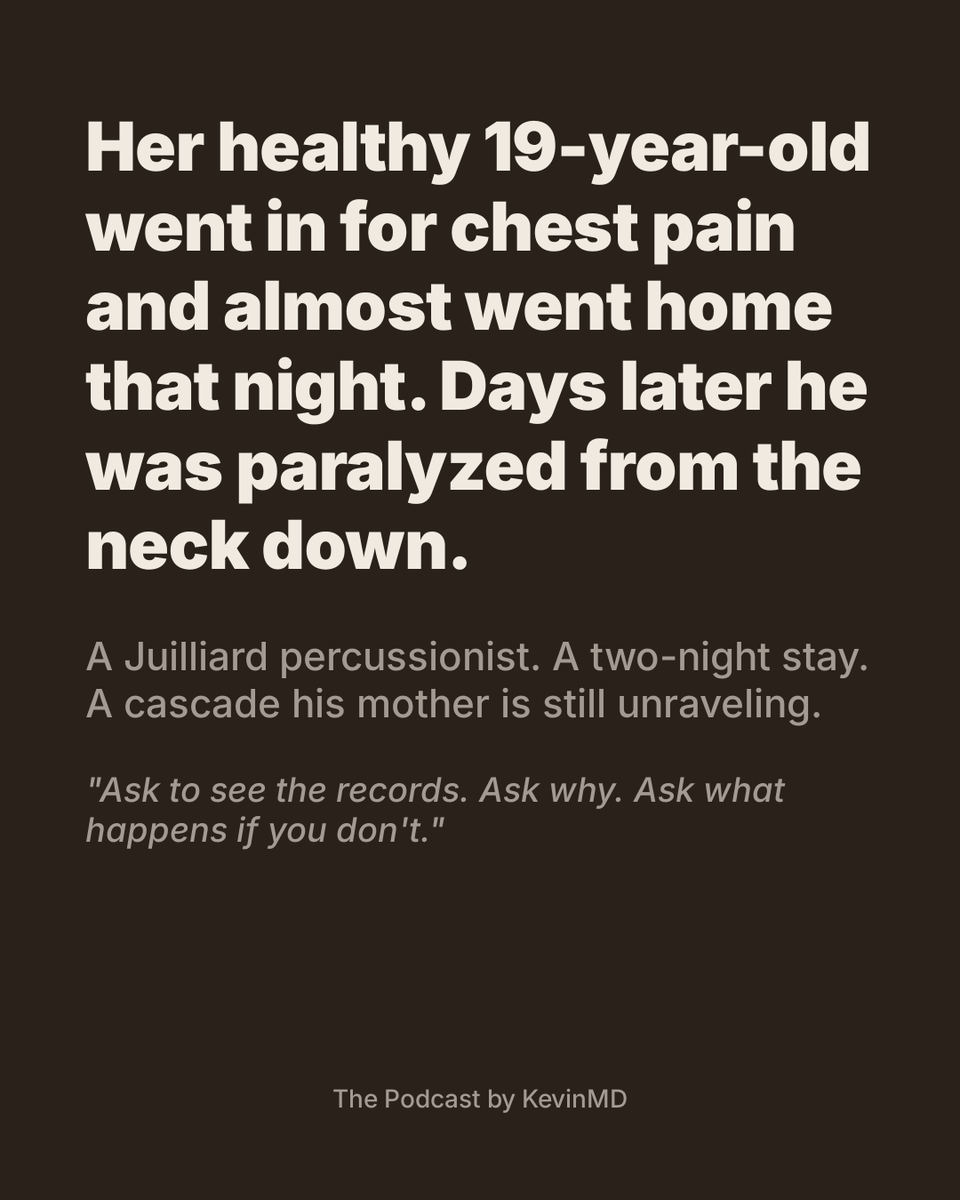
A healthy 19 year old went to the hospital for chest pain. He almost checked out that night. Days later he was paralyzed from the neck down and on a ventilator.
His mother went back through the medical records and reconstructed what happened. This is her account, and this is what the chart documented.
She is Laura Buchman, MBA, patient advocate and author of NERVE: Surviving Medical Madness. The patient is her son.
The sequence she pieced together from the records: an opioid on arrival that she says left him unable to answer his own clinical questions. An antibiotic she was told was Cipro that turned out to be a different fluoroquinolone, a drug class that carries FDA boxed warnings. Fentanyl, a respiratory depressant, given to a patient who was already struggling to breathe, with no explanation she could get. Scans she came to view as unnecessary. Acute hyponatremia severe enough that staff warned of brain damage or death. An elective tracheotomy the records showed was performed after MRSA was already known. Two more hospital-acquired infections. Then organ failure.
She believes the medications triggered the paralysis. That causal claim is hers, drawn from the chart, not a settled finding. What is harder to wave away is the institutional response when she asked questions. She was excluded from rounds. She asked the infectious disease physician whether the strong antibiotic was necessary and was told he had done the job for 25 years. That ended it. She describes being made to feel she should be quiet and grateful for the care he was getting.
The detail that should bother every clinician reading this: she did not have special training. She had an MBA, a frightened parent's instinct, and the willingness to request the records and read them against books on medical error. Everything she reconstructed was already sitting in the chart. The information was there. The system was simply not set up to surface it to the one person watching him around the clock.
Here is the part that should make every reader pay attention. One large analysis published in the New England Journal of Medicine found roughly one in four patients at the hospitals studied experienced an adverse event. Her family is not an outlier. They are a documented rate.
She does not blame the individual doctors, whom she calls kind. She blames a system that treats a family member with questions as a nuisance instead of a second set of eyes.
Listen to the full conversation on The Podcast by KevinMD. Link in the replies.
#PatientSafety #ThePodcastbyKevinMD
14
16
54
12,340
Jun 11
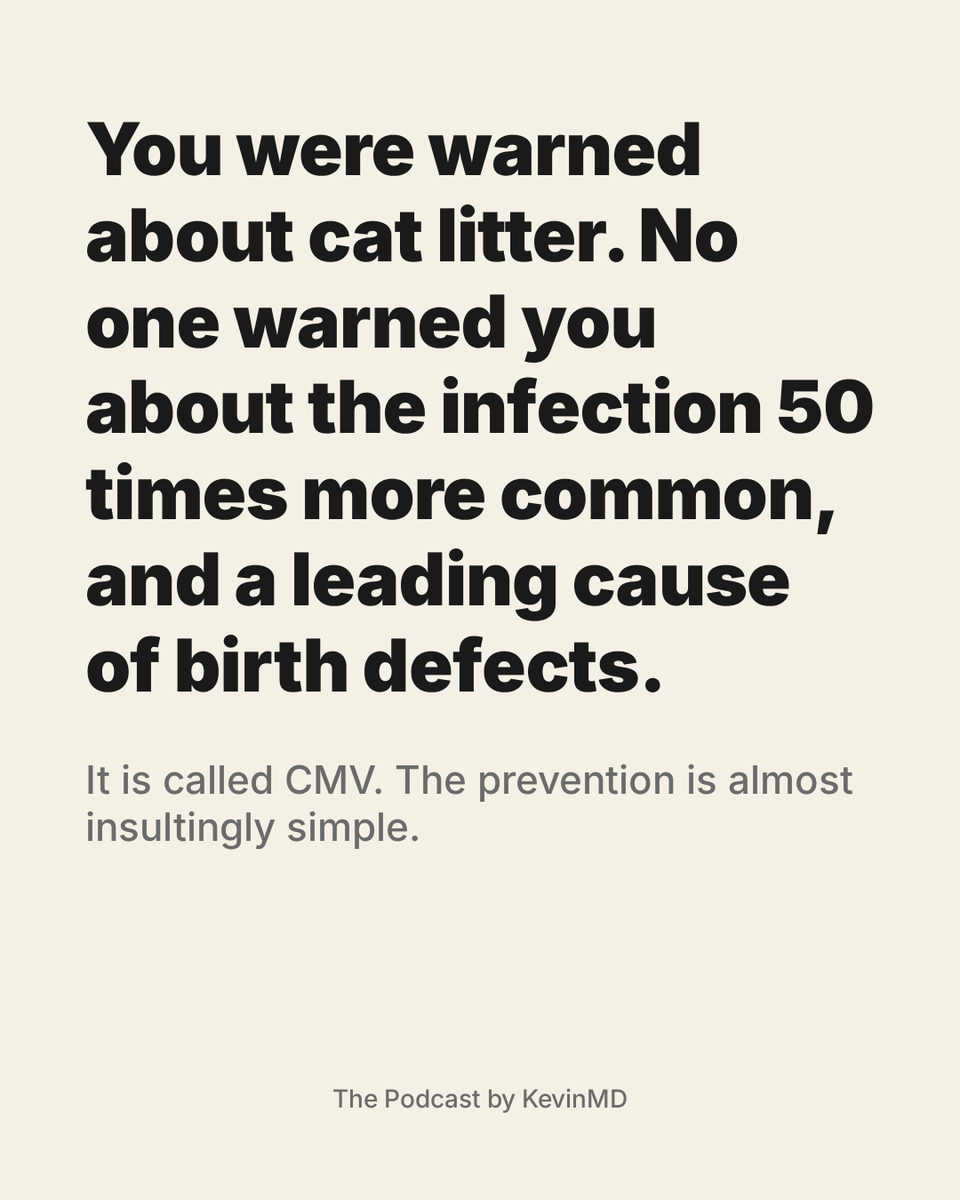
A mother asked her OB how she had never heard of the most common congenital infection in America. He told her women would not want to worry about one more thing.
That instinct has a name in medicine. Benevolent deception. The decision that a competent adult is better off not knowing something, made for her, without her.
The infection is CMV, cytomegalovirus. It is a leading cause of birth defects in the United States. It affects one in two hundred babies. Toxoplasmosis, the cat-litter warning every pregnant woman receives, affects one in ten thousand. We warn about the rare one and stay quiet about the common one.
In study after study, ninety percent of women have never heard of CMV. The major obstetrics body still does not recommend routinely discussing it, reasoning that the prevention steps are impractical. Those steps: do not share a toddler's spoon or toothbrush during pregnancy, do not finish their food, kiss them on the head instead of the lips.
When the same women are surveyed, ninety percent say they would want to know.
Here is why the silence has a cost beyond the abstract. CMV in a newborn can be treated, but only inside a narrow window. The diagnosis has to be made in the first month of life, and the antiviral has to start in that same month, or it no longer counts as congenital infection. Miss the window and a treatable cause of progressive hearing loss and brain injury simply goes untreated. By the available estimates, fewer than one in ten babies born with CMV is ever diagnosed at all.
So the chain runs like this. Mothers are not told. Symptomatic newborns are not flagged. The treatment window closes. And it traces back to a decision that a competent adult did not need a piece of information.
Writer Megan Nix, whose daughter was born with congenital CMV, is not arguing for screening every pregnant woman. She agrees with not doing that. Her argument is narrower and harder to dismiss. It is unethical to withhold information from an adult who has said, clearly and repeatedly, that she wants it. The fix is not a new test. It is a conversation that already should be happening.
Listen to the full conversation on The Podcast by KevinMD. Link in the replies.
What is one thing your clinicians never told you that you wish they had?
#CMV #ThePodcastbyKevinMD
5
2
7
1,343
Jun 10
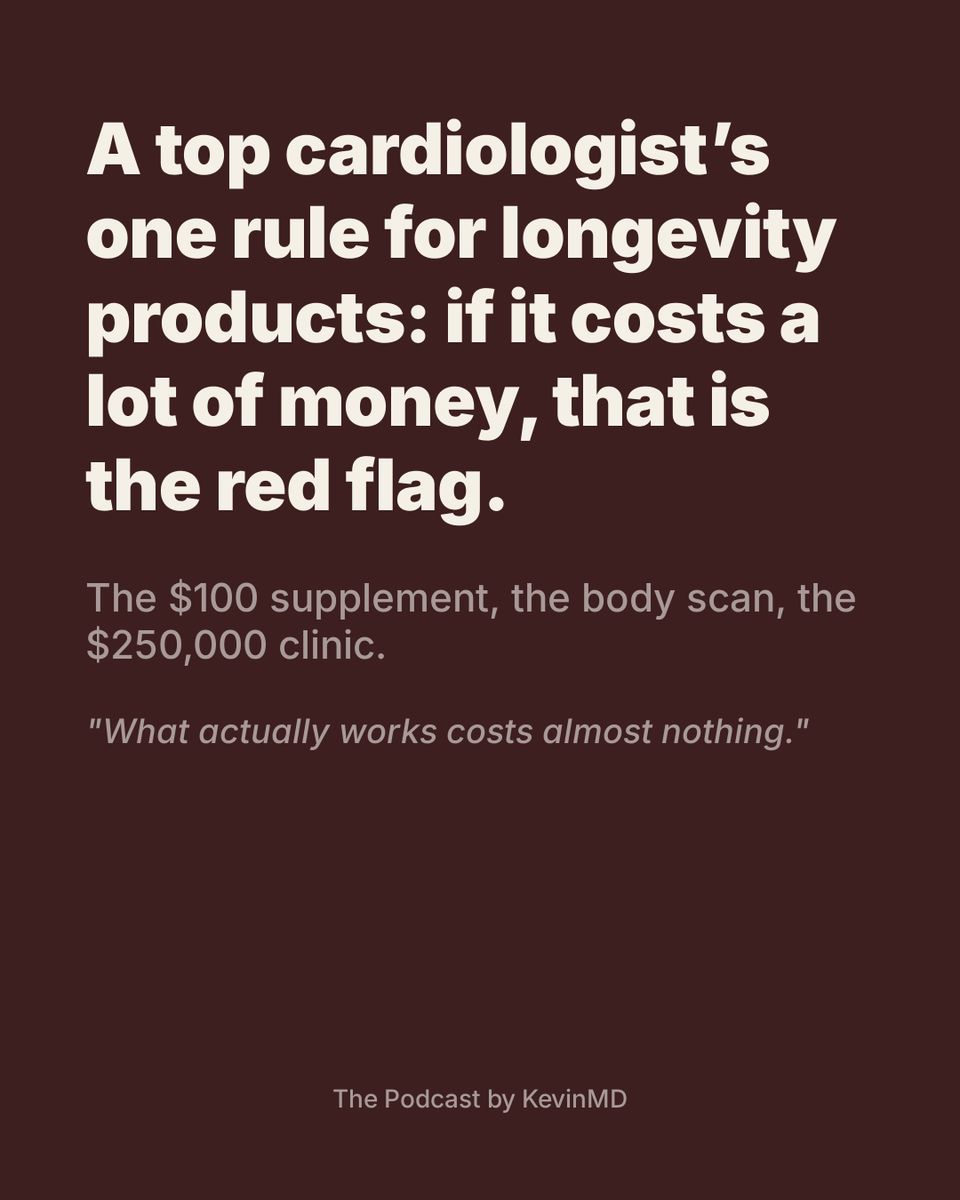
A bestselling cardiologist just took apart the longevity industry by name, and he started with the supplement in your kitchen.
Eric Topol, MD has spent his career in medical research. His new book "Super Agers" carries over 1,800 citations. He is about as far from a supplement influencer as it gets, which is exactly what makes his takedown land.
His targets:
The $100-a-month green-powder supplement that claims to be the only one with data behind it. Look closer and the studies are tiny and run by the company itself. No independent evidence it changes any health outcome.
The whole-body MRI marketed as early detection. No data that it helps. Plenty of harm: incidental nodules in healthy people, leading to biopsies, complications, and months of anxiety.
The longevity clinics charging $250,000 for plasmapheresis, stem cells, and hyperbaric chambers. An unregulated category, because supplements and these services get no FDA oversight.
His point on conflict of interest is the sharpest part: if someone is selling supplements or owns a longevity company, they cannot be an objective source on what works. A profit motive and honest advice do not mix.
He is just as hard on the protein craze. The one-gram-per-pound target pushed in other longevity books is not supported by the data. Past a modest bump for older adults, very high animal-protein intake promotes inflammation, the opposite of what you want.
And the punchline most people miss: what actually extends healthy years is nearly free. A mostly plant-based Mediterranean diet, regular sleep, walking, ten-dollar resistance bands. He cites a study of 105,000 people over 30 years where the ones who reached 70 disease-free ate exactly that way.
His rule of thumb, in seven words: when it starts to cost a lot of money, that should be a red flag.
What is the one longevity product you spent real money on before you knew whether it worked?
Listen to the full conversation on The Podcast by KevinMD. Link in the replies.
#Longevity #ThePodcastbyKevinMD
2
5
8
1,448
Jun 9
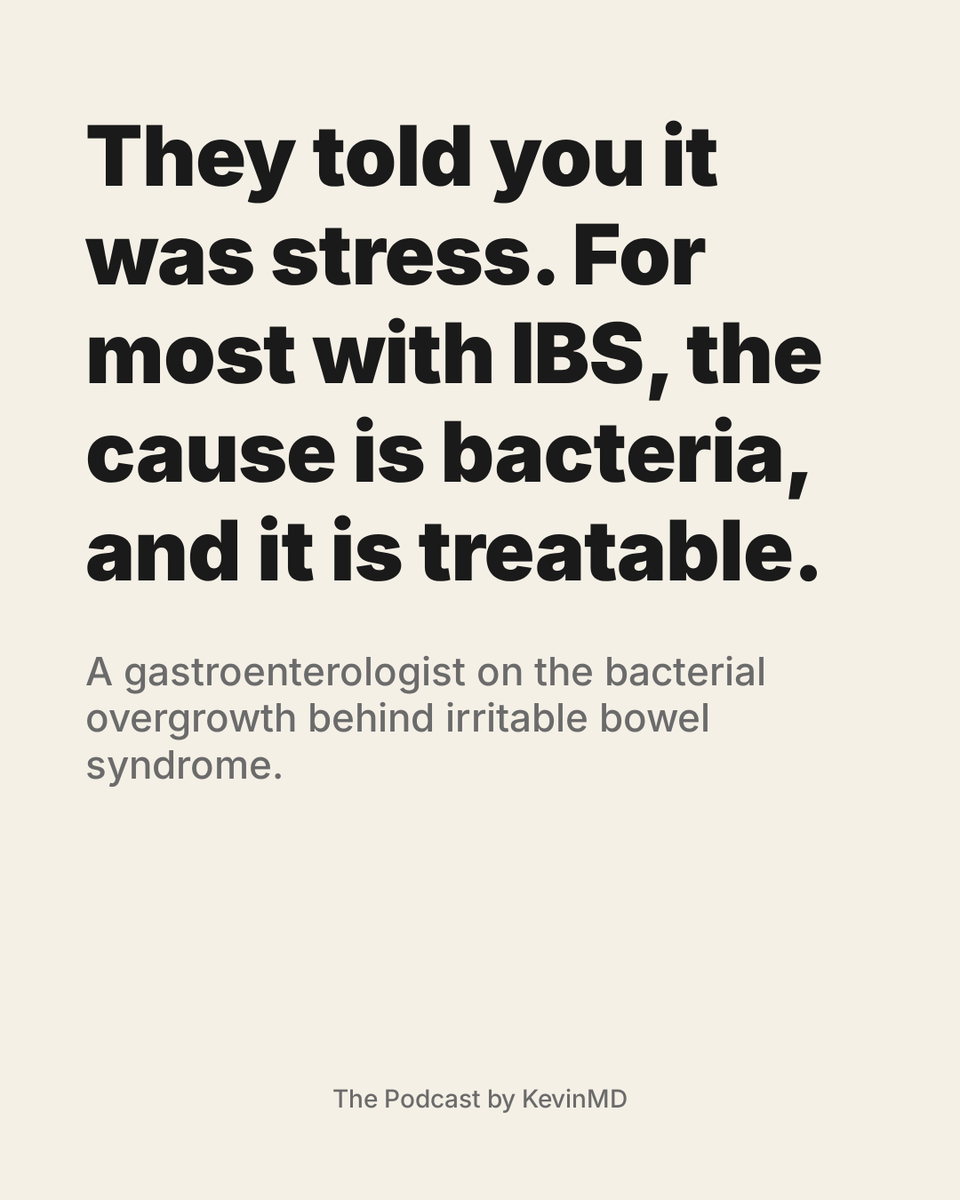
For decades, medicine treated irritable bowel syndrome as a stress disease. Mark Pimentel, MD, a gastroenterologist, says about 60 percent of it is something else entirely.
It's small intestinal bacterial overgrowth, or SIBO. The wrong bacteria colonize the small intestine, which is normally relatively clean, and start fermenting your food up to 63 times faster than normal. That is why the classic tell is bloating ten minutes after a meal.
The part most people have never heard: it often starts with food poisoning. Campylobacter, the most common cause of food poisoning in the US, triggers lasting IBS in roughly one in five people who get it. The infection leaves the body producing antibodies against the nerves of its own gut, which slows everything down and lets the bacteria move in.
For years the standard response was to treat the symptoms. A laxative for constipation. An antidiarrheal for diarrhea. Pimentel's argument is that this is backwards.
He describes patients who arrive having had three normal colonoscopies and still no answer, sent for one more test and then another, because the reflex is to keep ruling things out rather than confirm a positive diagnosis. Meanwhile the simplest tell goes unexamined: bloating ten minutes after a meal, the thing many people stopped mentioning years ago because they were told it was anxiety.
There is a breath test that can identify the overgrowth, now even at home, and a non-absorbed antibiotic, rifaximin, that clears it in a two-week course. A patient who responds and feels normal often does not need another colonoscopy, another celiac panel, another year of guessing.
His line is the one worth saving: we shouldn't be treating symptoms in IBS, we should be treating the cause. And he thinks the field is finally getting there, with new diagnostics and treatments in the pipeline that may eventually stop the condition at its source.
Listen to the full conversation on The Podcast by KevinMD. Link in the replies.
If you have IBS, has anyone ever tested you for SIBO, or was it only ever explained as stress?
#IBS #ThePodcastbyKevinMD
5
3
7
1,152
Jun 8
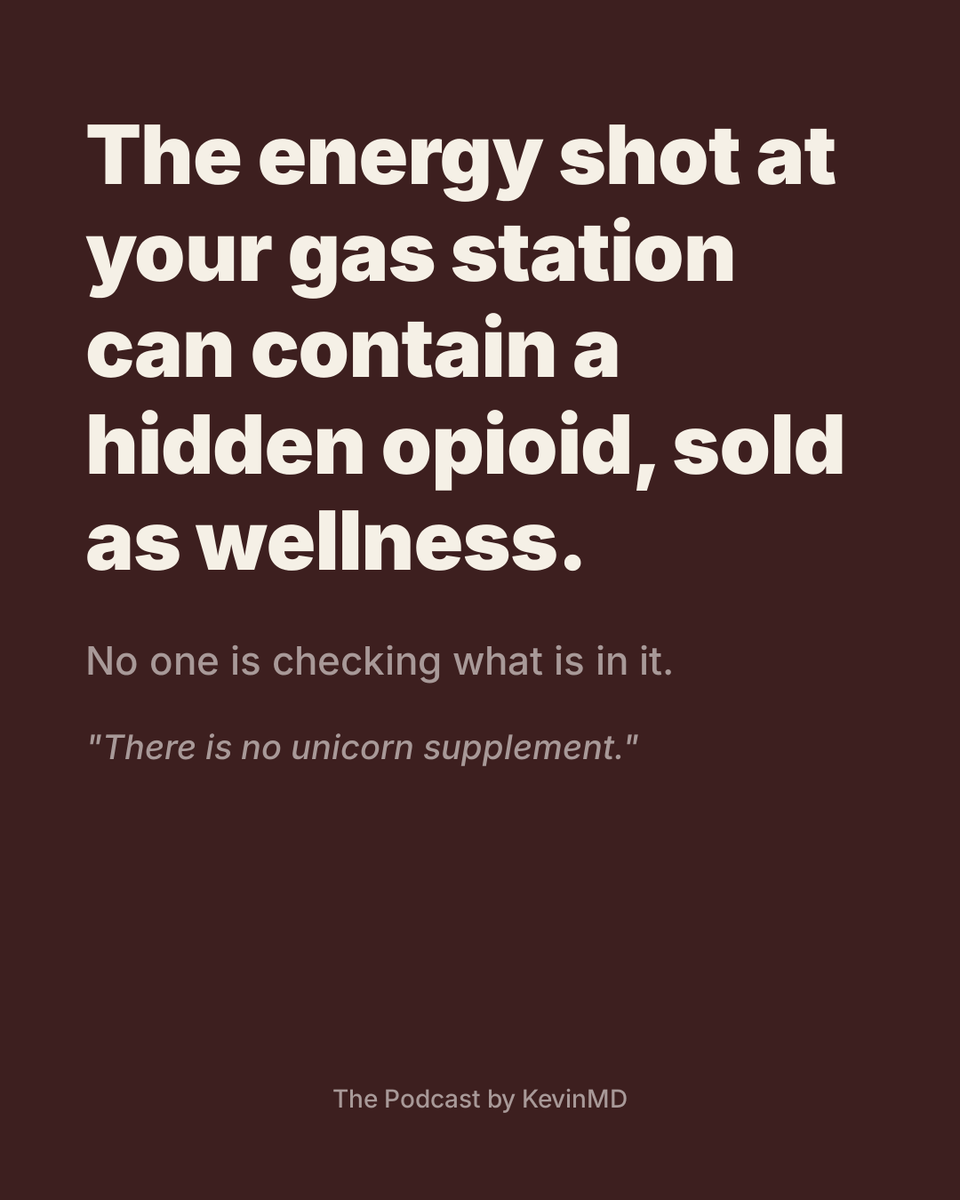
These are sold at gas stations and vape shops. They are labeled as energy and focus aids. And many of them contain compounds that act on the same receptors as opioids.
That is legal, by the way. The FDA chose not to regulate them.
Muhamad Aly Rifai, MD, a psychiatrist, internist, and addiction medicine specialist, treats people who became physically dependent on what they thought was an energy shot. Kratom and 7-OH (7-hydroxymitragynine) act on the opioid receptors. About 10 states have now banned 7-OH. The federal government has not.
Once someone is dependent, getting them off is not a weekend taper. He describes patients who need buprenorphine maintenance for a long stretch to come off a product they bought next to the lottery tickets. Poison control calls tied to these products are climbing.
Here is the gap that drives it. Only 19 percent of Americans even recognize the word kratom. People will doubt a prescription their own physician wrote and then trust a shiny bottle a convenience store clerk recommended, a product with zero clinical trials behind it. We fear addiction and romanticize the next natural alternative at the same time.
There is also a quieter regulatory mess underneath it. Some of these compounds sit in the same gray zone as cannabis, legal in some states, banned in others, scheduled one way federally and another way locally. The general public sees a labeled bottle on a shelf in a store and reasonably assumes someone signed off on it. No one did.
The fix he wants is not complicated. Clinicians should be asking every patient what over the counter products they take, because the estimate is that 30 to 40 percent are using something unregulated they never mention, sometimes with real drug interactions.
And his answer on whether any of it is worth recommending was one line: there is no unicorn supplement. Other than caffeine, nothing on that shelf does what it claims.
Listen to the full conversation on The Podcast by KevinMD. Link in the replies.
#AddictionMedicine #ThePodcastbyKevinMD
2
4
3
1,792
Jun 7
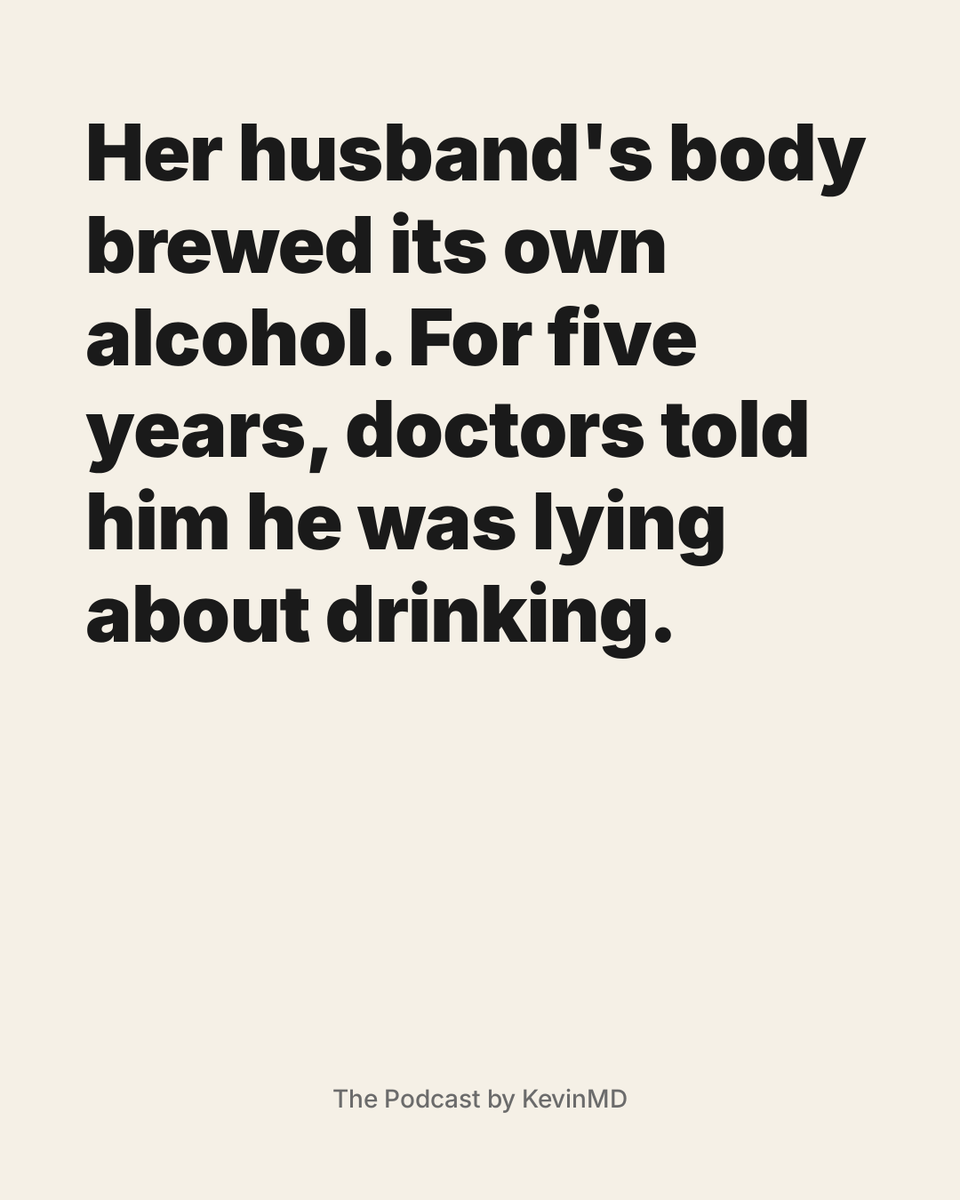
A man kept showing up drunk with a 0.3 or 0.4 blood alcohol level. He had not had a drink. It took five years and the right doctor to figure out why.
His name is Joe, and his wife, nurse researcher Barbara Cordell, spent those years watching him stumble, slur, and lose coordination on days he had not touched alcohol.
The mechanism is the strange part. Gut microbes fall out of balance, the fermenters everyone carries start growing unchecked, and they turn ordinary carbohydrates into more ethanol than the body can clear. The condition is called auto-brewery syndrome. It is rare, but likely underdiagnosed.
For years nobody believed it was possible. An emergency room found alcohol in his blood and concluded he was a secret alcoholic. Other physicians, friends and colleagues in medicine, said they had simply never heard of such a thing. The injustice was not the diagnosis. It was being called a liar by the people who were supposed to help.
One gastroenterologist read the case literature and ran an inpatient carbohydrate challenge. In a controlled room, with nothing to drink, the team watched his blood alcohol climb. They believed him because they saw it happen.
The fix followed the mechanism. Because the fermenting organisms feed on sugar and starch, a strict low-carbohydrate diet starves them, and that diet plus treatment resolved it. He is healthier now than before he got sick. The known risk factors track the same logic: long-term antibiotic use that disrupts the microbiome, and a high-carb Western diet that feeds it. Cordell has since connected with around a thousand people worldwide who suspect they have the same thing.
The bookmark-worthy takeaway for any clinician: when a patient insists they have these episodes and they are not drinking, that is worth taking seriously, not dismissing.
Listen to the full conversation on The Podcast by KevinMD. Link in the replies.
Search "The Podcast by KevinMD" wherever you listen to podcasts
What is the most surprising true diagnosis you have ever watched get dismissed because it sounded impossible? #AutoBrewerySyndrome #ThePodcastbyKevinMD
3
8
8
5,623
Jun 6
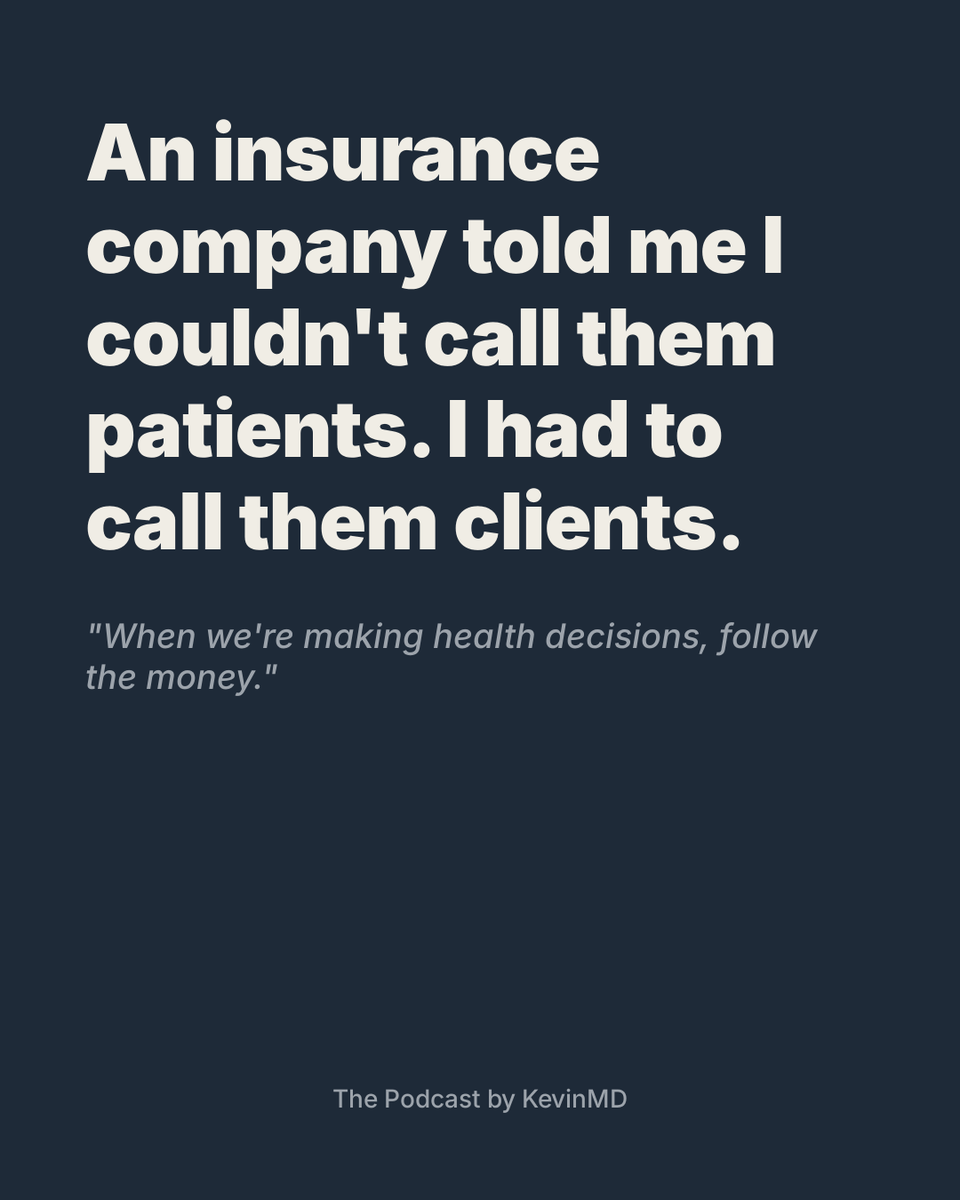
The health care system stopped calling you a patient and started calling you a client. That one word rewrote who it owes a duty to.
Nicholas Rosenlicht, MD, a psychiatrist and author of My Brother's Keeper, learned this firsthand. He was on a team negotiating insurance contracts for a community mental health center, and they were told they could not use the word patient. They had to say client.
It sounds like semantics. It is not.
A patient is someone society has agreed to protect. For as long as medicine has existed, the sick have been granted rights and special protections, because we recognized they need care. A client gets none of that. A client has only what is negotiated in the contract, and in health care those contracts are written by corporations with no input from doctors or patients.
Now hold that against how businesses actually work. A corporation's fiduciary duty runs to its shareholders and its board, not to its customers. A physician's fiduciary duty runs to the patient. That is the entire difference, and it is not an accident of vocabulary. Reclassify the person in the room from patient to client and you have quietly moved them out of the category the duty protects.
The same move gets made to physicians. "Provider" does to the doctor what "client" does to the patient: it makes the relationship interchangeable, a cookie-cutter service you can swap out, and it strips the autonomy that used to come with the title. Disempowerment by vocabulary, in both directions.
There is a reason mental health adopted "client" faster than any other field. The stigma around psychiatric illness makes "patient" feel heavy, even frightening, so a softer word feels kind. Rosenlicht argues it does the opposite. It sanitizes the relationship while quietly solidifying the stigma, and it lets a business model take over the room.
A business can be a client. A business can never be a patient. The word only fits a suffering human being who wants relief, and swapping it away is how you stop treating them like one.
We already have laws against the corporate practice of medicine in every state. They are simply not being enforced. Corporations build shell structures, hold the purse strings, and practice medicine in everything but name, while health care remains the largest lobbying force in the country.
His takeaway for anyone making a health decision: follow the money.
Listen to the full conversation on The Podcast by KevinMD. Link in the replies.
What is the first moment you stopped feeling like a patient and started feeling like a transaction?
#HealthcareReform #ThePodcastbyKevinMD
3
3
11
1,408
Jun 5
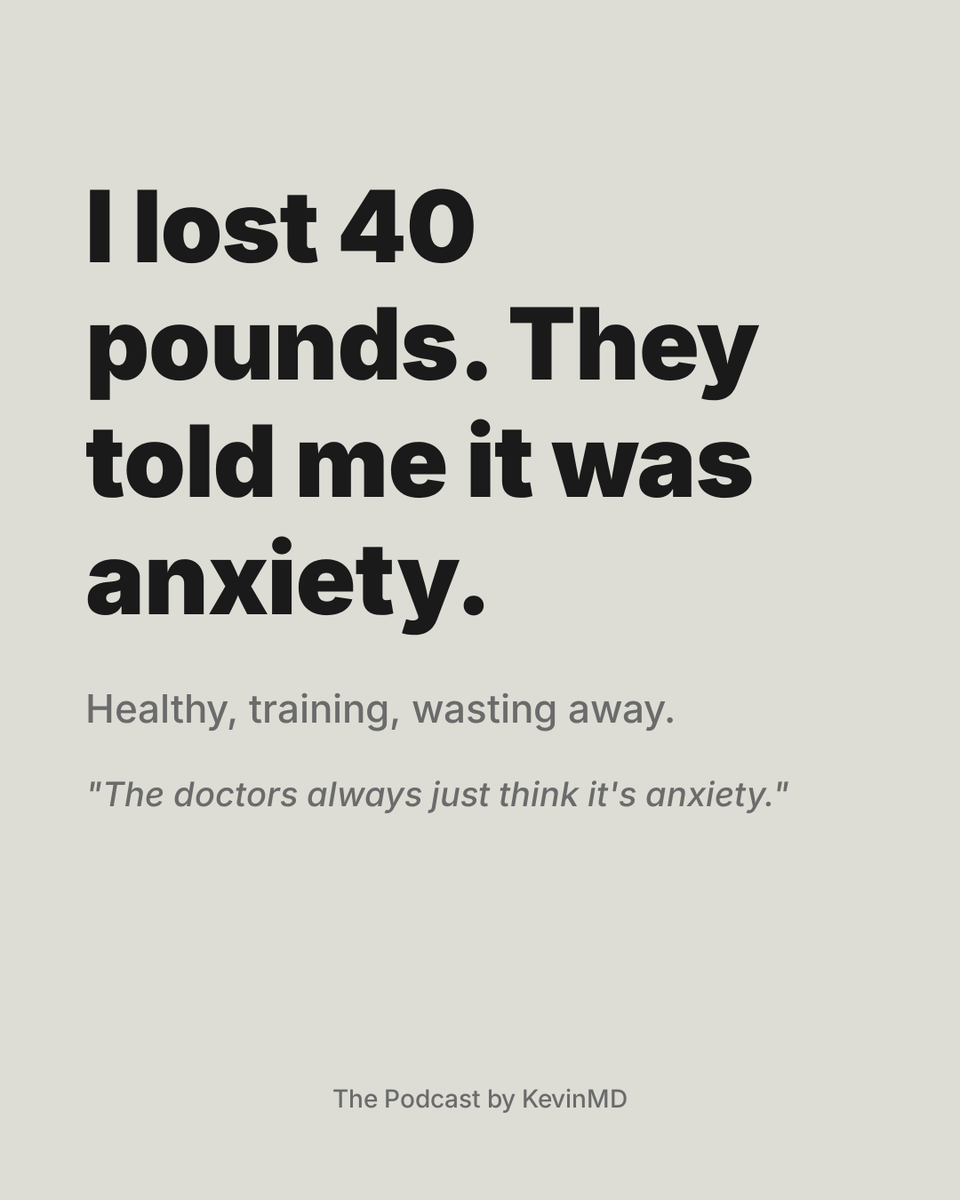
A healthy 19 year old lost 40 pounds and could barely think. Every doctor said it was anxiety. She diagnosed herself off a video, asked to be tested, and was told she probably did not have it because she had never vomited.
The test came back through the roof.
This is one of the most common reasoning failures in medicine: ruling out a diagnosis because the patient does not present the "textbook" way. Celiac disease does not require vomiting. It can show up as migraines, weight loss, brain fog, and malabsorption. Kamiah Gibson had all of it. She was a healthy 19 year old who got suddenly, severely sick, and the most available explanation, for months, was that an anxious young woman was imagining her own symptoms.
She had to advocate against her own doctors to get the blood test that finally confirmed it. A biopsy sealed it. She had been right from the start.
Notice how the diagnosis was delivered: over the phone, with the instruction to "eat gluten-free," two days before a three-week trip across the country. No counseling on cross-contamination, no plan, no follow-up scheduled. She was sick the entire trip and does not remember parts of it. The miss did not end at the diagnosis. It extended into how the diagnosis was handed over.
The part that should stay with us: she had been pre-med. After months of not being believed, she changed course to become a mental health therapist for people with chronic illness, because she knew firsthand what it does to a person to be sick and disbelieved at the same time. The disbelief did not just delay her care. It rerouted her life.
Kamiah Gibson is now a graduate student in social work. Her story is a clean case study in why "it's probably anxiety" is one of the most expensive sentences a clinician can say, and in how often the patient in the room has already done the diagnostic work everyone else is still refusing to start.
Listen to the full conversation on The Podcast by KevinMD. Link in the replies.
What is the diagnosis you have seen anchored away too early because the patient did not present the textbook way? #MedicalGaslighting #ThePodcastbyKevinMD
7
4
13
2,336