- Tweets 11,495
- Following 63
- Followers 3,523,588
- Likes 4,467
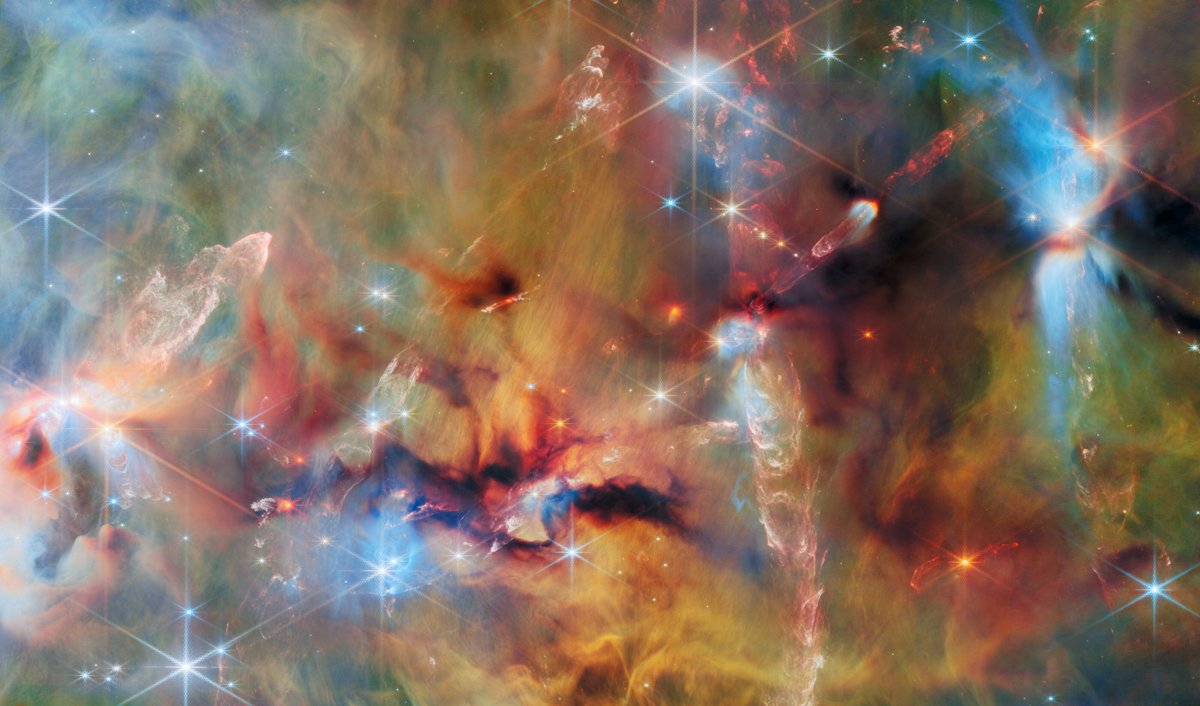
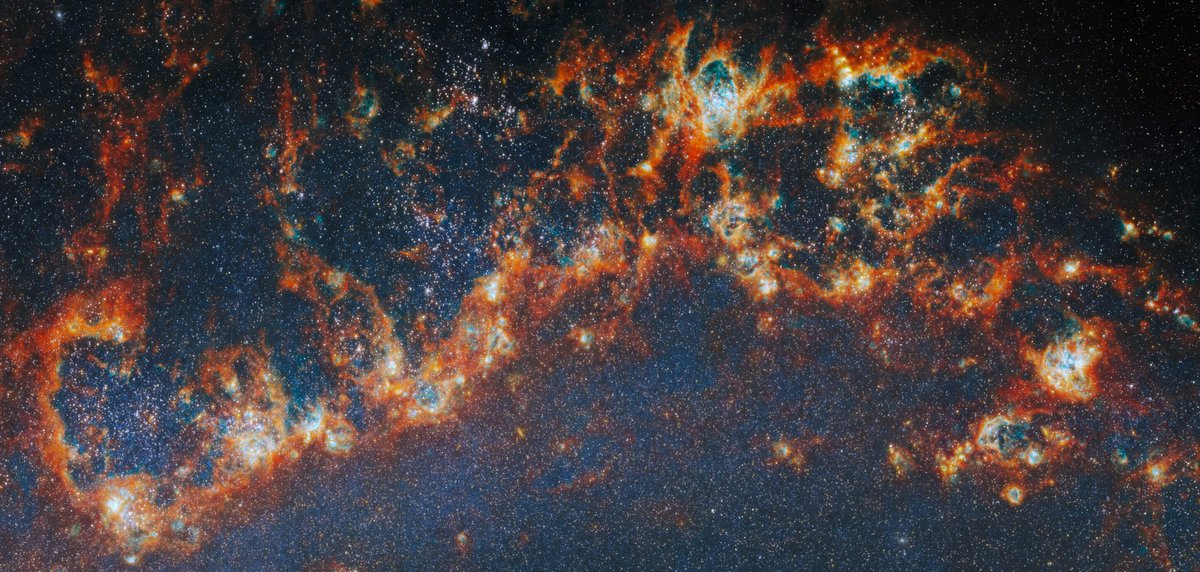

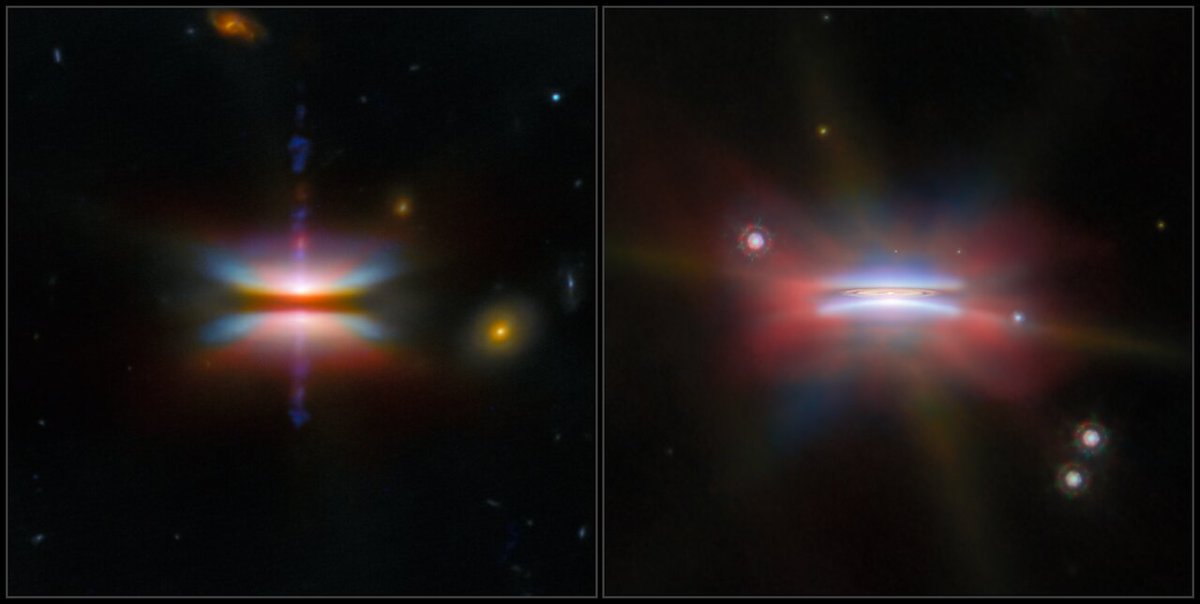




ALT An area inside a star-forming molecular cloud. The background is covered with layers of gas and dust in blue, green and yellowish colours. Thicker clumps of cold dust, dark brown to black, block out light completely. Stars lie among and atop the clouds, from small orange ones to large white or blue ones. Waves and streams of glowing whitish gas are created by jets from protostars colliding with the surrounding material.
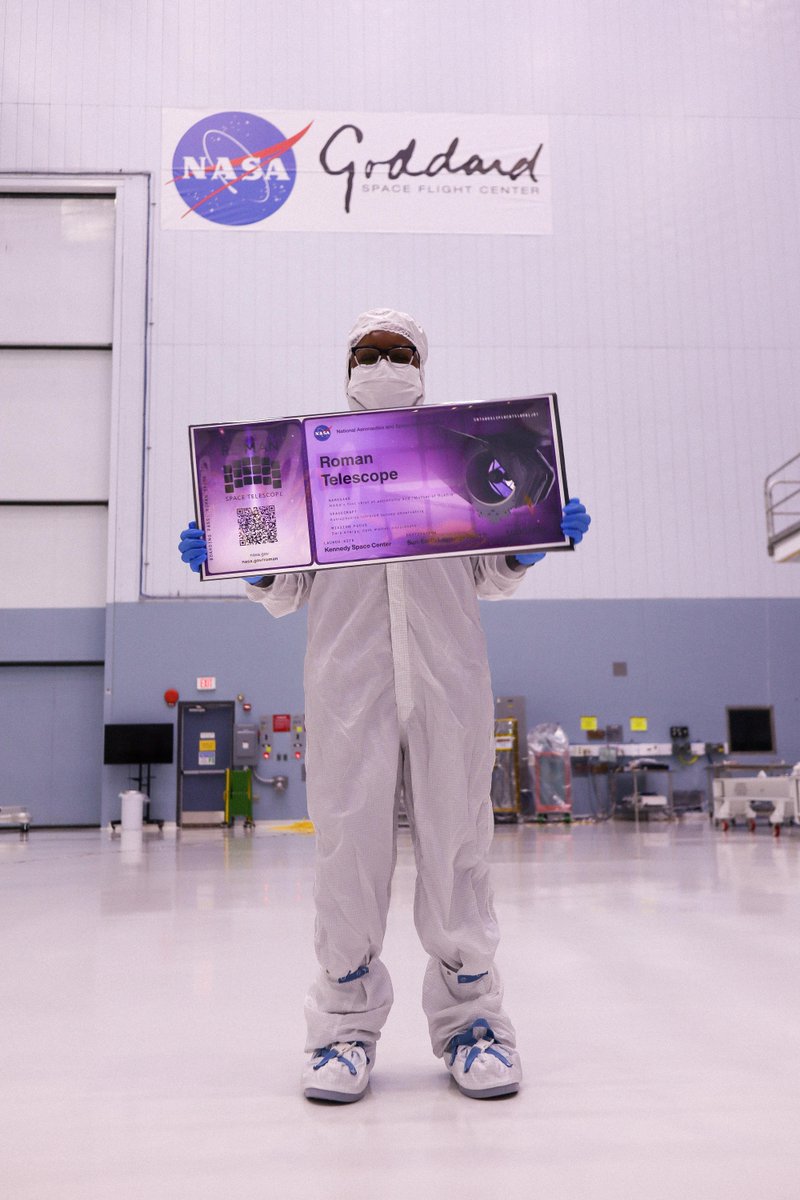
ALT A person holds a large, purple "boarding pass" for NASA's Nancy Grace Roman Space Telescope in Goddard's large cleanroom wearing a full white cleanroom suit. The boarding pass has the detector logo for Roman, an artist concept image of Roman, as well as a QR code, the telescope, and the NASA logo. "Roman Telescope" is written where the name would go.

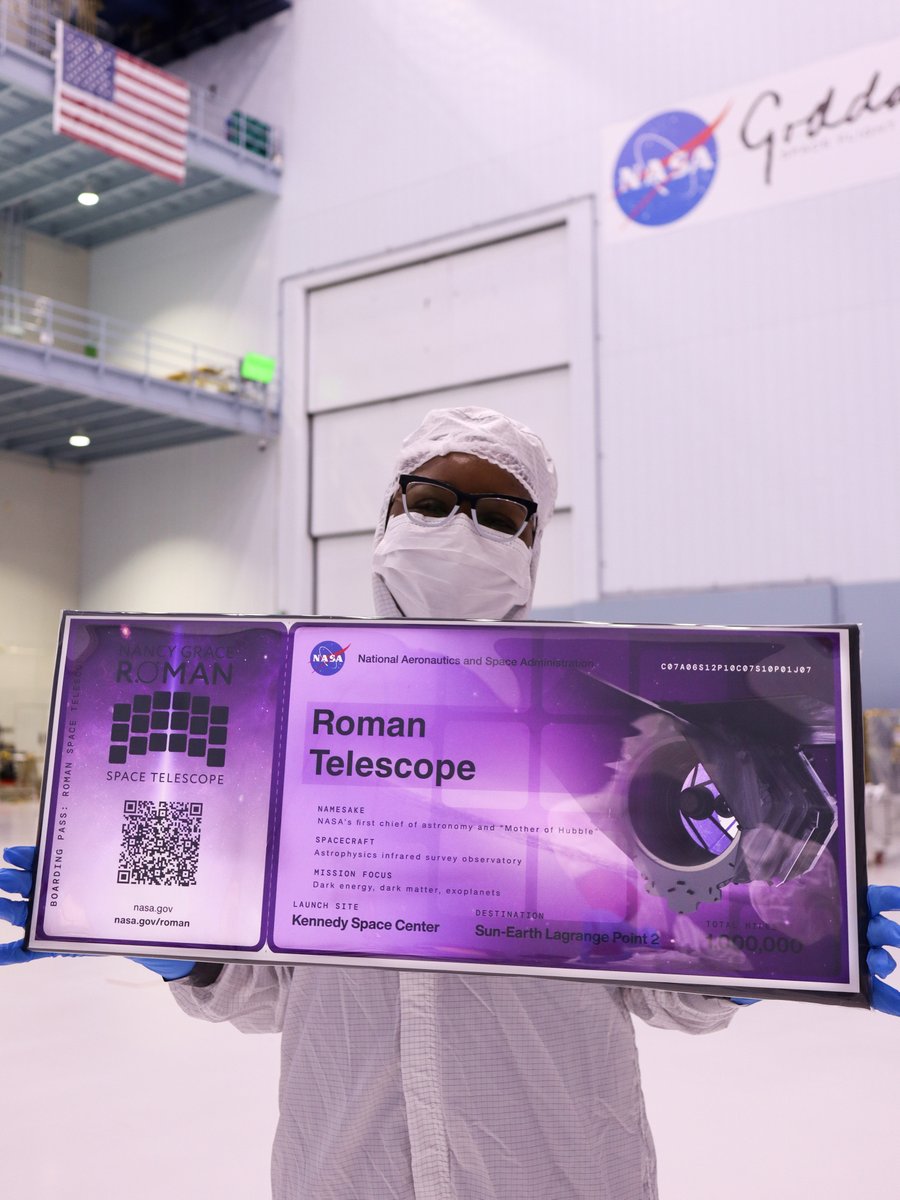
ALT A person in a head-to-toe white clean room suit holds a large purple "boarding pass" for NASA's Nancy Grace Roman Space Telescope in Goddard's large cleanroom. The boarding pass includes an image of the 18 detectors, an artist concept image of the telescope, a QR code, and the NASA logo. "Roman Telescope" is written where the name would go.
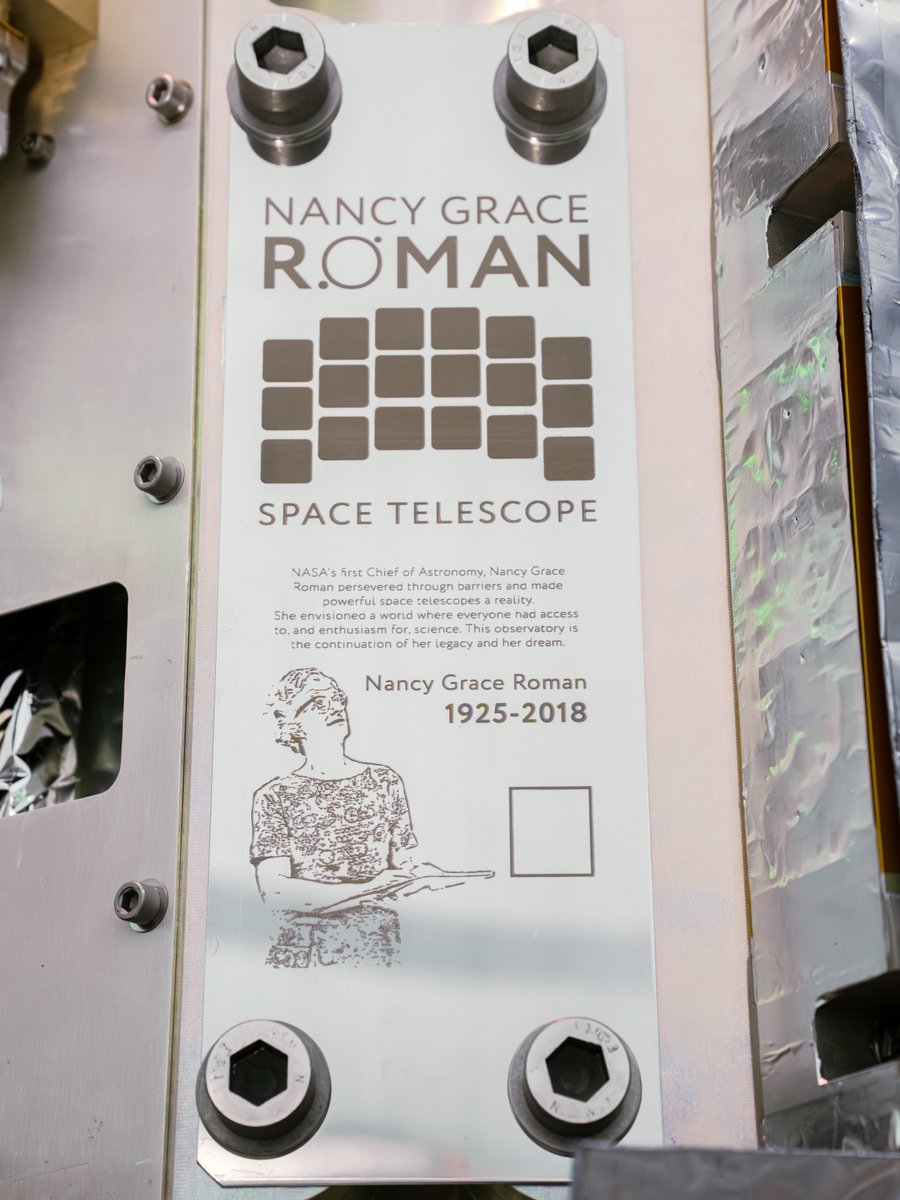
ALT The plate attached to the Roman telescope, where a memory card containing names will be attached. It's a tall, thin, rectangular silver plate. At the top of the plate is the stylized Nancy Grace Roman name logo. Below is the silhouette of Roman's 18-square detectors in their iconic arch shape. Text below that reads "NASA's first chief astronomer, Nancy Grace Roman, persevered through barriers and made powerful space telescopes a reality. She envisioned a world where everyone had access to, and enthusiasm for, science. This observatory is the continuation of her legacy and dream." Below the text is an illustration of Dr. Roman looking up, next to her name and the years 1925-2018. Below the years is a small box where the memory card will be affixed. The plate is held down with two large bolts at the top and bottom.
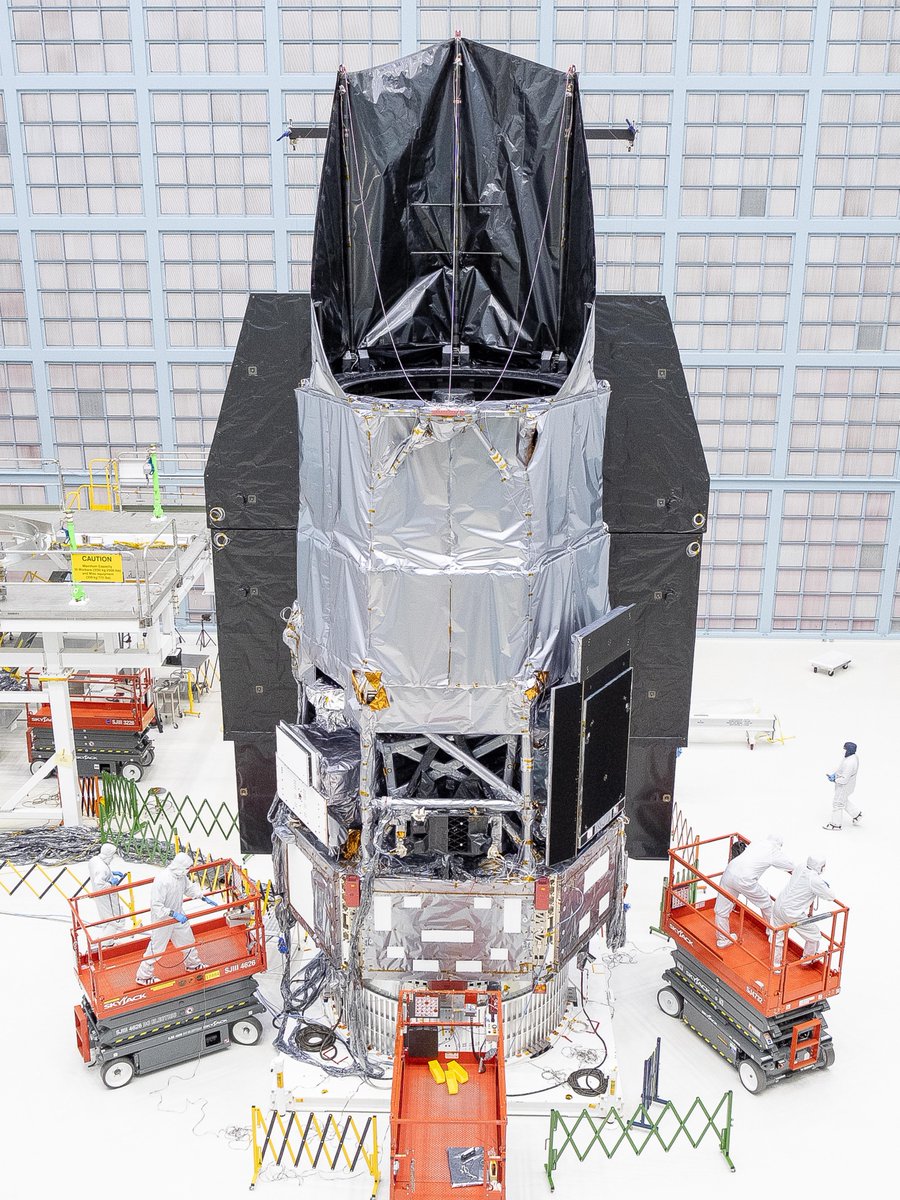
ALT The fully assembled Roman telescope in the clean room, standing upright. It's a silver cylinder with solar panels peeking out from behind both sides like wings. The hood is deployed, like a black sun visor on a baseball cap. Orange lifts and people in white cleanroom suits surrounded the telescope, highlighting how large it is. The unfolded lifts only reach about one-quarter of the way up the telescope's body. Instrumentation and cables are visible in a section about one-third of the way up the body. Thousands of tiny squares on the wall behind the telescope are air filters for the clean room.
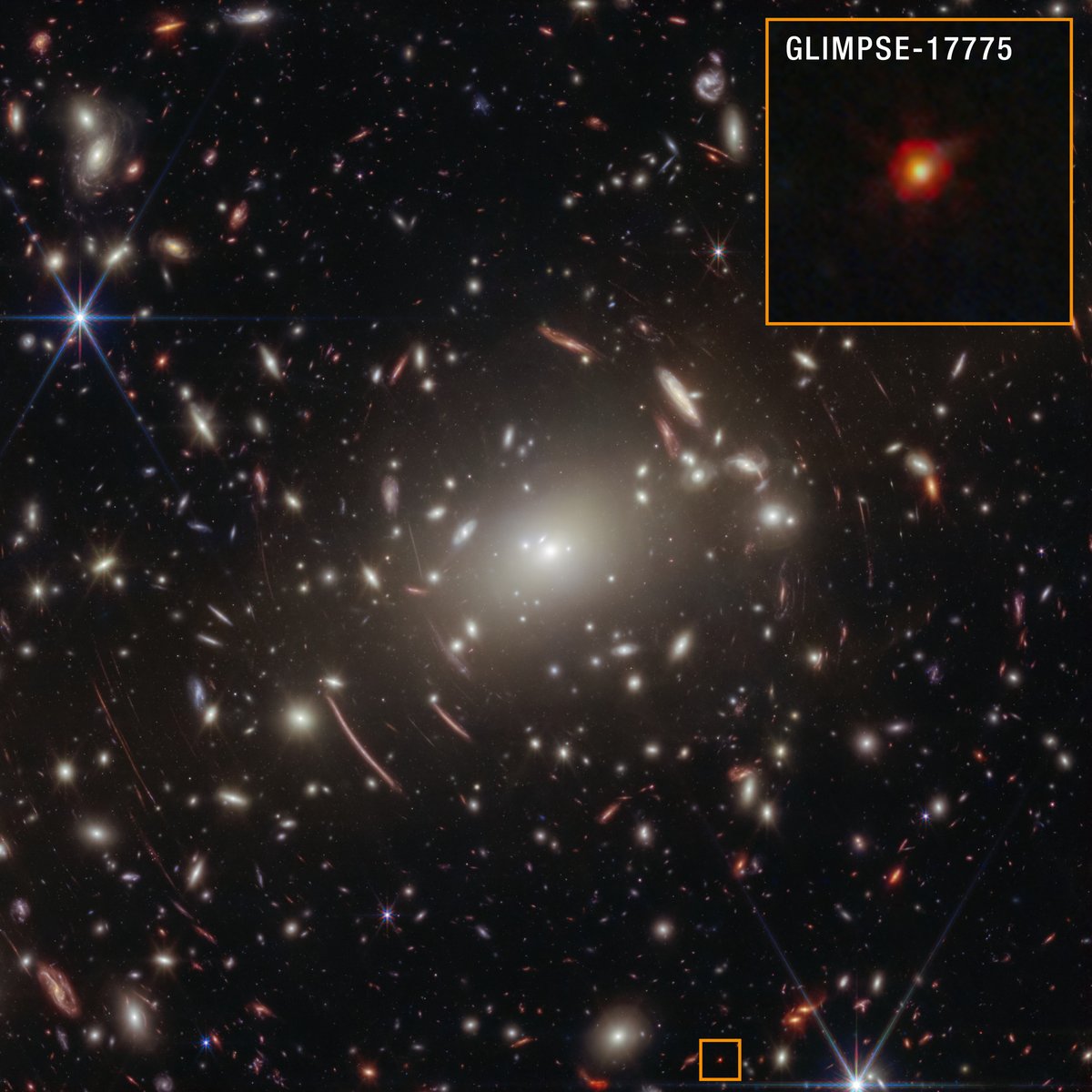
ALT A field of galaxies against the black background of space. In the center is a bright-white elliptical galaxy that is the core of the Abell S1063 galaxy cluster. Around the core are short, curved red lines, which are distant background galaxies magnified and warped by gravitational lensing. A couple of foreground stars appear large and bright with Webb’s signature eight-point diffraction spike pattern. Toward the very bottom, slightly off center toward the right, is a small red dot that is highlighted by an orange square outline. A larger orange square in the top right corner shows the object in more detail. The object, labeled “GLIMPSE-17775” looks like a fuzzy red dot with a yellow core.
ALT An area inside a star-forming molecular cloud. The background is covered with layers of gas and dust in blue, green and yellowish colours. Thicker clumps of cold dust, dark brown to black, block out light completely. Stars lie among and atop the clouds, from small orange ones to large white or blue ones. Waves and streams of glowing whitish gas are created by jets from protostars colliding with the surrounding material.
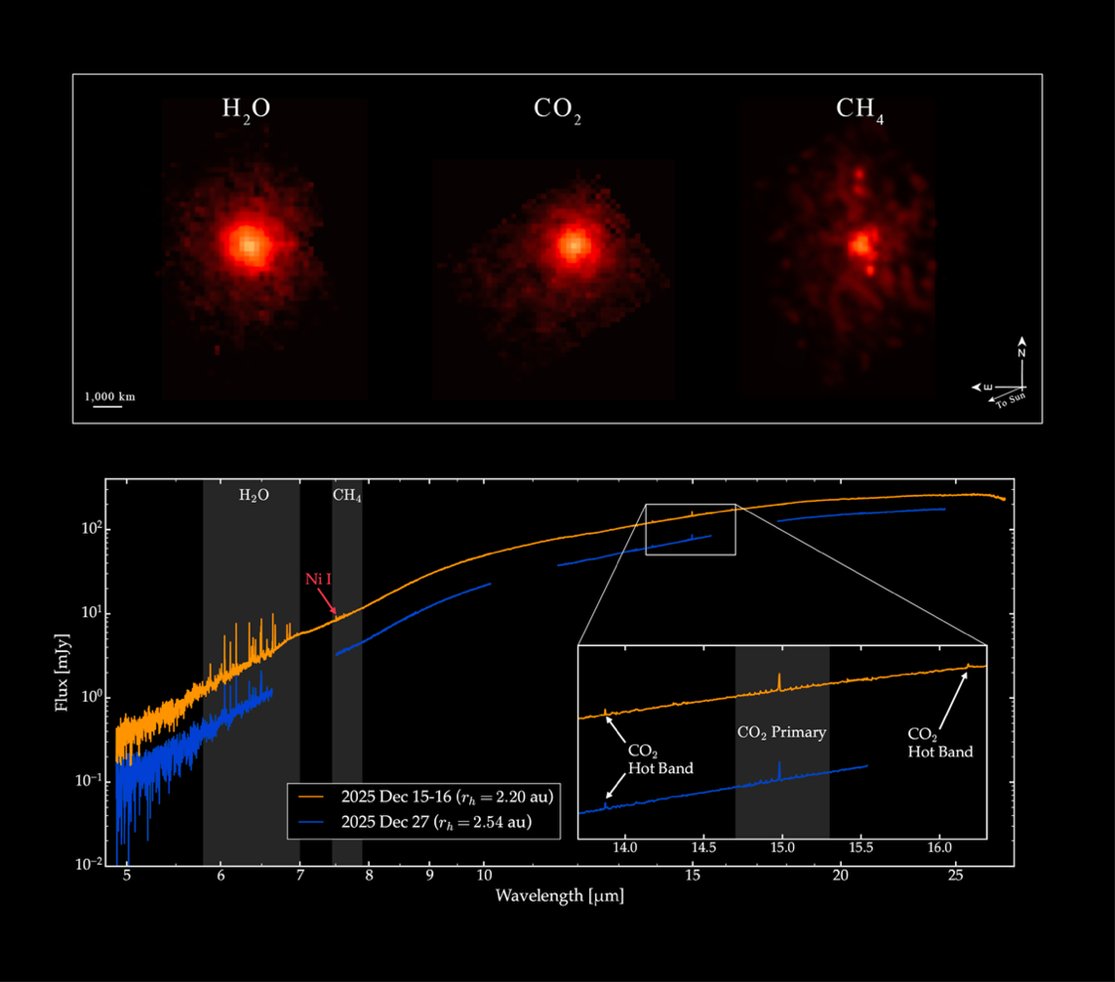
ALT The top image shows interstellar comet 3I/ATLAS as seen with MIRI (Mid-Infrared Instrument) on NASA’s James Webb Space Telescope, along with contours that illustrate where different gases were located at the time the comet was viewed. Water vapor spreads far beyond the nucleus because much of it is released from icy grains in the coma, while carbon dioxide and methane are most concentrated near the comet’s nucleus. The bottom image shows the spectrum, with the labels indicating the features from the various gases that Webb found escaping from the comet. Credit: NASA, ESA, CSA, STScI, M. Belyakov (Caltech), I. Wong (STScI), Image Processing: A. Pagan (STScI)
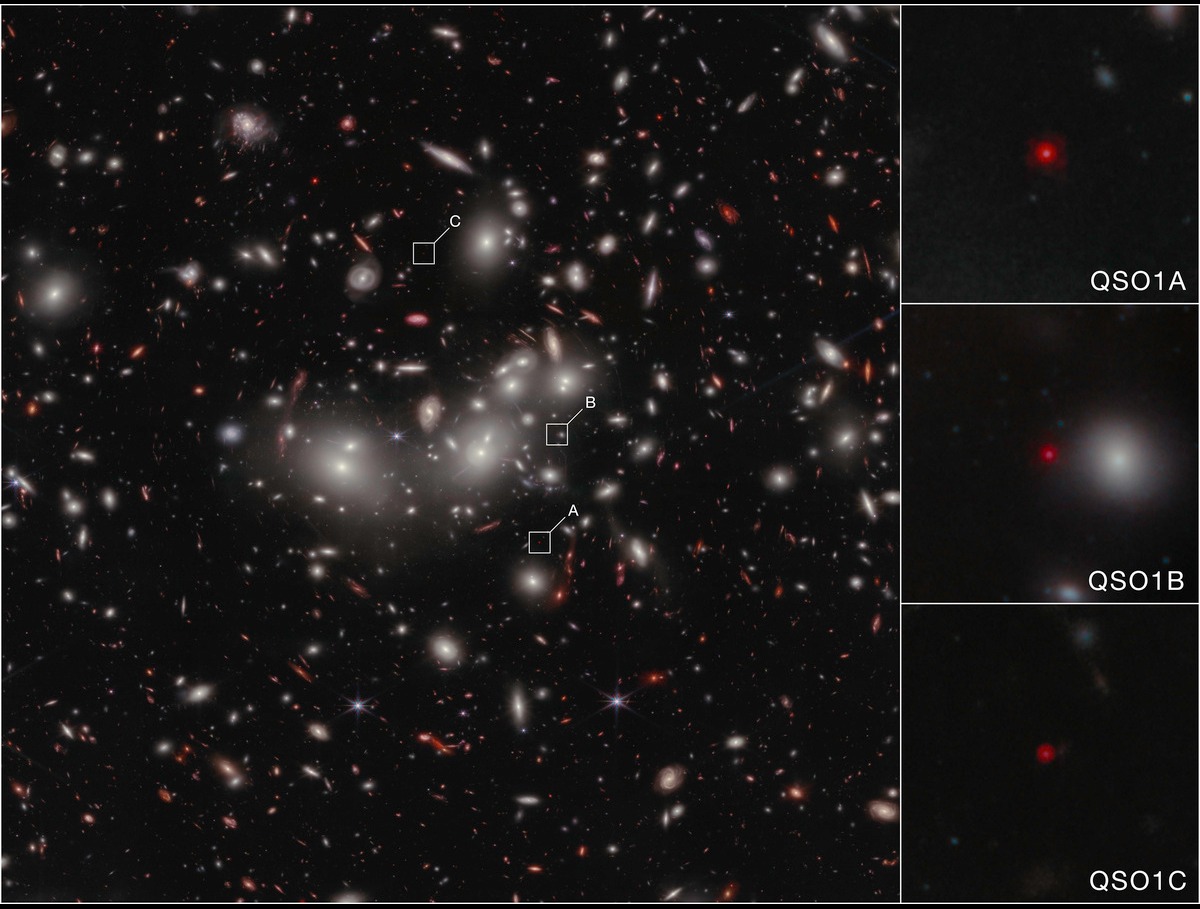
ALT Space telescope image showing hundreds of bright objects of different size, color, and shape on the black background of space. Colors range from white to deep red. Shapes include elliptical, spiral, dot-like, dash-like, and arcuate. Many of the large objects near the center of the image are fuzzy white, with bright white cores. Many smaller objects scattered throughout the image are pink to red. Three objects in the central part of the image are called out with small white boxes: A box labeled “C” at about 12 o’clock; one labeled “B” at 3 o’clock; and a box labeled “A” at 4 o’clock. Images of the three objects are enlarged in boxes running vertically along the right. From top to bottom these are labeled QSO1A, QSO1B, and QSO1C. At the center of each box is a tiny, circular red dot. QSO1A (top) is notably larger, brighter, and clearer than the other two. QSO1B, in the middle, is smallest and fuzziest, and is somewhat washed out by the light of a larger white object next to it.

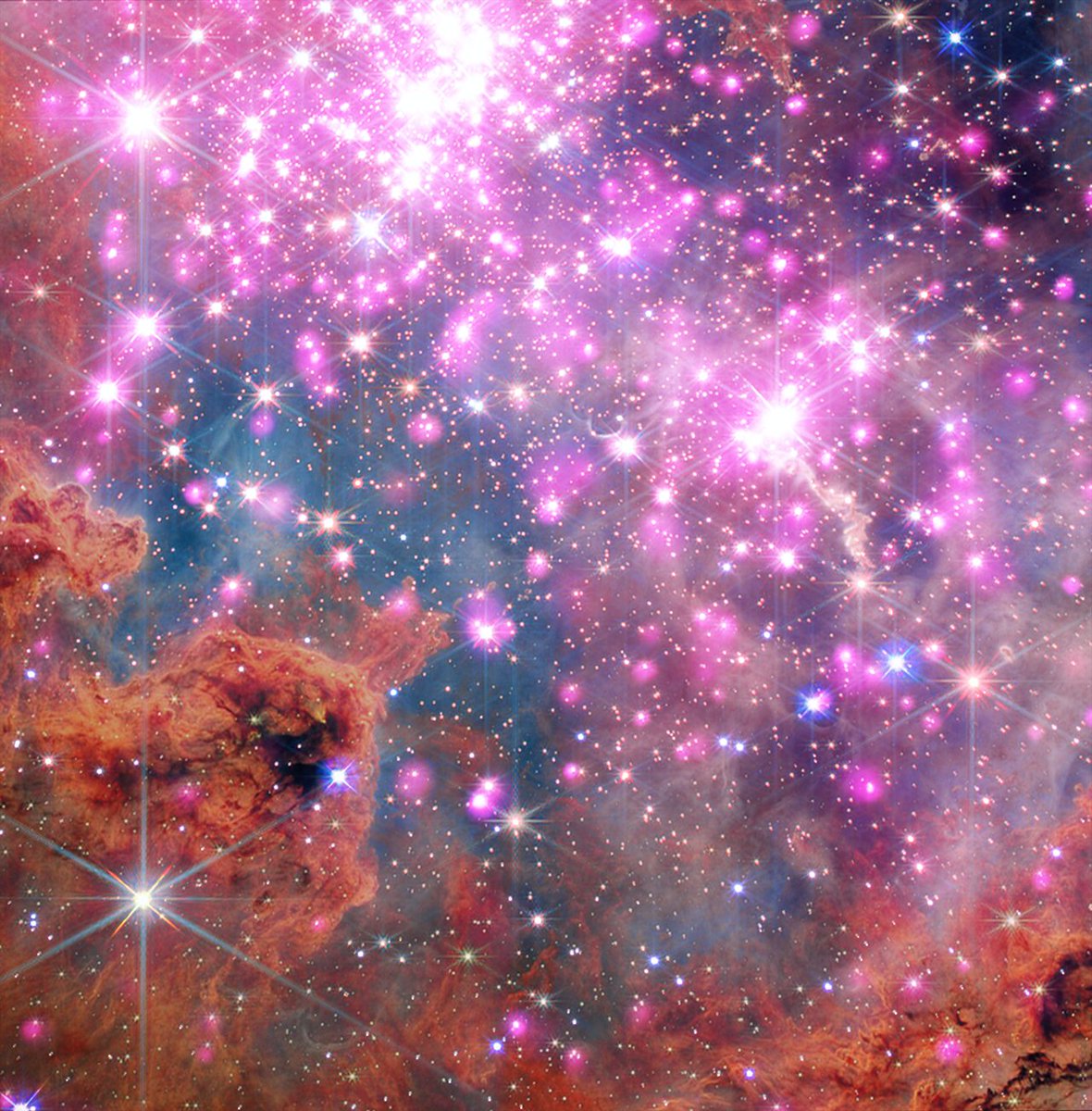
ALT This is a composite image of the young star cluster known as Westerlund 2. Here, scores of gleaming white specks ringed in neon pink are scattered across the image in a band that stretches from our lower right to our upper left, and beyond. Clouds of brick-orange dust enter the image from our lower left, and spread along the bottom edge of the frame, showing off the raw materials of this active stellar nursery.
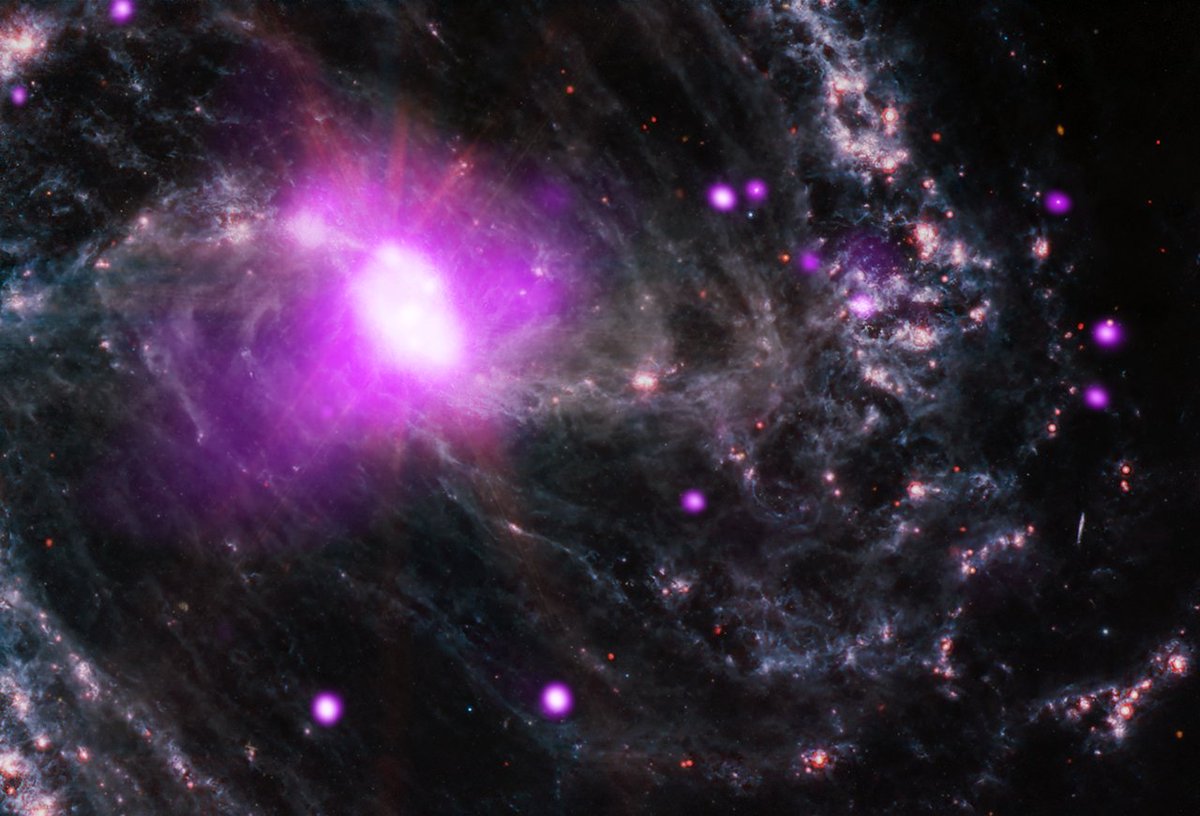
ALT A close up image of spiral galaxy NGC 1365 and the supermassive black hole at its center. Here, the galaxy is shown at a dramatic angle, as if the bright pink core is gazing past our right shoulder. Swirls of pale, grey-blue material, resembling waves in a dark ocean, spiral toward the radiant pink core, which hangs at our upper left. Glowing pink circles, and flecks of red, dot the churning spiral galaxy.

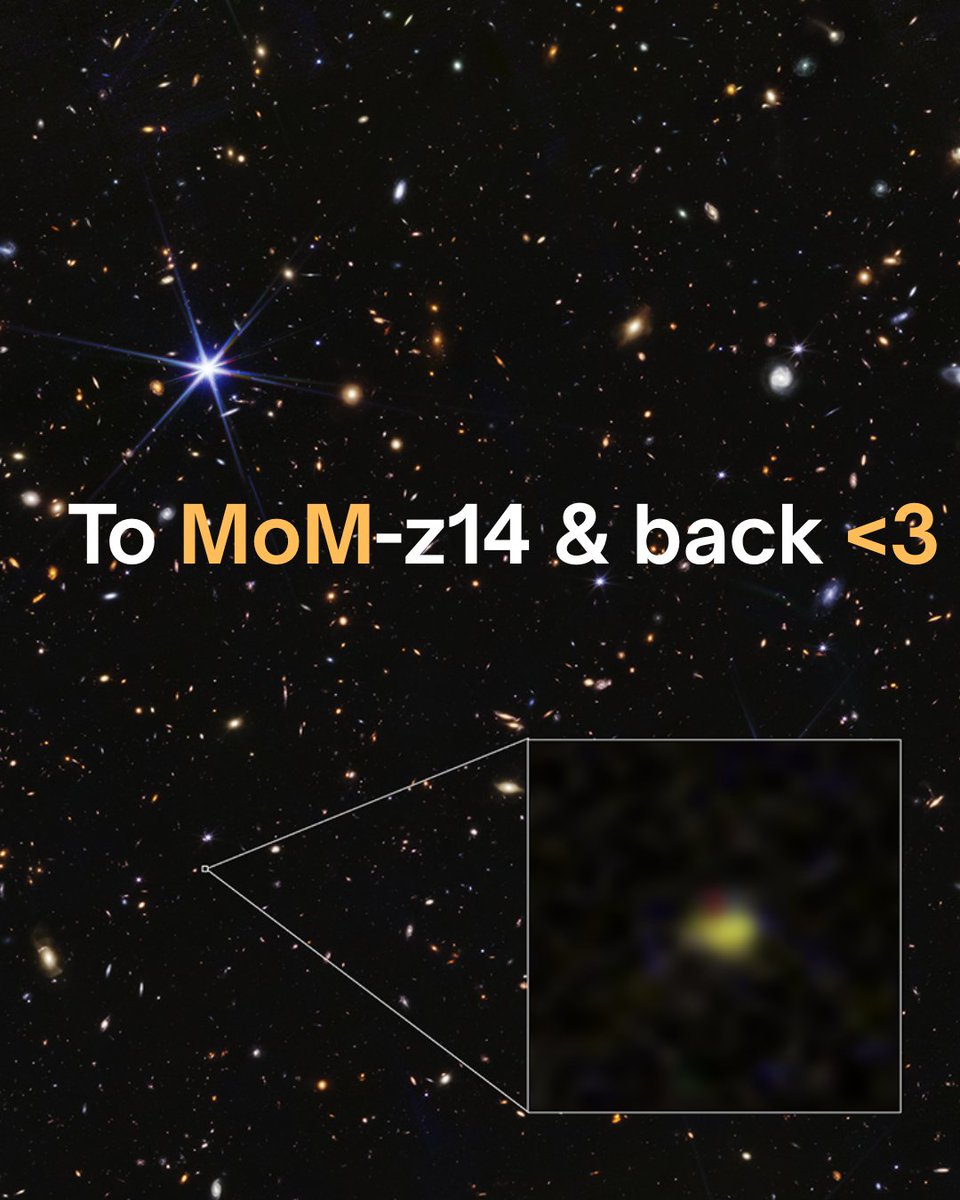
ALT A wide field of view showing deep space, dotted with many small galaxies and a few foreground stars that display six diffraction spikes. Galaxy MoM-z14 is highlighted with a magnified image in a graphic pull-out box in the lower right corner. The galaxy appears as a blurry yellow blob with a small red area at its top. The text \"To MoM-z14 & back <3\" is overlaid on the image in white and gold letters.
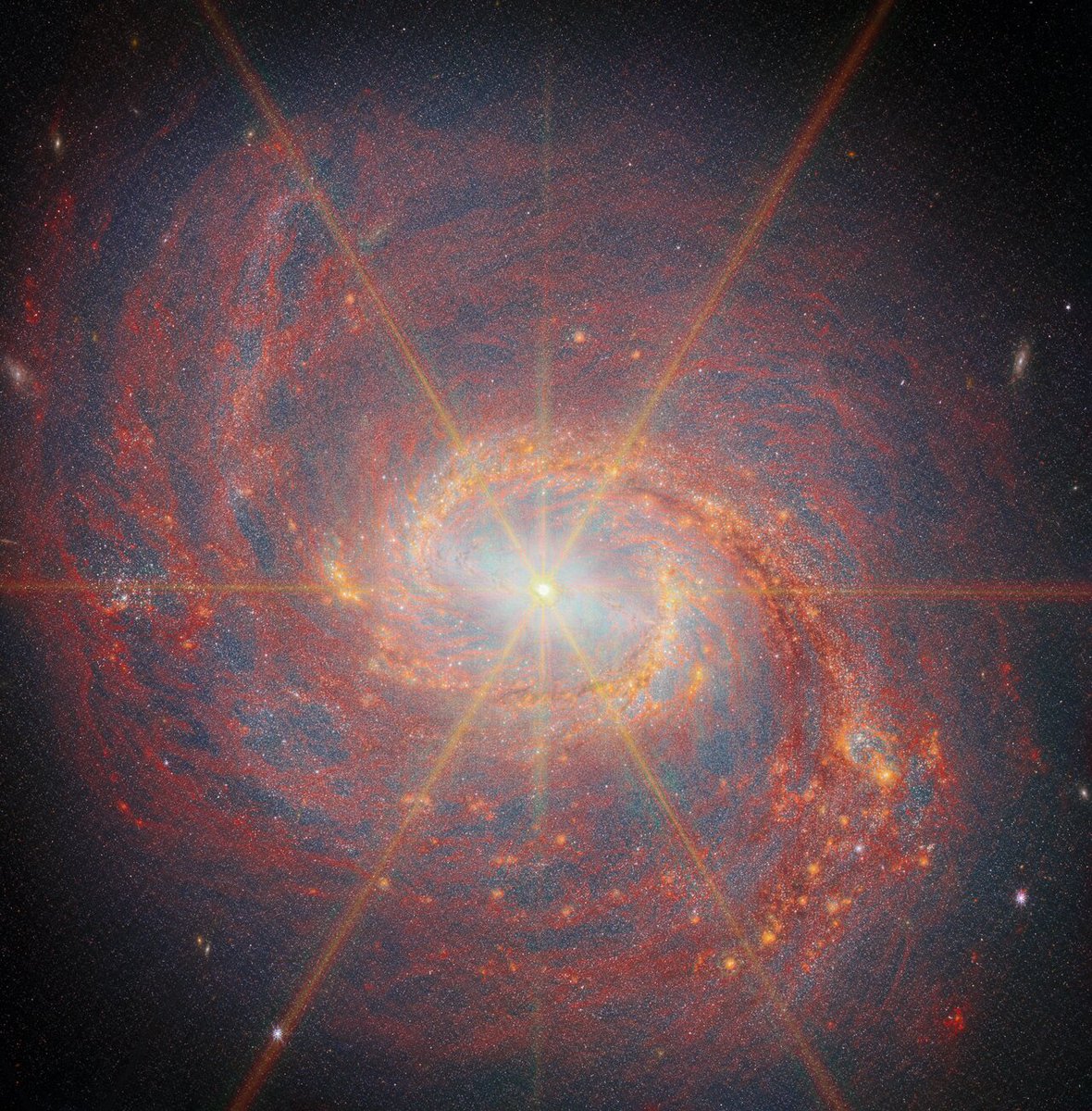
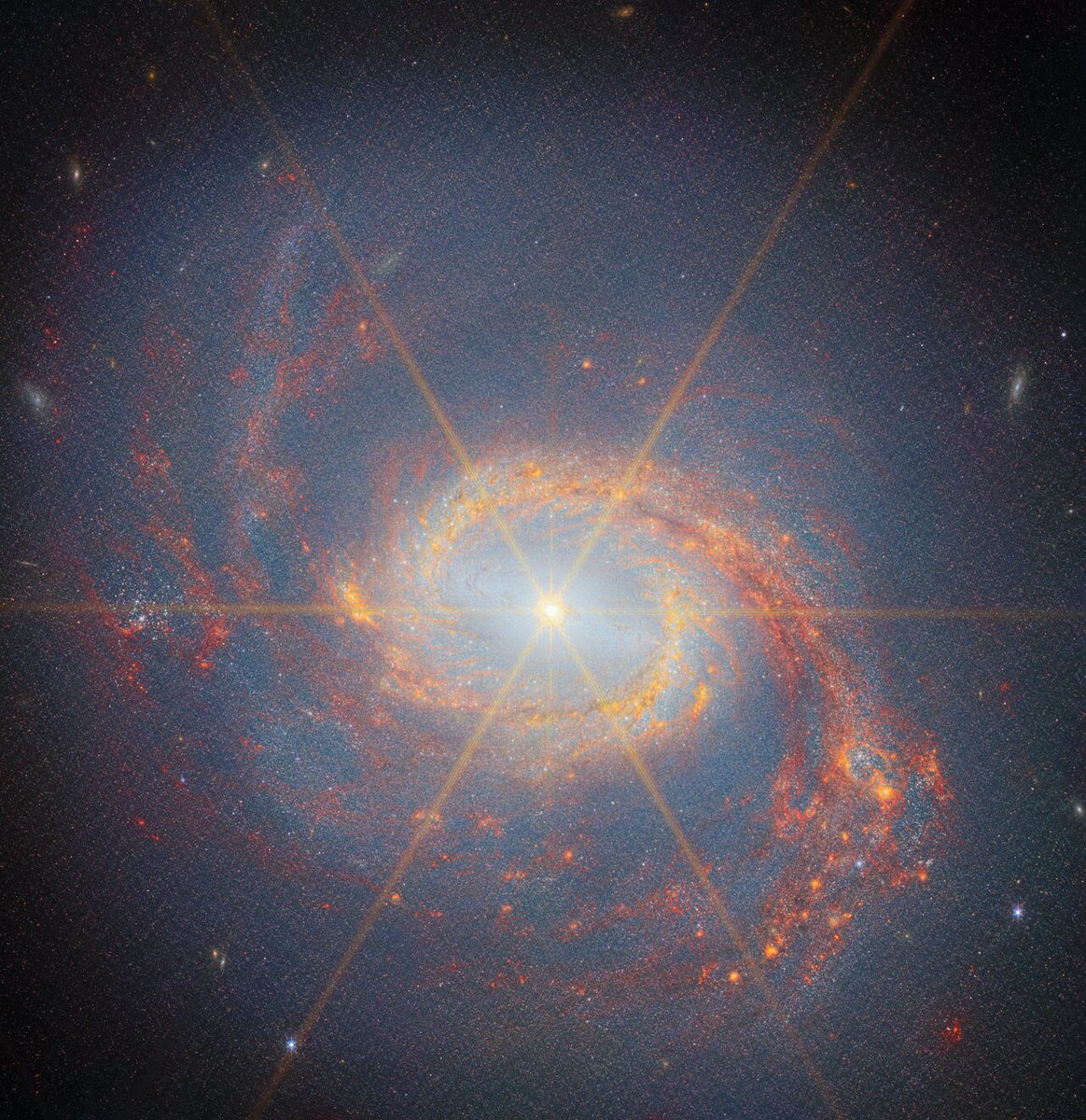
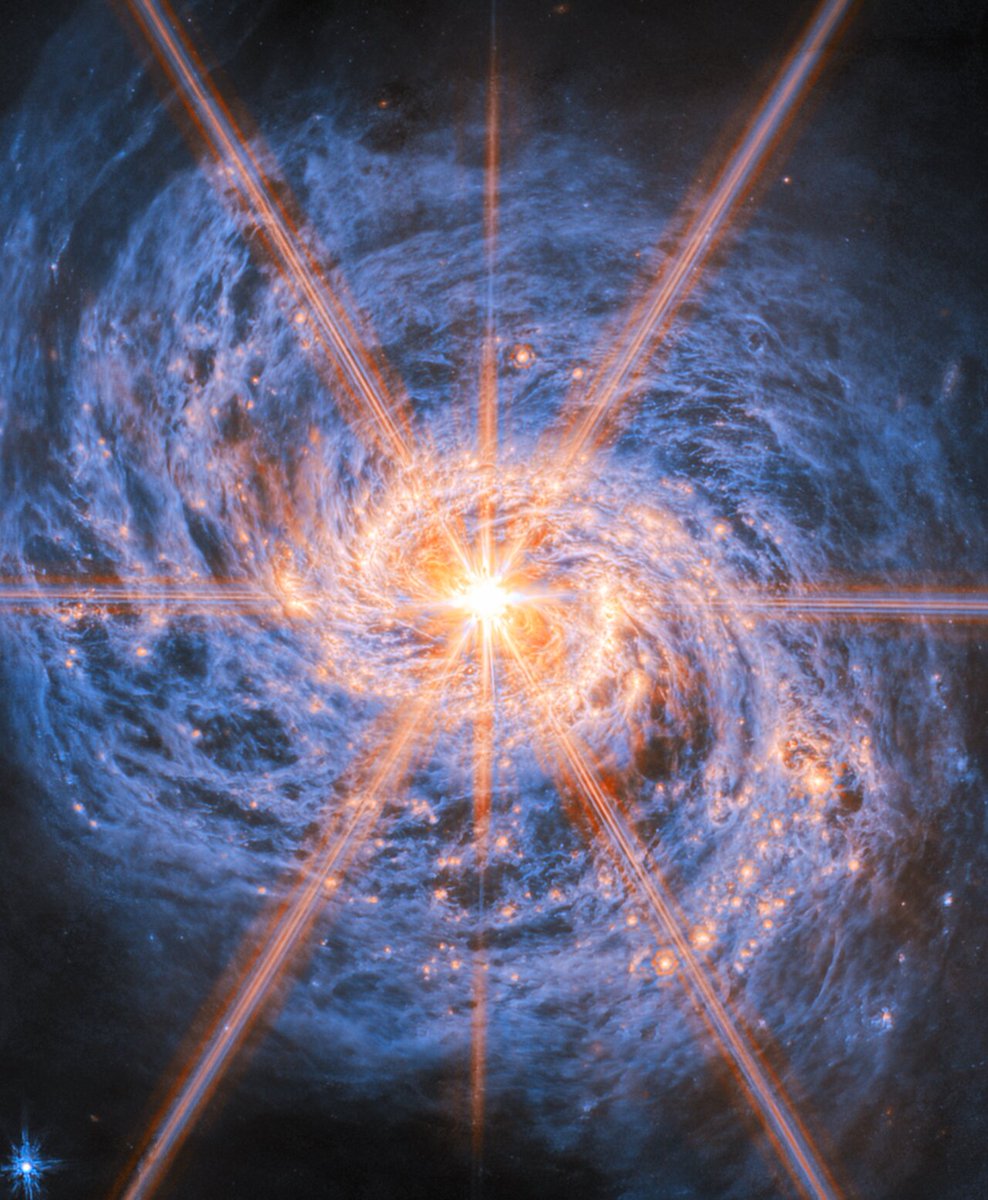
ALT A spiral galaxy shown in mid-infrared light. The image is dominated by an extremely bright glow from the galaxy\u2019s nucleus. Six large and two smaller rays of light emit from the centre, which are diffraction spikes created by the telescope\u2019s optics. The galaxy\u2019s spiral arms are visible by two lines of glowing orange bubbles which whirl out into the disc. Swirling blue clouds of dust make up the rest of the galaxy.\n
ALT A spiral galaxy shown in infrared light. Six long and two smaller rays of light emit from the center, which are diffraction spikes created by the telescope\u2019s optics. A glowing bar spans across the center. A glittering ring of stars and dust surrounds the bar; at each side, the ring splits off into a spiral arm that winds outwards. Faint, dark red dust clouds swirl throughout the rest of the disc, backed by a pale glow from all the galaxy\u2019s stars.