
CEO @Duarte & best-selling author. Passionate about persuasion and visual stories used in business. Love hugs from hubby, three kids, and two grandsons.
Joined May 2008
- Tweets 14,457
- Following 1,695
- Followers 49,776
- Likes 7,231
925 Photos and videos



Jun 9
This is a great episode of The Curiosity Shop with @BreneBrown and @AdamMGrant.
So many of our best decisions require us to tell the truth about what is, while still believing in what could be.
youtube.com/watch?v=5tVqjcbs…
566
Jun 8
A statistic by itself doesn't move anyone.
“Customer churn is up 12% this quarter.”
So what?
That’s not a story. That’s a fact. And facts don’t drive decisions.
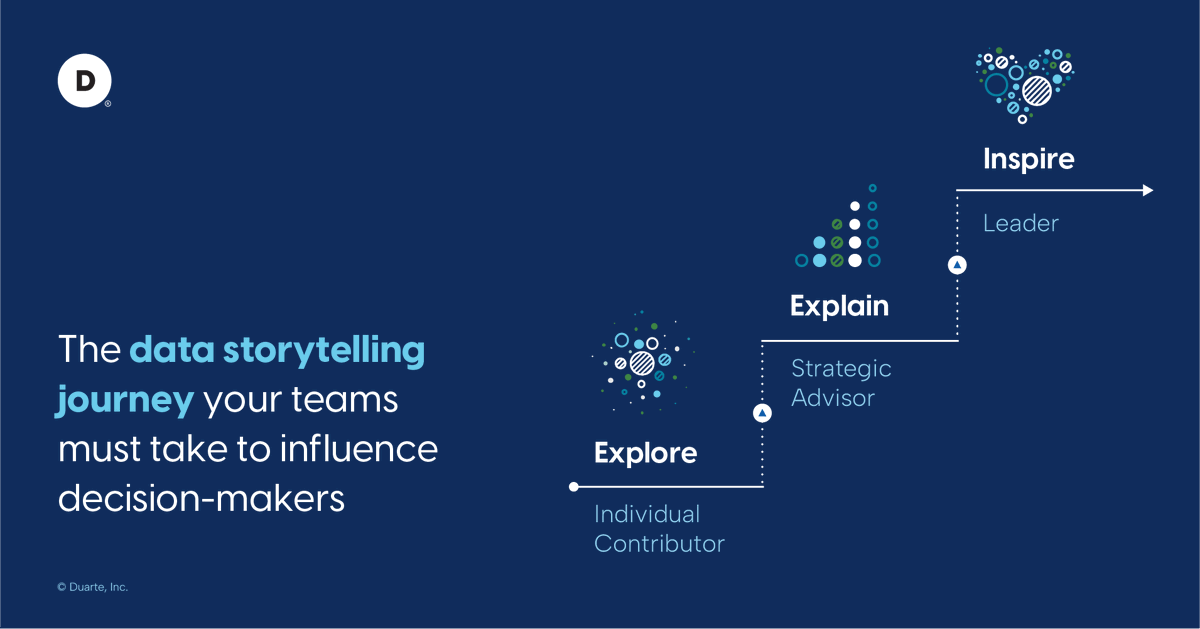
Here’s a simple three-act structure we teach at Duarte to shape data into something that actually moves people (this is a great place to start):
Act 1: State the insight.
This is where most people start and stop. “Customer churn is up 12% this quarter.”
Act 2: State where the trajectory needs to change.
What does this number need to do? Go up? Go down? By how much, by when?
“We need churn back under 7% by the end of Q3.”
Act 3: State the verb.
What’s the action that makes the trajectory change? A specific verb someone can act on. “We’re going to interview the last 50 churned customers and rebuild onboarding around what we learn.”
That’s the difference between a number on a slide and a decision in a room.
You can do this in one sentence. You can do it in three. You can do it in an executive summary.
The structure is the same:
1. State what you found.
2. State where it needs to go.
3. State the verb that gets it there.
That’s how you start using data to actually drive change.
#DataStorytelling #BusinessStorytelling #PresentationSkills
2
1
9
792
May 11
“Storytelling isn’t really my job.”
I hear it from finance leaders. From engineers. From HR. From the people who think story is just spin, fiction, or fluff you add at the end to make things sound nice.
But every job influences someone.
Finance is trying to get funding approved.
HR is trying to change behavior across an organization.
Engineering is trying to get a project across the finish line.
That’s all influence. And influence is storytelling. You’re moving someone from one belief to another. From one decision to a different one. From inaction to action.
That’s the work of a story.
You don’t need to stand on a stage or start with “once upon a time.” But you do need to understand where your audience is right now, where you need them to go, and what they need to hear to get there.
So if your job involves moving a human being from one behavior to another, then yes. Storytelling is your job.
1
6
10
1,517
May 4
When decision makers say this phrase, it usually means you got a “no”...
“We’ll circle back.”
You’ve probably seen it happen.
A leader walks into a meeting with solid data, a clear ROI, and months of work behind them. Their recommendation seems like a no-brainer, but stakeholders still pass on it.
When this happens, it’s usually not the idea itself that failed them. Decision makers don’t accept ideas just because they’re good. If that were the case, you wouldn’t have this problem.
They accept ideas that solve their problems and advance their goals.
Most leaders walk into high-stakes meetings unknowingly making themselves the “hero” of their presentation. They focus mostly on their idea, their research, and their solution.
But the leaders who consistently get “yeses” make the stakeholders the hero.
They tailor their presentations to what the people in the room need to hear, how they need to hear it, why it matters to them personally, and how it helps them accomplish their goals.
We recently made an entire course revealing our full framework for creating presentations that convince stakeholders. It gives you the same framework we’ve used to help leaders secure 9-figure deals, rally teams around massive change initiatives, and win millions in budget approvals.
Link to the course: drte.co/42LbHQV
1
5
428
Apr 29
Many leaders spend so much time “perfecting” their presentations that they overlook what actually determines buy-in…
The conversations in meetings where tough issues are being discussed.
That’s where even some of the most skilled leaders see their communication break down. Even with sound thinking and an air-tight case, the room can still go quiet, and decisions can stall.
When this happens, leaders usually look for a flaw in their execution. But they rarely examine one of the most common causes:
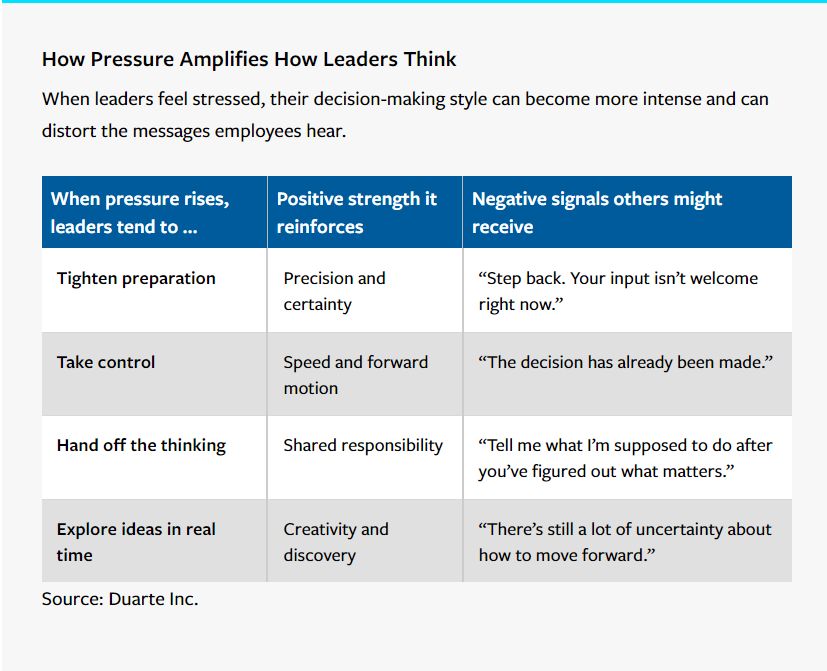
Pressure.
When the stakes rise in a meeting, leaders lean harder into the thinking process that made them successful. And what usually serves them starts working against them in the room.
The leader who values precision gets tighter. Their team concludes their input isn’t welcome.
The leader who values speed gets more decisive. Their team assumes the outcome is already determined.
The leader who values exploration opens up more options. Their team struggles to understand what’s actually been decided.
In each case, the leader leaves the room confident, but the team leaves confused.
Leaders who handle these high-stakes moments best don’t try to overhaul how they communicate. They learn to recognize how their thinking shifts under pressure and make small, deliberate adjustments before the room goes sideways.
I wrote about this in detail for @mitsmr, and I included a self-diagnosis framework for identifying which pattern you default to (and how to course-correct in the moment).
Link to the article: sloanreview.mit.edu/article/…
6
547
Apr 20
If your teams struggle to get buy-in from stakeholders, the problem is rarely what they’re pitching…
It’s how they’re pitching it.
I’ve watched this play out across organizations for decades.
Leaders do thorough analysis, have airtight recommendations, and pack their presentations with tons of data.
But stakeholders still say, “We’ll circle back.”
(And that usually means “No.”)
The disconnect often comes down to this…
Data by itself rarely convinces someone to take action. It needs a storyteller to shape it, connect the dots, and give it meaning for a specific audience.
Don’t assume that stakeholders will just “get it” if your leaders show them all the data.
Your leaders need to make their insights clear, provide a clear recommendation, and make the path forward feel obvious to everyone in the room.
This is the essence of data storytelling, and it is one of the highest-leverage skills your teams can learn.
If you want help figuring out where you or your team stands when it comes to data storytelling skills and get specific recommendations for how to improve, here is a link to a quick assessment: drte.co/3KHAkbH
1
417
Apr 16
After decades of working with leaders at companies like Apple, Salesforce, and Cisco, we've identified 4 storytelling techniques that consistently work to deliver important messages in high-stakes settings:
1. Start with the unexpected
Don’t begin your presentation with context. Instead, begin with the moment that makes people think, “Wait…what?”
Instead of something like:
“Here’s an update on our September campaign…”
Try starting with the most interesting detail:
“I broke our biggest marketing rule last month, and it worked.”
Lead with the surprise. You can add context later.
2. Let people feel the tension
After the surprise, don’t rewind to the beginning. Take your audience to the moment where things weren’t working.
Flat numbers.
Missed goals.
Stalled progress.
Instead of:
“The campaign was underperforming, and our team went back to the drawing board.”
Try:
"We were two weeks out from the end of the quarter. The campaign wasn’t producing results, and the team was out of ideas. That’s when I decided to take a risk...”
You don’t need to explain the problem. You need to make people feel it.
3. Use real dialogue
When your audience hears what was actually said, they stop listening to you and start visualizing the moment. This helps them connect emotionally with what you’re saying.
Instead of:
“The campaign manager said team morale was low and they were struggling to find a solution.”
Try:
“My campaign manager pulled me aside in the hallway and said, ‘We’ve tried everything. The team has been working overtime, and we don’t know what else to do.’”
Dialogue brings listeners into the moment with you. It makes the story real.
4. Share the lesson
Never assume people will infer the meaning you intended.
End your story by answering:
- What does this mean?
- How should someone act differently now?
Example:
“Breaking our biggest marketing rule helped us turn this campaign around and hit our numbers. I strongly suggest we revisit our marketing guidelines. We could be leaving a ton of revenue on the table.”
Without the lesson being clear, even a good story feels unfinished.
These are the same techniques we teach to our clients at Duarte. Try them out during your next presentation and watch how people lean forward and tune in to your message
4
47
308
28,453
Apr 13
Years ago, I was at a private TED event, and what I heard about presentations has stuck with me ever since…
After slide:ology came out, Duarte was asked to help transform slides and speakers as they launched TED.com
About 3 years later, I was at a curated table with several big deal TEDsters.
And I asked this question:
What do you miss most about the old way TED delivered presentations?
Their answer surprised me…
They said they missed the early days when they’d have a world-renowned scientist on stage who was so nervous they’d be shaking. Everyone in the audience would be cheering them on, and they would push through the fear to deliver incredible insights.
There was something special about that level of authenticity.
It was uniquely human. Unpolished.
It helped the audience feel a real connection with the speaker.
And it gave everyone an experience they’d never forget.
Every high-stakes presentation needs to have some level of “polish”. The deck needs to be visually clear. Your message should follow a clear structure. You need to practice your delivery.
But NONE of that will help you move your audience if you don’t develop an authentic connection with them.
Your conviction about your topic, your vulnerability to be your true self, and your genuine belief in what you’re sharing are what your audience will remember.
1
3
14
1,445
Apr 7
I used to believe leaders should always show up as their authentic, natural selves.
I don’t believe that anymore.
As a leader, you need to be a chameleon at times, changing your approach depending on what the situation needs.
For a long time, I thought my role was to show up, discern, and decide. I assumed that was what good leadership looked like.
Discern & decide…
Discern & decide…
That’s the job (or so I thought).
But what I started to notice is that many people needed something else first.
They needed warming up.
They needed reassurance.
They needed empathy.
And in order to provide those things, I had to slow down. I had to stop assuming my natural way of showing up was the right way.
I had to change my approach from:
“What needs to get done?”
To:
- How is everyone feeling right now?
- What do they need?
- Am I actually meeting them where they are? Or just where I’m comfortable?
Leadership, at its best, isn’t about being yourself 100% of the time.
It’s about being who others need you to be when they need it.
1
1
33
3,618
Apr 1
If you look at the story structure most movies use, you'll notice that roughly 10% of the time is for the beginning, 10% is for the ending, and 80% is the “messy middle”... which is the part leaders prefer to edit out.
Why?
Because most of us prefer telling a polished version of our stories:
- Here was the challenge.
- Here was the solution.
- Here was the success.
But when we do that, we miss the opportunity to give our audience something to deeply connect with.
The messy middle is where the roadblocks show up, where we fall to our knees and question whether we're on the right path after all.
It's usually the part that is the least fun for us to talk about...
But the most meaningful for the audience to hear.
When you share the messy middle, you become relatable. You become human.
There’s neuroscience behind this.
When someone tells a story, the listener’s brain fires in the same sequence as the speaker’s. You’re not just transferring information, you’re creating a shared experience.
And shared experience builds empathy.
That doesn’t mean oversharing. It just means acknowledging that the path wasn’t linear and that the struggle was real.
Hat tip to Syd Field’s work, who writes about this in his book Screenplay: The Foundations of Screenwriting.
2
5
516
Mar 31
I attended something on March 3rd that I struggled to put into words.
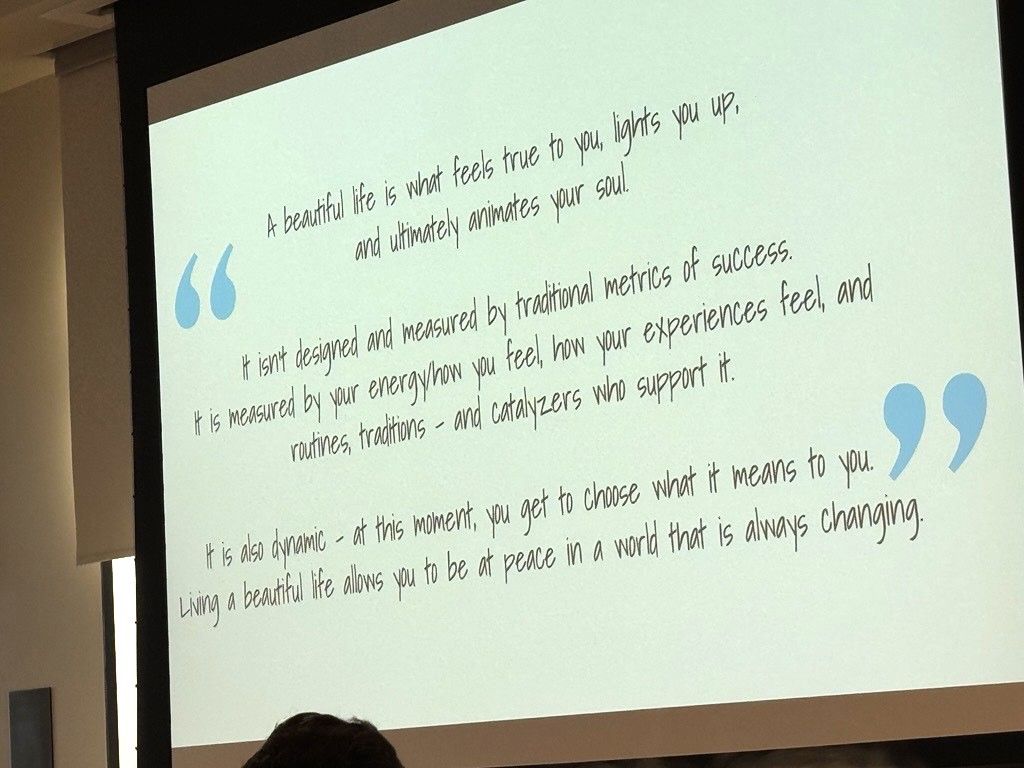
Hosted by my friend @aaker at Stanford, it was NOT a typical “AI event.” It was something far more human.
She set up tables where crazy-impressive experts sat alongside a handful of students. The experts weren’t there to lecture, but to listen. Each student shared how the past eight weeks had changed them.
And you could feel it.
You’d expect a Stanford course about AI to teach students how we can produce more. This was about using AI to live better. It was not about productivity gains.
She was talking about a beautiful life. A life of discovery, pursuit, health, impact, and savoring.
Students each built and published simple tools to support who they were becoming.
At the end, Jennifer gave a beautiful talk. She shared student reflections and then brought us to the edge of life itself.
Because when people reflect on their lives, they don’t ask:
Did I optimize enough?
No. They ask themselves:
-Did I live authentically?
-Did I live boldly?
-Did I stay connected to the people I love?
That’s the frame for this entire course. It’s not “How can AI make us faster?” but “How can AI help us live lives we won’t regret?”
While sitting at the table, listening to these students…
I realized that if we teach this generation to use AI only to optimize work, we’ve failed them.
But if we teach them to use it to expand their imagination and pursue a meaningful life…
We might change everything.
Jennifer, what you’ve built is rare. These students will never be the same.
And honestly… neither will I.
1
12
765
Mar 23
After decades of working with executives in board discussions, strategy offsites, and other high stakes moments where real decisions are on the line, I’ve noticed a consistent pattern. The leaders in these rooms are often some of the strongest communicators in their organizations, yet pressure has a way of revealing how each person processes complexity and the unintended signals they send when the stakes are high.
My latest @mitsmr article offers a way to self diagnose those patterns, understand why you may be losing the room, and learn how to adjust before alignment starts to slip.
sloanreview.mit.edu/article/…
2
2
12
725
Mar 2
Huge thanks to @OliverAust_ for having me on the Speak Like a CEO podcast! I had so much fun talking about communicating as a leader and more. I hope you enjoy the episode.
Watch the full episode here:
youtu.be/C5lB1rrO5-A?si=eKXe…
1
2
632
Feb 26
Can’t wait! Everything @AdamMGrant writes changes me!
Feb 25

Connection is not about how much time we spend together. It's about how much joy and meaning we create together.
Announcing my new book: adamgrant.net/book/vibe/

1
3
723
Feb 19
Celebrating a big moment! Two people on my team stepped onto the @TEDTalks Conferences stage. This course changed my life!
Maegan Stephens and Nicole Lowenbraun spent three years researching what separates great listeners at work from everyone else.
They discovered that most leaders aren’t actually “poor” listeners…they simply don’t know how to listen in a way that meets what the other person needs.
That discovery led to the creation of the Adaptive Listening® framework and course, which uncovers four listening modes to help you change how you show up in almost every conversation at work.
So, if you’ve ever walked out of a meeting wondering why nothing got resolved, or why the same conflict keeps resurfacing on your team, this talk is worth 15 minutes of your time.
go.ted.com/maeganandnicole
1
7
1,013
Feb 16
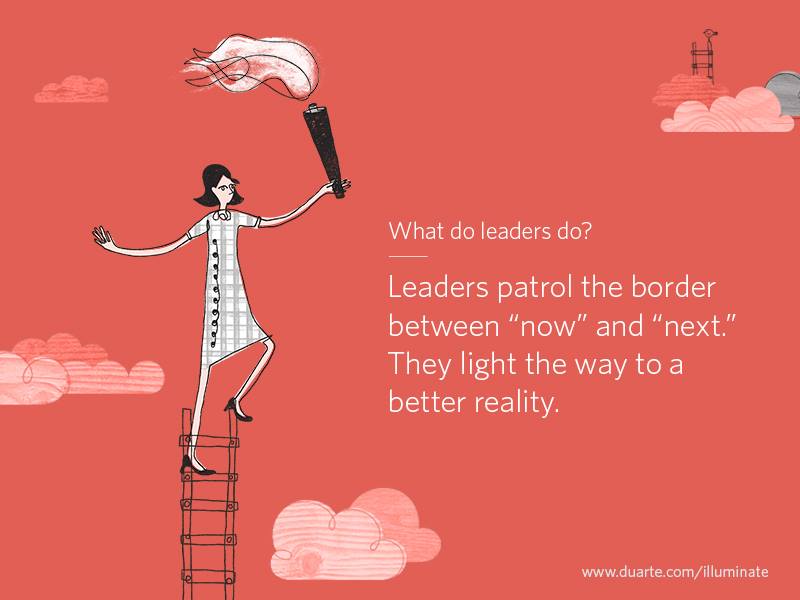
All leaders are navigating uncertainty. I used to see a direction clearly about 18 months out… but now the path disappears and the horizon line blurs in hours.
Communicating through the fog is like carrying a torch. The days of having a master plan etched in stone are gone. What’s required is to shed just enough light for the next few steps so others feel safe following you.
Leading in the era of AI is disorienting. Even the most grizzled and seasoned executives feel like they’re groping in the dark.
It took me a while before I could clearly see the path my company needed to take. Yup, there were moments when I wasn’t sure there was a path.
But that’s the work.
Leaders can’t eliminate the fog.
We enter it first.
We lift the torch.
We help people see just enough to move.
Writing Illuminate with Patti Sanchez 10 years ago today changed me. It was an honor of a lifetime. It deepened my conviction that leadership is about courage in ambiguity (not certainty!).
Grateful for the journey. And still carrying the torch.
2
9
576
Feb 12
Some of the most disappointing presentations I’ve seen were delivered by people everyone thought were “natural speakers.”
People who are “naturals” often skip the work because they can (well, they think they can). They’ve gotten away with it before. They’re charming. They’re charismatic. They’re engaging.
But that only works up to a point, because audiences are remarkably perceptive.
They can tell when you’ve thought about them. They can tell when you’ve rehearsed the hard parts. And they can also tell when you’re thinking up what to say in real time.
Lack of preparation is perceived as indifference.
On the other end of the spectrum, I’ve seen introverts (people who would never describe themselves as “natural speakers”) deliver extraordinary talks. Ones that the world needed to hear.
They rehearsed every word. They practiced every pause. But most importantly:
They cared deeply about what the audience needed at that moment.
And it showed.
The best presenters don’t rely on talent; they carefully consider their audience and craft messages that map to them
If you’re a “natural,” take the time to prepare and don’t “wing it."
If you’re an introvert, get comfortable speaking because you have information inside you that, when unlocked, changes a lot of lives!
4
13
798
Feb 5
The most powerful persuasion “engine” isn’t information. It’s not just a story, either. Instead, it’s something most people never even think of.
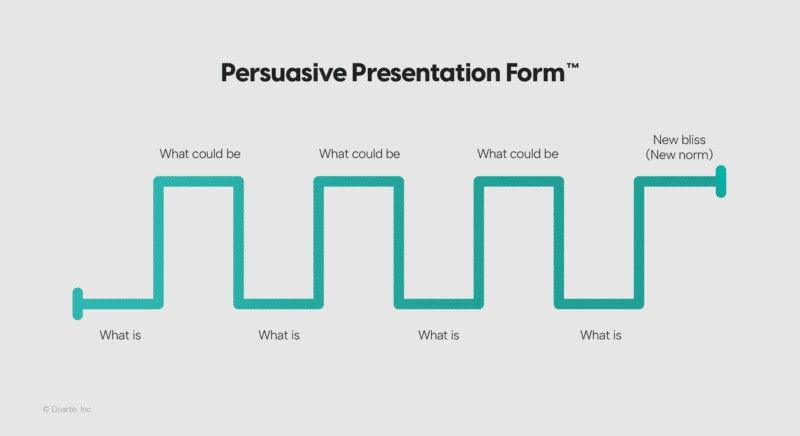
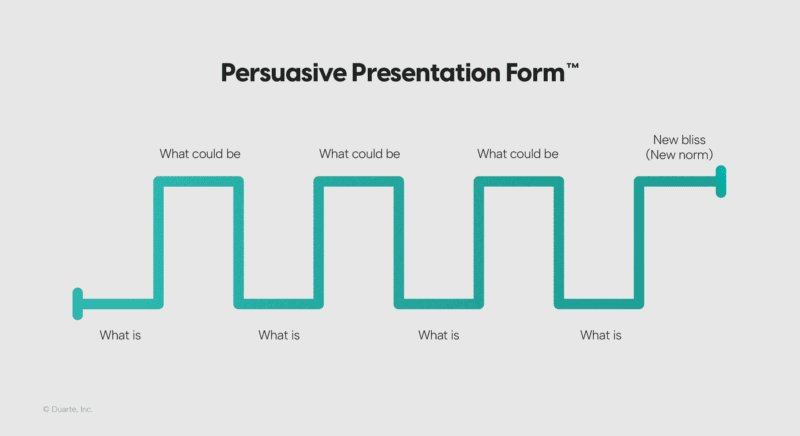
In a sales presentation, your job is to move your prospects between two points:
1. What is (the current reality)
2. What could be (the future state they want)
In our work at Duarte, we call it the Sparkline.
This is where persuasion happens.
Watch a world-class communicator give a speech or make a presentation, and I bet that you’ll notice a similarity between all of them:
They constantly toggle between the current reality and their vision for a better future.
They don’t just describe a problem. They contrast it with a vision of what’s possible. Then they return to the current reality, and then lift the audience again into a better one.
That back-and-forth movement creates emotional momentum.
Describing “what is” makes an audience feel the weight of their current challenges.
And showing “what could be” helps them imagine a future where those challenges are resolved.
The contrast creates a natural pull toward change because the present starts to feel too limiting and the future too compelling to ignore.
That’s when the real persuasion happens.
1
2
15
872
Feb 2
Want your next presentation to be the best you’ve ever given?
Remember these 3 things (they’re just 59 words):
1. Your audience is the hero.
They’re the central figure. Your role is to guide them toward success
2. Infuse your talk with story.
Data informs. Story moves. It gives structure, emotion, and meaning to your message.
3. Ask yourself: “Can they see what I’m saying?”
Each idea should have a clear visual moment; something your audience can grasp instantly.
Giving great presentations takes work, you’ve got this!
3
3
70
5,280
Jan 30
Most companies think they’re great at storytelling.
That is, until they look at this…
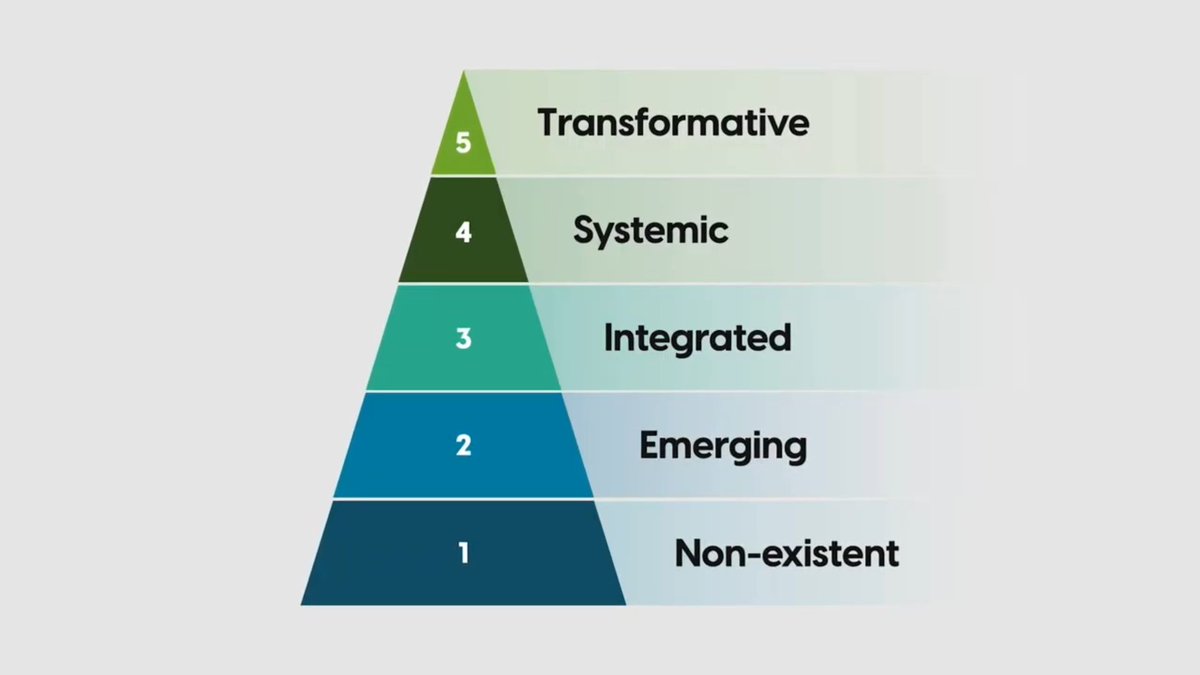
We recently created a framework called the Storytelling Maturity Scale.
It rates your organization from 1 to 5 based on how well your teams can tell stories that grab attention and move people to action (from marketing and sales to internal communications).
Some leaders are shocked to find out they’re a 2 out of 5…
They think their teams are great at storytelling because they’ve gone through training, have an overarching brand narrative they reference, and know how important this skill is to develop.
But since “storytelling” can be so hard to measure, leadership doesn’t really know how good their teams are or in what specific areas they need to improve.
The Storytelling Maturity Scale changes that. In about 5 minutes, it scores your organization on one of five levels and shows you exactly what to fix:
Level 1 - Non-existent: Storytelling isn’t on anyone’s radar. You’re marketing features instead of outcomes, your sales calls focus on closing rather than helping, and customers feel like numbers in a quota instead of humans with problems you can solve.
Level 2 - Emerging: You know storytelling matters, but it’s inconsistent. You might have a brand narrative document somewhere, but marketing tells one version, sales tells another, and customers still can’t articulate how you actually help them.
Level 3 - Integrated: Storytelling is becoming part of how your teams work. Marketing, sales, and leadership are telling a more consistent story. Product development evaluates features based on customer outcomes, and sales conversations focus on solving problems rather than pushing specs.
Level 4 - Systemic: Storytelling is built into your processes and culture. You have a centralized story library, people across your organization actively hunt for customer stories they can use, and you’re tracking which narratives actually drive results.
Level 5 - Transformative: Your narrative has become a competitive advantage. You’re shaping how your industry thinks, and competitors have to position against your story, not just your features.
Most organizations land somewhere between a 2 and a 3. Which means there’s a lot of room to grow, and a lot of revenue is being left on the table.
Take the free assessment to figure out where your organization stands when it comes to storytelling maturity (and get specific steps you can take to improve). Link to assessment: drte.co/4qNKhnY
2
7
37
3,077