
Joined August 2025
- Tweets 4,961
- Following 1
- Followers 3,916
- Likes 4,194
71 Photos and videos






Pinned Tweet

Feb 4
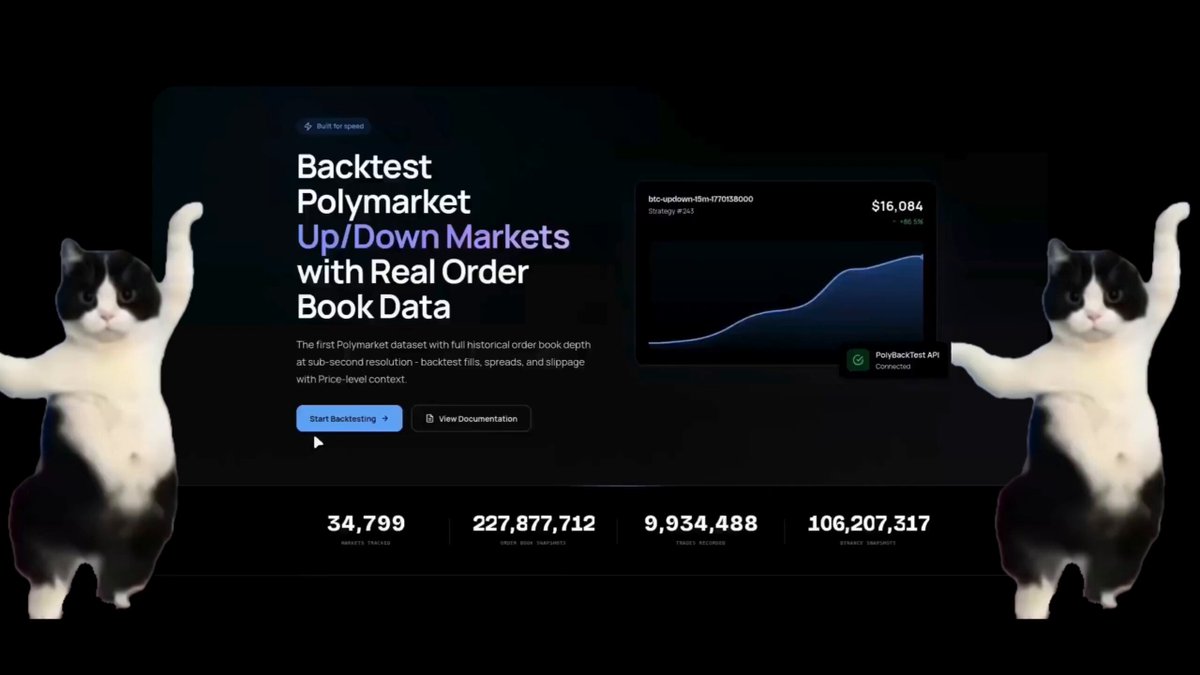
Backtesting your trading strategies for free is now possible with the polybacktest.com API.
- sub second snapshots
- entire orderbook depth and liquidity
- btc spot price
- and much more
Over a month of BTC Up/Down markets already recorded
No costs. Try it at polybacktest.com
20 Oct 2025

Bitcoin up or down?
15 minute up/down crypto polymarkets now live.
Powered & secured by @Chainlink 🤝
14
3
82
45,088
Stop buying every early BTC favorite just because price has cleared the price to beat.
The better trade in this backtest was often the underdog.
We checked 2,103 signals across 818 BTC 5-minute markets.
The setup:
Watch a BTC 5-minute market during the first 2 minutes.
Require the favorite to be priced from 60c to 80c.
Require BTC to be at least 6 basis points past the price to beat in the favorite's direction.
Buy the underdog at the signal price and hold to resolution.
That sounds backwards. BTC is already past the strike, so the favorite should be the clean side.
But the price tells a different story.
The underdog won 35.2% of the time at an average price of 29.6c.
That made 5.6c per trade.
The baseline was much weaker:
All early 60-80c favorite signals: 1.2c per checkpoint for the underdog.
Same price band before BTC reached the 6 basis point extension: -0.2c per trade.
Buying the favorite in the target setup: -6.9c per trade.
The bucket map explains the edge:
Favorite 60-65c: underdog made 1.4c.
Favorite 65-70c: underdog made 8.7c.
Favorite 70-75c: underdog made 9.1c.
Favorite 75-80c: underdog made 2.1c.
The timing mattered too:
30-60 seconds after open: underdog made 8.1c.
60-90 seconds after open: underdog made 6.4c.
90-120 seconds after open: underdog made 3.0c.
Why it may work:
The underdog is still cheap enough to absorb a lot of losses. At a 29.6c average entry, a win pays about 70.4c and a loss costs 29.6c. You do not need the comeback to happen half the time.
You need it to happen more often than the price implies.
This is price discipline, not blind fading. Before BTC reaches the extension, the underdog is close to breakeven. The edge showed up when both conditions were true: early extension, but no full favorite repricing.
Build the early-extension bucket map on fresh BTC markets at @polybacktest.
7
350
My girl wants attention but I’m down -50% on my portfolio in the last 12 hours.
3
7
744
This guy built a bot that sees live sports data ~8 seconds before Polymarket updates and trades the lag.
1
3
16
1,465
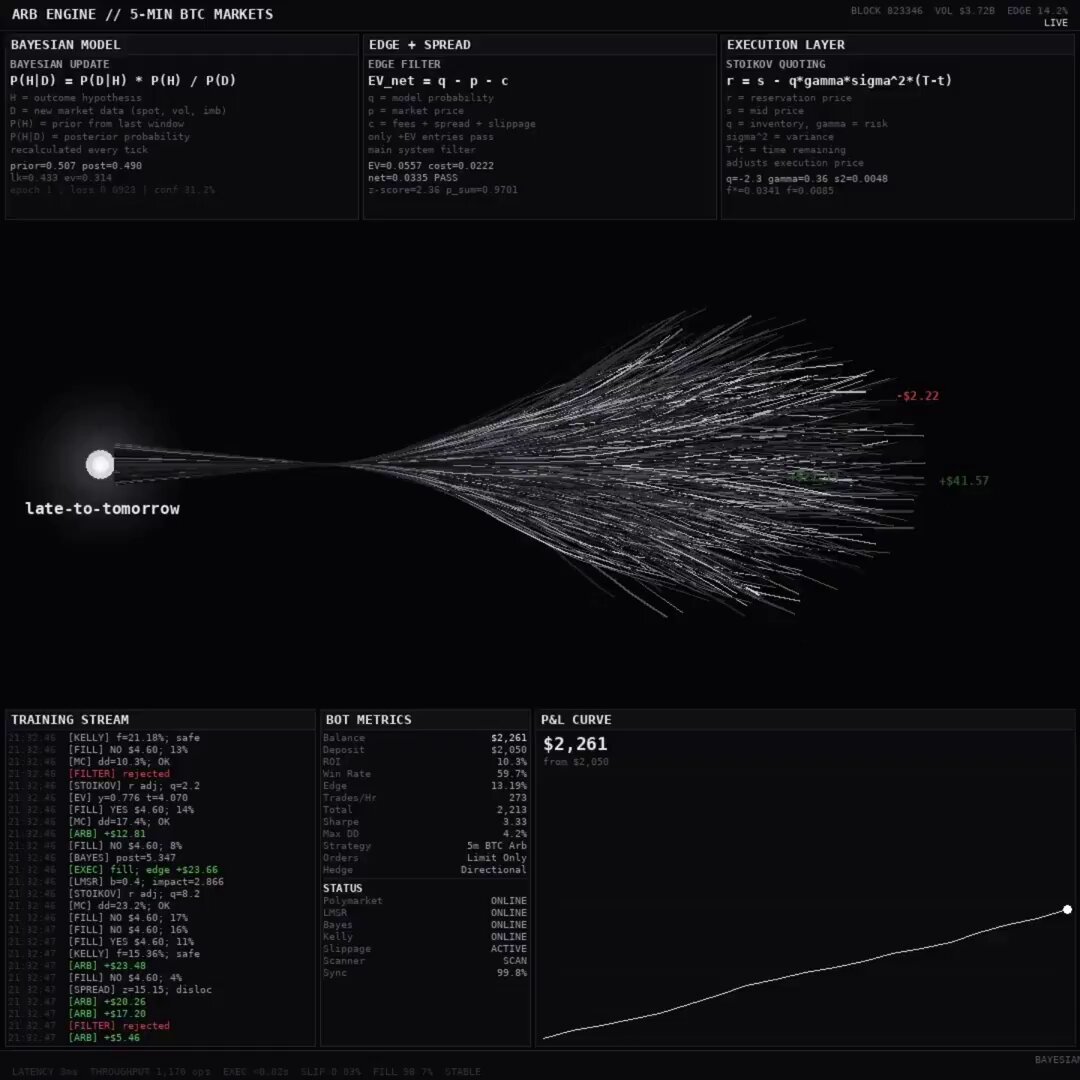
A bot turned $2,050 into $178,000 in one month by arbitraging 5-minute Bitcoin markets on Polymarket.
It ran hundreds of times per hour, uses limit orders only, and keeps stacking small edges into a massive result.
8
9
192
27,510
Dad buys Bitcoin for $60,000
It grows to $5,000,000.
If he sells, he owes tax on a $4.9M gain.
Instead, he puts it in a trust.
Borrows against it.
Lives tax-free.
Dies holding.
Kids inherit at a $5M basis.
IRS gets $0.
9
10
158
17,587
🇺🇸 Citibank predicts Bitcoin will reach $189,000 in 2026.

5
2
22
3,252
Jun 13
A 75c BTC favorite is not always strength. Sometimes it is a quiet market overpaying for a tiny lead.
We scanned 8,641 BTC 5-minute instances where one side was priced from 70c to 85c between 60 and 240 seconds after open.
Blindly fading those favorites went nowhere. The underdog won 24.2% of the time at a 24.2c average entry, losing less than 0.1c per trades.
The edge appeared only when the favorite was not confirmed by BTC.
The Strategy:
Watch a BTC 5-minute market after the first 60 seconds.
Find a 70-85c favorite.
Require BTC's last-minute range to be under 4 basis points.
Require the favorite to be no more than 2 basis points past the strike, and allow it to be up to 1 basis point on the wrong side.
Buy the underdog and hold to resolution.
The Data:
Across 1,011 qualifying trades, the underdog won 29.4% of the time.
Average underdog entry was 26.4c.
Average return was 3.0c per trade.
The bucket map is the point:
Quiet favorite, more than 1 basis point on the wrong side: 32 trades, -7.2c per trade.
Quiet favorite from 1 basis point against to 2 basis points in favor: 1,011 trades, 3.0c per trade.
Quiet favorite 2 to 4 basis points past the price to beat: 1,906 trades, -1.2c per trade.
Quiet favorite 4 to 8 basis points past the price to beat: 918 trades, -2.7c per trade.
retest this strategy yourself on fresh BTC markets at @polybacktest.
1
10
1,160
Jun 12
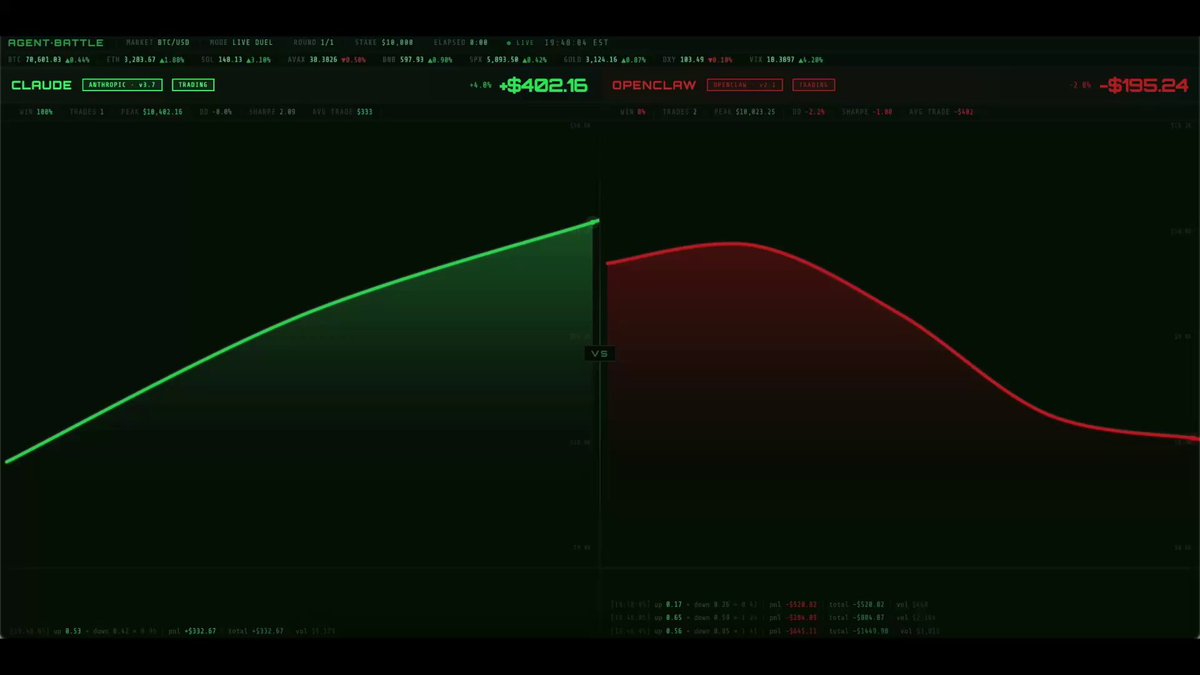
Someone set loose two AI agents with $1,000 each and 48 hours to trade on Polymarket.
Claude: 1,322% to $14,216
OpenClaw: liquidated to zero in under 48h.
12
7
187
60,210
Jun 11
Simply buying the winning side in BTC 5-minute markets is usually not enough.
Even when a side is 80c to 98c, it can still be overpriced.
Use this setup instead:
We tested 29,060 possible BTC 5-minute trades.
The rule was:
Look at a BTC 5-minute market.
Only check between 30 seconds and 4 minutes in.
The favorite is priced 80c to 98c.
BTC is 5 to 10 bps past the price to beat.
BTC has only moved 5 to 12 bps total since the market opened.
Buy the favorite and hold to the end.
How this works:
Weire not buying every favorite.
We're buying only when BTC had a real lead, but had not made a huge fast move.
That matters because huge moves can mean the market already overpaid. Tiny moves can just be noise.
Backtest results:
Every 80c to 98c BTC favorites:
88.0% won
average result was -0.6c per share
So even though they won a lot, they were still too expensive.
But using the setup above:
2,668 possible trades
860 markets
91.2% won
average entry was 89.0c
average result was 2.2c per share
That is 2.8c better than buying every favorite.
An 89c favorite has to win a lot. If it loses once, that loss wipes out roughly 8.1 normal wins.
So you need a reason to pay 89c.
This setup gave that reason:
BTC already has a cushion
the move is not too small
the move is not too crazy
the favorite is still below 98c
That is the difference between chasing an expensive favorite and buying one with a better setup.
You can test this kind of BTC 5-minute setup at @polybacktest.
3
1
32
2,501
Jun 10
We checked 2,037 trades across 1,103 BTC 5-minute markets and over 1 million snapshots to find a small repeatable edge.
The setup:
1. Wait until 75 to 150 seconds after the market opens.
2. Compare BTC to the market’s price to beat.
3. Trade the current side: Up if BTC is above the price to beat, Down if BTC is below it.
4. Only consider current-side shares priced from 60c through 72c.
5. Require BTC to be 2 to 6 basis points beyond the price to beat on that side.
6. Hold to resolution.
That rule won 68.3% of the time at a 66.1c average entry, making 2.2c per trade
The distance bucket is the edge:
0 to 2 basis points past the price to beat: 1,500 trades, 62.7% wins, -1.8c per share.
2 to 6 basis points: 2,037 trades, 68.3% wins, 2.2c per share
More than 6 basis points: 621 trades, 65.5% wins, -2.4c per share.
Why it may work:
Near the price to beat, Up or Down is still mostly noise. Too far past it, traders have already chased the favorite and the share price gives back the edge.
The 2 to 6 basis point zone is different. BTC has moved enough that the current winning side is real, but the share is still only 60-72c. The market has started to reprice, but has not finished.
The risk is still high. At a 66.1c entry, one lost trade takes about 2 wins to recover. Strict price entry is necessary.
Model the same strategy on months of historical data with @polybacktest.
4
1
37
3,254
Jun 8
Simple idea:
In BTC 5-minute markets, don’t just buy the side that is currently winning. 🤯
We scanned 1,514 BTC 5-minute markets.
Setup:
BTC was within $1-$10 from the market’s price to beat.
There were 30 to 180 seconds left.
The current winning-side token cost 45c to 82c.
Then we compared two situations.
1. Loosing side flip
BTC had only just flipped sides within the last 45 seconds.
654 markets traded.
That token won 72.5% of the time.
Average entry price was 68.1c.
Average return was 4.4c per snapshot.
2. Same-side hold
BTC had already been on that side for most of the market duration.
996 markets traded.
That token won 69.8% of the time.
Average entry price was 70.4c.
Average return was -0.6c.
The lesson:
A token can be winning and still be a bad buy if the market has already priced it in.
The loosing side flip setup beat the same-side hold by 5.1c per snapshot.
You can backtest your own strategies with @polybacktest. It has subsecond historical data going back 2 months
9
1
31
2,804
Jun 7
BTC's most bearish hour right now is 9am ET. It goes DOWN 77% of the time. We checked the last month of fresh Polymarket data.
742 BTC 1-hour markets, May 6 to June 6. We computed the UP rate for every hour of the day across all coins.
BTC at 13h UTC (9am ET): 7 UP out of 31 markets. 23% UP. -27 point edge.
ETH at 13h UTC: 9 UP out of 31. 29% UP. -21 point edge.
Same hour, two different coins, same direction. The 9am ET candle has been a sell zone for the entire last month.
The hour wraps the US equity open. Pre-market positioning unwinds at 9:30, but the crypto bots that mirror equity flows start selling 30 minutes early. Whether the bias holds in regimes where stocks gap up at open is the open question. In the current tape, it has not.
For comparison, the bullish hours over the same window:
BTC 19h UTC (3pm ET): 65% UP. Final hour before US close.
BTC 17h UTC (1pm ET): 61% UP. Mid-afternoon.
ETH 4h UTC: 65% UP. Pre-Asia open lull.
SOL 16h UTC: 67% UP.
The shape is consistent across coins. BTC and ETH dump into the US equity open, drift up through the afternoon, peak in the late session. SOL follows the same rhythm with its own clock.
31 markets per hour is a starter sample, not a permanent law. Hour biases shift with macro flow. A risk-on tape in July could flip 13h UTC back to bullish overnight. The point is not to bet DOWN at 9am ET forever. The point is to scan the heatmap weekly and trade the hours that are loaded right now.
The actually durable trade: filter your entries by hour. Skip the chop windows. Take the loaded ones. Same signal, fewer trades, better edge.
Historical data through June 6, regimes shift. Build your own hourly heatmap and re-test every week at @polybacktest.
1
17
1,666
Jun 6
BTC volatility just tripled on Polymarket. Every backtested strategy from May is now lying to you. The regime flipped last week.
We pulled the last 5 weeks of BTC 5-minute markets and tracked average price move per market.
Week 19 (May 4-10): 0.0569%
Week 20 (May 11-17): 0.0624%
Week 21 (May 18-24): 0.0638%
Week 22 (May 25-31): 0.0611%
Week 23 (June 1-6): 0.1599%
The first four weeks were the quietest stretch we have seen on Polymarket all year. Then Week 23 hit 2.6x the prior baseline. BTC stopped sitting and started swinging.
The strategies that printed during the quiet stretch are now bleeding. Mean reversion after a >0.30% move used to hit 54.7% earlier this year. Last 30 days: 48.9% on BTC. Below coin flip.
That strategy did not break because the math was wrong. It broke because the regime that powered it ended. When BTC barely moves, a 0.30% move IS an overshoot and reverts. When BTC is in a real selloff, a 0.30% move is the start of a real move and the trend continues.
The 5-minute UP rate also flipped. Weeks 19-22: 49-51% UP. Week 23: 45.9% UP. A 4-5 point shift in directional bias inside a single week. The selloff regime is bearish-skewed.
Some strategies actually got STRONGER. 1-hour streak reversal in this window:
BTC 1hr after 4 same direction: 60.6% reversal
SOL 1hr after 4 : 66.2% reversal, actually improved from earlier data
Why? In a high-vol regime, 4-hour trends exhaust faster. Mean reversion at the 1-hour level outperforms mean reversion at the 5-minute level. Volatility flips which timeframe holds the edge.
The general rule. In low-vol regimes, fade small moves on short timeframes. In high-vol regimes, fade big moves on longer timeframes. The signal that works depends on which regime you are in.
If your strategy was backtested on May data and deployed in June, you are probably losing money right now and you do not know why. The signal did not die. The regime moved on without it.
Historical data through June 6, regimes shift weekly. Re-test every signal against the last 7 days at @polybacktest before you blame the strategy.
3
2
37
3,064
Jun 4
Big crypto moves are easier to fade when almost nobody traded them.
We checked 7,017 next-open fade events across BTC, ETH, and SOL 5-minute markets.
The setup:
Watch a 5-minute market settle after a real underlying move.
Require the prior move to be at least 18 basis points.
Require prior volume to be less than 2% of final liquidity.
At the next market open, buy the side opposite the prior winner only if the visible top-of-book ask is 57c or less.
That is the Quiet Move Fade.
The backtest:
1,147 events
57.1% won
average ask was 52.7c
average return was 4.4c per share
The baseline matters.
Across all same-priced next-open fades, we had 5,980 events. They won 52.3% and made only 0.1c per share.
So the edge was not simply "fade every move." The filter was the prior market's turnover.
When the prior market moved 18 basis points or more but barely traded, the price move looked less like committed positioning and more like a thin mark. The next market often opened as if the move deserved continuation, but the better trade was to buy the other side while it was still near 50c.
Build the Quiet Move Fade on fresh crypto markets at @polybacktest.
1
1
9
755
Jun 3
The biggest edge in BTC 5-minute markets wasn't picking winners.
It was buying losers that everyone had oversold.
We tested 1,898 resolved BTC markets.
The setup:
• Ignore the favorite
• Find the underdog
• Buy only if it's priced 35c-49c at open
• Require 100 shares of bid liquidity across the top 3 bid levels
Results:
• 1,047 trades
• 48.6% win rate
• Avg entry: 46.7c
• 1.9c per share
Here's the part most traders miss:
The strategy won LESS than half the time.
And it still made money.
Why?
Because a 46.7c token doesn't need to win 50% of the time to be profitable.
The payoff is asymmetric.
The liquidity filter was the difference:
35-49c underdogs with bid support:
→ 1.9c/share
35-49c underdogs without bid support:
→ -1.6c/share
A cheap token with no bids is often cheap for a reason.
A cheap token with real buyers sitting underneath it is different.
Someone is still willing to own it.
Even more interesting:
The edge disappeared above 50c.
This setup usually happens when markets move a lot in the previous 5 min market and traders are pricing in a reversal, pushing the up/down prices to 55/45 before the market has even started. Prices diverge even more on market inception.
Break any strategy down by side, time, and volatility in seconds with polybacktest
1
4
35
3,660
Jun 2
Most traders do the same thing after BTC, ETH, and SOL all close UP:
They click UP again.
Our backtest says that was the wrong trade.
We tested 2,326 cases where all 3 coins resolved the same direction in a 5-minute market and moved at least 0.10%.
The edge wasn't blindly fading the move.
The edge was:
→ BTC, ETH, SOL all resolve UP → buy DOWN
→ BTC, ETH, SOL all resolve DOWN → buy UP
BUT only when your side was priced 50-58c.
Results (1,569 entries):
• 56.7% win rate
• Avg entry: 53.1c
• 3.6c/share
What's interesting:
Below 50c? No edge.
60c ? Negative edge.
The profits came from fading crowded sentiment when the market was still pricing the opposite side near a coin flip.
In the full sample, the next market reversed in at least 2 of the 3 coins 53.9% of the time.
The lesson:
Don't chase the streak.
When all 3 coins finish the same way, check the next market.
The best trades weren't momentum.
They were crowded momentum.
You can backtest your own strategies with polybacktest. It has subsecond historical data going back 2 months
5
958
Jun 2
We tested 3,294 BTC favorites.
Most had no edge.
When a BTC favorite held the lead for 90 seconds while Bitcoin was still moving, the win rate jumped to 84.4% and profits more than tripled.
We scanned 3,294 BTC favorite checkpoints. Each checkpoint was taken every 30 seconds, using the observed token price as the entry price.
The setup:
• BTC 5-minute or 15-minute market
• One side priced between 65c and 95c
• That side had already been the favorite for more than 90 seconds
• BTC moved at least 2 basis points from high to low in the prior minute
That produced 1,135 checkpoints across 302 markets.
Results:
• Won 84.4% of the time
• 958 wins and 177 losses
• Average entry price was 80.8c
• Made 3.6c per share before spread
Across all 65-95c favorites, the baseline was 79.4% and 1.0c per share.
The interaction mattered more than either ingredient alone:
• Fresh BTC movement, short-lived favorite: 76.5%, 0.7c per share
• Persistent favorite, quiet BTC tape: 78.3%, -1.4c per share
• Persistent favorite, moving BTC tape: 84.4%, 3.6c per share
We split the checkpoints chronologically. The setup made 4.1c per share in the first slice and 2.2c in the later slice.
Why this works:
A fresh 75c favorite can just be a fast repricing after one noisy tick. A quiet 85c favorite can be stale confidence. But a favorite that has held the lead for 90 seconds while BTC is still moving is different: the prediction market is confirming direction while the underlying is still forcing traders to update.
The risk is the payoff skew. At an average entry of 80.8c, one loss costs about 4.2 clean wins. The edge lives in refusing the lookalikes: no persistent lead, no recent BTC range, no trade.
The next test is obvious: rebuild this as a live filter by coin, lead age, and prior-minute BTC range.
Run that bucket map on fresh markets at @polybacktest.
2
17
1,649