
Joined March 2019
- Tweets 4,840
- Following 1,241
- Followers 26,929
- Likes 9,489
1,243 Photos and videos
Pinned Tweet

28 Aug 2025
1/6
Excited to publish our open letter to fellow Layer 1 Blockchain Founders!
@PraSagaofficial here, after 7 years building SagaChain, we're inviting everyone to collaborate on the next evolution of blockchain.
Let's decentralize the world together! Read it here: prasaga.com/resources/media/…
#Blockchain #Web3
16
15
46
6,562
Users share crypto products that have become part of their daily life. PraSaga's SagaChain enables enterprises to build persistent digital objects that transform the internet into a stateful platform, solving real-world problems.
2
3
46
Jun 17
Tokenized stocks are criticized for being a 'bandage' to the traditional financial system, rather than a fix. PraSaga's SagaChain takes a different approach with canonicalization, encoding assets as living, persistent objects within a unified class architecture.
1
2
5
132
Jun 15
GBBC's 101 Real-World Blockchain Use Cases Handbook 2026 Edition is out! With SagaChain's focus on persistent programmable objects & canonicalization, we're enabling enterprises to deploy scalable, real-world blockchain solutions.
2
2
5
165
Jun 11
Tired of manual crypto workflows? A Reddit user shares their frustration with tedious on-chain tasks like monitoring lending positions & revoking approvals. PraSaga's SagaChain automates complex digital systems with persistent programmable objects, streamlining workflows.
3
6
170
Jun 11
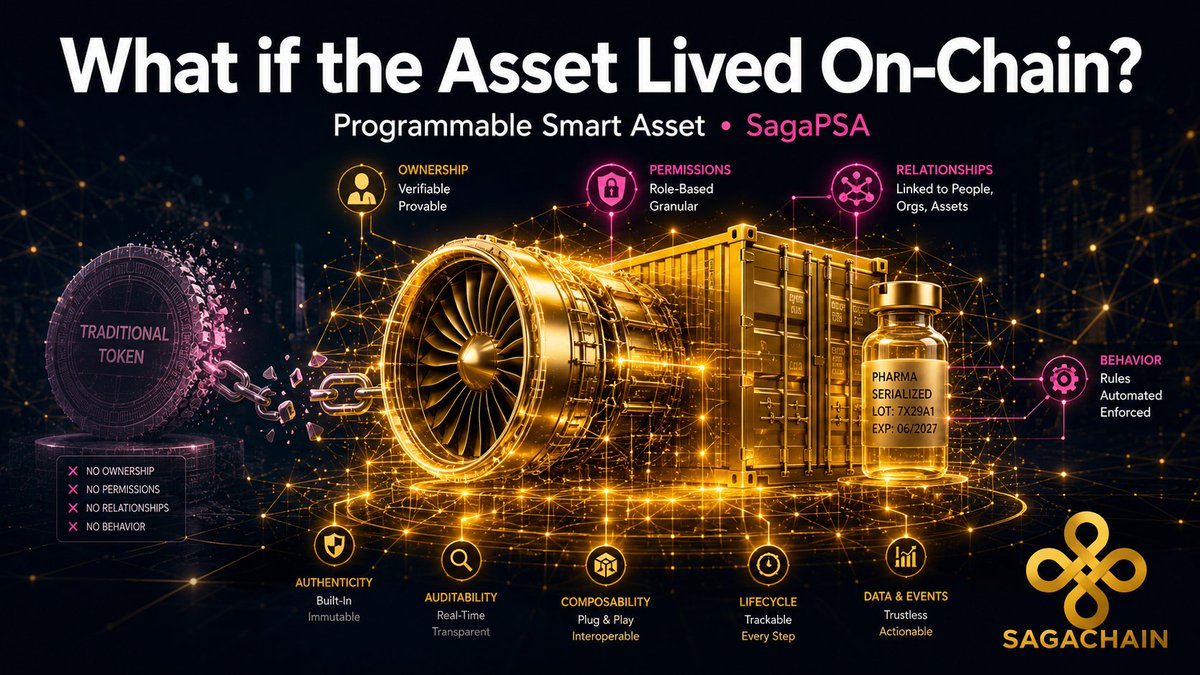
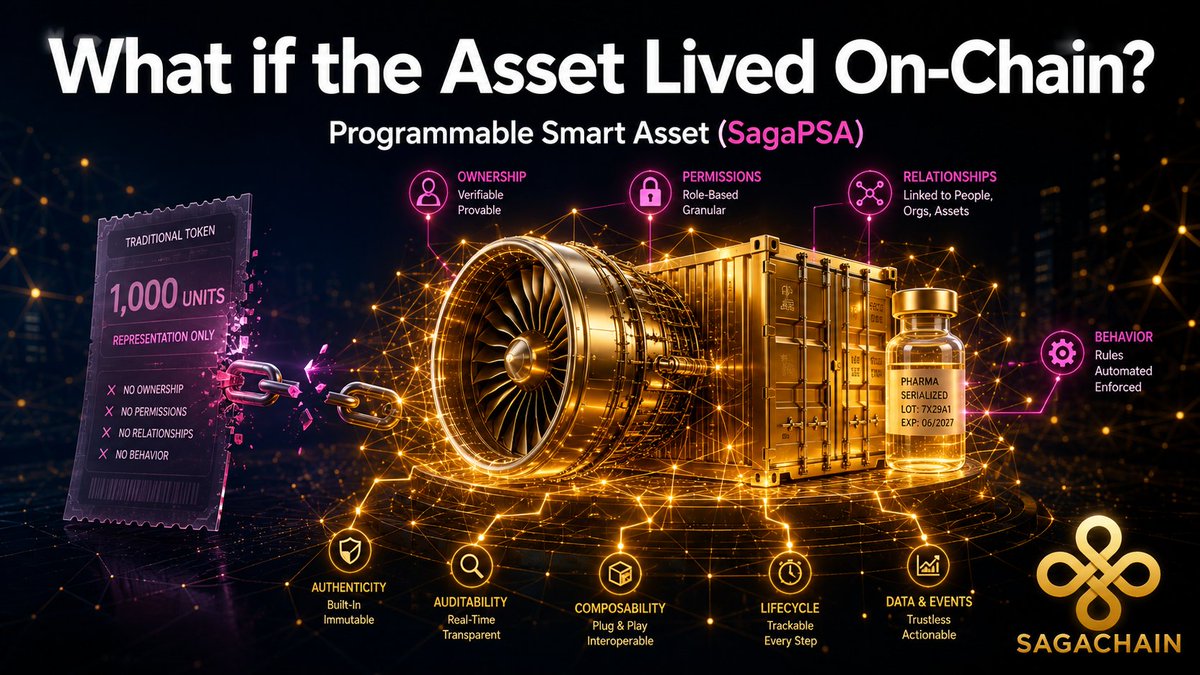
What if the asset lived on-chain instead of being represented by a token?
One of the assumptions that has shaped blockchain architecture from the beginning is that assets and tokens are effectively the same thing. In reality, they are not.
A token is a representation of an asset. It acts as a claim, a reference, or a receipt for something that exists elsewhere. For many blockchain use cases that distinction has been accepted as a technical limitation, but when enterprises begin modelling real-world ownership, contracts, intellectual property, financial instruments, or physical assets, that abstraction becomes increasingly problematic.
At @PrasagaOfficial, we challenged that assumption.
Rather than building another token-centric blockchain, SagaChain introduces the concept of the Programmable Smart Asset (SagaPSA). Instead of creating a token that points to an asset, the asset itself exists as a first-class object on-chain. Ownership, behaviour, permissions, relationships, and business logic become intrinsic characteristics of the asset rather than external functions managed through layers of smart contracts.
This may sound like a subtle architectural difference, but its implications are significant. When an aircraft engine, shipping container, pharmaceutical batch, digital agreement, or financial product exists directly on-chain, it can maintain its own state, enforce its own rules, manage its own relationships, and interact directly with other assets and entities within the ecosystem.
The result is a model that more closely reflects how enterprises actually operate. Complex ownership structures, asset hierarchies, permissions, lifecycle management, and business processes can be represented naturally rather than recreated through increasingly sophisticated contract logic. Instead of forcing the business to adapt to the limitations of blockchain infrastructure, the infrastructure adapts to the needs of the business.
For years, the industry has focused on how to bring real-world assets onto blockchain networks. Perhaps the more important question is whether representing those assets with tokens was ever the right approach in the first place.
When assets become first-class citizens, blockchain stops being a system of digital receipts and starts becoming a system capable of modelling the real world itself.
What enterprise use cases become possible when the asset, not the token, is the foundation of the
1
3
5
157
Jun 10
What if the asset lived on-chain instead of being represented by a token?
One of the assumptions that has shaped blockchain architecture from the beginning is that assets and tokens are effectively the same thing. In reality, they are not.
A token is a representation of an asset. It acts as a claim, a reference, or a receipt for something that exists elsewhere. For many blockchain use cases that distinction has been accepted as a technical limitation, but when enterprises begin modelling real-world ownership, contracts, intellectual property, financial instruments, or physical assets, that abstraction becomes increasingly problematic.
At @PrasagaOfficial, we challenged that assumption.
Rather than building another token-centric blockchain, SagaChain introduces the concept of the Programmable Smart Asset (SagaPSA). Instead of creating a token that points to an asset, the asset itself exists as a first-class object on-chain. Ownership, behaviour, permissions, relationships, and business logic become intrinsic characteristics of the asset rather than external functions managed through layers of smart contracts.
This may sound like a subtle architectural difference, but its implications are significant. When an aircraft engine, shipping container, pharmaceutical batch, digital agreement, or financial product exists directly on-chain, it can maintain its own state, enforce its own rules, manage its own relationships, and interact directly with other assets and entities within the ecosystem.
The result is a model that more closely reflects how enterprises actually operate. Complex ownership structures, asset hierarchies, permissions, lifecycle management, and business processes can be represented naturally rather than recreated through increasingly sophisticated contract logic. Instead of forcing the business to adapt to the limitations of blockchain infrastructure, the infrastructure adapts to the needs of the business.
For years, the industry has focused on how to bring real-world assets onto blockchain networks. Perhaps the more important question is whether representing those assets with tokens was ever the right approach in the first place.
When assets become first-class citizens, blockchain stops being a system of digital receipts and starts becoming a system capable of modelling the real world itself.
What enterprise use cases become possible when the asset, not the token, is the foundation of the architecture?
1
2
3
108
Jun 10
Anthropic just released Claude Mythos 5 AI model, focusing on cybersecurity, alongside a safer Fable 5 for the public. With AI governance becoming increasingly critical, SagaChain's SagaAI™ provides a non-bypassable, non-disputable AI governance runtime, ensuring secure and compliant AI operations.
1
1
4
195
Quantum resistance was the hottest sector in crypto during May's selloff, with projects rushing to claim readiness. PraSaga's SagaChain is built with a future-proof approach, featuring a hybrid consensus mechanism & scalable architecture along with NIST published approaches to tackle emerging threats.
2
4
90
Bitcoin inflows slow as investors chase AI, says Bernstein. PraSaga's SagaChain™ is poised to address this shift with its AI governance runtime, SagaAI™, ensuring non-bypassable and non-disputable AI governance.
2
2
4
176
Top crypto minds pivot to AI, but are they overlooking blockchain's true potential? PraSaga's SagaChain™ is designed to integrate AI governance at the infrastructure level with SagaAI™, ensuring non-bypassable and non-disputable AI governance.
3
5
128
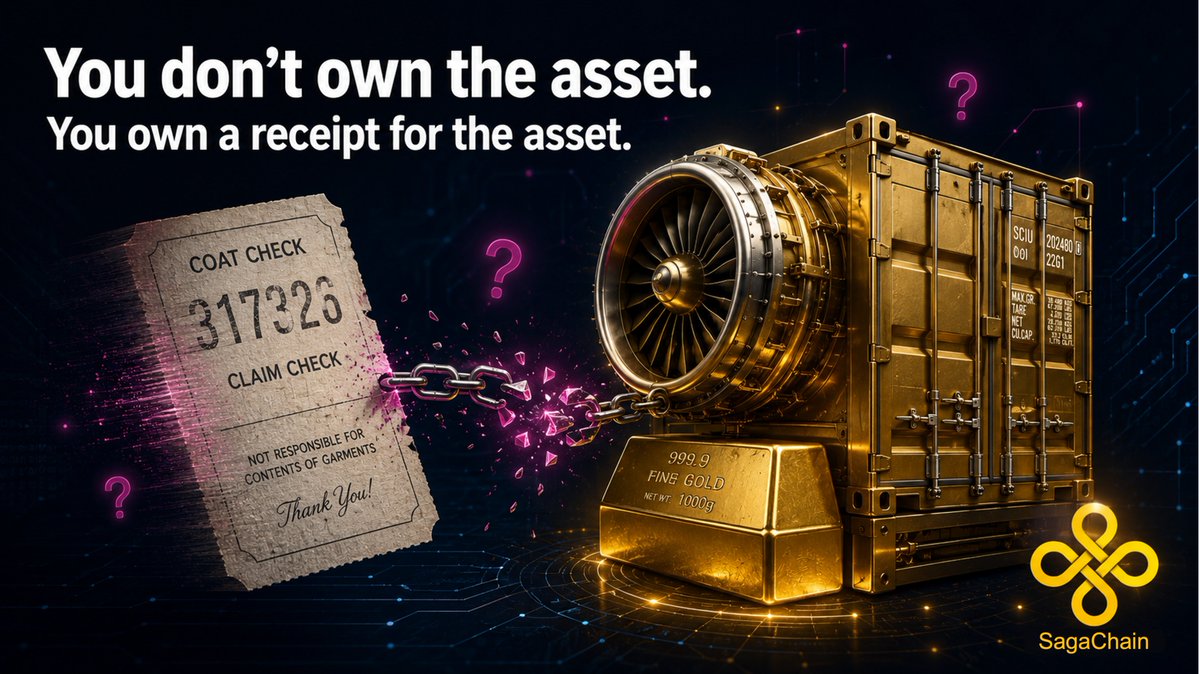
You don’t own the asset. You own a receipt for the asset.
That statement tends to make people uncomfortable.
For years, the blockchain industry has told us that tokenization is the answer to bringing real-world assets on-chain. Real estate, supply chains, intellectual property, financial instruments. Just create a token and represent the asset digitally.
But let’s pause and ask a simple question:
Does the token actually become the asset?
Or is it simply a claim check pointing somewhere else?
Imagine checking your coat at a restaurant. You hand over your coat and receive a numbered ticket.
The ticket has value because it references something valuable. But nobody would argue that the ticket is the coat.
Lose the ticket and you may still own the coat.
Transfer the ticket and questions immediately arise around custody, ownership, rights, and verification.
The ticket is an abstraction. A pointer. A receipt.
In many blockchain implementations today, tokens play the same role.
The actual asset, its attributes, relationships, business rules, compliance requirements, ownership history, and lifecycle often remain outside the chain. The token simply references them.
That may be sufficient for speculative markets.
It is far less compelling for enterprises.
Businesses do not operate on receipts. They operate on assets.
An aircraft engine is not a token.
A shipping container is not a token.
A pharmaceutical batch is not a token.
A financial contract is not a token.
These are complex business objects with properties, behaviours, permissions, relationships, and governance requirements that evolve over time.
The challenge for enterprise blockchain has never been creating digital receipts. We’ve become very good at that.
The challenge is creating digital assets that can exist, operate, and interact natively on-chain.
As enterprise leaders evaluate their next generation digital infrastructure, I believe this is one of the most important questions to ask:
Are you putting your assets on-chain, or are you putting receipts for your assets on-chain?
The answer has profound implications for scalability, governance, interoperability, and ultimately business value.
We’re curious where others stand on this.
Has tokenization been enough for enterprise adoption, or is it time to rethink the abstraction entirely?
3
5
121
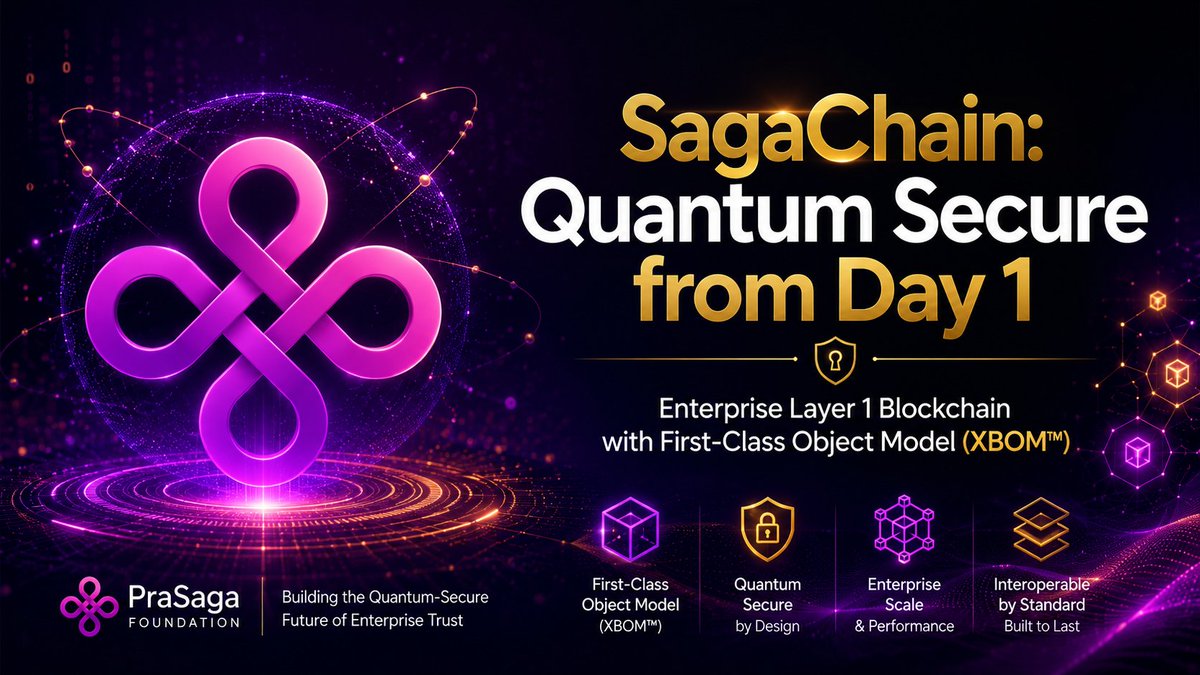
PraSaga Foundation @PrasagaC David Beberman, today is committing to building quantum security into SagaChain as a foundational element from Day 1 of launch.
With quantum computing advancing rapidly, safeguarding digital assets and critical infrastructure has become an essential consideration for forward-thinking enterprises. PraSaga is addressing this proactively by integrating quantum-resistant capabilities into the core architecture of SagaChain.
“Our team is deeply committed to delivering a blockchain platform that offers both breakthrough performance through our first-class object model and the long-term security that global enterprises require,” said @PrasagaCEO Michael Holmann.
“We are on track to make quantum resistance a reality from Day 1, supported by an clear technical roadmap that is currently in active development.” added David Beberman
PraSaga’s engineering efforts are focused on ensuring SagaChain can help organizations protect high-value applications in areas such as finance, supply chain, digital identity, and complex enterprise workflows well into the future.
The Foundation’s design documents for this initiative remain in early draft stages and will undergo thorough validation and review as part of our disciplined development process.
Enterprises and developers interested in learning more about building on a forward-secure blockchain are invited to visit prasaga.com or send email to sagastandards@prasaga.com to the team for partnership discussions.
About PraSaga Foundation
PraSaga Foundation is developing SagaChain, a high-performance Layer 1 blockchain featuring a revolutionary first-class object model. Designed for global enterprise adoption, SagaChain aims to deliver exceptional scalability alongside the security and reliability needed for mission-critical applications.
1
2
7
266
PraSagaOfficial retweeted

May 27
Things that make you go hmmmm..........
Since 2015 the world has directed TRILLIONS in economic activity trying to make MS-DOS do what it could not do on a single PC.
It does not matter how much you spend trying to make Smart Contracts scale, it physically cannot happen.
1
2
5
172
PraSagaOfficial retweeted
May 19
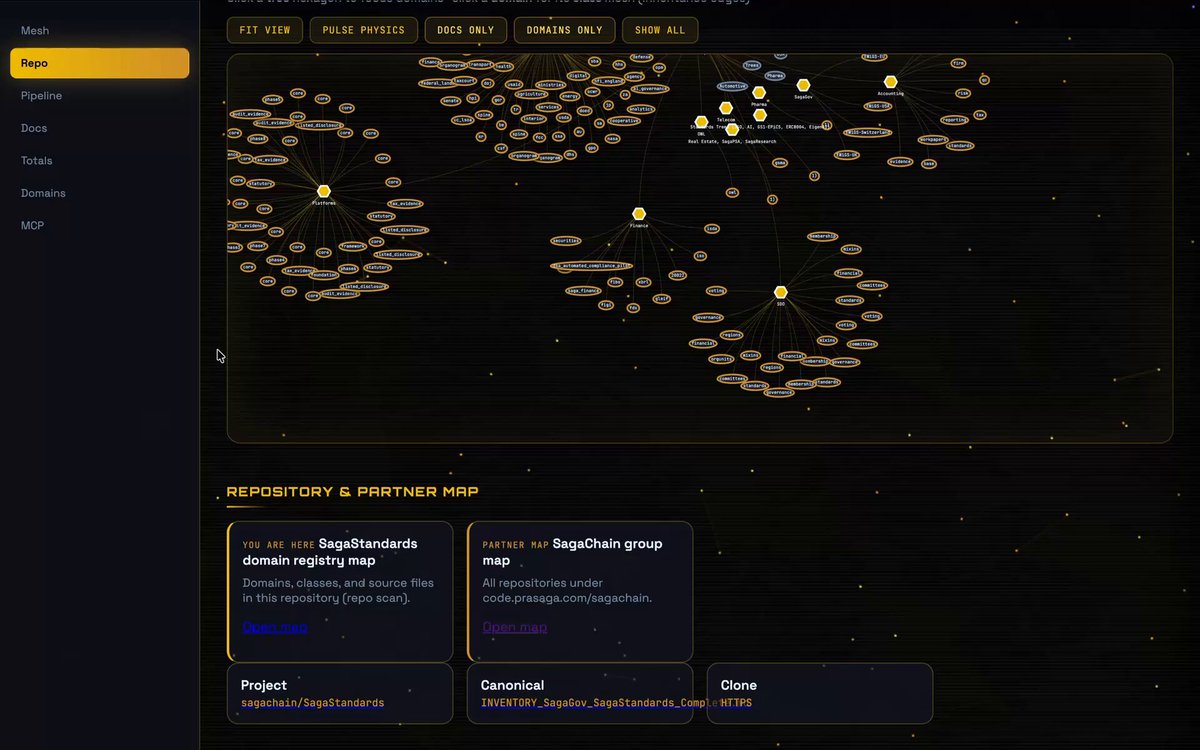
Years of work. 279 standards domains. 6,100 classes across finance, healthcare, gov, AI governance & more.
Today you can see all of it, in a browser, free, no login.
And when the live network is up? The registry reads directly from the chain. Real-time. Native. Every object, every account, every class. Graphically.
SagaRegistry UI is live. 🗺️ Links in comment👇
7
8
17
363,344
May 19
Years of work. 279 standards domains. 6,100 classes across finance, healthcare, gov, AI governance & more.
Today you can see all of it, in a browser, free, no login.
And when the live network is up? The registry reads directly from the chain. Real-time. Native. Every object, every account, every class. Graphically.
SagaRegistry UI is live. 🗺️ Links in comment👇
7
8
17
363,344
May 19
🔗 Standards map: standards-registry.prasaga.c…
🔗 Group map: group-registry.prasaga.com
1
2
228