
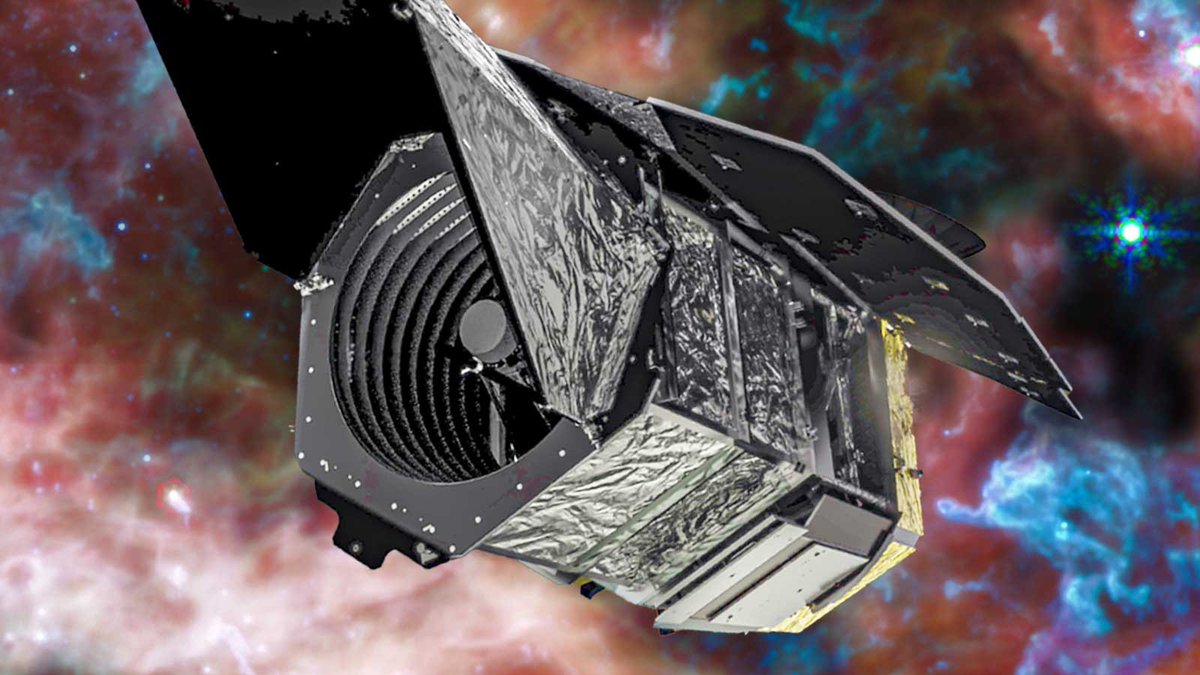


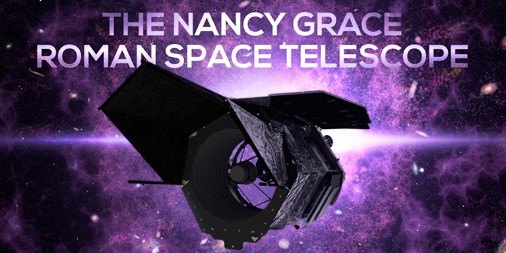






ALT The body of a space telescope appears like a long round tube, pointing left with its circular aperture door open to observe. The background is a mix of pinks and blues, and represents space.
ALT Text, The Nancy Grace Roman Space Telescope, runs at the top of an image that shows the body of the observatory, which appears like a long round tube, pointing left with its circular aperture door open to observe. The background is black and purple and represents space.

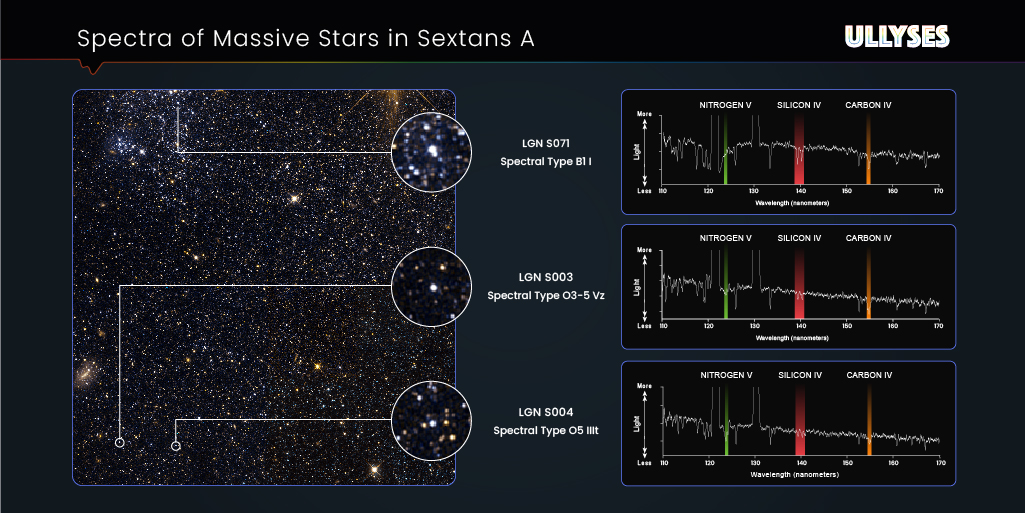
ALT The left half of the screen shows a star field, with three circled. Lines connect from the stars to larger views of the stars, which are circled at center. At right are three line graphs, or spectra, that represent the data for LGN S071, LGN S003, LGN S004. Specific elements are identified in each spectrum, including nitrogen V, silicon IV, and carbon IV.
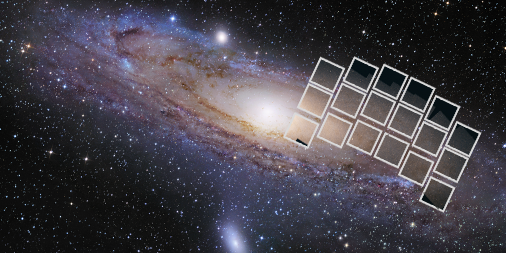
ALT Almost all of the Andromeda galaxy appears, angled slightly from top left to bottom right. It is a spiral shape, with blue star formation regions at the edges and a bright white central region. Toward the right is the Roman footprint, made up of 18 boxes, broken into six columns of three. They cover about a third of the galaxy.
ALT Text, The Nancy Grace Roman Space Telescope, runs at the top of an image that shows the body of the observatory, which appears like a long round tube, pointing left with its circular aperture door open to observe. The background is black and purple and represents space.
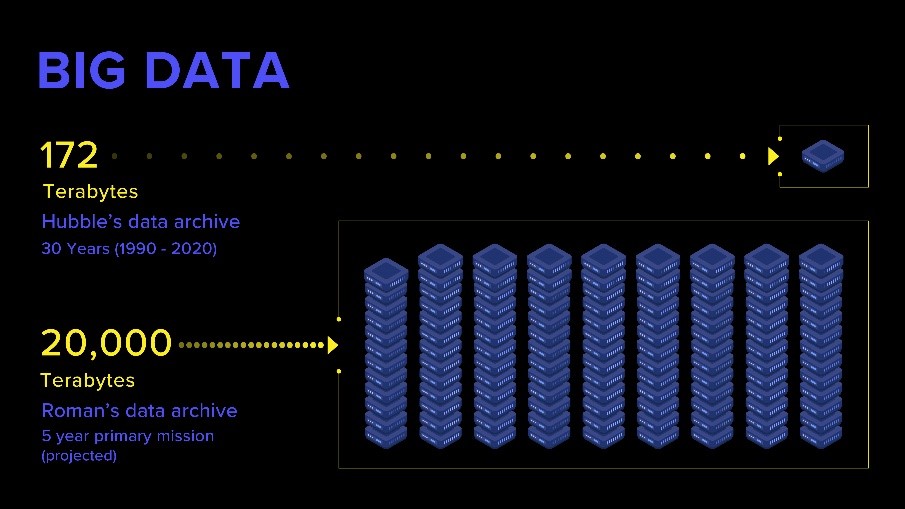
ALT Infographic comparing Hubble and Roman data quantities in both text and visuals. Top text reads 172 terabytes, Hubble's data archive, 30 years 1990 to 2020. Dotted line leads from text to graphic image of a hard drive. Bottom text reads 20,000 terabytes, Roman's data archive, 5 year primary mission (projected). A tighter, shorter dotted line than Hubble’s above leads to nine stacks of hard drives. Eight of the stacks contain 13 hard drives each, and the leftmost stack contains 12 hard drives. Credit: STScI.
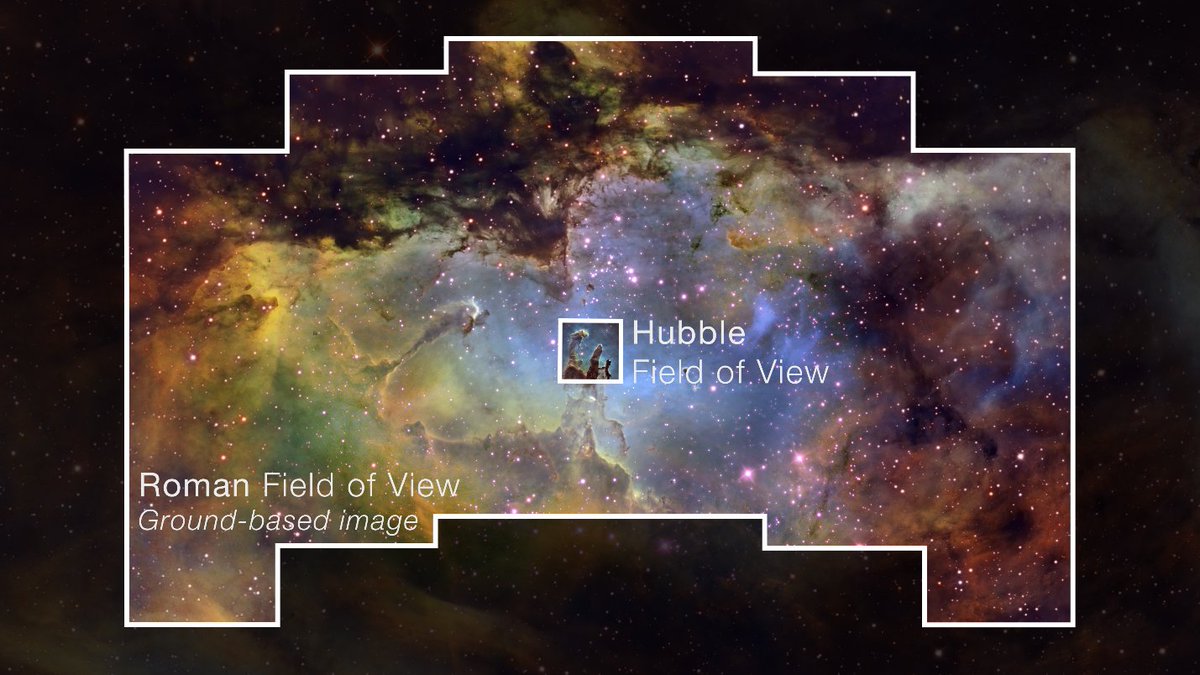
ALT Visual comparison of Roman and Hubble telescope fields of view. A colorful nebula is outlined in white in two regions. Text that reads, Roman field of view, ground-based image, is next to the large outline of the field of view from Roman, which takes up most of the image. Roman’s field of view isn’t a smooth rectangle. It is irregularly shaped, with columns at left that extend almost top to bottom, areas the jut out at the top, and a small area that juts in toward the bottom. Text in the middle of the image reads Hubble Field of View next much smaller white square in the center, highlighting what Hubble sees in a single pointing. Roman’s near-infrared field of view is more than 100 times larger than Hubble’s. The colorful image shown within Hubble’s footprints is the famous Pillars of Creation image, while the Roman footprint shows a portion of the vast Eagle Nebula.
ALT jupyter notebook logo, text in center "jupyter" inside of an orange sphere.
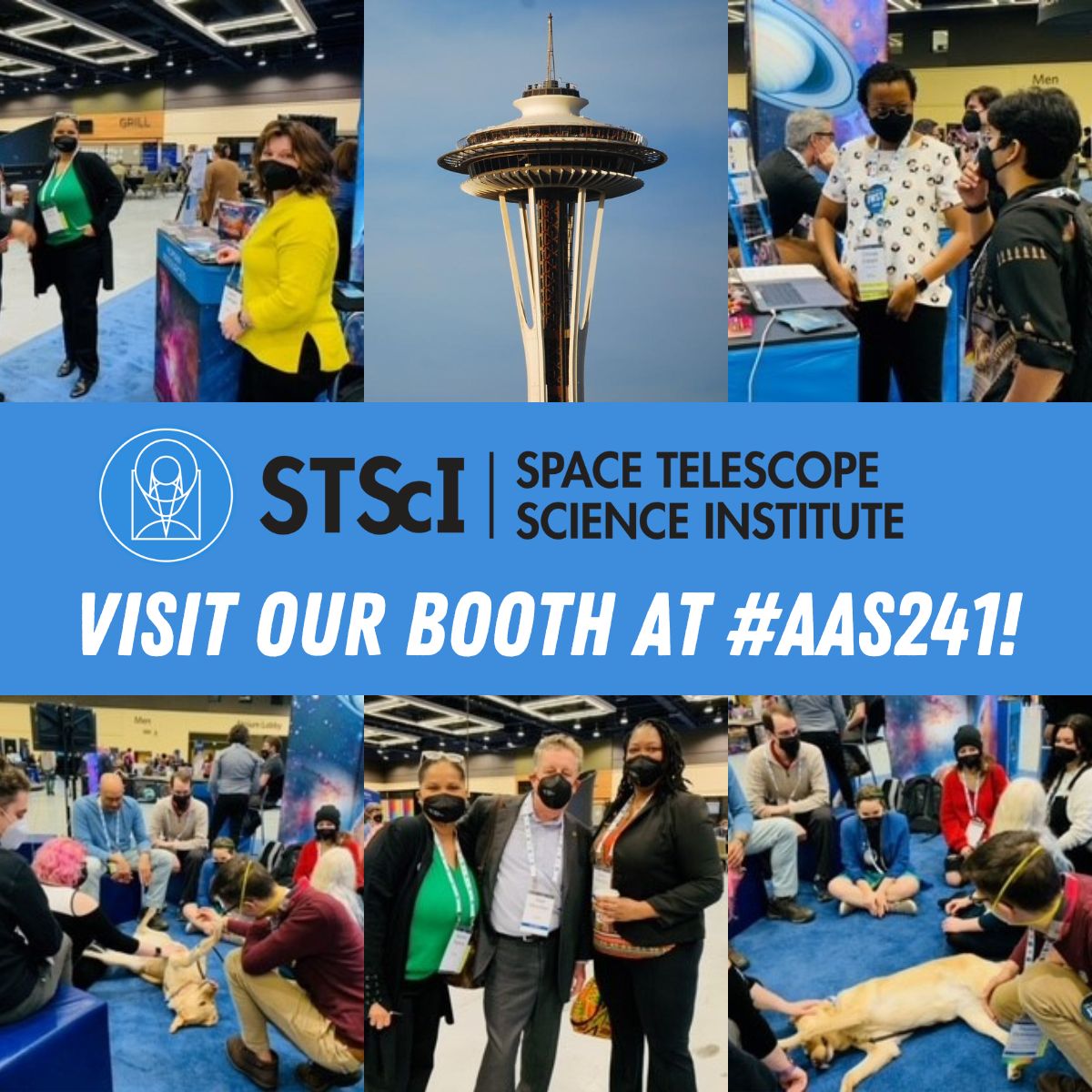
ALT Photo collage of conference activities
ALT AAS 241 logo with graphics of Webb, Hubble and Roman telescopes, text states " don't miss the stsci town hall today at 12:45 pst and the Roman town hall at 6:30 PST
ALT Text - We're hiring engineers, We offer, Work/Life integration Excellent benefits & generous paid time off Respectful and inclusive culture Meaningful work that impacts the universe Collaborative working environment

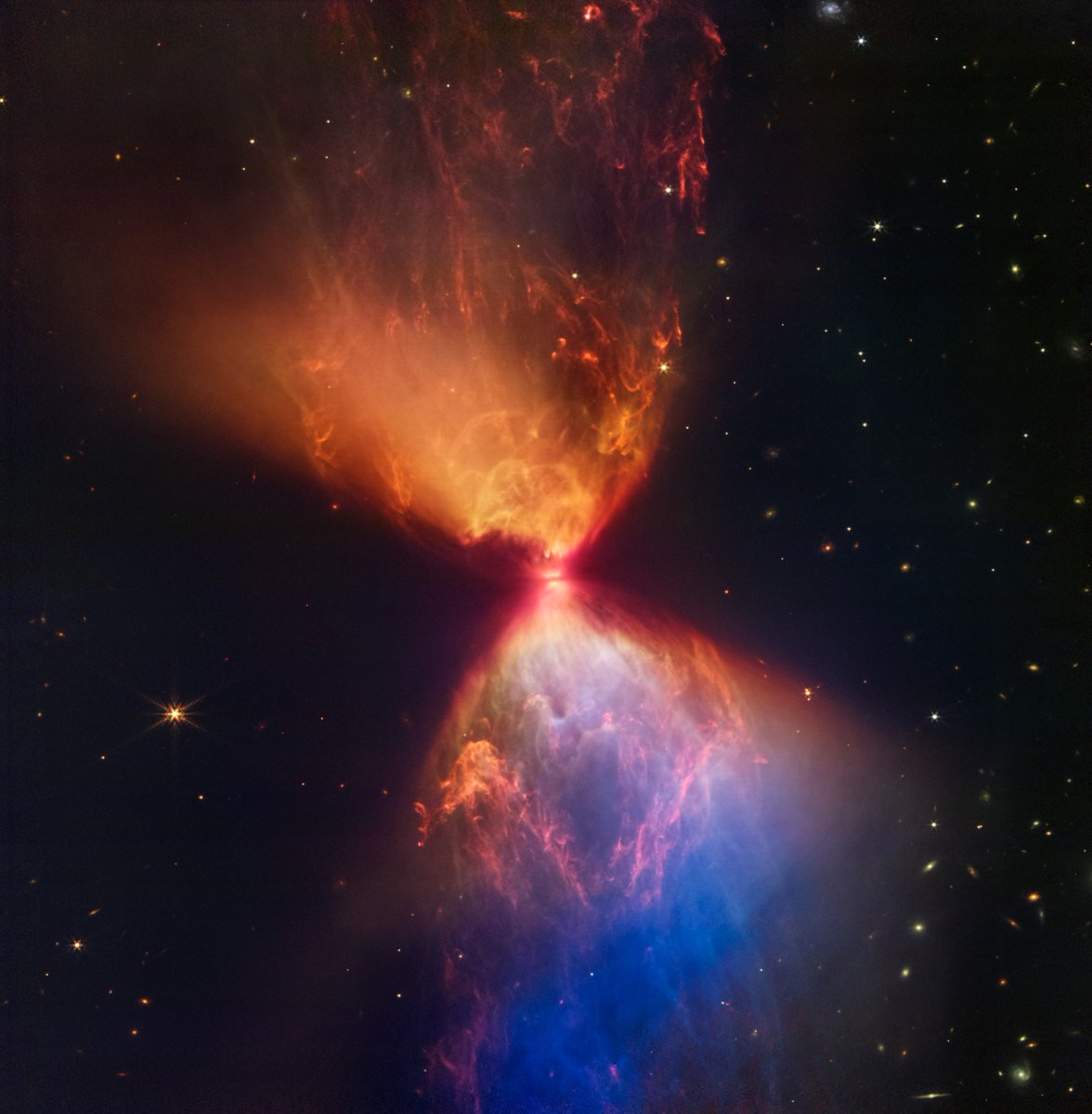
ALT A forming protostar surrounded by a large hourglass-shaped nebula. A bright orange object, the protostar, lies at the center of this image. In front of the protostar is a thin grey line, which is the protostar’s accretion disk. Above the protostar is an orange, triangular cloud of gas that points to the top left of the image. The area closest to the protostar is a brighter orange than the area to the top left, and has more pronounced plumes of orange gas. Below the protostar is another triangular cloud of gas that points to the bottom right of the image. The area closest to the protostar is a blend of pronounced blue and orange plumes of gas. Farther toward the bottom right, the color of the gas turns primarily blue. Stars and galaxies of many different shapes and sizes are scattered around the image, although they are noticeably more absent on the left side of the hourglass.
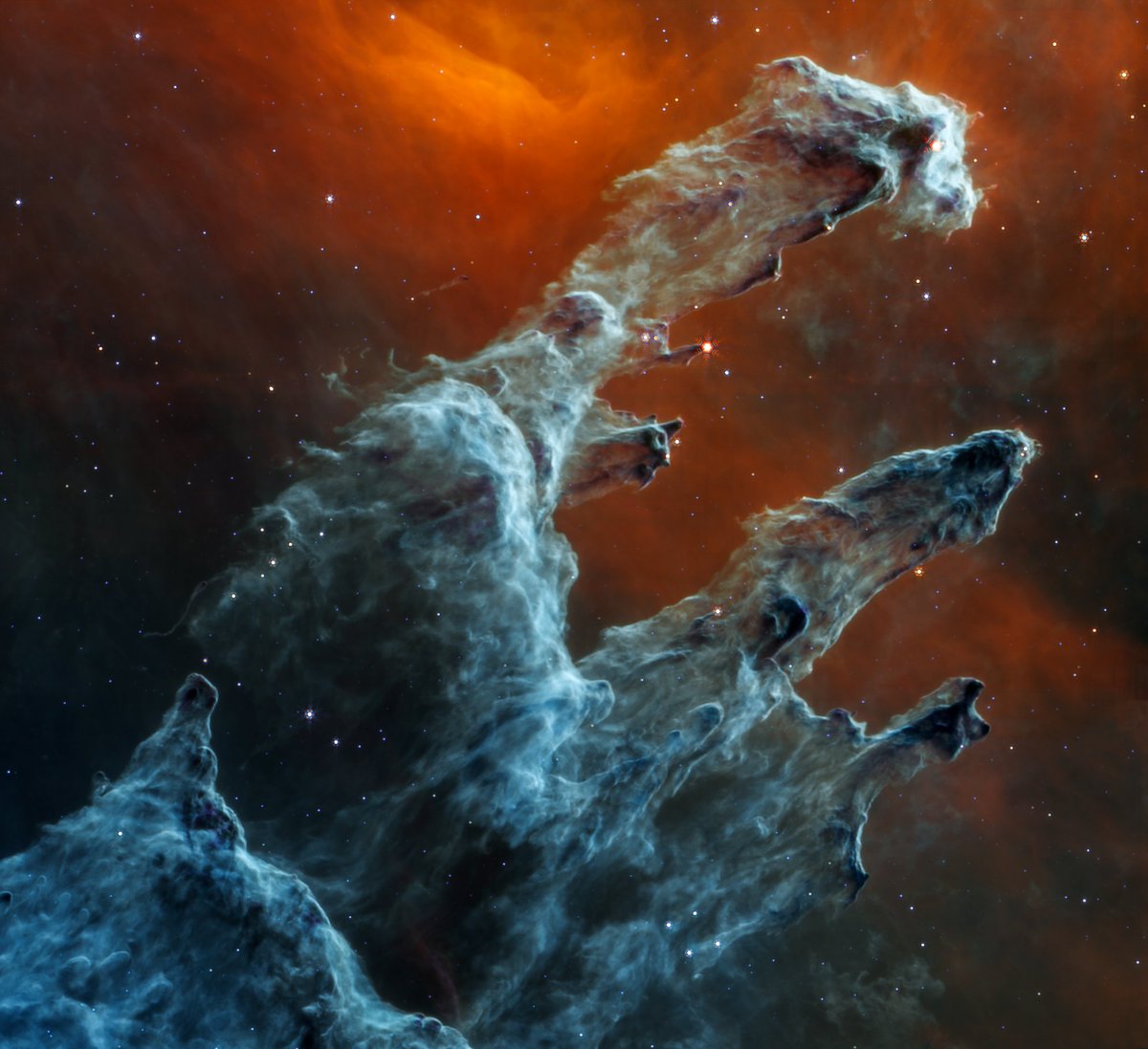
ALT Many layers and pillars of semi-opaque gas and dust overlay one another. These regions appear light blue and dark gray-blue. The first pillar starts at the bottom left and extends to the top right. There is one prominent red star, with tiny spikes at its tip. Lower on this pillar, there are several darker areas of dust that jut out, many with bright red stars that appear as small red dots at their ends. Below the top pillar are two slightly smaller pillars, both ending in dark gray-blue regions. The second pillar has a dark arch that looks like an upside-down L halfway down. The background of this scene is washed in shades of red. Toward the top center, in the background, is a V shape. At its lowest point, the V is a brilliant red. There are only several dozen tiny bright white and blue stars in this overall scene. Larger stars appear redder and are embedded in the pillars.