
Official X A/C for Sokodirectory.Com. The Leading Online News Platform for BIZ, Investments, Research, Analysis, Big Data & FinTech 🇰🇪🇹🇿🇺🇬🇷🇼🇧🇮🇸🇸
Joined August 2008
- Tweets 177,601
- Following 4,109
- Followers 17,467
- Likes 3,708
77,053 Photos and videos






Pinned Tweet

22 Nov 2017
We are all about Research, Mapping, Tracking your Investment. Follow @sokodirectory for the best Market News, Commodities in the Market
1
75
72
Jun 13
Deep in the Maasai Mara, a different kind of competition has been unfolding, one that has nothing to do with the lions and wildebeest that draw visitors from across the world sokodirectory.com/2026/06/de…
55
Jun 13
Deep Inside The Maasai Mara Silent Grassroots Business Revolution sokodirectory.com/2026/06/de…
53
Jun 12
County Brandy Rewards Loyal Consumers with Cars, Motorbikes, Cash and More in Nationwide Sh35 Million Campaign @KWALOFFICIAL
sokodirectory.com/2026/06/co…
1
42
Sokodirectory.com retweeted

Jun 11
I am increasingly convinced that the underfunding of Kenya’s most productive sectors is not an accident. It looks like a political economy designed to keep millions of young people poor, desperate, dependent and easy to manipulate.
When a government starves agriculture, manufacturing, MSMEs, trade and industry of serious funding, it is not merely making a budgetary mistake; it is weakening the very sectors that should feed the country, create jobs, expand exports, grow incomes and build a real tax base.
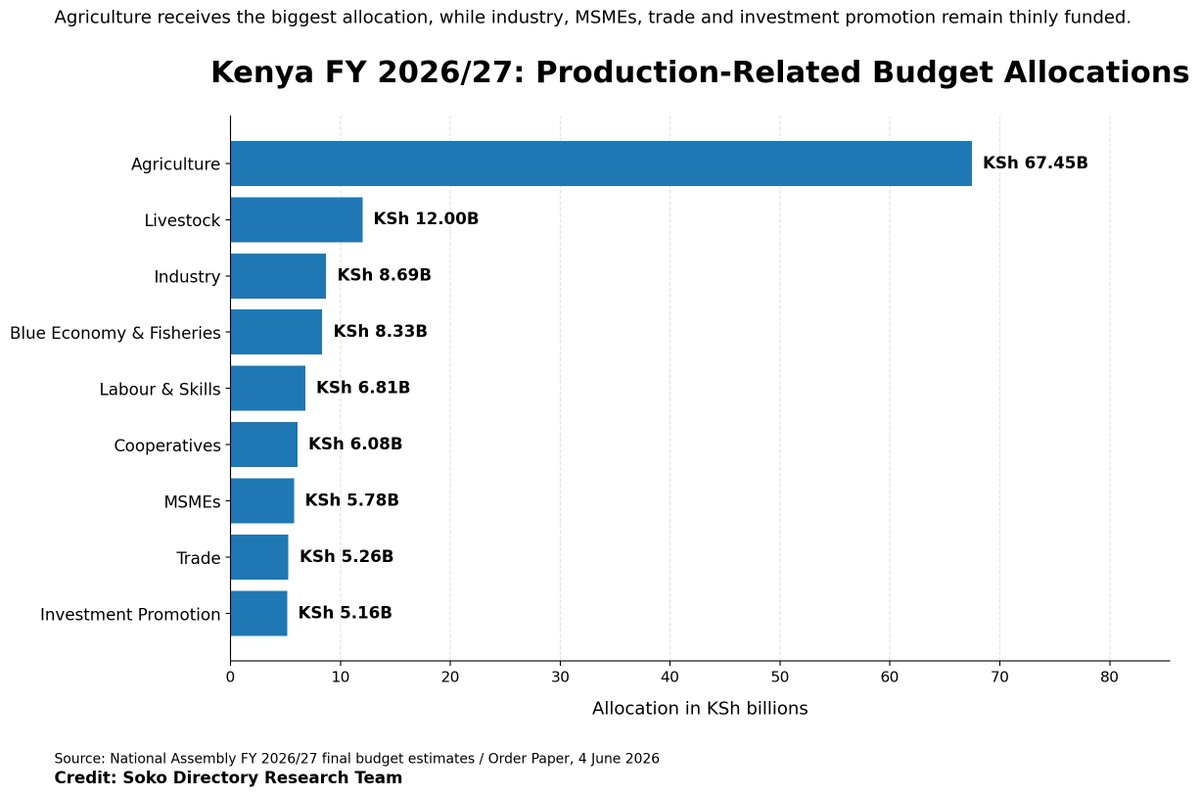
Look at the numbers. In a budget of about KSh 4.8 trillion, agriculture has been allocated about KSh 67.45 billion, livestock KSh 12 billion, industry only KSh 8.69 billion, MSMEs KSh 5.78 billion, trade KSh 5.26 billion, cooperatives KSh 6.08 billion, and investment promotion KSh 5.16 billion.
These are the sectors that should be powering factories, agro-processing, value addition, exports, affordable credit, rural incomes and youth employment. Yet they are being treated like footnotes in a budget that should be about production.
This is why unemployment will continue to haunt Kenya. You cannot create serious jobs by funding consumption while starving production. Jobs do not come from political rallies, token handouts, endless borrowing, empty empowerment slogans or photo opportunities.
Jobs come from farms that are producing, factories that are running, SMEs that can access credit, exporters that can compete, and value chains that are properly financed from the farm gate to the market.
Manufacturing is one of the biggest missed opportunities. If Kenya truly wanted to absorb unemployed youth, it would aggressively fund industrial parks, textile and leather value chains, agro-processing zones, affordable power, local raw materials, machinery financing and export incentives.
Instead, the State Department for Industry gets less than KSh 9 billion. That is not the budget of a country that wants to industrialise. That is the budget of a country comfortable with importing finished goods while exporting jobs to other economies.
Agriculture has also been badly shortchanged. Kenya talks about food security, but the money does not match the language. Agriculture is not just about food; it is the foundation of rural employment, household income, manufacturing inputs, exports and price stability.
When agriculture is underfunded, food becomes expensive, farmers remain poor, raw materials become scarce, factories struggle, and the cost of living rises. A hungry country cannot be a productive country.
MSMEs and trade have also been abandoned in real terms. These are the sectors where ordinary Kenyans are trying to survive every day — mama mbogas, kiosks, small manufacturers, traders, transporters, processors, artisans and young entrepreneurs.
Yet MSMEs get only KSh 5.78 billion and trade KSh 5.26 billion. That is too little to solve the cost of credit, delayed payments, market access, taxation pressure, digital infrastructure, compliance costs and the lack of working capital.
The dangerous outcome is simple: a broke youth is easier to control. A hungry citizen is easier to silence. A desperate population becomes easier to buy with tokens. When young people have no jobs, no capital, no industries, no farms that pay, no factories hiring and no hope of upward mobility, politics becomes a feeding programme. And once politics becomes about stomachs, democracy becomes weak.
An empty stomach does not defend democracy with confidence. It first looks for food. That is why underfunding production is not just an economic failure; it is a democratic danger. A government that does not fund agriculture, manufacturing and enterprise properly is not preparing young people for dignity. It is preparing them for dependency.
Kenya will not solve unemployment through speeches. It will solve unemployment by putting real money into production. Fund agriculture properly. Fund manufacturing seriously. Fund MSMEs aggressively. Fund trade and exports deliberately. Fund skills that match industry.
Lower the cost of power. Pay suppliers on time. Make credit affordable. Protect local producers. Build value chains. Anything less is a betrayal of the millions of young Kenyans waiting for work, dignity and a fair chance.
1
8
26
796
Sokodirectory.com retweeted
Jun 11
Family Bank [ @FamilyBankKenya ] will list its 1.305 billion shares by way of introduction on the Nairobi Securities Exchange [@NSE_PLC ] , with trading expected to commence by 23rd June 2026.
The listing allows existing over-the-counter shareholders to publicly trade without the bank raising fresh capital or immediately diluting current ownership.
This landmark move follows the bank's successful KSh 8 billion private placement and aligns with its strategic goal to achieve Tier One status.
Historically, this is only the third listing by introduction on the NSE.
1
2
7
830
Jun 11
The question every parent should ask themselves is simple: What would happen if my child were hospitalized tomorrow? @JubileeGroupKE sokodirectory.com/2026/06/de…
1
2
96
Jun 11
Many parents delay obtaining health insurance because they assume it requires a large upfront payment. Yet, affordability solutions are increasingly making coverage accessible @JubileeGroupKE sokodirectory.com/2026/06/de…
43
Jun 11
Few experiences are as frightening for a parent as receiving a late-night phone call informing them that their child has been injured or fallen seriously ill. A scary experience. sokodirectory.com/2026/06/de…
29
Jun 11
Dear Parent, What Happens If Your Child Is Hospitalized Tomorrow? @JubileeGroupKE sokodirectory.com/2026/06/de…
38
Jun 11
Competition will hurt Kenya Power if the company remains slow, inefficient, and dependent on tariff protection. But the most immediate enemy is not competition but leakage. @investwithSIB notes that system losses improved from 23.16% to 21.21%, but this is still far above the regulator’s target. The report frames the gap as a direct hit to earnings because losses above the allowable threshold cannot simply be passed to consumers through tariffs. sokodirectory.com/2026/06/si…
37
Jun 11
Kenya Power may lose part of its historic monopoly over direct retail sales, especially among high-value commercial and industrial customers according to @investwithSIB . But it can still win if it becomes the indispensable infrastructure landlord of the electricity economy: the company that owns and operates the wires, collects wheeling charges, keeps the network stable, and earns from every serious player that needs access to the national grid.sokodirectory.com/2026/06/si…
50
Jun 11
Kenya Power is no longer just a story about a utility selling electricity to homes, shops, factories, and offices. The deeper story, as Standard Investment Bank’s valuation update makes clear, is that Kenya Power is being pushed into a new electricity age where the most valuable asset may not be the bill it sends to customers, but the grid it controls. @investwithSIB sokodirectory.com/2026/06/si…
40
Jun 10
Kenyan Stocks Rally Despite Economic Headwinds As Investors Position For Key Monetary Policy Decision sokodirectory.com/2026/06/ke…
33
Sokodirectory.com retweeted

Sometimes the most expensive financial decision isn't what we buy, it's what we postpone.
When it comes to healthcare, waiting until you need cover can leave families facing difficult decisions at the worst possible time.

1
10
11
161
Jun 10
Chilean Wine Frontera Launches the New ‘Frontera Frutal ‘Collection sokodirectory.com/2026/06/ch…
38
Sokodirectory.com retweeted
Ukiona bill ya hospitali, ndiyo unajua kwanini Health Cover ni Lazima.
Jipange mapema na CoverBora na upate cover kwa baadhi ya gharama za matibabu zinazoweza kuja ukiwa hujajiandaa.

1
11
9
401
Longhorn Publishers emerged as the week’s best performer, surging 8.3 percent to KES 2.88. Jubilee Holdings followed closely with a 7.3 percent gain as investors positioned themselves ahead of the insurer’s final dividend book closure scheduled for June 11.
Car & General continued its impressive run, rising 6.9 percent and extending its year-to-date gain to more than 66 percent, making it one of the strongest performers on the exchange in 2026. sokodirectory.com/2026/06/ke…
4
209
KCB Group emerged among the standout movers, climbing 6 percent to KES 70.75, while Equity Group gained 4 percent to KES 77.25. NCBA Bank also registered a modest increase of 1.1 percent to KES 88.25.
The gains highlight sustained investor appetite for financial sector stocks amid expectations that interest rate developments could influence profitability and credit growth in the months ahead. sokodirectory.com/2026/06/ke…
1
1
267
According to the latest Kenya Weekly Market Wrap by @investwithSIB, investor confidence remained resilient as the Nairobi All Share Index (NASI) and NSE 25 Index both advanced by 2.3 percent during the week, while the NSE 10 and NSE 20 indices gained 2.2 percent and 1.3 percent, respectively. sokodirectory.com/2026/06/ke…
1
2
233
Kenyan Stocks Rally Despite Economic Headwinds As Investors Position For Key Monetary Policy Decision ~ @investwithSIB sokodirectory.com/2026/06/ke…
1
246