
Trade Altcoins, Stack Bitcoin.
Joined January 2023
- Tweets 11,292
- Following 6,725
- Followers 231,427
- Likes 2,581
1,520 Photos and videos



Pinned Tweet

31 Jul 2024
I'm a Crypto angel investor since 2017 having invested in 100 startups. Many failures, few unicorns.
Follow me for👇
Narratives and Guides: youtube.com/virtualbacon0x
Trading Alpha: t.me/vb_trade
Community: virtualbacon.com
572
187
1,619
1,834,153
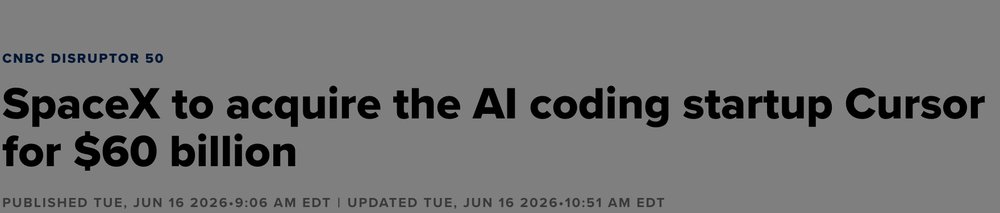
SpaceX is now the 4th most valuable company in America, it bought a $60B AI startup in stock barely a week after listing, and the Fed just went hawkish under a brand new chair. Let me say the unpopular thing about all of it.
This is what the late innings of an AI bull market look like, and it is also exactly when I get more careful, not less.
Start with the deal. A one-week-old IPO using its own freshly-minted stock to buy a $60B company tells you paper is cheap and confidence is total, which is less a knock on SpaceX than a reading on liquidity. When a company can print stock and the market treats it as hard currency, you are deep into the part of the cycle where everything feels easy and nothing feels risky.
So here is the part people do not want to hear: I am not shorting any of this. You cannot fade Elon. He commands the largest pool of retail exit liquidity on the planet, and the names attached to him get bid by passive flows the moment they hit the major indices. Shorting a max-hype, index-bound, Elon-driven asset because "the valuation makes no sense" is how thoughtful people get run over. The valuation has not made sense for a while. It can not-make-sense for a lot longer.
But not shorting is very different from buying and holding. On a max-hype name there are really only two honest plays. You speculate on the volatility with a plan and an exit, or you stay out entirely. The thing it is not is a buy-and-hold, and it is definitely not a buy-the-dip-next-week, because the IPO phase tends to be the local top. The real entry, if there ever is one, comes much later and much lower, after the excitement is gone and nobody is tweeting about it.
There is a second-order effect that matters more than any single ticker. A mega-event like this sucks liquidity out of everything else. When the biggest, loudest thing in the market is absorbing all the attention and all the capital, the rest of the tape gets thin. We have watched this movie before, every time one giant launch pulls the oxygen out of the room and the other things quietly bleed while everyone stares at the new shiny object.
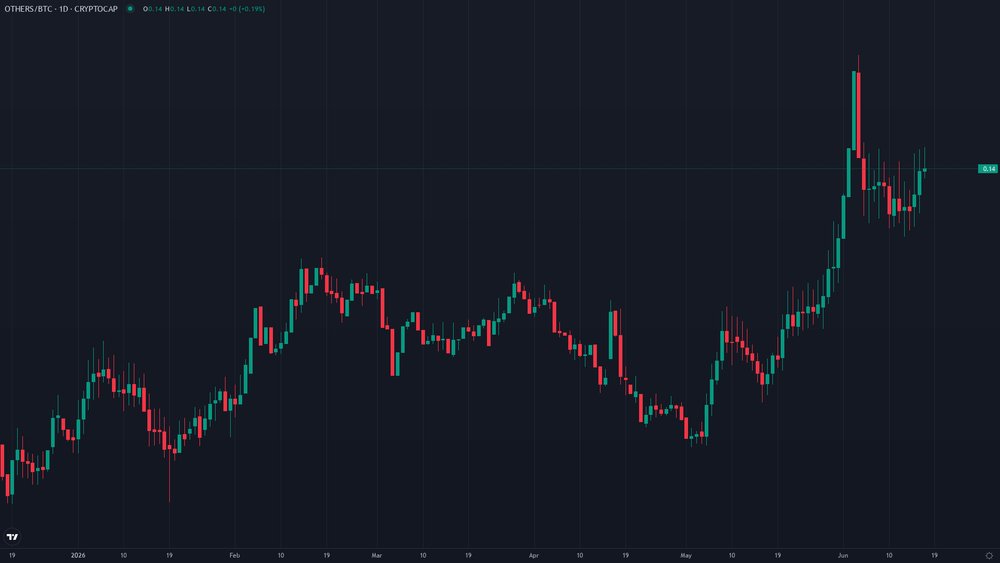
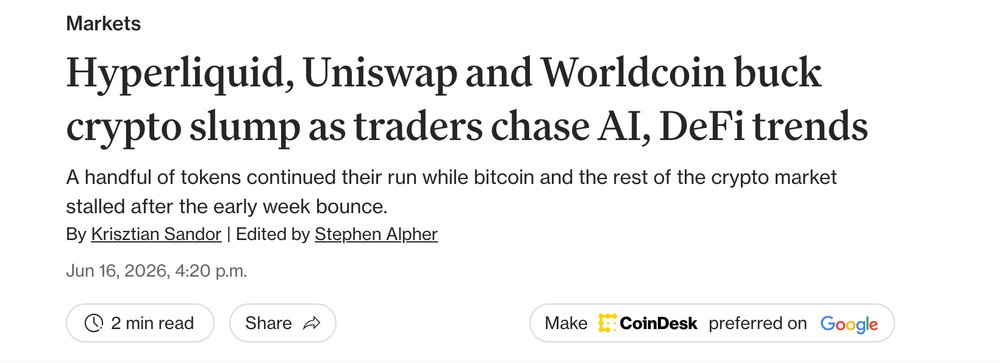
Which brings me to the alts. This week UNI, HYPE, WLD and SOL all caught a bid while bitcoin sat flat, then gave a chunk of it back the moment the Fed turned hawkish. I love the energy, but I read it as rotation, not as the start of a new everything-up regime. Capital leaving the thing that already ran and reaching for beta in the things that have not. That is normal, and it is tradeable, but it is late-cycle behavior, not early-cycle behavior. The tell is the OTHERS/BTC ratio going vertical while BTC itself is flat. Rotations like that resolve down, not up, once the leader rolls over.
And then the Fed. Warsh's first meeting came in hawkish, a hold, but the dot plot moved toward a hike this year and he did not even submit his own dot. None of it changes the bigger picture for me. A rate regime modulates how deep a drawdown gets. It does not change which part of the cycle you are standing in. People keep trading the headline when the clock is the only thing that matters.
So what do you actually do with a day like this? Less than you think. Days where everything is loud, a $60B deal lands, and a new Fed chair reshuffles the dots are days that reward patience, not reflexes. The bubble is real, and it does not pop on bad fundamentals. It pops after the last big IPOs are public and the froth has nowhere left to go. We are closer to that than we were a month ago. Enjoy the run, size accordingly, and keep the exit in mind while everyone else is busy celebrating the entrance.
5
15
1,209
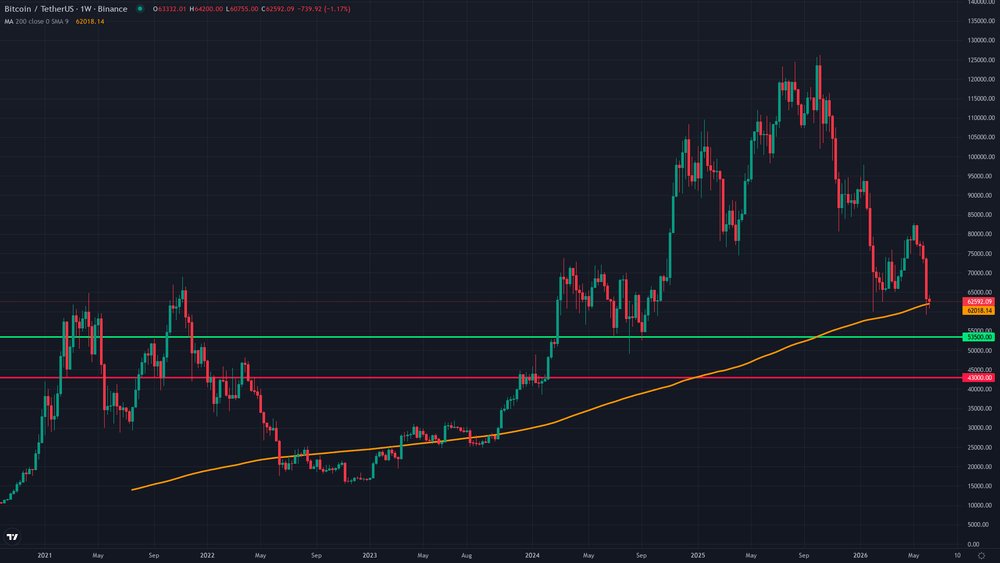
the more times a level gets tested, the more likely it breaks. a support that's held five times isn't getting stronger. each retest is eating the buyers who were defending it.
1
23
2,073
A new Fed chair cannot cut rates on day one even when cutting is the entire reason he got the job. Inflation is still too high, so the only honest first move is to look hawkish now and rework the framework so you can be dovish later. That is roughly what yesterday looked like. The statement got shorter, the forward guidance got deleted, and the line that survived was the one about keeping ample reserves in the system. Hawkish on the surface, with the plumbing for easing left fully intact underneath.
So how do you position when the destination is lower rates but the path there is months of looking tough? You stop trying to be clever about the exact bottom.
Here is how I actually hold it. Around 80% allocated to a core bitcoin position, 20% in cash. I am not trying to nail the absolute low, because nobody catches it and the people who claim they do are lying or lucky. I have a level where the last of that cash goes to work, and I am prepared to sit through a drawdown after I deploy it. Holding through the chop beats timing the turn, every cycle I have traded.
The single cleanest read on whether the path actually opens up is Brent crude. Above $100 tells you something broke, an escalation or a supply shock, and inflation is not coming down on that. Below $80 is back to pre-conflict levels, which is the energy backdrop that lets core inflation drift lower. Energy leaks into core prices on roughly a two-month lag, so today's oil tape is a preview of the inflation prints the Fed will be reacting to this fall. Brent just slid back near $78. If it holds there, the chair who cannot cut today gets the cover he needs to cut later.
None of this is a guarantee and I could be wrong about the timing. But the structure is simple: own the asset, keep dry powder, watch the one chart that actually decides whether the Fed gets to pivot.
6
2
54
3,528
i don't short bitcoin or any major alt even when i think we go lower. the only clean short is a coin that just printed a fresh all-time high while everything else is bleeding. tight stop right above the high, small size. everything else you just wait out.
10
2
57
5,024
Illinois just signed what crypto lawyers are calling the most anti-crypto law any US state has passed, and almost nobody outside the policy crowd is talking about it.
Here is what it does. Senate Bill 3019, the state's new budget, includes a 0.2% "privilege tax" on digital-asset activity. Not a tax on your gains. Not a tax on your income. A tax on the activity itself, charged on any registered platform you transact through.
The part that should bother you even if you have never touched Illinois:
- there is no exemption for moving coins between your own wallets
- it applies regardless of whether you made a profit or took a loss
- it is effective January 1, 2027
- brokers who operate without registering face a class-3 felony, up to a $25,000 fine and two to five years in prison
- out-of-state platforms with enough Illinois customers can get pulled in too
That wallet line is the whole story. Buy BTC, you pay. Hold your BTC on a custodian, you pay. Move it from one wallet you control to another wallet you control, you pay. The state is treating the simple act of holding and moving your own property as a taxable event, which is closer to taxing the act of saving than taxing a trade.
a16z's Miles Jennings put it plainly: there is no comparable state transaction tax on stocks, bonds, or derivatives anywhere in the country. Crypto is the only asset being singled out this way, which is exactly why he thinks it runs into federal problems.
The cynical read is that this was never about crypto policy at all. The whole package is engineered to raise roughly $800M to close a budget gap, and digital assets were the easiest pocket to reach into. The real risk for the rest of us is that budget-strapped states copy whatever raises money, and a few of Illinois's neighbors are already the obvious next candidates.
6
5
42
4,213
☕️ GM! Here are the most important market events over the last 24 hours:
🌍Market Overview:
🔸 The Fed held at 3.50-3.75% for a 4th straight meeting but turned hawkish in Warsh's debut: the 2026 dot-plot median jumped to 3.8% from 3.4%, 9 of 18 officials now see a hike, and the S&P fell 1.2%. #Fed
🔸 Intel jumped about 9% to a record near $130 after Trump said Apple agreed to design and build chips with Intel in the US, the biggest validation yet of the government's stake in the chipmaker.
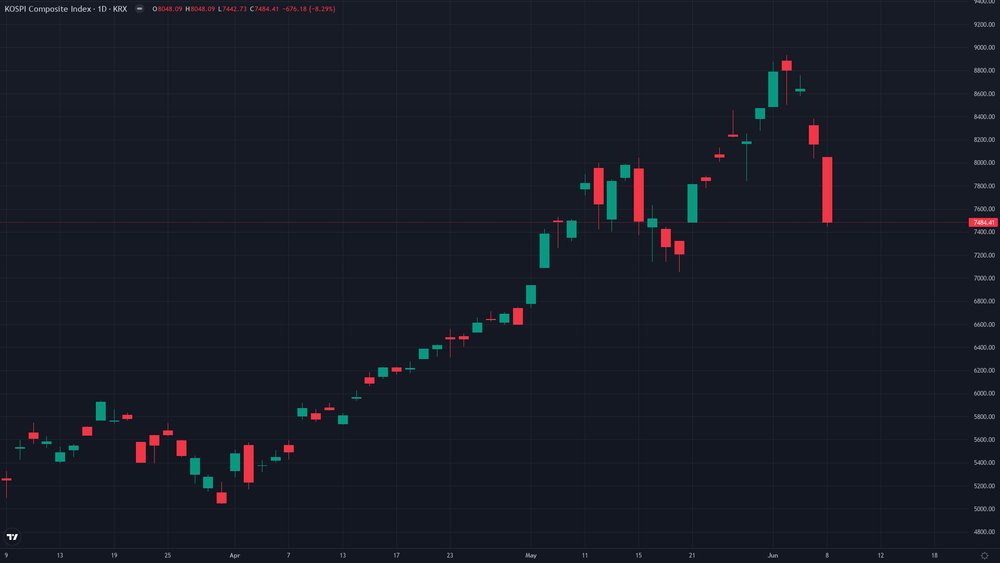
🔸 The US and Iran signed a deal to end the war and reopen the Strait of Hormuz, lifting the naval blockade; Brent fell to $78 and Japan's Nikkei and Korea's Kospi hit record highs as crypto shrugged it off. #Iran
🔸 SandboxAQ won a $500M CHIPS award to use AI to find new chipmaking materials, from PFAS-free chemicals to rare-earth-free magnets, with the government taking a minority stake in the Nvidia-backed startup. #AI
🔸 Google launched a $99.99 Gemini-native Home Speaker, its first audio device built for Gemini and its first standalone smart speaker since the 2020 Nest Audio, paired with a $10/month Home Premium tier.
🔸 World-model startup Odyssey raised $310M at a $1.45B valuation from Amazon, AMD Ventures and GV, betting that systems simulating physical environments are the next leap beyond large language models.
🪙Crypto Updates:
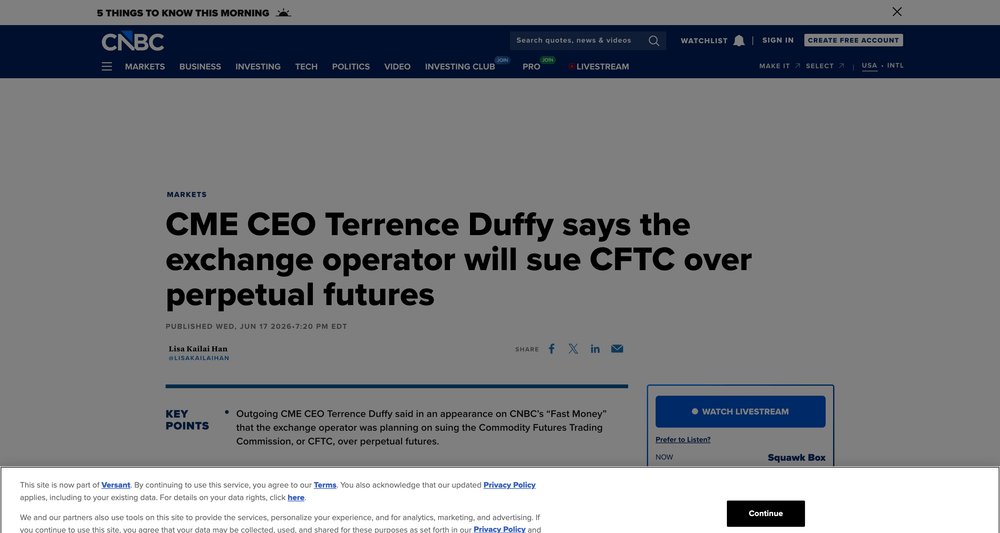
🔸 CME, the world's largest derivatives exchange, said it will sue the CFTC over crypto perpetual futures, arguing perps are actually swaps under the Dodd-Frank Act that must clear regulated exchanges. #CFTC
🔸 Moody's began publishing credit ratings on Solana, letting issuers of tokenized fixed income push machine-readable ratings on-chain; Solana is the first public permissionless chain to carry them at scale. SOL
🔸 Illinois enacted a 0.2% "privilege tax" on all digital-asset business activity with no exemptions, effective Jan 2027; a16z's Crypto Council called it the most punitive crypto tax in the country.
🔸 Bittensor is reviewing "Root Reborn," a proposal that would turn TAO validators into fund managers who pick which AI subnets to back and reinvest yield instead of selling subnet tokens to pay stakers. #TAO
🔸 Aster, a perpetuals DEX, will route 99% of daily fees into ASTER buybacks and burn a matching amount to cut supply from 7.82B toward 3B; ASTER popped over 10% then faded as the hawkish Fed pressured risk assets.
🔸 Fidelity and State Street both launched stablecoin-reserve funds, racing to manage the Treasuries and cash backing issuers under the new GENIUS Act as Wall Street builds out stablecoin plumbing.
3
22
2,523
peace deal signed, hormuz reopening, brent back near $78, nikkei and kospi at record highs. stocks ripped on it. crypto looked at the biggest geopolitical headline in months and shrugged, because it was busy trading the fed. tells you what crypto actually cares about right now.
4
4
89
4,733
Buried in yesterday's Fed statement: they reaffirmed "ample reserves," no change to the bond holdings. So the easing bias on rates came out, but the balance-sheet faucet stayed wide open. That faucet, not the rate line, is the real lever on liquidity.
1
3
48
3,970
everything was loud today. the fed, a $60B AI deal, alts ripping, bitcoin asleep. days like this pay patience, not reflexes.
11
2
83
8,876
warsh opened his first meeting calling the dot plot pencil marks "with large erasers" nobody feels constrained by, and one member (almost certainly him) skipped it entirely. the statement got cut to 130 words from 341, forward guidance gone. the fed's roadmap is now a sketch.
9
1
52
7,035
ethereum's biggest upgrade in years just hit its final dev stage. devnets live, no launch date yet.
the headline feature is enshrined proposer-builder separation, a dry name for the thing that finally unblocks L1 scaling. nobody tweets about it until the number moves.
14
12
224
13,233
Jun 17
LIVE: New Fed Chair Warsh's First FOMC. How will it Impact Markets? x.com/i/broadcasts/1qJVmmADv…
23
4,136
Jun 17
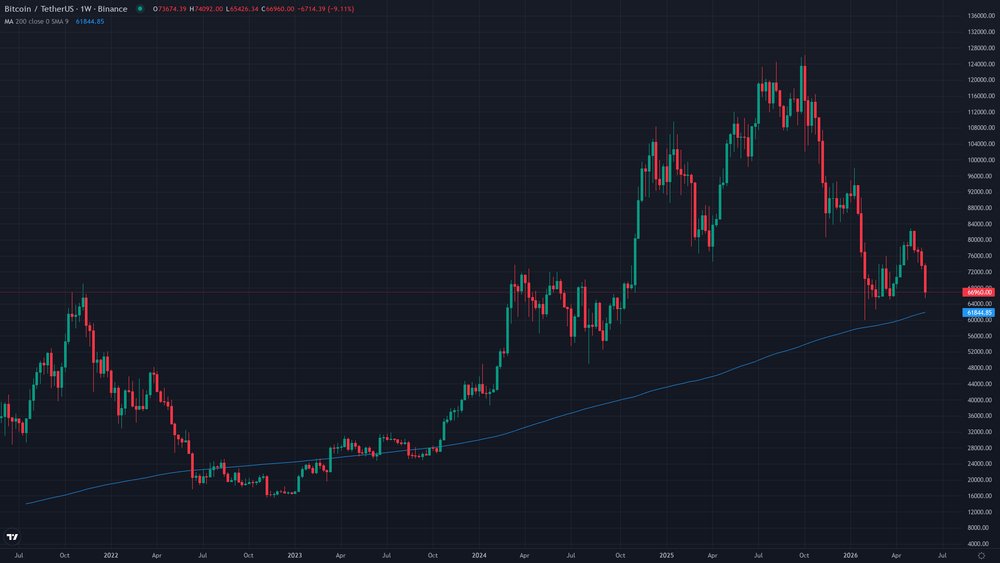
Bitcoin has sat at 66k for a week while money moves underneath it.
UNI 22% in a day, HYPE at a record, SOL 15% on the week. OTHERS/BTC just went vertical.
This is the part of the cycle where capital leaves what already ran and hunts beta in what hasn't. Rotation, not a top.
13
7
104
7,305
Jun 17
oil just had its worst four days of the year. cheaper oil is cooler inflation is an easier Fed. risk assets quietly love this.
3
53
4,633
Jun 17
A perp DEX token nobody outside crypto has heard of is now the best-performing large cap of 2026.
Hyperliquid's HYPE hit a record $76.85, up nearly 200% this year while bitcoin went sideways. Bitwise bought it for a spot ETF, Circle wired in USDC, the shorts got run over.
11
8
56
5,728
Jun 17
☕️ GM! Here are the most important market events over the last 24 hours:
🌍Market Overview:
🔸 The Fed delivers its first rate decision under Chair Kevin Warsh at 2 PM ET, widely expected to hold at 3.50-3.75% for a 4th straight meeting; the dot plot and Warsh's debut presser are the real signals. #Fed
🔸 SpaceX signed a $60B all-stock deal to buy AI coding startup Cursor, days after its record IPO, to challenge Anthropic and OpenAI; SpaceX rose 16% Tuesday, topping Amazon as the 4th most valuable US firm near $2.8T.
🔸 Brent crude fell below $79 a barrel, a three-month low and its first dip under $80 since March, sliding 5% Tuesday as markets price in a wave of Iranian supply once the US-Iran deal signs Friday.
🔸 OpenAI's Altman, Anthropic's Amodei and DeepMind's Hassabis joined a dozen tech chiefs at the G7 in Evian, where AI-model access took center stage as the EU pressed Washington to ease its foreign-access controls. #AI
🔸 The Dow topped 52,000 for the first time ever intraday before closing at a record 51,999.67, up 0.6%, as falling oil eased inflation fears and SpaceX's surge lifted cyclicals, just 4 months after first crossing 50,000.
🔸 AMD hit a record $547.26, up nearly 7% and about 131% in 2026, after buying memory firm Mext and unveiling its Ryzen AI Halo PC chips; the rally puts the chipmaker within reach of a $1T market cap. #AMD
🪙Crypto Updates:
🔸 Uniswap's UNI jumped 22.5% to $3.53, the standout in a broad altcoin rally as traders piled into DeFi while bitcoin stalled near $66,000 ahead of the Fed's first decision under Warsh. #DeFi
🔸 Ethereum's biggest protocol overhaul in years, Glamsterdam, hit its final development stage as devs began running devnets; its headline feature, enshrined proposer-builder separation, targets Layer-1 scaling.
🔸 Hyperliquid's HYPE surged to a fresh record above $76, up nearly 200% in 2026 and crypto's best-performing large-cap this year, after a Bitwise spot-ETF buy and Circle USDC integration drove short liquidations. #HYPE
🔸 Ripple invested in African fintech Flutterwave to bring its RLUSD stablecoin and the XRP Ledger to cross-border payments across Africa, deepening stablecoins' fastest-growing use: moving dollars where FX access is thin.
🔸 Worldcoin's WLD rose 12%, extending its monthly gain to roughly 180%, as traders chase it as a direct AI bet; the project co-founded by OpenAI's Sam Altman has ridden the AI rally alongside SpaceX's market debut.
🔸 Coinbase rolled out an AI adviser, stock options and pre-IPO markets in a finance push, adding USDC card rewards, borrowing against staked SOL via Jito and Morpho, and tools letting AI agents auto-trade within limits.
6
2
27
3,540
Jun 17
the only real question at Warsh's first FOMC is whether he submits a dot plot at all. the 2pm hold is 97% priced, nobody's trading that. but he spent a year calling the dot plot false precision, and skipping it on day one quietly retires the Fed's most-watched forward tool.
7
3
69
7,910
Jun 17
correction to this: BITA does hold spot bitcoin (the majority) plus IBIT, not zero. it sells covered calls on ~25-35% for income, so you keep most of the upside and cap it in a rip. the structure point stands, the 'zero bitcoin' framing was wrong
Jun 16

BlackRock now has a Bitcoin ETF that owns zero Bitcoin. It started trading on the Nasdaq today, and the ticker is BITA. Worth understanding what you actually buy here, because the name does a lot of work that the structure does not.
It is the iShares Bitcoin Premium Income ETF. The pitch is a 15 to 25% annual yield on Bitcoin exposure. That number is real, and the way it gets there is the whole story.
BITA does not hold spot Bitcoin. It holds shares of IBIT, BlackRock's spot Bitcoin ETF, and then it sells covered calls against those shares. A covered call is an option you sell that gives someone else the right to buy your position at a set price. In return for that right, they pay you a premium upfront. That premium is where the 15 to 25% yield comes from. You are renting out the upside on your Bitcoin and getting paid cash for it.
So here is the trade you are actually making. In a flat or choppy market, you collect the premium and you win, because Bitcoin is not going anywhere and you are getting paid to hold it. In a slow grind higher, you collect the premium and you capture roughly 70% of the move, which is the number BlackRock is targeting. But in a violent rip higher, the kind Bitcoin is famous for, your calls get exercised, your upside is capped, and you sit there watching spot run away from you while you keep the premium and not much else.
This is an income product wearing a growth product's name. It is built for someone who wants Bitcoin exposure plus cash flow and is willing to trade away the explosive upside to get it. That is a completely valid thing to want. Retirees, income-focused accounts, anyone who would rather clip a coupon than ride the full volatility.
What it is not is a bet on Bitcoin going to a new high. If your thesis is that Bitcoin runs hard from here, the covered-call structure is working directly against that thesis. You would capture more of that move just holding IBIT or spot.
The interesting part is what it signals. The covered-call ETF is the product you build when the audience for plain Bitcoin exposure is already saturated and the new money wants yield, not just a number that goes up. That is a more mature market than the one that existed two years ago. Know which product matches your actual thesis before the yield number does the deciding for you.
2
3
27
5,923
Jun 16
BlackRock now has a Bitcoin ETF that owns zero Bitcoin. It started trading on the Nasdaq today, and the ticker is BITA. Worth understanding what you actually buy here, because the name does a lot of work that the structure does not.
It is the iShares Bitcoin Premium Income ETF. The pitch is a 15 to 25% annual yield on Bitcoin exposure. That number is real, and the way it gets there is the whole story.
BITA does not hold spot Bitcoin. It holds shares of IBIT, BlackRock's spot Bitcoin ETF, and then it sells covered calls against those shares. A covered call is an option you sell that gives someone else the right to buy your position at a set price. In return for that right, they pay you a premium upfront. That premium is where the 15 to 25% yield comes from. You are renting out the upside on your Bitcoin and getting paid cash for it.
So here is the trade you are actually making. In a flat or choppy market, you collect the premium and you win, because Bitcoin is not going anywhere and you are getting paid to hold it. In a slow grind higher, you collect the premium and you capture roughly 70% of the move, which is the number BlackRock is targeting. But in a violent rip higher, the kind Bitcoin is famous for, your calls get exercised, your upside is capped, and you sit there watching spot run away from you while you keep the premium and not much else.
This is an income product wearing a growth product's name. It is built for someone who wants Bitcoin exposure plus cash flow and is willing to trade away the explosive upside to get it. That is a completely valid thing to want. Retirees, income-focused accounts, anyone who would rather clip a coupon than ride the full volatility.
What it is not is a bet on Bitcoin going to a new high. If your thesis is that Bitcoin runs hard from here, the covered-call structure is working directly against that thesis. You would capture more of that move just holding IBIT or spot.
The interesting part is what it signals. The covered-call ETF is the product you build when the audience for plain Bitcoin exposure is already saturated and the new money wants yield, not just a number that goes up. That is a more mature market than the one that existed two years ago. Know which product matches your actual thesis before the yield number does the deciding for you.
32
28
324
45,507
Jun 17
correction, I had this wrong: BITA holds spot bitcoin (the majority) plus IBIT, not zero. it sells covered calls on ~25-35% for income, so you keep most of the upside but cap it in a rip. the zero-bitcoin line was wrong
1
8
2,537