
Best PlayStyles for Every Position ⚽
🧤 GK → Deflector
🏃 RB / LB → Accelerator
🛡️ CB → Anticipate / Bruiser
⚔️ CDM → Anticipate / Guardian / Bruiser
🎯 CM → Tiki Taka / Bullet Pass
🎩 CAM → Tiki Taka / Finesse Expert / Trickster
⚡ RW / LW → Rapid / Finesse Expert / Trickster
🎯 ST → Clinical Finisher / Trickster / Finesse Expert
Choose the right PlayStyles and unlock the full potential of your players! 🚀
Which PlayStyle do you think is the most overpowered in FC Mobile❓


20
39
316
18,346

Mark Prince 🇬🇧🇬🇧🇬🇧 retweeted

2 Mar 2025
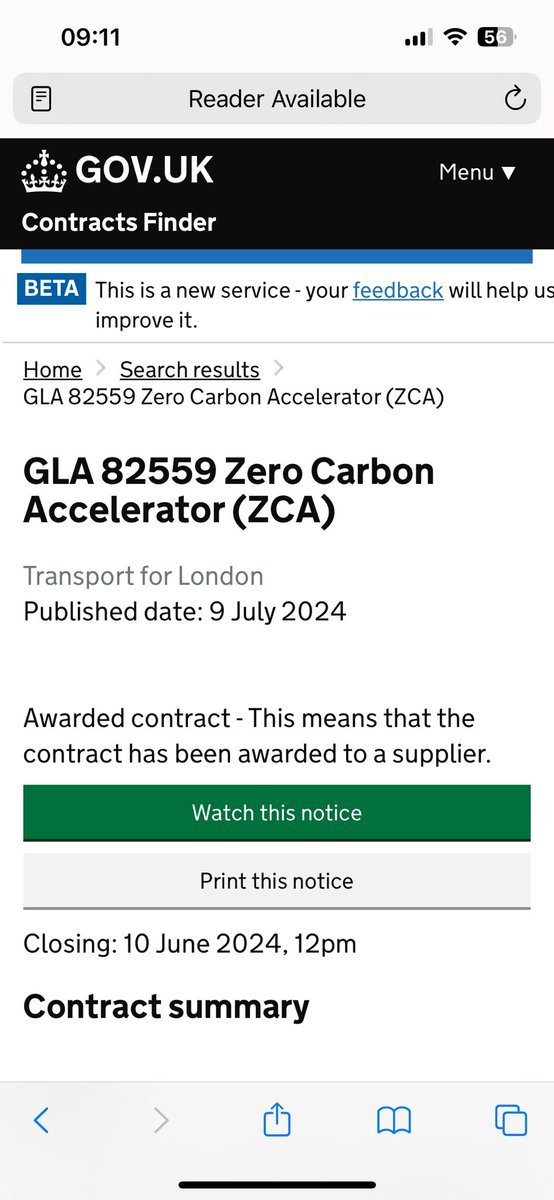
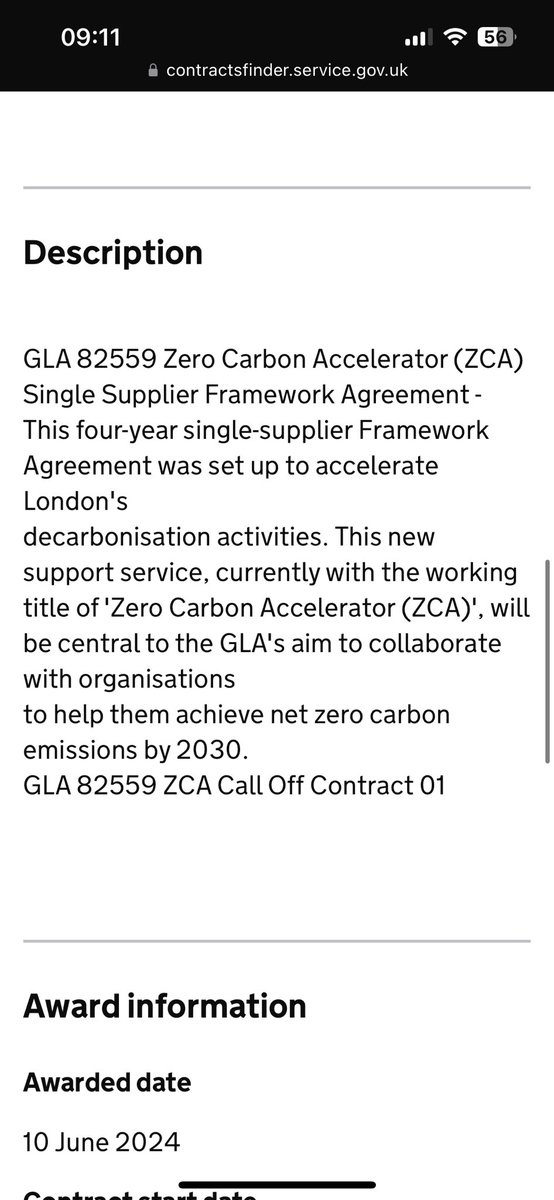
Cleaning costs have been slimmed down to reduce costs, but TFL has earmarked £150 million for an “Accelerator for Net Zero’
Again, it is a question of priorities. I am sure most commuters would prefer clean trains that weren’t covered in graffiti as a starting point.

8
139
344
18,589
Greg Cleare retweeted

Jun 12
Our Robotics Accelerator has launched with 15 startups helping shape the future of physical AI in Europe. 🤖
This three-month program will connect them with access to our AI stack, Gemini Robotics models and hands-on support from our teams.
Meet the companies → goo.gle/4oeEk2K
48
65
465
50,973

The bigger picture
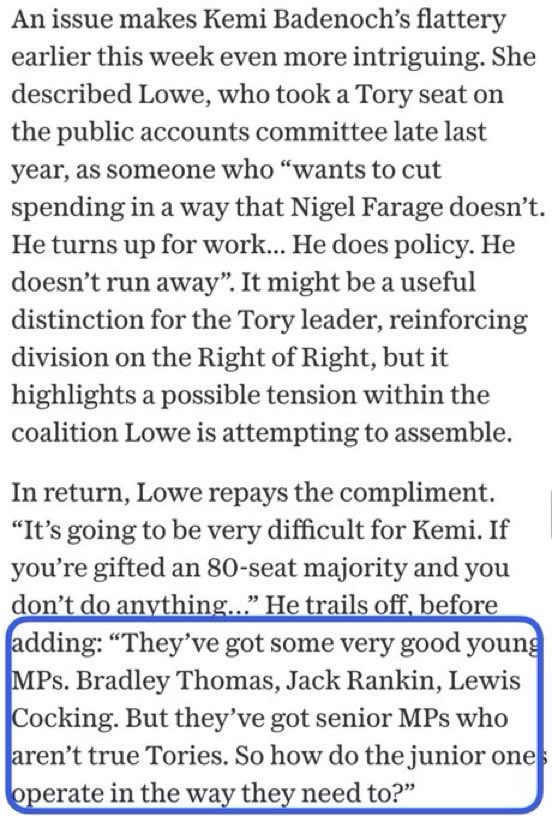
The right in Britain is fractured between Reform, Restore Britain, and remnants of the Conservatives. Public polling and by election dynamics show the split is already costing seats that would otherwise go to non Labour candidates. Lowe’s interview and positioning add another data point to the argument that his project functions, at minimum, as a pressure valve or alternative channel rather than a pure accelerator of the anti establishment shift many of his supporters claim to want.
This makes Lowe uniquely villainous not virtuous. The selective application of purity tests and harsh on Reform for its alleged compromises, lenient on his own openness to Tory cooperation is the observable pattern. Supporters who cannot or will not acknowledge it are choosing team loyalty over consistent standards. 😏

2
15

37. *P-8A Poseidon Maritime Patrol Aircraft Fleet* - 9 aircraft now operational at RAF Lossiemouth. Restored UK’s maritime patrol capability lost in 2010. Tracks Russian submarines, protects undersea cables, supports NATO operations. £3bn programme supporting 1000 jobs.
38. *Dreadnought-Class Nuclear Submarines* - 4 new submarines building at BAE Systems Barrow-in-Furness to replace Vanguard class. Maintain continuous at-sea nuclear deterrent through 2060s. £31bn programme, 30,000 jobs across UK supply chain.
39. *Type 26 & Type 31 Frigates* - 8 Type 26 ASW frigates and 5 Type 31 general purpose frigates under construction. First Type 26 “Glasgow” launched 2022. Rebuilding Royal Navy surface fleet with modern ASW and export potential. £8bn investment, 4,000 shipyard jobs.
40. *Challenger 3 Main Battle Tank* - Army upgrading 148 Challenger 2 tanks to Challenger 3 standard. New turret, 120mm smoothbore gun, advanced sensors. Deliveries from 2027. £800m contract with Rheinmetall BAE Systems Land, securing UK armoured vehicle capability.
41. *Boxer Mechanised Infantry Vehicles* - 623 Boxer 8x8 vehicles on order for British Army. Modular design replaces tracked vehicles. First vehicles delivered 2023. £2.8bn programme, production in Telford supporting 1,300 jobs.
42. *Protector RG Mk1 UAV* - RAF taking delivery of 16 Protector drones to replace Reaper. 40 hour endurance, certifiable for UK airspace. £1bn programme, operational from RAF Waddington from 2024.
43. *E-7 Wedgetail AEW&C Aircraft* - 3 aircraft ordered to replace Sentry AWACS. Advanced radar and battle management. First delivery 2024. £1.5bn programme, RAF Waddington base sustaining 700 jobs.
44. *Integrated Review 2021 Defence Command Paper* - Shifted focus to Indo-Pacific “tilt”, cyber, space, and technology. Increased defence budget £24bn over 4 years. Created new National Cyber Force and UK Space Command.
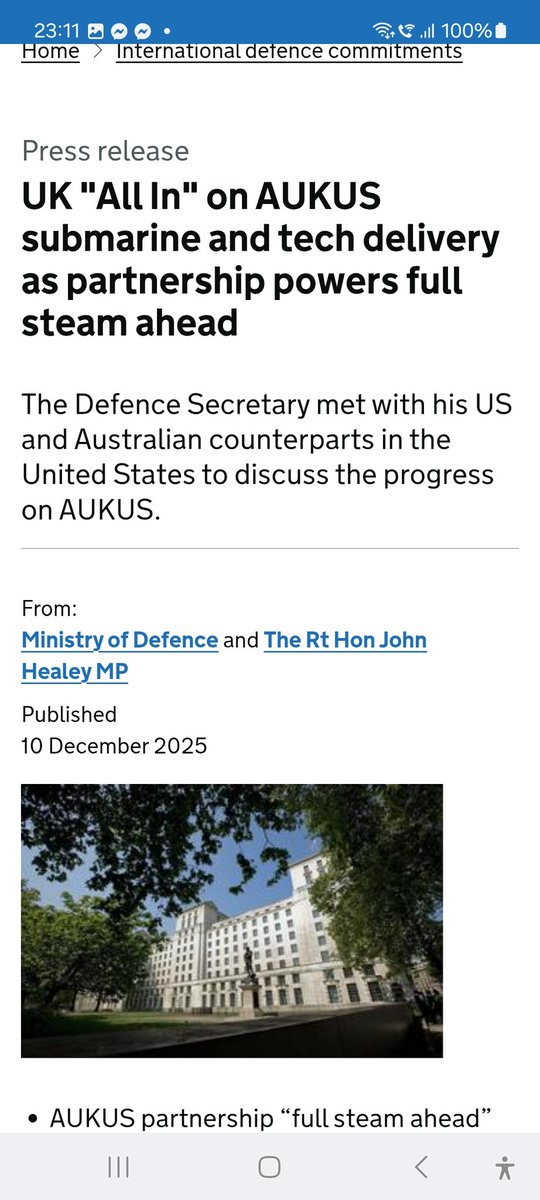
45. *AUKUS Partnership* - Trilateral security pact with US and Australia announced 2021. UK sharing nuclear submarine propulsion technology with Australia. Developing hypersonic, cyber, and AI capabilities. Long-term industrial cooperation.
46. *Integrated Procurement Model* - Defence Equipment & Support reforms cutting delays and cost overruns. New “fast track” routes for urgent operational needs. Saved £1.2bn through better contract management since 2020.
47. *UK Shipbuilding Strategy Refresh* - 30-year pipeline of naval orders for UK yards. “National Flagship” and commercial shipbuilding support. Goal: make UK most competitive shipbuilding nation in Europe by 2030.
48. *Defence Innovation Fund* - £1.5bn invested in Dstl, Defence and Security Accelerator, and dual-use tech. Focus on AI, quantum, space, hypersonics. 500 SMEs supported since 2021.
49. *Munitions & Missiles Stockpile Rebuild* - Contracts signed with BAE Systems, MBDA, Thales to increase production of ammunition, artillery shells, and missiles. £2.5bn invested post-Ukraine to restock and expand capacity. New production lines in Glascoed, Stevenage, Lostock.
50. *Future Combat Air System / Tempest* - UK leading GCAP programme with Italy and Japan to develop 6th generation fighter jet for 2035. £2bn UK investment to date. 18,000 jobs across BAE, Rolls-Royce, Leonardo UK.
51. *Defence Export Success* - UK became 2nd largest defence exporter globally 2021-2023. £33bn orders including Type 26 frigates to Australia/Canada, Typhoon jets to Qatar, Boxer to Germany. Supports 55,000 UK export jobs.
52. *Industrial Skills & Apprenticeships* - 20,000 new apprenticeships and graduate places in defence industry since 2020. Defence Skills Taskforce aligning training with future capability needs. BAE, Rolls-Royce, Babcock major recruiters.
53. *Regional Economic Impact* - Defence spending concentrated outside London/SE. Barrow, Glasgow, Portsmouth, Derby, Yeovil, Filton major hubs. £20bn annual GVA from defence manufacturing to UK regions.



26

18m
Famous Last Words: Musk replied, "Watch this," and floored the accelerator while attempting a rapid lane change.
The Physics: The McLaren F1 featured a massive 627-horsepower engine but lacked any traction control. Musk later admitted he did not fully know how to handle the car
9

Code for ‘its got a nice freeway on ramp to evaluate the accelerator peddle’
1
2
16

$3,000,000,000
That's the value of scholarships and grants secured by our community.
80,000 students. 180 countries and territories.
And it all started with one idea: that the right preparation changes everything.
The Scholarship Accelerator is the next chapter of that story.
We are just getting started. 🌍
2
4
6
165

I never drive one like this lol but from the left it’s parking brake -clutch - brake- accelerator

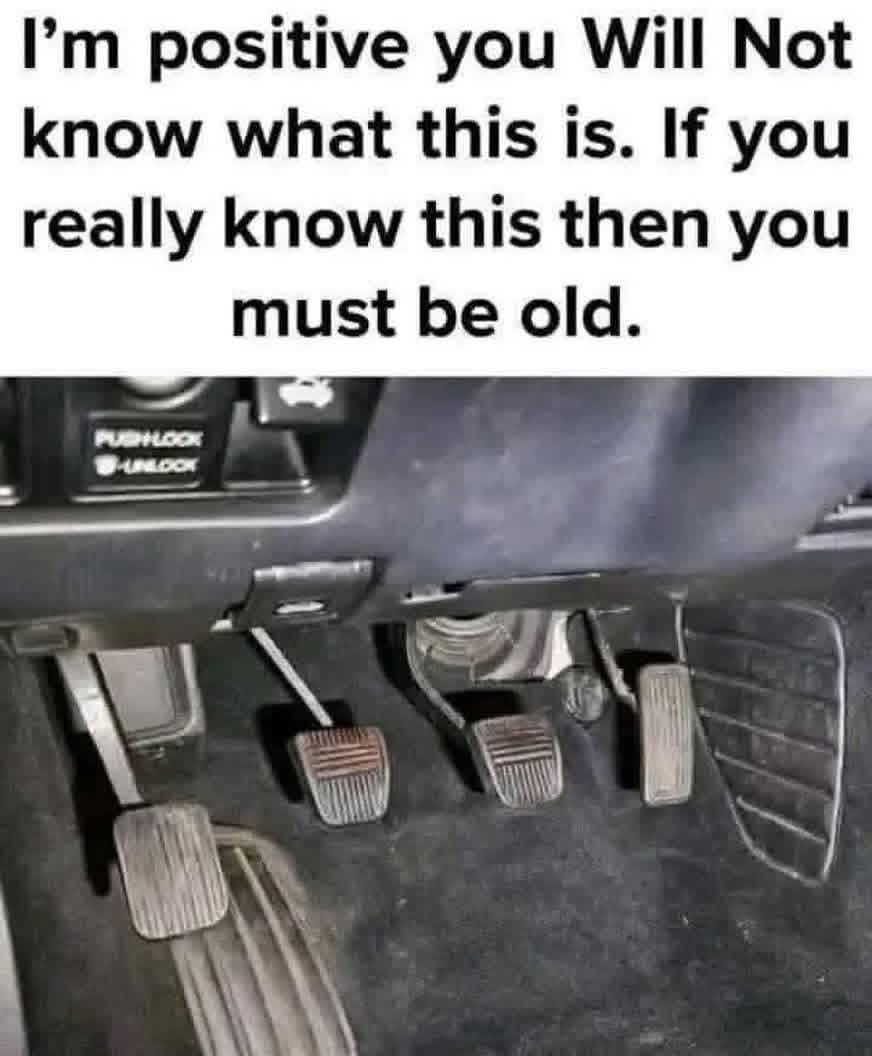

Someone should remind #Nato where the accelerator pedal is. 🫤
@JotaSport
@Cadillac
#LeMans24
#LeMans2026
62

26m
Finvolve and India Accelerator back Integra Robotics with $1.12 million pre-Series A funding
economictimes.indiatimes.com…

11
Abhishek Reddy retweeted

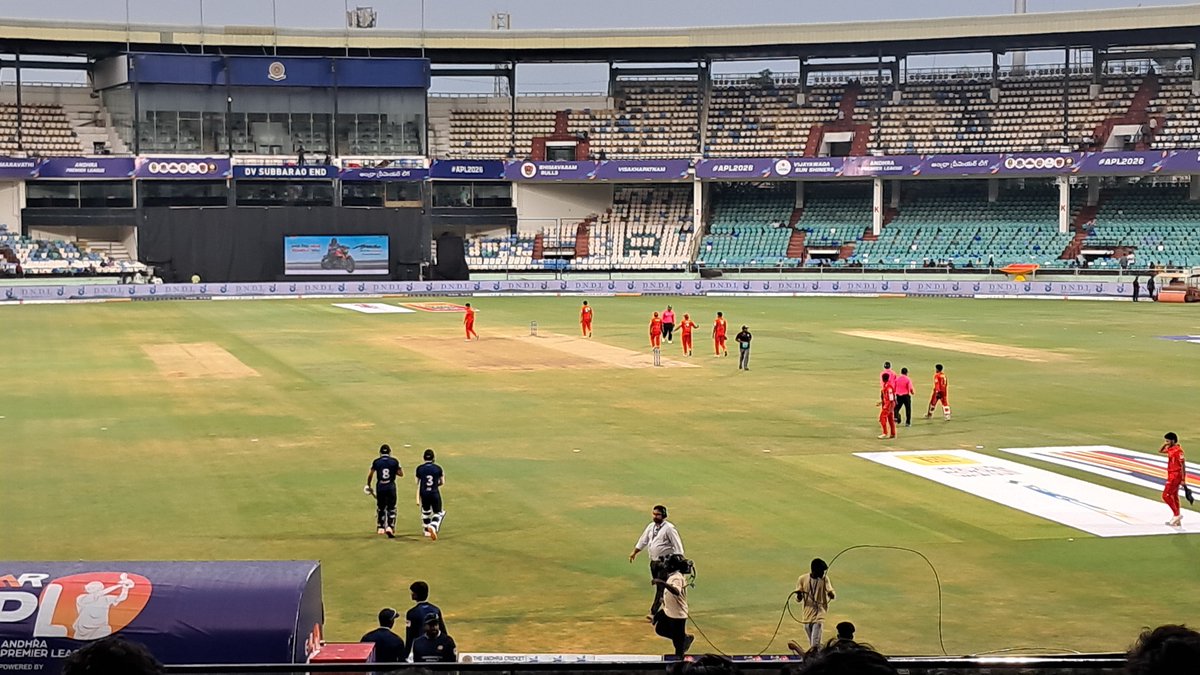
SDNV prasad presses the accelerator right away after the break 🔥
B2b Sixes of B Yeshwanth
1
1
14
Johan retweeted

Smartphones are not the explanation for the recent decline in fertility. Instead, they are an accelerator of deeper forces already at work.
Let’s start with the facts. Fertility is falling almost everywhere: in rich, middle-income, and poor countries; in secular and religious countries; and in countries with high and low levels of gender equality.
The decline accelerated around 2014. So, no country-specific explanation will work unless you are willing to believe that 200 distinct country-specific explanations arrived at roughly the same time.
Smartphones look like the obvious candidate: the first iPhone was released in 2007, and global adoption has been astonishingly fast.
Economists understand the first major decline in fertility in advanced economies, from 6 or 7 children per woman throughout most of human history to about 1.8, that occurred between the early 1800s and roughly 1970, well before smartphones. The main drivers were a sharp fall in child mortality (effective fertility was rarely above 3 and often close to 2) and the shift from a low-skill, rural agrarian economy to a high-skill, urban industrial one. We have quantitative models that fit these facts well.
Country-specific factors mattered too, of course. Proximity to low-fertility neighbors accelerated Hungary’s decline, while fragmented landowning structures accelerated France’s. But these were second-order mechanisms.
This is also why most economists long considered Paul Ehrlich’s doom scenarios implausible. We forecast that fertility in middle- and low-income economies would follow the same path as in the rich, probably faster, because reductions in child mortality reached India or Africa at lower income levels (medical technology is nearly universal, and most gains come from handwashing and cheap antibiotics, not Mayo Clinic-level care). Much of what we see in Africa or parts of Latin America today is still that old story.
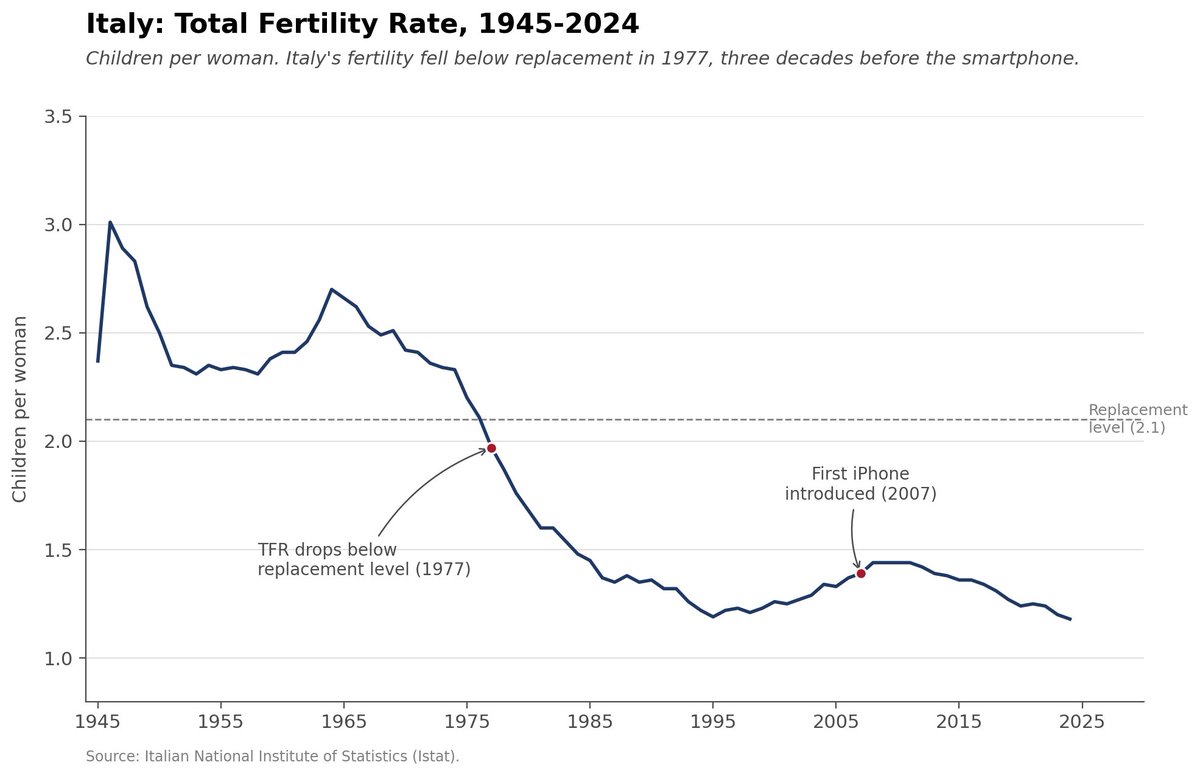
But in the 1980s, a new pattern appeared. Japan and Italy fell below 1.8, the level we had thought was the new floor. By 1990, Japan was at 1.54 and Italy at 1.36.
This second fertility decline began in Japan and Italy earlier than elsewhere, driven by country-specific factors, but the underlying dynamics were widespread: secularization, an education arms race, expensive housing, the dissolution of old social networks, and the shift to a service economy in which women’s bargaining power within the household is higher. The U.S. lagged because secularization came later, suburban housing remained relatively cheap, and African American fertility was still high. U.S. demographic patterns are exceptional and skew how academics (most of whom are in the U.S.) and the New York Times see the world.
My best guess is that, without smartphones, Italy’s 2025 fertility rate would be about 1.24 rather than 1.14. I doubt anyone will document an effect larger than 0.1-0.2. Italy was at 1.19 in 1995, not far from today’s 1.14. The TFR is cyclical due to tempo effects, so I do not read too much into the rise between 1995 and 2007 or the decline from 1.27 in 2019 to 1.14 today. The direct effect of smartphones is not zero, but it is not, by itself, that large.
Where social media, in general, and smartphones, in particular, matter is in the diffusion of social norms. What would have taken 25 years now happens in 10. Social media are not the cause of fertility decline; modernity is. But they are a very fast accelerator.
That is why social media are a major part of the story behind Guatemala (yes, Guatemala) going from 3.8 children per woman in 2005 to 1.9 in 2025. Without them, Guatemala would also have reached 1.9, just 20 years later.
Modernity, in its current form, is incompatible with replacement-level fertility. By modernity, I do not mean capitalism: fertility fell earlier and faster in socialist economies than in market economies. Socialist Hungary fell below replacement in 1960, and socialist Czechoslovakia in 1966 (both experienced small, short-lived baby booms in the mid-1970s). By modernity, I mean a society organized around rational, large-scale systems and formalized knowledge.
Countries will not converge to the same fertility rate. East Asia is likely stuck near 1, possibly below, given its unbalanced gender norms and toxic education systems. Latin America faces the same gender problem plus weak growth prospects, so I expect something around 1.2. Northern Europe has more egalitarian family structures and might hold near 1.5. The very religious societies are probably the only ones that will sustain 1.8.
All of this could change with AI or changes in population composition. We will see. But on the current evidence, deep sub-replacement fertility is the “new new normal.” Unless we reorganize our societies, better learn to handle it as best we can.
223
919
3,712
900,525
EmeShoTony retweeted

“Pure energy” making it sound like the mf got sent through a particle accelerator 💀
2
2
251
4,818

That kind of partner who actually pushes you is worth more than any amount of funding. The best accelerator experiences come from people who've built things themselves and can spot the gaps you can't see yet.
2

SuiPlug Testnet Summary 🚀@suiplug
What it is:
SuiPlug is a Web3 e-commerce platform on the Sui blockchain for buying real gadgets (laptops, phones, headphones, gaming gear, etc.) using crypto.
Testnet is now LIVE – open to everyone for testing and feedback.
Key Features
• Switch wallet to Sui Testnet
• Connect wallet → Browse & buy gadgets with SUI or USDT
• Instantly receive an Intelligent NFT in your wallet containing full purchase details, configuration, and proof of ownership
Recent Tech Upgrades
• Walrus integrated as decentralized storage layer (for product data, images, configs)
• Exploring Seal 🦭 for privacy-focused transactions
• Participating in Sui HydroPower (Sui’s accelerator/bootstrapping program)
Goal: Build a seamless on-chain shopping experience with verifiable NFT receipts that go beyond simple transactions.
Try it here: suiplug.store/ (Testnet flow)
It’s early stage they’re actively collecting feedback while iterating. The “Intelligent NFT” concept for physical/digital hybrid purchases is the standout idea.

6
4
10
185