

21 Jan 2025
Cooling and Durability:
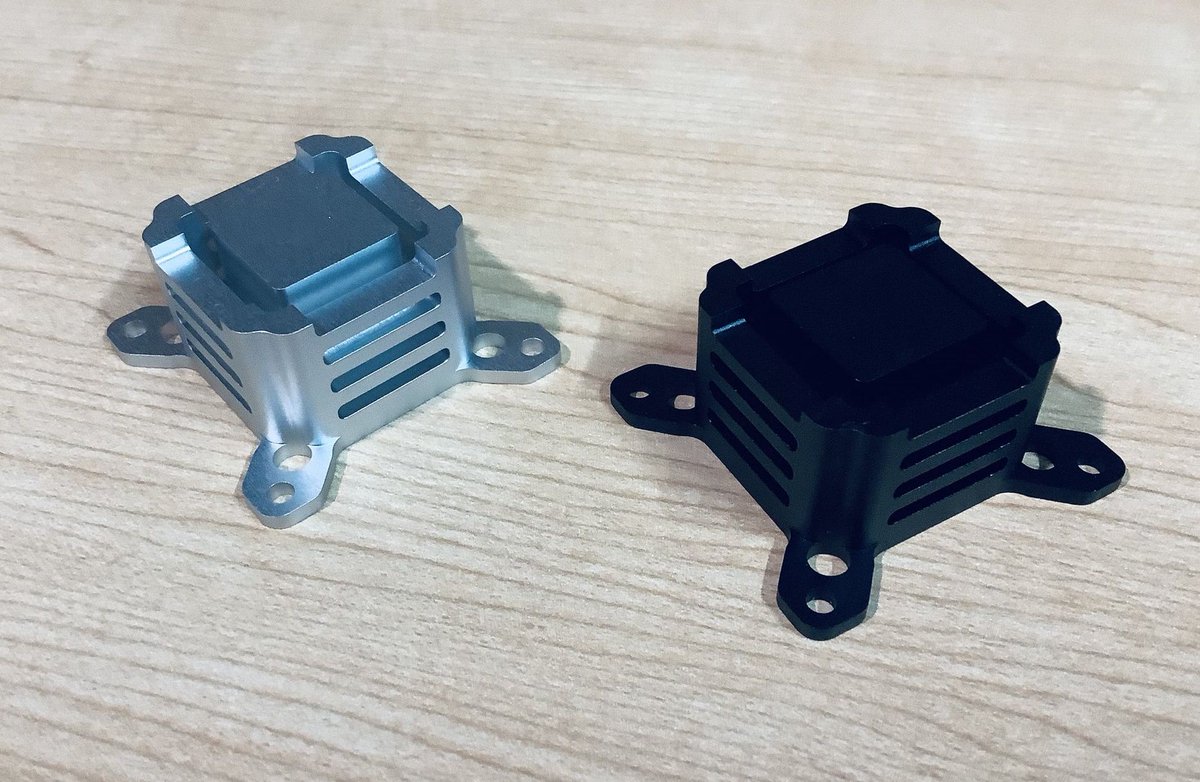
The Bitty Axe Comes stacked with the innovative ThermoColumn-AirMatrix! An advanced Heatsink and Semiconductor to help with Chip Cooling. 🥶
1
3
73


8 Nov 2024
Upgrading this classic #bitaxe 201 with our ThermoColumn-AirMatrix design! As we push the boundaries of open-source Bitcoin mining hardware development, our focus remains on achieving optimal passive cooling, silent, reducing the need for costly fans, enhancing efficiency, and preserving a sleek, compact form factor.
24
17
168
13,443
2 Nov 2024
A little more information about ThermoColumn-AirMatrix
2 Nov 2024

Excited to unveil the ThermoColumn-AirMatrix! Advanced Heatsink and Semiconductor Chip Cooling. Check out our GitHub repository to explore this advanced cooling technology engineered for peak efficiency and performance. github.com/BeeEvolved/Thermo…
6
1,219
2 Nov 2024
Open-source #Bitcoin mining hardware is about to get a little cooler. Presenting the MineOps BM1370 V1, featuring the ThermoColumn-AirMatrix system.
9
13
117
9,995
2 Nov 2024
Excited to unveil the ThermoColumn-AirMatrix! Advanced Heatsink and Semiconductor Chip Cooling. Check out our GitHub repository to explore this advanced cooling technology engineered for peak efficiency and performance. github.com/BeeEvolved/Thermo…
3
4
39
4,900

12 Jan 2024
Reaching new heights: A&S alum
@BashirTheKhan and AirMatrix pave the way for drone highways | Faculty of Arts & Science shar.es/agfZUr via artsci.utoronto.ca
3
2
347

22 Dec 2023
🧵 How the FAA regulates drone flights
LAANC is a system created and used by the FAA to integrate drone operations into the existing infrastructure for managing national airspace.
Here is a detailed breakdown:
Understanding LAANC:
LAANC (Low Altitude Authorization and Notification Capability) is a collaborative venture between the FAA and private industry. It plays a pivotal role in facilitating the integration of Unmanned Aircraft Systems (UAS) into controlled airspace.
Key Functions of LAANC:
• Access to controlled airspace at or below 400 feet.
• Awareness of permissible and restricted flight zones.
• Offers Air Traffic Professionals visibility into drone operations, improving overall airspace management.
UAS Data Exchange:
LAANC's functionality relies on the UAS Data Exchange, enabling the sharing of airspace data between the FAA and approved companies known as UAS Service Suppliers (USS). These USS entities provide the necessary desktop and mobile applications for utilizing LAANC capabilities.
Automation of Authorization:
LAANC streamlines the application and approval process for airspace authorizations. Drone operators, utilizing applications developed by FAA-approved UAS Service Suppliers, can quickly apply for airspace authorization.
Data Verification & Approval:
Authorization requests undergo thorough scrutiny against multiple data sources in the FAA UAS Data Exchange, encompassing UAS Facility Maps, Special Use Airspace data, Airports and Airspace Classes, as well as Temporary Flight Restrictions (TFRs) and Notices to Airmen (NOTAMs). If deemed compliant, pilots receive near-real-time authorization.
Operational Aspects:
• Drone pilots, unless specified in authorization, are not required to notify the tower before flying.
• LAANC strictly provides airspace authorizations; pilots must still adhere to NOTAMs, consider weather conditions, and comply with all airspace restrictions.
Utilizing LAANC:
• Drone pilots operating below 400 feet in controlled airspace around airports must obtain FAA airspace authorization.
• Available to Part 107 pilots and Recreational Flyers, access to LAANC is through FAA-approved UAS Service Suppliers.
Two Application Methods:
• Near real-time authorization request for operations under 400 feet (for Part 107 Pilots and Recreational Flyers).
• "Further coordination request" for flights above the designated altitude ceiling in a UAS Facility Map, up to 400 feet (available to Part 107 pilots, with applications up to 90 days in advance).
Qualification Requirements:
• Part 107 pilots must register drones and hold a Remote Pilot Certificate.
• Recreational Flyers need to register drones and take the Recreational UAS Safety Test (TRUST) before the first flight.
Coverage & Expansion:
• LAANC is available at 726 airports.
• For controlled airspace near airports without LAANC, the manual process allows for authorization application.
Approved LAANC UAS Service Suppliers:
Several companies, including AirMatrix, Airspace Link, Aloft, AstraUTM, AutoPylot, Avision, Botlink, eTT Aviation, FlightReady, UASidekick, and Wing.
Additional info about these software companies here: @getnexusio
Hope this has been helpful and informative!
4
363

25 Sep 2023
$PLTR If you're interested in the Palantir x AirMatrix Partnership ... ⬇️
Unlocking the Future of Drone Tech: Palantir Partners with AirMatrix
dailypalantir.com/post/unloc…
7
31
2,247

18 Aug 2023
AirMatrix, IN-FLIGHT Complete SAIL 4, BVLOS Drone Ops Over Urban Areas: Pushing the Boundaries of Complex Missions dlvr.it/StrSbz
4
44
18 Aug 2023
$PLTR
Unlocking the Future of Drone Tech: Palantir's Partnership with AirMatrix
dailypalantir.com/post/unloc…
1
16
1,560

Bashir Khan, Ayaan Haider and Shayaan Haider founded AirMatrix as a drone delivery initiative at the University of Toronto in 2018. It now provides critical drone infrastructure for private drone operators, airports and cities. on.forbes.com/6015P5ibv #ForbesUnder30Local: Toronto

3
3
28
42,246
25 Jul 2023
NEW ARTICLE ⬇️
Unlocking the Future of Drone Tech: Palantir Partners with AirMatrix
dailypalantir.com/post/unloc…
1
11
1,150

16 Jul 2023
AIRMATRIX.
$PLTR & AirMatrix are joining forces to make drone flying safe & smart. Using #AI data on weather, maps, & aerial signals for a real-time airspace view. Libra manages drone traffic & monetizes as drone usage grows.
Source: prnewswire.com/news-releases…
1
8
516

13 Jul 2023
$PLTR Palantir Announces New Partnership With AirMatrix
-Palantir is in focus as the company continues to expand its exposure to AI.
-The company announced a new partnership with Airmatrix and an expanded partnership with Carahsoft.
-PLTR is up almost 200% from its late-December low and has more than doubled from the May low.
1
1
3
812

13 Jul 2023
#Palantir Technologies and AirMatrix, an airspace infrastructure technology provider, yesterday announced a strategic partnership to accelerate and scale its drone operations.
thefastmode.com/technology-s…
1
3
2
242

13 Jul 2023
AirMatrix x $PLTR ⬇️
"The Foundry Ontology allows the extraction of valuable insights from complex data landscapes which AirMatrix proprietarily derives, including those relevant to autopilots in complex environments from updated urban data sets, micro-weather, millimeter-precise aerial coordinates, accurate maps, aerial uplink and downlink speeds, electromagnetic interference, ground-based radar, radio-frequency interference, telecommunications data, and more"
prnewswire.com/news-releases…
7
36
3,056

12 Jul 2023
Palantir AirMatrix !
Congrats to @_AirMatrix_ @BashirTheKhan @PalantirTech
investors.palantir.com/news-…
1
6
395