
Questions courtesy of @JeeC84 that need answering.
1. How do you plan to handle KYC/AML? Through Xaman, an external provider, or an address allowlist?
A. Issuer-Level KYC/AML (Primary Method)
Each RWA issuer is responsible for performing proper KYC/AML on investors before minting or distributing tokens. This is the standard model used by most compliant RWA platforms.
B. On-Chain Compliance Engine
I built a modular Compliance Engine (inspired by ERC-3643 / T-REX standards) directly into the smart contracts.
It supports:
-Address allowlisting / whitelisting
-Transfer restrictions (e.g., only verified addresses can send/receive certain RWAs)
-Jurisdiction blocking
-Investor limits (accredited investor rules, etc.)
-Time-locks or lock-up periods
C. Integration with External Providers
This will integrate with reputable third-party KYC/AML providers (such as Persona, Civic, or Sumsub) so users can complete verification directly in the app when required by a specific RWA. Once verified, their wallet address gets whitelisted on-chain for that asset.
D. Xaman & Unrestricted Tiers
-For fully permissionless / non-security RWAs, trading can remain open.
-For regulated offerings, we’ll clearly label them and require KYC.
1
20


Microsoft Defender has a public exploit granting SYSTEM on fully patched Windows. No patch yet. Defend with signature-based allowlisting.
#CyberSecurity #CISO #WindowsSecurity
12

Jun 15
How many emails did you receive this week?
50?
500?
5,000 across your organization?
Now ask yourself a harder question:
How many attachments were downloaded?
And how many of those downloads would you confidently approve if they landed in your inbox today?
The uncomfortable reality is that most organizations make hundreds or thousands of trust decisions every day.
A PDF.
A ZIP archive.
A software installer.
A browser download.
A shared document.
A file from a supplier.
A file from a customer.
A file from someone pretending to be both.
And all it takes is one mistake.
Industry reports continue to show that the human element plays a role in roughly 60% of breaches, while phishing and social-engineering-driven attacks remain among the most common initial access vectors.
The typical workflow looks like this:
• A user receives an email or clicks a link
• A file is downloaded
• The file reaches the endpoint
• The user interacts with it
• Security controls begin evaluating behavior
• Alerts are generated
• Investigation starts
But what if the attachment is malicious?
What if it's a brand-new payload?
What if the hash has never been seen before?
What if the domain was registered yesterday?
What if there is no existing signature to match against?
By the time an investigation begins, the trust decision has already been made.
That's the gap.
Not a visibility gap.
A trust gap.
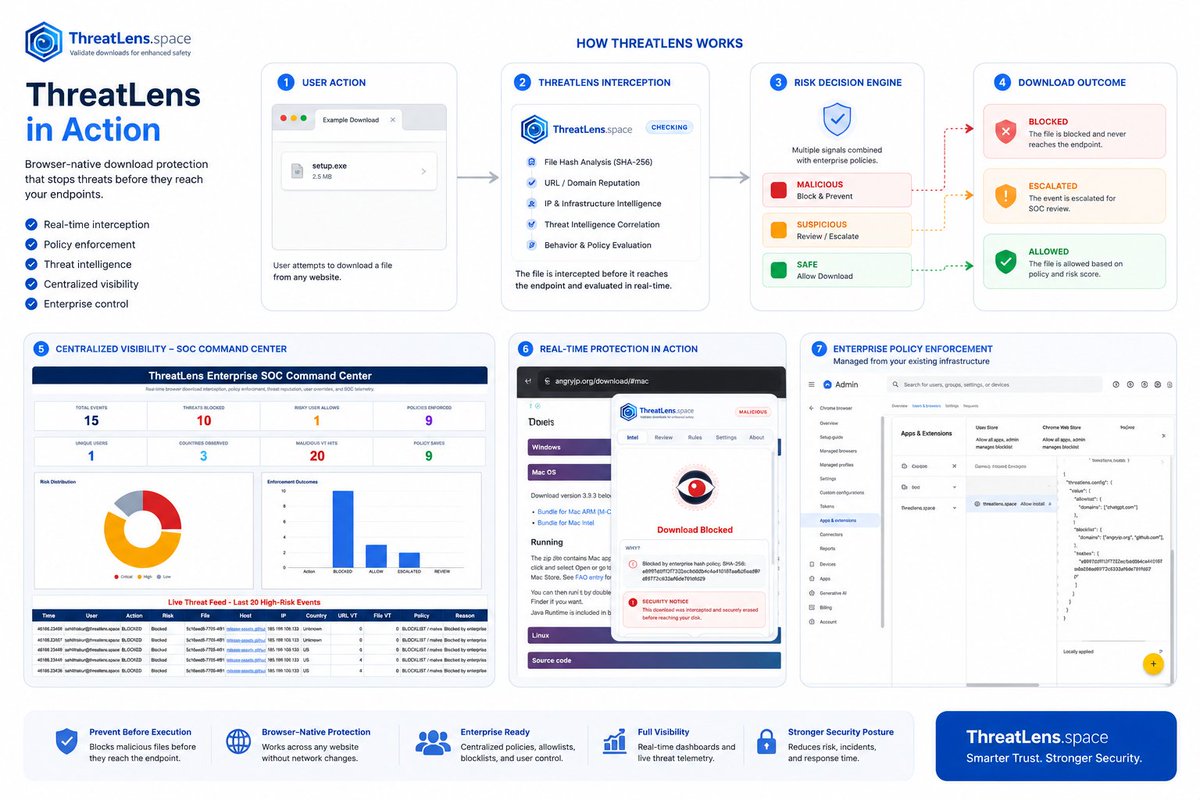
ThreatLens was built to introduce an additional verification layer before downloads are released to the endpoint.
Instead of relying solely on post-execution detection, ThreatLens evaluates multiple trust signals while the file is still in transit, including:
• File fingerprint analysis (SHA-256)
• URL and source reputation
• Domain age and registration intelligence
• IP and infrastructure intelligence
• Threat intelligence correlation
• Contextual risk analysis
• Enterprise allowlisting and blocklisting policies
• Centralized browser policy enforcement
• Download telemetry and audit visibility
The goal is not to replace EDRs, SIEMs, email security, or SOC teams.
The goal is to give organizations another opportunity to verify trust before execution occurs.
The screenshots below show ThreatLens operating in an enterprise workflow:
• Browser-level download interception
• Security verdict generation
• Organization-wide policy enforcement
• Centralized visibility for security teams
• Governance controls for MSPs, MSSPs, and enterprise environments
For MSPs, MSSPs, compliance teams, and security leaders, the question isn't whether users will continue downloading files.
They will.
The question is:
How many downloads enter your environment every week without anyone validating whether they should have been trusted in the first place?
I'm actively looking to connect with MSPs, MSSPs, cybersecurity consultancies, and enterprise security teams interested in browser-native security, download governance, and prevention-focused controls.
🌐 ThreatLens.space
📩 hello@threatlens.space
#CyberSecurity #MSP #MSSP #BrowserSecurity #ThreatIntelligence #SOC #SecurityOperations #Compliance #ChromeEnterprise #ZeroTrust #ManagedServices #SecurityEngineering
33
Tom Miller retweeted

Jun 13
I had Kimi K2.7-code add support for memory safe inline assembly to Fil-C.
Only allowlisting a small number of instructions for now
Seems to work so far. It even added some good tests. I'll have it write more tests tho
4
2
50
3,678

Jun 13
Ada je cara. Salah satu boleh guna ISP allowlisting. Nak explain malas, kau try google
1
2,680

Jun 12
• Interactive skills for threat modeling, scanning, triage, and patching
• Autonomous pipeline for C/C memory vulnerabilities with Docker and ASAN
• Customizable to your language, detector, or vulnerability class
• Sandboxed execution via gVisor with egress allowlisting
1
10

Jun 12
Rogue Planet: a zero-day that abuses Windows Defender to execute as SYSTEM.
Organisations running application allowlisting were protected before the exploit had a name.
You can win the race and still lose the exploit. Read our analysis here : linkedin.com/posts/yet-anoth…
3
208

Jun 12
6/ A secure MCP architecture should include:
✅ Approved MCP server registry
✅ Strong authentication
✅ Least-privilege access
✅ Tool allowlisting
✅ Human approval for high-risk actions
✅ Input/output validation
2
13
Kim Oppalfens (MVP) ✖️ retweeted

Jun 11
YaACDB, Yet another Appcontrol Demonstrated Benefit or AAFTWA! Application allowlisting For The Win Again. Want a kickstart for your Appcontrol for business projects, appcontrol.ai
Jun 11

Microsoft Defender RoguePlanet Zero-Day Grants SYSTEM Access on Updated
Windows
thehackernews.com/2026/06/mi…
1
194

Jun 11
Security isn’t optional, it’s the baseline.
Look for 2FA, withdrawal allowlisting, and login alerts before you trust any platform with your money.
One weak setting is all it takes to lose everything overnight.
1
61
2,610


Jun 11
🔍 Did you know? The RoguePlanet exploit allows attackers to spawn a SYSTEM shell on fully updated Windows systems, posing a severe risk for control & credential dumping. Application allowlisting is key to blocking this threat! #WindowsSecurity #AppAllowlisting
11

Jun 11
We do Block-first Endpoint Security with Application Control and Allowlisting. Our security philosophy is "Deny by default" and only allow "Known good" instead of "Detection". We're Prevention.
1
1
102

Jun 10
After validating Nightmare Eclipse's #RoguePlanet privilege escalation exploit, ThreatLocker Threat Intelligence has published a breakdown of how it works and mitigation strategies organizations can implement. Organizations that deploy Application Allowlisting are already protected.
Read the full analysis: bit.ly/4el7Tvj
#NightmareEclipse #ZeroDay #ThreatIntel #BlueTeam #SOC #CyberSecurity
1
1
174

Jun 10
"Organizations using application allowlisting can prevent the exploit from executing, providing an effective layer of protection against this attack,"
Jun 10

Microsoft Defender 'RoguePlanet' zero-day grants SYSTEM privileges bleepingcomputer.com/news/mi…
1
54

Jun 10
The security tool that's supposed to stop privilege escalation is the one doing the privilege escalation.
RoguePlanet is a confirmed, publicly weaponized Microsoft Defender zero-day — a race condition in Defender's file remediation logic that hands an attacker SYSTEM privileges on fully patched Windows 10 and 11. No CVE assigned. No patch. The June 2026 Patch Tuesday updates, which dropped hours before this disclosure, don't touch it.
The timing is not accidental. The researcher — Nightmare Eclipse (@deadeclipse666) — published RoguePlanet at approximately 7 PM ET on June 9, within hours of Patch Tuesday closing. This is the cadence. GreenPlasma and YellowKey, two BitLocker zero-days from the same researcher, also landed today. RoguePlanet is the fifth confirmed zero-day in a campaign that has now moved systematically through BitLocker, Windows core components, and Microsoft Defender. Each disclosure is PGP-signed. The blog is live. ThreatLocker's CEO Danny Jenkins independently reproduced it on video — Windows 11, KB5094126 installed, 100% reliable on that configuration. This is not a fabrication.
The original vulnerability was worse. Nightmare Eclipse's own write-up confirms RoguePlanet started as remote code execution: coerce a victim to open a malicious .vhd(x) from an SMB share, Defender overwrites its own files, RCE follows via junction attack. Microsoft silently patched mpengine! SysIO* in mid-May, closing that path without public acknowledgment. The researcher spent three weeks rewriting the exploit to still reach SYSTEM via LPE. The RCE variant's patch status remains ambiguous — Microsoft has said nothing about it publicly.
The race condition's variable success rate on different hardware is real but not the operative finding. The operative finding is that the June 2026 patches don't close this, and a working PoC is sitting on a self-hosted git platform at projectnightcrawler.dev — available to anyone, no friction. It's self-hosted because GitHub and GitLab have already removed the researcher's prior work at Microsoft's request. The threat of legal action, including an MSRC post thinly warning researchers against "malicious activity causing real harm," achieved the opposite of its intended effect. You pressure a researcher into building their own distribution infrastructure, the PoC library outlasts whatever legal posture you take. It always does.
The MITRE mapping is straightforward: T1068 (Exploitation for Privilege Escalation) via the race condition, T1548 (Abuse Elevation Control Mechanism) riding Defender's own SYSTEM context, T1553 (Subvert Trust Controls) because the escalation vector is the security tooling itself. The original RCE path maps to T1190 (Exploit Public-Facing Application) via SMB coercion — that variant's closure is unconfirmed.
The immediate risk is high for any Windows environment running Defender as primary endpoint protection without application allowlisting. LPE-to-SYSTEM is the post-exploitation workhorse. Ransomware affiliates and initial access brokers use it to complete privilege chains after phishing or credential stuffing delivers a low-privilege foothold. RoguePlanet is a clean, publicly available tool that closes that gap in one step.
There is no patch. The current best-available mitigation is application allowlisting — ThreatLocker's own statement is that their allowlisting blocks the exploit's execution chain, which aligns with MITRE D3FEND M1038. Organizations running Defender without that layer are exposed until Microsoft ships a fix.
The medium-term picture is the broader campaign. The researcher claims additional memory corruption vulnerabilities in Defender, plus separate batches in "several other components." The projectnightcrawler.dev repository distributes working exploits regardless of what happens next. The floor dropped out from under organizations that assumed this month's patches closed the Defender risk surface. It hadn't opened yet.
1
711