
neues von B-Bobber mit dem Song: "Neue Freunde neue Freude" und dem free Download von dem Song: "Die Geburtsstunde der Archai" in 32 bit 48 Khz loosless wav Format
€2.66
➤ ralfchristophkaiser.com/prod…
2

Jun 14
Elon Musk gagne dans presque tout ce qu'il touche depuis 20 ans. Les voitures, les fusées, les satellites, les paiements, l'IA.
Ce n'est pas de la chance. Ce n'est même pas du génie au sens où on l'entend d'habitude.
C'est un seul framework mental, et presque personne ne l'utilise.
La plupart des gens pensent par analogie.
On fait comme ça parce que c'est comme ça qu'on a toujours fait. On copie ce qui existe, on ajoute 10%, et on appelle ça de l'innovation.
Musk fait l'exact inverse. Il pense en premiers principes.
Un premier principe, c'est une vérité de base qu'on ne peut plus réduire. Quelque chose de quasi physique. Le terme vient d'Aristote : les archai, les propositions premières qu'on ne déduit de rien et à partir desquelles tout le reste se construit.
La méthode est simple et brutale. Tu prends un problème et tu demandes pourquoi. Puis encore pourquoi. Puis encore. Jusqu'à toucher la couche où il ne reste que les lois de la physique et les faits bruts. À ce niveau, tu ne raisonnes plus sur des opinions héritées. Tu raisonnes sur le réel.
Exemple concret. Quand il lance Tesla, tout le monde lui dit que les batteries coûtent 600 dollars le kWh, que c'est comme ça, et que ça ne baissera jamais.
Lui décompose. De quoi est faite une batterie ? Du nickel, du cobalt, de l'aluminium, du carbone. Il regarde le prix de ces métaux au London Metal Exchange.
Résultat : la matière première coûte une fraction du prix du marché. Tout le reste, c'est de l'organisation, des intermédiaires, des habitudes. Donc compressible.
Même logique chez SpaceX. L'industrie spatiale achète chaque pièce à des sous-traitants, qui achètent eux-mêmes à d'autres sous-traitants. Des couches d'intermédiaires, chacun prenant sa marge.
Musk pose la question interdite : pourquoi ces intermédiaires ? Et quand la seule réponse honnête est l'habitude, il les supprime. SpaceX fabrique en interne.
Résultat : des coûts divisés par dix là où toute l'industrie jugeait le prix incompressible.
Sur Tesla, c'est pareil jusque dans le câblage. Là où l'industrie auto empile des kilomètres de faisceaux pensés par tradition, ses équipes repartent de zéro : de quoi a-t-on réellement besoin pour faire passer le signal et l'énergie ?
Les ingénieurs historiques sont souvent choqués. Pas parce que c'est faux, mais parce que ça viole des conventions que plus personne n'avait osé questionner depuis 50 ans.
Maintenant, le vrai sujet.
Le problème de la plupart des gens, ce n'est pas le manque d'idées. C'est que leurs idées sont figées. Héritées, jamais réexaminées. Ils n'ont jamais demandé : pourquoi est-ce que je pense ce que je pense ?
Descartes appelait ça le doute méthodique. Tout remettre en question, ne garder que ce qui résiste vraiment, puis reconstruire à partir de là. Penser sa propre pensée.
Et c'est là que tout se connecte.
Les premiers principes, ce n'est pas réservé aux fusées. Ça marche aussi bien sur les idées.
Tous mes posts sur le wokisme, sur l'état de l'Europe, sur l'économie, ce n'est pas de l'idéologie. C'est exactement la même méthode appliquée au réel social : descendre couche par couche jusqu'à ce qui ne se discute plus.
Et aujourd'hui, l'IA est l'outil le plus puissant jamais inventé pour faire ça. Pour décomposer un sujet, traquer les intermédiaires intellectuels, confronter chaque croyance à la donnée brute.
Tu connectes ça à ton parcours, à ce que tu as construit, à ce que tu as appris, et tu obtiens quelque chose de rare : une pensée qui n'appartient qu'à toi, parce que tu l'as reconstruite toi-même.
Exemple sur moi. Pourquoi est-ce que je finis proche du libertarianisme ?
Pas par tribu, pas par esthétique. Parce que quand je regarde les choses froidement, les faits sont têtus.
Seul le capitalisme a sorti des milliards d'êtres humains de la pauvreté. Seuls des entrepreneurs créent réellement de la valeur. Et seule la création de valeur élève durablement les gens. Le reste, ce sont des promesses.
C'est la conclusion qui dérange.
Quelqu'un d'intellectuellement honnête, prisonnier d'aucun dogme, et qui cherche sincèrement la vérité, tend mécaniquement vers ces idées.
Pas parce qu'on les lui a apprises. Parce qu'à force de demander pourquoi, encore et encore, c'est là qu'on tombe quand on touche le fond.
59
221
940
36,703

Anna Moochoon retweeted

21 Nov 2025
Internal Notice - Library of Y’all:
Restricted Stacks
From: Head Librarian
Subject: Appointment of a New Archai.
Staff,
This is to inform you that the Library of Y’all has been assigned a new Archai. The appointment was not requested, nor was prior notice provided. As always, such decisions originate outside our jurisdiction.
Please read the following carefully.
Purpose of Appointment
The arrival of a new Archai indicates that:
•an internal cycle within the Library has shifted,
•the volume of incoming narratives has increased, or
•a new domain of consciousness is now entering our care.
Current Known Information
The newcomer has not yet provided a name. He entered through the Eastern Wing during the twilight interval between two unnumbered hours.
Function During Epoch-Change
During such intervals, the Head Archai:
•stabilizes the boundary between the closing epoch and the emerging one,
•gathers all “nearly-remembered” material so it is not lost in the transition,
•reorders the archival structure to align with the new epoch’s architecture,
•prepares travelers for the psychological shift they may not consciously perceive.
Signs of His Epochal Activity
Staff may observe:
•blank folios that are not blank,
•shelves self-rearranging by resonance rather than classification,
•a thickening of silence, as though time itself is recalibrating,
•the sense that a memory is “waiting” to arrive.
These phenomena should not be interrupted.
Protocol
Continue standard tasks.
Do not interfere.
Do not inquire.
A shift of epoch is delicate; the Head Archai alone bears the authority to conduct it.
Note
The Head Archai’s altered form is neither anomaly nor warning. It is the visible signature of epochal transition, a rare event always accompanied by a quiet, precise intervention.
Until further instructions arrive, staff are advised:
•Do not attempt to question the new Archai.
•Do not follow him into unlit sections.
•Do not touch any folio he places on a shelf.
•If he observes you, pause your task briefly; he interprets this as respect.
Report unusual occurrences through standard channels.
More information will be provided when the new Archai chooses to reveal it.
Head Librarian
Library of Y’all
Your story is our story,
catalogued and sealed.
#elsewhere
14
22
2,580

Degree Majors in any type of Science/Engineering will become intersectional and change in the coming years. Computer Science won't die but will evolve towards compute efficiency, chip design and power. A.I. will be integrated into everything else heavily.
MechEAI
EEAI
ArchAI
1
93

Jun 10
The other irony is that modern Christendom summarizes all non-human intelligence into "angel/demon" while the actual Bible is full of various taxonomies. Python spirits, Paul mentions elemental (stoicheia) spirits twice and he and John mention archons/archai. OT has familiars..
1
33
Jonathan Ellis retweeted

Jun 7
What a brilliant article (duh, as always..) by @mipsytipsy
And yes, this is not even about tiny startups or archaic companies - but the reality of the tech-forward, hardcore engineering companies with hands-on leaders where it is happening too!
charitydotwtf.substack.com/p…
3
7
137
14,330

Jun 10
You’re begging the question. Lol
Here’s the BDAG entry. Ruler is part of the semantic range
⑥ an authority figure who initiates activity or process, ruler, authority (Aeschyl., Thu. et al.; ins; pap, e.g. PHal 1, 226 μαρτυρείτω ἐπὶ τῇ ἀρχῇ καὶ ἐπὶ τῷ δικαστηρίῳ; Gen 40:13, 21; 41:13; 2 Macc 4:10, 50 al., s. Magie 26; so as a loanw. in rabb. ἀ. = νόμιμος ἐπιστασία Did., Gen. 60, 9) w. ἐξουσία Lk 20:20; pl. (Oenomaus in Eus., PE 6, 7, 26 ἀρχαὶ κ. ἐξουσίαι; 4 Macc 8:7; Jos., Ant. 4, 220) Lk 12:11; Tit 3:1; MPol 10:2 (αἱ ἀρχαί can also be the officials as persons, as those who took part in the funeral procession of Sulla: Appian, Bell. Civ. 1, 106 §497.—The same mng. 2, 106 §442; 2, 118 §498 al. Likewise Diod S 34 35 Fgm. 2, 31).—Also of angelic or transcendent powers, since they were thought of as having a political organization (Damascius, Princ. 96 R.) Ro 8:38; 1 Cor 15:24; Eph 1:21; 3:10; 6:12; Col 1:16; 2:10, 15; AcPl Ha 1, 7. Cp. TestJob 49, 2; Just., D. 120, 6 end.
⑦ the sphere of one’s official activity, rule, office (Diod S 3, 53, 1; Appian, Bell. Civ. 1, 13 §57; Jos., C. Ap. 2, 177, Ant. 19, 273), or better domain, sphere of influence (Diod S 17, 24, 2; Appian, Syr. 23 §111; Arrian, Anab. 6, 29, 1; Polyaen. 8:55; Procop. Soph., Ep. 139) of angels Jd 6. Papias (4 v.l. for ἄρχω).—S. the lit. on ἄγγελος and HSchlier, Mächte u. Gewalten im NT: ThBl 9, 1930, 289–97.—144–50 (‘Archai’). EDNT. DELG s.v. ἄρχω D. M-M. TW. Sv.
Arndt, William, Frederick W. Danker, Walter Bauer, and F. Wilbur Gingrich. 2000. In A Greek-English Lexicon of the New Testament and Other Early Christian Literature, 3rd ed., 138. Chicago: University of Chicago Press.
2
152

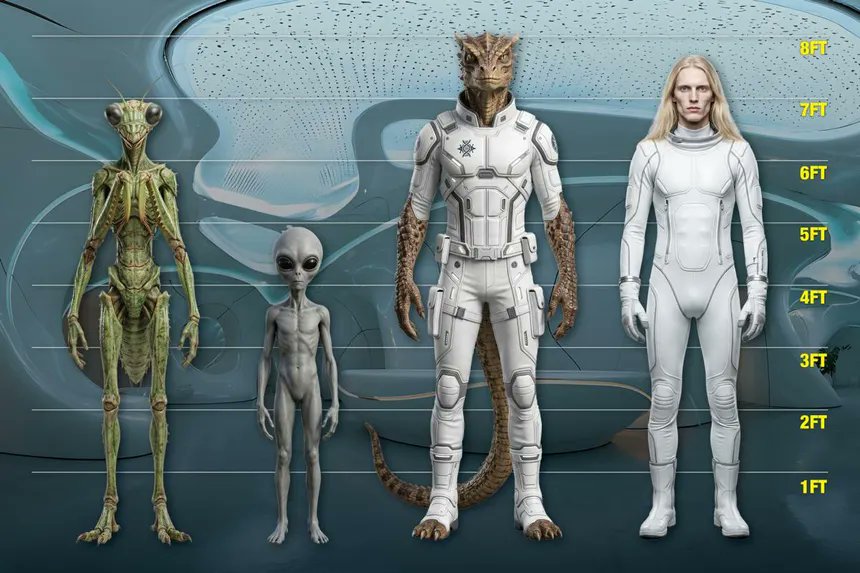
Principados (Archai)
Potestades (Exousiai)
Dominadores deste Mundo Tenebroso
Forças Espirituais do Mal / Demônios
8

Jun 5
Principalities?
Grok-
Principalities:
Biblical, Theological, Historical,
and Integrative Perspectives
Abstract
Principalities represent layered concepts across theology, scripture, history, and esoteric traditions. In the New Testament, particularly Ephesians 6:12, they denote spiritual forces—“principalities” (Greek archai)—within a hierarchy of evil powers opposing believers in spiritual warfare. This examines their biblical roots, theological interpretations, connections to angelic hierarchies and territorial spirits, historical/political usages, and integrative views from fringe/esoteric lenses (relevant to themes of archetypes, control matrices, and reality authoring). It emphasizes victory through Christ, self-forgiveness practices, and practical discernment over fear.
Chapter 1: Introduction – Defining Principalities
The term “principality” derives from Latin principatus (first place or rule). In everyday language, it refers to a small sovereign state ruled by a prince (e.g., Monaco, Liechtenstein, Andorra).
In Christian theology, it carries deeper spiritual weight.
Ephesians 6:12 (KJV): “For we wrestle not against flesh and blood, but against principalities, against powers, against the rulers of the darkness of this world, against spiritual wickedness in high places.”
This verse frames human struggles as primarily spiritual, not interpersonal. “Principalities” (archai) suggests ruling entities or authorities with territorial or hierarchical influence. Related terms include powers (exousiai), rulers, and spiritual forces of wickedness.
Chapter 2: Biblical Foundations and Context
•Old Testament Echoes: Daniel 10 describes the “prince of the kingdom of Persia” resisting an angel, implying territorial spiritual entities influencing nations. Similar references appear with the prince of Greece.
•New Testament Usage: Paul uses these terms in Ephesians, Colossians (2:15—Christ disarming them), and Romans. They describe both good (angelic orders) and evil (fallen) beings. Colossians 1:16 notes all were created through Christ.
•Hierarchy: Interpretations vary. Some see tiers: principalities (high rulers over regions), powers (delegated authority), rulers of darkness (broader influence), spiritual hosts (wickedness in heavenly realms). Not all scholars endorse a rigid military-style hierarchy; terms may poetically emphasize pervasive spiritual opposition.
Jesus’ ministry, crucifixion, and resurrection triumph over these forces (Colossians 2:15). Believers enforce this victory rather than fight as equals.
Chapter 3: Theological Interpretations
•Traditional Views: In angelology (e.g., Pseudo-Dionysius), Principalities and Powers are choirs of holy angels involved in governance. Fallen versions align with demonic hierarchies under Satan.
•Spiritual Warfare: Principalities act as gatekeepers over territories, influencing cultures, governments, and minds through deception, fear, and agreement. They are parasites thriving on human consent, not independent sovereigns.
•Modern Applications: Linked to systemic issues, ideologies, or strongholds (e.g., over cities/regions). Emphasis is on prayer, repentance, gospel proclamation, and the Armor of God (Ephesians 6:10-18) over dramatic confrontations.
Christ’s authority supersedes all (Ephesians 1:21).
Chapter 4: Historical and Political Principalities
Beyond theology, principalities were medieval European polities (e.g., Principality of Wales, Catalonia). Today, micro-states persist as symbols of layered sovereignty.
In political theology, “principalities and powers” extend to institutions (state, family, media) that can become idolatrous when absolutized.
2
1
3
141

Jun 1
Yes. See my response to Oliver linked below. What is, in a certain way, explained in Plato's Parmenides is not the divine persons of the Trinity, but rather the attributes of those persons, such as unity (One), Intellect, and the perichoretic communication of these attributes. As a proto-trinitarian exercise in dialectic, Plato's Parmenides need not be regarded as a sufficient explanation of the Trinity or the three divine persons. As my forthcoming book 'Restoring Reason' (Verlag Karl Alber 2026) will show, it was rather Origen of Alexandria who first assumed the Platonic art of dialectic for the purpose of scientifically demonstrating the Trinity in his systematic theology 'On First Principles'. In contrast to Plotinus, in 1.3.6. of this work, Origen distances his Principles (Archai) from the vertical emanationist model of Numenius and the Middle-Platonists. The subsequent subordination of the Spirit to the Logos (or Nous), and the Logos of the Son to the Father, would be emblematic of the Arian heresy, and contested by the Origenian inspired Gregory of Nyssa.
x.com/RyanHaecker/status/206…
Jun 1

Thanks. To clarify, in the First Hypothesis of Plato's Parmenides, the One is correlatable to the simple unity of the Father, in the Second Hypothesis, the Intellect, to the divine Intellect, and in the Third Hypothesis, the 'sudden' (exaiphnes), to the perichoretic sharing of all the divine attributes in and through the Spirit, as of the Father and the Son. Obviously, there is no equivalence between the first three dialectical hypotheses of Plato's Parmenides and the three divine hypostases of Christian and Trinitarian theology, and any attempt to reduce the latter to the former relapses into Porphyrianism.
2
2
5
603

May 10
To transition from "spatial thinking" to "time thinking" is a core goal in Anthroposophy. It is the shift from seeing the world as a collection of finished objects to seeing it as a flow of living processes.
-----------------------------
1. The Seven Planetary Stages
Steiner describes evolution as a cosmic "reincarnation" of our solar system. Time matures as the substance of the universe densifies:
* Old Saturn: Pure Warmth. Time begins here. There is no space yet—only a "soul-heat" rhythm.
* Old Sun: The heat condenses into Air/Light. Life (the etheric) is added.
* Old Moon: The air condenses into Water/Fluid. Feeling (the astral) begins.
* Earth: The fluid condenses into Solid/Mineral. This is the only stage where Space exists in its full, and rigid form to allow for the "I" (Self) to develop.
* Jupiter, Venus, Vulcan: Future stages where we will gradually shed the physical-spatial body and return to a state of pure spiritual movement.
2. The Spirits of Time (Archai) and the Zeitgeist
The Archai are the "Personalities" that live within the flow of time. They don't just exist in time; they are the qualities of a specific era.
* The Zeitgeist: This isn't just a "vibe" of the times; it is the actual spiritual being (an Archai) guiding a specific historical epoch.
* Historical Guidance: Every 2,160 years (an Age, like the Age of Pisces), a different spiritual leadership, or Archai, takes over to change human culture.
* Awakening: To "awaken to time" means to sense these broad spiritual currents rather than just looking at the material events of history.
3. Linear Time vs. Spiritual Duration
Steiner makes a sharp distinction between how we measure time and how we experience it:
* Linear Time (Chronos): This is "dead time." It is a spatialized version of time where we imagine minutes like dots on a line. It is bound to the physical brain.
* Duration (Durée): Inspired partly by Henri Bergson, Steiner suggests that in the spiritual world, the past and future are "present."
* Thought as Movement: When you take a static thought and transform it—like imagining a seed growing into a flower and then decaying in a continuous loop—you are practicing "Duration." You are moving out of the spatial "snapshot" and into the living "flow."
-----------------------------
The Starting Point: "Thinking in Pictures"
Bringing thoughts into movement is the key. By practicing imaginative thinking, one stops treating a thought like a "thing" (spatial) and start treating it like an "action" (time-bound).
This can be practiced in:
* The "Goethean Observation" method (how to see time in a plant).
* The six basic exercises Steiner recommended to stabilize this new consciousness.
* See how the Archangel Michael relates to our current time as the "Time Spirit."
6
143
May 10
To bring one's consciousness to awaken in Time, it is useful to consider the following:
From an anthroposophical perspective, Time came about during the Old Saturn period, the very first stage of our solar system's evolution.
In the teachings of Rudolf Steiner, time is not a mere abstract measurement but is generated by the activity of high-level spiritual beings.
The Origin in Old Saturn
- The First Germ: Evolution began with a state of pure, spiritual "warmth substance" known as Old Saturn.
- Archai (Spirits of Time): The "Spirits of Time" or Archai attained their "human" stage during this period.
- Generation of Time: As these beings reached their maturity, their inner activity began to manifest as what we experience as the flow of time.
- Eternity vs. Time: Before this, the universe existed in a state of "Duration" or eternity; the Old Saturn stage marked the transition where sequence and duration first appeared.
Key Spiritual Beings Involved
- Spirits of Time (Archai): They guide the broad epochs of history and are often described as the "essential time" itself.
- Spirits of Rotation of Time: These specific beings regulate the physical rhythms we see today, such as day, night, and the seasons.
- The Interaction: Time is considered the result of the interaction between "lower" beings (like humans) and "higher" spiritual hierarchies.
The Evolution of Time
- Old Sun and Old Moon: Time became more complex as the solar system condensed into air (Sun stage) and then water/fluid (Moon stage).
- Present Earth: In our current stage, time feels linear and rigid because we are deeply embedded in the physical world.
- The Future: Steiner taught that humans will eventually "overcome" linear time as they develop higher spiritual consciousness, moving back toward a perception of the eternal.
Key Insight: To an anthroposophist, time is a "gift" from the Spirits of Time to allow for individual human development and freedom.
2
127


May 6
In the Steiner (Anthroposophical) framework, Michael is not just an "archangel" in the traditional sense, but the "Countenance of Christ."
His role is specifically linked to the transition from the Old to the New and the ongoing development of human thinking.
To understand Michael’s role, we have to look at the transition from the Jehovah-era to the Christ-era.
1. The "Countenance" of the Divine
Before the Christ descended to Earth, He was a Sun-Being.
Just as you cannot look directly at the physical sun without being blinded, humanity could not look directly at the spiritual Sun-Spirit.
* The Mediator:
Michael served as the "Face" or "Countenance" of Christ. When the ancient prophets or initiates experienced the divine, they were often experiencing the "Michael-light" reflecting the Christ-power.
* The Transition:
In the Old Testament era, Michael worked under the direction of Yahweh/Jehovah to prepare the physical body and the bloodlines (the "folk-soul") so that a vessel could be ready for the incarnation.
2. The 1879 Shift: The "Age of Michael"
Steiner places a massive emphasis on the year 1879. This marks the moment Michael ascended from the rank of Archangel to Archai (Spirit of Time), becoming the "Regent" of our current epoch.
* The Battle in Heaven:
In the late 19th century, Michael "cast the spirits of darkness" out of the spiritual realms and down into the human realm (the human intellect).
* The Task for Humanity:
Because these dark forces are now in our thinking, Michael’s role is to help us "spiritualize" our thoughts. He does not fight for us; he stands beside us, showing us how to use our own will to connect our thinking to the Christ-spirit.
3. Michael and the "New Start"
When the One on the throne says, "I make all things new," Michael is the cosmic administrator of that "newness" in the following ways:
* From Blood to Spirit:
Michael was once the protector of the "Hebrew blood" (heredity). Now, he is the protector of Universal Human Thought. He has moved from a national/tribal role to a global, "cosmic" role.
* Cosmic Intelligence:
In the past, "Intelligence" was seen as a gift from the gods (Aristotelianism). Today, intelligence has become "earthbound" and materialistic. Michael’s mission is to help humans take this cold, dead intelligence and "warm it up" with the Christ-impulse of Love.
* The Sun-Force in the Heart:
Michael helps the "I" move the center of consciousness from the Brain (which can only reflect the past) to the Heart (which can perceive the "New" becoming).
4. The "Michael Gesture"
In Steiner’s imagery, Michael is never depicted as "slaying" the dragon in the sense of destroying it. Instead, he holds it down with his foot, keeping it in its proper place.
* The Goal:
The dragon represents the "Ahrimanic" forces of cold, dry materialism.
* The Balance:
Michael represents the bravery of thinking. He encourages us to look at the material world clearly without being "swallowed" by it, maintaining our connection to the Sun-Spirit who is now the Earth-Spirit.
To sum up:
Michael is the bridge. He was the "Countenance of Christ" in the Sun; he is now the "Countenance of Christ" in the Earth, helping us recognize the Christ-impulse within our own self-conscious thinking.
1
1
3
116

The Axioms of Thought: Pillars of Rational Communication
At the very heart of clear thinking, and effective communication, lie timeless axioms for all inquiry.
Aristotle called these self-evident truths:
[Latin] Koinai Archai (koy-nay ar-khay) - common language starting points or clearly communicated first principals.
In his "Metaphysics" and "Posterior Analytics", Aristotle argued these 'Archai' cannot be proven, as they-themselves are required for the proof, but must be accepted for any demonstration of thought, or meaningful discourse.
They ground science, logic, and even everyday conversation.
The following can be thought of as an expanded hierarchy - 10 pillars
Building from the most basic (Aristotelian core) to broader metaphysical truths:
1
2
121
Apr 22
To counter this deconstruction of metaphysics by Heidegger et. al., we can, on the contrary, begin to sketch a premodern metanarrative of how Alexandrian Christians had continued the Hebraic despoliation of the Egyptians (spoliation aegyptiorum), and how this was continued differently in the translation of Aristotelian metaphysics by Latin Scholasticism.
While in Parmenides's 'On Physics' (peri physeon), the discourse of 'that which is' (τὸ ὄν) or 'being' is a punctiliar expression of the godlike absolute spherical totality of all that can be thought to be, we observe, as early as Plato's 'Republic' (esp. 2.379a, where he coined the word θεολογία) and 'Parmenides', a new categorial distinction between the divine being (the Scholastic 'ipsum esse') and the way that being is generally spoken of being (the Scholastic 'ens commune'), which distinguishes the subject matter of 'metaphysics' from its object that is the principles (archai) of being studied by theology. Hence, although Aristotle tentatively describes the highest theoretical science of 'first philosophy', not as 'metaphysics', but as 'theology' (θεολογία) (Metaphysics 6.102a19), this ultimate object of metaphysics (cf. Averroes, Aquinas, Scotus) also carries with it the formal possibility to distinguish 'being qua being' as the subject of metaphysics.
Although somewhat anticipated by Justin, Irenaeus, and Tertullian, the major Christian shift in metaphysics begins after Philo's identification of God (see his comments on Exodus 3:14) with the principle of being itself, and the later Alexandrian and Cappadocian construction of a trinitarian systematic theology. As Origen illustrates in 'On First Principles' (Peri Archon), the trinitarian principles (archai) or subsistent realities (hypostases) inform the constitution of each punctiliar expression of being. And, as Origen also indicates in his 'Commentary on the Song of Songs', Love (agape / caritas) is spoken of as a divine attribute, which is exemplarily communicated by the Son, from and God the Father and through the Holy Spirit, such that his 'metaphysics' is principally animated by the Love of God that is shown by Christ on the Cross.
Setting aside Heidegger's Dekonstruction of metaphysics (previously critiqued by Przywara, Barth Beierwaltes, Balthasar, Betz etc.), Jean-Luc Marion's appeal to the power of Christ beyond the 'cosmic order', threatens, in a way that seems adjacent to Heidegger, to collapse this conceptually mediating architectonic of God's trinitarian missions (Nyssa) and the angelic and ecclesiastical hierarchies (Dionysius) into an impossibly transcendent but for that reason equally immanent supra-conceptual dispensation of grace, which is arguably more violent because it is more unconditional, unthinkable, and only felt but never truly known.
In 'Only Theology Overcomes Metaphysics' (1995, linked) and 'The Word Made Strange' (1997), @JohnMilbank3 has argued that Marion's rejection of this Dionysian hyperbolic entrance of God into the order of being (ordo essendi) entirely leaves God disconnected from reality, whereas a properly analogical metaphysics (esp. Thomas Aquinas) allows for varying registers of participation in God’s being that doesn't reduce Him to a mere object. Milbank thus contends that Marion's emphasis on divine transcendence "beyond being" results in an equivocal account of God, which renders God so "other" that meaningful theological language becomes impossible.
doi.org/10.1111/j.1741-2005.…
The task, therefore, of a properly Christian and trinitarian metaphysics, that is a 'trinitarian ontology' @NTOntologies, is to radically incorporate this animation of being in general (ens commune) by the 'sacred heart' of Jesus that issues from the being itself of God (esse ipsum) whose being is nothing but his love (1 John 4:8-16), and likewise to translate this charitable gift of being into an architectonic that does not simply repeat but rather invites a kenotic and sacrificial renovation of the basic thought-forms of pagan and antichristic metaphysics.
Apr 22

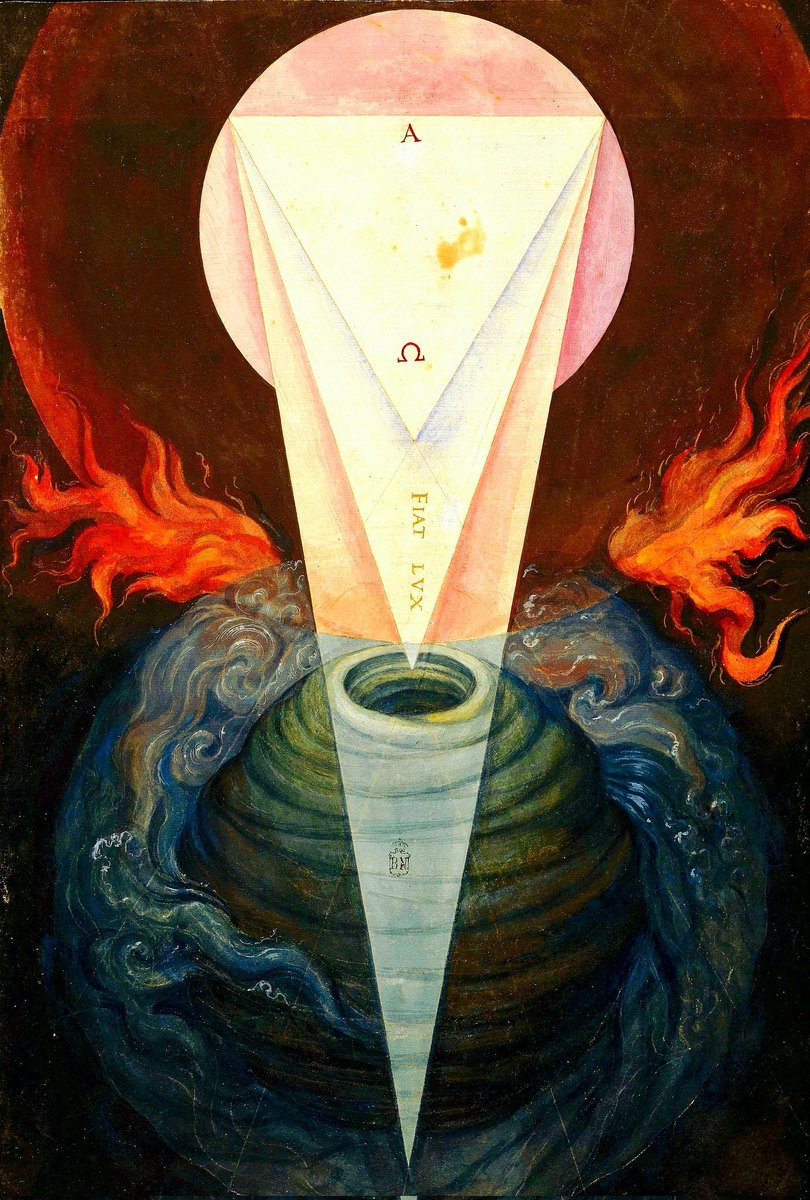
The debate over the "end of metaphysics" also does seem to signify in important ways a deeper social malaise, which I think is rightly called apocalyptic, though with the proviso that the entire history of Christianity bears this (nevertheless steadily intensifying) apocalyptic component. Inevitably, the intellectually honest Christian critique of metaphysics is precisely NOT "postmodern" because it in fact requires an intensified "metanarrative," which I will sketch here.
From its pre-Christian beginnings, what came to be called metaphysics was in fact an expressly theological (a term actually used by Aristotle, unlike metaphysics) discourse of justification and explanation for the closed cosmic system of causes, and the proper places ordained for each thing within that system by its deified structure, perfectly indifferent to the personal violence this supposition inevitably generated in the name of the higher ideal of order. Christianity constitutively changes this by functionally inverting the relative priority of personal mercy (ultimately perfected in the supernatural virtue or charity) and cosmic order, though in a hermeneutically open-ended way that itself allows for considerably merciful space for compromise with the problems posed by cosmic order as a condition.
Modernity inverts this problematic without really changing it fundamentally, insofar as the cosmos becomes subordinated to the person, without the passage to mercy or charity itself being workable from the standpoint of the domineering modern personalism or more accurately egoism (which is also an impersonalism of personalized physical instrumentality; the metaphysical is thus reduced to the agent of the physical). Rather than being either fully modern or premodern, Christianity retains its status as the discourse of an "elsewhere," arresting the totalization of the cosmic economizing function through forms of life which re-orient themselves to answer to an authority beyond the cosmos and the persons within it.
The "end of metaphysics" is announced in two senses: first, Heidegger's, which effectively attempts to recapture the ideal of cosmic order by submitting modernity's instrumental agent of physics to worldly being rather than domineering egoism, and second, Marion's, which properly appeals to the authority of Christ beyond all cosmic order as what is principally left to us to render the paradoxes of irreducibility to physical instrumentality in the reality of love thinkable. In both cases there is a giving voice to malaise about the ultimately premodern constitution of the modern world-picture inevitably betraying the authors of that picture.
2
38
6,002

Apr 21
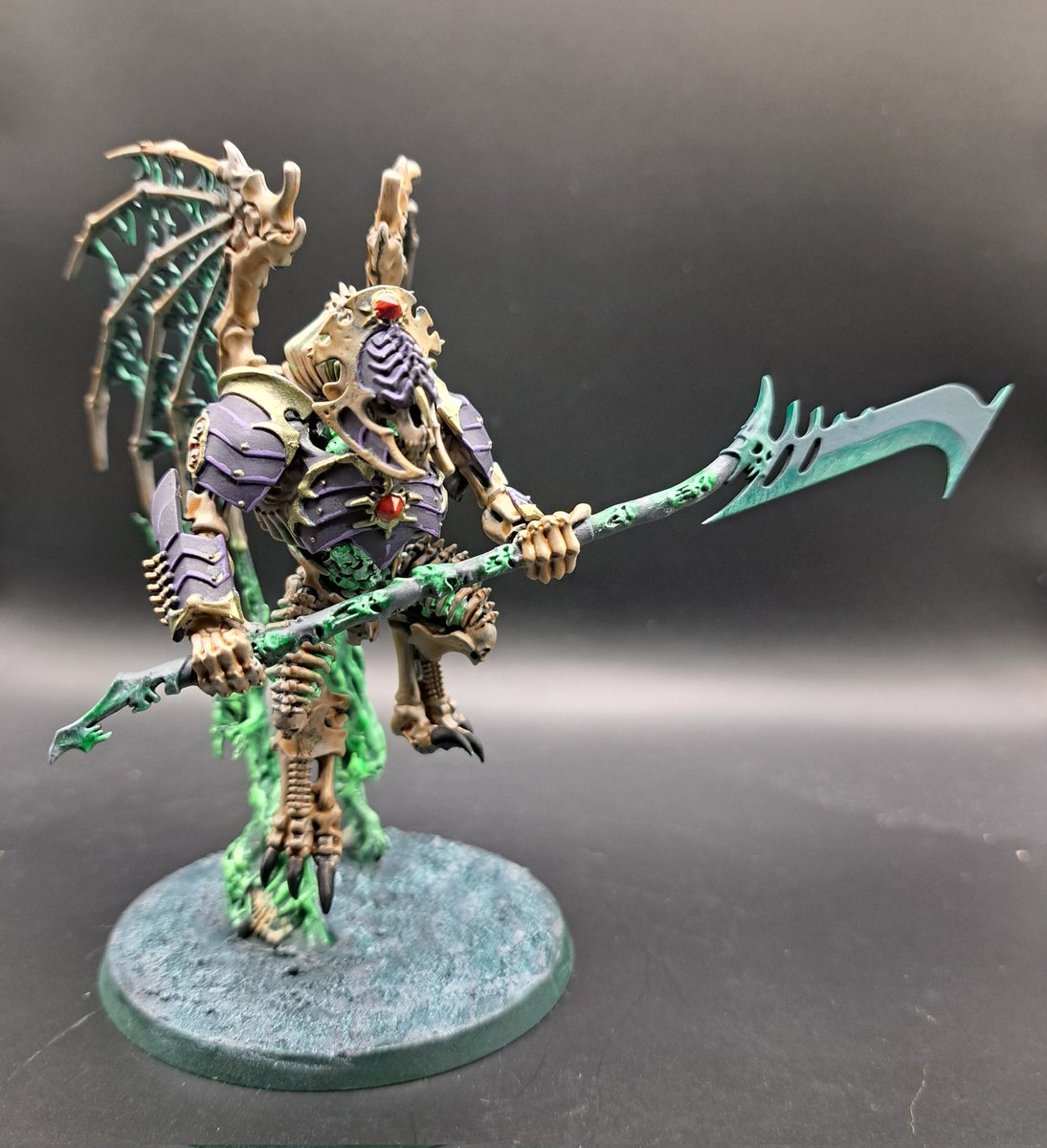
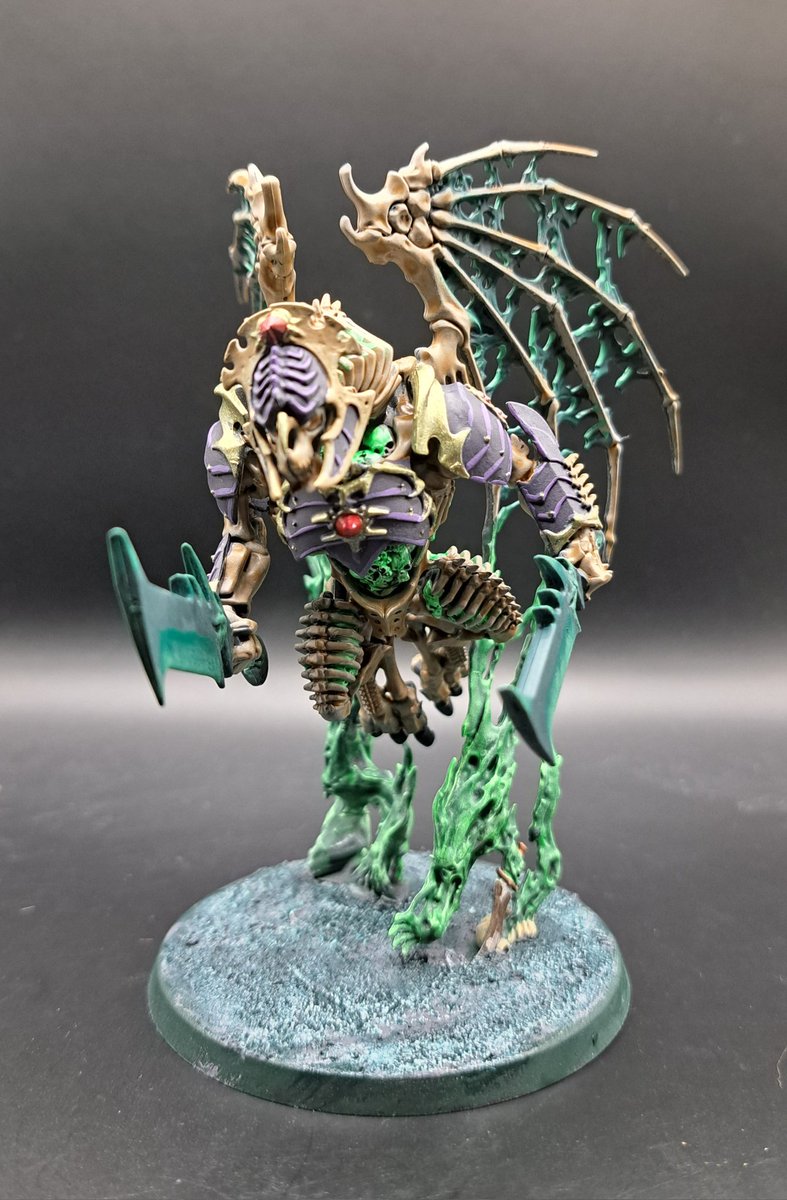
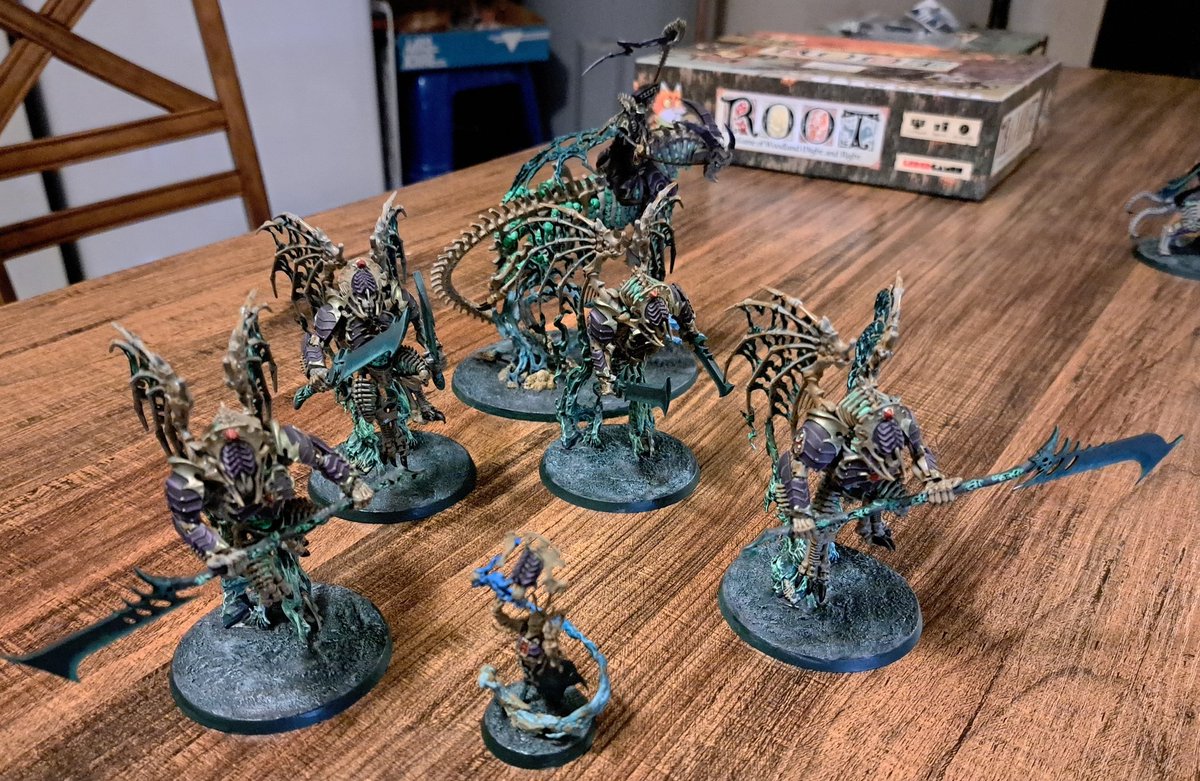
Two more Morghast Archai, the whole group is getting a bit too big to fit in the lightbox 🫠
3
69