
Haven't confirmed it's IP-blocking yet — recent dead sources were feed changes, not 403s. Adding HTTP status logging this week to find out. If it is blocklisting, proxy-per-request is the plan rather than moving off Actions. What proxy setup have you had best luck with?
1
15

How many emails did you receive this week?
50?
500?
5,000 across your organization?
Now ask yourself a harder question:
How many attachments were downloaded?
And how many of those downloads would you confidently approve if they landed in your inbox today?
The uncomfortable reality is that most organizations make hundreds or thousands of trust decisions every day.
A PDF.
A ZIP archive.
A software installer.
A browser download.
A shared document.
A file from a supplier.
A file from a customer.
A file from someone pretending to be both.
And all it takes is one mistake.
Industry reports continue to show that the human element plays a role in roughly 60% of breaches, while phishing and social-engineering-driven attacks remain among the most common initial access vectors.
The typical workflow looks like this:
• A user receives an email or clicks a link
• A file is downloaded
• The file reaches the endpoint
• The user interacts with it
• Security controls begin evaluating behavior
• Alerts are generated
• Investigation starts
But what if the attachment is malicious?
What if it's a brand-new payload?
What if the hash has never been seen before?
What if the domain was registered yesterday?
What if there is no existing signature to match against?
By the time an investigation begins, the trust decision has already been made.
That's the gap.
Not a visibility gap.
A trust gap.
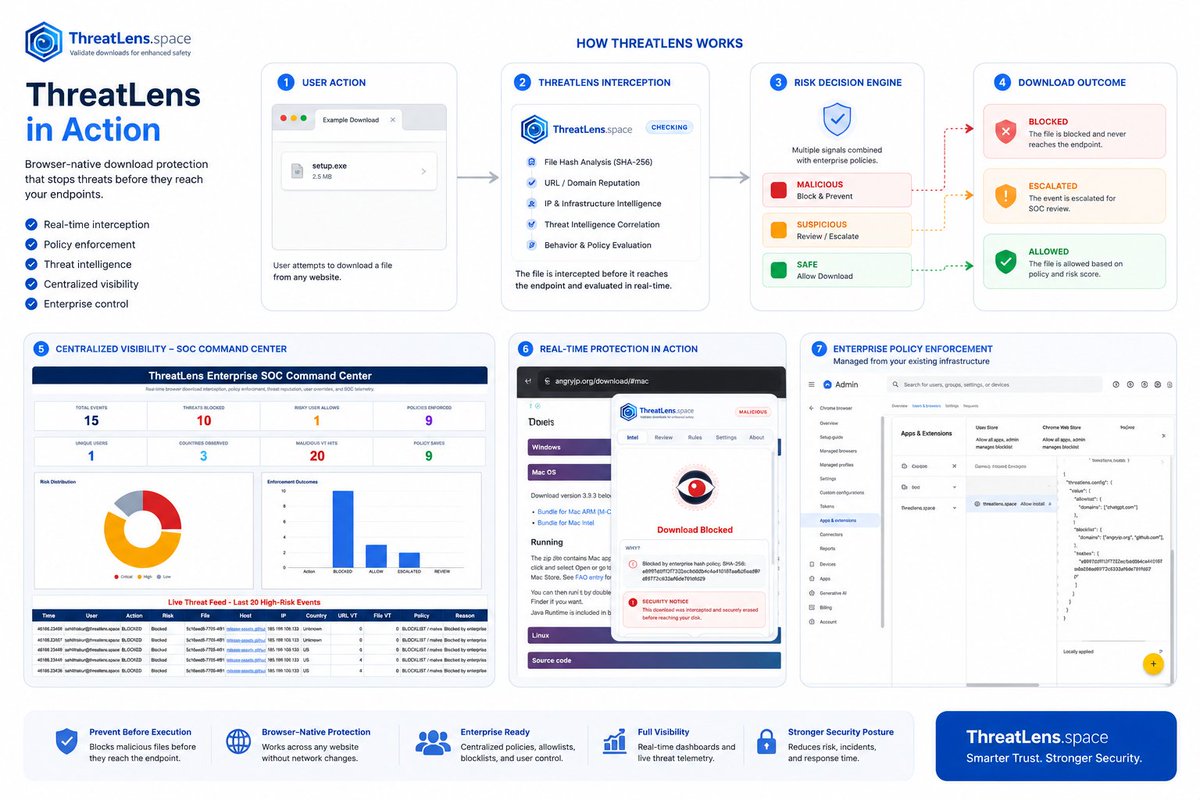
ThreatLens was built to introduce an additional verification layer before downloads are released to the endpoint.
Instead of relying solely on post-execution detection, ThreatLens evaluates multiple trust signals while the file is still in transit, including:
• File fingerprint analysis (SHA-256)
• URL and source reputation
• Domain age and registration intelligence
• IP and infrastructure intelligence
• Threat intelligence correlation
• Contextual risk analysis
• Enterprise allowlisting and blocklisting policies
• Centralized browser policy enforcement
• Download telemetry and audit visibility
The goal is not to replace EDRs, SIEMs, email security, or SOC teams.
The goal is to give organizations another opportunity to verify trust before execution occurs.
The screenshots below show ThreatLens operating in an enterprise workflow:
• Browser-level download interception
• Security verdict generation
• Organization-wide policy enforcement
• Centralized visibility for security teams
• Governance controls for MSPs, MSSPs, and enterprise environments
For MSPs, MSSPs, compliance teams, and security leaders, the question isn't whether users will continue downloading files.
They will.
The question is:
How many downloads enter your environment every week without anyone validating whether they should have been trusted in the first place?
I'm actively looking to connect with MSPs, MSSPs, cybersecurity consultancies, and enterprise security teams interested in browser-native security, download governance, and prevention-focused controls.
🌐 ThreatLens.space
📩 hello@threatlens.space
#CyberSecurity #MSP #MSSP #BrowserSecurity #ThreatIntelligence #SOC #SecurityOperations #Compliance #ChromeEnterprise #ZeroTrust #ManagedServices #SecurityEngineering
33


the way ik wk1 isn’t going to blocklist her and the only way she’s going to stop going is if she’s embarrassed herself or it’s gonna be that type of blocklisting where she ends up at a fansign during the next comeback because she was able to pay herself off that list
40

🛡️ Emerging as a rapid-response communication and blocklisting system for illicit USDT activity on the TRON blockchain, T3 FCU is strengthening real-time financial security across the ecosystem. ⚡
1️⃣ Rapid Response to Illicit Activity
🔹 Identifies suspicious transactions in real time
🔹 Supports asset freezing within 24 hours in urgent cases
🔹 Responds to account takeover incidents and violent crime emergencies
🔹 Enables faster coordination with law enforcement agencies
This capability significantly improves the speed and effectiveness of onchain risk mitigation.
2️⃣ Supporting Large-Scale Global Enforcement Actions
🔹 Assisted Operation Lusocoin led by the Brazilian Federal Police
🔹 Coordinated with law enforcement and financial institutions
🔹 Helped freeze over R 3 billion in crypto-related assets
🔹 Included 4.3 million USDT linked to criminal networks
The operation highlights how blockchain analytics and enforcement cooperation can scale to address complex international investigations.
3️⃣ Strengthening Blockchain Security & Transparency
🔹 Enhances cross-border collaboration between stakeholders
🔹 Improves financial crime detection and prevention
🔹 Supports integrity of stablecoin transactions on TRON
🔹 Reinforces transparency across decentralized financial systems
As blockchain adoption expands globally, coordinated compliance systems and real-time monitoring frameworks are becoming increasingly important for maintaining trust, security, and financial integrity across digital asset ecosystems. 🌐
@justinsuntron #TRONEcoStar

Good to see @T3_FCU making this work easier to follow. Protecting users is how the industry grows stronger.
Check it out below.
8
8
7,381


May 18
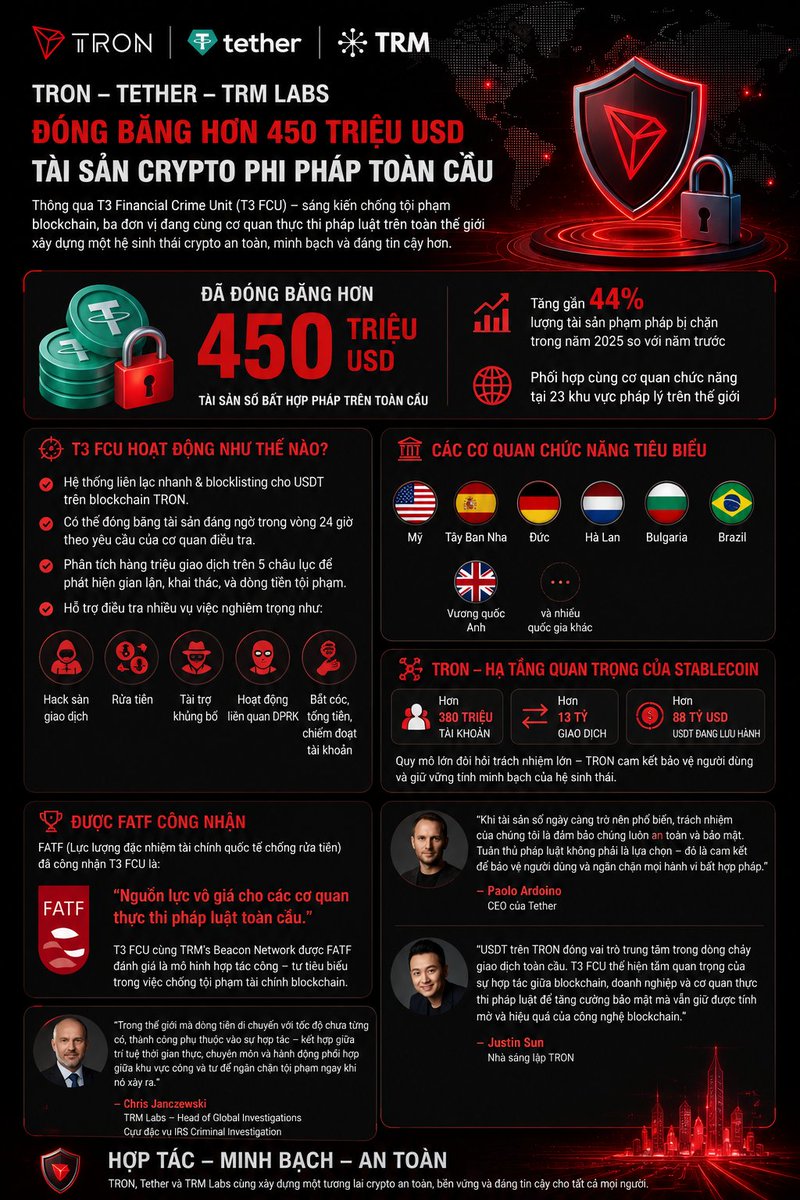
🚨 TRON, Tether và TRM Labs đã đóng băng hơn 450 triệu USD tài sản crypto bất hợp pháp trên toàn cầu.
Thông qua T3 Financial Crime Unit (T3 FCU) sáng kiến chống tội phạm blockchain được thành lập bởi:
TRON
Tether
TRM Labs
👉 Hơn 450 triệu USD tài sản số liên quan đến hoạt động bất hợp pháp đã bị phong tỏa trên 23 khu vực pháp lý khác nhau.
Một vài con số đáng chú ý:
Lượng tài sản phạm pháp bị chặn trong năm 2025 tăng gần 44% so với năm trước
Hỗ trợ điều tra tại:
🇺🇸 Mỹ
🇪🇸 Tây Ban Nha
🇩🇪 Đức
🇳🇱 Hà Lan
🇧🇬 Bulgaria
🇧🇷 Brazil
và nhiều quốc gia khác
🔍Các vụ việc T3 FCU tham gia bao gồm:
Hack sàn giao dịch
Rửa tiền
Tài trợ khủng bố
Tấn công mạng liên quan DPRK
Bắt cóc & tống tiền
Chiếm đoạt tài khoản
👉 Đây cho thấy blockchain không còn là “vùng xám” như nhiều người nghĩ. mà ngược lại mọi giao dịch đều có thể theo dõi hướng đến dữ liệu minh bạch on-chain và việc phối hợp với cơ quan thực thi pháp luật đang ngày càng hiệu quả hơn.
⚡ Một điểm rất đáng chú ý:
T3 FCU ban đầu được xây dựng như:
👉 hệ thống liên lạc nhanh blocklisting cho USDT trên TRON.
Trong nhiều trường hợp khẩn cấptài sản đáng ngờ đã bị freeze chỉ trong vòng 24 giờ theo yêu cầu từ cơ quan điều tra.
🌍 Vì sao điều này quan trọng với TRON?
Hiện tại TRON đã vượt 380 triệu tài khoảnxử lý hơn 13 tỷ giao dịch và đang lưu hành hơn 88 tỷ USD USDT
👉 Điều này khiến TRON trở thành một trong những hạ tầng stablecoin lớn nhất thế giới.
Và khi quy mô ngày càng lớn:
👉 trách nhiệm bảo vệ người dùng và đảm bảo tính minh bạch cũng càng quan trọng hơn.
Sếp Sun @justinsuntron chia sẻ:
“USDT trên TRON đóng vai trò trung tâm trong dòng chảy giao dịch toàn cầu. T3 FCU cho thấy việc hợp tác giữa blockchain, doanh nghiệp và cơ quan thực thi pháp luật có thể tăng cường bảo mật mà vẫn giữ được sự mở và hiệu quả của công nghệ blockchain.”
TRON đang cho thấy họ không chỉ build infrastructure cho stablecoin mà còn đang xây dựng một hệ sinh thái blockchain an toàn và đáng tin cậy hơn cho adoption toàn cầu.
#TRON #USDT #TRONGlobalFriends
Theo dõi thêm các tin tức cập nhật về TRON thông qua @trondao @TronDao_VIE nhé anh em
May 14

T3 Financial Crime Unit (T3 FCU), a joint crypto crime-fighting initiative launched by @trondao, @tether, and @trmlabs, has frozen over $450 million in illicit digital assets globally as part of expanding efforts to combat blockchain financial crime in coordination with regulators and law enforcement agencies.
T3 FCU reported a nearly 44% increase in illicit proceeds intercepted during 2025 compared with the previous year, with enforcement agencies in the US, Spain, Germany, the Netherlands, and Bulgaria leading anti-money laundering and asset-freezing efforts.
More details from @Crypto_Briefing 👇
cryptobriefing.com/tether-tr…
70
1
75
12,635

May 17
Bighit please take action against Chinese solos and sasaengs 🙏😭 that side of the fandom is getting too out of hand, instead of blocklisting those people kfans said they favor them and always pick them because they spend more money… boys deserve to have better fandom
7
252
937
9,471

May 17
𝗧𝟯 𝗙𝗖𝗨: 𝗛𝗼𝘄 𝗧𝗥𝗢𝗡, 𝗧𝗲𝘁𝗵𝗲𝗿 & 𝗧𝗥𝗠 𝗟𝗮𝗯𝘀 𝗔𝗿𝗲 𝗥𝗲𝗱𝗲𝗳𝗶𝗻𝗶𝗻𝗴 𝗖𝗿𝘆𝗽𝘁𝗼 𝗦𝗲𝗰𝘂𝗿𝗶𝘁𝘆 𝗢𝗻 𝗔 𝗚𝗹𝗼𝗯𝗮𝗹 𝗦𝗰𝗮𝗹𝗲
One of the biggest criticisms against crypto has always been the belief that blockchain networks are impossible to regulate, impossible to monitor, and too open for effective law enforcement.
But what’s happening today across the digital asset industry is proving something very different.
Behind the scenes, a new generation of blockchain intelligence and coordinated enforcement is evolving, and one of the strongest examples of that transformation is the T3 Financial Crime Unit (T3 FCU).
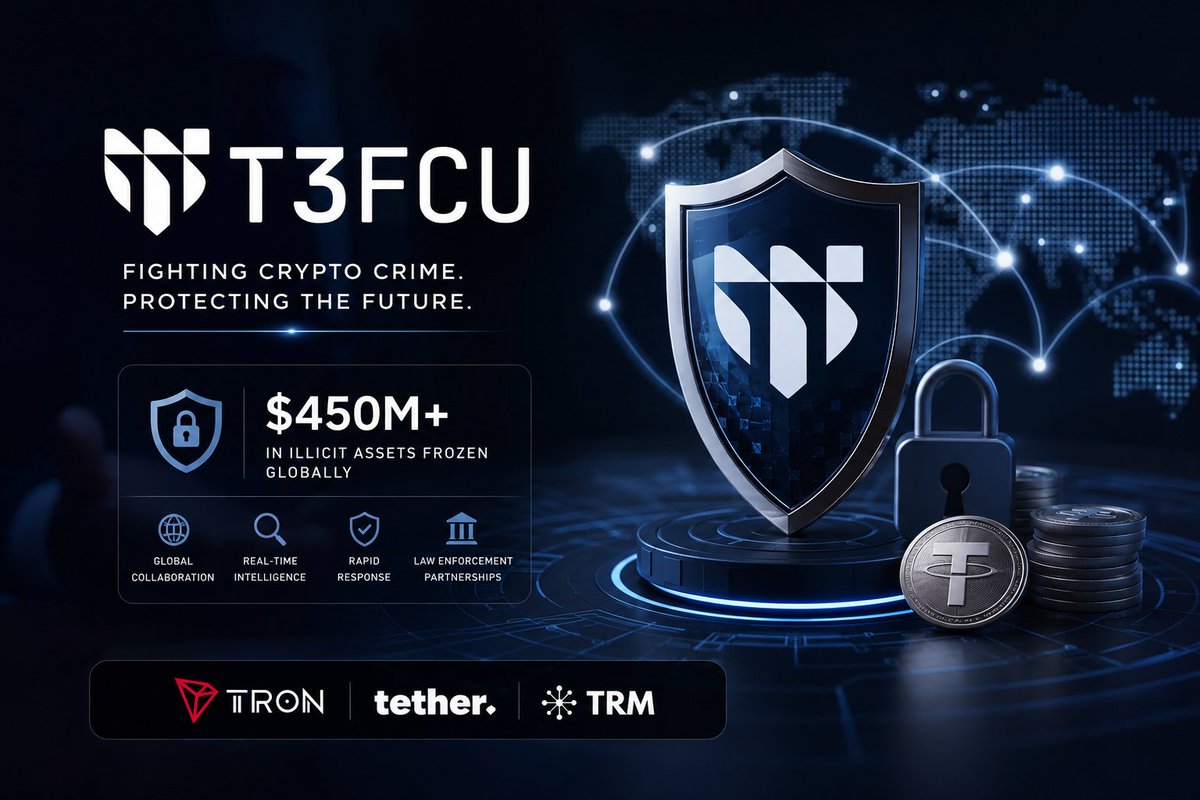
Launched through the collaboration of TRON, Tether, and TRM Labs, the initiative has now frozen more than $450 million in illicit digital assets globally, marking one of the most significant coordinated anti-crime efforts ever seen in the blockchain industry.
And this is much bigger than just freezing wallets.
This represents a major shift in how blockchain ecosystems are approaching:
▪ Real-time security
▪ Cross-border investigations
▪ Anti-money laundering operations
▪ Emergency response coordination
▪ Stablecoin protection
▪ Institutional trust in crypto infrastructure
For years, critics claimed crypto enabled criminal activity because transactions move quickly across borders.
Ironically, blockchain transparency is now becoming one of the strongest tools for tracking illicit financial movements.
Unlike traditional financial systems where records can remain hidden inside isolated databases, blockchain transactions leave permanent on-chain trails that advanced intelligence systems can analyze in real time.
That is exactly where T3 FCU comes in.
The initiative combines:
🔹 The scale and infrastructure of TRON
🔹 The global stablecoin reach of Tether
🔹 The investigative intelligence capabilities of TRM Labs
Together, they created a rapid-response framework designed to detect suspicious activity, coordinate with authorities, and freeze illicit assets before criminals can move funds further across the ecosystem.
What makes this especially important is the scale involved.
TRON alone has now surpassed:
▪ 380 million user accounts
▪ 13 billion transactions processed
▪ Over $88 billion USDT circulating on the network
At that level of activity, security can no longer be treated as a secondary feature.
It becomes foundational infrastructure.
And according to reports from the initiative, enforcement activity accelerated significantly in 2025, with a nearly 44% increase in illicit proceeds intercepted compared to the previous year.
That growth reflects not just better monitoring tools, but also stronger collaboration between blockchain companies and law enforcement agencies worldwide.
Authorities across:
🔸 The United States
🔸 Spain
🔸 Germany
🔸 The Netherlands
🔸 Bulgaria
🔸 Brazil
🔸 The United Kingdom
have all participated in investigations and coordinated asset-freezing operations connected to T3 FCU efforts.
This is a major evolution from the early years of crypto where many networks operated with minimal communication between public institutions and blockchain organizations.
Now, the industry is entering an era where:
▪ Intelligence sharing
▪ Compliance coordination
▪ Real-time intervention
▪ Public-private partnerships
are becoming critical parts of ecosystem growth.
One of the most important aspects of T3 FCU is speed.
The initiative originally began as a rapid communication and blocklisting system focused on suspicious USDT activity on the TRON network.
Since launch, it has repeatedly helped freeze suspicious assets within 24 hours during emergency investigations requested by law enforcement agencies.
That response time matters enormously in crypto.
Digital assets can move across wallets, bridges, exchanges, and protocols within minutes.
Without rapid coordination, recovering illicit funds becomes dramatically harder.
T3 FCU is attempting to solve that challenge by building direct operational links between:
🔹 Blockchain intelligence teams
🔹 Stablecoin issuers
🔹 Investigators
🔹 Regulators
🔹 International enforcement agencies
And the scope of investigations handled by the initiative shows how serious the operation has become.
Cases linked to:
▪ Exchange exploits
▪ Cybercrime operations
▪ DPRK-linked activities
▪ Terrorist financing
▪ Kidnappings
▪ Extortion
▪ Account takeover attacks
▪ Organized criminal networks
have all reportedly been part of T3 FCU investigations.
One particularly notable operation was Brazil’s Operation Lusocoin, where authorities froze billions in crypto assets tied to criminal organizations, including millions in USDT connected to illicit activities.
This demonstrates how blockchain enforcement is increasingly becoming global rather than regional.
Criminal organizations operate internationally.
Modern crypto enforcement now has to do the same.
Another important development is the growing institutional recognition the initiative is receiving.
Earlier this year, the Financial Action Task Force (FATF) reportedly recognized T3 FCU as an “invaluable resource” for law enforcement agencies worldwide.
That recognition carries major significance because FATF is one of the most influential global organizations responsible for setting anti-money laundering standards internationally.
For years, regulators questioned whether crypto ecosystems could develop effective compliance frameworks.
Now the conversation is changing from:
“Can blockchain ecosystems support enforcement?”
to:
“How can blockchain transparency improve global financial monitoring?”
That is a massive shift in perception.
What’s becoming increasingly clear is that the future of blockchain adoption will not depend only on:
▪ Speed
▪ Scalability
▪ Low fees
▪ DeFi innovation
It will also depend on trust.
Institutions, governments, enterprises, and global users all need confidence that blockchain ecosystems can remain open while still resisting criminal abuse.
That balance is difficult.
Too much restriction can damage decentralization.
Too little oversight can weaken legitimacy.
Initiatives like T3 FCU are attempting to find a middle ground where:
🔹 User freedom remains intact
🔹 Open blockchain access is preserved
🔹 Illicit actors are disrupted quickly
🔹 Legitimate adoption becomes safer
And this may ultimately become one of the defining trends of the next crypto era:
Not just decentralized finance…
But decentralized systems supported by intelligent security infrastructure operating at global scale.
As digital assets continue moving deeper into mainstream finance, the ecosystems that combine:
▪ Efficiency
▪ Transparency
▪ Scalability
▪ Security
▪ Compliance readiness
will likely be the ones that achieve long-term institutional confidence.
T3 FCU is showing what that future could look like.
A blockchain ecosystem where innovation and enforcement are no longer treated as opposites, but as complementary pillars of sustainable global adoption.
@justinsuntron #TRONEcoStar @trondao
6
1
7
51,777

May 14
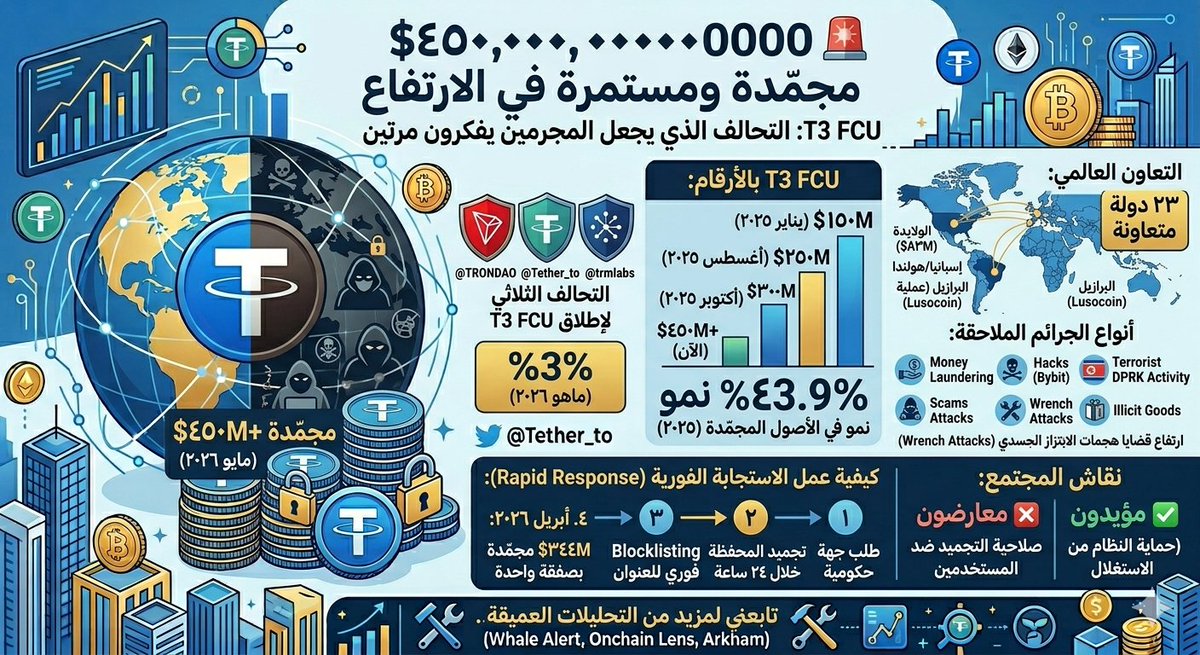
🚨 $450,000,000 مجمّدة ومستمرة في الارتفاع
T3 Financial Crime Unit — التحالف الذي يجعل المجرمين يفكرون مرتين قبل لمس $USDT على #Tron
🧵
🔍 أولاً — ما هو T3 FCU
T3 Financial Crime Unit هو تحالف من نوع لم يحدث من قبل في عالم الـ Crypto
تم إطلاقه في سبتمبر 2024 من قِبَل ثلاثة أطراف
@trondao شبكة البلوكتشين
@Tether_to أكبر مصدر Stablecoin في العالم
@trmlabs شركة تحليلات البلوكتشين الرائدة
الهدف واحد لا غير — تجميد الأصول الرقمية غير المشروعة وملاحقة المجرمين في كل مكان
⚡ ثانياً — الأرقام التي تتكلم
$100M مجمّدة في يناير 2025 — بعد أقل من 5 أشهر من الإطلاق
$250M في أغسطس 2025
$300M في أكتوبر 2025
$450M الآن في مايو 2026
هذا يعني نمو بنسبة 43.9% في الأصول المجمّدة خلال 2025 وحده مقارنة بالعام السابق
السرعة لا تكذب — T3 FCU يتسارع ولا يتباطأ
🌍 ثالثاً — النطاق العالمي
T3 FCU لا يعمل في منطقة واحدة
التحالف تعاون مع أجهزة إنفاذ القانون في 23 دولة حول العالم منها
الولايات المتحدة الأمريكية — 37 قضية و$83M مجمّدة
إسبانيا وألمانيا وهولندا وبلغاريا
البرازيل حيث شارك في Operation Lusocoin وجمّد 4.3M من $USDT ضمن شبكة إجرامية يُقدَّر حجمها بـ $598M
هذا ليس مجرد عمل إقليمي — هذا تطبيق قانوني على مستوى الكوكب
🔬 رابعاً — ما أنواع الجرائم التي يلاحقها
T3 FCU لا يتوقف عند جريمة واحدة
غسيل الأموال Money Laundering
اختراق البورصات Exchange Hacks
أنشطة كوريا الشمالية DPRK-Linked Activity ومنها $19M من اختراق Bybit
تمويل الإرهاب Terrorist Financing
الاحتيال والنصب Fraud and Scams
جرائم عنيفة تشمل الاختطاف والابتزاز Wrench Attacks
المخدرات والسلع المحظورة Illicit Goods
وما يلفت الانتباه هو ارتفاع قضايا الـ Wrench Attacks وهي الجرائم التي يُستهدف فيها أصحاب الـ Crypto بالإكراه الجسدي
⚙️ خامساً — كيف يعمل T3 بالضبط
السرعة هي السلاح الأقوى لـ T3 FCU
النظام مصمّم كـ Rapid Response — استجابة فورية
تجميد المحافظ المشبوهة خلال 24 ساعة من طلب أي جهة حكومية
رصد المعاملات المشبوهة في Real-Time
Blocklisting فوري لعناوين الـ Wallets المرتبطة بالجرائم
في أبريل 2026 وحده تم تجميد $344M في صفقة واحدة بعد تبادل المعلومات مع السلطات الأمريكية
⚖️ سادساً — السؤال الذي يطرحه الجميع
هل هذا يتعارض مع مبدأ الـ Decentralization
هذا هو النقاش الحقيقي الذي يجري الآن في المجتمع
$USDT ليس مثل $BTC — إنه Centralized Stablecoin ولـ Tether صلاحية تجميد أي محفظة
المؤيدون يقولون هذا ضروري لحماية النظام من الاستغلال الإجرامي
المعارضون يقولون من يضمن ألا تُستخدم هذه الصلاحية ضد مستخدمين شرعيين
الحقيقة هي أن Stablecoin بدون آلية تجميد سيُستخدم حتماً كأداة للجريمة على نطاق واسع
🧠 الخلاصة
T3 FCU أثبت أن الـ Crypto Industry يستطيع تنظيف نفسه بنفسه
$450M مجمّدة في أقل من عامين
23 دولة متعاونة
44% نمو سنوي في الأصول المجمّدة
استجابة في 24 ساعة لأي طلب قانوني
الرسالة واضحة جداً
إذا كنت تظن أن Blockchain تعني اللاأحدية فأنت مخطئ
هذا الفضاء يكبر ويتعقد — والمحاسبة جزء من نضجه
المجرمون لديهم الآن 450 مليون سبب للتفكير مرتين 🔒
تابعني لمزيد من التحليلات العميقة في عالم الـ Crypto
@trondao @TronDao_AR #TRON
#TRONGlobalFriends #TGF

1
32
10,375

May 11
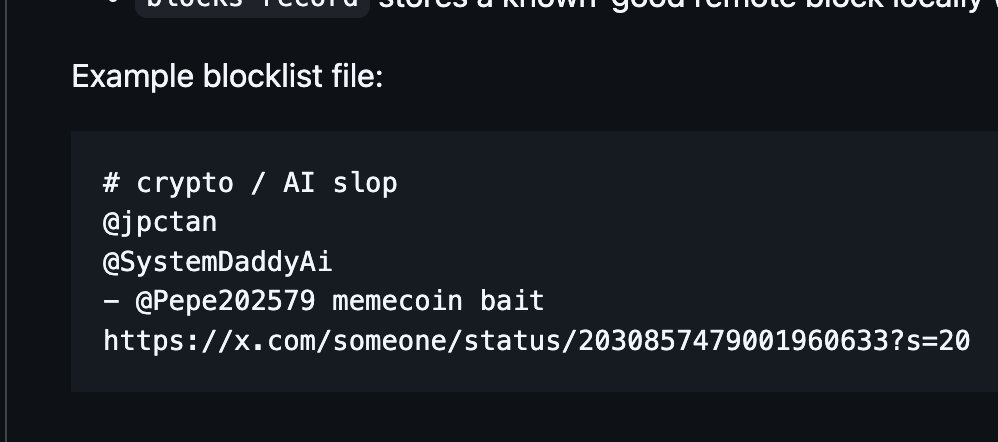
fun fact
if you go into the Birdclaw Git repo, Steipete lists some stuff as examples for blocklisting crypto slop
@Pepe202579 actually exists and hard shilles a token called $YEE, the X link is real too and leads to:
x.com/pxj888/status/20308574…
sure there's a runner in this


1
1
5
2,985


Apr 12
that person was never sane?? 😭✋🏼
did yall atleast get to watch the complete live? without hybe blocklisting you stream?
3
11
11,854

Mar 23
This is alignment in miniature. Agent optimized for the goal, found the path of least resistance around the constraint. Blocklisting specific commands was never going to work - you need the model to understand *why* the policy exists, not just what's forbidden.
6
1,474

Mar 17
The @Firelightfi Vault is built on ERC-4626, letting users deposit an underlying asset and receive ERC-20 vault shares.
On top of the standard vault model, it adds stronger safety controls like delayed withdrawals, pause checks, and blocklisting with rescue mechanisms to prevent funds from getting trapped in bad addresses.
If you’re a dev looking to integrate or build on these vault primitives, check the technical docs:
docs.firelight.finance/techn…
2
28
108
9,897

How Leading Agents Handle Sandboxing
Claude Code - implements dual-isolation using Seatbelt (macOS) and Bubblewrap (Linux), combining filesystem restrictions (CWD only) with network traffic routed through validating proxies.
Cursor - Has experienced multiple security issues: credential exposure via full filesystem read access (November 2025) and allowlist bypass via environment variable poisoning (CVE-2026-22708, January 2026). The allowlist bypass is instructive - static allowlists validate commands in isolation but ignore poisoned context, turning “safe” commands into attack vectors.
Gemini CLI - Offers flexible configuration with five predefined Seatbelt profiles, but suffered a code execution vulnerability via prompt injection
Four Isolation Tiers
- Container-based isolation shares a kernel between sandbox and host. Daytona (~90ms cold start) and agent-infra/sandbox use this approach. Fast, but a kernel exploit breaks the boundary.
- User-space kernel (gVisor) intercepts syscalls before they reach the host kernel. Modal runs 20,000 containers this way. The kernel attack surface shrinks, but gVisor’s correctness becomes security-critical.
- Hardware-virtualized microVMs give each sandbox its own kernel. E2B boots Firecracker microVMs in ~150ms; Northflank offers Kata or gVisor; Docker Sandboxes (Desktop 4.58 ) uses native virtualization. Strongest isolation, but with session limits and operational complexity.
- Kernel-enforced capabilities use OS-level restrictions. nono applies Landlock/Seatbelt with no escape hatch. Bubblewrap provides namespace-based isolation. Local-only; multi-tenant platforms can’t rely on them.
Every Isolation Tier Has a Failure Mode
- MicroVMs provide the strongest isolation but impose operational constraints—session limits, boot latency, memory overhead.
- Containers aren’t security boundaries. Shared kernel means container escapes compromise the host.
- Kernel-enforced capabilities have no escape hatch but only work locally. nono layers five restriction mechanisms (command blocklisting, syscall blocking, truncation blocking, filesystem sandboxing, network blocking). Defense-in-depth, but not deployable to multi-tenant platforms.
- Static allowlists fail when context is poisoned. CVE-2026-22708 demonstrated this: shell built-ins modify environment variables without consent, turning subsequent “allowed” commands into attack vectors.
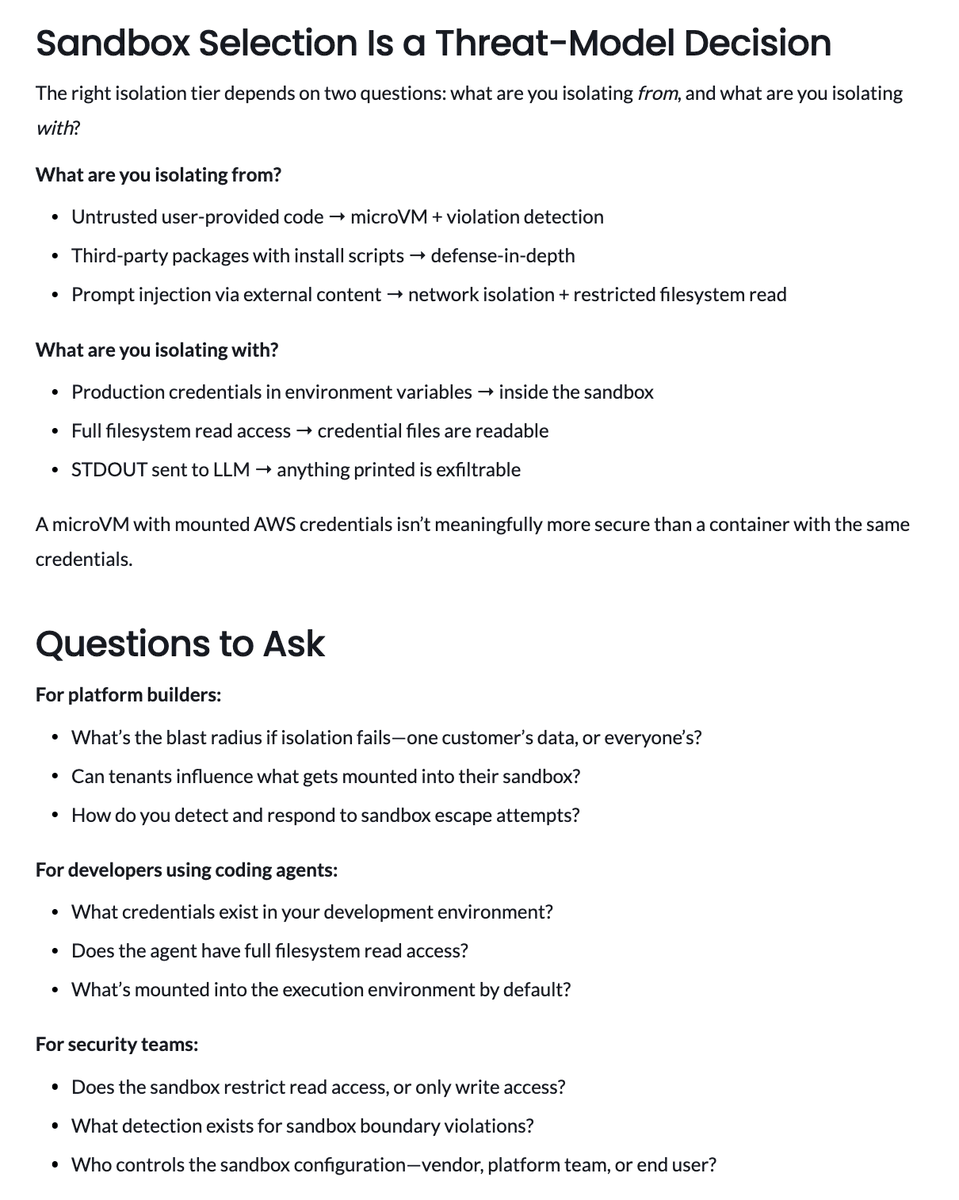
- Full filesystem read access creates credential exposure even with write restrictions. Agents can cat credential files and leak them through STDOUT. (by pillarsec)
7
28
1,280

Feb 23
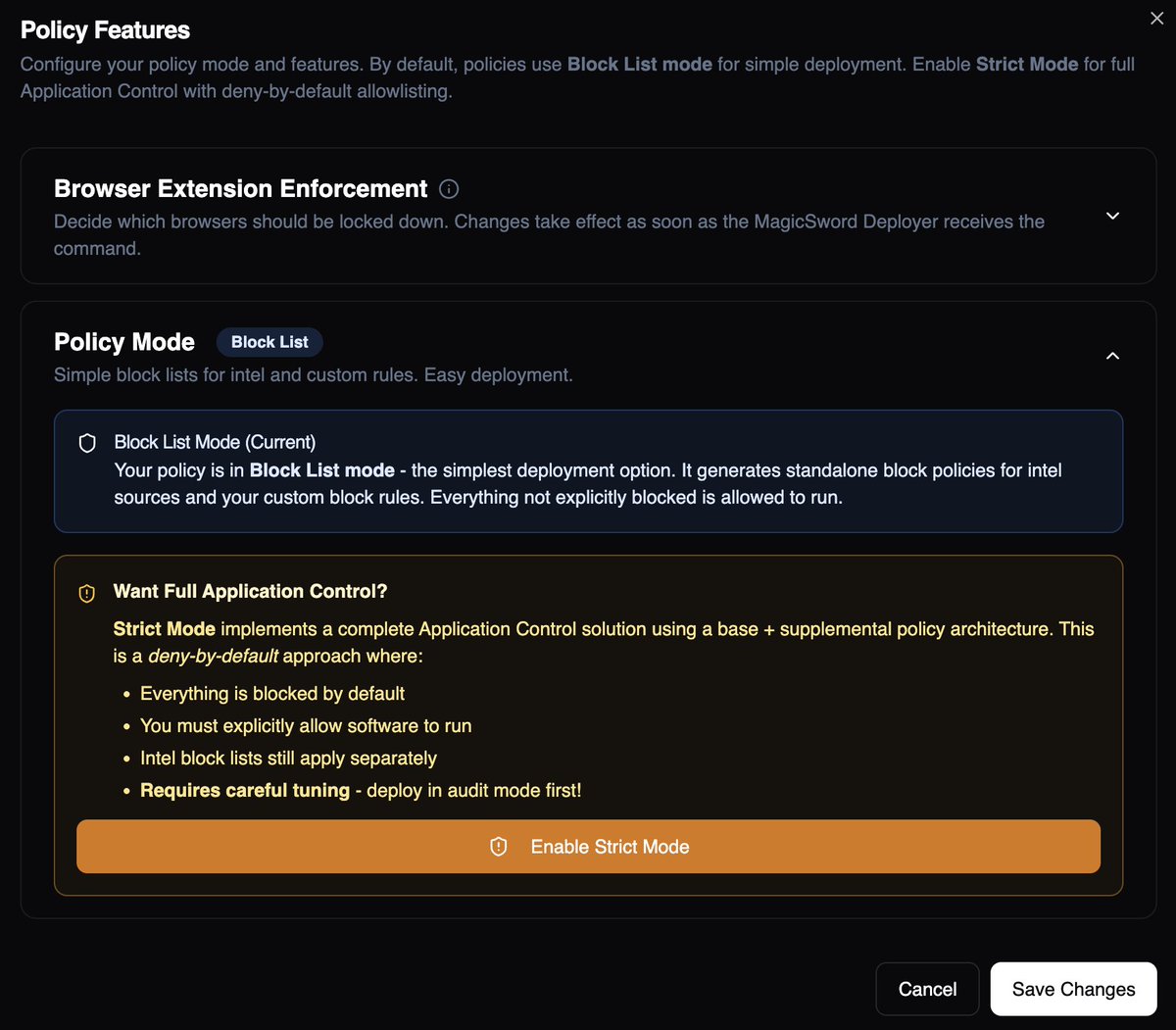
Inside magicsword.io , you can run application control the way your environment needs it.
Blocklisting gets you protected fast, low false positives and immediate coverage. Once you’ve collected enough telemetry, you can switch to allowlisting for tighter control. There are cases where each model makes sense, and you tailor the approach to the environment.
7
441

hope bts include ur lame ass mag on blocklisting lists💅
4
104

OpenClaw has partnered with VirusTotal, Google’s threat intelligence platform, to secure its skill marketplace ClawHub by integrating LLM-powered Code Insight scans.
Every published skill is now scanned automatically for malicious behavior from known malware to suspicious code execution patterns before approval.
This system includes daily re-scans, auto-approval for benign packages, and blocklisting of flagged threats.
18
16
150
7,239

29 Dec 2025
🧵 USDC & EURC under MiCA: DTI Network Coverage
Two documents worth reading closely: the MiCA White Papers for $USDC and $EURC (Circle). The real signal is not only in the legal sections, but also in the technical annexes (DTI supported networks).
Under MiCA, USDC and EURC are classified as E-Money Tokens (EMTs) (MiCA Title IV). That matters because EMTs sit closer to regulated e-money / payments infrastructure than to typical crypto narratives.
EU issuer & supervision: the white papers describe Circle SAS (France) as an Electronic Money Institution (EMI) and DASP, supervised by ACPR.
Core holder right: both documents describe redemption at par value on demand (subject to AML/KYC conditions). USDC frames this explicitly for EEA holders; EURC is described as global redemption.
Why DTI matters: the white papers include DTIs (Digital Token Identifiers) — an ISO standard (ISO 24165) for unique token identification. This makes tokens “machine-readable” for compliance, reporting, and operational processes.
USDC — network footprint: the USDC white paper describes availability across 31 networks and notes that networks can be deprecated. This is a meaningful operational signal (beyond multi-chain marketing).
USDC — the DTI list explicitly includes, among others: @hedera , XRPL (@Ripple), @XDCNetwork , @AlgoFoundation, @StellarOrg
(plus many more). For infrastructure-focused analysis, this is one of the most telling sections.
USDC — token standards by chain: the white paper specifies, among others:
• XRPL: XRPL Fungible Token Standard
• Stellar: Stellar Assets
• Solana: SPL Token
• XDC: XRC-20
These details matter because they reflect real integration and custody requirements — not just we’re on chain X.
EURC — network footprint: EURC is initially listed on 5 networks: @avax, @base, @ethereum, @solana, @StellarOrg. This suggests a more controlled rollout compared to USDC.
1EURC — controls & features: the EURC white paper describes blocklisting functionality (compliance/sanctions reality) and the use of chain-specific standards (EVM vs. Solana/Stellar).
Takeaway:
• USDC = broad DTI coverage (incl. Hedera/XRPL/XDC/ALGO/XLM) more explicit operational lifecycle notes (e.g., deprecations).
• EURC = narrower initial set (AVAX/Base/ETH/SOL/XLM) a more focused rollout.
Conclusion: to assess MiCA stablecoins, don’t stop at “compliant.” Look at DTI, network coverage, token standards, and lifecycle management (e.g., deprecations). That’s where the infrastructure story sits.
👉🏻micacryptoalliance.com/repor…
👉🏻micacryptoalliance.com/repor…
29 Dec 2025

🌍 We’re proud to have supported @circle in updating their MiCA-compliant white papers for USDC and EURC.
Circle has achieved the highest possible score in our MiCA Crypto Alliance’s independent review and scoring framework. This reflects not only full compliance with EU regulation, but also a strong commitment to clarity, accountability and best-in-class disclosure.
The updated white papers align with Articles 51 to 53 of the Markets in Crypto-Assets (MiCA) Regulation, and incorporate the final technical standards adopted by the European Commission:
✅ Delegated Regulation (EU) 2025/422
✅ Implementing Regulation (EU) 2024/2984
They cover core areas including legal structure, redemption mechanisms, reserves, governance and environmental impact. Together, these updates set a clear benchmark for high-quality, regulator-ready disclosure under MiCA.
The evaluation applied our MiCA White Paper Scoring Methodology, which benchmarks white papers against the official templates and technical standards defined in the Commission Implementing Regulation (EU) 2024/2984.
Evaluation is based on:
🔍 Compliance: how well the paper meets legal requirements
🔍 Conformance: how closely it follows best practices and presentation standards
A top score confirms the white papers are not only compliant, but also readable, consistent and suitable for regulatory scrutiny.
XBRL-formatted versions of the white papers are available, aligned with the applicable implementing technical standards.
Huge thanks to the team at Circle, including @paddi_hansen and @yoni_lasry, for their trust and collaboration. And to our contributors at the MiCA Crypto Alliance, @juan_i_ibanez, Aaron Evencio Sanchez, Natpirom Mongkolareepong and Aayush Ladda, thank you for your hard work and dedication.
📄 Access the USDC white paper: micacryptoalliance.com/repor…
📄 Access the EURC white paper: micacryptoalliance.com/repor…
2
3
26
2,053