June 14th is Flag Day (U.S.)
---America’s Flag Day marks the Second Continental Congress’s adoption of the first U.S. national flag on June 14, 1777. The first flag featured the same 13 red and white stripes we see today. However, the number and arrangement of stars have changed as the number of states has increased over the centuries. The current flag has remained the same since 1960.
---HISTORY:
---The current design of the U.S. flag is its 27th; the design of the flag has been modified officially 26 times since 1777. The 48-star flag was in effect for 47 years until the 49-star version became official on July 4, 1959. The 50-star flag was ordered by then President Eisenhower on August 21, 1959, and was adopted in July 1960. It is the longest-used version of the U.S. flag and has been in use for over 64 years.
---In 1916, President Woodrow Wilson made a proclamation establishing June 14th as Flag Day. In August 1949, National Flag Day was established by an act of Congress, which was signed by Harry Truman.
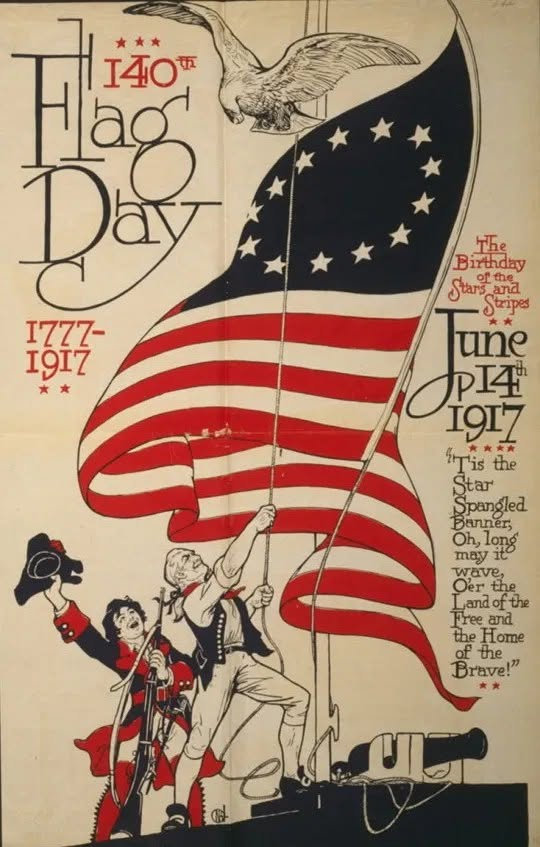
---PICTURE: 140th U.S. Flag Day poster. 1777-1917. The birthday of the stars and stripes, June 14th, 1917. 'Tis the Star-Spangled Banner, oh, long may it wave, o'er the land of the free and the home of the brave!" Library of Congress description: "Poster showing a man raising the American flag, with a minuteman cheering and an eagle flying above."
---nationaltoday .com, Wikipedia, checkiday .com, Pinterest See less
1
33


Jun 10
June 10th is National Iced Tea Day and June is National Iced Tea Month
---National Iced Tea Day celebrates the refreshing summer-friendly drink, which makes up about 85% of tea consumed in the United States. People first started drinking iced tea in the United States around the 1860's, and the first recipes for it were printed in cookbooks in the 1870's. The growth of iced tea can partly be attributed to the availability of ice, which began being shipped from the northern states to southern states and the Caribbean at the beginning of that century. But the primary impetus for the expanded popularity of the drink can be credited to Richard Blechynden, who served it at the World's Fair in St. Louis in 1904, which led to many people bringing it to all parts of the country. Prohibition, which lasted from 1920 to 1933, also helped keep iced tea drinking popular. Black iced tea is the most common, but many types of tea leaves can be used. The tea can be sweetened or unsweetened, and lemons, limes and herbs can be added. There are many possible health benefits of drinking tea, and it contains flavonoids that quite possibly have antioxidant properties. But, if the tea is bottled with high amounts of sugar or high fructose corn syrup, the health benefits may be partly neutralized. Home-brewed tea may be the healthiest, as the brewer knows exactly what's in it.
---checkiday .com, tea-happiness .com

1
16
May 31
May 31st is National Smile Day
---Today, wear your best smile
---You've probably heard that it takes more muscles to frown than it does to smile. But, somehow, over the years, most people tend to forget this. Babies smile about 400 times a day, while the average adult only smiles 20 times. Today is a day to fix this and to smile as much as possible. National Smile Day was created by Dr. Tim Stirneman and Jim Wojdyla of Compassionate Dental Care in Lake in the Hills, Illinois, to "share with the world what the power of a healthy smile can do."
---History of National Smile Day
---The history of the smile can be traced back to monkeys and apes, according to primatologist Signe Preuschoft. These animals bare their teeth in a facsimile of a smile to show dominance or warn off predators. The theory is that humans copied this behavior, and, over time, the smile evolved to show amusement and enjoyment. Research indicates that on the way to portraying happiness, smiles were a way of attracting mates among early humans.
---If you’ve ever wondered why older portraits often showed unsmiling people, it was because people in that era had a lot of tooth rot caused by sugar and a poor diet. Plus, more common was the aristocratic perception that smiling and laughing was indecorous and showed a lack of self-control or good manners. One of the few exceptions was Leonardo da Vinci’s “Mona Lisa,” although the portrait’s ambiguity is part of its fame. As dentistry and an attitude of authenticity developed, people began smiling even in portraits, this time with their teeth on display.
---Studies of yearbook photographs over the years point to the breadth of smiles increasing over the years. The study indicates that because participants had to hold the pose for longer periods in the earlier days of photography, their smiles gradually dimmed. The prevalence of smiling in the recent past is linked to culture and traditions and varies from country to country. Some regions with high individualism and low population density had a higher incidence of people who smiled. A study found that the biggest reason people smile, however, can be attributed to a country’s tradition of diverse immigration over time. So places like Brazil and the United States, where people do not share common customs or languages, see higher incidences of smiles. The study states that this is because the smile is part of a universal language.
---A French neurologist, Guillaume Duchenne, who studied the mechanism of facial expression, discovered there are two types of smiles: a Duchenne smile and a non-Duchenne smile. The former smiles with the eyes or is a genuine smile, whereas the latter is an ambiguous, non-genuine, or simply polite smile.
---nationaltoday .com, checkiday .com, Grok

1
2
116
May 16
Armed Forces Day in 2026 is celebrated on May 16. It is always celebrated on the third Saturday of May. This day recognizes and honors the men and women serving in the United States Armed Forces and is a time to express appreciation for their service and sacrifice. The Veterans of Foreign Wars (VFW) also recognizes this day.
---Armed Forces Day is a special holiday for people all over the world to come together and thank the men and women of the United States Armed Forces. First conceived by President Harry S. Truman, the holiday was established in 1949. On July 26, 1947, President Truman signed the National Security Act, which brought the branches of the military under the National Military Establishment. The creation of a single day celebration for all five branches of the United States military made sense due to its recent unification under the Department of Defense.
---History of Armed Forces Day
---The history of the United States Armed Forces spans over two centuries. The United States rapidly evolved from being a new nation fighting for independence against Great Britain between 1775 and 1783, to fighting in the landmark American Civil War from 1861 to 1865, to proving their valor and strength during World War II, and finally emerging as a world superpower towards the end of the 20th century. The U.S. armed forces comprise five branches of the military: the Army, Air Force, Navy, Marine Corps, and the Coast Guard.
---The origin of the United States Army dates back to 1775 when the Continental Congress established the Continental Army, Continental Navy, and Continental Marines, commanded and led by General George Washington. This newly assembled military force fought the British during the American Revolutionary War with French soldiers by its side, leading to the Treaty of Paris and its independence. In 1789, the new Constitution delegated the president as the commander in chief of the military, with the authority to create laws, levy taxes, and declare war.
---Ever since its formation, the primary responsibility of the Army division of the Armed Forces is to fight battles on land and deploy the military for takeover. The United States Army Corps of Engineers mainly control the rivers of inland America. Following the war against the British Army, the U.S. Army was still relatively small and operating in peacetime. This changed in the 1940s when the Air Force became a completely separate unit outside of the Army Air Forces. In 1947, control of the U.S. Army switched over from the War Department to the Defense Department.
---The major wars that the U.S. Army participated in were the Indian Wars of the 1790s, the War of 1812, the American Civil War in 1861, the Spanish-American War of 1898, World Wars I and II in 1917 and 1941 respectively, the Korean War in 1950, and the Vietnam War in 1965. The U.S. military also took part in the Gulf War in 1991 and the war in Afghanistan.
---As of 2019, the Armed Forces of America fall under the command of the Department of Defense and the Coast Guard, which is authorized by the Department of Homeland Security.
---The President of the United States is the commander in chief, and they exercise their authority through the Secretary of Defense and the Chairman of the Joint Chiefs of Staff, who supervises combat operations. AI Overview. nationaltoday .com, checkiday .com, Pinterest

2
2
66
May 14
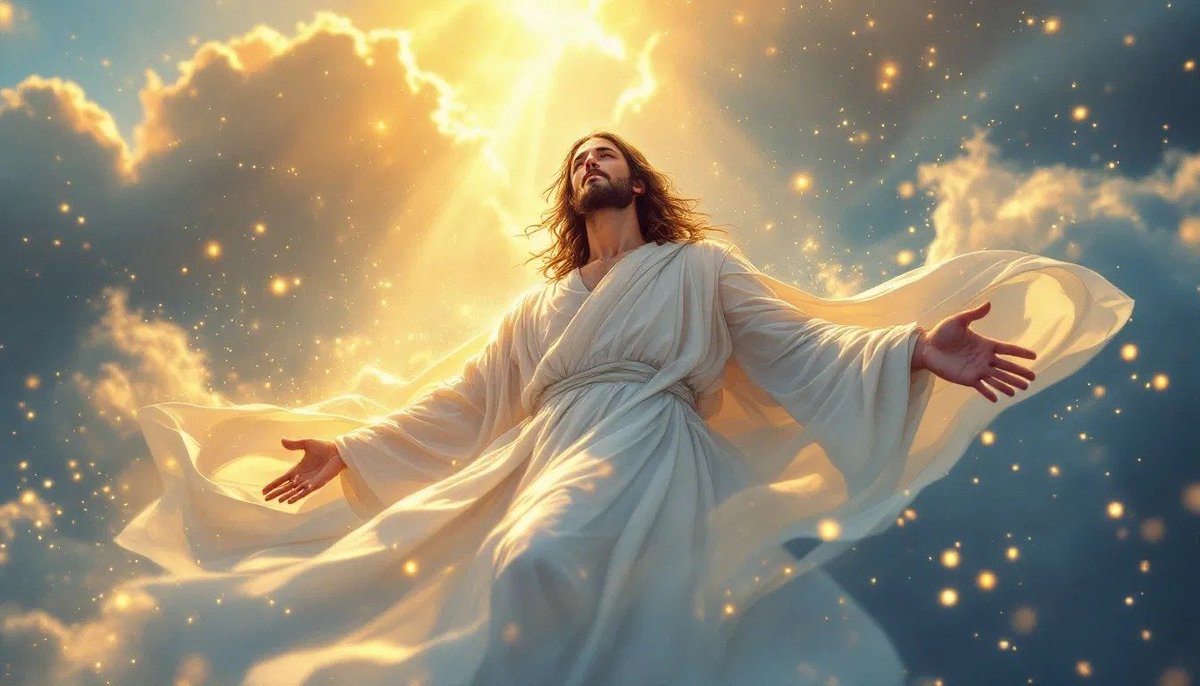
In 2026, Ascension Day—celebrated 40 days after Easter Sunday to mark Jesus Christ's ascension into heaven—falls on Thursday, May 14, 2026. While traditionally a Thursday, some regions, including many U.S. dioceses, observe this holy day on the following Sunday, May 17, 2026.
---Ascension takes place on the fortieth day of Easter and commemorates Jesus's ascension into heaven as described in the New Testament of the Bible. This year, it will take place on May 29. According to the Bible, after his resurrection on Easter, Jesus met with his disciples' multiple times over the forty-day period and instructed them on how to continue to carry out his teachings. On the fortieth day, he took them to the Mount of Olives, and they watched as he ascended into heaven.
---Ascension is one of the earliest Christian festivals, dating back to 68 CE. It takes place ten days before Pentecost and is always on a Thursday, although some churches celebrate it on the following Sunday. Many Eastern Orthodox churches follow the Julian calendar, so Easter—and Ascension—is later than it is for Western churches. Some churches have "church crawls" where people go to different churches for different prayer events. Some Western churches extinguish and take away a Paschal candle after the gospel is read on the day, which symbolizes Christ leaving Earth. The liturgy during Ascension and through Pentecost is joyful, as it marks the triumph of the risen Christ.
---Known by multiple names — The Feast of the Ascension, The Ascension of Jesus, Ascension Thursday, Holy Thursday, or Solemnity of the Ascension of the Lord — this is a Christian holiday that doubles as a public holiday in many countries like Austria, Belgium, Denmark, Germany, France, and more.
---History of Ascension Day
---One of the earliest Christian festivals, Ascension Day marks the end of the Easter season. This event is celebrated primarily by Catholics and Anglican Christians; most Protestant churches do not follow this tradition anymore.
---As per the New Testament in the Bible, after Jesus Christ’s crucifixion on Good Friday, he was resurrected from the dead in three days, on the day we know as Easter Sunday. For 40 days after this, he stayed with his Apostles (the primary disciples of Christ) to instruct them on how to carry out his teachings. As the Bible says, at the end of day 40, Jesus Christ and his disciples went to Mount Olivet (or the Mount of Olives), near Jerusalem. After asking them to stay, Christ then ascended to heaven to take his seat at the right hand of God, under the gaze of his disciples. To Christians, the ascension signifies that Christ completed his work on Earth and allowed him to prepare a place for his followers in heaven.
---Initially a part of Easter celebrations, this day was later separated from Easter, along with Pentecost. Celebration of Pentecost ends the cycle of Easter-related events in the Christian calendar.
---checkiday .com, nationaltoday .com, AI Overview, Stockcake
2
47
Apr 16
April 16th is National Librarian Day
---It's a day to recognize the vital role librarians play in communities, providing access to information and resources. The day was revived by the American Library Association in 2004 as part of a campaign to raise awareness and appreciation for library staff.
---You may think of them as book-slingers who spend all day cataloging and reshelving, but librarians play a much more important role. From children’s storytime to literacy classes, libraries offer a wealth of free public resources.
---Trained in Library Science, professional librarians work with complex cataloging systems to organize books, make purchasing decisions for their library, liaise with local schools and universities, organize events and programming, teach classes, and more. Their role is constantly evolving to adapt to new technology and social needs.
---History of National Librarian Day
---Stereotyped in pop culture as bespectacled older ladies who constantly shush their teen patrons, librarians are dedicated professionals who perform a variety of tasks to keep libraries running, organize programming, and update their collection
---Librarians date back to the eighth century BCE, when Ashurbanipal, King of Assyria, introduced librarianship as a profession after he put a library in his palace in Nineveh. The "keeper of books" at his library oversaw thousands of tablets. Following the death of Alexander the Great in 323 BCE, Ptolemy created the Great Library of Alexandria, which housed all Greek literature and was known for its famous librarians, such as Callimachus.
---At the end of the Roman Republic and at the beginning of the Roman Empire, Roman aristocrats often had libraries in their homes. Some lent out materials as librarians would. Some Roman emperors created public libraries where scholars worked as librarians. Following the fall of Rome, librarians worked in Christian monasteries. They often oversaw monks who copied books. A little while later, people called librarius worked to expand cataloging, inventory, and classification.
---After reemerging in the fourteenth century, universities began having libraries and librarians. Private libraries developed in Europe during the Renaissance, which were planned and organized by librarians. Materials were restricted, but libraries were open to the public. Librarians soon created the Bibliotheca Universalis, a universal listing of all printed books. The influence of these librarians and the use of Bibliotheca Universalis changed libraries. Literature meant for entertainment began being included with literature of academic importance. Oxford's Bodleian library was opened at this time, which was known as the first modern library. Libraries also became more efficient after the library catalog made its debut in 1595.
Professionalization of librarians started in the nineteenth century, when the first training school and universities related to the profession were opened, the first professional library associations were formed, and the first licensing procedures were started. A similar amount of women and men worked as librarians in 1920, but eighty percent of librarians were women by 1960. The number remains close to this today. On National Librarian Day, we honor librarians for the role they play in connecting us with information at libraries.
---The first large libraries in the U.S. were mostly privately owned and required entry fees or paid memberships to gain access. The concept of free public libraries took hold by the late 1800s. In the early 20th century, after Melvil Dewey standardized library cataloging with his Dewey Decimal System and other practices, public libraries rapidly expanded with thousands of new branches across the country. By 1900, the scope of libraries also expanded, with many offering reference departments and interlibrary loans. During the Great Depression, libraries served as a lifeline for struggling families seeking a cozy refuge and free entertainment.
---Today, libraries function as so much more than repositories of knowledge. To keep up with changing technology, library offerings now include audiobooks, e-reader materials, free computer skills classes, and access to free online resources. Many public libraries offer language and citizenship classes, access to useful tools, technology like 3D printers and computers, and free workshops on a variety of hobbies and life skills. They provide a quiet shelter during hot or rainy days at no cost, and they serve as a safe, welcoming hangout for children and teens.
nationaltoday .com, AI Overview, checkiday .com, stockcake .com

2
60


Apr 13
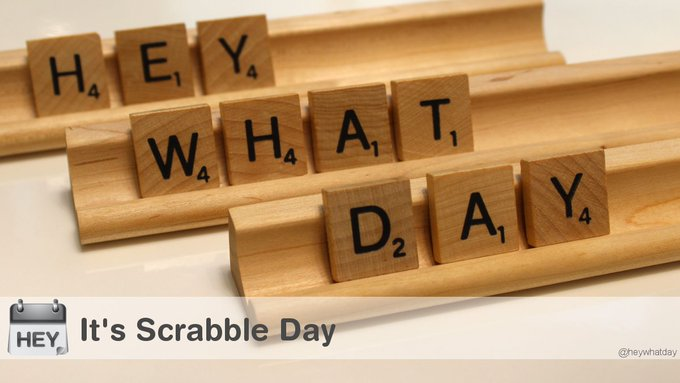
Use your words,
and your plants,
to Make lunch Count,
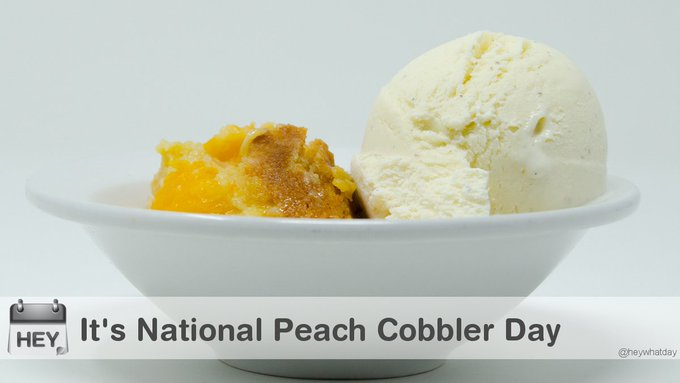
with Peach Cobbler!
13 APR!
@HeyWhatDay @checkiday
P.S. Peaches in Minecraft would be nice!


2
49

Day 4 Countdown to #GlobalHolisticWealthDay on #April9th.🌎
The #HolisticWealthRetreat in #Jamaica on the historic Holistic Wealth Trail —experience what it means to live #holisticallywealthy.🌿
youtube.com/shorts/O7tEz6Gkl…
@HeyWhatDay
@checkiday @HolistWealthPod @holisticinstitu
2
2
47


Feb 12
David blames Lonnie for telling him about off-menu add-ons at Burger King.
1
9
471



2
51