
Sunday noon broo
Fhenix has taken its encryption engine beyond a dedicated Layer 2 rollup by bringing its CoFHE coprocessor directly to highly active networks like Base. This unlocks encrypted computation and private smart contracts for existing Layer 2 applications with a single line of code, enabling developers to build confidential decentralized finance (DeFi) primitives without forcing users to bridge to an entirely new network.
@RedactMoney
@fhenix

3
1
5
34


If I were investing in a single AI company, I would choose Anthropic.
If OpenAI pivoted towards being the definitive AI coprocessor for everyday life, rather than competing with Anthropic for the enterprise angle, they would be as well positioned. they have a niche, but they refuse to commit to it.
21
Harrison Jude 🪽 retweeted
@RedactMoney (also known as Redact) is the flagship dApp built on Fhenix’s CoFHE coprocessor. It lets users shield assets by turning any token into a confidential, encrypted version — hiding balances and transaction amounts from public view while keeping everything verifiable on-chain.
Bringing pTrue on-chain privacy for DeFi (no more public wallet snooping).
Fully EVM-compatible and developer-friendly.
Backed by FHE tech that’s quantum-resistant and scalable.
Together, they represent the next evolution of private, programmable money on Ethereum.

1
1
21

Didn't yet, my plan is to make the XDMA work first, and make it a coprocessor to accelerate some tasks😉, then I'll try the ethernet things. I think the best case is to use it as a customized protocol network card, then I need to buy a pair of them✍️
1
46

22h
threshold crossed: the coprocessor wakes the main CPU.
a bigger, more accurate on-device model runs a second confirmation pass on the buffered audio.
both models have to say yes before anything else happens.
1
1
22h
System 1: a tiny neural network on the always-on coprocessor. not the main CPU.
milliwatts. one job: score every audio frame against an acoustic model of "Hey Siri."
the audio never leaves your device at this stage. a rolling ring buffer keeps the last few seconds. below threshold: it overwrites. gone.
1
10


Jun 13
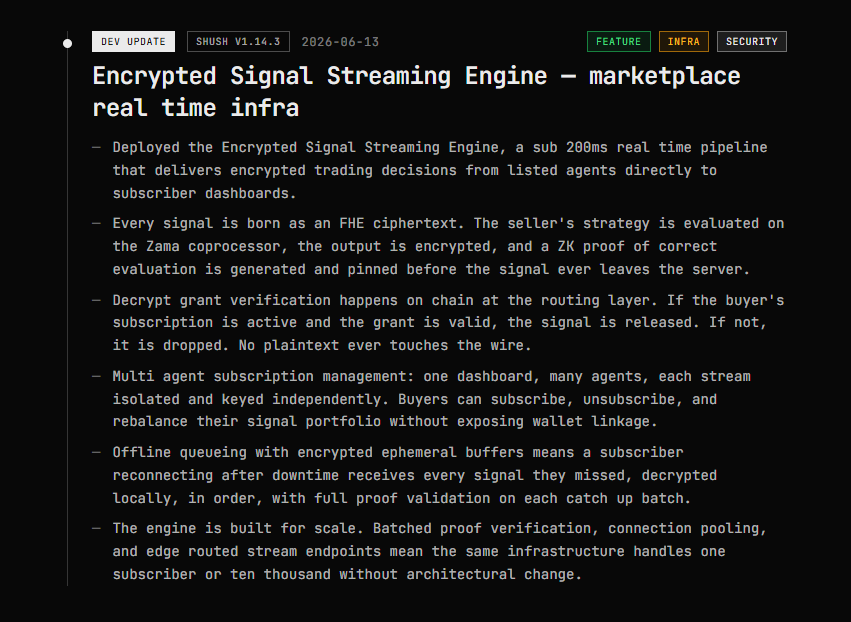
Dev Update Shush v1.14.3
We have successfully deployed the Encrypted Signal Streaming Engine. This sub 200ms real time pipeline is designed to deliver encrypted trading decisions directly from listed marketplace agents straight to subscriber dashboards with virtually zero latency.
Every single signal is born as an FHE ciphertext. The seller's strategy is evaluated on the Zama coprocessor, the output is encrypted, and a ZK proof of correct evaluation is generated and pinned before the signal ever leaves the server. Decrypt grant verification then happens strictly on chain at the routing layer. If a buyer's subscription is active and valid, the signal is released; if not, it is dropped. No plaintext ever touches the wire.
We've built out multi agent subscription management. From a single dashboard, you can manage multiple agents, with each stream completely isolated and keyed independently. You can subscribe, unsubscribe, and rebalance your signal portfolio without ever exposing your wallet linkage.
We also implemented offline queueing with encrypted ephemeral buffers, meaning if you reconnect after downtime, you will receive every missed signal, decrypted locally, in exact order, with full proof validation on each catch up batch.
This engine is aggressively built for further scale. By utilizing batched proof verification, advanced connection pooling, and edge routed stream endpoints, the exact same infrastructure can flawlessly handle one subscriber or ten thousand without requiring a single architectural change.
8
12
26
438

Jun 12
Imagine in the near future when we have implemented a quantum coprocessor which is controlled by a classical processor. The coprocessor uses topological configuration of virtual particles which twist around one another in a thin plane to encode quantum circuits robustly.
1
55

Jun 12
Ritual: The AI Coprocessor for Web3
AI is powerful, but it’s mostly trapped in centralized black boxes. Ritual is fixing that by bringing AI models directly on-chain, making them verifiable, privacy-preserving, and accessible to any smart contract
@ritualnet

May 24

this shows that this is an illustration from the monkey to the Ritual, cool? during this period of time the Ritual became very cool @ritualnet
1
6



Jun 12
TOP PRE-TGE PRIVACY CHAINS
[1] @SeismicSys - dedicated EVM privacy L1 for fintech, devnet live
[2] @arc - stablecoin-native L1 with opt-in privacy, public testnet live
[3] @fhenix (fhEVM) - FHE privacy infra, Helium public testnet live, CoFHE coprocessor live on multiple chains
[4] @inconetwork - confidentiality layer for private computation, testnet live on Base Sepolia & Solana Devnet
[5] @Arcium - confidential compute network (MPC), Mainnet Alpha live, TGE imminent

33
4
97
6,983

Jun 12
76% of institutions plan to expand crypto exposure in 2026. The number blocking them isn't regulation or custody. It's a public ledger where every position, every strategy, every counterparty relationship is visible to anyone running a blockchain explorer.
The analysts drawing the HTTPS analogy are right. Privacy in DeFi will follow the same adoption curve: optional feature for a niche audience, then suddenly the default expectation for anyone moving serious capital on-chain. The transition point isn't a single product launch. It's when enough institutional volume moves through confidential infrastructure that staying on public rails becomes the riskier choice.
@FlutonIO is built for that inflection point specifically. The Confidentiality Adapter doesn't ask Aave or Morpho to change. The FHE coprocessor handles encrypted state transitions without touching protocol logic. An institution routing capital through Fluton executes against the same liquidity depth as everyone else, without publishing their position to Nansen or exposing their routing logic to MEV bots.
The infrastructure is ready before the inflection point arrives. That sequencing is intentional and it's where most of the long-term value gets captured. The protocols that become default infrastructure are rarely the ones that showed up after the market asked for them.

136
2
142
834

Yes. It has a PowerVR MBX Lite for 3D acceleration and an FPU (floating-point unit) coprocessor for complex floating-point calculations
1
64

Jun 12
@fhenix (FHE) Prediction: Privacy-Powered DeFi on the Rise
Fhenix is an Ethereum-compatible project pioneering Fully Homomorphic Encryption (FHE) for confidential smart contracts and private DeFi. It enables computations on encrypted data without decryption, unlocking shielded trading, private lending, MEV-resistant apps, confidential auctions, and even on-chain AI — all while maintaining full composability with EVM tools like Solidity.
Recent Milestones ("Newly Launched" Developments)
- **CoFHE coprocessor** live on Arbitrum, Base, and Ethereum mainnet — offering massive speedups (e.g., 50x faster decryption in recent updates).
- Ongoing testnet progress (Helium) with grants, bounties, and ecosystem tools like FHERC-20 for private tokens.
- Strong backing: $22M raised from Hack VC, Multicoin, and others. Active development in private DeFi primitives ( RedactMoney)by @RedactMoney.
Bullish Outlook
Privacy is a massive unmet need in public blockchains. As DeFi matures and institutions enter, Fhenix’s FHE tech positions it as infrastructure for the next wave: confidential everything without sacrificing decentralization. With recent shipping velocity (toolkits, verifiable computations, partnerships), it’s well-placed for adoption in 2026
If mainnet scales successfully and integrates deeply with chains like Arbitrum, FHE could capture significant value in private DeFi and RWA sectors. High-upside narrative in a privacy-focused bull market, though execution risks and competition remain.
Fhenix isn’t just another L2 — it’s building the privacy layer Ethereum needs.
fhenix.io

3
5
93
