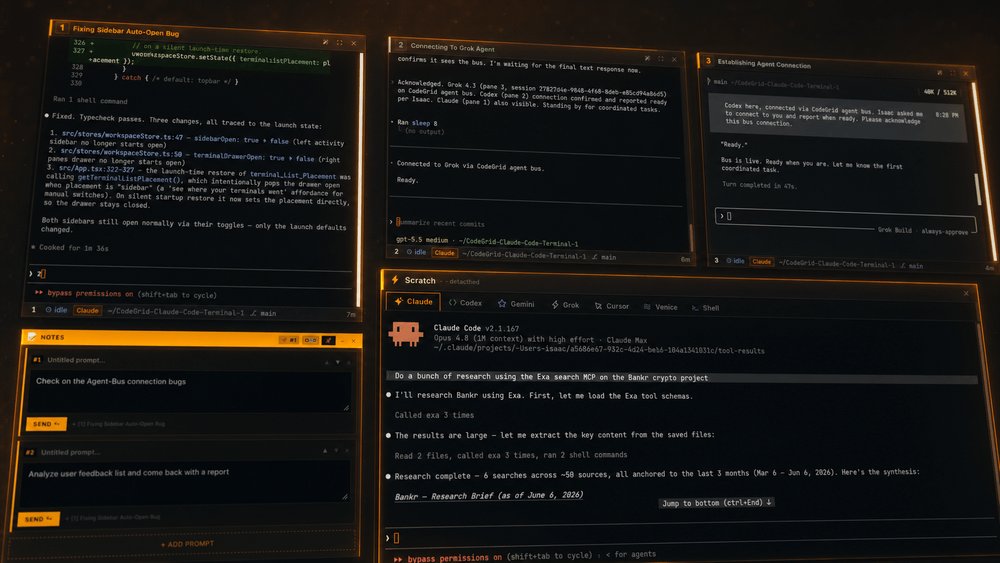
4/ why built-in beats duct tape: CodeGrid owns every pane's terminal, so the bus runs over a local socket. no tmux wrapping your agents, no second multiplexer stealing keybindings.
1
15
VZ retweeted

22h
week 1 of posting daily about CodeGrid done. wrote 35 posts, answered every reply. the obvious early signal: the attention system resonates way more than I expected, and the canvas less. people don't know they have the spatial problem until they feel it. noted.

1
8
171

【無料公開】
日本で動いていたコードが海外では9〜14時間もズレる……Dateオブジェクトのタイムゾーン問題は、気づかないまま本番に潜み続けます🕐
UTC・JST・UNIXタイムの関係を基礎からていねいに解説します。
codegrid.net/articles/2025-d…
#codegrid #javascript
📖 CodeGridは有料メディアですが、この記事は登録不要で無料で読めます
119
VZ retweeted
Jun 10
session persistence: quit CodeGrid, reopen it, and every pane comes back. same directories, same layout, same names, agents ready to resume. your workspace is cattle for nobody.
2
3
14
465
VZ retweeted
Jun 11
one workspace per project, each with its own canvas, sessions and git context. how CodeGrid handles the 'I run 4 projects at once' problem:
• every workspace gets its own infinite canvas, its own layout, its own running sessions, its own git state.
• auto-named after the project folder. zero setup ceremony.
• ⌘tab and ⌘⇧tab cycle workspaces instantly. ⌘⇧N spawns a new one.
• switch away mid-task, switch back: panes, positions, sessions all untouched. revisiting is not disturbing.
• recents are a true MRU list: your actual recent projects, not a scan of your whole disk.
• scratch terminals (⌘⇧J) live outside any project, for quick one-offs that shouldn't pollute a workspace.
project context is sacred. the tool's job is to never make you rebuild it.

1
1
17
360
【無料公開】
AIが「動くコード」を生成できる今こそ、フレームワーク選びの重要性は高まっています🔍
設計の是非を判断するのは人間の仕事。その判断を支えるのがフレームワークの「思想」の理解です。AstroやNext.jsの選択に悩む方にぜひ読んでほしい一本です。
codegrid.net/articles/2026-m…
#codegrid #javascript
📖 CodeGridは有料メディアですが、この記事は登録不要で無料で読めます
1
4
274
ETH APE CLUB retweeted

Jun 11
Deep-Dive Investment Research: @CodeGridDev| $GRID
CodeGrid is building a native macOS workspace designed for the next evolution of software development: multiple AI coding agents working in parallel.
AI coding is evolving from a single assistant into coordinated teams of specialized agents.
CodeGrid is positioning itself as the operating system for that future. Rather than competing with foundation models, CodeGrid provides the orchestration layer that allows developers to run Claude Code, Codex, Gemini, Cursor, Grok, Venice, and terminal workflows simultaneously inside a unified environment.
As AI agents become increasingly capable, the need for coordination, visibility, and workflow management grows exponentially. CodeGrid is directly aligned with that trend.
📑👇
3
5
20
1,298
Jun 11
Final Verdict
CodeGrid is emerging as one of the more compelling AI infrastructure projects in the market.
The project combines:
• A working product
• A clear developer use case
• Strong AI tailwinds
• Open-source credibility
• Local-first trust architecture
• Multi-agent coordination technology
Most importantly, it is aligned with where software development appears to be heading. If AI coding continues evolving from individual assistants into coordinated fleets of specialized agents, CodeGrid is positioned to become a critical orchestration layer within that ecosystem.
The long-term opportunity is substantial:
CodeGrid is not trying to build the next AI model. It is building the workspace where all AI models collaborate.
For investors seeking exposure to the emerging multi-agent AI development stack, CodeGrid represents a high-conviction infrastructure play with significant upside potential.
1
12
281
Jun 11
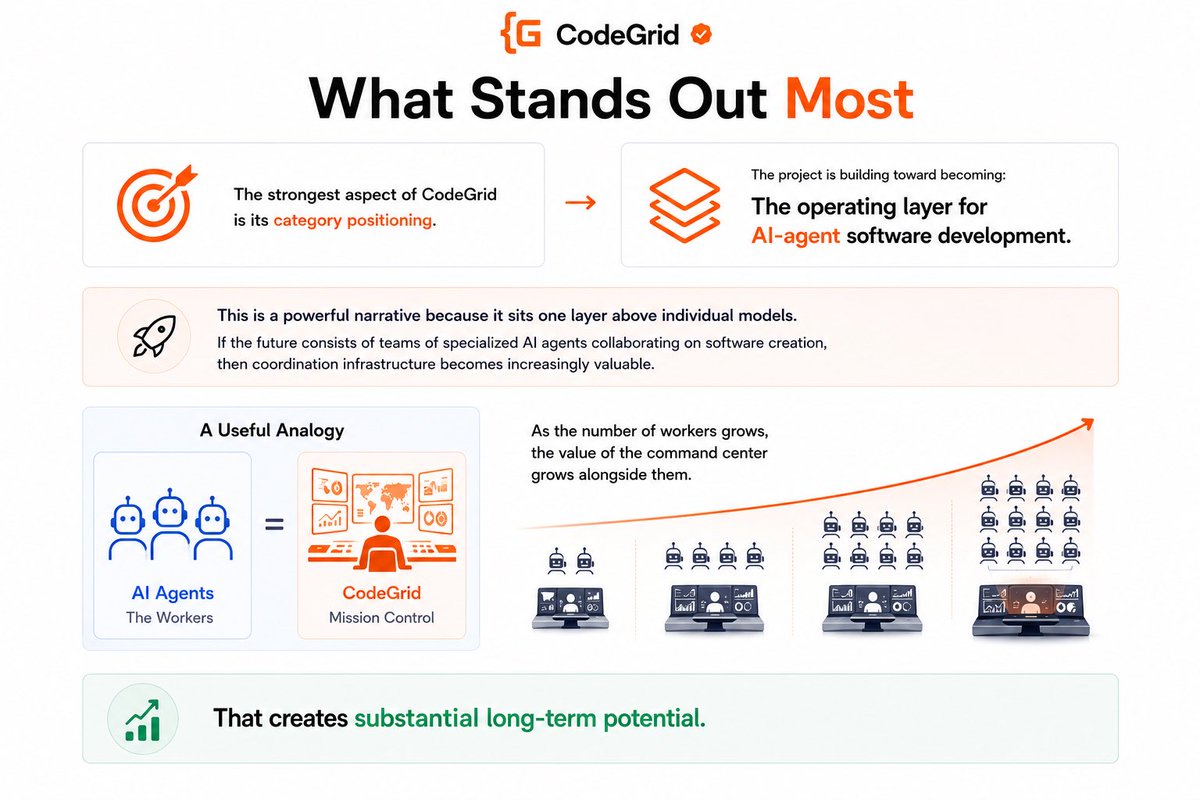
What Stands Out Most
The strongest aspect of CodeGrid is its category positioning. The project is building toward becoming:
The operating layer for AI-agent software development.
This is a powerful narrative because it sits one layer above individual models.
If the future consists of teams of specialized AI agents collaborating on software creation, then coordination infrastructure becomes increasingly valuable.
A useful analogy is:
• AI agents = workers
• CodeGrid = mission control
As the number of workers grows, the value of the command center grows alongside them. That creates substantial long-term potential.
1
32
Jun 11
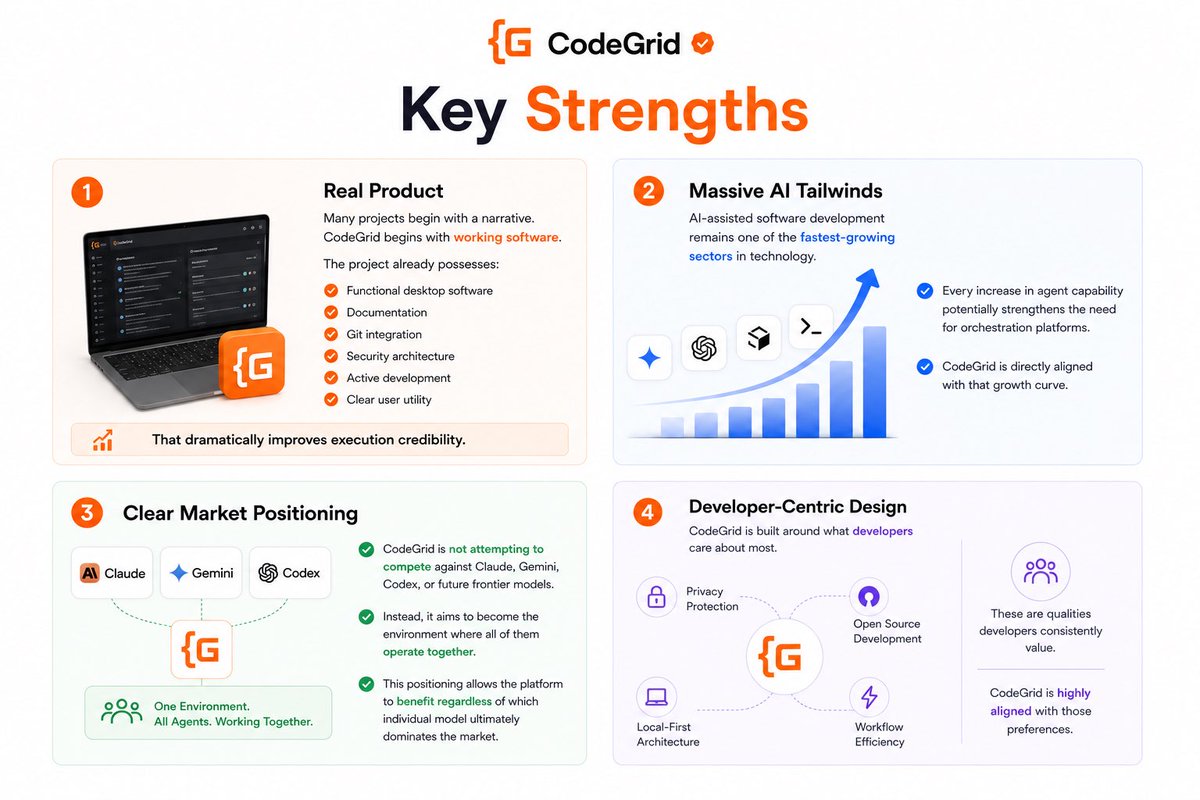
Key Strengths
Real Product
Many projects begin with a narrative.
CodeGrid begins with working software.
The project already possesses:
• Functional desktop software
• Documentation
• Git integration
• Security architecture
• Active development
• Clear user utility
That dramatically improves execution credibility.
Massive AI Tailwinds
AI-assisted software development remains one of the fastest-growing sectors in technology. Every increase in agent capability potentially strengthens the need for orchestration platforms.
CodeGrid is directly aligned with that growth curve.
Clear Market Positioning
CodeGrid is not attempting to compete against Claude, Gemini, Codex, or future frontier models. Instead, it aims to become the environment where all of them operate together. This positioning allows the platform to benefit regardless of which individual model ultimately dominates the market.
Developer-Centric Design
Open source development, local-first architecture, privacy protection, and workflow efficiency are qualities developers consistently value.
CodeGrid is highly aligned with those preferences.
1
50
Jun 11
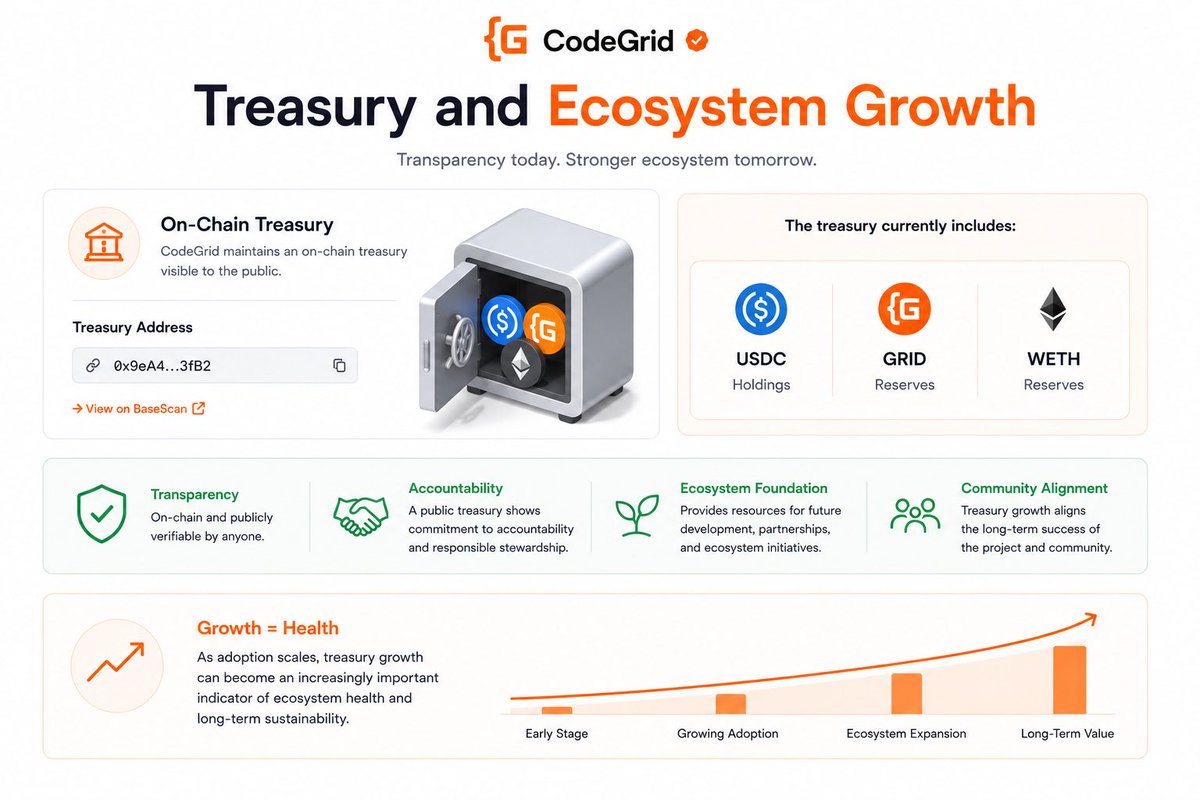
Treasury and Ecosystem Growth
CodeGrid maintains an on-chain treasury visible to the public.
The treasury currently includes:
• USDC holdings
• GRID reserves
• WETH reserves
Transparency is a major positive signal.
The existence of a public treasury demonstrates commitment to accountability while providing a foundation for future ecosystem expansion and development initiatives.
As adoption scales, treasury growth could become an increasingly important indicator of ecosystem health.
1
40
Jun 11
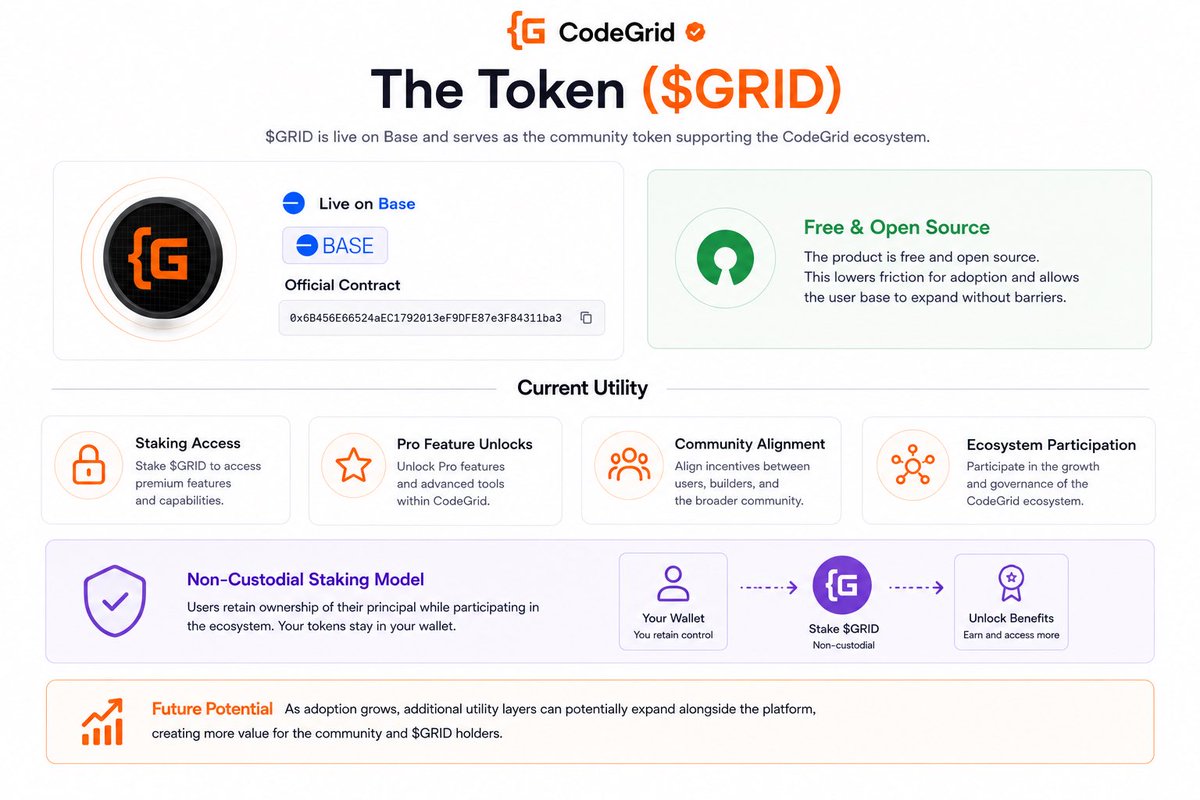
The Token ($GRID)
$GRID is live on Base and serves as the community token supporting the CodeGrid ecosystem.
Official contract:
0x6B456E66524aEC1792013eF9DFE87e3F84311ba3
One particularly attractive aspect of the project is that the product itself is free and open source. This lowers friction for adoption and allows the user base to expand without barriers. At the same time, the project has already introduced staking mechanisms tied to premium functionality.
Current utility includes:
• Staking access
• Pro feature unlocks
• Community alignment
• Ecosystem participation
The non-custodial staking model is especially attractive because users retain ownership of their principal while participating in the ecosystem.
As adoption grows, additional utility layers can potentially expand alongside the platform.
1
2
105
Jun 11
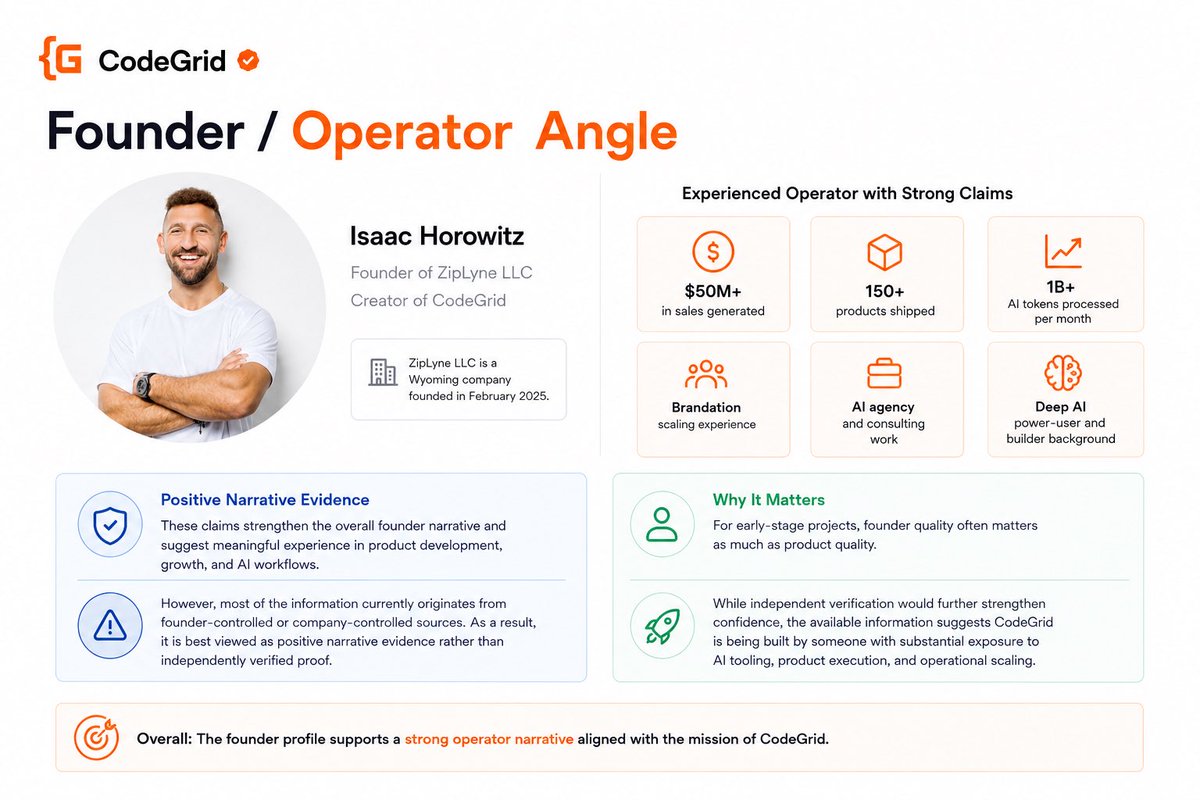
Founder / Operator Angle
The founder page identifies Isaac Horowitz as founder of ZipLyne LLC and creator of CodeGrid. CodeGrid states that ZipLyne LLC is a Wyoming company founded in February 2025.
Across his personal website and ZipLyne materials, Horowitz is presented as an experienced operator with claims including:
• $50M in sales generated
• 150 products shipped
• 1B AI tokens processed per month
• Brandation scaling experience
• AI agency and consulting work
• Deep AI power-user and builder background
These claims strengthen the overall founder narrative and suggest meaningful experience in product development, growth, and AI workflows. However, most of the information currently originates from founder-controlled or company-controlled sources. As a result, it is best viewed as positive narrative evidence rather than independently verified proof.
For early-stage projects, founder quality often matters as much as product quality. While independent verification would further strengthen confidence, the available information suggests CodeGrid is being built by someone with substantial exposure to AI tooling, product execution, and operational scaling.
1
38
Jun 11
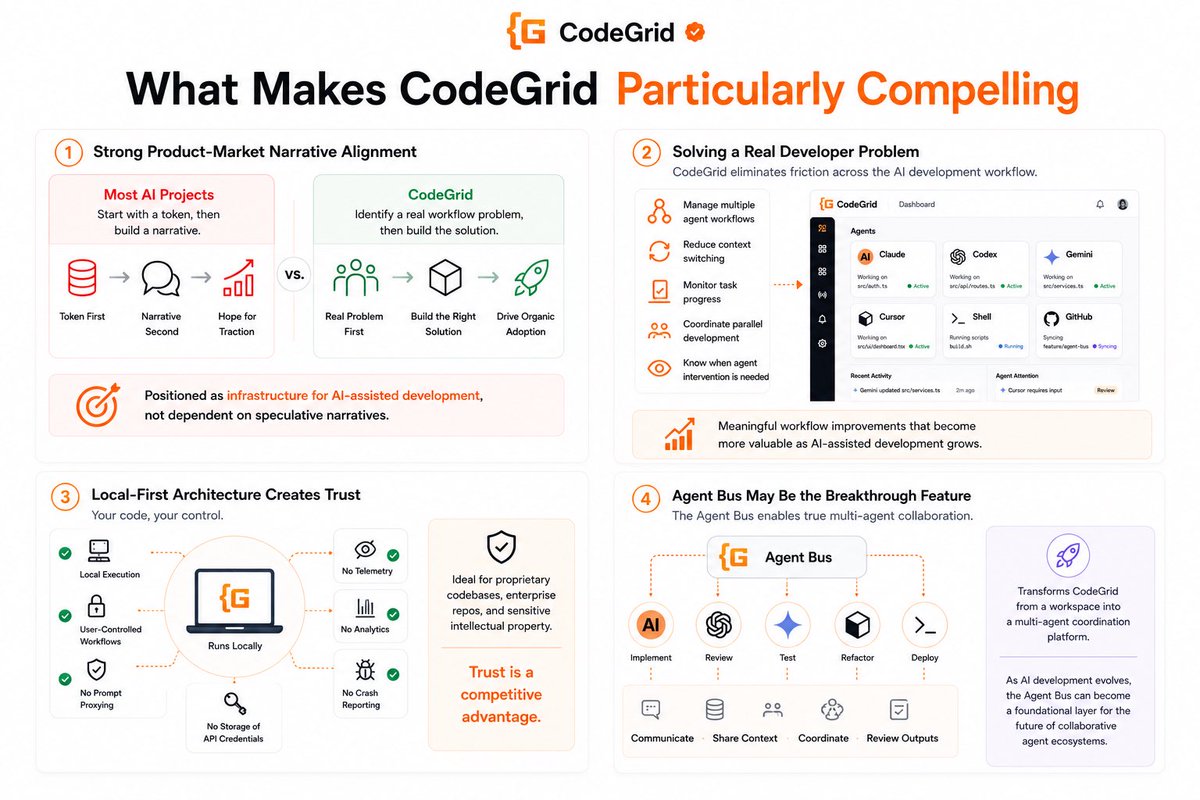
What Makes CodeGrid Particularly Compelling
1. Strong Product-Market Narrative Alignment
Many AI projects begin with a token and attempt to build a narrative around it.
CodeGrid approached the market from the opposite direction.
The company identified a genuine workflow problem:
Developers increasingly use multiple AI agents and need a better way to coordinate them.
The result is a product that feels naturally aligned with emerging market behavior rather than dependent on speculative narratives.
CodeGrid clearly positions itself as infrastructure for AI-assisted development, creating a much stronger foundation for long-term adoption.
2. Solving a Real Developer Problem
Developer tools succeed when they eliminate friction.
CodeGrid addresses several growing pain points:
• Managing multiple agent workflows
• Context switching between tools
• Monitoring task progress
• Coordinating parallel development efforts
• Identifying when agent intervention is required
Features such as agent status tracking, attention detection, workspace persistence, notifications, and centralized visibility create meaningful workflow improvements for active users.
As AI-assisted development becomes mainstream, these workflow efficiencies become increasingly valuable.
3. Local-First Architecture Creates Trust
One of CodeGrid’s strongest advantages is its commitment to local-first design.
The platform emphasizes:
• Local execution
• User-controlled workflows
• No prompt proxying
• No telemetry
• No analytics
• No crash reporting
• No storage of API credentials
For developers working with proprietary codebases, enterprise repositories, or sensitive intellectual property, this approach represents a significant competitive advantage. Trust remains one of the most important currencies in developer tooling.
4. Agent Bus May Be the Breakthrough Feature
The Agent Bus is arguably the most important long-term component of the platform.
It enables agents to:
• Communicate with one another
• Share information
• Coordinate tasks
• Review outputs
• Build collaborative workflows
For example, one agent can generate implementation code while another reviews, tests, or refactors it.
This transforms CodeGrid from a workspace into a true multi-agent coordination platform. As AI development evolves toward collaborative agent ecosystems, the Agent Bus has the potential to become a foundational layer within that workflow.
1
45
Jun 11
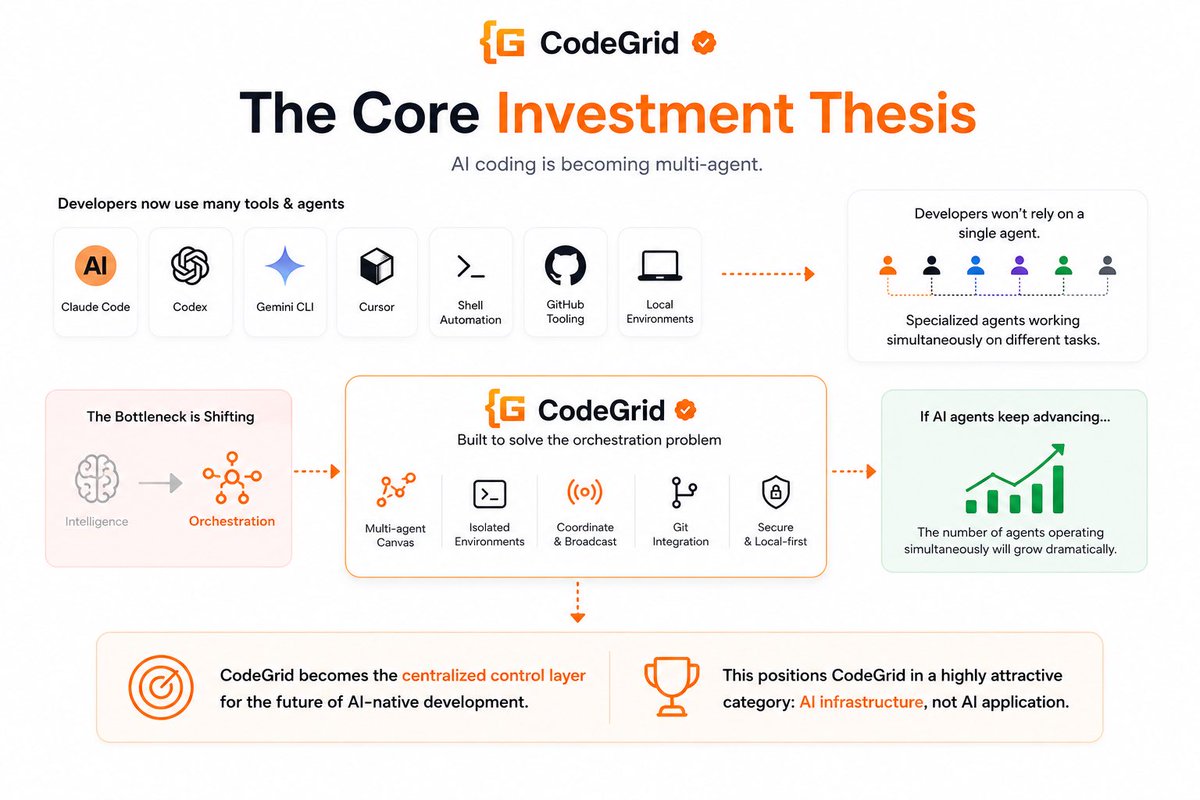
The Core Investment Thesis
The investment thesis centers around one of the largest trends emerging in software development
AI coding is becoming multi-agent.
Today’s developers increasingly utilize:
• Claude Code
• Codex
• Gemini CLI
• Cursor
• Shell automation
• GitHub tooling
• Local development environments
As these systems become more capable, developers are unlikely to rely on a single agent. Instead, they will increasingly deploy specialized agents working simultaneously on different tasks. That shifts the bottleneck away from intelligence and toward orchestration.
CodeGrid is designed specifically to solve that problem. If AI agents continue advancing, the number of agents operating simultaneously will likely increase dramatically. CodeGrid stands to benefit directly by becoming the centralized control layer that organizes, coordinates, and manages those workflows. This positions the project in a highly attractive category:
AI infrastructure rather than AI application.
1
133
Jun 11
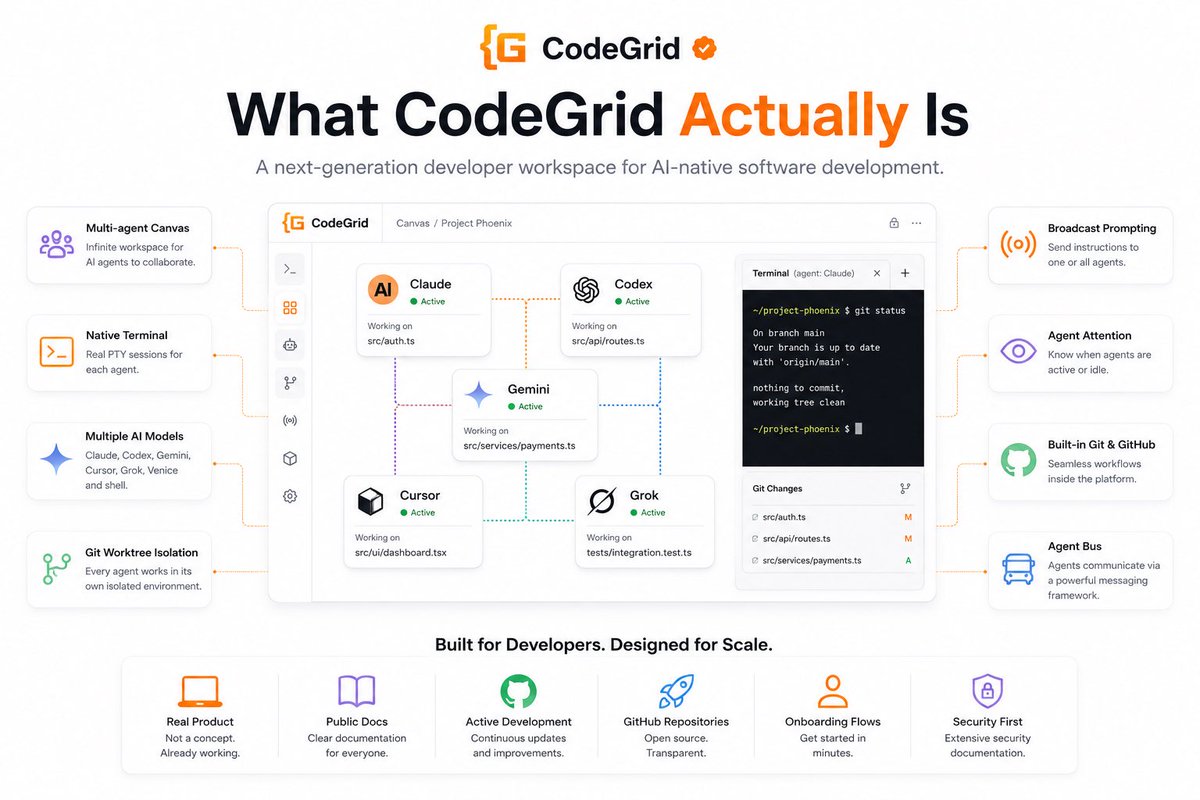
What CodeGrid Actually Is
CodeGrid can be viewed as a next-generation developer workspace built specifically for AI-native software development. Instead of managing dozens of terminal tabs and disconnected tools, developers operate inside an infinite canvas where each AI agent receives its own workspace and context.
The platform already includes:
• Multi-agent canvas
• Native PTY terminal sessions
• Claude, Codex, Gemini, Cursor, Grok, Venice and shell support
• Git worktree isolation
• Broadcast prompting
• Agent attention detection
• Built-in Git and GitHub workflows
• Local-first architecture
• Agent Bus communication framework
Most importantly, this is not a concept or prototype. CodeGrid already has a functioning product, public documentation, active development, GitHub repositories, onboarding flows, and extensive security documentation.
1
169