
The New Testament is the ANTITHESIS of the Old Testament - the clue ice the name. Christianity rejects all the 615 commandments in the Torah and says absolutely anyone can be a member of the religion and not based on whether they are an Israelite.

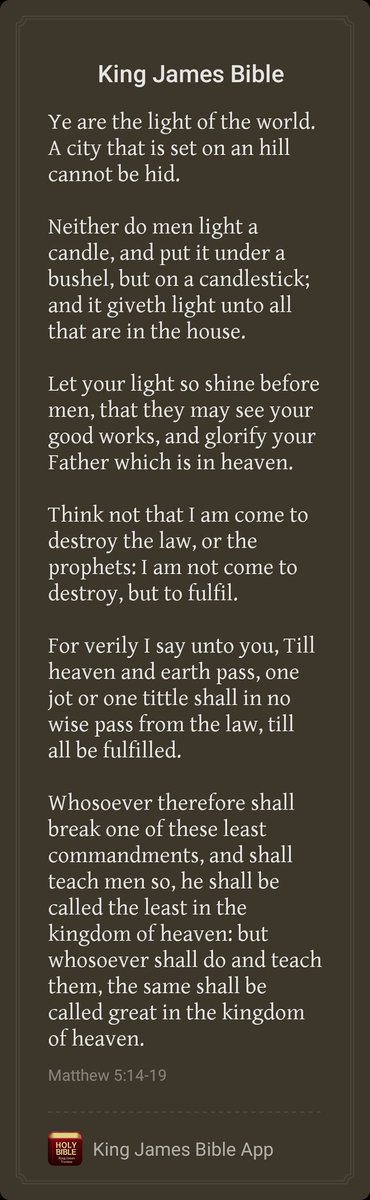

How come people don't teach their children the 10 Commandments? If people love their children, you will raise them upright so they will be productive human beings in society. I seen folks stealing from stores while they're holding their kids in their arms.
1

And so they needed, before anything, to defend themselves from my love which had become lost in the almighty commandments of a God who asked for everything from me, and I thought they defended themselves from their only lover who loved them all, when actually they needed keep us?
1
2

No, there is a point. You are going to hell if you won't obey God's commandments. Not just the dietary laws, but the 10. Do you get how you need to rest on Saturdays and not do Christmas and Easter?
2
Cute Turtle Seeing Signs 👨🍳 retweeted

15m
10 Commandments on 𝕏
Rule 1 - Post as frequently as possible.
Rule 2 - Repost the same content, especially if it's trending.
Rule 3 - Copy content that's performing well.
Rule 4 - Follow everyone who interacts with you.
Rule 5 - Never stop interacting.
Rule 6 - Don't use AI or bots to reply.
Rule 7 - Don't change your niche.
Rule 8 - Don't be negative.
Rule 9 - Be an interaction farmer.
Rule 10 - Be as fake as possible.


gm gm ☕️
- nu week, let’s run it up
- monday money blessings
- have a profitable week, frens 💯
can I get a gm back? 🧡🐢

6
2
8
45
Mean Mr. Mustang retweeted

Another good Evangelical “commandments done away with” White Christian.

1
8
19
171

Islam and socialism is a contradiction. PRIVATE property was instilled since the first commandments of God to Moses pbuH
2

Whose standard do you follow: God's commandments or man's opinions?
The Israelites' standard was never politics, culture, or popular opinion—it was God's law.
#IUICKenya #GodsLaws #BibleTruth #Repent
@OkiyaOmtatah @HistoryKE
1
3


No problems, Muslims believe and apply the ten commandments and the full laws of Moses. Such things as stoning to death, amputation, hanging, blinding is practiced in Sharia.
It can be found in the Torah that came before the Qur'an.😑
2

‘Yet they did not listen even to their judges; for they lusted after other gods & bowed down to them. They soon turned aside from the way in which their ancestors had walked, who had obeyed the commandments of the Lord’ (Judges 2)
A reminder to walk Jesus’ way
#DailyPrayer
1
6

Paul speaks about “obeying the law” in a few interconnected ways—sometimes warning that the Law cannot save by itself, and other times insisting that Christians truly uphold God’s commandments, fulfilled through love and lived “according to the Spirit.”
Passages in Paul where he speaks most directly about “law” and obedience
Romans 13:8–10 — commandments are fulfilled in love“For he who loves his neighbour has fulfilled the Law…” and the commandments are “summed up” in loving one’s neighbor.
Galatians 5:13, 16, 18, 23 — living by the Spirit rather than being under the law’s bondagePaul connects Christian life to freedom and to walking “according to the Spirit,” contrasting this with the works/desires that lead to death.
He also says that where the Spirit guides, believers are “not… under the law” (in the sense of being governed by flesh/enslavement).
And he states that “against” the Spirit’s fruits (love, joy, peace, etc.) “there is no law.”
1 Timothy 1:9 — the law’s role Paul says “The law is not made for the just,” clarifying that law has a particular diagnostic/disciplinary function, not a saving function for those living in righteousness.
Romans 8:2 — freedom from the “law of sin and death,” enabling obedience Paul teaches that the “law of the Spirit of life” sets believers free from the law of sin and death—so that doing God’s commandments becomes possible “only… as the result of a gift of God” (grace).
Romans 7:24–25 — the need for deliverance (context for why obedience is not self-achieved) Paul describes the problem and then gives thanks for deliverance through Christ.
Galatians 6:2 — “the law of Christ” Paul uses the phrase “law of Christ,” indicating a renewed, Christ-shaped “obedience” lived through communion with Christ.
Paul also gives concrete “discipline” and order in the Church
While that’s not the “moral law” question in the abstract, Paul does command practices of order/discipline for local churches—showing a real expectation of obedience to apostolic directives (given with authority):
1 Corinthians 11:2 and 1 Corinthians 14:40, Colossians 2:5 (discipline/order in the churches).
Key idea (how Paul can sound both “pro-law” and “anti-law”)
In Paul, “obedience” does not mean “salvation by mere legalism.” Instead:
the Law’s demands are truly kept,
but they are fulfilled—especially by love—through Christ and the Spirit, not by human self-sufficiency.
6
Lord Oberon King of the Fae retweeted

Some teachers claim the entire law of Moses, including the Ten Commandments and Sabbath, was abolished. This perspective, suggesting bad theology can coexist with love for Jesus, raises concerns. #Theology #Christianity
1
33
Jean-Noel Noel retweeted

The 10 Commandments of All Things Self-Defense
1. Thou Shalt Maintain Vigilant Total Awareness — Keep your head on a swivel; know your surroundings, exits, and the intentions of those around you at all times. Complacency is the enemy.

16
15
19
1,310
jori ståhl retweeted

Man did not invent capitalism. He discovered it by obeying the Ten Commandments. When we align ourselves with this law, we can bring Paradise to Earth.
LONG LIVE FREEDOM, DAMN IT...!!!
117
846
5,668
99,655

As Christians we should love God and love or neighbour as we love ourselves. These we were told by Jesus are the greatest commandments. I don't recall him telling us we should bomb our neighbours and get involved in never ending wars?
1