
My brother is a retired NYPD detective, graduated from the academy in 1985. Was shot and wounded in 1987, and went on to do undercover work in narcotics as a uc, not an investigator. He said that when they started compstat, the CO, ExO, the admin Lt. would panic if the violent numbers increased. So they would reclassify robberies to larceny or petty larceny, assaults with weapons would be come assault 3and so on. That was in the late 1980s or 90s under Bill Bratton…
21
WokeFrance retweeted

3 Mar 2025
Compstat, developed by the NYPD in the 90's, revolutionized how law enforcement agencies track and respond to crime.
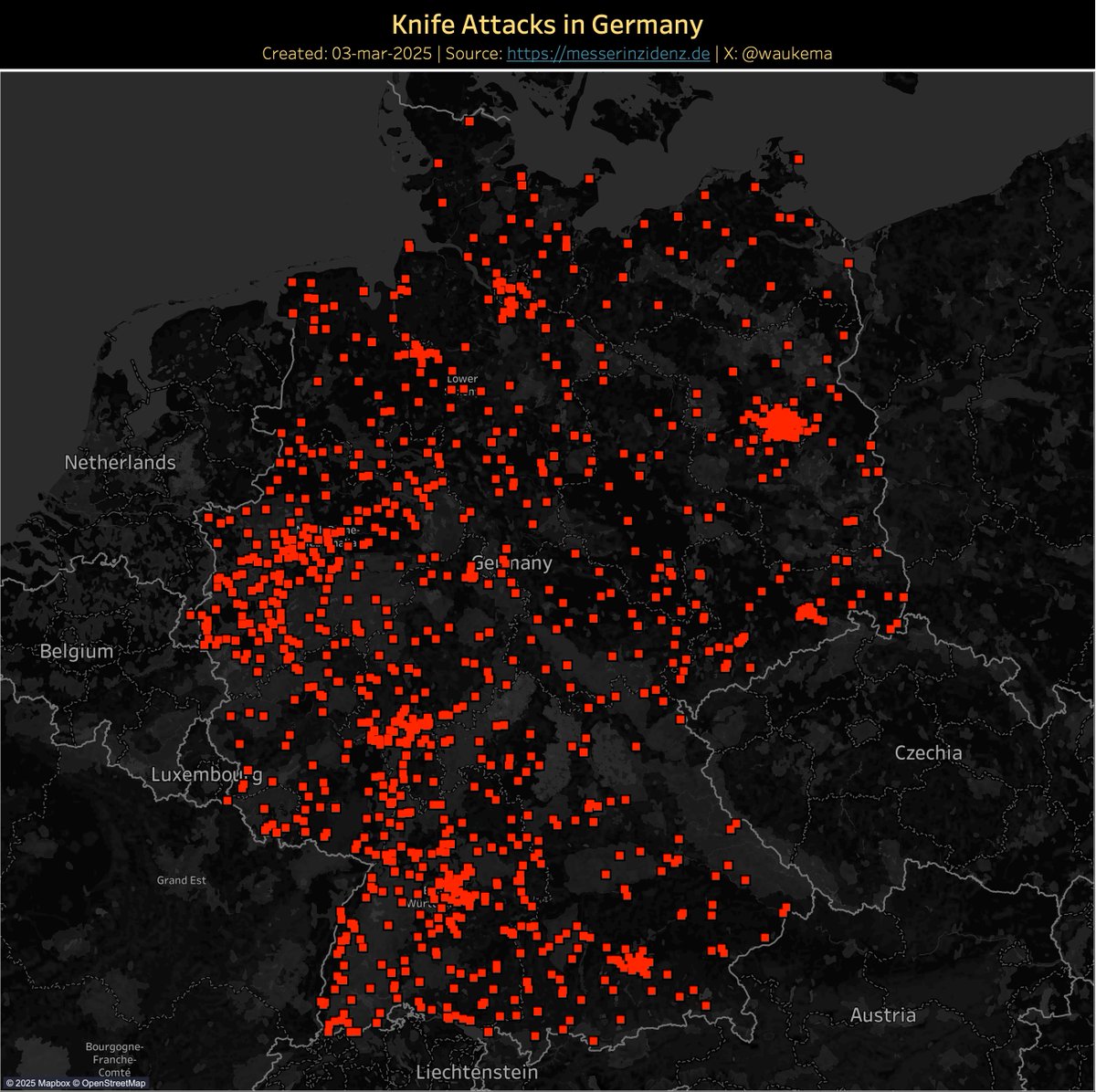
@zieglercloud tracks knife-attacks in Germany. Andy shares his data on messerinzidenz.de
Showing 2444 attacks since august 2024:
49
352
523
62,474

1is30e5{transform:rotate(360deg);} .r-1iusvr4{flex-basis:0px;} .r-1iww7jx{width:28px;} .r-
For the most current data, check official sources like the Chicago Police Department CompStat reports, the City’s Violence Reduction Dashboard, or the University of Chicago Crime Lab. gang
21

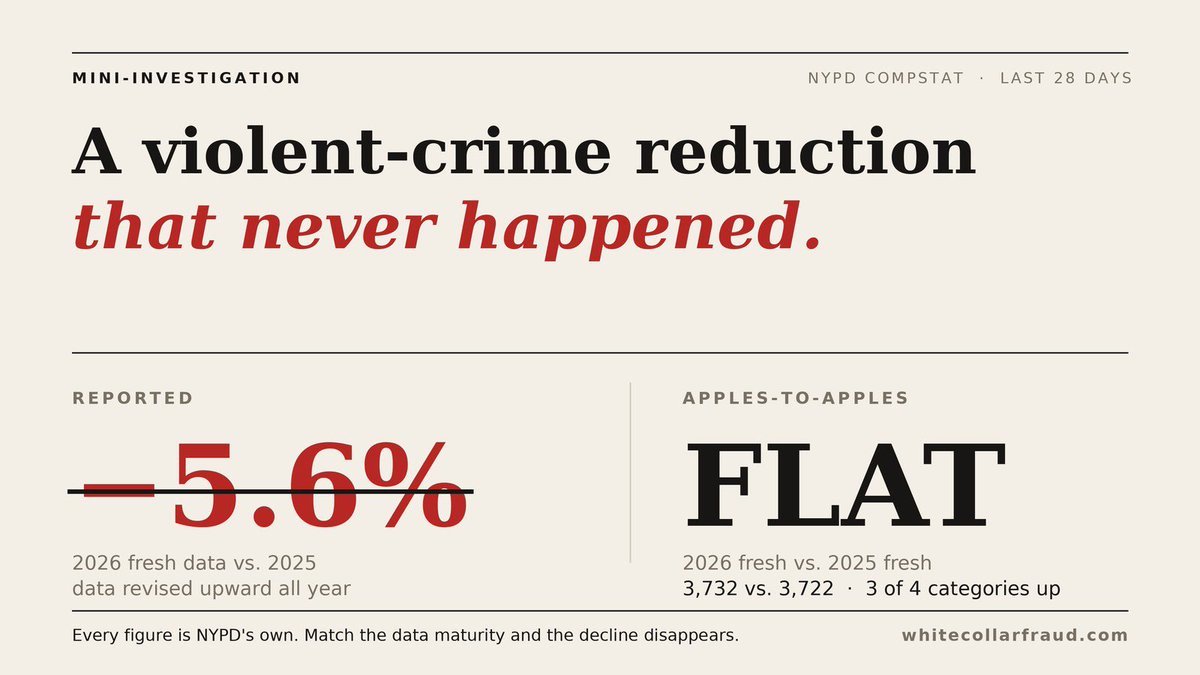
NEW MINI-INVESTIGATION: How NYC reports a violent-crime decline that didn’t happen. Let’s look at the last 28 days.
🚨 There was no 5.6% drop in violent crime. NYPD’s own report produces that number by comparing two different kinds of data. Match them, and the decline vanishes — apples-to-apples, violent crime is flat, with three of four categories actually higher than a year ago.
Here’s the trick.
For the latest 28-day period, NYPD compares fresh, preliminary 2026 numbers against 2025 numbers that have had a full year to be revised upward. Both reports admit it in writing: figures are “preliminary and subject to further analysis and revision.” The current year hasn’t been revised yet. Last year has — all year long.
Compare the same kind of data — 2026 preliminary against the preliminary 2025 numbers NYPD itself published for the identical 28-day period a year ago — and the 5.6% decline doesn’t shrink. It disappears.
As the report frames it (2026 fresh vs. 2025 revised):
• Murder: 22 vs. 25 (−12.0%)
• Rape: 153 vs. 153 (0.0%)
• Robbery: 1,040 vs. 1,253 (−17.0%)
• Felony Assault: 2,517 vs. 2,523 (−0.2%)
Total violent felonies: 3,732 vs. 3,954 = −5.6%
Same kind of data (2026 fresh vs. 2025 fresh):
• Murder: 22 vs. 14 ( 57.1%) — small numbers, so read the counts, not the percent
• Rape: 153 vs. 146 ( 4.8%)
• Robbery: 1,040 vs. 1,191 (−12.7%)
• Felony Assault: 2,517 vs. 2,371 ( 6.2%)
Total violent felonies: 3,732 vs. 3,722 = dead flat.
Three of the four major violent-felony categories are higher than a year ago. The “decline” is an artifact of the comparison, not the crime data.
Here’s where the 5.6% comes from. Over the past year, NYPD revised the 2025 numbers upward — its own counts for the identical 28-day period, a year apart:
• Murder: 14 → 25
• Rape: 146 → 153
• Robbery: 1,191 → 1,253
• Felony Assault: 2,371 → 2,523
Total: 3,722 → 3,954 ( 232 crimes)
Inflate last year’s baseline by 232 crimes, hold this year’s un-inflated, and you’ve conjured a 5.6% “improvement” out of thin air. Nothing about actual crime changed. Only the maturity of the data did.
The revisions themselves are routine. The spin isn’t. And this isn’t a one-administration problem — CompStat has reported preliminary-against-revised under every mayor. That’s the point: the comparison is built to flatter whoever’s in office, every single week.
If 2026 follows the same pattern, these “fresh” 2026 numbers will get revised upward too — and today’s flat line will tilt positive.
One window, equal length, both sides 28 days, both numbers straight from NYPD’s own reports. (I’m not touching year-to-date — the 2026 report runs through June 14, the 2025 report through June 15, so YTD isn’t a valid one-to-one comparison. The 28-day window is.)
The report’s framing: down 5.6%.
Apples-to-apples: flat, with three of four categories up.
Same source. Same crimes. The decline only exists if you grade two different years on two different curves.
ALT NYPD misleading crime stats
13
46
99
9,101

💡CompStat & CitiStat changed how cities measure performance. AI can take it further.
Our new StatGPT Workbook gives cities a blueprint for bringing AI into performance management, built on workshops with 14 cities & real prototypes. Access the workbook➡️ datasmart.hks.harvard.edu/en…
65

Angela Davis, the godmother of Soros prosecutors, stakes her entire case on a single claim: that incarceration and aggressive policing don't actually reduce crime.
Then consider New York. After years of staggering violence, the city ran exactly that experiment -- and the results, as documented in @PeterMoskos's book, demolish the claim:
- Murders fell 70% over the 1990s.
- The steepest drop followed 1994, when the NYPD embraced proactive policing and Compstat (the data-driven system that mapped crime in real time and held precinct commanders accountable for driving it down.) Nearly 20% fewer murders a year, five years running.
- Across two decades, murders fell 87% even as the population grew, dropping below 300 in a city of 8 million.
If Davis and the prosecutors who follow her truly want what's best for the communities they call oppressed, New York should thrill them. The lives saved were overwhelmingly in those very neighborhoods. More than 90% of the city's shooting victims were black or Hispanic -- so driving murder down rescued them directly.
Tens of thousands of mostly minority New Yorkers are alive today because cops, prosecutors, and prisons did what a generation of academics swore couldn't be done.
That's the strange thing about this moment: We're being asked to unlearn something we already proved, at enormous cost, within living memory.

6
29
114
13,563

Can't have the sportsball parade on June 19. The over under on the number of citywide shootings would break compstat and the prediction markets.
Jun 14

Congratulations to the Knicks, but can we have a serious conversation?
A championship parade on the same day as Regents exams feels like a setup. NYC students have worked all year for these tests.
Move the parade to Friday. The city will still celebrate.
42


Jun 14
Yes, you are! 🙄
The positive stats you shared (record-low murders and shootings in early 2026) are real on paper for gun violence. But they sit on top of two bigger problems: selective data manipulation on everything else, and constitutional rights being restricted in the name of those murder numbers.
Crime stats manipulation
NYPD numbers start as preliminary reports filed right after incidents. They get audited and revised later by the Data Integrity Unit. In recent years, those revisions have been almost always upward:
Overall index crimes revised up an average of ~2.7% (sometimes 4.5–6% in periods like 2025).
Murders revised up ~13.5% on average.
A big claimed drop can shrink hard once the audits land.
There was even a 2025 scandal where a transit captain got demoted for ordering fake reclassifications and forged signatures to make his district’s numbers look better. CompStat (the system that grades precincts) creates real pressure to show “improvement.” Serious crimes get downgraded initially (felony assault → misdemeanor) because felonies mean more paperwork and scrutiny. Murders are harder to hide (there’s a body), so they become the shiny headline. Everything else — assaults, thefts, harassment, disorder — gets easier to massage, delay, or bury in the fine print. That’s why you see “major crime down” and “record lows” headlines while total reported offenses and daily quality-of-life crimes tell a messier story. Preliminary announcements get the press; the upward revisions come quietly later.Constitutional rights being traded for “reduce murders”
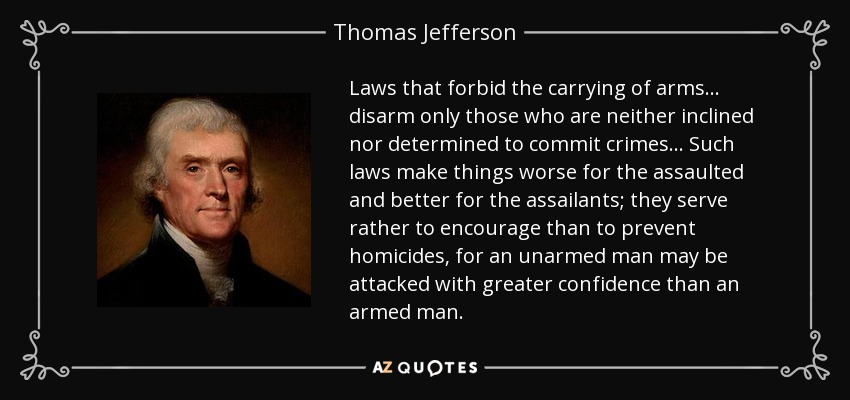
The main vehicle is gun control. Most NYC murders involve guns, so the city’s long-standing answer has been extremely strict rules: tough permitting, feature bans, magazine limits, sensitive-place restrictions, etc. These are sold explicitly as tools to cut gun murders and keep weapons out of the wrong hands.
The constitutional issue is the 2nd Amendment. It protects an individual right to keep and bear arms for self-defense (Supreme Court in Heller 2008 and Bruen 2022). Bruen already killed New York’s old “may-issue” concealed-carry system because it wasn’t rooted in historical tradition. A lot of the remaining NYC restrictions are still being litigated on the same grounds — they burden law-abiding citizens without the required historical justification.
The trade-off critics point out: These laws restrict everyone’s rights (including people who follow every rule and just want to defend themselves), while criminals ignore them and get guns illegally anyway. Targeted enforcement against illegal guns and repeat offenders can drive down gun murders without broadly disarming or burdening legal owners. When the policy instead leans on wide restrictions justified by the murder stats, that’s the rights being curtailed.
Meanwhile the manipulated or selectively presented numbers on other crimes let officials claim overall “success,” which helps justify keeping or expanding the rights-limiting measures.
Real drops in gun violence can come from focused policing (seizing illegal guns, hitting gangs). That part isn’t fake. But when the rest of the crime picture gets gamed and constitutional protections get chipped away in the name of the murder headline, you’re not getting clean progress — you’re getting a narrative that trades individual rights for selective stats.
The data, the revision patterns, the 2025 scandal, and the court cases on the gun laws are all public record. That’s the mechanism.
There was literally a shooting live last night during the riot. I'll bet it wasn't legal...
1
34
Jun 14
Bless your indoctrinated heart...
How the numbers get massaged (the data manipulation part)NYPD crime stats aren't raw counts of victim experiences. They go through layers of classification, auditing, and incentives:Preliminary hype vs. final audited numbers: Monthly/quarterly press releases use early data. These get revised — and every single major crime total in a long analysis was revised upward (average 2.7%, up to 6% in some months; 4.5% average in 2025). Murders get revised up ~13.5% on average. A claimed 24% murder drop in one month became ~9% after audit. Headlines scream big wins; later corrections get less attention. In 2023, initial "crime down" claims flipped to "crime up" after revisions. vitalcitynyc.org
Reclassification and downgrading during processing: Crimes are classified by report date (not occurrence). Initial complaints often start at one severity and get downgraded (or sometimes upgraded) as evidence comes in — e.g., assault severity based on injury documentation, robbery vs. larceny depending on force/weapon perception. The auditing process (precinct units central Data Integrity) corrects some, but initial under-classification reduces "serious crime" counts early on. There is documented historical pressure under CompStat to make numbers look better (retired officer surveys admitted downgrading to hit targets). nytimes.com
Isolated but real recent scandal: In March 2025, a Transit District captain (Steven Hyland) was demoted after an Internal Affairs audit found he directed subordinates to falsify reports — forging signatures and reclassifying complaints (assaults, grand larcenies) to make his district's numbers look better. NYPD said it was limited and didn't move citywide totals much, but it shows the incentive structure still produces this behavior. nypost.com
Cherry-picked categories: "Major crime" or "index crime" usually means the classic 7 FBI UCR felonies. These saw modest declines (~3% overall in 2025). But felony assault (serious injury, weapon, or protected worker) is up ~44% since 2019 and remains at multi-decade highs. Total reported offenses (all crimes, not just the 7) sit ~25% above pre-pandemic levels. Petty larcenies, misdemeanor assaults, harassment, etc., drive daily disorder and aren't in the "crime is down" talking points."
You're being lied to. Do your own research. It's all there for you to find...
2
1
43


prefeitura.rio/forca-municip…
Vi um pouco do trabalho da Compstat, bem interessante.
Creio que temos capacidade técnica, a questão será se a gestão dele terá a força de vontade necessária para tomar as duras decisões necessárias para se resolver o problema.
17

Jun 13
How does it feel to be this stupid?
New York City is experiencing its safest start to a year on record. According to the latest NYPD CompStat Data, violent crime has dropped to the lowest levels in recorded history.
1
45

Jun 13
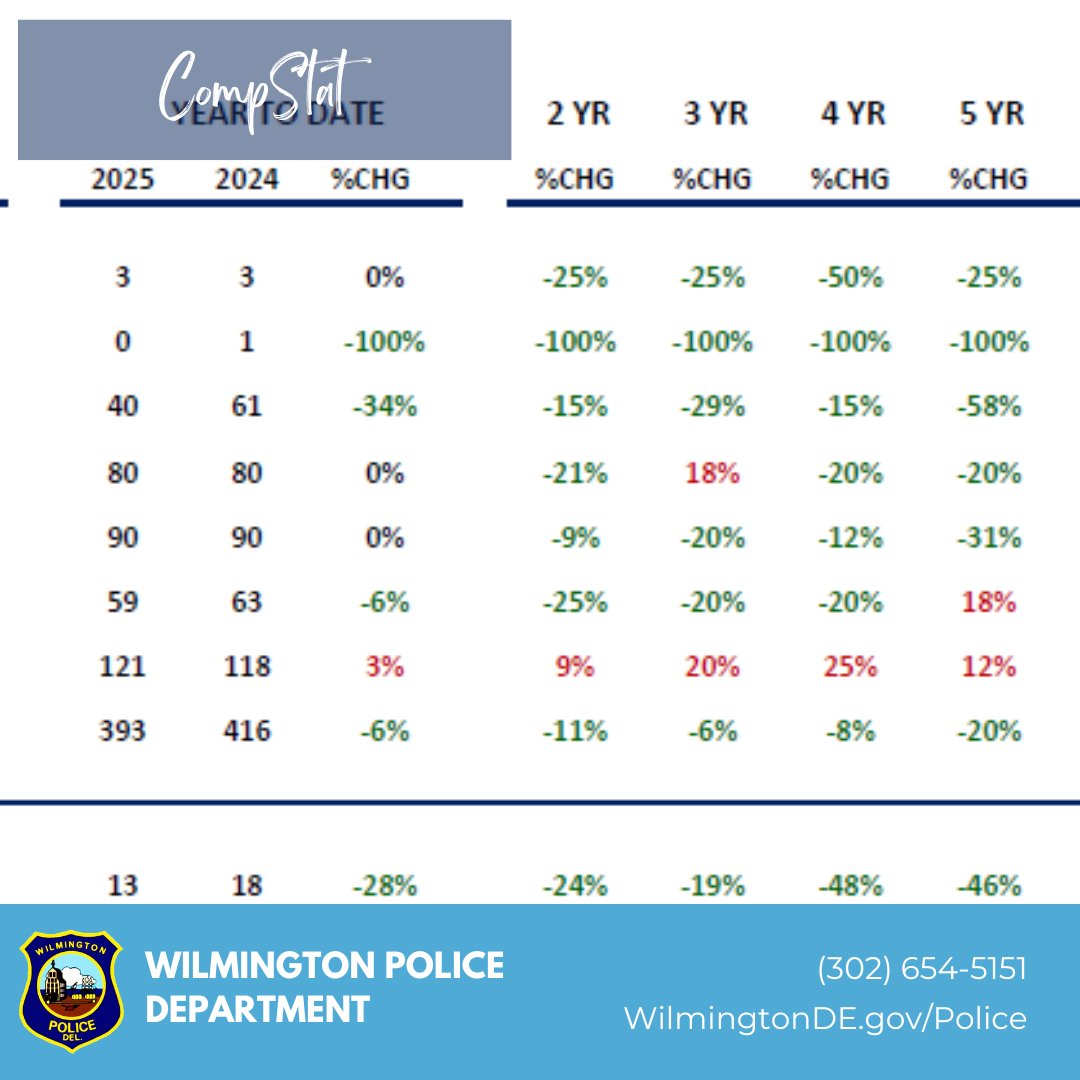
Strategy Saturday: Our CompStat methodology applies business management principles to policing, and holds department leaders and supervisors accountable for crimes and trends in their areas of responsibility.
WilmingtonDE.gov/Police
1
53

Jun 12
With all the problems the job has I would love to know what he does all day besides cooking the Compstat books.
1
90

While i think some of the fans are scumbags lets not lie…if the people of NY didn’t respect the NYPD then why does the data show a historical drop in key crime metrics, particularly murders and shootings, during Mamdani’s early months in office. Check official NYPD CompStat reports.
2
2
57

Jun 10
Lessons from Rudy Giuliani’s New York and Nayib Bukele’s El Salvador
Real-world models show what focused, data-driven enforcement of violent crime can achieve.
In New York City during the 1990s, Mayor Rudy Giuliani and Police Commissioner William Bratton implemented CompStat, a revolutionary data-driven system that tracked crime in real time, held precinct commanders accountable through weekly meetings, and deployed resources precisely where violence clustered. The results were dramatic: from 1993 to 2001, murders dropped 66%, robberies fell 67%, and overall major crimes were cut in half. Property crimes tumbled far faster than national trends. The strategy restored public order, made streets walkable again, and proved that proactive policing of visible disorder deters escalation into violence.
In El Salvador, President Nayib Bukele faced gang domination that made the country one of the world’s most violent. He launched a decisive crackdown: mass arrests of suspected gang members, territorial control plans, mega-prisons for incapacitation, and a sustained state of emergency that shattered gang control. Homicide rates plummeted from over 100 per 100,000 to around 1.9, restoring safety for ordinary citizens and enabling economic recovery. The core lesson: order is the foundation of liberty. Without safe communities, property rights are illusory.
David Simon’s Insight: End the Drug War Distraction
Creator David Simon, whose The Wire depicted the devastating intersection of policing, drugs, and urban decay in Baltimore, has been unequivocal: the War on Drugs has destroyed communities, families, and law enforcement itself. It rewards cops for making easy drug stats on street corners rather than doing the hard, essential work of solving violent crimes. It fills prisons with non-violent offenders, militarizes departments, and diverts resources from predators who actually terrorize neighborhoods. Simon’s blunt policy recommendation from the show and his commentary: end the drug war.
A paleo-libertarian/paleo-conservative approach fully agrees on this point. Non-violent drug use and possession are victimless activities that do not justify the massive diversion of police time, prosecutorial resources, and incarceration. Refocus entirely on violent aggression.
Decriminalize or de-prioritize simple possession. This frees officers to target murderers, rapists, and armed robbers, the predators whose removal makes streets peaceful.
3
77

NYPD’s official explanation, in CompStat releases and joint announcements with the mayor, credits the declines exclusively to “precision policing”: gun seizures (>1,000 YTD), gang takedowns, targeted deployments and foot patrols. You know, tough on crime stuff.
No NYPD statements attribute the drops to the new social-service offices or housing funding, all programs that are very new: the Community Safety Office launched mid-March; the housing plan and full budget came in mid-May. The January–May 2026 crime numbers largely predate all these initiatives.
So, what are these root cause solutions you claim, against the NYPD's explanations, as being responsible?
1.) Creation of the Mayor’s Office of Community Safety (March 19). Funded at $40 million annually, it basically consolidates some existing offices (e.g., Office to Prevent Gun Violence, Office of Community Mental Health) populated with de Blasio-era criminal justice officials.
Of note: By 2021 (de Blasio's last year), most major index crimes were up year-over-year, with murders up ~45% over two years in some periods and transit/hate crimes spiking. Yay that it's come down since.
2.) Housing Investments (explicitly linked by the administration to Stability and Crime Reduction). It's budget is $5.6 billion total in the 5-year plan. Funding is now locked in for the year. However, no new affordable units have been completed or occupied yet. Repairs and vacant-unit turnovers are in the planning/funding pipeline for FY2027 onward. Measurable effects on crime would take years.
No “housing-first” homelessness expansions have been implemented in the first five months.
3.) Mental Health and Related Social Investments. Budgeted at $47 million annually (starting FY2027) for expanded mental health access. Programs build on preexisting efforts rather than brand-new citywide rollouts.
Bottom line: The administration has taken some early steps that align with its stated root-cause strategy. However, these are mostly organizational setups and future-year funding commitments. Tangible, on-the-ground outcomes (new homes occupied, scaled crisis-response teams, measurable poverty reductions) have not yet materialized in the first five months, so they do not, and cannot, yet explain the immediate crime declines.
17
NYPD’s official explanation, in CompStat releases and joint announcements with the mayor, credits the declines exclusively to “precision policing”: gun seizures (>1,000 YTD), gang takedowns, targeted deployments and foot patrols. You know, tough on crime stuff.
No NYPD statements attribute the drops to the new social-service offices or housing funding, all programs that are very new: the Community Safety Office launched mid-March; the housing plan and full budget came in mid-May. The January–May 2026 crime numbers largely predate all these initiatives.
So, what are these root cause solutions you claim, against the NYPD's explanations, as being responsible?
1.) Creation of the Mayor’s Office of Community Safety (March 19). Funded at $40 million annually, it basically consolidates some existing offices (e.g., Office to Prevent Gun Violence, Office of Community Mental Health) populated with de Blasio-era criminal justice officials.
Of note: By 2021 (de Blasio's last year), most major index crimes were up year-over-year, with murders up ~45% over two years in some periods and transit/hate crimes spiking. Yay that it's come down since.
2.) Housing Investments (explicitly linked by the administration to Stability and Crime Reduction). It's budget is $5.6 billion total in the 5-year plan. Funding is now locked in for the year. However, no new affordable units have been completed or occupied yet. Repairs and vacant-unit turnovers are in the planning/funding pipeline for FY2027 onward. Measurable effects on crime would take years.
No “housing-first” homelessness expansions have been implemented in the first five months.
3.) Mental Health and Related Social Investments. Budgeted at $47 million annually (starting FY2027) for expanded mental health access. Programs build on preexisting efforts rather than brand-new citywide rollouts.
Bottom line: The administration has taken some early steps that align with its stated root-cause strategy. However, these are mostly organizational setups and future-year funding commitments. Tangible, on-the-ground outcomes (new homes occupied, scaled crisis-response teams, measurable poverty reductions) have not yet materialized in the first five months, so they do not, and cannot, yet explain the immediate crime declines.
Jun 5

Wow it’s almost like “tough on crime” doesn’t actually work and you have to address the root causes
29

Jun 10
IM SO PISSED OFF i have my compstat final on the day of my friends bday😭😭😭😭😭😭😭😭😭😭😭😭😭😭😭😭😭😭😭😭😭😭😭😭😭😭😭😭😭😭😭😭
11