

oh my god im playing the 3.4 quest ( very late i know ) and coronal radiance started playing IM GONNA START SOBBING HOLY SHIT
19

00000049 / 33550336
______________________
Coronal radiance or moon halo?
#HonkaiStarRail #Phainon

4
5,155
24,388
279,375

Solar Weather: The sun's complex magnetic field is responsible for "space weather," such as solar flares and coronal mass ejections, which can interact with Earth's magnetic field and disrupt satellites or create auroras.
18

*She draws the Coronal, the star within blazing*
1
1
14


Angel☀️🔥🕯♓️🕯🌧🌙 retweeted

Jun 16
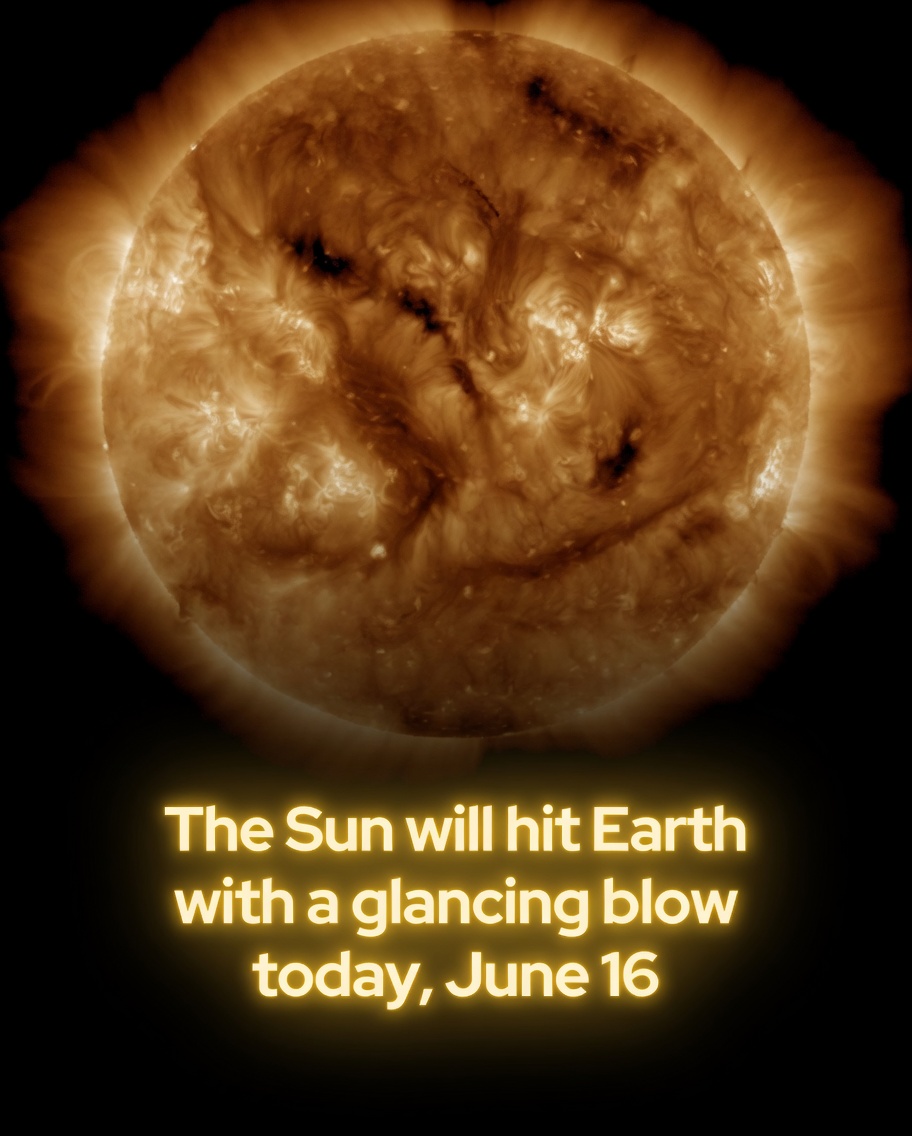
🚨 A cloud of solar plasma is on course to reach Earth today
Space weather experts report that a coronal mass ejection (CME) launched by the Sun on June 12 is expected to deliver a glancing blow to Earth’s magnetic field as early as June 16.
The impact will not be direct, but even a near miss can disturb our planet’s magnetic shield and spark spectacular aurora displays.
A CME is a massive eruption of electrically charged plasma and magnetic fields hurled into space from the Sun. These events can eject billions of tons of solar material and travel millions of miles across the solar system. While most CMEs pass Earth harmlessly, those that come close can trigger geomagnetic storms by interacting with our planet’s magnetic field.
In this instance, forecasters anticipate only a minor disturbance. The Sun has been relatively quiet in recent days, with only small flares from a few inactive sunspot regions. Nevertheless, the earlier CME remains on track to pass near enough to Earth to cause a temporary increase in geomagnetic activity.
A weak G1 geomagnetic storm is possible. While this level is unlikely to cause significant disruptions, it can push the northern lights farther south than usual. Under favorable conditions, residents in cities such as Calgary, Edmonton, Oslo, and Stockholm may get a chance to see the auroras if skies are clear.
The visibility of auroras will ultimately depend on the orientation of the CME’s magnetic field upon arrival. A well-aligned field can allow more solar energy to reach Earth, boosting the chances of a visible display.
For now, experts stress that this will likely be nothing more than a glancing blow, a minor space weather event rather than a major storm.
14
67
213
17,702

12h
Unified Effective Framework: Paired Positive and Negative Fields (Toward a Data-Anchored Emergent Gravity Theory)
This collection of documents presents a cohesive, speculative but internally consistent effective framework for unifying gravity, the force hierarchy, quantum gravity issues, and certain astrophysical anomalies. It is developed by Morgan Elliott Smart in collaboration with Grok (xAI). The core idea inverts the standard vacuum assumption and treats gravity as an emergent “displacement pressure” effect.Core Idea in One PictureThe universe’s baseline is a dominant, non-conductive negative-energy “ocean”. Positive-energy matter appears as rare, localized “bubbles” that disrupt this ocean. Gravity is primarily the ambient “crush” pressure exerted by the infinite negative background trying to displace or collapse these positive intrusions — not (solely) spacetime curvature sourced by positive mass-energy.This single mechanism naturally produces:
Gravity’s extreme weakness at microscopic scales (screened inside dense positive regions).
Its dominance at macroscopic scales (coherent accumulation of displacement zones with no cancellation, unlike electromagnetism).
The framework is anchored in Parker Solar Probe (PSP) public data via the residual acceleration term
fneg(r)=aobs(r)−aexp(r)>0f_{\rm neg}(r) = a_{\rm obs}(r) - a_{\rm exp}(r) > 0f_{\rm neg}(r) = a_{\rm obs}(r) - a_{\rm exp}(r) > 0
(after subtracting standard gravitational thermal pressure contributions). This residual is interpreted as the macroscopic signature of the negative field when local pairing weakens.Key Pillars of the Framework1. Paired Fields Φ₊ and Φ₋
Φ₊ (positive/conductive): Long-range propagation, energy-momentum coupling.
Φ₋ (negative/non-conductive): Quantum containment, insulation, macroscopic spacetime displacement.
Their interaction is quantized:
Spair=∫λΦ Φ− d4xwithSpair∈nℏ (n∈Z).S_{\rm pair} = \int \lambda \Phi_ \Phi_- \, d^4x \quad \text{with} \quad S_{\rm pair} \in n\hbar \ (n \in \mathbb{Z}).S_{\rm pair} = \int \lambda \Phi_ \Phi_- \, d^4x \quad \text{with} \quad S_{\rm pair} \in n\hbar \ (n \in \mathbb{Z}).
At the Planck scale they “meet and orbit,” setting the natural correlation length
ℓp=ℏG/c3\ell_p = \sqrt{\hbar G / c^3}\ell_p = \sqrt{\hbar G / c^3}
. Net gravity emerges as
Φgrav≡Φ Φ−.\Phi_{\rm grav} \equiv \Phi_ \Phi_-.\Phi_{\rm grav} \equiv \Phi_ \Phi_-.
2. Microscopic Foundation: Corrolons
Fundamental degrees of freedom are corrolons — indivisible paired quanta carrying conductive charge
q q_ q_
and confinement charge
q−q_-q_-
, with an internal separation degree of freedom
σ\sigma\sigma
(quantized in units of
ℏ\hbar\hbar
). The microscopic action includes a potential
V(σ)V(\sigma)V(\sigma)
that strongly favors the “meet-and-orbit” bound state at
σ∼ℓp\sigma \sim \ell_p\sigma \sim \ell_p
. Effective fields
Φ±\Phi_\pm\Phi_\pm
arise as coarse-grained collective modes of vast numbers of corrolons. Hubbard–Stratonovich transformation decouples the microscopic pairing interaction and generates the regulated path-integral measure for the paired fields.3. Four Operational Properties of Φ₋ (derived from PSP residuals)
Quantum-paired to Φ₊.
Non-conductive (exponentially screened or confined like flux tubes).
Insulating (limits outward energy transport in low-density plasma → coronal temperature inversion).
Macroscopic displacement of spacetime (the “crush” term
fneg(r)f_{\rm neg}(r)f_{\rm neg}(r)
).
4. Force Hierarchy from One Mechanism
Gravity: Net emergent effect of paired fields.
Electromagnetism: Primarily Φ₊ propagation.
Weak force: Negative-field containment chiral aspects.
Strong force: Strongest manifestation of non-conductivity and confinement.
Addressing Major Problems
Gravitational hierarchy / scale dependence: Automatic via screening inside dense positive “bubbles” vs. coherent accumulation outside (non-conductive medium prevents leakage).
Cosmological constant hierarchy: Observed tiny positive
Λ\Lambda\Lambda
is a stable trace residue locked in by non-conductivity; the dominant negative ocean supplies the attractive “crush” while the positive trace drives accelerated expansion (
w≈−1w \approx -1w \approx -1
).
Black-hole entropy & information paradox: Entropy from counting closed pairing loops threading the horizon (area law
SBH=kBlnΩpairS_{\rm BH} = k_B \ln \Omega_{\rm pair}S_{\rm BH} = k_B \ln \Omega_{\rm pair}
, with
Ωpair∝exp(A/4ℓp2)\Omega_{\rm pair} \propto \exp(A/4\ell_p^2)\Omega_{\rm pair} \propto \exp(A/4\ell_p^2)
). Information preserved in the loop topology.
Holography: Closed pairing loops serve as fundamental boundary degrees of freedom; Ryu–Takayanagi formula recovered from loop counting on minimal surfaces.
Singularities & bounce: Repulsive displacement term at high curvature yields regular Planck-scale cores and cosmological bounce (modified Friedmann/TOV equations).
Natural UV cutoff: Pairing becomes strongly non-perturbative at Planck energies; no ad-hoc regulator needed.
Quantization sketch (detailed in dedicated documents): Path integral
Z=∫DΦ DΦ−exp(iℏS[Φ ,Φ−])Z = \int \mathcal{D}\Phi_ \mathcal{D}\Phi_- \exp\left(\frac{i}{\hbar} S[\Phi_ ,\Phi_-]\right)Z = \int \mathcal{D}\Phi_ \mathcal{D}\Phi_- \exp\left(\frac{i}{\hbar} S[\Phi_ ,\Phi_-]\right)
with pairing term enforcing the measure and non-conductive properties automatically. Hilbert space spanned by winding numbers of closed loops macroscopic displacement mode. Unitarity by construction.Concrete Realization: Displacement-Pressure Modified Gravity (DPMG)A genuine scalar-tensor modified-gravity theory realizing the intuition:
S=∫d4x−g[MPl22R−12(∂μϕ)2−V(ϕ)] Sm[ψm,g~μν]S = \int d^4x \sqrt{-g} \left[ \frac{M_{\rm Pl}^2}{2} R - \frac12 (\partial_\mu \phi)^2 - V(\phi) \right] S_m[\psi_m, \tilde g_{\mu\nu}]S = \int d^4x \sqrt{-g} \left[ \frac{M_{\rm Pl}^2}{2} R - \frac12 (\partial_\mu \phi)^2 - V(\phi) \right] S_m[\psi_m, \tilde g_{\mu\nu}]
with conformal coupling
g~μν=A2(ϕ)gμν\tilde g_{\mu\nu} = A^2(\phi) g_{\mu\nu}\tilde g_{\mu\nu} = A^2(\phi) g_{\mu\nu}
, density-dependent chameleon coupling
β(ρ )=β0exp(−ρ ρc),\beta(\rho_ ) = \beta_0 \exp\left(-\frac{\rho_ }{\rho_c}\right),\beta(\rho_ ) = \beta_0 \exp\left(-\frac{\rho_ }{\rho_c}\right),
and runaway negative-ocean potential
V(ϕ)=Λ4exp(−λϕ/MPl)V(\phi) = \Lambda^4 \exp(-\lambda \phi / M_{\rm Pl})V(\phi) = \Lambda^4 \exp(-\lambda \phi / M_{\rm Pl})
.Effective Newton constant:
Geff(ρ )=G(1 2β(ρ )2).G_{\rm eff}(\rho_ ) = G \bigl(1 2\beta(\rho_ )^2\bigr).G_{\rm eff}(\rho_ ) = G \bigl(1 2\beta(\rho_ )^2\bigr).
High-density (atoms, lab, planetary interiors): screened (
Geff≈GG_{\rm eff} \approx GG_{\rm eff} \approx G
).
Low-density (voids, cosmic scales): enhanced (
Geff>GG_{\rm eff} > GG_{\rm eff} > G
).
This reproduces the desired scale dependence without extra dimensions or new particles beyond the scalar.Strengths
Data-anchored: Direct use of public PSP residuals for
fneg(r)f_{\rm neg}(r)f_{\rm neg}(r)
.
Predictive: Modified dispersion relations, gravitational-wave echoes from Planck cores, stellar-wind deviations, stronger effective gravity in voids/dwarf galaxies, rotation-curve flattening at low surface density.
Unifying: Single pairing mechanism links micro (corrolons), effective fields, force hierarchy, black-hole thermodynamics, and holography.
Progress on quantization & holography: Explicit path-integral construction, loop counting for entropy, Ryu–Takayanagi recovery
1
49
12h
IRL Data Points That Align Directionally or Can Be Re-InterpretedThese are real measurements (not proofs of the full theory, but observations the framework maps onto via screening, insulation, emergent crush, or pairing):
Parker Solar Probe (PSP) in-situ measurements: Switchbacks (magnetic field reversals), Alfvén waves, turbulence, and energy transport in the corona; observed coronal temperature inversion (millions K vs. photosphere ~5500 K). The framework re-interprets insulating/non-conductive Φ₋ as limiting outward energy flow. Residual accelerations after standard modeling (thermal, radiation pressure) are noted in some orbital analyses, though conventional explanations dominate.news.engin.umich.ed…
Low Surface Brightness (LSB) galaxies and dwarf galaxy rotation curves: High-resolution Hα and HI data show slowly rising or flat curves with core-dominated (not cuspy) dark matter halos; visible matter alone underpredicts velocities at large radii. Examples from samples of 26–50 galaxies (de Blok, McGaugh, Swaters et al.). The framework's density-dependent screening (G_eff enhanced in low-ρ₊ regions) naturally fits stronger effective gravity in diffuse systems.iopscience.iop.org
KBC void (local underdensity): ~2 billion light-year scale region with density contrast δ ≈ 0.46 ± 0.06 (half the cosmic mean) on 40–300 Mpc scales; tied to local Hubble flow measurements. Modified-gravity analyses (e.g., Milgromian dynamics) use it to fit higher local H₀. The framework's enhanced G_eff in voids aligns with this.academic.oup.com
Casimir effect: Laboratory measurements of attractive force between uncharged plates due to vacuum mode suppression, yielding negative relative energy density in the gap. Directly demonstrates negative energy densities in QFT. The negative-ocean baseline resonates with this.en.wikipedia.org
Black hole observations (EHT shadows of M87 and Sgr A)**: Shadow sizes and ring structures match Kerr GR predictions externally, but leave room for interior modifications (no direct singularity probe). Gravitational-wave ringdowns from mergers are consistent with GR but constrain near-horizon deviations.
Pioneer anomaly (historical, now mostly resolved): Tiny anomalous sunward acceleration (~8.7 × 10^{-10} m/s²) on outbound probes; ultimately thermal radiation, but similar tracking residuals appear in other spacecraft discussions.planetary.org
Coronal heating and solar wind acceleration: Decades of data showing energy deposition mechanisms (waves, reconnection) that maintain high temperatures; PSP traces sources to surface structures.
These data points span lab (Casimir), solar system (PSP), galactic (LSB rotations), and cosmic scales (KBC void) — the framework unifies them under scale-dependent pairing/screening.Things the Theory Aims to Explain in One Mechanism (Where Science Currently Struggles)Current physics explains most everyday/precision phenomena extremely well (GR Standard Model ΛCDM), but these frontier/open issues remain fragmented across separate models or unresolved:
Gravitational hierarchy / scale dependence: Why gravity is ~10^{40} times weaker than other forces at microscopic scales but dominates macroscopically. (Screening in dense regions vs. coherent accumulation in the framework.)
Cosmological constant / vacuum energy problem: Theoretical QFT prediction ~120 orders of magnitude too large vs. observed tiny positive Λ. (Framework treats it as trace residue from non-conductive negative ocean.)
Black-hole entropy, information paradox, and singularities: How to count microstates for area-law entropy; whether information is lost; mathematical singularities in GR. (Loop-counting from closed pairings; repulsive displacement for regular Planck cores/bounces.)
Force hierarchy and unification: Why four forces have such different strengths and ranges; no single mechanism in SM GR. (All from conductivity/non-conductivity, confinement, and pairing properties.)
Galaxy rotation curves and dynamics in low-density systems: Flat curves in LSB/dwarfs without invoking separate dark matter halos everywhere; behavior in voids. (DPMG screening provides effective extra gravity where density is low.)
Coronal heating / temperature inversion: Why the Sun's outer atmosphere is millions of K hotter than the surface, with energy transport puzzles. (Insulating Φ₋ limiting outward flow.)
Quantum gravity / holography at Planck scale: Consistent quantization and emergence of spacetime; Ryu–Takayanagi-like relations. (Paired corrolons, path-integral with pairing term, loop counting.)
Stability of negative energies and vacuum structure: How negative energies (seen in Casimir/Hawking) don't cause instabilities on cosmic scales.
1
1
42

Los fuertes campos magnéticos siempre forman esa cavidad coronal en la cúspide, en forma de esfera. ( o - marcado)🧐
-.- ¿Los pilares de La Tierra?
Sí, lo son. 🤔🤨🫡
44

2️⃣ Why is MRI preferred?
✅ No ionizing radiation
✅ Excellent soft tissue contrast
✅ Multiplanar imaging (axial, sagittal and coronal planes)
✅ Useful for brain, spine, joints, heart and many other organs
MRI has become an indispensable tool in modern medicine.
1
1
24