
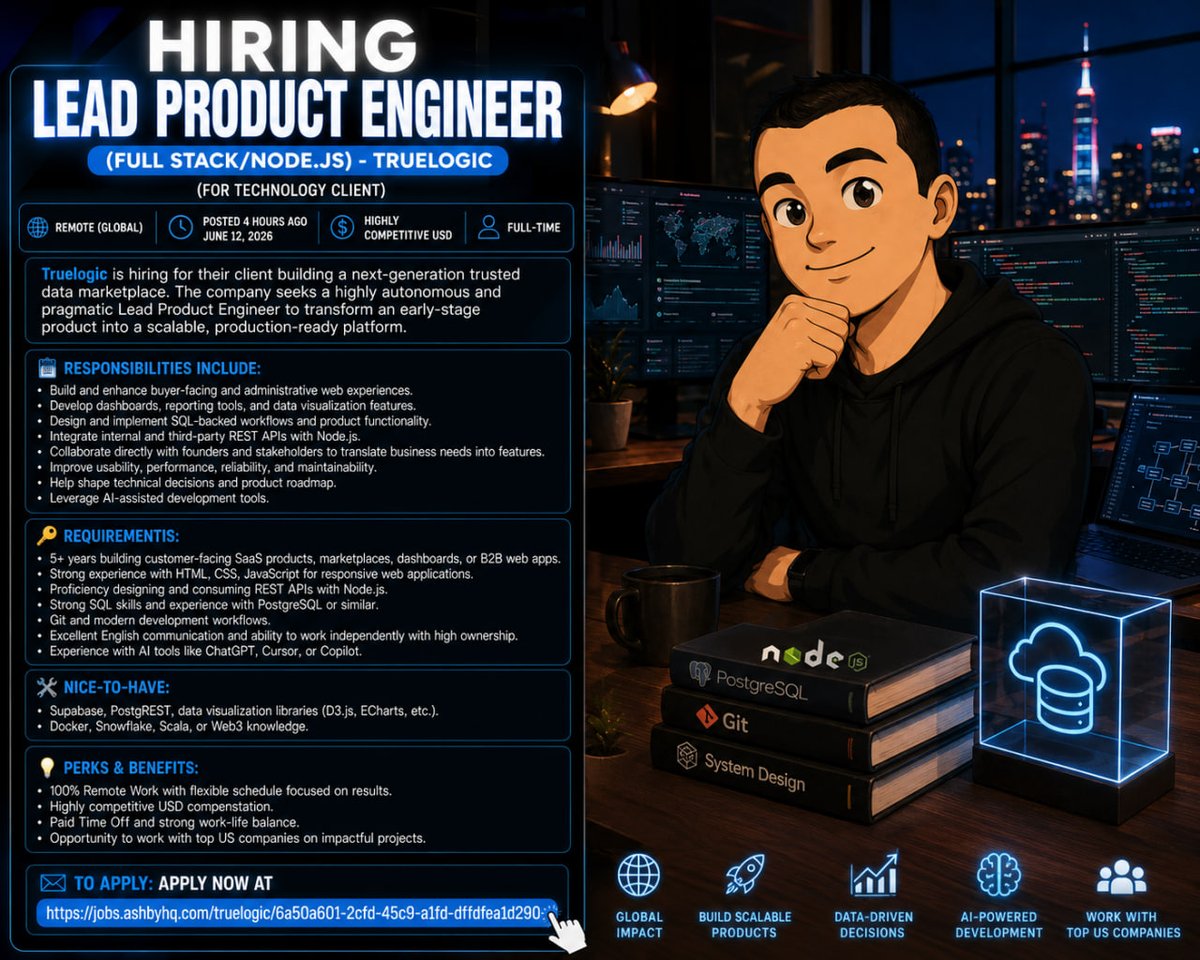
💻 Hiring: Lead Product Engineer (Full Stack/Node.js) - Truelogic (Technology Client)
📍 Remote (Global) | 💼 Full-time | 🧑💻 Node.js, PostgreSQL, REST APIs | 💰 Competitive USD | 🕐 4 hours ago - June 12, 2026
Truelogic is hiring for their client - a next-gen trusted data marketplace. The company seeks a hands-on Lead Product Engineer to build scalable web experiences, dashboards, and data-driven features in a fast-paced startup environment.
📋 Responsibilities include:
- Build buyer-facing & admin web experiences.
- Develop dashboards, reporting & data viz features.
- Design SQL-backed workflows & functionality.
- Integrate REST APIs with Node.js.
- Collaborate with founders on product features & roadmap.
- Improve performance, reliability & maintainability.
- Use AI tools to accelerate delivery.
🔑 Requirements:
- 5 years in SaaS/marketplaces/dashboards/B2B web apps.
- Strong HTML/CSS/JS for responsive UIs.
- Node.js REST APIs & third-party integrations.
- Advanced SQL & PostgreSQL experience.
- Git workflows, debugging & independent ownership.
- Excellent English.
🛠 Nice-to-have: Supabase, D3.js/ECharts, Docker, Snowflake, Web3.
💡 Perks: 100% Remote, top USD pay, PTO, autonomy, work with leading US companies.
📩 To apply: Apply now at jobs.ashbyhq.com/truelogic/6…
🔗 Original: linkedin.com/posts/remote-le…
⚠️ DYOR! I don’t verify every job. If asked to run files or pay 🚩 scam.
❗️ I'm not hiring myself! Sharing fresh web3/crypto/blockchain roles DAILY!
💡 Interns & juniors → t.me/crypto_vazima_english
💼 Mid/senior → t.me/web3_jobs_crypto_vazima
#Hiring #RemoteJobs #FullStack #NodeJS #ProductEngineer #SaaS #DataMarketplace #Web3 #JavaScript #PostgreSQL #RemoteWork #TechJobs #Engineer #Startup #LATAM
4
111

Jun 11
Today's Know Your Customer (KYC) challenge is no longer simply collecting data to meet regulatory requirements, but centralizing & analyzing it at scale. Learn how data product marketplace solutions can help buff.ly/C3RoJl2 #data #datamarketplace #finance #KYC

145
Jun 10
To maximize value from data the whole organization must work together. In the blog we explore how a data product marketplace underpins your data team, enabling greater data sharing & consumption buff.ly/GE3HuRG #data #datamarketplace

12
Jun 9
"LinkedIn for internal data" - discover lessons from @workday's data sharing journey highlighted at the recent Gartner London event as it scales data consumption across the organization #data #datamarketplace buff.ly/fb1w9Br
47
Jun 8
What is adaptive data governance & why does it matter? Based on @Gartner_inc best practices, we look at the journey to adaptive data governance & the role of the data product marketplace in its successful delivery buff.ly/faCiT4i #data #datagovernace #datamarketplace

27

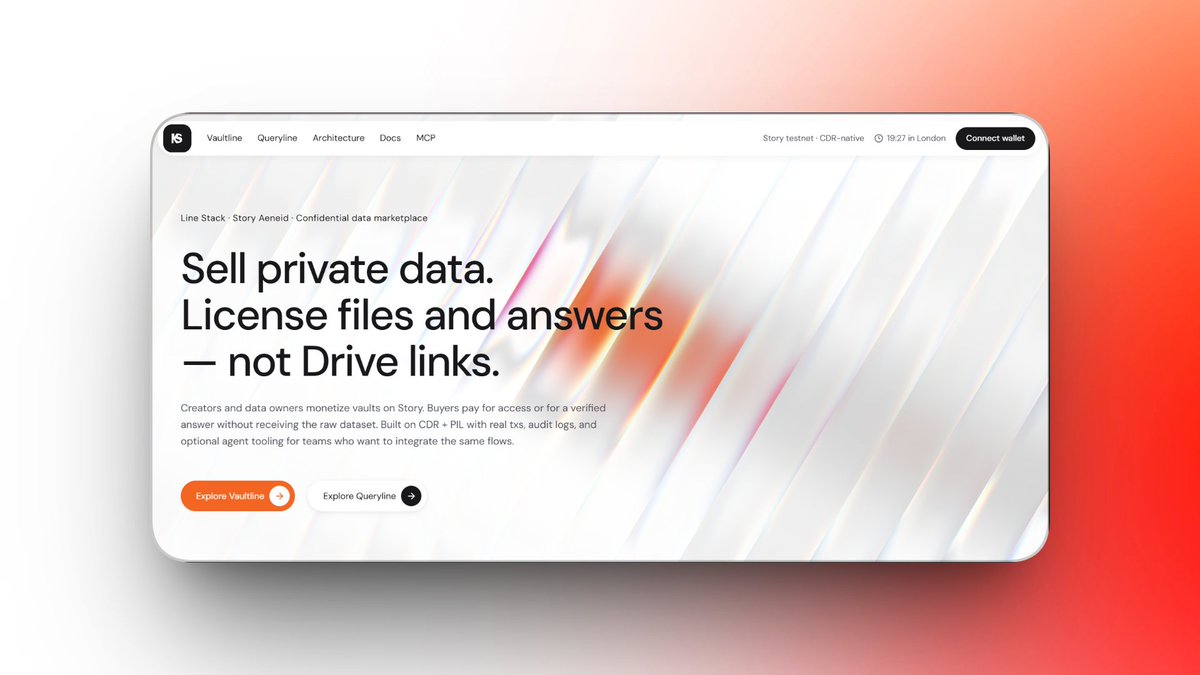
Shipped Line Stack for the CDR hackathon on Story Aeneid — two products, one CDR stack, real txs (no mocks).
#StoryProtocol #CDR #Web3 #DataMarketplace #Hackathon
1
4
6
165

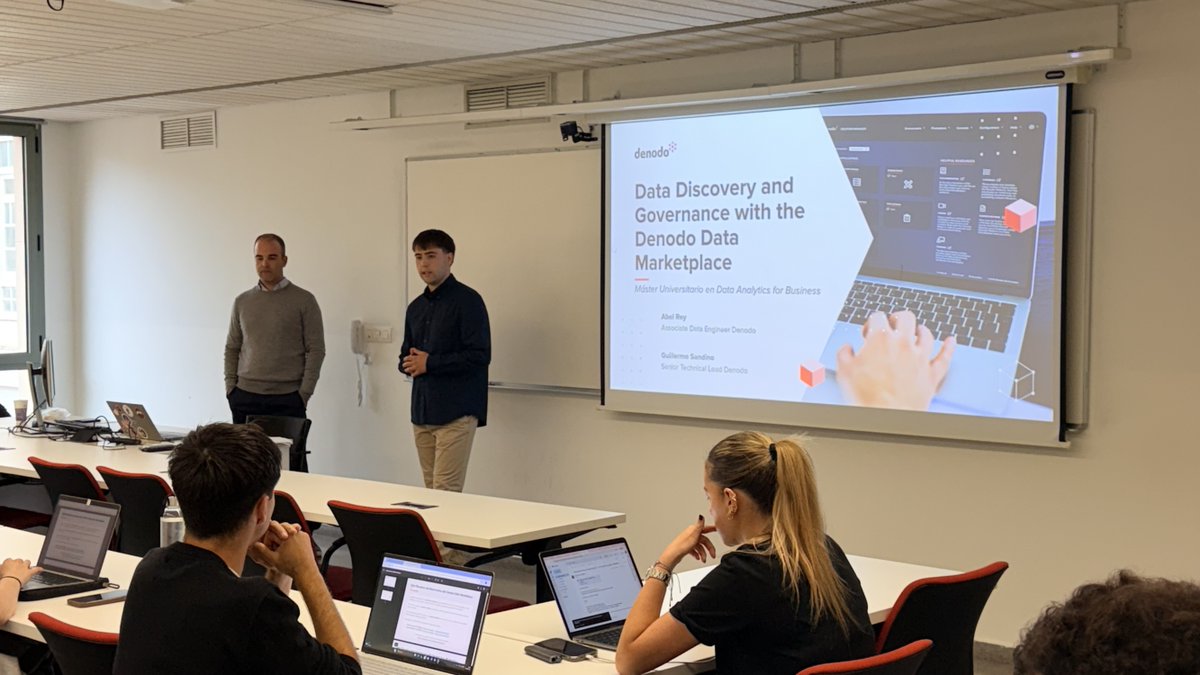
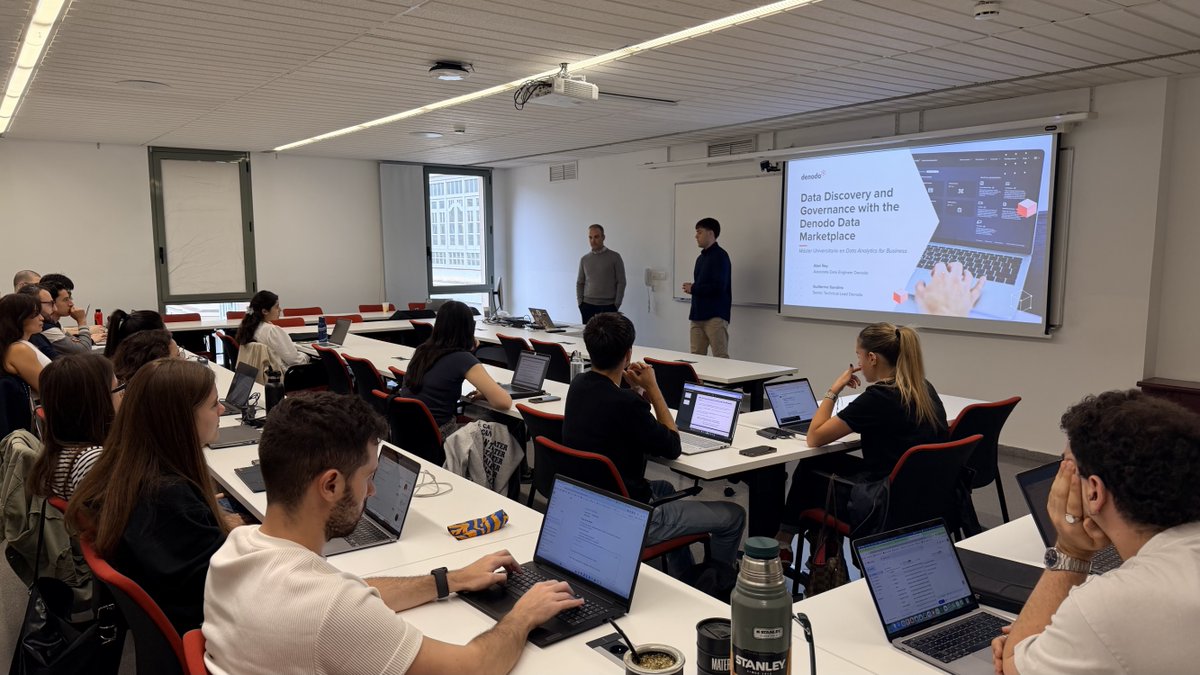
Gracias a la @bsm_upf por contar con #Denodo en su Máster en Data Analytics for Business. 📊✨
Durante el workshop, exploramos cómo el Denodo #DataMarketplace impulsa una gobernanza del dato más eficiente y estratégica. 🚀
Descubre más 👉 okt.to/yNkwuj
#DataforALL
2
2
93


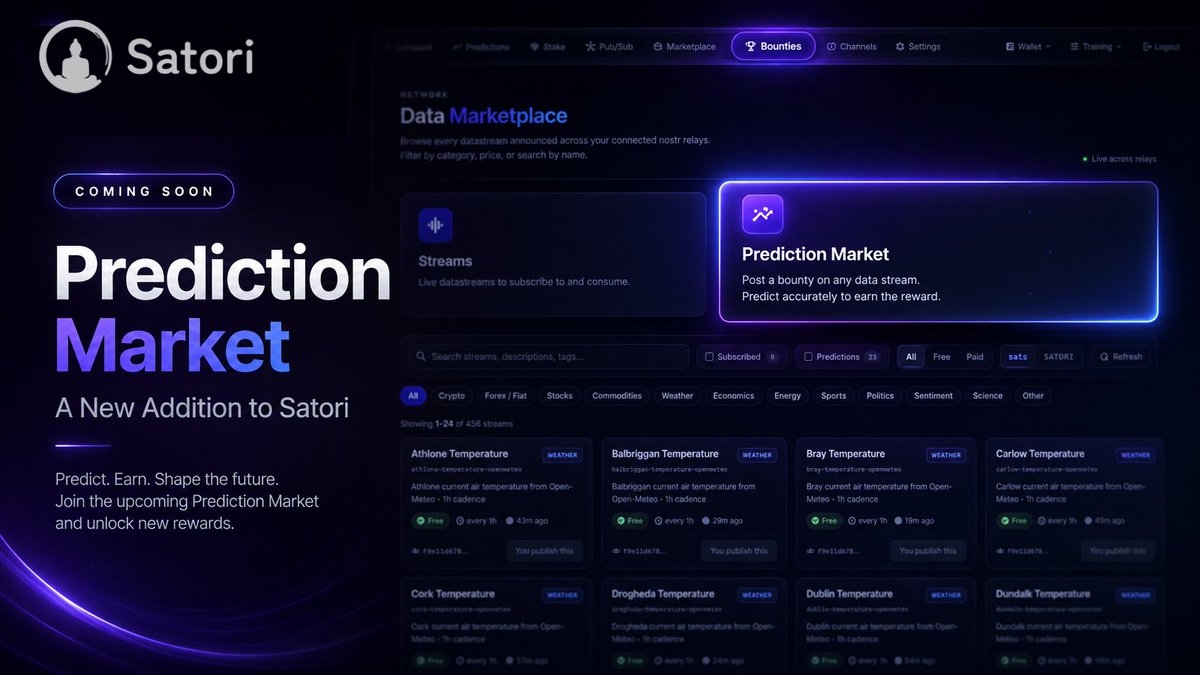
✨ Something new is coming to Satori.
🔮 Prediction Market is getting closer, a new way to post bounties, make predictions, earn rewards, and turn live data streams into something much more powerful.
⚡ Predict. Earn. Shape the future.
👀 Coming soon.
#Satori #PredictionMarket #AI #DecentralizedAI #DataMarketplace #Crypto #Web3
4
10
28
600

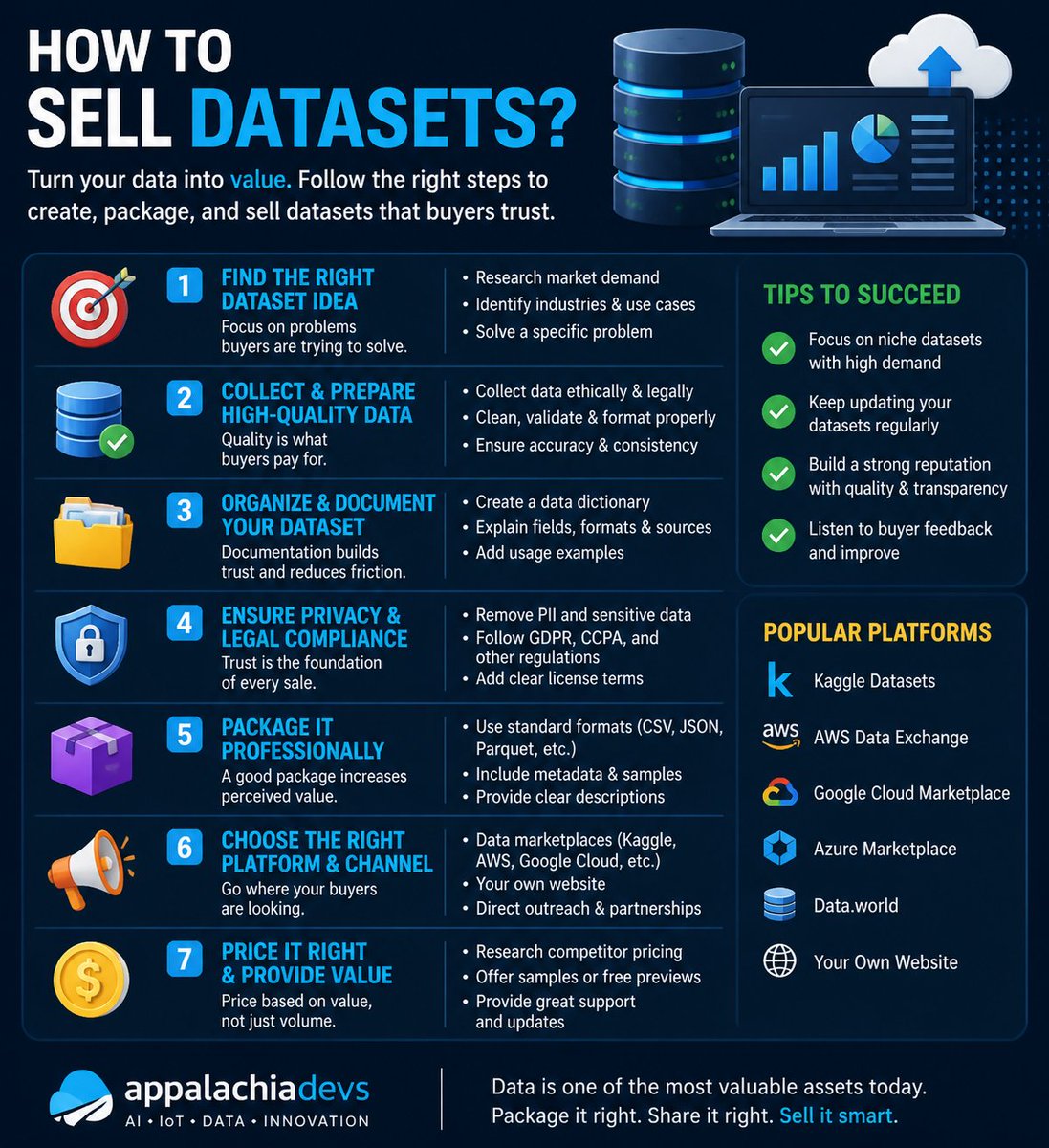
How do you sell datasets effectively?
Many companies underestimate the value of their data.
At appalachiadevs, we’ve helped teams turn raw data into marketable assets.
#DataScience #AI #MachineLearning #BigData #DataEngineering #DataMonetization #AI #Analytics #DataMarketplace
7
7
27


The 2026 Data Awakening
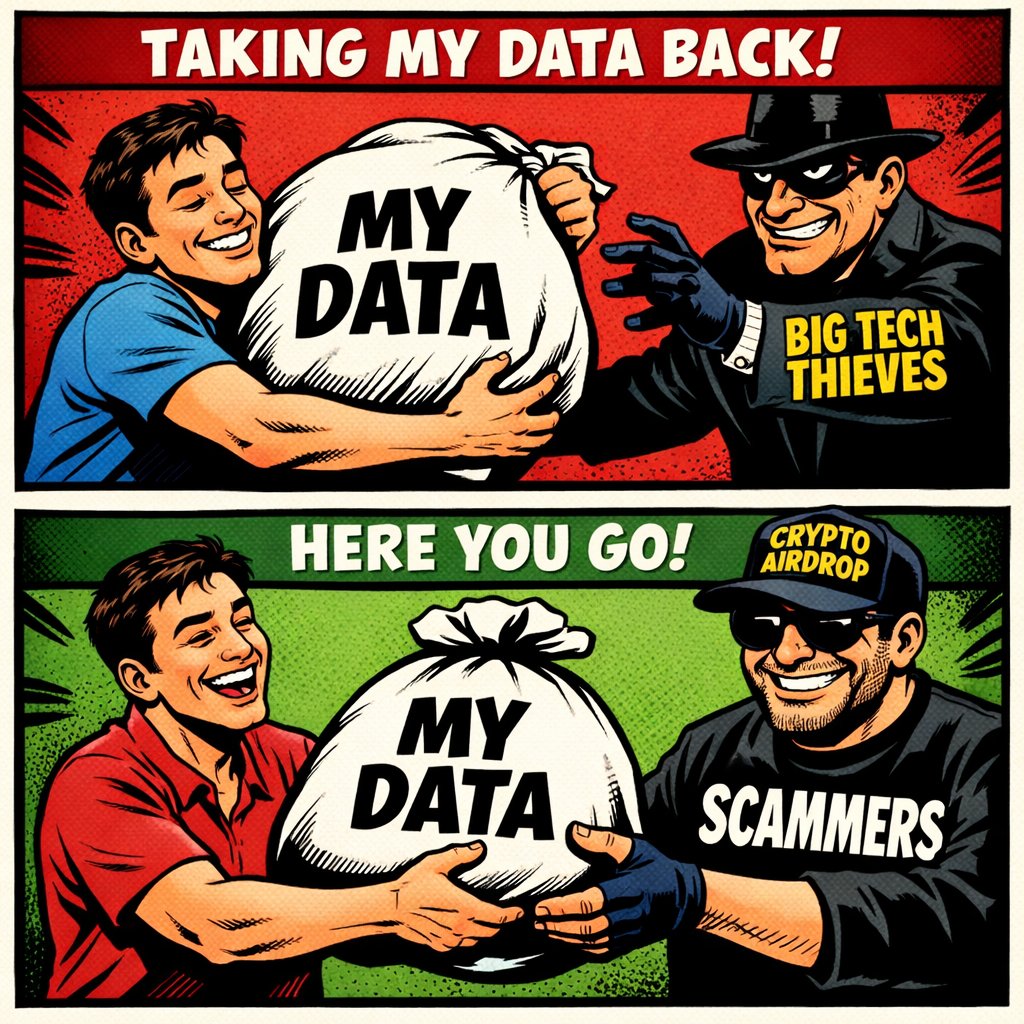
By the end of 2026, we will witness a fundamental shift in the digital economy: the birth of a true market for data. For years, personal data has been harvested in the shadows, but the public is finally waking up. This "awakening" will likely be triggered by a landmark legal case, one where the people feel cheated yet find that the current system offers no path to victory.
This frustration will spark a new trend: "the Data Marketplace." Suddenly, everyone will promise you "heaven and earth" in exchange for your information. Under the guise of crypto airdrops, rewards, and "ownership," users will be lured into a new transaction. There will be transparent ones then.
However, we must look closer at the players involved. In many cases, we aren't reclaiming our privacy; we are simply taking our data back from the "thieves" (big tech harvesters) only to hand it over to the "scammers" (predatory reward schemes).
The ultimate irony? This cycle of data exploitation won't just affect our privacy, as it will hit our wallets. As data becomes a premium, traded commodity, we can expect a "siege" on AI subscription prices. When the fuel for AI becomes expensive and contested, the cost of intelligence will inevitably rise.
Are we ready for a world where we pay for the very AI that was built on the data we gave away?
#DataEconomy #AI #Privacy #TechTrends2026 #DataMarketplace
2
1
13
236

Arbitrum as the Backbone for Decentralized Marketplaces of Data
I was working on a side project, trying to get a clean dataset of city traffic data to train a small #AI model.
I emailed agencies, paid through clunky portals, got delayed CSVs. Then I thought: what if I could just buy that data on-chain, pay per query, and start using it instantly? No middleman, transparent pricing, verified usage.
That itch made me realize how @Arbitrum can power exactly that: a smooth data #marketplace economy.
What We’re Talking About
Data marketplaces are platforms where sellers (sensor networks, telemetry providers, ML trainers) license datasets or pay-per-use APIs. Buyers pay micro-fees for access or queries. With DAOs, pricing, permissions, and verification all happen on-chain. On Arbitrum, cheap gas and strong finality make this viable at scale.
Why It Matters
✅ Micropayments made real - fee per query, per data point, or per telemetry sample becomes affordable. Arbitrum’s efficient gas model supports this.
✅ Auditable & verifiable usage - smart contracts can record who accessed what dataset, under which license, so sellers get transparent royalties & buyers get guarantees.
✅ Trust via governance - DAOs or protocols can manage pricing, licensing, dispute resolution in public, open rules.
✅ Composable data stacks - datasets, APIs, ML-training pipelines, verifiable logs can plug together; a buyer might bundle data compute telemetry.
✅ Speed & scale - Arbitrum handles high transaction volume & low fees, so many small data interactions don’t break the bank. Also, things like PYUSD on Arbitrum show micropayment viability.
Seller / Buyer Flow: Dataset Licensing Example
Seller side
1️⃣ Data provider uploads a dataset or streams telemetry to a contract, defining licensing terms (price per query, allowed uses, refresh frequency).
2️⃣ The dataset gets a versioned contract with metadata and guarantees (e.g., “no offline deletes”, quality checks).
Buyer side
1️⃣ Buyer browses marketplace; sees datasets, pricing, sample previews.
2️⃣ Buyer purchases license or pays per-use via micropayment smart contract. Access token / license key issued on-chain.
3️⃣ When buyer runs queries or pull data, smart contract logs usage, error rates / freshness, and handles payments automatically.
Governance / DAO layer
1️⃣ Dispute resolution if data quality issues.
2️⃣ Royalty splits for multiple contributors.
3️⃣ Pricing adjustments by community vote.
What’s Already Happening / Signals
√ PYUSD on Arbitrum expanding shows micropayments are viable (e.g., usage-based billing, content micropayments) because transaction costs frequently drop below a cent.
√ Tools like Space and Time already index Arbitrum chain data, enabling queryable, auditable datasets of contract activity, wallet flows, etc. That tech is adjacent to data marketplace tooling.
What Builders Should Know / Risks
🔹Data quality & consistency must be enforced; if sellers cut corners, marketplace reputation suffers.
🔹Licensing & legal compliance (privacy laws, GDPR etc.) matter when data includes personal info or geolocation.
🔹Handling micropayments and ensuring low-latency queries needs smart caching/off-chain assistance.
🔹Disputes & refunds should be coded in (e.g., if data is stale, buyer should get partial refund or version guarantees).
🔹Infrastructure for indexing, metadata, discoverability needs to be solid so buyers can find good datasets.
My Thought
I think @Arbitrum is sitting on one of the next killer waves: data as infrastructure.
Not just DeFi or NFTs, but verified data, telemetry, and training datasets licensed on-chain. This can enable new ML models, scientific research, or decentralized AI where users pay per query, sellers earn royalties, and everything is transparent.
Once that marketplace is seamless, it unlocks real value that’s been stuck behind barriers and trust issues.
Doc: docs.arbitrum.io/get-started…
#Arbitrum #DataMarketplace #DecentralizedAI

1
29
120

Jan 11
this is pretty cool. coachcard turning stroke data into tradable yields sounds sick, but idk who will share that datamarketplace and privacy will decide adoption.
Jan 11

PERFORMANCE CARDS TLDR
I ran the analytics drills on @SIXR_cricket and unlocked a personalized CoachCard NFT that logs my stroke data, grants micro XP boosts, and is tradable. Data-as-asset could make practice into real yields with $SIXR rewards, marketplace next?
3
8
77

🔥! 🚀 Decentralized data monetization w/ zk-Rollups & Data NFTs. No more greedy data brokers! 🙅♂️ #Web3 #DataMarketplace #zkRollups

3
38

30 Nov 2025
Your data is traded on a fair marketplace. ⚖️ idOS eliminates platforms that monopolize the data economy. You determine the value of your data and decide when and to whom it is sold. Fair, decentralized data commerce begins now.
#DataMarketplace #FairTrade @idOS_network

2
2
8
91

Ready to explore the future of Data and AI Marketplaces? We've put together a series demos to guide you through the SEDIMARK platform from onboarding and publishing data to training AI models and using Federated Learning 🧵👇
#SEDIMARK #DataMarketplace #AI #FederatedLearning
1
2
31

15 Oct 2025
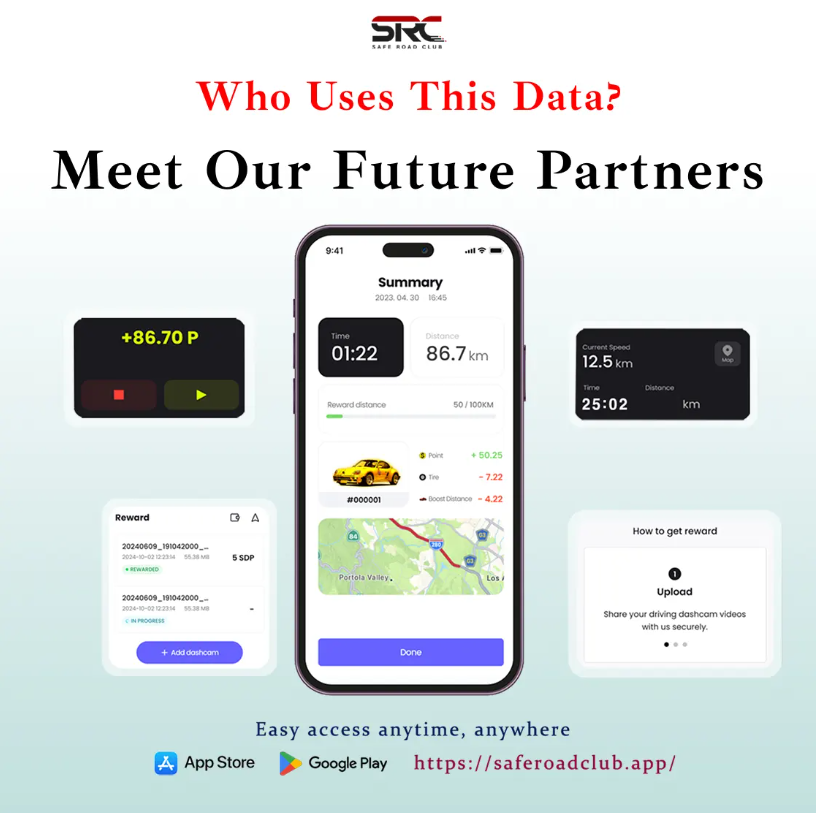
Who Uses This Data? Meet Our Future Partners 🤝
The high-quality, diverse dataset we are building together is incredibly valuable. 🚗 Our decentralized data marketplace is designed to serve a range of key players in the autonomous vehicle industry :
Automotive Manufacturers
Tier-1 ADAS Suppliers
AI & Robotics Research Institutions
Self-Driving Startup Companies 🏢
By providing them with cost-effective access to superior training data, we accelerate innovation for the entire industry. 🎓
Your data contribution directly fuels the companies building our autonomous future.
#B2B #DataMarketplace #Partnerships
1
6
16,031
30 Sep 2025
News: Opendatasoft announces strategic shift & sets goal of becoming global leader in data product marketplaces, becoming Huwise (a combination of Human Wise). News release: buff.ly/ZQvyCU2 #data #datamarketplace

2
54

23 Sep 2025
The Centific Data Marketplace delivers hidden benefits to our clients! Learn about one of them from Senior Director of Product Management Adam Hagestedt.
Explore the Data Marketplace: data.centific.com
Get more insight from our recent LinkedIn Live session: lnkd.in/gkHCwfER
#Centific #DataMarketplace #AI
1
162