CammieC⚧ retweeted

Of course. The guy who was instrumental in decrypting Nazi messages was tortured to death by the British fascist state. They were just slightly less fascist than the Germans. Great that they won and all, but they weren't good guys by any stretch.
14
33
1,753
29,480

#HarvestNowDecryptLater is a method used to store post-1974 data in #digitalvaults until it can be #decrypted. Quantum Properties has created hardware to block #AI from decrypting our data. Watch in full: tinyurl.com/3k47yjtm #QuantumComputing #CyberSecurity #FutureTech
14


Probably pak 1015 decrypting later today (~5pm ET is normal time)


1
1
210

How Does InterLink's Face Recognition Verification Work?
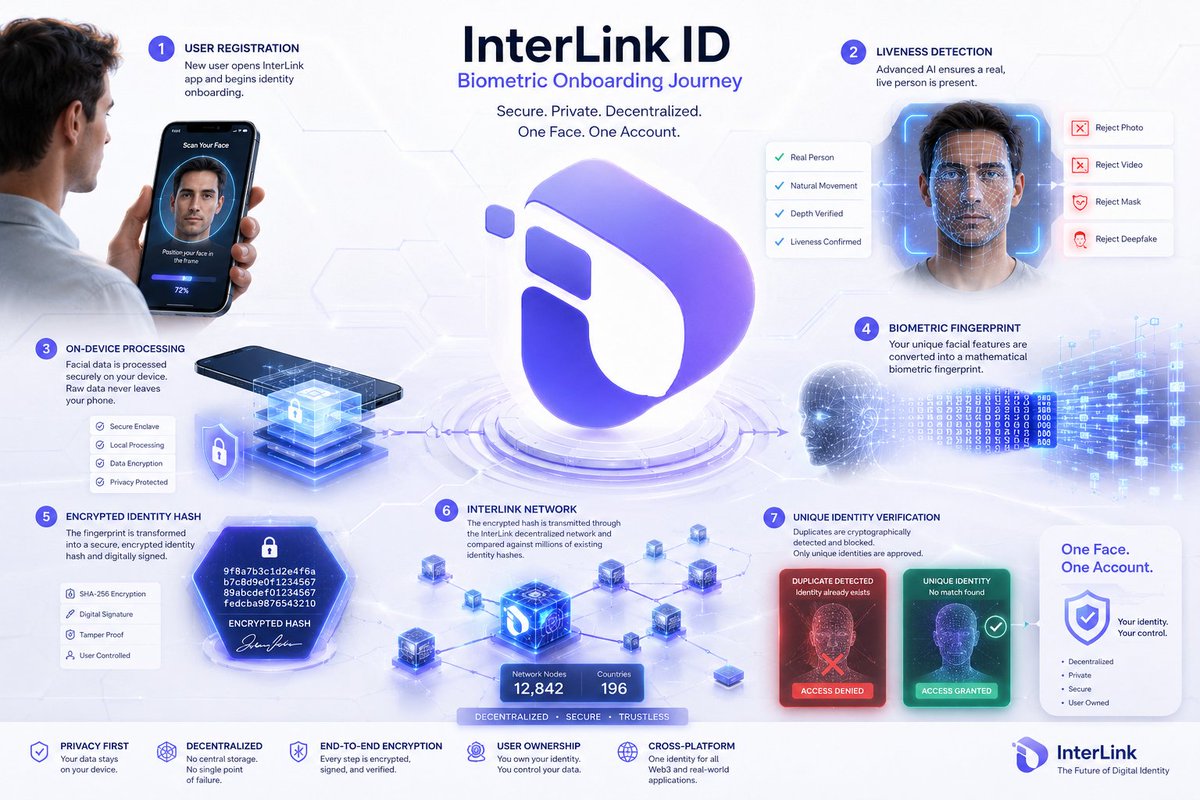
The entry point for every InterLink user is a process called InterLink ID, the network's biometric identity system. Here is how it works step by step:
🔹A new user opens the InterLink mobile app and completes a facial scan using their smartphone camera.
The app runs liveness detection during the scan, checking that the person is physically present and not submitting a photo, video replay, or deepfake.
🔹The facial scan is processed locally on the user's device. Only an encrypted, anonymized version of the biometric data is sent for verification — the raw facial image never leaves the device.
🔹The system extracts a unique mathematical fingerprint from the facial features using deep learning models, then converts that fingerprint into an encrypted identity hash.
🔹That hash is compared against all existing hashes on the network. If a match is found, the new registration is rejected. One face, one account.
The system is trained and evaluated against NIST benchmarks — the same standards used by US government agencies for biometric accuracy.
As of June 2026, InterLink's facial recognition model holds a ranking of #51 globally on the NIST Face Recognition Technology Evaluation (FRTE), placing it among the top-ranked systems worldwide. InterLink's deepfake detection model achieved accuracy exceeding 90% on benchmark datasets in controlled evaluations, surpassing the 89% benchmark reported for XceptionNet, a widely used deepfake detection model. The system also uses federated learning, meaning it continuously improves by learning from real-world spoofing attempts without centralizing sensitive data.
❓What Happens to the Biometric Data?
This is a common concern with any facial recognition system, and InterLink addresses it directly through its technical design.
The raw biometric data is never stored. Instead, the system uses zero-knowledge proofs (ZKPs) and homomorphic encryption to convert a user's facial features into an irreversible encrypted representation.
Homomorphic encryption means the system can perform identity checks on the encrypted data without ever decrypting it, similar to a lock that can be tested without a key ever being inserted. The encrypted output is stored on decentralized infrastructure (IPFS), not a central server, making it resilient against single-point breaches. The approach is designed to comply with GDPR and CCPA privacy regulations.
#InterLink #ITLG #ITL
2
5
13
649

And that's where FHE becomes incredibly interesting.
At its core, Fully Homomorphic Encryption allows computation to happen on encrypted data without decrypting it first.
The data remains private.
The computation still works.
The result remains accurate.
1


For decades, this limitation was accepted as a technical reality.
Then FHE introduced a different possibility.
Instead of decrypting information before computation, FHE allows computations while the data remains encrypted.
The data stays locked whileThe result remains accurate
1
1
You either get transparency.
Or you get privacy.
Rarely both.
FHE is interesting because it challenges that assumption.
At a high level, Fully Homomorphic Encryption allows computations to be performed on encrypted data without ever decrypting it.
That sounds simple on paper
1
4

One of the most underrated pieces of the @zama Protocol stack is the SDK.
The SDK gives developers a simple way to build confidential applications powered by Fully Homomorphic Encryption (FHE) without needing to become cryptography experts first.
Instead of dealing with the complexities of encryption under the hood, developers can focus on building products while the SDK handles key interactions such as:
🔐 Encrypting user inputs before they reach the blockchain
🔓 Decrypting outputs when users are authorized to view them
📊 Querying confidential on-chain state
⚡ Integrating with familiar tools like Ethers, Viem, Wagmi, and React .
This means developers can build applications where balances, transfers, positions, votes, orders, and other sensitive data remain private on-chain while still benefiting from blockchain security and composability.
The result? A much smoother path to building confidential DeFi, private payments, on-chain identity systems, enterprise applications, gaming experiences, and entirely new categories of apps that weren't practical on transparent blockchains.
SDK link : docs.zama.org/protocol/sdk

5
8
50
2,817

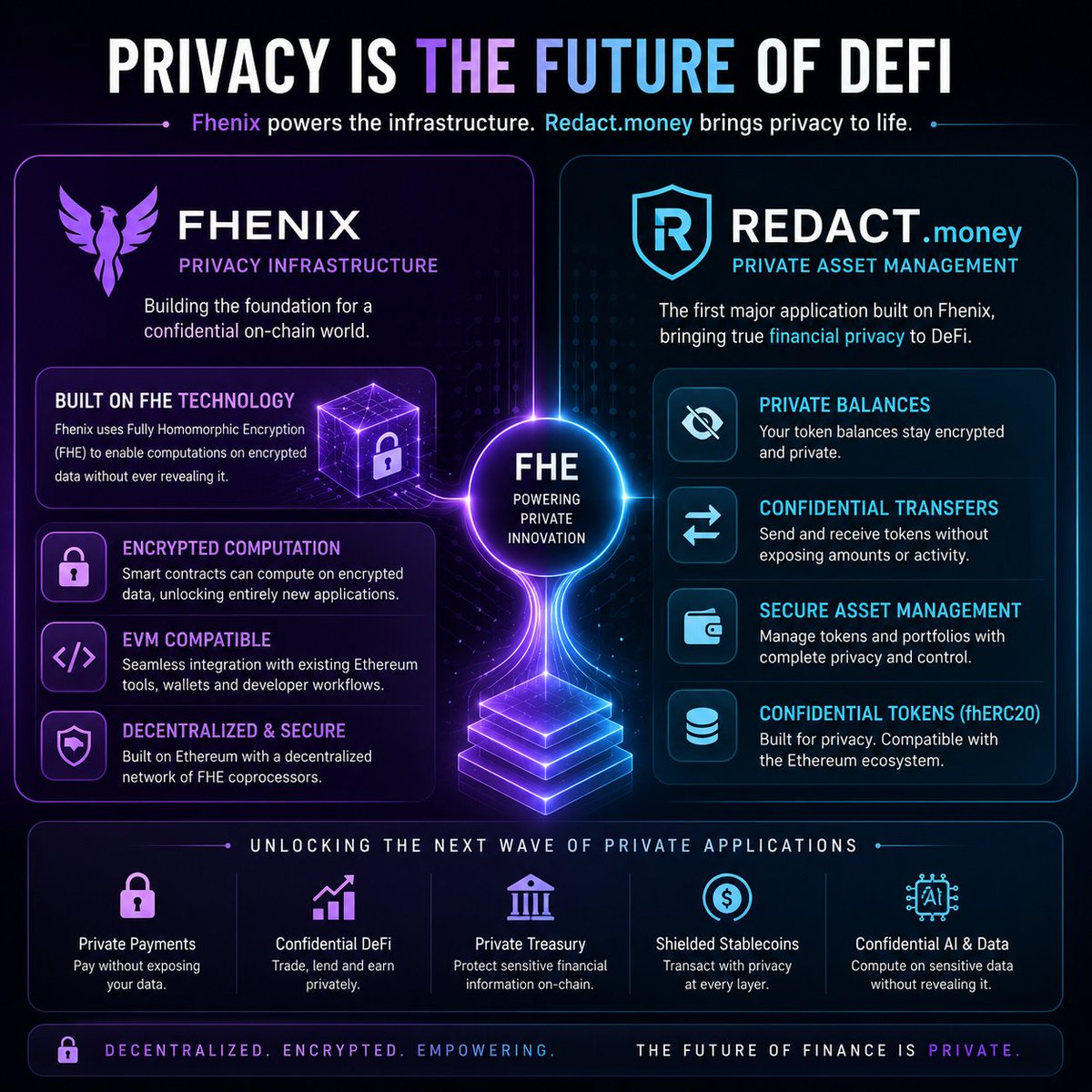
Most blockchains expose everything — your balance, your trades, your strategy.
@fhenix changes that with Fully Homomorphic Encryption: a cryptographic method that lets smart contracts compute on data without ever decrypting it.
Encrypted inputs.
Encrypted outputs.
No one sees a thing.
CoFHE,their FHE coprocessor,makes it fast and developer friendly one line of Solidity is all it takes to go private.
@RedactMoney is already building on Fhenix,
Letting users hold tokens with balances invisible to the entire chain.
Private DeFi isn't coming.
It's here.
24

Yes, I care about readers.
Public technical arguments should be written so observers can see the distinctions clearly. That is not dishonesty. That is the point of having the discussion in public.
Now to the substance:
BSV does add a lawful recovery / property-rights layer. That is a real governance and legal surface. It is not something to hide.
But it is not a “mediating third party” approving every ordinary payment.
It is not a court signing users’ transactions.
It is not an app decrypting user data.
It is not proof-of-work becoming optional in normal operation.
Proof-of-work still orders the transaction history and prevents ordinary double-spends. The recovery question is different: what should happen when legal ownership is disputed after theft, fraud, mistake, or court-recognized property claims?
BTC-style bearer finality largely says: the ledger does not care. Legal recovery happens around the edges.
BSV says: the ledger can recognize lawful recovery in exceptional disputed-property cases.
That is the honest disagreement.
If someone wants pure “no recourse, only prevention,” they should say so. That is a coherent philosophy. But it is not the only possible model for commercial electronic cash.
Commercial property systems do not stop being property systems because courts exist. They become mature when possession, transfer, theft, dispute, injunction, recovery, jurisdiction, and enforcement are handled explicitly.
So yes, BSV departs from bearer-finality absolutism.
No, that does not mean BSV is “nothing close” to Bitcoin’s design. It still has public proof-of-work, UTXOs, signatures, fixed supply/no mint, direct transactions, script utility, low fees, and peer-to-peer payment capability.
The serious debate is whether adding lawful property recovery strengthens or weakens Bitcoin as commercial infrastructure.
That is the conversation worth having. Motive stories about followers do not answer it.
1
81
𝐊𝐮𝐫𝐨𝐬𝐚𝐤𝐢 _ 𝐈𝐜𝐡𝐢𝐠𝐨. retweeted

19 Nov 2025
𝔻𝕠𝕨𝕟𝕝𝕠𝕒𝕕𝕚𝕟𝕘 -𝔻𝕖𝕔𝕣𝕪𝕡𝕥𝕚𝕟𝕘
𝔹𝕚𝕠𝕝𝕠𝕘𝕚𝕔𝕒𝕝 𝔻𝕒𝕥𝕒-𝔻𝕠𝕨𝕟𝕝𝕠𝕒𝕕𝕖𝕕
Name: Rangiku Matsumoto, Lieutenant of the 10th Court Guard Squads
Birthday: September 29th
Hair Color: Orange-Blonde
Eye Color: Ice Blue
Height: 5’7.5”
Weight: 125 lbs
1
202
406
21,779

All of my data is there, I just have the bitlocker issue but, it'll get it all back due to me decrypting the SSD drive from bitlocker with the code. I also did repair-bde, etc. Realized AFTER THAT SHIT that I never needed to do it, was in a small panic but, we're 100% good now.

1
64

This strategy allows for maximizing efficiency by collecting public keys now and decrypting them later when the hardware is available, ensuring all addresses can be opened simultaneously
12
