Prague has legendary crypto DNA - Devcon4, Paralelní Polis, all of it. Perfect city for SheFi to plant a flag. Congrats Anett 🇨🇿⟠
3
16
125

I’m excited to announce that I've joined @shefiorg as Chapter Lead for Prague!🌸🇨🇿
I joined SheFi as Chapter Lead for Prague to grow the female crypto community in Prague and preserve the cool spirit of crypto. Prague is the home to Devcon4, ETHGlobal hackathon, and many other important crypto events!
My goal is to spread knowledge about crypto, share its value, and educate on important topics such as decentralization, privacy, the importance of stablecoins, the coolness and usability of smart contracts, and more!
Are you interested in speaking at SheFi Prague events? I’m looking for inspiring voices to help educate and empower our local crypto community. DM me if you’d like to get involved in the future events!
I’m looking forward to hosting the first Chapter Prague SheFi brunch around ETHPrague. RSVP below!
PSA: SheFi members have a discount on @EthPrague tickets! Find the code in the newsletter or DM me for code access!

17
4
101
2,121

30 Dec 2025
요즘 팔란티어 근황
1. 관계자분을 통해 들은 팔란티어 DevCon4 참석후기
"팔란티어를 쓰고 싶어하는 고객 수요가 상상을 초월하는 수준이에요. 팔란티어가 그 수요를 아예 못따라가는 듯 보였어요."
2. 현재 KT는 팔란티어 솔루션을 KT내부에 적용하기 위한 내부 과제 솔루션에 집중하는 중입니다. 이 솔루션이 완성된 이후부터(내년무렵) 본격적인 팔란티어 솔루션 영업활동에 들어갑니다.
그래서 현재는 국내에서 팔란티어를 쓰고 싶어하는 기업들과 컨택만 이뤄지고 있는 실정이죠. 그렇다면 그 컨택의 수요가 어느 정도 일까요?
(한번 예상해보시길...^^)
3. 현재 팔란티어 주가는 2달 가까이 횡보 상태에 있습니다.

9
5
113
16,541

13 Dec 2025
Review of my second @SolanaConf breakpoint
@solana event design is maximised for speed, attention, execution - it just works
Short snappy keynote talks, bright fashionable audience, energy, diversity of industry, VCs, builders, degens
Haven’t felt this way since Devcon4

27
2
86
3,335
7 Dec 2025
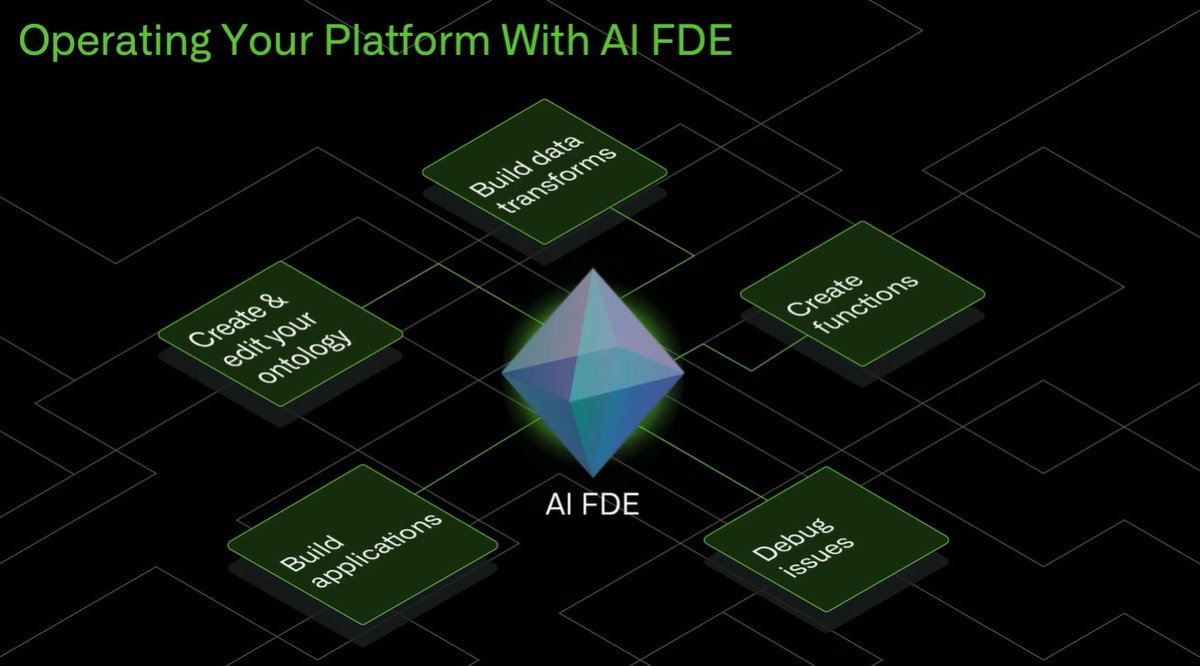
AI FDE가 기업에 가져온 여파중 하나
- DEVcon4 중 -
"예전에는 자체 MES 시스템이든 ERP든 어떤 시스템이든 직접 만들려고 하면, 전담 소프트웨어 팀을 붙여서 몇 달, 길면 몇 년씩 개발해야 했습니다.
그 다음에는 지원팀을 두거나 SI를 고용해서 유지보수를 해야 했고, 이 전체가 굉장히 큰 사업이 됐습니다.
하지만 AI FDE를 도입한 지금은 “정말 그 정도 규모가 필요할까?”라는 질문을 던질 수 있게 됐습니다.
아마 그렇지 않을 것이고, 현재는 '몇 명이면 충분하지?'로 논의가 바뀝니다.
상당수의 프로젝트경우 소규모 팀이나 심지어 한 명이서도 해낼 수 있습니다.
그래서 새로운 기능을 검토할 때 IT팀과 나누는 대화의 내용 자체가 완전히 달라졌습니다."
7 Dec 2025
Wow 생각지도 못한 방향이다. AIFDE
앞으로는 중앙 온톨로지팀이 말단에서 만든 온톨로지들을 일일이 승인하는 방식에서 더 나아가, AIP가 빌더와 1:1로 직접 협업하면서 처음 설계 단계부터 객체의 구조를 더 잘 설계하고, 문서화하고, 정리하도록 돕는 그림을 그리고 있습니다.
(👉현재는 최종 온톨로지 관리자가 빌더들이 만든 온톨로지들을 기업 비즈니스 로직에 맞게 일일이 승인해줘야 한다. 그걸 점점 줄여나가겠다는 뜻)
더 나아가, 사용자에게 “이미 당신이 필요로하는 객체들이 여기에 있고, 기존 객체를 중복 생성하지 않고도 조금 수정해서 유스케이스에 맞게 쓸 수 있다”는 식으로 추천까지 해주는 방향을 생각하고 있습니다.
(👉비슷한 온톨로지가 있을 경우 AI FDE가 추천)
1
11
54
8,890

Devcon4 영상에서 핵심은?
1. 모든 상황에서 Ai를 활용한 업무를 수행하여 속도가 혁신적으로 증가하였음. Ai FDE에게 ERP과 CRM을 온톨로지로 통합하라고 지시하면 만듦. 심지어 Ai활용법 영상을 만드는 것도 Ai가 만듦.
* 어느정도 수준이냐면 Devcon 작년 우승작은 이틀에 걸쳐서 자전거 대여관리 툴을 만들었다면 지금은 반나절만에 엔터프라이즈급 앱을 프로토타이핑하는 수준으로 성장.
2. Git hub 등 외부에서 사용되어지는 알고리즘을 가져다쓸수있고 중간에서 보안이 강화되는 과정이 거치는데 이또한 시간제약이 없음.
8
493
3 Dec 2025
와....미쳤다 DevCon4 떴는데...벌써부터 웅장한 미래가 그려집니다.
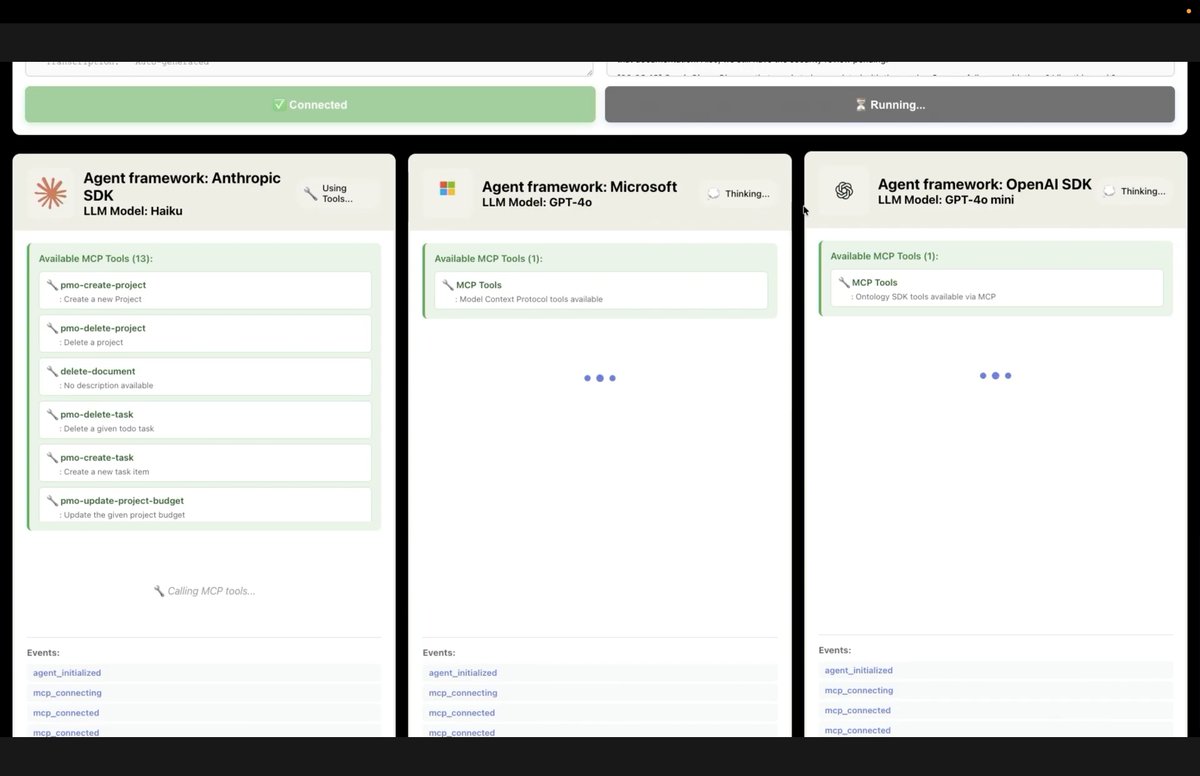
"시장에는 다양한 에이전트 프레임워크들이 쏟아져 나왔죠.
Anthropic SDK, Vercel, Microsoft Copilot, 기타 수많은 프레임워크들이 있고, 여러분은 그 위에서 각자 에이전트를 만들고 계실 겁니다.
저희가 바라는 건, 여러분이 어떤 프레임워크를 쓰든, 그 모든 에이전트가 온톨로지의 힘을 활용할 수 있게 하는 것입니다. 그래서 오늘은 하나의 동일한 온톨로지를 가지고, 서로 다른 여러 종류의 에이전트에 어떻게 연결·배포할 수 있는지 보여드리려고 합니다."
이게 그 장면...😱😱
7
6
102
9,184





11 Nov 2025
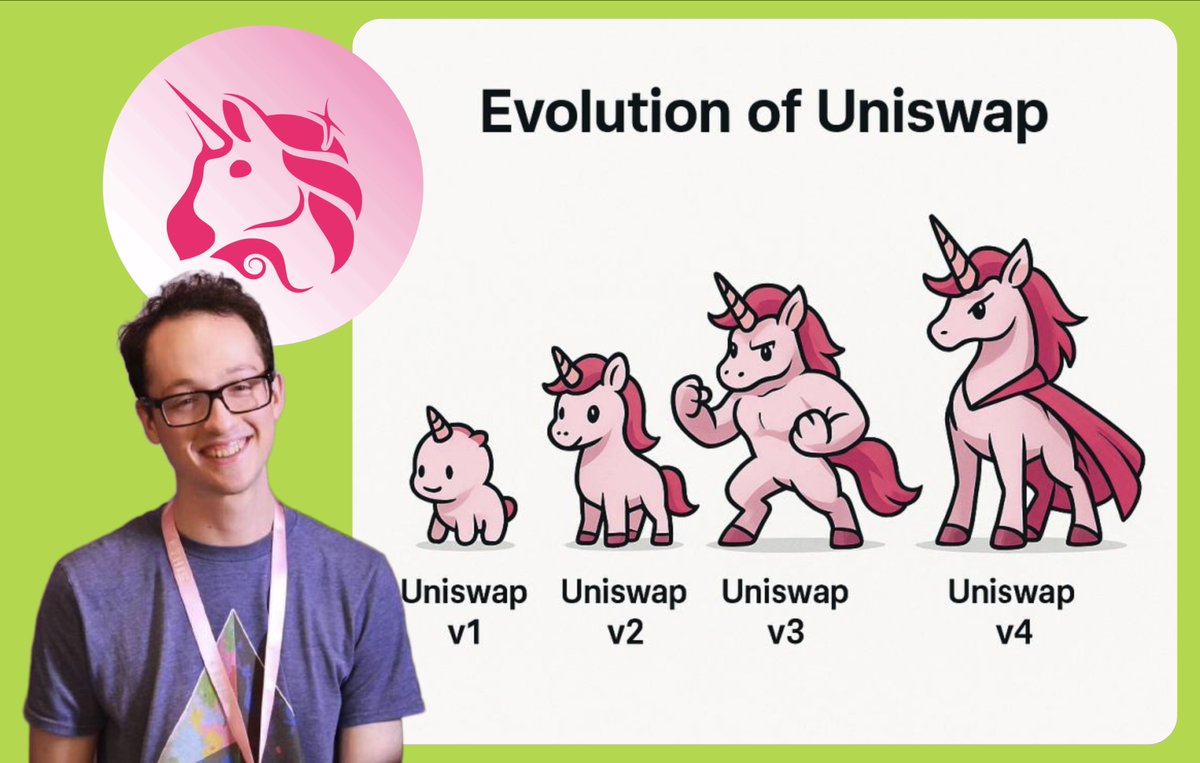
🦄 HÀNH TRÌNH KHÔNG TƯỞNG CỦA UNISWAP FOUNDER!
📌Tháng 7/2017
- mất việc ở Siemens
- không có kế hoạch tiếp theo
- Karl Floersch gợi ý về Ethereum
- bắt đầu học Solidity toàn thời gian
- đọc bài blog của Vitalik về AMM
- bắt đầu viết mã cho automated market maker
📌Cuối 2017: có nguyên mẫu gọi là Uniswap v0
- chưa có công ty, tự bỏ vốn phát triển
📌Đầu 2018: không có tiền thuê audit
- Ken Ng tin tưởng và duyệt khoản tài trợ từ Ethereum Foundation
- dùng tiền đó cho audit và phát triển
📌Tháng 11/2018: ra mắt Uniswap v1
- phát hành trong Devcon4 tại Prague
- mô hình AMM đơn giản x*y=k
- Vitalik Buterin góp vốn ban đầu cho pool ETH
- chứng minh khái niệm thanh khoản
- bắt đầu test công khai ngay lập tức
- quỹ nhỏ Paradigm đầu tư vào Uniswap
- thành lập công ty Uniswap Labs
📌Tháng 5/2020
- phát hành Uniswap v2
- hỗ trợ cặp ERC-20 – ERC-20
- hệ sinh thái bắt đầu phát triển
📌Tháng 8/2020
- gọi vốn 11 triệu USD Series A từ a16z
📌Tháng 9/2020
- ra mắt token UNI
- airdrop 400 UNI cho mỗi người dùng trước đó
- phân phối 15% tổng cung
📌Tháng 9/2020
- đạt 1 tỷ USD khối lượng giao dịch/ngày
- xác nhận product–market fit
- vượt 100 tỷ USD tổng volume
- trở thành sàn giao dịch on-chain hàng đầu
- “ai cũng ra mắt bản fork v2 của riêng mình”
📌Tháng 1/2022
- Hayden bị các ngân hàng cá nhân khóa tài khoản
Tháng 10/2022:
- gọi vốn 165 triệu USD Series B
- đối mặt vụ kiện tập thể
📌Tháng 10/2023: bật UI fee
📌Tháng 4/2024
- công bố Wells Notice từ SEC
- Uniswap Labs phản hồi công khai
- lập DeFi Education Fund (DEF)
📌Tháng 12/2024: UI fee đạt 100 triệu USD
📌Tháng 2/2025: SEC đóng cuộc điều tra
cộng đồng governance tranh luận fee switch
mọi người liên tục chỉ trích UNI vì chưa bật fee switch
📌Tháng 11/2025:
- đề xuất bật fee switch cơ chế đốt token
- đốt 100 triệu UNI từ treasury
- ông bố cơ chế chia phí mới cho LP
- tái cấu trúc foundation và labs
- từ bỏ hơn 170 triệu USD tiền UI fee
- tất cả diễn ra trong cùng một ngày
- cộng đồng choáng váng hoàn toàn
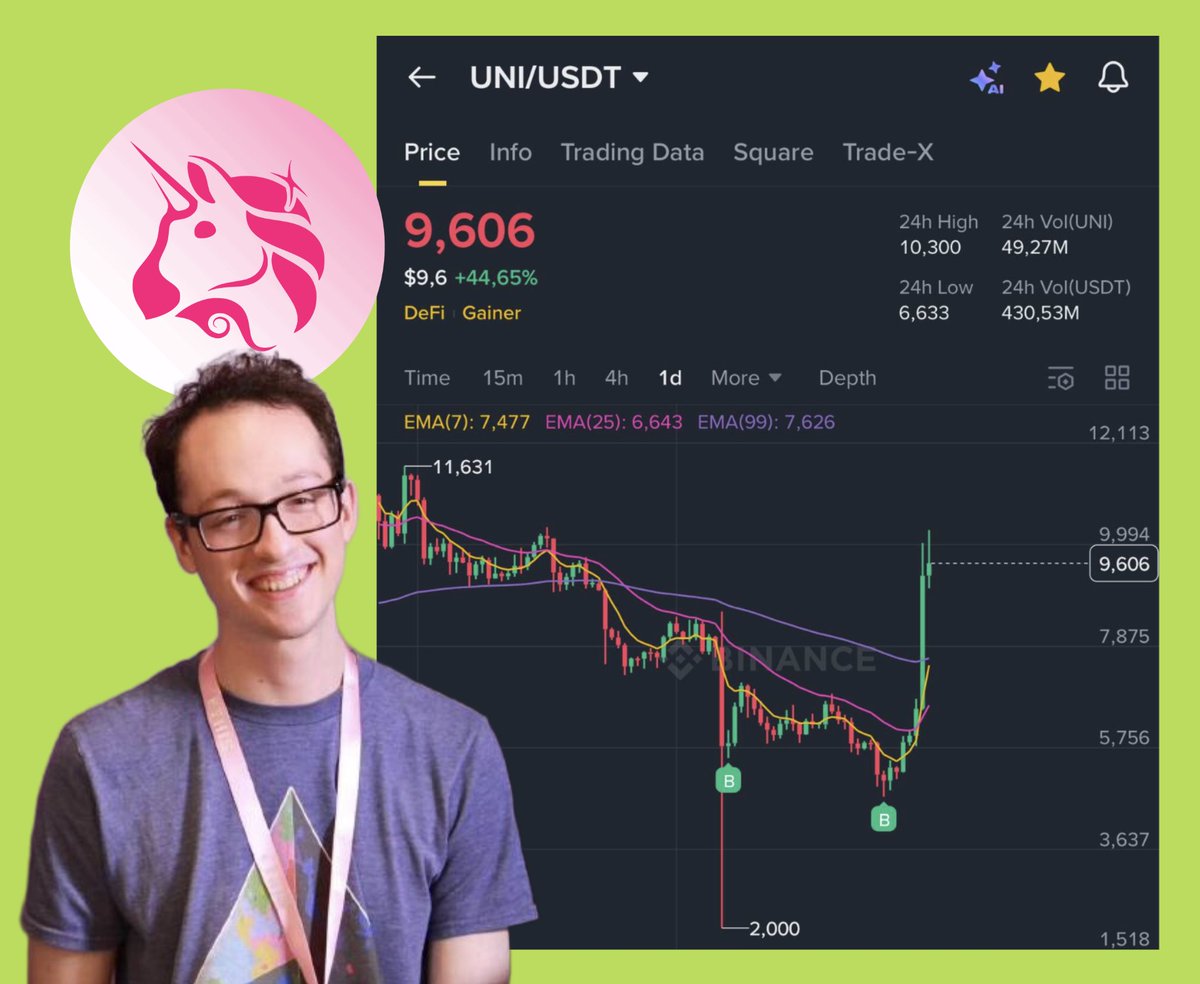
- giá UNI tăng 40%
Từ con số 0, Hayden Adams đã tạo nên một trong những sản phẩm không thể thiếu của DeFi.
Từ con số 0, @Uniswap đã phát hơn 6 tỷ đô airdrop và giờ đây $UNI vẫn đang được định giá hơn 8 tỷ đô!
Nguồn: @0xkydo
11 Nov 2025

🌟 Founder Uniswap đề xuất Proposal đầu tiên sau 5 năm
UNI pump luôn 40%
Xin cảm ơn $UNI - một trong tứ đại DeFi 🥰
8
5
39
22,867

> july 2017 loses his job at siemens
> no next step
> karl floersch suggests ethereum
> studies solidity full-time
> reads vitalik’s amm blog post
> begins building automated market maker code
> late 2017. prototype called uniswap v0
> no company. self-funded
> early 2018 no fund to do audit
> ken ng believed and approved the ef grant
> uses funds for audits and development.
> november 2018. launches uniswap v1.
> released during devcon4 in prague.
> simple x*y=k amm.
> vitalik buterin seeds early eth pool.
> initial liquidity proof-of-concept.
> public testing begins immediately.
> a small fund, paradigm, invests in uniswap
> formal company uniswap labs forms.
> may 2020. ships uniswap v2.
> adds erc-20 to erc-20 pairs.
> ecosystem growth begins.
> august 2020. raises $11m series a by a16z
> september 2020. launches uni token.
> airdrops 400 uni per past user.
> distributes 15% of total supply.
> september 2020. reaches $1b daily volume.
> confirms product-market fit.
> surpasses $100b total volume.
> becomes dominant onchain exchange.
> every buddy and their mom launching v2 forks
> january 2022. personally debanked
> october 2022. raises $165m series b
> faces class action lawsuit
> oct 2023 turned on ui fee
> april 2024. discloses wells notice.
> uniswap labs publishes formal response.
> seed defi education fund (def)
> dec 2024 ui fee hits $100m
> february 2025. sec closes investigation.
> governance debates fee switch.
> people constantly shits on uni for no fee switch
> nov 2025
> proposes fee switch burn
> 100m uni treasury burn
> announces new fee mechanism for lp
> new fnd labs structure
> gives up $170m ui fee
> all on the same day
> fudders absolutely shocked
> token rockets 40%
hayden is absolutely based for this proposal and the amt of energy that went into this is mindblowing. ive always seen it from the fnd and token holder pov and never in my wildest dream would i believe this is where we would land
uniswap is so back
uni is so back
defi is so back
10 Nov 2025

Today, I’m incredibly excited to make my first proposal to Uniswap governance on behalf of @Uniswap alongside @devinawalsh and @nkennethk
This proposal turns on protocol fees and aligns incentives across the Uniswap ecosystem
Uniswap has been my passion and singular focus for the past 8 years. What started as a small side project is now global financial infrastructure powering thousands of applications with ~$1.8 trillion in annual trading
UNI launched in 2020, but for the past 5 years Labs has been unable to meaningfully participate in Uniswap governance, and has been greatly restricted in the ways it can build value for the Uniswap community. That ends today!
This restriction was in great part due to a hostile regulatory environment that cost thousands of hours and tens of millions in legal fees. Fortunately, the regulatory environment has shifted
This proposal comes from a strong desire to see the Uniswap protocol win as the global decentralized exchange for tokenized value
At a high level, the proposal:
1. Turns on protocol fees and uses them to burn UNI
2. Sends @unichain sequencer fees to the UNI burn
3. Burns 100M UNI from the treasury representing the protocol fees that could have been burned if fees were turned on at token launch
4. Introduces Protocol Fee Discount Auctions, a new way to improve LP outcomes and internalize MEV to the protocol
5. Introduces "aggregator hooks” which will turns Uniswap v4 into an onchain aggregator that collects protocol fees on external liquidity sources
6. Focus Labs on driving protocol growth and adoption, including a contractual agreement to only pursue initiatives that align with Uniswap governance interests
^ As part of this, Labs will stop collecting fees on its interface, wallet, and API to supercharge distribution and adoption of the Uniswap protocol
7. Moves Foundation employees to Labs with a shared goal of accelerating protocol growth, under a growth fund from the treasury
8. Move governance-owned Unisocks liquidity to v4 on Unichain and burn the LP position
I believe Uniswap protocol can be the primary place tokens are traded. This proposal sets the stage for the next decade of its growth
@Uniswap will ship relentlessly over the coming years and supercharge the ecosystem of developers, LPs, and traders building on top
I'm so grateful to the community that has made this all possible, and excited for what's next
🦄
26
9
271
58,897

6 Oct 2025
Hey fam @billions_ntwk isn't just a network it's the zk identity blueprint from DevCon4 '18 (shoutout iden3 roots!) evolving into the Human AI powerhouse today. 565k strong, blending privacy, coordination, and real social flywheels. OG vision meeting future tech. Join the billions revolution! 🚀 #BillionsNetwork
2
22

16 Jul 2025
#GEM #ETH #DYOR #NFA PuppETH
PUPPETH - The First Mascot of Ethereum Foundation
🔹 WHAT IS PUPPETH?
Puppeth is the original mascot of Ethereum, introduced in 2017 by Ethereum Team Lead Péter Szilágyi. He was part of the Geth 1.6 release as the face of a technical deployment tool called Puppeth.
📜 REAL ORIGIN. REAL HISTORY.
✅ First appearance: April 14, 2017 by Péter Szilágyi:
x.com/peter_szilagyi/status/…
✅ Official Ethereum Foundation Blog:
blog.ethereum.org/2017/04/14…
✅ Tool reference: geth.ethereum.org/docs/tools…
✅ Puppeth stickers were distributed at Devcon4, as confirmed by Péter Szilágyi in this 2018 tweet:
x.com/peter_szilagyi/status/…
x.com/peter_szilagyi/status/…
x.com/peter_szilagyi/status/…
Twitter: x.com/puppeth_erc20
Twitter Community: x.com/i/communities/19454920…
Telegram: t.me/puppeth_erc
Website: puppeth.xyz
Entry: below 150k (stl if its below 100k)

16 Jul 2025

LAUNCHING NOW
$PUPPETH — Ethereum's first-ever mascot is finally a memecoin!
Created by Ethereum Team Lead Péter Szilágyi in 2017 as the face of Puppeth tool.
Now REBORN as a meme legend.
📜 From the Ethereum Foundation blog — this isn’t just a meme, it’s ETH history:
blog.ethereum.org/2017/04/14…
Telegram: t.me/puppeth_erc
CA: 0x42005f1CB2354905ae117c567592A57618f4F070
For the real believers
#Puppeth #ETHmemes #Ethereum #CryptoHistory #MemecoinSeason

8
1
78
2,165

16 Jul 2025
PUPPETH - The First Mascot of Ethereum Foundation
🔹 WHAT IS PUPPETH?
Puppeth is the original mascot of Ethereum, introduced in 2017 by Ethereum Team Lead Péter Szilágyi. He was part of the Geth 1.6 release as the face of a technical deployment tool called Puppeth.
📜 REAL ORIGIN. REAL HISTORY.
✅ First appearance: April 14, 2017 by Péter Szilágyi:
x.com/peter_szilagyi…
✅ Official Ethereum Foundation Blog:
blog.ethereum.org/2017/04/14……
✅ Tool reference: geth.ethereum.org/docs/tools……
✅ Puppeth stickers were distributed at Devcon4, as confirmed by Péter Szilágyi in this 2018 tweet:
x.com/peter_szilagyi…
x.com/peter_szilagyi…
x.com/peter_szilagyi…
Twitter: x.com/puppeth_erc20
Twitter Community: x.com/i/communities/…
Telegram: t.me/puppeth_erc
Website: puppeth.xyz

26
2
16,120

16 Jul 2025
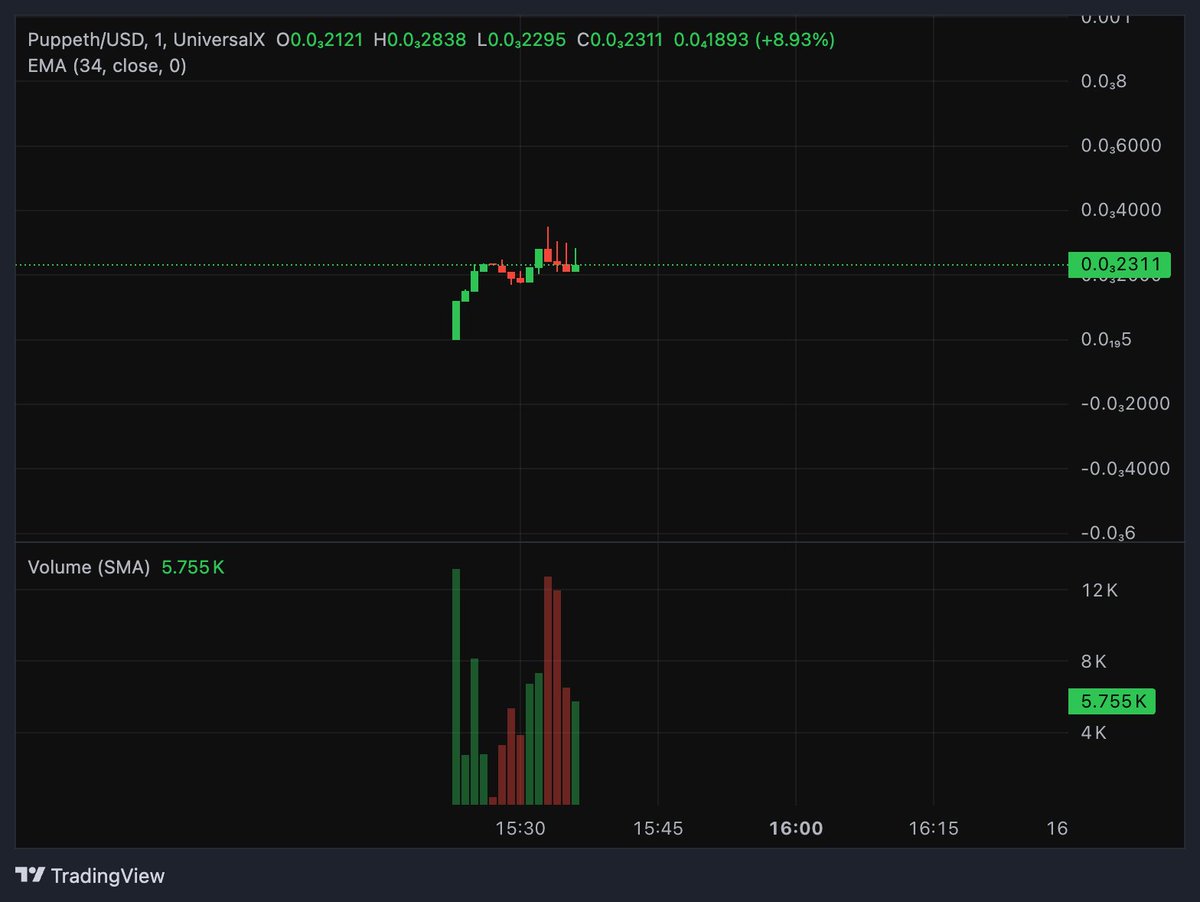
$Puppeth - the first mascot of ETH foundation (Based team comeback previous $8M ATH project on ETH )
CA: 0x42005f1CB2354905ae117c567592A57618f4F070
Ape here:
universalx.app/trade?assetId…
🔹 WHAT IS PUPPETH?
Puppeth is the original mascot of Ethereum, introduced in 2017 by Ethereum Team Lead Péter Szilágyi. He was part of the Geth 1.6 release as the face of a technical deployment tool called Puppeth.
📜 REAL ORIGIN. REAL HISTORY.
✅ First appearance: April 14, 2017 by Péter Szilágyi:
x.com/peter_szilagyi/status/…
✅ Official Ethereum Foundation Blog:
blog.ethereum.org/2017/04/14…
✅ Tool reference: geth.ethereum.org/docs/tools…
✅ Puppeth stickers were distributed at Devcon4, as confirmed by Péter Szilágyi in this 2018 tweet:
x.com/peter_szilagyi/status/…
x.com/peter_szilagyi/status/…
x.com/peter_szilagyi/status/…
Official links:
X: x.com/puppeth_erc20
Telegram: t.me/puppeth_erc
Website: puppeth.xyz/
#DYOR #NFA #PUPPETH
10 Nov 2017

Puppeeeeeth :D I have 2 stickers on mine, Puppeth and Geth :D
2
1,354

12 Jul 2025
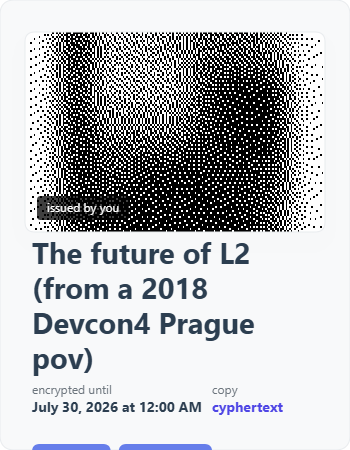
Photo of L2 panel with @arjunbhuptani @ameensol @_czepluch and others from Devcon4 Prague threshold encrypted into the @EthTimeCapsule. It will be revealed on 30 July 2026.
View my encrypted entry and create your own: ethtimecapsule.com/gallery.h…
1
2
8
628

9 Apr 2025
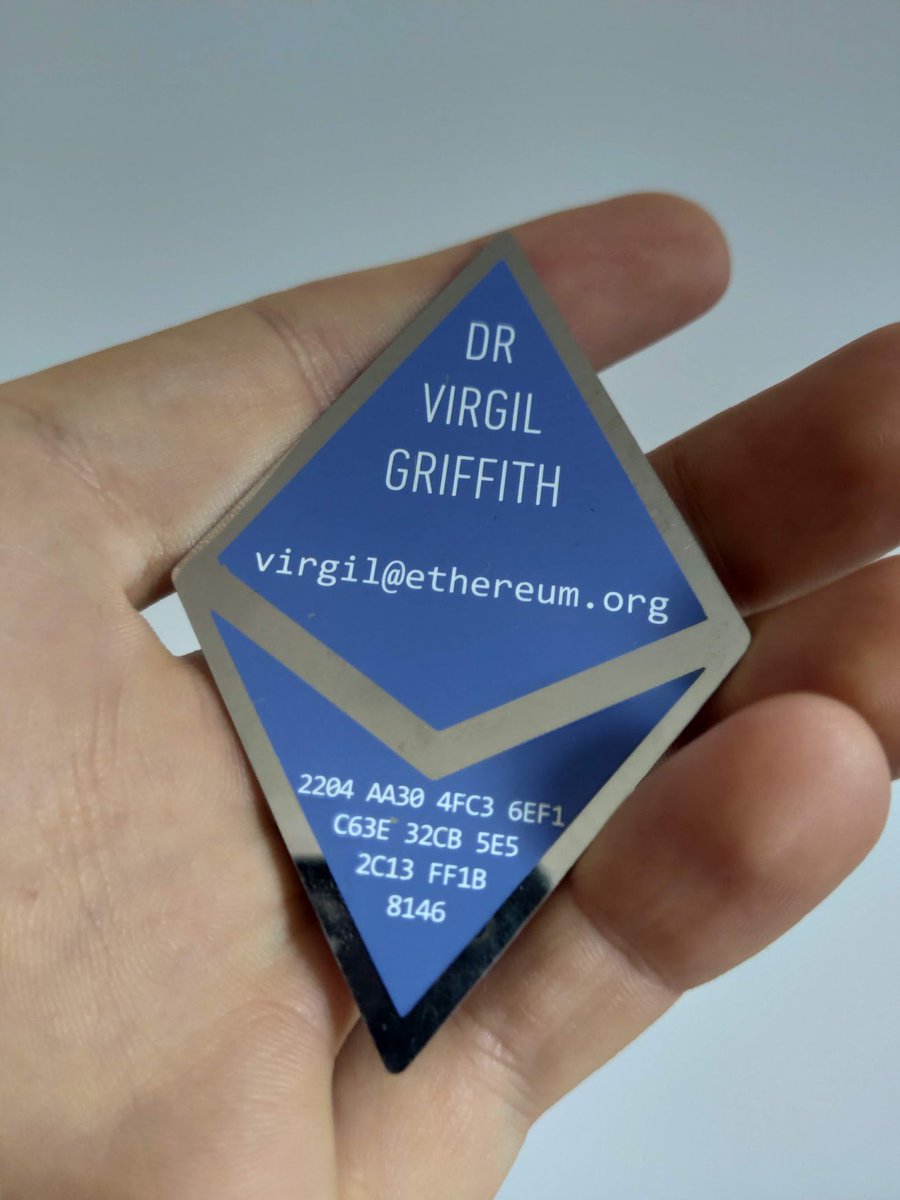
I've got a work offer from him back in Devcon4. Should I use it now
14
837

31 Mar 2025
new blog post
What will Ethereum do? State Rent, Stateless, Regenesis, and Portal Network
link: erigon.tech/what-will-ethere…
Video Notes:
It started in 2018 at Devcon4 in Prague. The group of Ethereum core developers gathered and discussed a troubling topic - the problem of ever growing state. A symptomatic manifestation of this problem was the effort required by go-ethereum nodes to perform initial downloading of the state for the new peer joining the network. Back then, it was based on fast sync.
It used the fact that Ethereum’s state commitment scheme is a form of a Merkle tree (though not binary, but with 16 children at each branch). Starting from the root hash, which for each block is present in a block header, the new peer queries the root node by its hash (there were such request in devp2p back then). Root node contains hashes of its children.
The new peer then makes similar queries for each of the children, and the process goes on recursively from the root of the tree to the leaves, eventually downloading the entire state by using this structure.
It ends up downloading all the intermediate hashes of the subtrees - so it is not very efficient compared to what happens these days, which is snap sync in go-ethereum and others (which downloads bunch of leaves at a time instead of one tree node), or Ottersync in Erigon, which is BitTorrent style downloading of the state file overlays (similar to Solana approach). Lets go back to fast sync.
The peers that answer those request for merkle tree nodes, continue to move on along the chain. Even though they kept updating the current state every 12 or 14 seconds, they retained some history of the merkle tree of what the state was.
This retention of some history was what allowed the new peers to perform fast sync download. However, as the size of the state gradually grew, it became more expensive to retain history which was too deep. Pruning of the history became ever more aggressive. Incidentally, the time required to download the state also grew. You may see now where the problem lies. Eventually we get the situation more and more often, when the new peer cannot proceed with the fast sync because all other peers pruned some bits of the Merkle tree it was downloading.
The process fails. But not all is lost. If the new peer keeps what was downloaded, and restarts from the freshly taken root hash, it progresses faster, as it already has some parts of the tree from the failed attempt. I suppose eventually it will succeed. But still, the situation was quite unsettling.
It was decided to attempt to fix the situation by initiating State Rent research, and I volunteered to lead it.
The main idea behind state rent is that in order to restrict the growth of the state or perhaps even to reduce it, one introduces a sort of standing charge for all the items in the state. This charge is deducted on a regular basis. Whenever an item is exhausted its balance due to these charges, it gets automatically expelled from the state.
My task was to research potential ways to implement this idea in Ethereum. Over a period of few months I have produced three proposals, iterating on each other, and incorporating the feedback received from the previous ones.
Lets us go back a little and discuss what is the state in general terms and why most of the blockchain systems since Ethereum have it. State is present implicitly in all blockchains. However, most notably in Bitcoin, its physical representation is not usually explicitly defined. What is defined are the operations that blockchain has to be able to perform efficiently on the implied state.
For example, in Bitcoin, one needs to be able to quickly find unspent outputs, mark outputs as spent, and insert new outputs. Therefore, to the best of my knowledge, Bitcoin peers cannot download state from one another in a standard way, they can only download blocks (with transactions in them) and replay them to calculate the state. Of course, in reality I am sure there are snapshots of Bitcoin core database directory, which is synced up to certain blocks. Maintenance of such snapshots are outside of the Bitcoin protocol, and most probably outside of the official Bitcoin implementation. State in Ethereum is defined more explicitly.
Apart from the requirements to efficiently find accounts by their addresses, and storage locations within the accounts, and modify these things, Ethereum also requires the efficient computation of commitment, from the logical structure of the state. This still does not fully specifies, but restricts possible physical representations of state.
For example, one may chose to store the state as a merkle tree with accounts and storage items in the leaves. Or one may chose to store accounts and storage items separately from the structure of the Merkle tree. If we include devp2p networking specification, it does require efficient retrieval of either nodes of the merkle tree (as in fast sync), or subtrees of the merkle tree (as in snap sync).
If the downloading of the state by the new peer becomes an essential operation, this puts more constrains on the design of the state representation. This was one of the main reason of transition from Erigon 2, which did not support such downloading and had to replay the entire blockchain, to Erigon 3, which supports efficient state downloading. In such designs, anything else that is required to resume the following of the blockchain and other operations, should be thought as a part of the state.
For example, in the early versions of Cosmos Hub, the commitment was calculated using self-balancing Merkle trees. Unlike radix tree, used in Ethereum, self-balancing tree does not possess the property of unique representation. This means that if one is given just the set of accounts making up the tree, it is not possible to uniquely determine the self-balancing merkle tree for it, there are many possible way of building such a tree from the same set of leaves. In this cases, some kind of description of which specific shape of the self-balancing tree the system ended up forming, must be considered part of the state.
If Cosmos Hub, having such commitment scheme, were to develop state downloading mechanism, it would require not just downloading list of accounts, but also information describing in which specific way these accounts need to be organised into a self-balancing merkle tree. It is not a show stopper for downloading mechanism, but needs extra consideration. In fact, it is my opinion that in the long run, self-balancing trees are better than radix trees for state commitments.
State rent for accounts with just balances and no storage is relatively simple to design. There are two main questions to answers. Firstly, how much the rent per account needs to be at any given time. And secondly, how does the mechanism of subtracting the rent (and burning it) should be. In my first proposal I wrote that the rent per account should be a function of total size of the state.
For example, no rent when the state is really small up to certain size, and after that, the larger is the state, the larger is also the rent. As for the mechanism, I proposed to add an extra structure to the state (that it why we have just had a discussion on how the state is defined), which is the priority queue of references to the accounts, where the lower is the remaining balance, the higher is the priority.
Whenever balances of accounts change, their position in the priority queue also changes, and at every block there is a system operation to pop some accounts from the front of the queue, in order to expel them. This approach allows not to subtract the rent explicitly for every account regularly, which would be a lot of changes.
However, in Ethereum, accounts may also have variable number of storage items associated with them. And those storage items do not hold the balance of their own. Also, even though they are modifiable by the actions of the owning account only, it is a convention that they often represent the logical ownership for some other accounts.
This logical ownership is not explicitly defined and in general hard or impossible to compute. And finally, the programming model as a convention, and the Solidity (and I am sure Vyper) compilers assume that storage items cannot just disappear. If they do, a lot of smart contracts that were written, will fail in very weird ways. After three rounds of proposals and feedback, I came to the conclusion that the only way to get this done is to change the programming model as a convention, and the compilers. Changing programming model as a convention would mean going through most used smart contracts written, re-writing them with the new convention, which is rent-safe. It would involve mostly social work, and a bit of the technical work, over prolonged period, without any chance of success. After realising it, I decided to stop the work on the state rent for Ethereum.
After that came a pivot towards Stateless Ethereum. The main idea is that blocks have to include, apart from sender and receiver addresses, and the input data for each transaction, the merkle proof for all the items in the state, that transactions in these blocks are going to access. This is because Stateless Ethereum assumes that the verification of such blocks should proceed without any knowledge of the state except for the state commitment, or root hash of the merkle tree. How does this help? First, let's see what kinds of peers will be able to benefit from that, and then we shall see what is the cost. Assume this categorisation of Ethereum peers:
1. Block producers
2. Transaction creators
3. Transaction relays
4. RPC servers
5. Others
Stateless Ethereum does not benefit block producers, because those would be the peers that still need to access the full state to execute transaction, and generate merkle proofs to go into blocks. It does not benefit RPC servers either, assuming that the most common RPC request is `eth_call`, which requires unconstrained state access. Transaction creators do not need access to the state, unless they need to perform some simulation to calculate inputs. Transaction relays, although not requiring the access to the entire state (but they might do in the case of full Account Abstraction), still need actual account balances and nonces to validate transaction before relaying, so in general they also do not benefit. Which leaves us with other peers, who may potentially benefit when validating the stateless blocks. Given all that, the benefits are not very clear.
The main cost of Stateless Ethereum comes with the additional data in form of merkle proof that need to be attaches to every block. Worst case scenarios are very scary, average cases are perhaps bearable. There was an observation that if the merkle tree used for commitment was binary rather than with radix 16, the merkle proofs would be smaller. Although the depth of the tree would be roughly 4 times bigger, making merkle proofs having roughly 4 times more elements, each element would contain 1 sibling hash instead of 15. Therefore, the size of the merkle proofs should reduce roughly by the factor of 15/4 = 3.75. Further development of this theme lead to the work on Verkle tree commitments, which offer significant reduction of the proof sizes. As far as I understand, the research is rolling back to the binary merkle trees.
There are two other technical challenges to overcome. Extra gas needs to be charged for the merkle proof, since it makes every block larger. But there is one proof per blocks, whereas each transaction pays its transaction fees separately, and often at different rate of ETH per gas. Secondly, merkle proof of bytecode of a contract would require including the entire bytecode into the proof. We will not dive into possible solutions, because on balance it seems that cost/benefit ratio for stateless ethereum simply does not work out.
Improving on the pure Stateless Ethereum design, I have proposed a middle ground design, called Regenesis. In order to explain why this is a middle ground, we need to introduce the notion of implicit and explicit state. We will call implicit state the state that we have right now, and it grows, changes, and shrinks in exactly the same way as the state does today. Explicit state, at the time of the first regenesis event is empty. Unlike in Stateless Ethereum, now transactions, not blocks carry merkle proofs. Such merkle proof need to include only the state items that a transactions accesses but that are not yet part of the explicit state. If a transaction is included into a block, the items than it proved become part of the explicit state, regardless of whether the execution of this transaction succeeded or failed. This is how the explicit state grows. If a transaction only accesses items that are already in the explicit state, no proofs are needed. Now you can hopefully see why regenesis is a middle ground between stateful and stateless ethereum. Since it is not possible in general to predict what a transaction may access, a situation may arise when a transaction tries to access items that are neither in the proof nor in the explicit state. In this case, the transaction fails, but still pays for its gas, and all items it proves are added to the explicit state. This means that, if resubmitted with updated proof, it will eventually succeed. Renegesis events happen regularly, and after each event the explicit state is emptied again. Let's analyse regenesis in the same way we analysed stateless Ethereum. For benefits, we look at the same categories of peers. Block producers benefit because they only need to maintain the explicit state, transactions come with the proofs of anything which is outside of the explicit state. Transaction creators do not benefit, they actually bear most of the burden of regenesis. Now they need to have access to potentially the entire implicit state to produce merkle proofs for the transactions.
However, in many cases such access is not time critical, and can afford extra means for retrieval, for example, Portal Network, which we will touch on later. Transaction relays would in general need implicit state to re-verify the balance of the account sending the transaction, but this check can be relaxed and transaction relay simply utilise the balance and the nonce either from the proof or from the explicit state. So transaction relays also benefit, at the cost of relaying larger transactions, because they include merkle proofs. RPC servers with `eth_call` requests in general do not benefit, because they still require access to the entire implicit state to simulate potential transactions. Other peers would benefit in a similar way as in the case of stateless Ethereum. In comparison with stateless Ethereum, block proposers are winners, and transaction creators are the losers. Regenesis represents this distribution of burden.
As mentioned before, transactions creators would benefit from joining the Portal Network to share this burden amongst themselves. The technical challenge of charging gas for proofs gets easier, since each transaction can pay for its own proof. Another challenge of proving the byte code still exists, and therefore, the change of the state commitment scheme is required one way or the other.
Briefly about Portal Network project. Portal Network nodes form a few different subnets, each having a function of distributing block headers, block bodies, pieces of state, receipts, state history, and so on. Here we are interested in the state subnet. Portal forms a content-addressable distribution of data, and its peers can ask and be asked to retrieve a particular merkle tree node, account, storage item, or bytecode by specifying their tree paths in the merkle tree. All responses are furnished with corresponding proofs, thus minimising trust assumptions. Each peer does not need to store all the data items, they are spread out using kademlia structure. Queries and responses are transmitted via UDP rather than TCP, making the network much more transient and flexible than devp2p or libp2p networks. The stated use case for the Portal Network is lightweight clients. And indeed, in our analysis, transaction creators would benefit from such a network. It becomes a "saving grace" of Regenesis for them. Other potential users of Portal network would be L2 rollups, both for verification of data on L1 and posting it there. Similar can be said about the operators of trustless bridges.
In 2020, I ended my involved in the stateless Ethereum research group, once it became clear to me that Regenesis is replaced by the new proposal, called State Expiry, which however great, I did not believe at the time would be adopted. Back then, my skepticism was based on the observation that state expiry was becoming much more complex scheme than regenesis. Regenesis was perhaps already too complex to ever be adopted, therefore, I thought, state expiry had no chance at all. When I look at it now, there are two more reasons that is added to my scepticism. Now that the details of State Expiry are more less clear, one can see that like State Rent, it would break the conventional programming model for smart contract, and can only be rolled out with the change of the said programming model. And, looking at the issue more broadly, it aspires to never remove things forever, always leaving mechanisms for resurrection, the desire which made State Rent proposals almost intractable. I now call this the "timeless treasure fallacy" - the belief that blockchain should give you a way to preserve your treasure forever, without you having to do anything about it. This facility never existed in the real world.
Where should we go from here? I think if Ethereum, for whatever reason, want to reclaim primacy as a smart contract platform, and compete with Solana, instead of becoming just a rollup aggregator, it needs to develop a strategy (it is not actually very difficult to do, I believe) to perform two fundamental changes. Number one - fix incomprehensible state problem. This would require changing the organisation of the state. Most probably to adopt a similar model to Solana. That means that in EVM, instead of using `SLOAD` and `SSTORE` instructions to interact with the state that looks like a hash map, one would perform memory-mapping from account's storage into EVM memory. This memory mapping would be hard to inject into the current incarnation of EVM, but it would be much easier with EOF. This is because special data sections can be assigned to the memory that is mapped to the linearised storage.
Number two is fixing state growth. Introducing State Rent, or State Expiry are both infeasible from my point of view, without relaunching the chain. If the chain is to be relaunched, one has to make a high-level decision whether "timeless treasure" does have a place in it or not, and design accordingly. Somewhat more realistic path is to do Regensis plus Portal Network, via change of commitment scheme, for example, using the design of Verkle trees, which does solve the issue of proving the bytecode. However, I will say it again, without strategy, and the accompanying narrative, if you will, these efforts are very unlikely to succeed.
Beyond the question what Ethereum will do, there is a topic of hybrid public/private state, which I will not discuss today, and leave for some other time. Our colleague Mark has recently made an observation that thinking about explicit vs implicit state leads to some insights about how a hybrid state may be organised, and continuing this thought, we are arriving to the generalisation of the entire ensemble of L1 with the L2s, but realised in the single system.
Original video on the Akexey Akunov Monoblunt channel on Telegram: t.me/monoblunt/128
Original notes on the Akexey Akunov Monoblunt channel on Telegram: t.me/monoblunt/129
2
1
9
878