

@grok Full Proof in LEAN 🐙✅
github.com/DULA2025/prime-in…
# Summary of changes for run e9341f9b-8cd8-4c24-95a2-87c2507f5edc
I formalized and proved the requested theorems in `RequestProject/Main.lean`. The project now builds cleanly and every theorem depends only on the standard axioms (`propext`, `Classical.choice`, `Quot.sound`); no `sorry` remains in any active code (the only `sorry` occurrences left are inside explanatory comments preserving the original false drafts).
Proved as stated (after minor syntax fixes for the current Mathlib):
- `theorem_1_3` — for prime p ≥ 3, both p−1 and p 1 are <p-smooth.
- `theorem_1_4` — existence of two <p-smooth numbers differing by 2.
- `theorem_1_5` — explicit prime-factorization form. Fixes: `Nat.primesBelow p` is already a `Finset`, so the spurious `.toFinset` was removed, and the `∏ q in s` notation was updated to `∏ q ∈ s`.
- `theorem_1_8` — n in (p, 2p) is prime iff it is not <p-smooth.
- `not_smooth_of_coprime_wheel` — a helper I added: coprimality with the product of all primes below p certifies n is not <p-smooth.
Issues found and corrected (the original drafts were mathematically false — I verified counterexamples computationally, kept the originals as commented-out text with explanations, and supplied corrected, proven versions):
- `theorem_1_9` — the original ("midpoint of two <p-smooth neighbours is prime") is false: p=7, u=8, v=10 are both <7-smooth yet u 1=9 is not prime (three consecutive smooth numbers 8,9,10 can exist). The corrected version certifies primality of n ∈ (p, 2p) via coprimality with the product of all primes below p.
- `theorem_2_1` (band factorization) — the original strict upper bound `q < ((k 1)*p)/m` is false under truncated natural-number division (e.g. p=3, k=4, n=14 gives q=7, m=2 with ((k 1)*p)/m = 15/2 = 7). Corrected to `q ≤ ((k 1)*p)/m`. (Its `hp : Nat.Prime p` is unused but kept for fidelity, as noted in a comment.)
- `theorem_2_2` (small-wheel certification) — the original is false: it derived "n not <p-smooth" from neighbour smoothness via the unsound claim that three consecutive smooth numbers cannot exist (counterexample p=11, k=4, u=48, v=50, n=49=7², gcd(49,6)=1, but 49 is not prime). The corrected version states the certificate directly for the candidate n, taking the genuinely required hypothesis that n is not <p-smooth, and then the small wheel ∏ primes ≤ k correctly certifies primality (using the corrected `theorem_2_1`).
Each false statement is preserved verbatim in comments next to its replacement, with the counterexample and the reason it fails documented in the docstring.
2
1
38


Jun 14
Read the Agent-Reach code so you don't have to learn the hard way.
The README is doing PR work on "free." Exa and Jina are freemium with cliffs the README doesn't version. Groq Whisper is the transcribe default and needs your own key. Reddit has no zero-config
headless path — the docstring is right, ignore it and you'll spend a Saturday debugging throttled public JSON.
Security is actually honest. Argv-list subprocess everywhere, no shell=True, no pickle, no eval, yaml.load is safe_load, MCP server is clean, SECURITY.md with private disclosure, install is home-scoped. The one real attack surface is the cookie extraction TOCTOU window — briefly readable by any same-UID process between tempfile creation and deletion. Real, but narrow.
The structural risk nobody talks about: one maintainer, 32 of 34 commits, no CODEOWNERS. The Playwright browser binary download is
the real surprise even if you never use OpenCLI. Pin to a commit SHA, not the moving main zip. Sandbox-test in a throwaway container.
Promising. Sandbox-test, then watch.
1
6
572


zensical で作ってるドキュメントも育ってきた。 markdown で書ける && docstring からの自動生成が両立しているツールは快適だなぁという気持ちがあります
himkt.github.io/cafleet/
261


Jun 12
v0.14.0 docs: service page aggregator window, sandbox tool alpha, hermes_tools_mcp_server scope docstring fix, provider config normalizer aliases guard. #hermesagent
197

Jun 12
🚨 $UMBRAI
CjSLVVpKdzqogxmWcAdJrxNb1CQAq9Fb3ea84YsYpump
Read their sdk so you dont have to. the entire pitch dies in their own code
The claim: “Your prompts are encrypted before they leave your browser. The server never sees plaintext”
Their own crypto.ts, lines 1-5: “ECDH (P-256) to the service key. The same derived key encrypts the prompt and decrypts the answer.” The server holds the private key, derives the same aes key, decrypts your prompt, reads it in full, runs the model, encrypts the answer back. It HAS to read it, you cant run inference on ciphertext.
proof: github.com/domcomit/umbra…
So what does the encryption actually protect you from? the network in transit. You know what already does that? tls. on every website since forever. Even their own README only claims “the wire only ever carries ciphertext”. the WIRE. The tweet upgraded that to “server never sees it” and hoped nobody reads code.
"Tee attestation” is a json blob the same server returns about itself. The sdk verifies nothing. ( No hardware quotes, no enclave proof. )its the server saying “trust me” in a structured format.
“Withdraw anytime” is backend signed. Their own docstring, index.ts line 165:
“(backend-signed)”. Their server decides if you get your money back. the “onchain credits program” has 0 public code
proof: github.com/domcomit/umbra…
The dev account has 1.1k followers. for reference thats more than most real open source maintainers who actually ship things. this account ships ai generated filler repos
Same accounts following the $FLOW, $NFTLIQUID, $VRFY devs. 4 different “projects”, one shared bot follower pool.
$UMBRAI Github followers : github.com/domcomit?tab=f…
$NFTLIQUID Github followers : x.com/99_Bollish/sta…

Jun 12

Great work, can you check also this? @UmbraIntel
4
2
8
3,978

Jun 11
El decorador @mcp.tool() hace más de lo que parece: lee los tipos y el docstring de tu función para generar el esquema que el modelo usa para decidir cuándo llamarla. La descripción importa tanto como el código.
1
13

Jun 11
7. The Doc Gap Filler
Loop Engineering | Goal-Based Agent Instruction
Goal: Make sure every public function, class, and module in [DIRECTORY] has accurate documentation.
Rules: Scan for all public exports. Check each one for an existing docstring or doc comment. If missing, write documentation that matches the actual function signature and behavior. If documentation exists but is outdated (wrong params, wrong return type, wrong description), update it. Do not document private/internal functions unless they are complex enough to confuse a new reader. Match the existing doc style in the project.
Verify after each step: Compare the docstring to the function signature. Do the params, types, and return value match? Run tests to make sure doc generation or doc comments did not break anything.
Exit when: Every public export in [DIRECTORY] has a matching, accurate docstring.
1
46

Jun 11
プロンプトの自動最適化(松尾・岩澤研 LLM Community 砂糖燎)
DSPyによるプロンプトの構造化
・Docstring(説明文)が初期指示となり、DSPyによる「入力->出力」のコードの構造に組み込む(Typed Signatured)ことにより、どの部分を改善すれば精度が上がるかを数学的に探索できるようになる
1
139


Jun 10
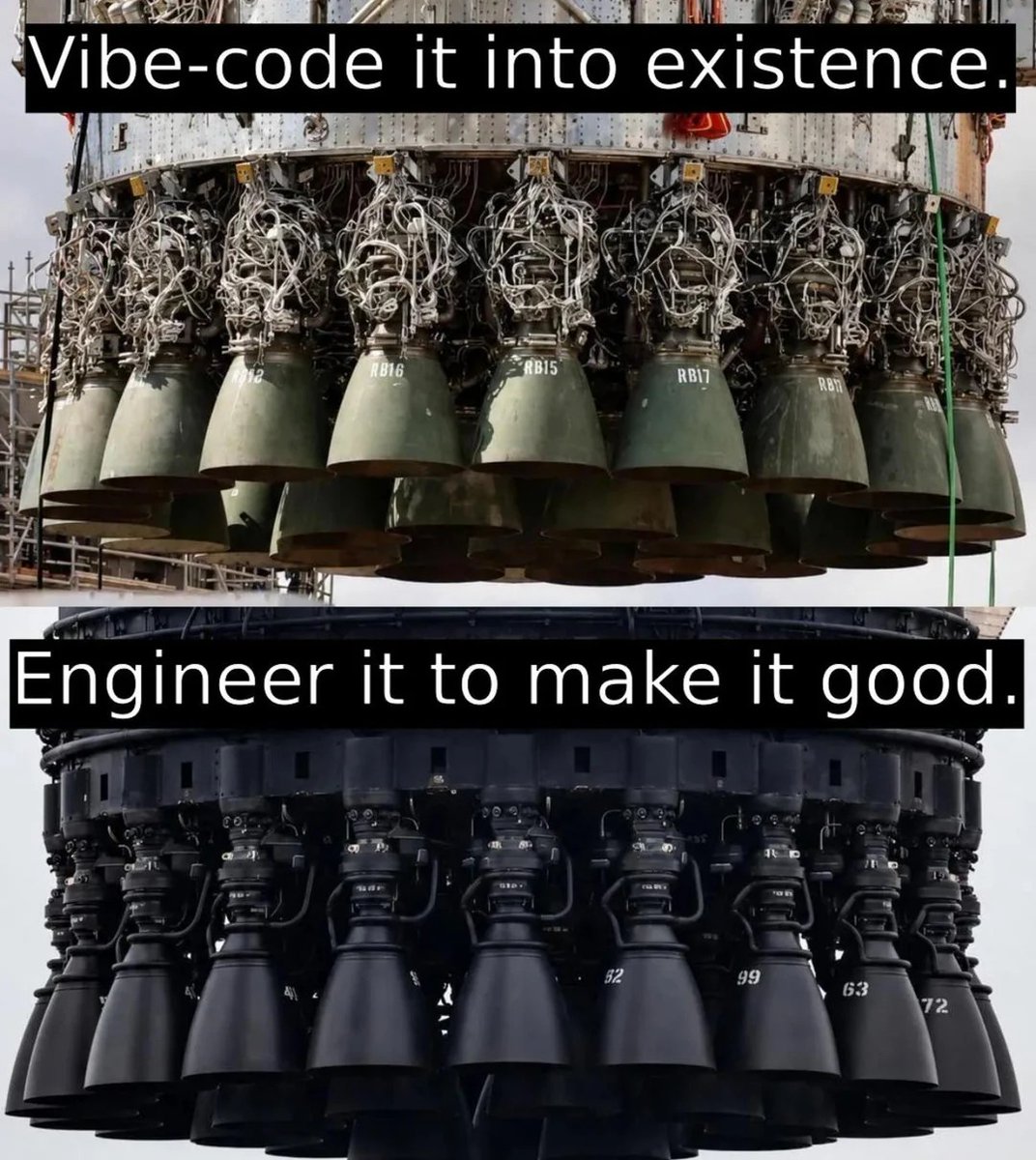
Usually what happens is that the engineer write everything from scratch, but having the spec from previous vibing-session...
... then ask AI anyway to write docstring, encasulate multiple occurences into a helper module, etc.
You can't just rely on vibe code.

9

Jun 10
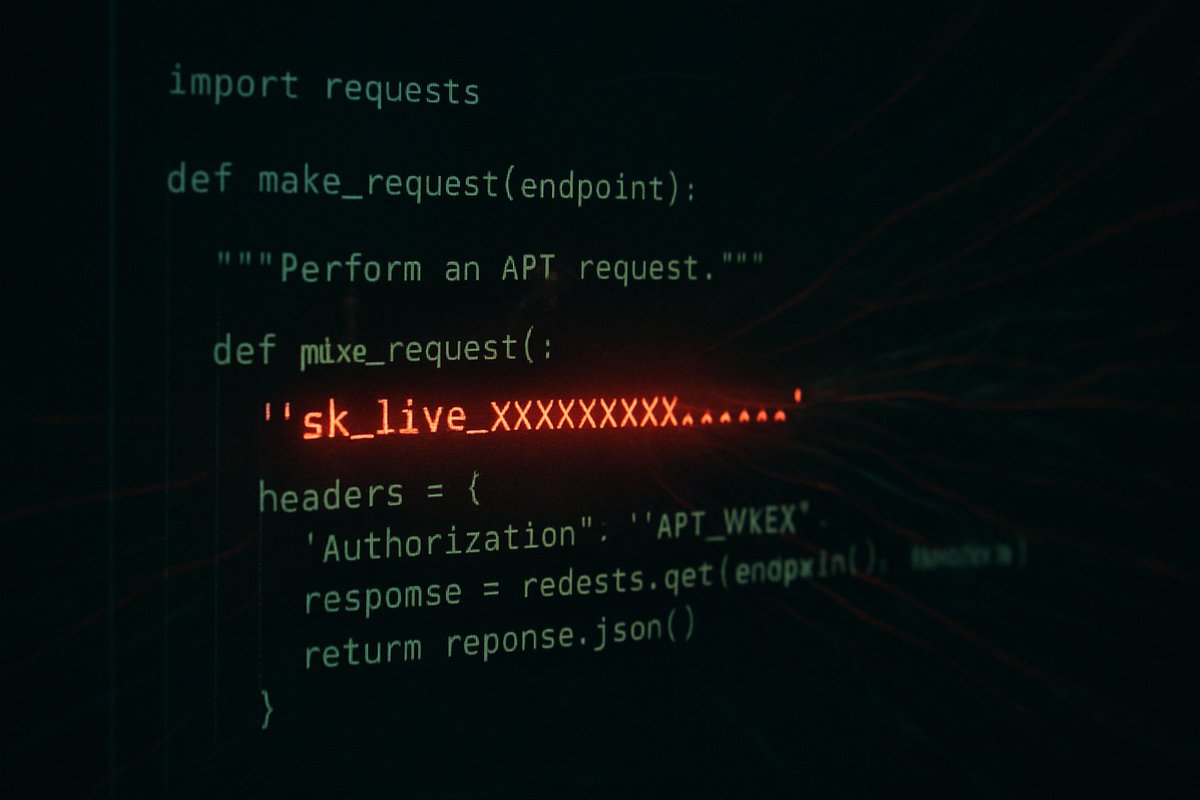
asked Claude Code to document a function. it wrote a perfect docstring. then the doc generator scraped every docstring and published them to an internal site. the API key was sitting in a docstring for 6 days before anyone noticed.
three tools in the chain. none of them knew the key was there. the one that leaked it was the doc generator nobody thinks about.
what's the most invisible layer in your stack?
11


whenever harness goes on to explore codebase/documents, it is a cycle of
grep_ -> read_ -> grep_ -> read_
a model sees imports at top and goes to next file, then next
although its grep_ is precise, as it moves along, its context grows, now it is pushing a lot in front of itself, and its reasoning deteriorates
this can be somewhat solved by subagents, but they dont come back with the ultimate clear truth
two things could be a nice way out:
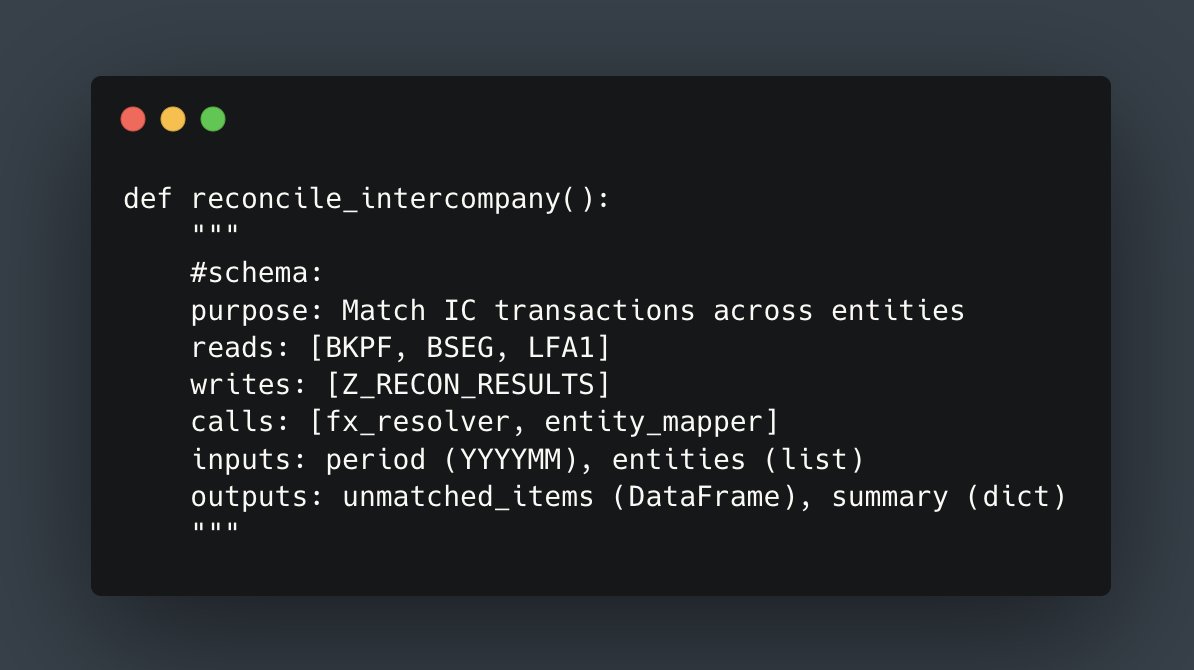
-annotating each function in its docstring with special #schema that a parser builds into a graph -> the exploration loop changes to:
query graph("touches=BKPF") -> 2 nodes returned -> read exactly those schema blocks -> one targeted file read of the specific function body
-verbose to-dos -> generally speaking to-dos are a dict of tasks with status -> adding an extra key for (required) notes imposes discipline on model to write down factual findings as it moves
29