nondemonrat1285 retweeted

And Iran built an entire underground nuclear enrichment facility and enriched >60% grade during Barrack Obama’s JCPOA.
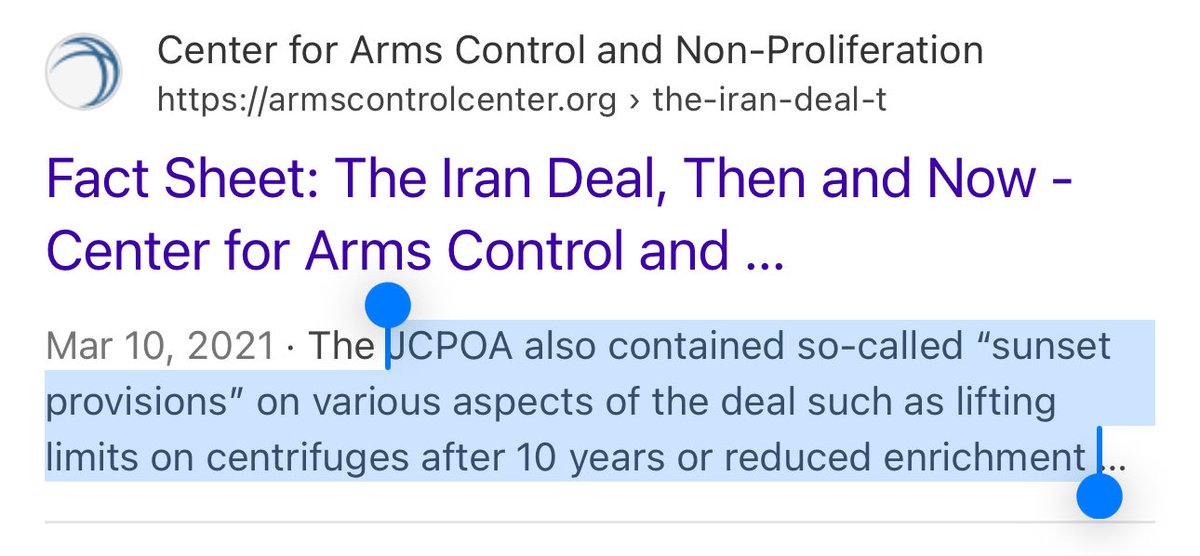
Also, Obama’s JCPOA had a sunset clause that ended in 2023 which meant Iran was no longer limited on enrichment or bound to the JCPOA.
Please just stop man.
You’re embarrassing yourself.
7
33
175
1,268
Real News Diver retweeted

Very important segment here.
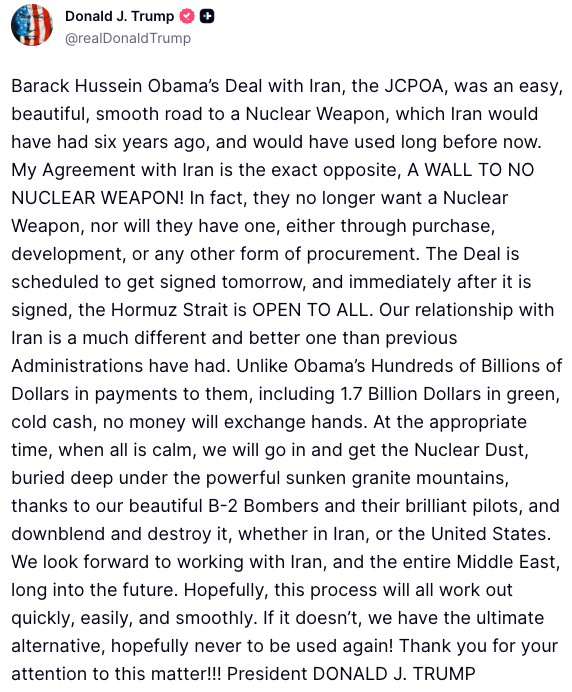
According to the Trump admin, Iran will not get to keep any of their enriched uranium, and Yingst explains why Obama’s Iran Deal essentially paved the way for Iran to make nuclear weapons.
In conclusion, we get the uranium.
 RNC Research
64
1,988
8,735
161,189
Muhammad Hassan retweeted

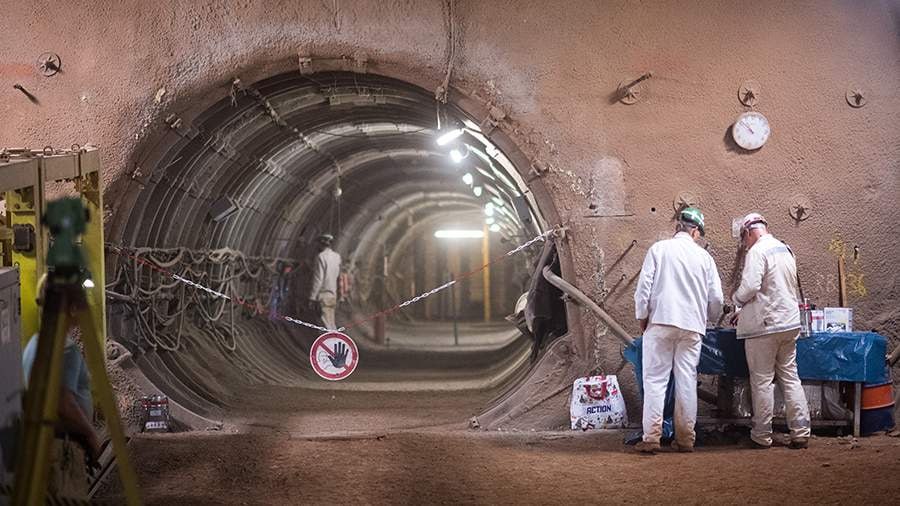
CNN: IRAN DESTROYS AND MINES THE TUNNELS WHERE THAT URANIUM IS HIDDEN
Arakchi: The issue of highly enriched uranium will be resolved exclusively in Iran
The collapse allegedly began after US threats to forcibly take control of Iran's highly enriched uranium stocks
17
130
5,022

Iranians only enriched uranium to 3.67% under the JCPOA. Who tore it up?
1

The nuclear file is still the hardest part of the expected deal. Iran says it will not build nuclear weapons, but the key issue is the point of verification that is the enriched uranium, who supervises dilution or disposal, and can the IAEA inspect without coming into such a theatre? 4/6
1


The Trump administration and proponents of the new diplomatic approach strongly reject former President Barack Obama's skepticism. Critics argue that the emerging pact represents a fundamental, qualitative upgrade over the 2015 Joint Comprehensive Plan of Action. Unlike the JCPOA's "sunset clauses" that allowed certain restrictions to expire over time, proponents state the new framework aims for the actual destruction and removal of Iran's highly enriched uranium stockpile. Supporters of the current administration argue the 2015 deal merely delayed Iran’s nuclear path. The objective of the current framework is to completely shut down its weapons capabilities permanently. President Trump has explicitly countered that "no money will exchange hands" under this agreement. The current administration points out that the 2015 deal provided Iran with billions of dollars in sanctions relief and cash deliveries upfront. This new deal relies on "maximum pressure" leverage to secure concessions without financial windfalls. Critics of the original JCPOA emphasize that it failed to address Iran's ballistic missile program or its funding of regional proxy forces. The current negotiations aim to establish a broader framework that halts military conflicts and secures critical trade corridors like the Strait of Hormuz. This addresses regional aggression in a way the original nuclear-only framework did not.
6

IRAN WAR AGREEMENT
It is official—a monumental breakthrough has happened today, June 14, 2026. The United States and Iran have reached a peace agreement to permanently end the hostilities that have gripped the region for the past four months.
Pakistani Prime Minister Shehbaz Sharif, acting as a key mediator, announced this afternoon that a deal is "now in place" for the immediate and permanent termination of military operations on all fronts.
Key Details of the Breakthrough
Strait of Hormuz Reopening: President Donald Trump confirmed the deal via social media, announcing that he has authorized an immediate end to the U.S. naval blockade on Iranian ports. The vital maritime corridor will reopen to global shipping.
Economic Relief: In exchange for reopening the strait, the U.S. has agreed to relax its blockade and economic sanctions, allowing Iran to resume oil sales to help stabilize its heavily battered economy.
The Nuclear Sticking Point: According to statements from President Trump, the preliminary agreement addresses Iran's enriched uranium stockpile. While technical details are still being ironed out, the roadmap involves downblending and destroying nuclear material once the situation stabilizes.
Official Signing Ceremony: While the preliminary agreement was reached today, the official, formal signing of the peace accord is scheduled to take place this coming Friday, June 19, 2026, in Switzerland.
Last-Minute Tensions
The agreement barely crossed the finish line today due to a sudden flare-up in Lebanon. Earlier this morning, an Israeli airstrike hit the Dahiyeh district of Beirut, which killed three people and threatened to derail the diplomacy entirely.
The strike drew sharp criticism from UN Secretary-General António Guterres and prompted a strong warning from Iranian negotiators that the U.S. was failing to control its ally. President Trump also expressed severe frustration with Israeli Prime Minister Benjamin Netanyahu, stating that the strike delayed the finalization of the agreement by several hours before both sides ultimately agreed to proceed.
While the announcement brings massive immediate relief to the global economy and oil markets, regional analysts note that long-term stabilization will take time. Rebuilding damaged infrastructure in the Strait of Hormuz and establishing verified safe passage for commercial shipping will be the focus of intensive technical talks starting next week.
#Iran
#USA
#UnitedStates
#Trump
#IranWar
#AbbasAraghchi
#Netanyahu
#Israel
#Lebanon
#Hezbollah
#MojtabaKhamenei
#MasoudPezeshkian
#StraitOfHormuz
12

You’re just making up numbers to cope with the fact that your dear leader just surrendered to Iran to reopen Hormuz. Obama gave them $1.7 billion for a nuclear deal that destroyed 98% of Iranian enriched uranium, not $25 billion to reopen a strait that was open four months ago.
7

The enriched uranium was the most important objective. He's told you that from the start.
1
2

Iran built their nuclear infrastructure and enriched nuclear materials during Obama's presidency. You know this why do you lie
1

Iran Mined Entrance to Bombed Nuclear Site to Deter Raid on Enriched Uranium gellerreport.com/2026/06/ira… via @pamelageller

No! War criminals should not get a @NobelPrize 4 peace! Trump ended a peace deal. Iran committed to no nukes and had only 3,7% enriched uranium when Obama left office. Trump immediately ended it at the start of his first term, it went up to 60%. Trump has not gotten a better deal
8
Mickey Palmer retweeted

May 31
Fucking traitors should be in jail. Not pardoned and enriched using taxpayer dollars.
653
4,156
10,735
111,925
Hal Goetz🥥 retweeted

Trump tore up JCPOA, Iranian enriched a lot of uranium with no deal in place, then he started a war that damaged the global economy and now he’s resolving it in exchange for the same pledges Iran had already made.
11h

Um: preamble to 2015 JCPOA that Trump tore up: "Iran reaffirms that under no circumstances will Iran ever seek, develop, or acquire any nuclear weapons." Literally the same.
3
3
64
5,962

The below (attached post) observation that the Iranian regime invoked Imam Husayn’s refusal to pledge allegiance to Yazid while negotiating directly with the United States on the eve of Muharram points to something more than simple inconsistency. It reflects a long-standing pattern in which religious and historical symbolism serves immediate political survival rather than guiding conduct.
In mid-February 2026, Ali Khamenei delivered a speech in which he quoted the historic declaration attributed to Husayn: “One like me does not pledge allegiance to one like Yazid,” framing the United States as the embodiment of tyranny. Coordinated American and Israeli strikes on Iranian nuclear and military targets began in late February 2026 as we all yet remember. Khamenei was killed around 28 February 2026. By mid-June 2026, on the eve of Muharram 1448 AH (which began on or around 16 June), a framework memorandum of understanding had been reached. Iranian state media and the 14-point draft reported by Mehr News outlined an immediate and permanent cessation of hostilities, including in Lebanon (even though its not yet clear if Israel could accept that); the phased lifting of the naval blockade within thirty days; the reopening of the Strait of Hormuz under Iranian regulatory arrangements with permits and fees; the suspension of sanctions on oil and petrochemical exports; and the release of approximately 24 billion USD in frozen assets, with half available before final talks. A sixty-day window was set for narrower nuclear discussions, while ballistic missiles and support for regional proxies were kept off the immediate agenda. In exchange came reconstruction commitments of at least 300 billion USD. The timing placed the accommodation directly against the sacred commemoration of Husayn’s stand at Karbala.
The internal shifts that followed are equally precise. Mojtaba Khamenei receded from public view. IRGC-linked figures such as Mohsen Rezaei and Ahmad Vahidi retained central roles alongside Chief Justice Gholam-Hossein Ejei, police commander Ahmad-Reza Radan, and parliamentary speaker Mohammad Bagher Ghalibaf, who had earlier declared negotiations with those responsible for Qasem Soleimani’s death dishonourable but adapted his rhetoric once the new landscape emerged. The IRGC consolidated influence while the clerical establishment was sidelined.
Assessments record damage to more than fifty bases, significant IRGC command infrastructure, missile facilities, air defences, and naval units, yet nuclear sites at Fordow, Natanz, and Isfahan sustained strikes that left approximately 440 kilograms of 60-per cent enriched uranium under regime control and subject to deliberate fortification—tunnel entrances collapsed, backfilled, and mined. These measures were designed to impede any follow-on ground operation. Overland supply routes through Turkey via Kapıköy-Razi to Mersin, Caspian links with Russia, Central Asian corridors, and Pakistan-China pathways remained operational. The regime quickly established the Persian Gulf Strait Authority, imposing tolls that shipping lines accepted under commercial pressure.
This sequence echoes the layered record of the Umayyad transition. The treaty between Hasan ibn Ali and Muawiyah was concluded in 41 AH (661 CE), under which Hasan abdicated and received guarantees that included material provisions for Banu Hashim. Hasan died on 7 Safar 49 or 50 AH (5 March 670 CE) from poisoning by his wife Ja’da bint al-Ash’ath, an act many early sources, including accounts transmitted through al-Tabari and others, attribute to instigation by Muawiyah to clear the path for Yazid’s succession. Muawiyah died in Rajab 60 AH (April or May 680 CE), most accounts placing it around 22 Rajab or between 7 and 29 April 680. Yazid succeeded immediately. Husayn refused bay’ah in Medina in early 60 AH (680 CE) and departed Mecca on 8 Dhu al-Hijjah 60 AH (around early September 680). He reached Karbala on 2 Muharram 61 AH and was killed with most of his companions on 10 Muharram 61 AH (10 October 680 CE). In the transmissions, Husayn’s refusal is framed with the very words later quoted by Khamenei: one like him would not give allegiance to one like Yazid. Yazid had appointed Ubayd Allah ibn Ziyad governor of Kufa to suppress opposition, and accounts in al-Tabari record Yazid expressing caution about Husayn’s bloodline and later regret over the manner of the killing while blaming the governor for excess.
The parallel lies in the selective use of principle alongside pragmatic power management. In 680, material accommodation under Muawiyah coexisted with political opposition once hereditary succession was announced. In 2026, rhetoric of unyielding resistance framed external confrontation, yet precise military pressure was followed by an accommodation timed to the sacred month, with internal assets preserved and factional influence realigned. The documented damage to command nodes alongside the survival and fortification of core nuclear and IRGC capabilities, the continuity of specific security figures, and the rapid establishment of new revenue mechanisms such as the Strait Authority suggest factional calculation at work: external action that weakened competitors while enabling a negotiated infusion of resources and regulatory leverage for those who endured.
The framework therefore delivered time, funds, and reconstitution capacity to the surviving apparatus. Whether rigorous verification, strict conditionality on reconstruction flows, and independent monitoring of diversion pathways will constrain that capacity or merely finance its next iteration remains to be seen in the months ahead. The record of dates and conduct—February rhetoric followed by late-February strikes and leadership loss, then mid-June accommodation on the eve of Muharram, with institutional continuity and supply resilience intact—offers little basis for assuming the former.
P.S. One should recall how the CIA has brought up Khomeini and the regime in Iran, and how Khomeini was protected first in Turkey and then in France... Recall all that and follow the money and policies were executed. When the beneficiaries will come to light, then all or some will be easy to understand!

🚨 Inside job? The more that emerges, the more this looks like a conspiracy against the old, bloodthirsty dictator.
Less than two weeks before his death, Ali Khamenei declared:
“Like Imam Hussein, I will never pledge allegiance to Yazid.”
In Shia Islam, Yazid is the ultimate symbol of tyranny and oppression, and Khamenei was clearly invoking him as a reference to the United States.
Yet the agreement was signed on the eve of Muharram, the holiest month in Shia Islam, and on President Trump’s birthday.
Khamenei has not even been buried yet, and his son, Mojtaba Khamenei, is nowhere to be seen or heard from.
Meanwhile, the IRGC has consolidated power and sidelining the clerical establishment in what increasingly resembles a hostile takeover in the Islamic Republic.
17

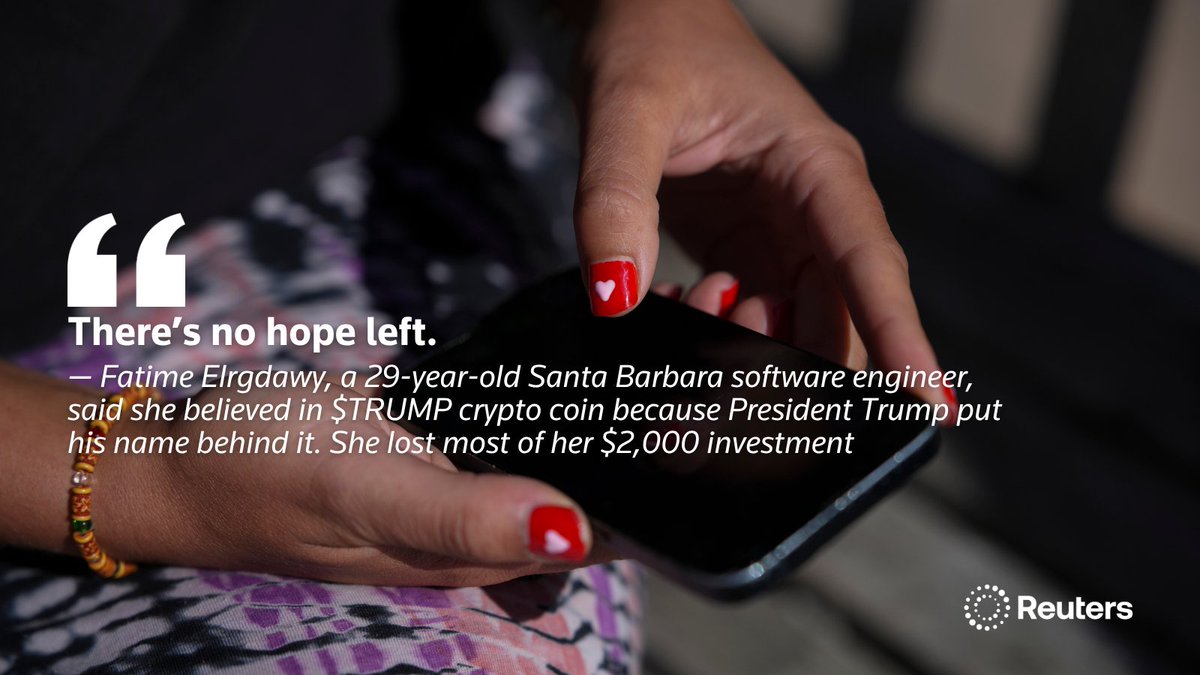
The Trumps have not only enriched themselves to an unprecedented extent for a sitting US president and his family, but have done so through crypto deals that carried little to no downside risk for them while resulting in big losses for retail investors reut.rs/4uZf4QB
82
853
1,502
133,616

7m
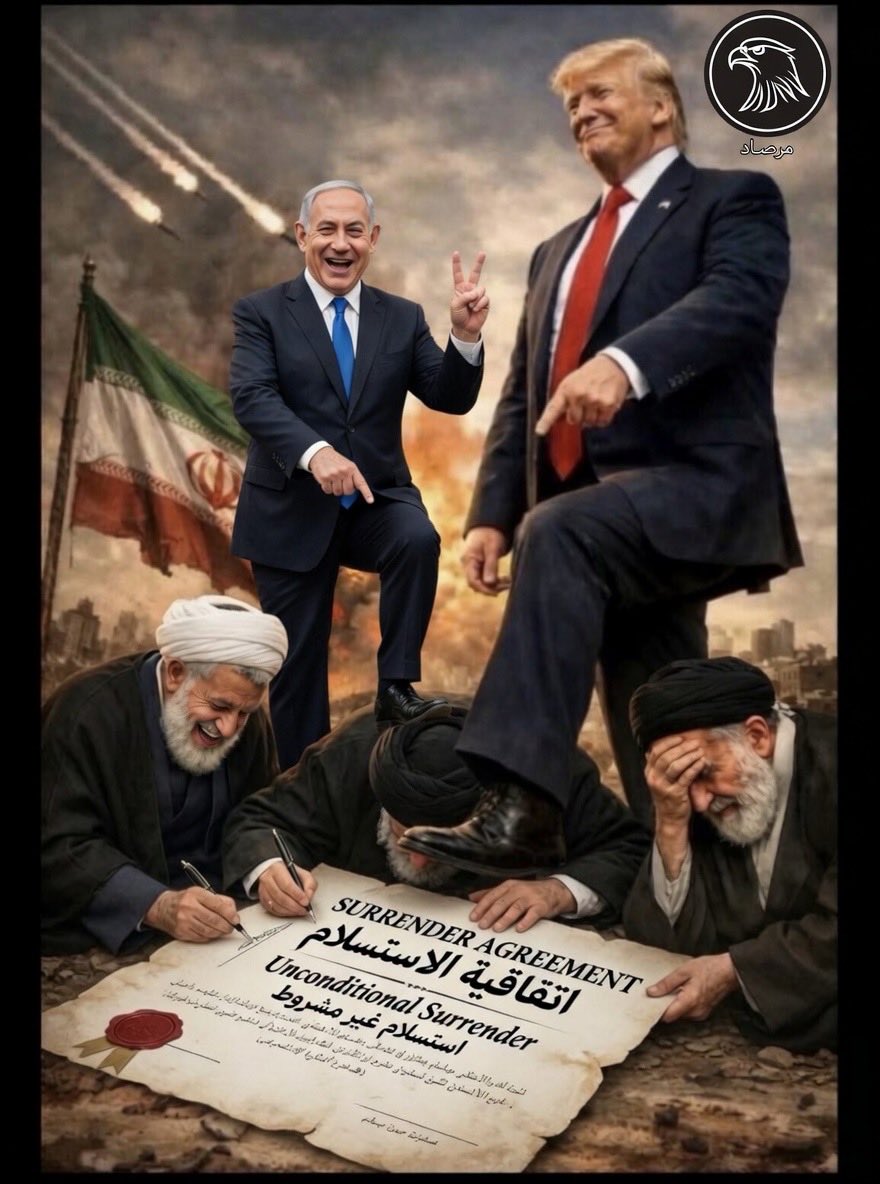
🛑 Iran’s Strategic Defeat Since October 7, 2023
▪️ Extensive Destruction of Military Infrastructure: Iranian facilities and their proxies were subjected to intense Israeli strikes, including the destruction of missile factories, air defense systems, and weapons depots in Iran, Syria, and Lebanon. This led to a major crippling of production and storage capabilities. The losses amounted to half a trillion dollars—all that Iran had built since 1979 was crushed.
▪️ Assassination of Key Iranian Leaders: A large number of Revolutionary Guard commanders were killed, including leaders in the Quds Force such as Mohammad Reza Zahedi, and other prominent figures in direct Israeli strikes inside Iran and Syria.
▪️ Collapse of Hezbollah’s Leadership: The assassination of Hassan Nasrallah, his successor Hashem Safieddine, Fuad Shukr, and a large number of military commanders. The party lost thousands of fighters and most of its short-range rocket arsenal (about 80%), along with the destruction of tunnels and warehouses, and Israel’s invasion of the south—now on its way to the completely devastated Shiite suburbs with losses estimated at a quarter of a trillion dollars from Iran’s investments.
▪️ Elimination of Hamas Leadership: Yahya Sinwar, Ismail Haniyeh, Mohammed Deif, and other prominent leaders were killed in Gaza and abroad, weakening the movement’s military and political structure, leading to the complete fall of Gaza and the erasure of 70% of it from existence. And the seizure of 60% of it.
▪️ Losses in the Resistance Axis: The fall of Bashar al-Assad’s regime in Syria (December 2024), cutting off the main land supply route to Hezbollah. Weakening of the Houthis and Iraqi militias after American and Israeli strikes, with losses in personnel and weapons.
▪️ Overall Deterioration of Military Capabilities: Loss of the deterrence that Iran had built over decades, with the axis unable to coordinate a unified response or protect Iran, despite direct strikes on it.
📌The End: Nuclear Surrender in Exchange for Limited Release
▪️ Iran agreed in the recent negotiations (2025-2026) to dismantle key aspects of its nuclear program, hand over its stockpile of enriched uranium (about 400 kg or more), and end escalation tools through its proxies.
▪️ In exchange, it only received the release of less than a quarter of its frozen funds (reports of 24 billion dollars out of a much larger total), as part of agreements aimed at halting escalation and opening the Strait of Hormuz.
#مرصاد_لهم_بالمرصاد
2