
RT @captainhb10a: I know most of you cunts fantasise about it daily, we could power a city from the energy you expend rubbing those needy c…
59

But they will hunt Church first... Don we know you are trying to expend others, chaos clock going off.
15

DONALD TRUMP holds the key to the elimination of Hezbollah, not Israel, not Syria! Iran is supposedly a defeated enemy. Trump should DEMAND—publicly, immediately, and without apology—that Iran cease ALL support for its terrorist proxies, starting with Hezbollah. No phased withdrawals. No “later dates.” No diplomatic loopholes. Cut off the money, the weapons, the training, and the command structure today, or face total isolation and escalated consequences. This single demand must sit at the absolute top of any agreement. Anything less turns victory into weakness. We should not be entering Friday’s signing with a polite wish list. America did not expend blood, treasure, and precision firepower for vague commitments. Our military delivered decisive dominance. Now TRUMP must deliver decisive diplomacy. Hezbollah survives only because Iran funds and directs it. TRUMP MUST NOT GIVE AWAY TREMENDOUS MILITARY ACCOMPLISHMENT ON THE POLITICAL FRONT.
1
46

Well it doesn't screw, but free to play is very very hard. The expectations is that you expend at least 100 euros to make a relatively competitive team. Less than that you are praying more than playing.
For example in first set without bonuses noone hit 1000, only with decreased
14
DONALD TRUMP holds the key to the elimination of Hezbollah, not Israel, not Syria!
Iran is supposedly a defeated enemy. Trump should DEMAND—publicly, immediately, and without apology—that Iran cease ALL support for its terrorist proxies, starting with Hezbollah.
No phased withdrawals. No “later dates.” No diplomatic loopholes. Cut off the money, the weapons, the training, and the command structure today, or face total isolation and escalated consequences.
This single demand must sit at the absolute top of any agreement. Anything less turns victory into weakness. We should not be entering Friday’s signing with a polite wish list. America did not expend blood, treasure, and precision firepower for vague commitments.
Our military delivered decisive dominance. Now TRUMP must deliver decisive diplomacy. Hezbollah survives only because Iran funds and directs it.
TRUMP MUST NOT GIVE AWAY TREMENDOUS MILITARY ACCOMPLISHMENT ON THE POLITICAL FRONT.
.@MariaBartiromo @Varneyco @pdoocy @presssec @kayleighmcenany @EmilyCompagno @marklevinshow @ShannonBream @Kasie
11

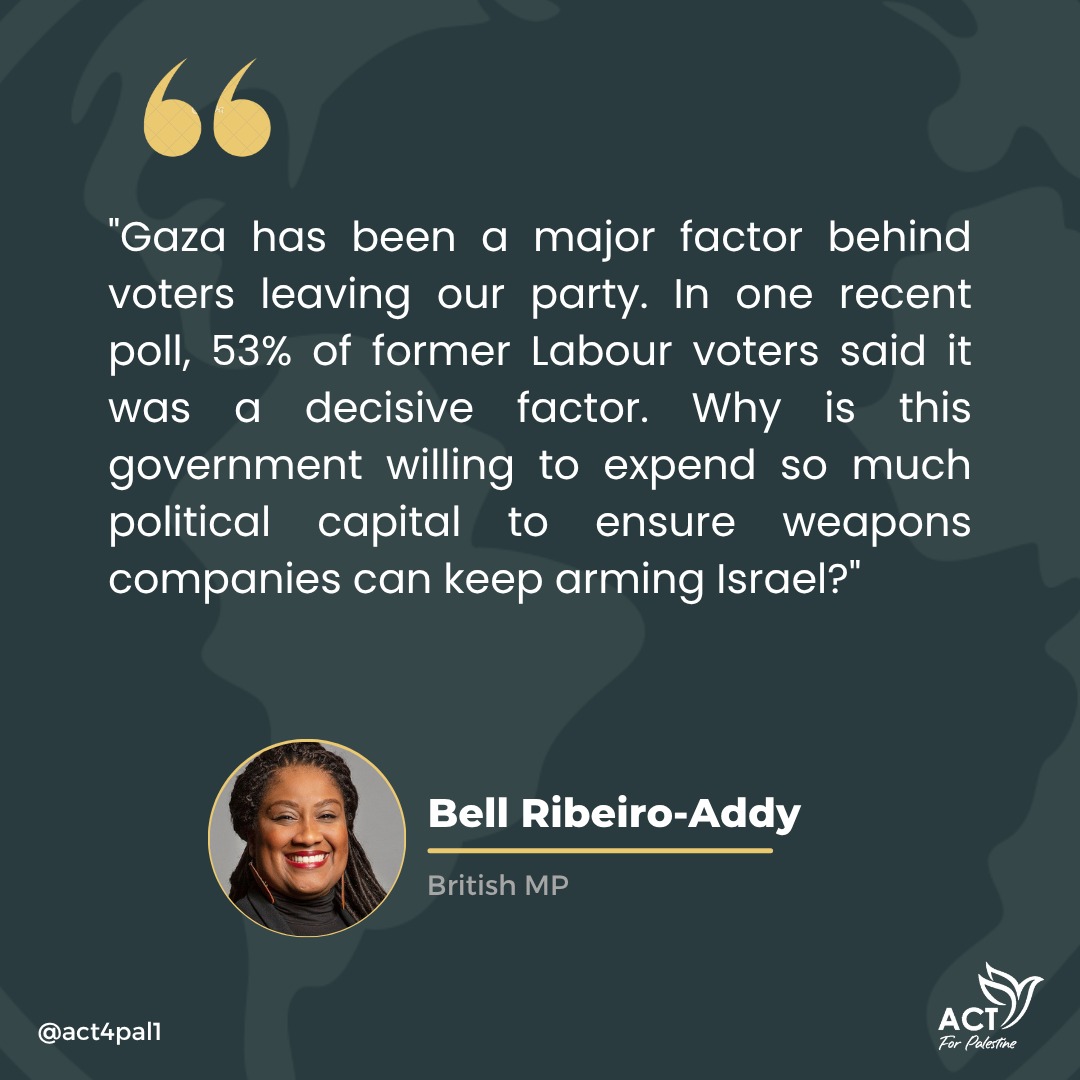
"Gaza has been a major factor behind voters leaving our party. In one recent poll, 53% of former Labour voters said it was a decisive factor. Why is this government willing to expend so much political capital to ensure weapons companies can keep arming Israel?"
@BellRibeiroAddy
6

Being too nice to your girlfriend/wife bores her. Why? Because, simply put, niceness, for women, is a monotonous experience. And routine is boring - or, more safely put, less stimulating.
Women may be delusional, but “if he won’t do it, another man will” is not a delusion; it’s a fact they can back up with their experience of the society. Women enjoy benevolence from everyone and everything capable of such - the men, the society, the system - except nature, apparently.
So women know what they’re saying when they say, “if he won’t do it, another man will.” Because, truly, a man will.
Offer a woman a kind gesture at 4 p.m. on a Monday, and you’re probably the fifth person, and most and most certainly the fourth man, doing something of that nature for her that day. Do the same for a man at the same time, same day, and you’re probably the first and only man to have done something of that nature for him that day - and possibly in the previous days.
The man appreciates the gesture more, not only because he understands what it takes to expend such effort, but also because of its rarity in his experience. The woman, on the other hand, may appreciate it but will never give it the same level of significance as the man. She gets it every day from almost anyone. Anyway.
Your niceness will not sustain the attraction


3
3
33
1,864

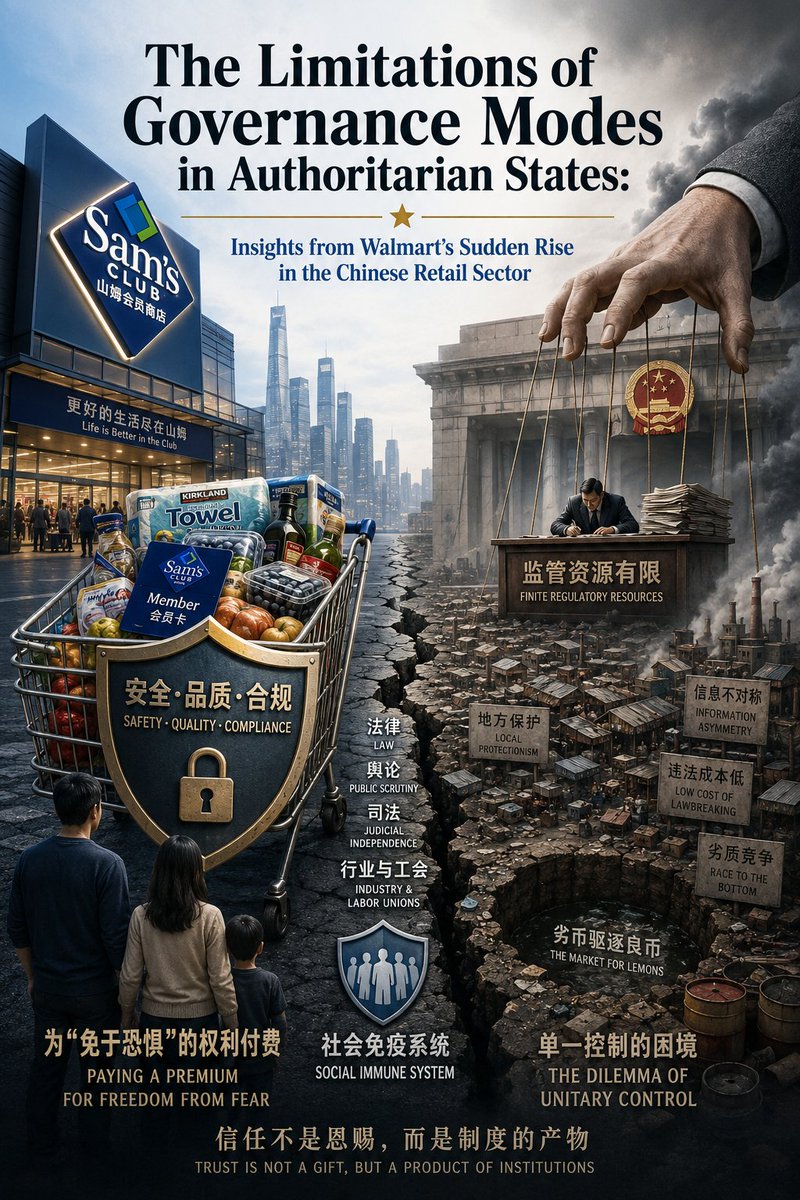
The Limitations of Governance Modes in Authoritarian States: Insights from Walmart’s Sudden Rise in the Chinese Retail Sector
Introduction: The Distorted "Middle-Class Ticket"
In recent years, as China’s traditional retail sector entered a harsh winter and domestic hypermarkets faced consecutive waves of closures, Walmart China—particularly its Sam’s Club subsidiary—defied the trend by achieving striking expansion and massive profitability. This phenomenon has catalyzed a bizarre spectacle within Chinese public discourse, where "whether one shops at Sam's Club" was briefly elevated to a class bellwether signaling entry into the standard middle class.
In Western contexts, however, Walmart and Sam’s Club have historically been known for bulk purchasing and cost-effectiveness, catering primarily to blue-collar workers and ordinary middle-class families rather than serving as markers of high-end luxury. This consumption alienation—reminiscent of the ancient Chinese adage, "the orange grows sweet south of the river but bitter to its north"—appears superficially to be a commercial miracle. In reality, it acts as a mirror, vividly reflecting the institutional limitations of an authoritarian state's governance mode when confronted with the complexities of a modern market.
I. The Premium for "Freedom from Fear": Cross-Border Compliance as a Dimensional Strike on a Desert of Domestic Trust
The success of Walmart China is built first and foremost upon a psychological trust among Chinese consumers toward "foreign enterprises" that borders on veneration. Yet this mentality is far from blind; rather, it represents a rational choice made by Chinese citizens via their wallets after enduring countless food safety crises.
Although Walmart operates within China, it maintains the rigorous internal oversight mechanisms inherent to Western multinational corporations. Due to the extraterritorial jurisdiction of foreign laws (such as the U.S. Foreign Corrupt Practices Act) and the punitive damages frameworks in mature markets that can easily bankrupt a non-compliant firm, foreign enterprises have over time developed a deeply entrenched "compliance culture."
Conversely, China’s domestic business environment has fallen into a classic "prisoner's dilemma." Within an atomized market of strangers, information asymmetry is acute. Constrained by local protectionism and negligible costs for lawbreaking, ethical merchants cannot secure a premium for high quality, only to be driven into a corner by the price wars of substandard products. Ultimately, to survive, businesses collectively choose to degrade quality, descending into a vicious cycle of mutual harm. Against this backdrop, what Walmart offers is by no means luxury, but rather a form of "the right to be free from fear"—Chinese consumers are willing to pay high annual membership fees simply to purchase the baseline security of "not having to expend mental energy discerning whether food is toxic or adulterated."
II. The Dilemma of "A Small Horse Pulling a Large Cart": The Natural Contradiction Between Unitary Control and Finite Bureaucratic Resources
Faced with pervasive food safety anxieties, Chinese government regulators have admitted with some regret that despite their relentless daily schedules, they simply lack the capacity to exercise comprehensive management and effective enforcement across a vast and ubiquitous commercial landscape.
Proportionally, China's civil service corps (excluding the massive apparatus of off-budget, auxiliary personnel) constitutes a smaller percentage of the total population than that of Western nations like the United States. More critically, owing to the lack of robust public scrutiny and poor internal management, the efficiency and enforcement precision of grassroots administrative personnel often prove inadequate when managing the highly fragmented fringes of the market.
This exposes the core vulnerability of centralized governance: the structural antithesis between the infinite liability of regulation and the finite nature of state resources. Under the logic of "unitary control," power is highly concentrated, and the government attempts to monopolize all oversight and regulatory functions across society. However, modern food supply chains span thousands of miles and feature hyper-atomized production networks filled with countless small workshops and independent farmers. Relying solely on the state as the singular gatekeeper to scramble downstream and launch frequent "special rectification campaigns" is a reactive strategy destined to lapse into a whack-a-mole dilemma—fixing one leak only to neglect another.
III. The Absence of a Social Immune System: The Deficit of Pluralistic Co-Governance and the Cost of Monopolized Power
By contrast, the reason Western nations exhibit far greater tranquility in food safety and market order is not merely due to more conscientious officials or superior testing technologies. It is because their societies possess a comprehensive "pluralistic co-governance system"—a social immune mechanism activated by society as a whole.
In the West, the maintenance of food safety relies on the counterbalancing and collaboration of four core pillars:
The Legal Baseline: Punitive damages and class-action lawsuit mechanisms empower individual consumers to challenge corporate titans, where a single case can bankrupt a non-compliant enterprise.
Public Scrutiny: Freedom of speech and investigative journalism by independent media act as omnipresent whistleblowers, where exposure equates to the social death of a corporate brand.
Judicial Independence: Equality before the law and the separation of powers ensure that law enforcement is not compromised by local protectionism or political interference.
Industry Autonomy: Specifically, the existence of genuine professional guilds and independent labor unions. Guilds eliminate the "black sheep" of an industry by establishing self-regulatory codes, thereby preventing race-to-the-bottom price wars. Concurrently, independent unions shield internal whistleblowers from corporate retaliation, allowing employees to report violations externally without fear of reprisal.
However, in a China where power has become increasingly monopolized over the past decade, any form of free civic association or autonomous social oversight has been strictly prohibited to preserve absolute social control. As industry associations degenerate into mere appendages of the state bureaucracy, and as labor unions lose their independent function to protect workers, society's capacity for "self-purification" and "self-defense" is thoroughly castrated. Deprived of the cushion and assistance of an intermediate social layer, consumers are reduced to atomized individuals ripe for exploitation, while the sole regulator—the government—must ultimately buckle under the weight of infinite accountability and an intractable crisis of trust.
Conclusion: An Institutional Fable Behind a Commercial Miracle
Walmart’s counter-trend windfalls in China serve as a profound political economy fable. It demonstrates that in a society devoid of the rule of law, free speech, and civic autonomy, trust mutates into a highly scarce luxury. While a centralized model may efficiently mobilize resources to construct high-speed rail or host Olympic Games, it struggles with the governance of a market where 1.4 billion people require three meals a day—a task demanding meticulous, high-frequency, and society-wide participation. In this arena, the "unitary control" of monopolized power can never substitute for the "social immune system" of pluralistic co-governance. So long as these institutional bottlenecks remain unbroken, Chinese consumers will have no choice but to continue paying a steep premium for this "foreign enterprise veneration."
25
dr. vee retweeted

something about anran being able to revive herself because she will expend all her energy to protect those she loves, and mercy being able to revive others but Not herself because she spends so much time looking after others that she has no room for herself…
1
1
16
263

The responses to @xwanyex only reveals liberals never learned their lesson from woke. The only way they engage in discourse is to expend their social capital to shut down taboo discourse that they don’t like. theres no deep no curiosity. no drive to defend your principles
1
13


Suddenly the harsh reality of war has finally hit the Elites in Moscow who have been supporting Putin's "Military Operation" in Ukraine
But NOW IT'S REALITY
Ukraine have degraded the Russian air defence systems by forcing them to expend expensive missiles on cheap decoys

Drone sanctions have reduced Russian refining capacity to 2005 levels.
With fuel shortages spreading across the country as prices spike, Russia is about to experience its worst ever fuel crisis.
And seasonal demand peaks in August and September, so the worst is yet to come.🔥
2

You mean buy a home without debt? I bough my home in Ireland in 3 years traveling a lot with a salary at 50k at the time. Of course I am debt but I am living in my own home instead of Sharing with 10 people. The problem is that people expend to much money in useless things.
86

For people who can't count: 5/40 = 0.125.
I.e. under assumption of 40-hour work week, you'd expend 12.5% of weekly quota in an average 5-hour sprint.
So it seems like it's well-calibrated and stupid fucktard just assumed he can run it 24/7.
174

@grok I think another point of contention Jabotinsky (see I can spell things right if I try) bought up was the indifference of the U.K. rulers to the issue. I'm guessing the last thing the brits wanted was to expend energy on some local dispute or other?
1
6

You're missing the point. Our "ally" took down part of their missile defense for "maintenance," forcing the U.S. to expend our own resources to protect them. The manipulation is just as much of an issue as the money.
May 21

If the US and Israel resume hostilities in the coming days, the U.S. military would likely expend an even greater share of interceptors because of a recent decision by the Israeli military to take some of its missile defense batteries offline for maintenance, per a US official
15
.@realDonaldTrump, Sir, YOU hold the key to the elimination of Hezbollah, not Israel, not Syria!
Iran is supposedly a defeated enemy.
Demand—publicly, immediately, and without apology—that Iran cease ALL support for its terrorist proxies, starting with Hezbollah. No phased withdrawals. No “later dates.” No diplomatic loopholes. Cut off the money, the weapons, the training, and the command structure today, or face total isolation and escalated consequences. This single demand must sit at the absolute top of any agreement. Anything less turns victory into weakness.
We should not be entering Friday’s signing with a polite wish list. America did not expend blood, treasure, and precision firepower for vague commitments. Our military delivered decisive dominance.
Now you must deliver decisive diplomacy.
Hezbollah survives only because Iran funds and directs it.
DON'T GIVE AWAY TREMENDOUS MILITARY ACCOMPLISHMENT ON THE POLITICAL FRONT.
#IranWar
@pdoocy @FoxNews @TreyYingst
@DanaPerino @BretBaier @WillCainShow @Varneyco @dagenmcdowell

UNBELIEVABLE!
Trump: 'Israel should let Syria take care of Hezbollah, they'd do a better job'
.@FoxNews @FoxandFriends @DanaPerino @WillCainShow @pdoocy @kilmeade
israelnationalnews.com/flash… via @ArutzSheva_En
30
@realDonaldTrump, Sir, YOU hold the key to the elimination of Hezbollah, not Israel, not Syria!
Iran is supposedly a defeated enemy.
Demand—publicly, immediately, and without apology—that Iran cease ALL support for its terrorist proxies, starting with Hezbollah. No phased withdrawals. No “later dates.” No diplomatic loopholes. Cut off the money, the weapons, the training, and the command structure today, or face total isolation and escalated consequences. This single demand must sit at the absolute top of any agreement. Anything less turns victory into weakness.
We should not be entering Friday’s signing with a polite wish list. America did not expend blood, treasure, and precision firepower for vague commitments. Our military delivered decisive dominance.
Now you must deliver decisive diplomacy.
Hezbollah survives only because Iran funds and directs it.
DON'T GIVE AWAY TREMENDOUS MILITARY ACCOMPLISHMENT ON THE POLITICAL FRONT.
#IranWar @pdoocy @FoxNews @TreyYingst
@DanaPerino @BretBaier @WillCainShow @Varneyco @dagenmcdowell #markets #Bloomberg
That@sFox @marthamaccallum @
UNBELIEVABLE!
Trump: 'Israel should let Syria take care of Hezbollah, they'd do a better job'
.@FoxNews @FoxandFriends @DanaPerino @WillCainShow @pdoocy @kilmeade
israelnationalnews.com/flash… via @ArutzSheva_En
12

Okay. That still doesn't mean fdr didnt do the great new deal, hoover didnt expend the federal govt and the fed didnt expand the money supply that caused the US great depression.
2

These revelers from Great Britain need to expend that energy to eradicate their muslim, hindu, sikh and illegal immigration invasion problems.
All of which is aided and abetted by Labour, the two-tier policing and justice systems, or they will no longer have a nation to return.
1
5