Blackchild🌚🖤 retweeted

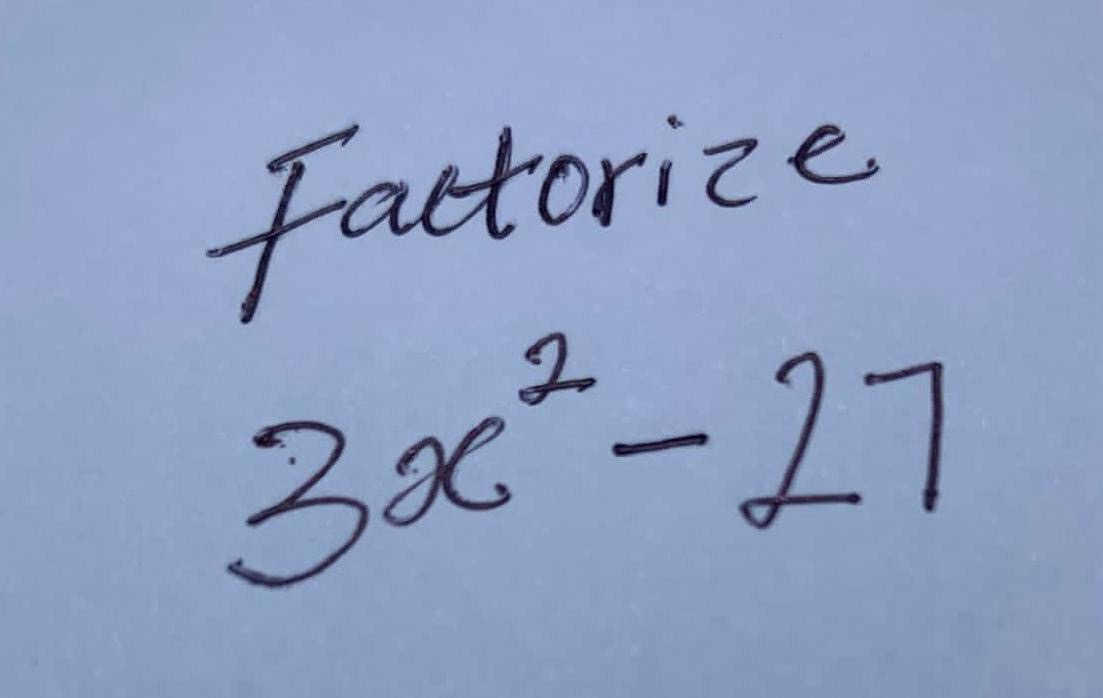
I'm a math teacher. Let me teach you how to factorize😂




1
2
59


Jun 13
That wasn't the point.
The point is 4=2x2. You can't factorize 4 any other way using only primes.
If 1 were a prime, you could do 4=2x2=2x2x1=2x2x1x1 and so on. It wouldn't be unique anymore
4
214

Lets factorize in primes and get an infinite loop of 1s
2
446


Jun 11
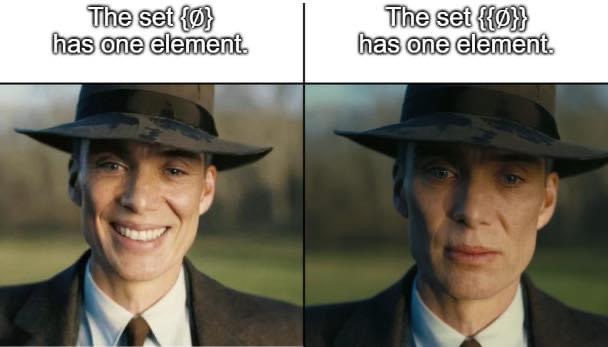
Beetween the two parenthesis, you need a in the 5th line or you cannot factorize an already factorisation
10

Jun 10
If you factorize the second set by its curly brackets, you will get the first set
Jun 10

1
117


Worst Case Scenario=WCS
Best Case Scenario =BCS
'Making it' is Constant ( K).
Factorize the above equation
Collecting like terms= WCS X BCS
W B= K ( Constant).
22

Jun 10
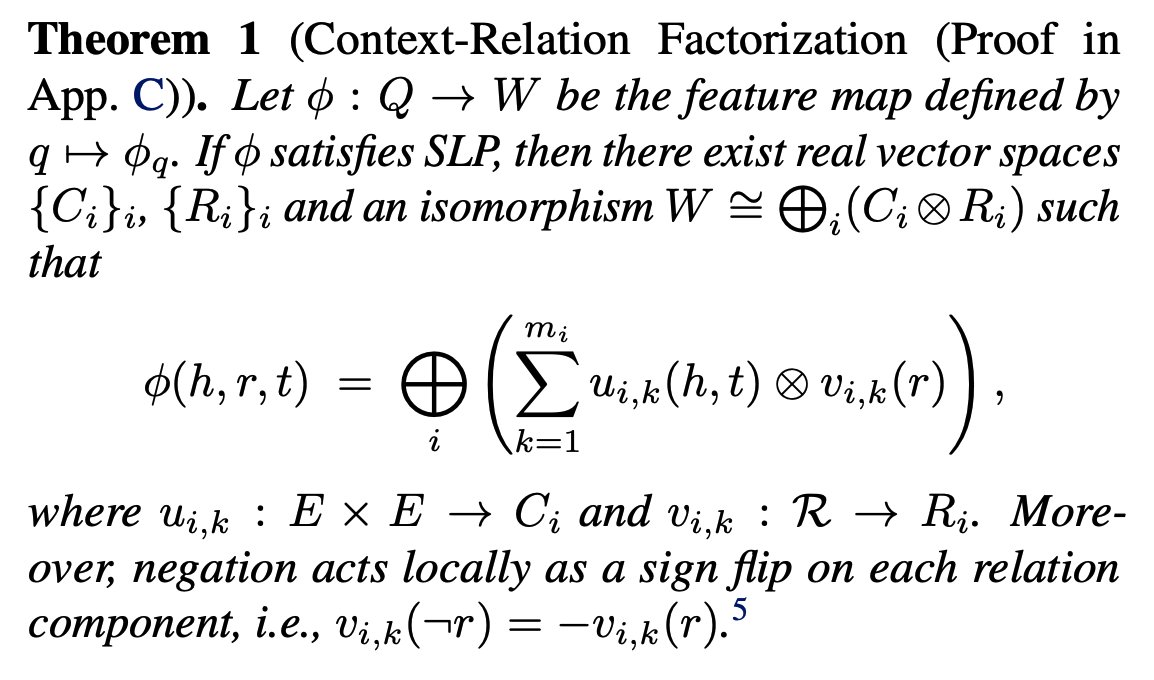
Using relation algebra and representation theory, we show that negation equivariance forces gradient features to factorize via tensor product.
This echoes Smolensky's tensor-product binding (1990), but as a necessity under first-order update dynamics.
(5/11)
1
5
215

Jun 10
He tried to factorize the history, like they factorize sets in mathematics.
35

imo 5
because if you factorize
b b*b
you have
b*(b 1)
the multiplication of a number with his successor give 30 ?
We can try 3*4 =12
it's not enough
We can try 4 *5 =20
it's not enough
We can try 5*6=30
and it's ok
the solution is b=5
11

That black thing sitting there takes multiple profiles & is not me nor my thoughts. It is more like a computerized Psycopath that a hacker took years to factorize.

than El Chopo not even when other men come into the picture.
El Chopo & his son's are to big to step up higher than their names when children were birthed & marriage already.
39

Jun 2
Got 5. How?
{sqrt(64) sqrt [sqrt (16)]} / sqrt(4) =>
Solving the nested sqrts --
{(sqrt(64) sqrt(4)}/sqrt(4) =>
if sqrt(64) is the same as sqrt(16 x 4), then we can
factorize the numerator, i.e:
sqrt(4){sqrt (16) 1)} / (sqrt(4) =>
If you simplify by eliminating sqrt(4) from both the numerator and the denominator, then we have:
sqrt(16) 1 or 4 1 = 5. Anybody else, explain theirs.
3
8
466

Jun 1
Slideshows are the king of the content for app promotion on TikTok. They are easy af to create and engage better with users than videos. This makes them super easy to automate and stitch to posting services.
-Copy competitor’s formats
-Factorize them
-Repeat ad infinitum

8
4
112
19,635

May 31
Over a weekend, an OpenAI model solved a mathematical problem that had defeated mathematicians for 80 years.
The Unit Distance Problem
Erdős asked this in 1946: Scatter a bunch of points on a piece of paper. How many pairs of those points can sit exactly 1 unit apart?
Say you draw 4 points as a square with side length 1 — you get 4 pairs at unit distance. But what if you rearranged them differently? Could you get more?
What's the theoretical maximum?
What scientists believed for 80 years that the square grid — points arranged like the intersections on graph paper — was the optimal configuration.
An internal OpenAI model solved this ancient problem by connecting it to a completely different field — algebraic number theory, which studies how numbers factorize in extended mathematical systems.
From that unexpected angle, it constructed an infinite family of point arrangements that genuinely outperform the square grid by a measurable margin.
The proof the AI produced was completely valid, then human mathematicians stepped in and refined it further.
AI saw a connection between two fields in mathematics that nobody had linked before. And sometimes, that's exactly what science needs.
Find more about this here:
openai.com/index/model-dispr…
2
57

This is essentially because Q-functions do not factorize in high-dimensions, and the world's structure is very non-stationary. Changes to the structure of a Factored MDP will break its solution in unpredictable ways without analytic prescriptions for how to fix it.
1
6
311