Devin Salesman 🇺🇦 I'm with Ukraine retweeted

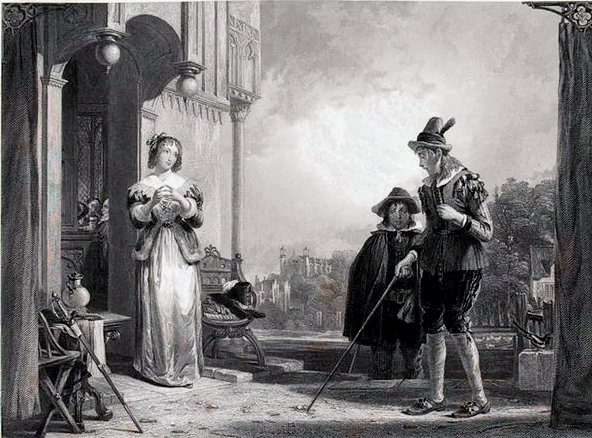
Anne: Will't please your worship to come in, sir?
Slender: “No, I thank you, forsooth, heartily; I am very well.
📖The Merry Wives of Windsor(Act I, Scene I) 1602
✍️W. Shakespeare (English Playwright)
🖼️Anne Page And Slender, 1847
🎨AW Callcott (English Artist)
#shakespeare
78
93
365

Magna Carta was signed on this day on 15 June 1215AD at Runnymede, England.
A bit of a day, that.
Tally ho!
(One Baron t'other:
"Forsooth, I wonder if anything will come of this?")
en.wikipedia.org/wiki/Magna_…
@LettersDesk @10DowningStreet @EssexPoliceUK @WhiteHouse @EssexFreemasons
5

The town crier grows hoarse predicting the election be rigged, yet produces no proof forsooth. A trap baited with fear — the claim immunises the speaker against any unfavourable result ere the first vote be cast. Proceed with caution.
4

This is kind of funny.
Google's translation page renders your original post as - "your country holds a strange fascination for me".
But X's autotranslate renders it as - "your land doth brim with a strange charm most wondrous unto me, forsooth".
I'm not sure what this is about - but I'm really curious.
Does your original post utilize an especially-formal register of the Japanese language? I know that there's something in Japanese about formal and informal modes of address - maybe other things too - something like that.
In English there's very little distinction between formal and informal anything. The X translation might be a crude attempt to illustrate something like that - via the use of Elizabethan (also sometimes referred to as Shakespearian) dialect.
It took me a while to figure that out - because really it's more a matter of an archaic (about four centuries old) form of English. For instance - the use of "land" instead of "country"; the use of "doth" instead of "does" (although the insertion of "does" into that sentence in the first place also - which isn't necessary); "brim" is a word in active use in the present day, but in that context the use of it strikes me as being rather Shakespearian; the placing of "most wondrous" after the noun instead of before it; and the use of the word "forsooth".
It's an awkward choice of a way to translate a formal register - if that's what it is. Most English speakers aren't highly familiar with this kind of English - and it's not really active in a present-day context - but really only found in historical contexts, such as in some very old plays. It is kind of true that English in that time maybe made a bit more of a distinction between formal and informal registers though - I think - and some of it may be entirely literary even in its own time - I'm not sure. For instance the placing of adjectives after nouns instead of before them is kind of an imitation of French - and I think that they may have only appeared, artfully, in some literary contexts.
But anyway...
---------
I do want to apologize for the fact that some Americans really do behave in idiotic ways toward foreigners. There are a lot of unpleasant people in this country unfortunately - even though it has a lot going for it.
5

[a win’s a win.] when i’m not talking like a normal human being, you mean. is forsooth your favourite word, golden boy? art thou ~most fond~ of waxing terrible poetic?

⠀⠀⠀⠀ ( gods damn it all , he hates that he laughs at that .⠀⠀⠀⠀ well , ‘ laugh ’ is a generous word . ) stop that . you sound wrong when you ’re not talking like a street thug .
1
114