
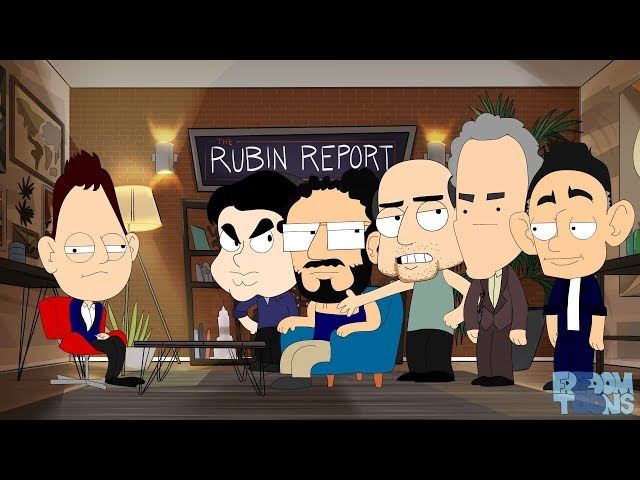
They look like freedomtoons characters that escaped containment. They're about to epicly own a strawman red haired SJW 2017 style.
2
685


I will enjoy watching this show fail spectacular or fall into the same niche as freedomtoons
204

Is The Simpsons Monopoly Go! campaign done by FreedomToons or am I just connecting style and sound dots...?
11

The gimmick of the show seems to just be that the self insert trio have a Freedomtoons design looking landlord with monkey ears & a tail, hence "Chimptopia"
Looking thru the KS and account I honestly sympathize with their situation, but the decisions made thus far are baffling
5
132

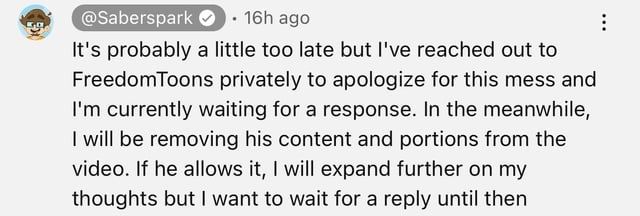

That comments sounds like it was inspired by a recent Freedomtoons cartoon?
5

>posting freedomtoons as a "le epic pwn"
Thanks for confirming how room temp iq you are
1
66

Jun 4
I can tell by the fact you use a freedomtoons quote ti make yoyr argument that you're retarded.
18

Any proof someone was convicted unjustly?
Also for the depiction of jan 6th they were depicting the smoke in the air you can see if you look up photos. Ill post it here. Another L for freedomtoons (somehow free yet not free to speak your own mind)

6
1
5
1,103

Jun 1
Dave's the last one I'm willing to allow, may be repeating the talking points because he actually believes them. His whole career has just been moving from one group to the next, taking on new truths as if each time he's finally found the holy grail.
See freedomtoons...
1
3
299

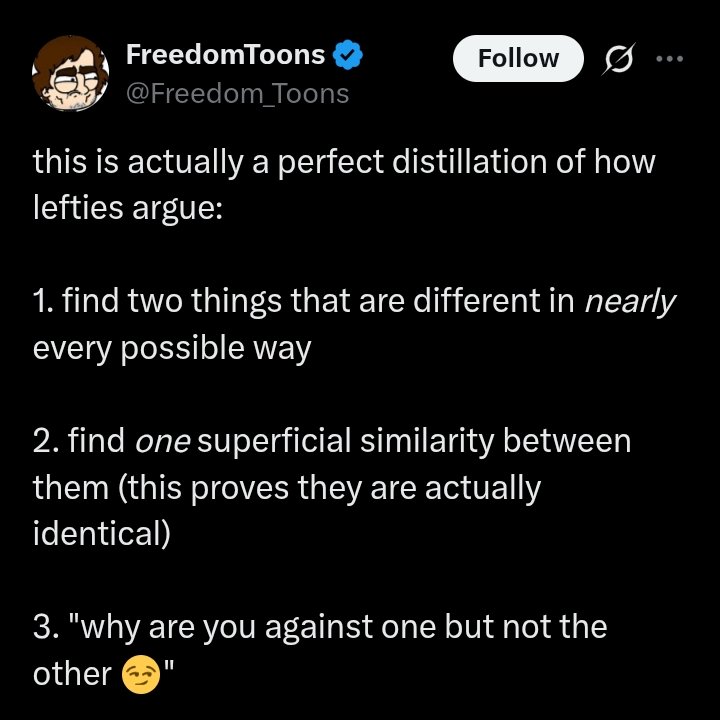

Freedomtoons new anthology. The episode on YouTube is good
1
13


Dude, you follow freaking FreedomToons and a 01/06 coup participant.
3
85

FreedomToons is political, true.
But his latest project Twisted Plots isn't any more political than the #1 trending show on Amazon Prime or Disney Plus 🤷.
1
187

Just so you know, it's a lie.
It's not because of how Christians or religious people act. It's not the establishment of traditional religions - and, in fact, the complete absence of such would be a massive point of contention against any sort of higher power, as their creation doesn't seem to inherently acknowledge them, as one would more expect.
The reality is that every single person inherently knows there is a god, there is right and wrong, and much of what this entails. It can get a bit muddled when getting into hyper specific nuances, but the necessity of morality to judge people demands that they have a moral agency to be judged. You don't judge a rock for rolling down a hill because it never had any other choice, it is merely acted upon. And free will itself is not sufficient, because an uninformed decision is not really a decision. Everyone must have a moral compass, and the ability to ignore it.
There is a decentralized effort to deny God precisely because a lack of free will means any of your failings were not your own, but a mere eventuality of What you are. All the excuses are just attempts to justify it, like saying religious people are hypocritical or religions are old fashioned - After all, why would hypocrisy be "wrong" if any religion establishing what is "wrong" is false? Why would you not expect an all powerful God to have the dedication of the oldest human institutions?
By pure happenstance, the first publicly released episode of Twisted Plots by FreedomToons actually broaches this subject of morality and free will, and the specific impulse by scientists and others to actively deny it. I highly recommend it, absolute cinema.
youtube.com/watch?v=wVgZ1stN…
May 28

If the idea of an intelligent, transcendent creator wasn't tied to any religion, I'm certain most scientists would accept it as the most plausible explanation for why the universe exists and why it appears so designed and finely-tuned for life.
Many scientists are put off the idea of a creator by traditional religion (or maybe more accurately, by religious people). Others (a small minority) hate the idea of anything existing that's more intelligent than they are.
I'm not saying we should get rid of religion so that scientists will believe in God. I'm explaining that the objection to the mere idea of God – an intelligent, transcendent creator – mostly isn't based on logic or lack of evidence, it's rooted in rejection of religion.
A recent conversation with an atheist biologist supports this. He was raised Catholic, and his objections to God stemmed entirely from his objection to miracles and Catholic doctrines, which he rejected as a teen. He didn't have any logical objections to God, himself, but to religious claims. To him, God was so inextricably tied to those claims that God got thrown out along with them.
So, why don't scientists just acknowledge a deistic sort of God while rejecting religion?
I wonder about this a lot.
As near as I can tell, some of them dislike religion and religious people so much they'll jettison the truth over it. I recall the biology grad student I talked with decades ago who agreed that developments in biology supported design, but said he and his colleagues were hesitant to publicly acknowledge it, because it would support Christians.
*sigh*
What a mess.
It's complicated, y'all. If you're Christian, keep this in mind when you have conversations with science-minded atheists.
And here's something most of us don't want to hear: The way we conduct ourselves may be the only Gospel some people ever receive – and that includes our children. They "hear" how we behave far more than what we say.
2
2
2,523


Wha? Nah you didn't. I was saying what Freedomtoons does is why it's popular and not like traditional political channels.
1
1
30