
Jun 9
Join @GenIncode (AIM: #GENI) Full year results briefing TOMORROW at 11am BST via @InvestorMeetCo
⬇️Click below to register
investormeetcompany.com/geni…
28
STan SLam retweeted

Full list of stocks reporting next week in the UK.
Monday:
Kefi Gold - KEFI
Genincode - GENI
Tuesday:
Bellway - BWY
Lbg Media - LBG
Vianet Group - VNET
Oxford Instruments - OXIG
Molten Ventures - GROW
Wednesday:
Wh Smith - SMWH
TwentyFour Income Fund Ltd - TFIF
Frontier Dev - FDEV
H-Power - HPOW
Workspace - WKP
VP Plc - VP.
Pennon - PNN
Motorpoint - MOTR
Fuller Smith & Turner - FSTA
Thursday:
Ncc - NCC
Safestore - SAFE
Crest Nicholson - CRST
Wizz Air - WIZZ
Paypoint - PAY
Norcros - NXR
Halma - HLMA
Friday:
No Companies Reporting
Did I miss any ?
2
14
1,199
Jun 8
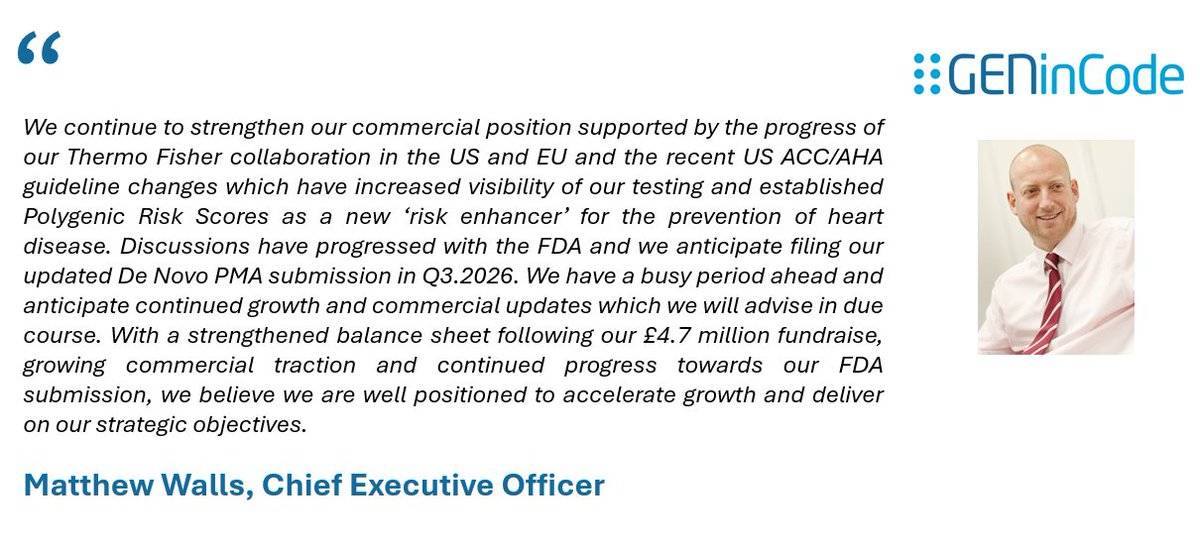
➡️@GenIncode #GENI - Final results
✅Well positioned for accelerated commercial scale up
📈 Revenues 14% y-o-y to £3.1m
🤝 Thermo Fisher collaboration agreement to manufacture, distribute & sell CARDIO inCode
⬆️ Increasing US commercial sales of LIPID inCode and CARDIO inCode
1
140

[REUTERS] Genincode Reports FY2025 Revenue Increases 14% To £3.1 Million
8


Jun 6
UK Trading Updates
Mon-GENinCode
Tues-Bellway-LBG Media-Molten Ventures-Oxford Instruments
Weds-Fuller, Smith & Turner-H-Power-Motorpoint-Pennon-Twentyfour Select Monthly Income Fund-WH Smith-Workspace-Vianet-Vp
Thurs-PayPoint-Halma-NCC-Norcros-Safestore-Wizz Air Holdings
3
165

Today's biggest share price movers on AIM at the close via @MonkComms
Marechale Capital 66% #MAC
Genincode 19% #GENI
Boohoo 16% #DEBS
Mothercare -50% #MTC
Wellnex Life -18% #WNX
thearmchairtrader.com/aim-ma…
1
3
292

Apr 14
High-risk ovarian cancer surveillance vs surgery: insights into ROCA testing hospitalhealthcare.com/clini…
#Oncology #ROCA @GenIncode #Geni #Genig #Genincode @NHS @uclh
2
91
#GENI $GENI Analysts maintain a Strong Buy consensus for @GenIncode (GENI.L) as of February 2026, with 12-month price targets ranging from 7.50p to 11.50p. These targets represent a significant potential upside of over 500% from recent trading levels near 1.15p.
The positive outlook is primarily driven by the company's progress toward U.S. FDA De Novo classification for its CARDIO inCode-Score test, with final data submission expected in Q1 2026
Analyst Price Targets & Ratings
Based on current analyst coverage as of February 2026:
Consensus Rating: Strong Buy.
Average Price Target: 7.50p.
High Price Target: 11.50p.
Low Price Target: 7.50p.
Implied Upside: Approximately 535% to 614% based on a share price of ~1.15p.
Strategic Partnerships: The company is in active discussions with major distributors for test distribution in both the U.S. and EU, which could significantly accelerate commercial scaling once approved.
U.S. Regulatory Catalyst: #Genincode is addressing FDA "deficiencies" for its CARDIO inCode-Score test. A successful Q1 2026 data submission could unlock a U.S. market estimated at $10.5 billion.

1
5
431

Feb 19
@GenIncode Plc (#LSE: #GENI) currently has a consensus 12-month target price of 7.50p.
Based on the most recent analyst data from February 2026:
Average Target Price: 7.50p.
High Estimate: 11.50p.
Low Estimate: 7.50p.
Implied Upside: This target represents a potential increase of approximately 597% to 614% from the recent trading price of ~1.08p.
Key Performance Drivers
FDA Approval Progress: The company is currently addressing "deficiencies" in its De Novo application for the CARDIO inCode-Score test, with a final data submission expected in Q1 2026.
US Market Access: National marketing in the US as a medical device "kit" could unlock an estimated $10.5 billion addressable market.
Recent Funding: As of 6 February 2026, GENinCode raised £4.7 million to extend its cash runway and support the ongoing FDA process.
Regulatory Sensitivity: The stock has shown high sensitivity to regulatory news, previously jumping 32% in a single day following New York State Department of Health approval in late 2025.
1
2
3
168
Feb 17
#GENI $GENI
@GenIncode
(AIM: GENI) has experienced a volatile trading period in recent months, with the share price moving from 1.55 pence in mid-September to a peak of 4.45 pence in late October before retracing to 2.60 pence and stabilising near 1.2 pence at the time of writing.
The rise was driven primarily by renewed market confidence following an update confirming progress in the FDA Supervisory Review of CARDIO inCode-Score, where the company clarified that outstanding issues had been reduced and a clear path forward had been agreed for additional submissions.
Investor optimism was further supported by a statement addressing the share price movement, which highlighted continued commercial momentum in core markets, although it also made the market clear that the company was unaware of any specific recent for the recent share price rise.
The subsequent decline reflected profit taking and conservative sentiment ahead of year end, particularly given delays in FDA approval and slower revenue recognition in the NHS.
Despite this volatility, GENinCode remains positioned at the intersection of preventive cardiovascular genetics and expanding clinical demand.
The company has reported meaningful operational progress across the first half of 2025, supported by strengthening revenues and expanding international adoption.
According to its half year results, income rose 15 percent year on year to £1.6 million, driven by the growth of LIPID inCode and CARDIO inCode-Score in the United States, United Kingdom and Europe. More than forty US clinics now use the platform for coronary heart disease risk assessment, reflecting rising clinical interest in polygenic testing.
Ongoing discussions with commercial partners aim to widen distribution once regulatory clearance for CARDIO inCode-Score is achieved.
These developments indicate that revenue diversification is beginning to take shape across several major healthcare systems.
Clinical and regulatory progress has remained central to the company’s strategy, particularly in advancing its polygenic risk technologies.
The FDA process surrounding CARDIO inCode-Score continues to evolve after the earlier assessment, with GENinCode reporting that remaining data requirements are well defined and expected to be addressed through a new submission in early 2026.
Commercial and academic validation is also increasing, supported by a landmark study published in JACC Advances showing improved risk stratification through genetic scoring.
Meanwhile, the ROCA ovarian cancer surveillance test has begun NHS deployment under a partnership with UCLH and the North Central London Cancer Alliance, creating a new clinical avenue for the company. Across Europe, sales of LIPID inCode and THROMBO inCode continue to expand in Spain, Italy and Germany.
The commercial outlook has strengthened further with new state approvals in the United States, including authorisation for CARDIO inCode-Score in New York State, one of the country’s most stringent regulatory environments.
GENinCode has also entered a collaboration with Thermo Fisher to support broader adoption of its test portfolio, a development that could materially accelerate US growth.
While NHS restructuring has delayed expansion in certain regions, the company continues to deliver on targets in Spain and Germany and is scaling its pilot programmes across Catalonia and Extremadura.
With cardiovascular disease remaining the world’s leading cause of mortality, the demand for predictive genetic tools is expected to rise.
GENinCode now enters 2026 with improved scientific validation, expanding international sales channels and a regulatory pathway that, once completed, may unlock the company’s most significant commercial opportunity to date.

2
2
6
709
Feb 16
5-year, 7-figure collaboration for @GenIncode
Based on recent chatter on investor forums (as of February 16, 2026), there are reports of a potential 5-year, 7-figure collaboration for #GENinCode Plc (#GENI) expected to be announced, with some sources indicating a joint venture (JV) involving a major Spanish genetics company linked to a 'Sergio Olivero'.
Company Involved: GENinCode Plc (#AIM: $GENI), an Oxford-based company focusing on cardiovascular disease (CVD) predictive genetics.
The Rumor: Social media posts on platforms like X, Reddit, and Telegram suggest a 7-figure [p/a], 5-year collaboration is slated for announcement, possibly next week.
Key Individuals/Entities: The collaboration is reportedly a joint venture with a major Spanish genetics firm that has connections to someone called "Sergio Olivero".

1
21
23
337
Feb 10
#geni $GENI @GenIncode (AIM: GENI) has experienced a volatile trading period in recent months, with the share price moving from 1.55 pence in mid-September to a peak of 4.45 pence in late October before retracing to 2.60 pence and stabilising near 1.15 pence at the time of writing. The rise was driven primarily by renewed market confidence following an update confirming progress in the FDA Supervisory Review of CARDIO inCode-Score, where the company clarified that outstanding issues had been reduced and a clear path forward had been agreed for additional submissions. Investor optimism was further supported by a statement addressing the share price movement, which highlighted continued commercial momentum in core markets, although it also made the market clear that the company was unaware of any specific recent for the recent share price rise. The subsequent decline reflected profit taking and conservative sentiment ahead of year end, particularly given delays in FDA approval and slower revenue recognition in the NHS. Despite this volatility, GENinCode remains positioned at the intersection of preventive cardiovascular genetics and expanding clinical demand.
The company has reported meaningful operational progress across the first half of 2025, supported by strengthening revenues and expanding international adoption. According to its half year results, income rose 15 percent year on year to £1.6 million, driven by the growth of LIPID inCode and CARDIO inCode-Score in the United States, United Kingdom and Europe. More than forty US clinics now use the platform for coronary heart disease risk assessment, reflecting rising clinical interest in polygenic testing. Ongoing discussions with commercial partners aim to widen distribution once regulatory clearance for CARDIO inCode-Score is achieved. These developments indicate that revenue diversification is beginning to take shape across several major healthcare systems.
Clinical and regulatory progress has remained central to the company’s strategy, particularly in advancing its polygenic risk technologies. The FDA process surrounding CARDIO inCode-Score continues to evolve after the earlier assessment, with GENinCode reporting that remaining data requirements are well defined and expected to be addressed through a new submission in early 2026. Commercial and academic validation is also increasing, supported by a landmark study published in JACC Advances showing improved risk stratification through genetic scoring. Meanwhile, the ROCA ovarian cancer surveillance test has begun NHS deployment under a partnership with UCLH and the North Central London Cancer Alliance, creating a new clinical avenue for the company. Across Europe, sales of LIPID inCode and THROMBO inCode continue to expand in Spain, Italy and Germany.
The commercial outlook has strengthened further with new state approvals in the United States, including authorisation for CARDIO inCode-Score in New York State, one of the country’s most stringent regulatory environments. GENinCode has also entered a collaboration with Thermo Fisher to support broader adoption of its test portfolio, a development that could materially accelerate US growth. While NHS restructuring has delayed expansion in certain regions, the company continues to deliver on targets in Spain and Germany and is scaling its pilot programmes across Catalonia and Extremadura. With cardiovascular disease remaining the world’s leading cause of mortality, the demand for predictive genetic tools is expected to rise. GENinCode now enters 2026 with improved scientific validation, expanding international sales channels and a regulatory pathway that, once completed, may unlock the company’s most significant commercial opportunity to date.

54
56
621
Bulletin Board Heroes: February 3
Zak Mir takes a charting look at FTSE 100, Dax, Dow, Bitcoin, Gold, Avacta, Chesterfield, Cyanconnode, Fulcrum Metals, Genincode, Hardide, IMC, Shearwater, Strategic Minerals, Ovoca Bio/Talisman Metals, Tungsten West. - Zaks Traders Cafe zakstraderscafe.com/bulletin… #FTSE100 #DAX #DOW #BTC #ETH #Gold #AVCT #CSC #CYAN #FMET #GENI #HDD #IMC #SWG #SML #TLM #TUN
5
8
2,088

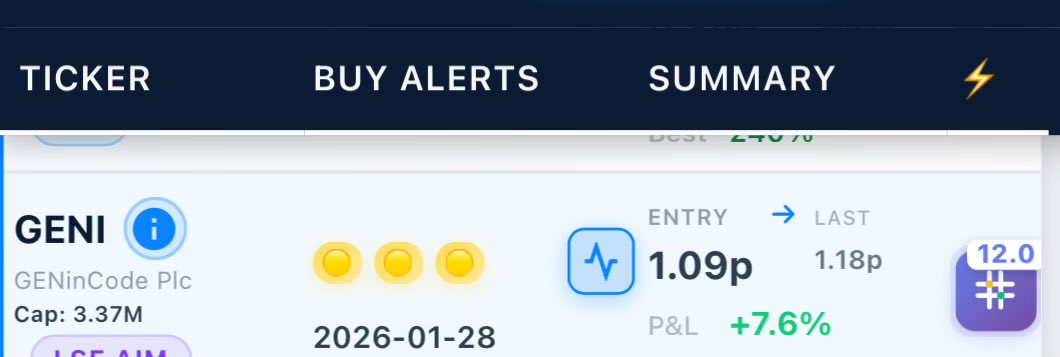
$GENI (GENinCode)
Still early. Still watching.
Healthcare is starting to heat up as rotation from metals begins.
Quiet price action, early structure forming.
No hype. No rush.
Just tracking.
#GENI #AIM #LSE #Healthcare #SmallCaps
1
2
397
Another day of gains on the AIM All Share as geopolitical tensions ease – for now anyway – and US economic data keeps doves on watch at the Federal Reserve. At the bell, the index was up eight and half points at 817.15.
#EUA Eurasia Mining 33%
#KITW Kitwave 33%
#SMI Strategic Minerals 17%
#GENI Genincode -45%
#LND Landore Resources -32%
thearmchairtrader.com/aim-ma…
2
591


4 Dec 2025
Bulletin Board Heroes: December 4
Zak Mir takes a charting look at FTSE 100, Dax, Dow, Bitcoin, Ethereum, Gold, Eco, Fragrant, Genincode, GS Chain, Hot Rocks, Hamak, Mirriad, Medpal, Shearwater, Sulnox, Tap, Westmount, Zenith. - Zaks Traders Cafe zakstraderscafe.com/bulletin… #FTSE100 #DAX #DOW #BTC #ETH #Gold #ECO #FPP #GENI #GSC #HRIP #HAMA #MIRI #MPAL #SWG #SNOX #TAP #WTE #ZEN
1
3
11
802