
 ຸ
ຸ

19s
Well, I’m glad my son will have graduated undergrad before they continue to make this a race to the bottom.




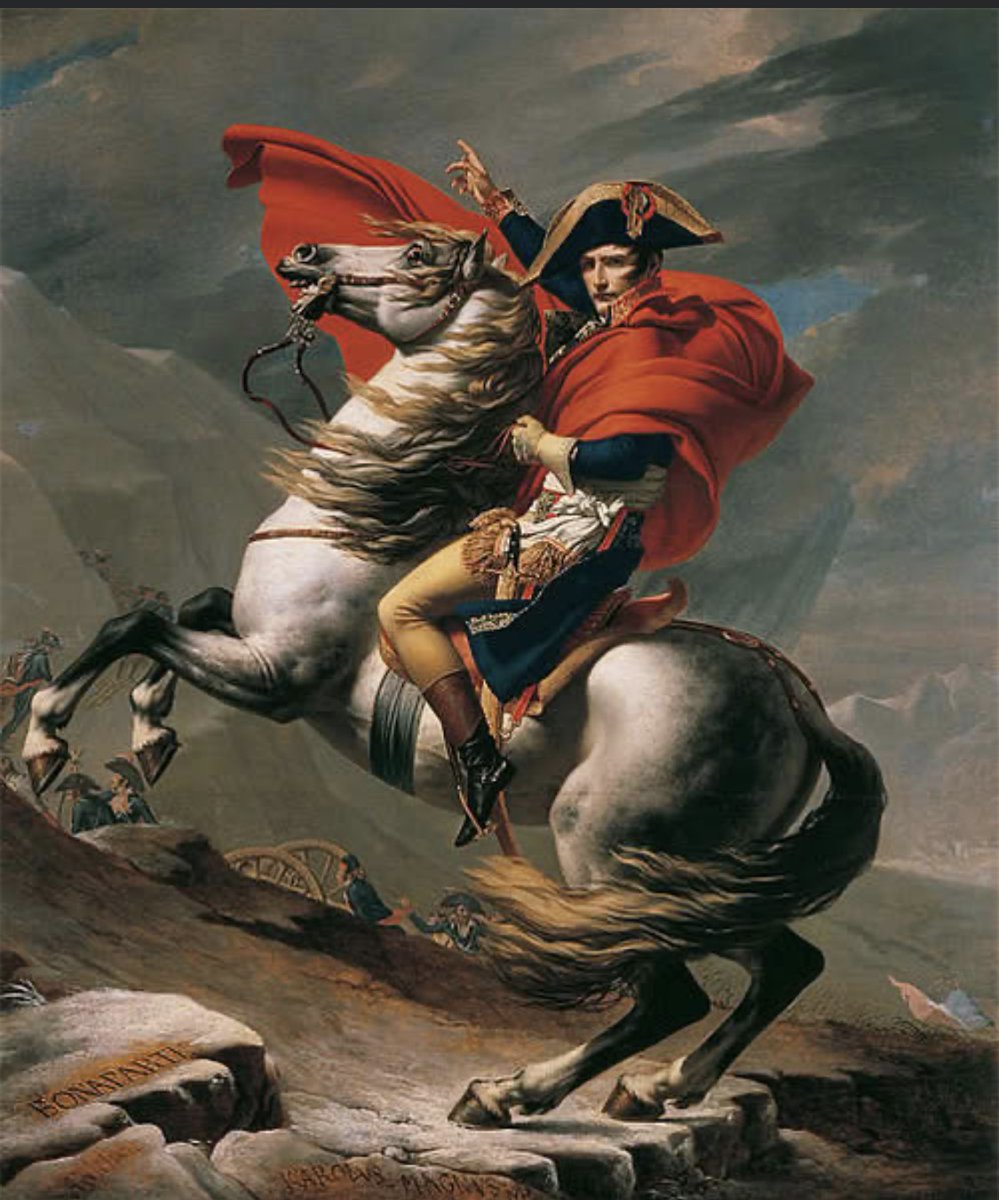
Napoleon Bonaparte (1769–1821) was a brilliant French military general and statesman who rose to prominence during the French Revolution and ultimately crowned himself the first Emperor of France. Widely considered one of the greatest military commanders in history, he fought in over 60 battles, losing only seven, and fundamentally restructured European politics, law, and education. His legal framework, the Napoleonic Code, remains the structural foundation of civil law systems across the globe today.
Rise to Power Corsican Origins: Born in Ajaccio, Corsica, shortly after the island came under French control. Military Education: Graduated as an artillery officer from the prestigious École Militaire in Paris. Revolutionary Breakthrough: Gained national fame by successfully recapturing the city of Toulon from British forces in 1793.The 1799 Coup: Overthrew the French Directory government to establish the French Consulate, naming himself First Consul.Coronation: Formally crowned himself Emperor Napoleon I in a grand ceremony in 1804.
Major Achievements and Reforms: The Napoleonic Code: Unified French civil law, abolishing feudal privileges and establishing religious freedom.Institutional Modernization: Overhauled the French educational framework, centralized the financial system, and built lasting infrastructure. Military Innovation: Pioneered the independent "corps" system, vastly improving army speed, flexibility, and communication on the battlefield. European Dominance: Defeated multiple powerful coalitions, securing legendary victories like the Battle of Austerlitz in 1805.
Downfall and Exile. Invasion of Russia: Launched a catastrophic invasion in 1812, where brutal winter conditions decimated his 600,000-strong Grande Armée.First Exile: Abdicated the throne in 1814 after allied European coalitions captured Paris; he was sent to the Mediterranean island of Elba. The Hundred Days: Escaped Elba in 1815, marched back to Paris, and successfully rallied an army to briefly reclaim his crown. Battle of Waterloo: Suffered his final, definitive military defeat on June 18, 1815, against British and Prussian forces. Death on St. Helena: Banished to the remote South Atlantic island of Saint Helena, where he died in exile in 1821.
Common Myth: Was He Short? Despite the enduring cultural myth of the "Napoleon Complex," he was not short for his era. He stood roughly 5 feet 7 inches (1.68 meters) tall, which was actually slightly above the average height of a 19th-century French man. The misconception arose from differences between French and British measuring units, compounded by relentless British wartime caricature prints. 🇫🇷
3
Melissa retweeted

Jun 13
💙💛 Fellas, can I get some good wishes for a kid from Ukraine who just graduated high school in the US with honors?
I went to the high school graduation of one of my best friend’s sons this afternoon. I've known his mom for most of my life or to be precise, since I was seven and she was six. We were in the same class in Ukraine.
We used to hang out every time I went back to Ukraine. Her son Alex is four years older than my son, but they have always had the best time together.
After the full-scale invasion, I brought her and Alex to the US. It was in the summer of 2022.
Alex was very traumatized and flinched every time he heard an ambulance or a fire truck's sirens.
He started high school that fall. Four years later, he graduated with honors after taking all AP classes and getting a nearly perfect score on his SATs.
Now he’s going to my alma mater to pursue a degree in mechanical engineering!
Please leave him a nice message! I'm going to print them out for him because it was just his mom and me at his graduation and he needs to know that people everywhere support Ukrainians.
272
401
2,086
16,095
elle da chaewon e namtan 🏀📖 emma retweeted

graduated from the choi sooyoung school of hairography with a masters in cuntology with a focus on gaginomics
 angel
angel
2
544
2,670
25,733
ASK OF BARON🇬🇭🇦🇪 retweeted

i graduated with Berneese , now she has her own apartment, traveled to many countries wey i still dey push center table before i go fit sleep herh😭
 𝓰𝓪𝓫𝓫𝔂🇬🇭🇨🇻🇪🇸🇦🇷💎✨
55
112
909
24,257

Maybe because it has only graduated 3 or 4 cohorts, the senior most are not yet consultants that you want us to name as 'known good doctors'
4
The Tool Guy retweeted

Chris, you graduated from Peace River Bible Institute, so you should be familiar with Psalm 34:13.
“Keep your tongue from evil and your lips from speaking deceit.”
You can disagree with a man’s politics, but this post is a new low, even for you.
Do better.
Jun 13

That’s Epstein’s accomplice…..right?
Yeah…… I don’t think I will take parenting advice from him either.
4
10
417

RT @steve78333: From Michigan. Born in Michigan. Graduated from the University of Michigan. And the perfect fit to be the next senator from…
1

I’m officially graduated from college, I want to thank everyone I spoke too through my time in college in this community, some of you helped me at the worst times and helped me to get more creative. The real journey is ahead and my story starts now!
1
8

👑 Emily T 👑 retweeted

Konje we graduated ka “Cum Laude” one more step to that red gown

28
23
273
4,477

God those uniforms look old, but I had already graduated college by this point, ugh
3
Sassygirl retweeted

1h
The former CEO of Waffle House went to Georgia Tech. He spoke at my daughter’s commencement when she graduated with a degree in Applied Mathematics from Georgia Tech.
His business model works for every day Americans who want decent breakfast food for a decent price.
Are you a foreigner or a northerner? I can’t tell. Actually, I don’t care. You’re not southern.

Americans too deluded and brainwashed to realise that these people just going to fucking waffle house and acting like it’s the best thing they have ever experience are obviously just doing it for engagement
7
14
80
3,034

I graduated with a 3.9 GPA, am an author of 48 books and stories. I've been following trump since the 70s and watched him grift & cheat. BTW, when you start name calling you lose. If you haven't read the book, you shouldn't claim it as your source. Bye
6