
Trans Women in Sport: What Does the Science Say?
Here’s a summary of what we do see:
After 2 years of GAHT, trans women show little to no advantage over cis women in tests like running 1.5 miles or number of sit-ups.
By 1–3 years on GAHT, many performance differences in studied metrics narrow substantially or disappear.
However, in strength tests (e.g. push-ups, grip strength), some small residual advantage may persist.
In contrast, some areas suggest worse performance: lung function, efficiency of breathing, and fitness (Braga et al., Saitong et al., and Alvares et al.) when normalised to body size.
In one study of national-level volleyball players, athletic trans women performed similarly to cis women (but below cis men) across multiple physical metrics.
In a UK study, athletic trans women (on hormones for 4–6 years) had worse performance in lung function, jump height, and relative VO₂ max (a measure of fitness) than cis women, but absolute grip strength was higher.
The most comprehensive synthesis to date, a 2026 systematic review and meta-analysis (Sieczkowska et al., British Journal of Sports Medicine) of 52 studies and 6,485 participants, found that trans women on 1–3 years of GAHT had upper-body strength, lower-body strength and relative VO₂ max comparable to cis women, despite higher absolute lean mass. The authors concluded the evidence does not support theories of inherent athletic advantage for trans women over cis women.
A 2025 longitudinal study (Harper et al., European Journal of Sport Science) tracked 9 trans women runners and 1 trans woman swimmer before and after starting GAHT. Race times slowed by around 15% in runners (with bigger decrements in longer-distance events) and around 5% in the swimmer. After adjusting for training volume, the runners’ age-graded performance scores did not differ pre- versus post-GAHT, meaning they were roughly as competitive in the women’s category as they had previously been in the men’s category. This is the first study to use both retrospective and prospective data on the same trans women athletes before and after GAHT.
In short: any performance advantage that exists is likely to be small, context-specific, and not universal.
Safety concerns
Despite frequent public talk, there is no robust empirical evidence that trans women increase injury risk to cisgender women in sport.
Most policies that cite safety are based on theoretical models (assuming trans women are the same as cis men, and comparing cis men to cis women), not on observed injury data.
What rules currently exist
Many sporting bodies have eligibility policies. These often require:
Maintaining testosterone levels below a threshold (e.g. < 5 nmol/L) for a set duration (e.g. 24 months).
Submission of performance data (times, strength metrics, prior competition data).
Some sports, however, have banned trans women entirely — but these bans tend to lack scientific justification, and they ignore the diversity among trans women in body size, physiology, training history, etc.
In summary
There is very low participation of trans people in sport due to a large number of barriers such as actual or anticipated discrimination.
Hormone therapy leads to substantial physical changes in trans women, which often narrow or eliminate many performance differences over time.
Any remaining differences are small and vary by sport. Some studies show a slight residual advantage in certain measures (e.g., handgrip strength) and a disadvantage in others (e.g., lung function and aerobic fitness). How much this matters depends on the demands of the specific sport.
Safety concerns are mostly hypothetical. To date, there is no solid evidence that trans women pose a greater injury risk to cis women in sport.
Fairness and inclusion can coexist. With thoughtful, evidence-based policies, both can be achieved without resorting to blanket bans.
youtu.be/B8CzqxhZk7I?si=C7H4…
transresearch.org.au/post/tr…
1
59
Trans Women in Sport: What Does the Science Say?
Here’s a summary of what we do see:
After 2 years of GAHT, trans women show little to no advantage over cis women in tests like running 1.5 miles or number of sit-ups.
By 1–3 years on GAHT, many performance differences in studied metrics narrow substantially or disappear.
However, in strength tests (e.g. push-ups, grip strength), some small residual advantage may persist.
In contrast, some areas suggest worse performance: lung function, efficiency of breathing, and fitness (Braga et al., Saitong et al., and Alvares et al.) when normalised to body size.
In one study of national-level volleyball players, athletic trans women performed similarly to cis women (but below cis men) across multiple physical metrics.
In a UK study, athletic trans women (on hormones for 4–6 years) had worse performance in lung function, jump height, and relative VO₂ max (a measure of fitness) than cis women, but absolute grip strength was higher.
The most comprehensive synthesis to date, a 2026 systematic review and meta-analysis (Sieczkowska et al., British Journal of Sports Medicine) of 52 studies and 6,485 participants, found that trans women on 1–3 years of GAHT had upper-body strength, lower-body strength and relative VO₂ max comparable to cis women, despite higher absolute lean mass. The authors concluded the evidence does not support theories of inherent athletic advantage for trans women over cis women.
A 2025 longitudinal study (Harper et al., European Journal of Sport Science) tracked 9 trans women runners and 1 trans woman swimmer before and after starting GAHT. Race times slowed by around 15% in runners (with bigger decrements in longer-distance events) and around 5% in the swimmer. After adjusting for training volume, the runners’ age-graded performance scores did not differ pre- versus post-GAHT, meaning they were roughly as competitive in the women’s category as they had previously been in the men’s category. This is the first study to use both retrospective and prospective data on the same trans women athletes before and after GAHT.
In short: any performance advantage that exists is likely to be small, context-specific, and not universal.
Safety concerns
Despite frequent public talk, there is no robust empirical evidence that trans women increase injury risk to cisgender women in sport.
Most policies that cite safety are based on theoretical models (assuming trans women are the same as cis men, and comparing cis men to cis women), not on observed injury data.
What rules currently exist
Many sporting bodies have eligibility policies. These often require:
Maintaining testosterone levels below a threshold (e.g. < 5 nmol/L) for a set duration (e.g. 24 months).
Submission of performance data (times, strength metrics, prior competition data).
Some sports, however, have banned trans women entirely — but these bans tend to lack scientific justification, and they ignore the diversity among trans women in body size, physiology, training history, etc.
In summary
There is very low participation of trans people in sport due to a large number of barriers such as actual or anticipated discrimination.
Hormone therapy leads to substantial physical changes in trans women, which often narrow or eliminate many performance differences over time.
Any remaining differences are small and vary by sport. Some studies show a slight residual advantage in certain measures (e.g., handgrip strength) and a disadvantage in others (e.g., lung function and aerobic fitness). How much this matters depends on the demands of the specific sport.
Safety concerns are mostly hypothetical. To date, there is no solid evidence that trans women pose a greater injury risk to cis women in sport.
Fairness and inclusion can coexist. With thoughtful, evidence-based policies, both can be achieved without resorting to blanket bans.
youtu.be/B8CzqxhZk7I?si=C7H4…
transresearch.org.au/post/tr…
59
Trans Women in Sport: What Does the Science Say?
Here’s a summary of what we do see:
After 2 years of GAHT, trans women show little to no advantage over cis women in tests like running 1.5 miles or number of sit-ups.
By 1–3 years on GAHT, many performance differences in studied metrics narrow substantially or disappear.
However, in strength tests (e.g. push-ups, grip strength), some small residual advantage may persist.
In contrast, some areas suggest worse performance: lung function, efficiency of breathing, and fitness (Braga et al., Saitong et al., and Alvares et al.) when normalised to body size.
In one study of national-level volleyball players, athletic trans women performed similarly to cis women (but below cis men) across multiple physical metrics.
In a UK study, athletic trans women (on hormones for 4–6 years) had worse performance in lung function, jump height, and relative VO₂ max (a measure of fitness) than cis women, but absolute grip strength was higher.
The most comprehensive synthesis to date, a 2026 systematic review and meta-analysis (Sieczkowska et al., British Journal of Sports Medicine) of 52 studies and 6,485 participants, found that trans women on 1–3 years of GAHT had upper-body strength, lower-body strength and relative VO₂ max comparable to cis women, despite higher absolute lean mass. The authors concluded the evidence does not support theories of inherent athletic advantage for trans women over cis women.
A 2025 longitudinal study (Harper et al., European Journal of Sport Science) tracked 9 trans women runners and 1 trans woman swimmer before and after starting GAHT. Race times slowed by around 15% in runners (with bigger decrements in longer-distance events) and around 5% in the swimmer. After adjusting for training volume, the runners’ age-graded performance scores did not differ pre- versus post-GAHT, meaning they were roughly as competitive in the women’s category as they had previously been in the men’s category. This is the first study to use both retrospective and prospective data on the same trans women athletes before and after GAHT.
In short: any performance advantage that exists is likely to be small, context-specific, and not universal.
Safety concerns
Despite frequent public talk, there is no robust empirical evidence that trans women increase injury risk to cisgender women in sport.
Most policies that cite safety are based on theoretical models (assuming trans women are the same as cis men, and comparing cis men to cis women), not on observed injury data.
What rules currently exist
Many sporting bodies have eligibility policies. These often require:
Maintaining testosterone levels below a threshold (e.g. < 5 nmol/L) for a set duration (e.g. 24 months).
Submission of performance data (times, strength metrics, prior competition data).
Some sports, however, have banned trans women entirely — but these bans tend to lack scientific justification, and they ignore the diversity among trans women in body size, physiology, training history, etc.
In summary
There is very low participation of trans people in sport due to a large number of barriers such as actual or anticipated discrimination.
Hormone therapy leads to substantial physical changes in trans women, which often narrow or eliminate many performance differences over time.
Any remaining differences are small and vary by sport. Some studies show a slight residual advantage in certain measures (e.g., handgrip strength) and a disadvantage in others (e.g., lung function and aerobic fitness). How much this matters depends on the demands of the specific sport.
Safety concerns are mostly hypothetical. To date, there is no solid evidence that trans women pose a greater injury risk to cis women in sport.
Fairness and inclusion can coexist. With thoughtful, evidence-based policies, both can be achieved without resorting to blanket bans.
youtu.be/B8CzqxhZk7I?si=C7H4…
transresearch.org.au/post/tr…
2
123

Effect of relative handgrip strength and back muscle strength on the incidence of hypertension: 18-year follow-up in a population-based cohort study
doi.org/10.1038/s41371-026-0…
88
- Absolute handgrip strength showed statistically significant results only in Asian Working Group for Sarcopenia (AWGS) and Korea National Health and Nutrition Examination Survey (KNHNES) criteria.
1
85

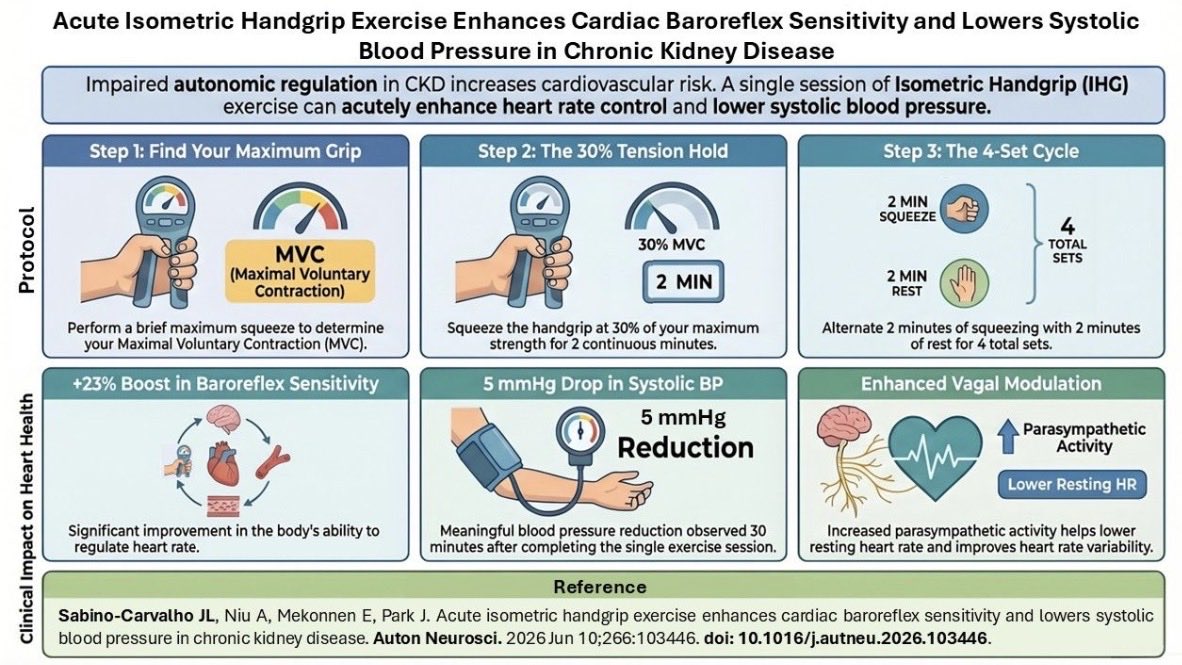
⚠️ Excited to share our latest article published at Autonomic Neuroscience: Basic & Clinical! 🎉
“Acute Isometric Handgrip Exercise Enhances Cardiac Baroreflex Sensitivity and Lowers Systolic Blood Pressure in CKD”
Link: doi.org/10.1016/j.autneu.202…
#ckd #exercise #isometric
1
1
21

Macron figured out Trump's grab-and-pull power handshake, & counters it with his own twist handgrip.
I'm not sure if this was before, or after Trump did the grab-and-pull trick on Macron's wife Brigitte, though (12 seconds, from 3:02-3:14 on video). rumble.com/v7bc62k-fox-news-…
1
3
135

This honestly looks like a really good handgrip for washing lol
1
1
125

18h
Brief figures from the best available evidence (low/very-low certainty):
Upper-body counterpressure maneuvers (e.g., isometric handgrip/arm tensing) may increase systolic blood pressure by an average of ≈32 mmHg in a small randomized trial (n=19) summarized in ILCOR evidence reviews.
They may also increase heart rate by an average of ≈8 beats/min in the same summary (based on a single study; weak evidence).
1
202

Apple works for most people, not for him. The Chinese Ultra's are for selective people that's why they're cancelling their upcoming Ultra.
Btw,Oppo find x8 Ultra was for most people cause it had the best camera with better handgrip, Xiaomi 17U followed it but unfortunately x9U and x300U aren’t for most people for daily usage.
31



Jun 15
sangat tydak cocok untuk penggunaan satu tangan saat tangan satunya berpegangan di handgrip KRL atau TJ. Huhuhu
1
14


Jun 15
tadi juga superr full busnya...dan luka op ku agak nyeri gara2 jarak tangan dengan handgripnya terlalu jauh (aku di sisi kiri bus, tanganku di handgrip sisi kanan bus).
Makasih banyak, aku bener2 ketolong banget 🙏🏼🙏🏼 semoga kakaknya sehat selalu dan dikelilingi orang2 baik yaaa
13
Jun 15
Ya Allah makasih banget, makasih juga buat kakak2 yg tadi di bus 5C dari arah Juanda. Pake kacamata, jaket bomber (kalau gasalah), sama tas selempang coach biru..makasih banget udah ngasih handgrip bus..
Mungkin cuma kebetulan, tapi aku makasihh banget 🙏🏼🙏🏼
1
41

Jun 15
You know, I don’t think I’ve ever seen a forward handgrip threaded directly to a pistol barrel before…
2

Jun 15
video live dh di awal ngomongin yj abis fanmeet adalah titik aku berdedikasi pada kapal ini, berdiri teguh tegak dan mengendalikan seluruh muscle core penuh usaha seperti penumpang gak kedapetan handgrip TJ 2 yang lagi belok di gambir

3
11
358

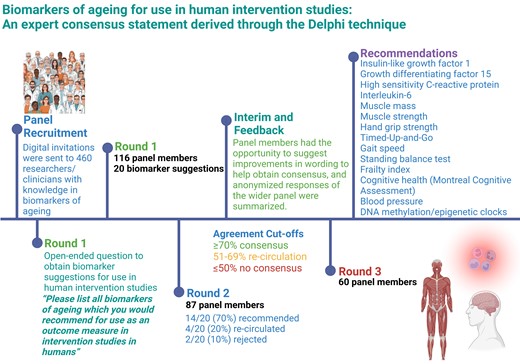
potential biomarkers
1. IGF-1
2. Growth differentiating factor 15
3. hsCRP
4. IL-6
5. Muscle mass
6. Muscle strength
7. Handgrip strength
8. Timed-Up-and-Go test
9. Gait speed
10. Standing balance test
11. Frailty index
12. Cognitive health (Montreal Cognitive

A group of experts sat together and outlined potential biomarkers of aging.
They reached a consensus (≥70% agreement) on 14 of them:
1. IGF-1
2. Growth differentiating factor 15
3. hsCRP
4. IL-6
5. Muscle mass
6. Muscle strength
7. Handgrip strength
8. Timed-Up-and-Go test
9. Gait speed
10. Standing balance test
11. Frailty index
12. Cognitive health (Montreal Cognitive Assessment)
13. Blood pressure
14. DNA methylation/Epigenetic clocks
They didn't claim this is a definitive list
Video on ranking biomarkers: youtu.be/SgKp5mm0ALI?si=4ARy…
Paper: academic.oup.com/biomedgeron…
12