
From @Afcon27Gazette NOTICEBOARD: 'Imara kama Simba ...' Kenyans are entertained. Ali (Alasdair Howorth) has captivating reports of matches at the World Cup. Anyone know which 'mtaa' this Kenyan-Scot was raised and schooled?
@OlympicsKe @ombachi13 @Nondies @hillcrest_prep


Pape Gueye the best player on the pitch for arguably the 5th competitive match in a row. He is the definition of 'criminally underrated'.
1
71
From @Afcon27Gazette NOTICEBOARD: We bestow Alasdair Howorth (@ahoworth97) the 'Ali's Africa Football' You-tuber hon-Kenyan status. Bloke looks authentic in that shirt; talking about @harambee_stars opponents.
Last meeting, 17 Nov 2015, Pria: Cabo
youtu.be/UvEu2JQNNC0?si=xjgZ…
1
28

La crónica que encontré, escrita por Alasdalr Howorth, habla de como vivieron la histórica clasificación a este torneo, sobre «Morabeza» y los dias previos al duelo con España, una de las candidatas.
1
28
auSoleildeMidi retweeted

Jun 13
Ian Howorth scatta in pellicola e quello che dice a proposito della Fotografia analogica è una dichiarazione d'amore totale.
"È difficile rispondere, ma immagino che la fotografia su pellicola non sia solo un prodotto finito, sia anche uno stato mentale. "

3
18
373
Gregory Wirtel 🦬 retweeted

May 22
HOWORTH (1887) continued:
“In Siberia, as we have seen, the death of the Mammoth and its companions was immediately followed by a sudden declension in temperature, which of itself and in the absence of other causes made that area incompatible with the life conditions of the Mammoth, but this was a correlative occurrence, and not the immediate cause of the great destruction. It is unlikely that the cold would have killed the bear and glutton, the musk-sheep, etc., which we know were in many instances overwhelmed by the same cause, whatever it was that destroyed the Mammoth.
The fact of the bones occurring in great caches or deposits, in which various species are mixed pell-mell, is very important. Different species do not come together to do so, nor does the lion come to take his last sleep with the lamb. The fact of finding masses of animal remains of mixed species, all showing the same state of preservation, not only points to a more or less contemporary death, but is quite fatal to the theory that they ended their days peaceably by purely normal causes.
Their state of preservation proves that they were covered over and protected immediately after their deposition, and have remained so covered and protected ever since, and this along many degrees of longitude, and by continuous undisturbed beds of clay and gravel.
Wrangell says, "The best Mammoth bones, as well as the greatest number, are found at a certain depth below the surface, usually in clay-hills, more rarely in black earth. The more solid the clay, the better the bones are preserved. Experience has also shown that more are found in elevations situated near high hills…”
The evidence is equally or even more conclusive from Europe, where, in the great deposits of loess and in the brick clays, &c., in many places, as at Folkestone, Flamborough Head, Bournemouth, &c., we find the caches of bones in positions entirely out of the reach of any possible rivers or river floods, and on the Continent in beds which are quite undisturbed and continuous over large areas, showing that they were spread by some continuous and far-reaching cause.
Schmidt, probably the most skilled geologist who has examined the Siberian Mammoth-beds in situ, says in reference to this very notion, "The northern rivers throw down no great amount of mud. No Mammoth could sink into the brown layers of mud which remain on the low grounds after spring floods.”
Vast hecatombs are found in certain places like New Siberia, 150 miles distant from, or in high grounds far away from any possible river channel…remains are found where no river could possibly flow.
Myriads of fresh skeletons of Mammoths, rhinoceroses, bisons, etc., in Siberia or in Europe...have every sign that they formed parts of a contemporaneous fauna destroyed at the same time.
As Cuvier says, arguing from another point,
"But how have so many ferocious beings that inhabited our forests been extirpated from them? The only answer we can provide is that they must have been destroyed at the same time and by the same cause as the great herbivores that inhabited the forests alongside them, and of whom no more traces are found today."
However ingeniously and with whatever subtlety we may deal with our evidence, the facts constrain us therefore to one inevitable conclusion, namely, that the Mammoth and its companions perished by some wide-spread catastrophe which operated over a wide area and not through the slow processes of the ordinary struggle for existence, and that the greater portion of the remains we find in Siberia and Europe are not the result of gradual accumulation under normal causes for untold ages, but the result of one of Nature's hecatombs on a grand and wide-spread scale, when a vast fauna perished simultaneously.
We must next inquire what the nature of this catastrophe was.
The first piece of evidence I would quote is of a singularly direct kind, and we owe it to the experienced skill of Professor Brandt. Speaking of the famous rhinoceros found on the Wilui by Pallas, he says, "On a careful examination of the head of the Rhinoceros Tichorinus from the Wilui, it was further remarkable that the blood-vessels and even the fine capillaries were seen to be filled with brown coagulated blood, which, in many places still preserved its red colour." This is exactly the kind of evidence we look for when we want to know whether an animal has been drowned or suffocated. Asphyxia is always accompanied by the gorging of the capillaries with blood, and the facts justify at all events a probable inference that this particular rhinoceros was the victim of drowning.
Schrenck submitted the head of the Rhinoceros Merkii, already described, to a similar examination, and one passage in his memoir is singularly interesting when taken in conjunction with the remarks of Brandt just quoted. Speaking of its nostrils, he says, "They were wide open, and in the case of the one on the right side, which was uninjured, a number of horizontal folds were ranged in rows about it. The mouth was also partly open, whence it may be concluded that the animal died from suffocation, which it tried to avoid by keeping the nostrils wide asunder."
To continue. The occurrence of immense caches in which the remains of many species of wild animals are incongruously mixed together pell-mell, often on high ground, seems unaccountable, save on the theory that they were driven to take shelter together on some point of vantage, in view of an advancing flood of water, collecting together on some dry place, and reduced to a common condition of timidity and helplessness by a flood which has overwhelmed the flat country. As Horace says, referring to Deucalion’s deluge,
"Omne cum Proteus pecus egit altos
Visere montes." (When Proteus drove all his flock to visit the high mountains.)
Evidence is forthcoming from the deposits where the Mammoths' remains occur further inland, and where we find marine shells which clearly evidence the former presence of the ocean. This was known to Pallas, and has been confirmed amply by Middendorf and others. Thus the former describes the occurrence near Ust Tatarskoi on the Irtish of numerous shells, mostly fossilized, but others preserving their horny pellicles, and in some cases retaining traces of the mollusk itself. In these same layers were found the bones of elephants and many other animals. "This undoubtedly," he adds, "has come from a great inundation. We have in it an evident proof that the sea once bathed these countries."
At a short distance from Kopanofskoi on the Volga were found several bones of an elephant. Pallas says he "obtained a jaw-bone much petrified, and as-it-were coated with fine gravel and muscles.”
Murchison describes pleistocene marine shells as occurring a long way south of the White Sea. Similar marine shells are found mixed with Mammoths' remains in the valley of the Lower Somme, and in the deposits of the English Channel, while we know that the sea bottom from Lowestoft to Dunkirk is strewn with large numbers of Mammoths' bones; so in Torbay, etc…traces of the results of a catastrophe.
This completes my survey of the evidence furnished by the Mammoth itself, and I believe that not only is it consistent with the conclusion that that animal and its companions were finally extinguished by a sudden catastrophe, involving a great diluvial movement. The evidence is not only ample, but it is evidence which converges from all sides.
I will lastly quote the opinion of Erman, whose critical skill and knowledge were perhaps greater than those of any of the Siberian explorers. He has the following remarks: "The ground at Yakutsk . . . consists, to the depth of at least 100 feet, of strata of loam, pure sand, and magnetic sand. They have been deposited from waters which at one time, and it may be presumed suddenly, overflowed the whole country as far as the Polar Sea. In these deepest strata are found twigs, rocks, and leaves of trees of the birch and willow kinds; Everywhere throughout these immense deposits are now lying the bones of antediluvian quadrupeds along with vegetable remains.
It is only in the lower strata of the New Siberian wood-hills that the trunks have that position which they would assume in swimming or sinking undisturbed. On the summit of the hills they lie flung upon one another in the wildest disorder, forced upright in spite of gravitation, and with their tops broken off or crushed as if they had been thrown with great violence from the south on a bank, and there heaped up. Now a smooth sea covering the tops of these hills on the islands, would, even with the present form of the interjacent ground, extend to Yakutsk, which is but 270 feet above the sea.
The flood may have poured down from the high mountains through the rocky valleys. The animals and trees which it carried off from above could sink but slowly in the muddy and rapid waves, but must have been thrown upon the older parts of Kotelnoi and New Siberia in the greatest number and with the greatest force..”
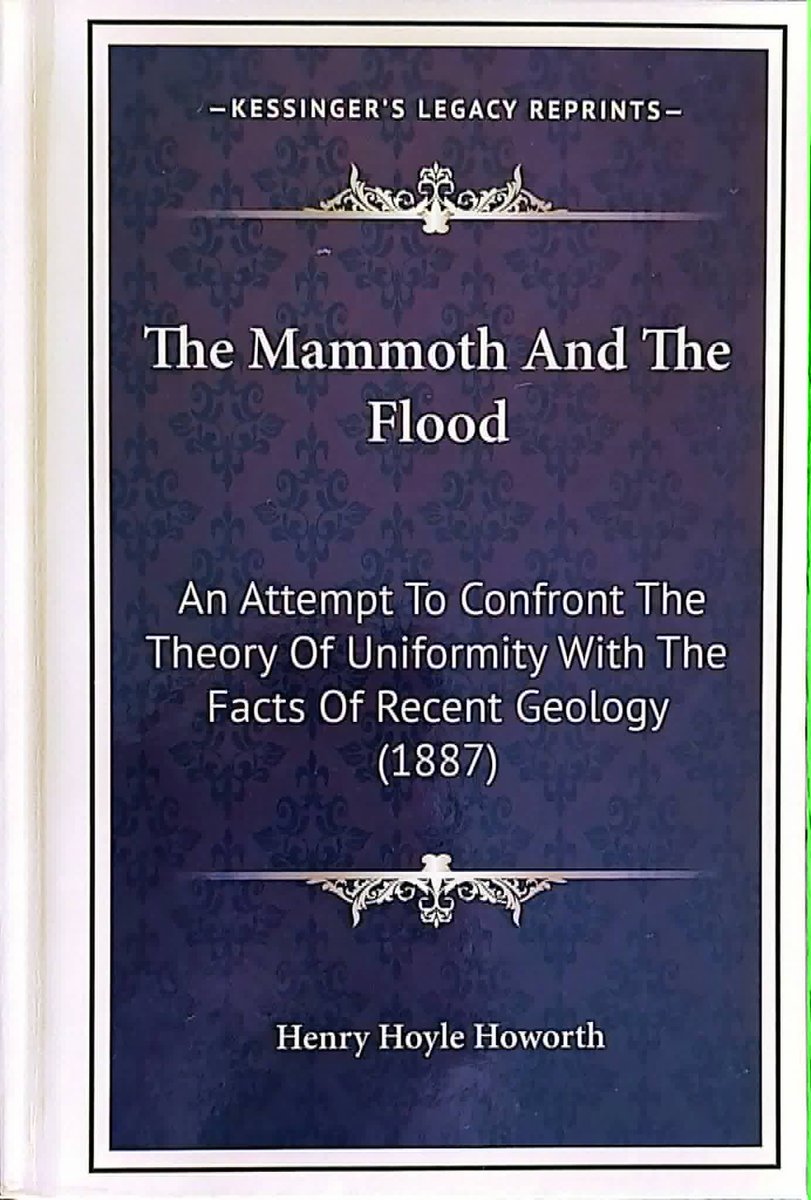
THE MAMMOTH AND THE FLOOD
HENRY H. HOWORTH (1887)

5
12
62
4,831
Jay retweeted

🌎🏆 𝐆𝐑𝐎𝐔𝐏 𝐇
🇪🇸 Spain
Alex Kirkland | @alexkirkland
🇨🇻 Cape Verde
Ali Howorth | @ahoworth97
🇸🇦 Saudi Arabia
Martin Lowe | @plasticpitch
🇺🇾 Uruguay
Jessie Losch | @JessieLosch
𝐒𝐏𝐎𝐓𝐈𝐅𝐘 👉 open.spotify.com/episode/2jE…
𝐀𝐏𝐏𝐋𝐄 👉 podcasts.apple.com/podcast/2…

13
16
13,620






May 16
THE MAMMOTH AND THE FLOOD - HENRY H. HOWORTH (1887) -Part 2
The following facts, "I claim, prove several conclusions. They prove in the first place that a very great cataclysm or catastrophe occurred at the close of the Mammoth period, by which that animal, with its companions, were overwhelmed over a very large part of the Earth's surface. Secondly, that this catastrophe involved a widespread flood of water, which not only killed the animals, but also buried them under continuous beds of loam or gravel. Thirdly, that the same catastrophe was accompanied by a very great and sudden change of climate in Siberia, by which the animals which had previously lived in fairly temperate conditions were frozen in their flesh under the ground and have remained frozen ever since. Fourthly, that this catastrophe took place when man was already occupying the earth, and constitutes the gap which is almost universally admitted to exist between so-called palæolithic and neolithic man. Fifthly, that this catastrophe is in all probability the same one pointed out in the traditions of so many races as the primæval flood from which their legendary history begins. Wherever we turn in the temperate regions of the world we seem to be on the track of this great catastrophe, which swept away the greater part of an ancient fauna, and which especially destroyed the larger and more unwieldy animals, allowing the smaller ones alone to escape, and which forms a great dividing line in the recent biological history of Australia as well as Europe, of Siberia as well as America. This vast effort seems from inexorable evidence to have been due to the exertion of some cataclysmic force by which the Earth's crust was greatly disturbed, not merely locally, but over a large part of its surface. It was in consequence of this dislocation that the loose watery envelope which covers a large portion of the world was set in motion, and sweeping over the land drowned and then buried deep in gravel, loam and clay, hecatombs of living beings, a vast cemetery of life, causing a deluge apparently unparalleled in extent and completeness in any other geological period; a catastrophe which may well claim therefore to be spoken of as the great flood."
The evidence for this conclusion had been accumulating for some time. Olfers quotes from a work called the "Hi Chao Sin Yu" (a late Ming to early Qing Chinese geographical compilation), a passage where it is stated that "The Olose (i.e. the Russians) who had recently visited China reported that the frozen sea washed their country."
Nordenskiold, speaking of the Yenissei tundra, says it is in summer completely free of snow, but at a limited depth from the surface the ground is continually frozen, and adds that in it the "Mammoth remains are found, and along with them masses of old drift wood originating from the Mammoth period, known by the Russian natives of Siberia under the distinctive name of Noah's wood."
Such accounts were more than mere legend. In 1787, Sarytschef, who accompanied Billing in his well-known journey through Siberia, was sent in company with Dr. Merck and others from Sredne Kolymsk to Yakutsk. He tells us that the inhabitants of Alaseisk, a small town of the Alaseya, told him that about a hundred versts ( ≈ 106 km) from there the river had washed out of its sandy bank the skeleton of a great animal, of which only one-half was visible. "It was apparently about the height of an elephant, in an upright position, and in an entire state, still retaining its skin, and, in some places, its hair."
Pallas concluded that the woolly rhinoceros carcass could only have been carried from southern regions into the frozen north during a great flood or deluge. In 1772, Pallas received parts of a well-preserved woolly rhinoceros (R. antiquitatis) found by Yakut hunters near the Vilui River. The nearly complete carcass, buried in riverbank sand, still retained skin, hair, flesh, eyeballs, tendons, and cartilage. He states this view perhaps more emphatically than any of the older naturalists. After describing the distribution of Mammoth remains along the plains of Northern Siberia, and their occurrence in association with marine débris, he adds that "these animals were transported from the South into these Northern regions, when this part of the world was submerged by a great catastrophe which was probably violent and sudden."
The discoveries continued into the following century. In 1799, Tungus chief Ossip Schumakhof noticed a strange mound on the Tamut peninsula near the Lena's mouth; by 1801 it had partially thawed, revealing a large animal with a tusk. After further seasonal thawing, by 1803 it had slid down to a lower sand bank.
Botanist Adams, hearing of a fully intact mammoth, traveled there and examined it in 1806. The hide on the animal's underside still bore thick hair, so heavy that ten men struggled to drag it, and a pood of scattered hair was collected from the ground. The site, originally seven fathoms below the surface of a 35–40 fathom bank, lies on what Wrangell mapped as a peninsula (later shown as an island on the 1855 Russian survey) in the Polar Sea opposite Kumak Surka, with its points called Myss Bykofskoi and Myss Mostach.
This find carried profound implications for understanding how these animals had been preserved. Adams's Mammoth was not found as asserted in a mass of ice, but was found in beds of gravel intercalated with clay, such beds, wherever they have been found in situ, being continuous and undisturbed. "Now, by no physical process known to us can we understand how soft flesh could thus be buried in ground while it is frozen as hard as flint without disintegrating it. We cannot push an elephant's body into a mass of solid ice or hard frozen gravel and clay without entirely destroying the fine articulations and pounding the whole mass into a jelly, nor would we fail in greatly disturbing the ground in the process. Not only does the frozen ground of Siberia preserve the flesh deposited in it, but it is quite clear that no flesh could remain intact in this way unless it were permanently frozen, and it follows inevitably that the bodies of Mammoths, etc., which are now found intact in the Siberian tundras must have been frozen immediately after death, and have remained frozen since they were first entombed. This change of climate must have been sudden and must also have been continental."
Several naturalists, approaching the question independently, arrived at the same conclusion. Dr. Buckland says: "One thing, however, is certain as to this Mammoth, i.e. Adams', that whether it was imbedded in a matrix of frozen earth, it must have been rapidly and totally enveloped in that matrix before its flesh had undergone decay, and that, whatever may have been the climate of the coast of Siberia in antecedent times, not only was it intensely cold within a few days after the Mammoth perished, but it has also continued cold from that time to the present hour."
Cuvier likewise thought it would have been impossible for an entire body to retain its flesh and skin without decaying unless it had been rapidly subjected to extreme cold: "But whatever this cause may have been, it must have been sudden; bones and ivory so perfectly preserved in the plains of Siberia are preserved only by the cold which freezes them there, or which in general halts the action of the elements upon them. If this cold had arrived only gradually and slowly, these bones, and even more so the soft parts with which they are still sometimes enveloped, would have had time to decompose like those found in warm and temperate countries. Thus all hypotheses of a gradual cooling of the Earth, or of a slow variation either in the inclination or in the position of the axis of the globe, collapse in themselves."
French geologist M. d'Archiac concurred, noting that "another circumstance, which must have accompanied or followed very closely the phenomenon whatever it may have been, is a rapid lowering of temperature, such that the decomposition of flesh and other soft parts was prevented in a great number of cases."
Part 3 to follow…
THE MAMMOTH AND THE FLOOD
AN ATTEMPT TO CONFRONT THE THEORY OF UNIFORMITY WITH THE FACTS OF RECENT GEOLOGY
HENRY H. HOWORTH (1887)
8
25
141
3,753