
Jun 2
The http4s client implementation for sttp gets Scala Native support! 🎉
github.com/softwaremill/sttp…
1
2
14
426
I was finally able to retire all custom forks – the entire stack for this app is now published for Scala Native 0.5.
Smithy4s, http4s, Skunk, dumbo (migrations)
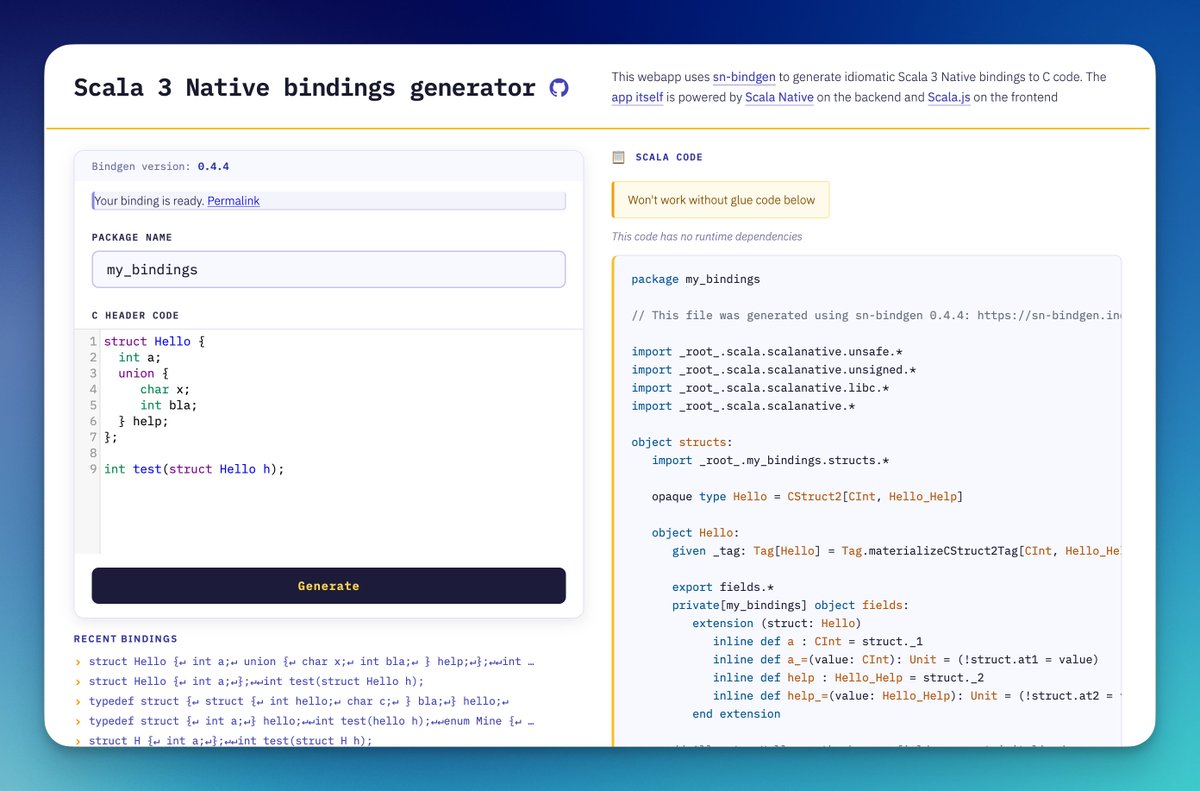
22 Sep 2025

To celebrate the release of Cats Effect for Native 0.5, I rebuilt my web interface for sn-bindgen in Smithy4s and Http4s.
Now on Native 0.5, and actually working!
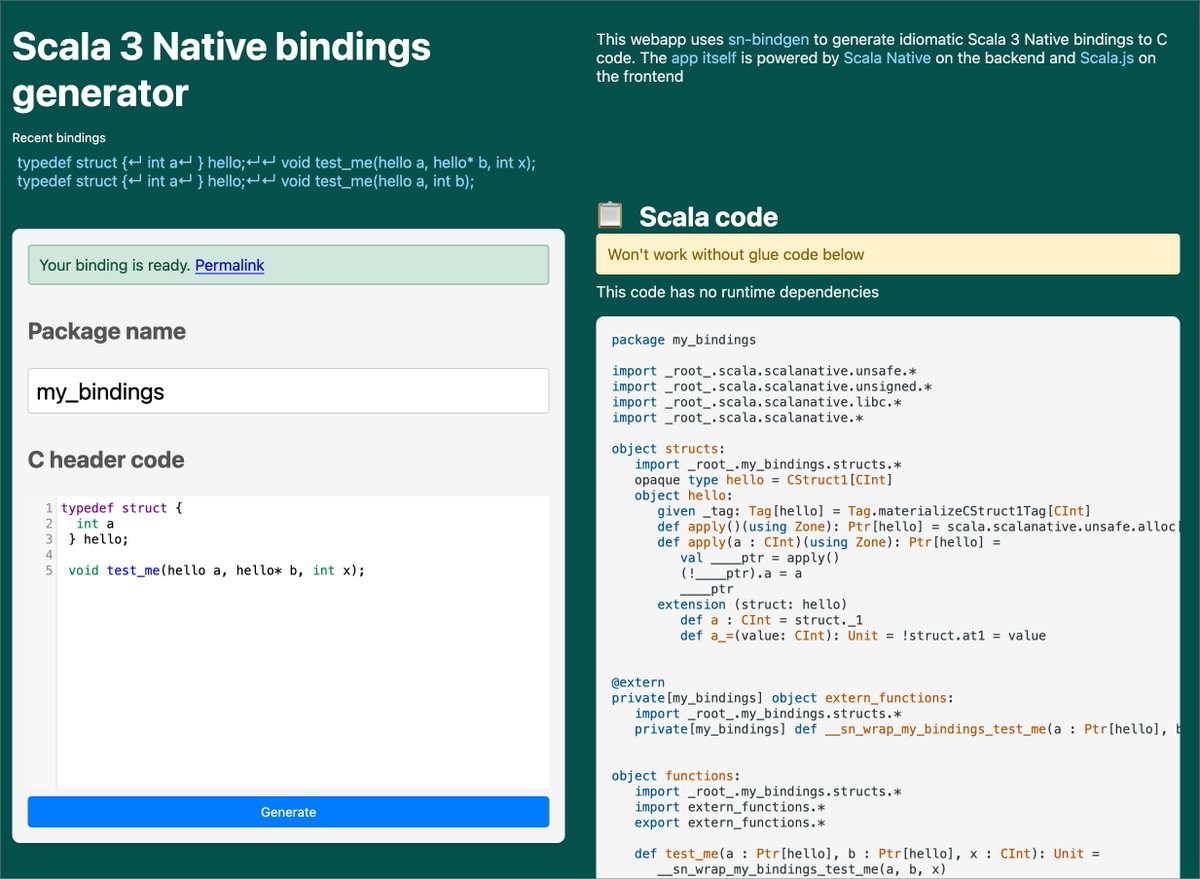
1
2
24
1,085

Jun 1
A bunch of updates for sttp-client 4:
• Scala Native support for the http4s backend
• cookie propagation across redirects using a CookieStorage
• three bug fixes, both found & fixed by AI
Enjoy :)
github.com/softwaremill/sttp…
2
11
677
May 1
Tapir v1.13.18 is out! 🎉 It's just a patch release, but anyone who has been waiting for http4s server cross-compilation to Scala Native 0.5 is going to be very happy. (Myself included! 😀) #scala
github.com/softwaremill/tapi…
3
22
411

Apr 11
github.com/disneystreaming/s…
We've also been looking at S3 support with Michal Pawlik. It needs some more work but there's non-negative progress 😅
1
2
59
Apr 10
Big things happening today.
- @http4s with Scala Native 0.5 support released: github.com/http4s/http4s/rel…
- Smithy4s follows: github.com/disneystreaming/s…
2
2
20
674
Apr 10
http4s 0.23.34 is out 🎉
The Typelevel stack is now almost completely on Scala Native 0.5:
✅ Cats Effect
✅ fs2
✅ http4s
✅ Weaver
❌ Skunk
github.com/http4s/http4s/rel…
1
2
23
458
Mar 17
Another piece of the puzzle has been updated to Scala Native 0.5, this time it's fs2! 🎉
Now let's wait for http4s, skunk and weaver to join the party! ⌛
github.com/typelevel/fs2/rel…
3
11
430
Mar 9
http4s is a backbone for many mission-critical systems. I'm pleased to share that "Pure functional HTTP APIs in Scala" by Jens Grassel is free once again, and this time it's for good! 📖
1
3
21
937

Me with http4s
Jan 29

When you see a version number like
0.2.67
You know it’s actually a really mature piece of software.
1
2
223
Jan 2
Anyone who has ever implemented AWS request signing manually will be pleased to know there is an http4s module for it 👇 #scala
1
5
187

23 Dec 2025
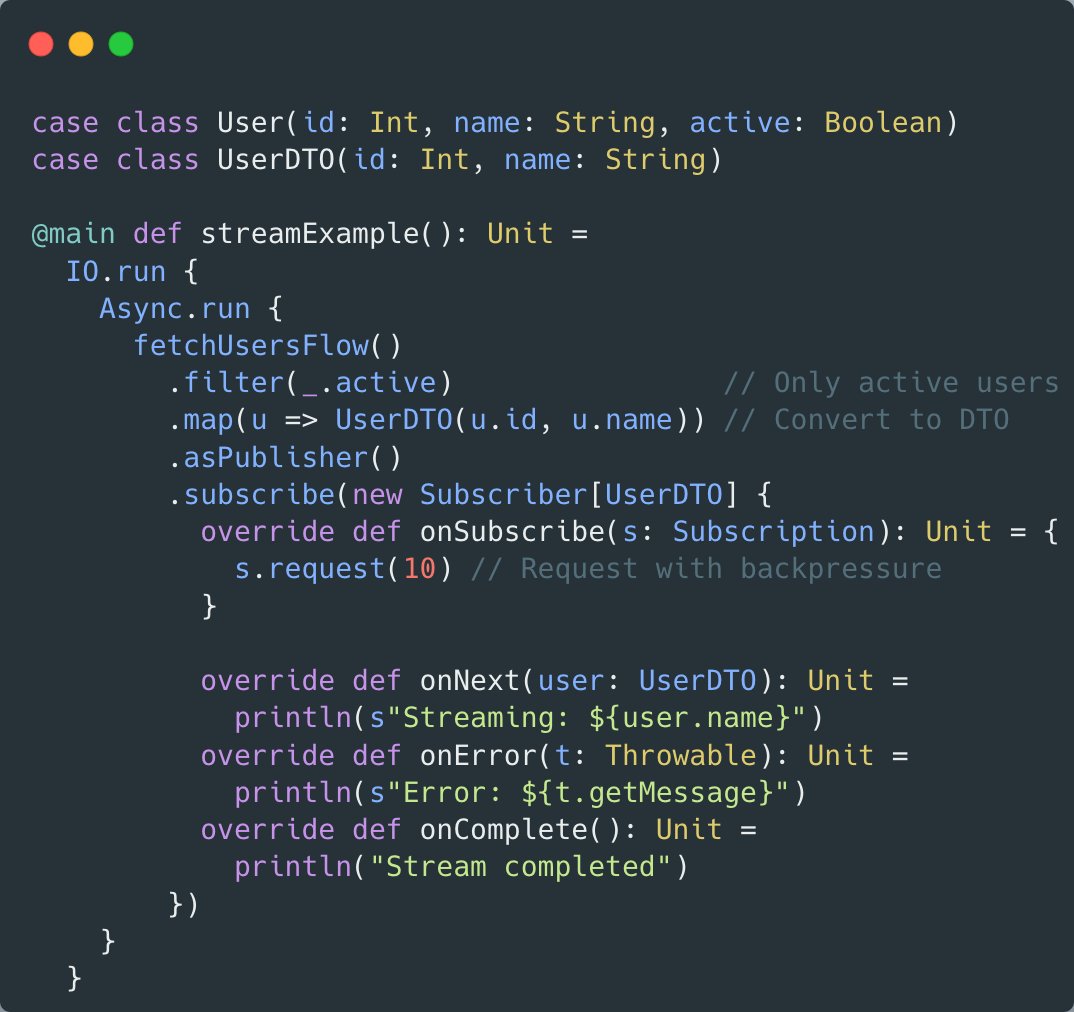
Hey, #Scala lovers 💕, Santa is coming 🎅, bringing version 0.11.0 of #YAES this year! 🎁 This time, we added the integration with Reactive Streams so that you can use YAES with any library implementing the standard (Akka, Vert.x, Http4s...).
Here are the release notes: github.com/rcardin/yaes/rele…
Merry Christmas 🎄, and keep on coding!
cc @ScalaTimes, @petr_zapletal
2
15
661
31 Oct 2025
Respect to Dylan Halperin for his massive contribution to @http4s! 🚀 His new MultipartReceiver is in the latest version after over a year of review, adding safer, fail-fast file uploads with size limits and no buffering. #scala github.com/http4s/http4s/rel…
5
323

24 Oct 2025
http4sは触った程度でしかないんですが、IOとか出てきて面食らった記憶があります。関数型に馴染みがないととっつきにくさはあるのかなと思いました。
1
2
319

22 Oct 2025
I dunno. Moggi 1991 is based on category theory, and, like it or not, is where the treatment of effects in lambda calculi comes from.
That said, the study of lambda calculi is not necessarily category theoretic, nor even is the study of type theory. If we look at type theory through the lens of the Curry-Howard correspondence, we encounter category theory in that the “logic” side is a constructivist logic that is the “internal logic” of an elementary topos, and this can be useful to know.
More to the point, though, it’s category theory—the algebra of composition—that tells us what “composition” even means. So I can’t agree that promoting category theory is unnecessary zealotry, since its absence entails a loss of precision. (I have an intermediate/advanced Scala/cats/cats-effect/http4s interview exercise that hinges on this).
That said, I have dissuaded, and continue to dissuade, functional programmers from “studying category theory to be better functional programmers.” One employer ran a study group on Milewski’s book, and he admitted it didn’t help him with Cats code at all. A Haskell programmer, or Cats programmer, or PureScript programmer, or fp-ts programmer… will learn category theory more effectively than a “Categories for the Working Mathematician” reader will, for the purposes of writing software.
1
12
499
29 Sep 2025
Probably the fastest way to build a Scala REST API is with the OpenAPI Generator codegen tool. It has an sbt plugin, supports libraries like Akka & Http4s, and the latest release adds sttp4 support! 👏 #scala openapi-generator.tech/
1
1
11
573

27 Sep 2025
My fun task for today was getting rid of soon-to-be-deprecated NGINX Unit in my project (x.com/velvetbaldmime/status/…) and just deploying naked http4s containers with Scala Native to kubernetes, with a bunch of other complications.
It was not fun, kubernetes is not fun.
22 Sep 2025
To celebrate the release of Cats Effect for Native 0.5, I rebuilt my web interface for sn-bindgen in Smithy4s and Http4s.
Now on Native 0.5, and actually working!
1
2
273
24 Sep 2025
If you are a Scala developer, you should know fs2 is the Ur-API. It powers http4s, including SSE and websockets. It powers Doobie and Skunk, including streaming query results. fs2-kafka is the best way to use Kafka. And they all trivially integrate because they use the same stream-of-effects abstractions.
I won’t use Scala without Cats, cats-effect, and fs2. (It’s likely I’ll never use Scala again anyway, but this is a non-negotiable prerequisite.)

It's very easy to spot some experienced with fs2 Stream programming and someone who isn't.
The API is quite diverse, you need experience to master it.
1
1
7
1,075

24 Sep 2025
CVE-2025-59822
HTTP Request Smuggling Vulnerability in Http4s Scala HTTP Services Framework
vulmon.com/vulnerabilitydeta…
2
1
330
23 Sep 2025
Funny, I wanted to write: "Why hasn't http4s cut a release in over 9 months?" #scala
1
3
414