Krome retweeted

Why Humacyte is a Strong Buy at the $1 Mark: The Ultimate Inflection Point
At its current price of around $1.00, Humacyte ($HUMA) presents a highly asymmetric risk-to-reward profile. The market has temporarily penalized the stock for a recent dilution, completely masking a massive fundamental shift that dramatically increases the company's odds of long-term success.
Here is the breakdown of why $HUMA is sitting at a major cyclical inflection point.
1. The Clinical Breakthrough & The Dilution Trap
Humacyte recently released stellar final results from its Phase 3 hemodialysis trial, significantly de-risking the path toward FDA approval. Unfortunately, management did what biotech companies routinely must do: they immediately used that positive momentum to shore up the balance sheet, initiating a $50 million public offering.
While the market hates short-term dilution, this capital injection was a strategic necessity:
The Cash Position: Humacyte will sit on approximately $75 million in cash.
The Baseline Burn: With a quarterly operational cash burn of roughly $25 million, this current cash pile safely funds the company through the end of Q1 2027.
2. The $60 Million Capital Bridge
As we approach the anticipated FDA decision, the market should begin pricing in an approval, driving the equity higher. This creates a highly elegant funding backstop already built into the share structure:
The $2.11 Warrant Trigger: If the stock clears and holds above $2.11, the company can trigger the exercise of outstanding warrants, injecting an additional $60 million of non-debt capital directly onto the balance sheet.
This $60 million influx provides the perfect financial bridge to carry Humacyte all the way through to the Symvess commercial approval, which is expected sometime in Q2 or Q3 of 2027.
3. The Commercial Game-Changer: Dialysis vs. Trauma
Many investors are looking at Humacyte solely through the lens of its vascular trauma indication. However, trauma is notoriously difficult to commercialize; you have to spend immense resources persuading individual hospital networks and emergency surgeons to change their acute care protocols.
Symvess for hemodialysis is an entirely different beast:
Immediate Market Access: The market size for dialysis access is exponentially larger than trauma.
The Fresenius Catalyst: Humacyte has a powerful strategic partner in Fresenius Medical Care, the global leader in dialysis care. This partnership provides an established, ready-made distribution network.
If the real-world commercial roll-out mirrors the exceptional data seen in the clinical trials, I am highly confident Humacyte can eventually capture 30% to 40% of the total market share. Achieving this level of penetration will effectively shut the door on future dilutive capital raises.
4. The Domino Effect: A Multi-Billion Dollar Pipeline
The brilliance of Humacyte's platform is that the Acellular Tissue Engineered Vessel (ATEV) used for trauma, dialysis, and Peripheral Arterial Disease (PAD) is exactly the same product.
An approval in dialysis establishes a powerful domino effect:
[Dialysis Approval] ➔ [Validates Platform] ➔ [De-risks PAD Approval] ➔ [De-risks CABG Approval]
The Margin Expansion: Because it is the exact same underlying technology, manufacturing costs will plummet as production scales up, significantly boosting gross margins.
The Familiarity Advantage: Once hospitals, vascular surgeons, and insurance providers become comfortable with Symvess for dialysis, adoption friction for the PAD and CABG (coronary artery bypass graft) indications will vanish, leading to much faster revenue generation.
The Revenue Potential: Dialysis, PAD, and CABG each represent distinct commercial opportunities with peak sales potential ranging from $500 million to over $1.5 billion each.
The Long-Term Valuation Target
We are looking at a classic biotech inflection point. The short-term dilution pain is behind us, the cash runway is clear, and the commercial runway is immense.
If Humacyte successfully executes its launch and achieves regulatory approvals across its broader pipeline indications, a long-term realistic stock price target of $45 to $100 per share is completely achievable.
Disclaimer: This is my own fundamental and financial opinion. Not Financial Advice (NFA). Do your own research.
Enjoyed this deep dive? Hit follow for future $HUMA updates, where I’ll continue breaking down the core fundamentals and mapping out the technical charts!
1
2
8
232

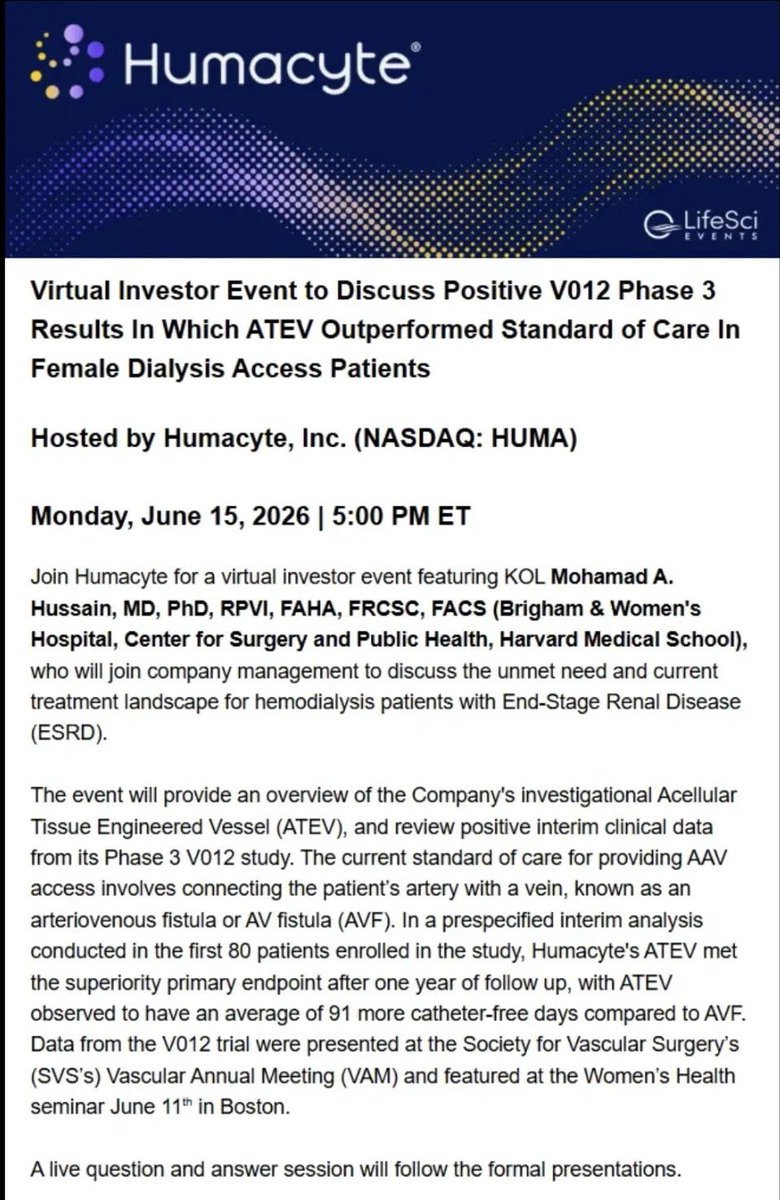
June 15th Humacyte will have a virtual investor event at 5:00 PM ET explaining the positive Phase 3 V012 interim results $HUMA
47
GrumpyGigDriver 🇺🇲🇺🇸🔞💸🎲🏈🎆🎇🧨✨ retweeted

@DrLauraNiklason @humacyte congratulations! Great day for Humacyte and medical advancement. 🎉🥳
1
5
397
GrumpyGigDriver 🇺🇲🇺🇸🔞💸🎲🏈🎆🎇🧨✨ retweeted

Jun 11
$HUMA: Humacyte (-20.9%) trading lower premarket after announcing top-line interim results for the V012 Phase 3 study and pricing an offering of 47,619,048 shares of common stock at $1.05/share.
1
1
1,096
GrumpyGigDriver 🇺🇲🇺🇸🔞💸🎲🏈🎆🎇🧨✨ retweeted

Jun 10
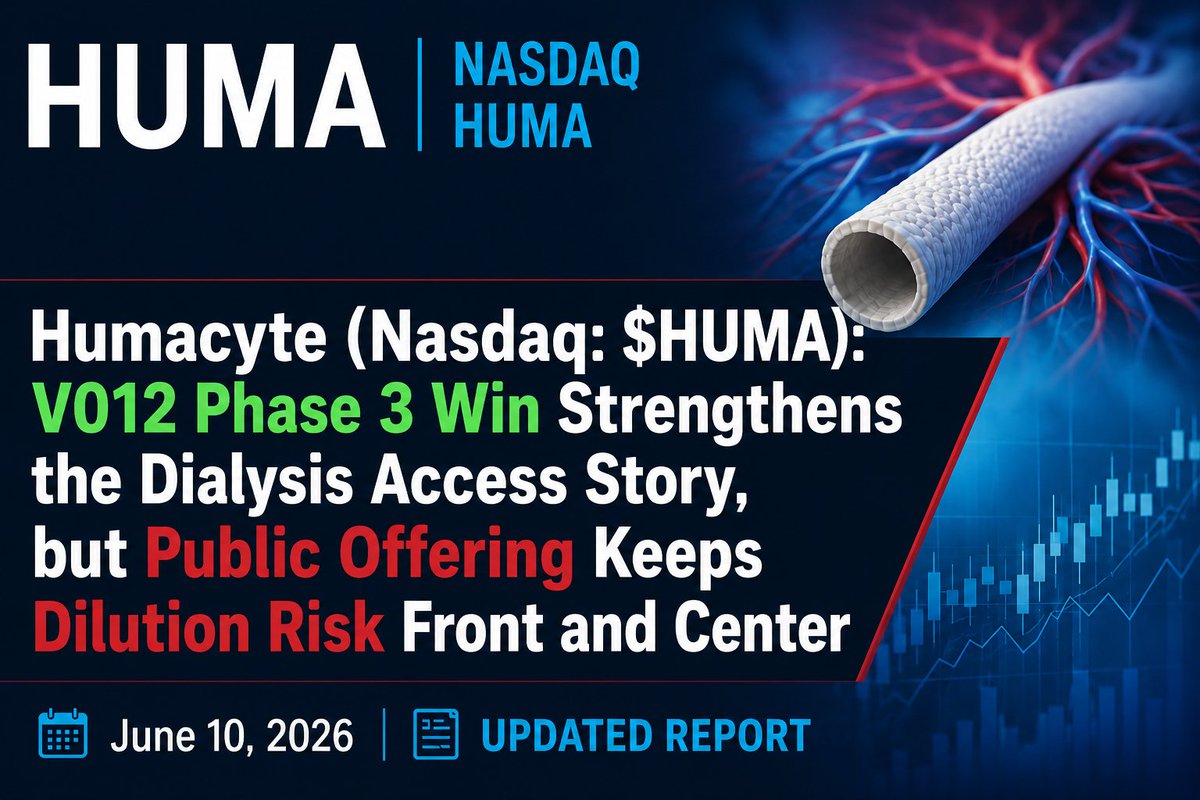
Humacyte (Nasdaq: $HUMA): V012 Phase 3 Win Strengthens the Dialysis Access Story, but Public Offering Keeps Dilution Risk Front and Center merlintrader.com/humacyte-ju…
1
3
3
1,225
GrumpyGigDriver 🇺🇲🇺🇸🔞💸🎲🏈🎆🎇🧨✨ retweeted

Jun 12
H.C. Wainwright raises Humacyte stock price target on trial data investing.com/news/analyst-r…
2
5
319
GrumpyGigDriver 🇺🇲🇺🇸🔞💸🎲🏈🎆🎇🧨✨ retweeted

Jun 12
$HUMA Humacyte The 3.5mm bioengineered coronary vessels are getting ready for their first-in-human CABG clinical trials! But every great journey needs a powerful team. @American_Heart and @gatesfoundation, let’s join forces to change the future #HeartHealth
3
4
643
GrumpyGigDriver 🇺🇲🇺🇸🔞💸🎲🏈🎆🎇🧨✨ retweeted

Jun 12
$huma im a type 1 diabetic and i would like to know whatever happen to the BIOVASCULAR PANCREAS humacyte was working on. this could be a game changer?
2
2
5
696
GrumpyGigDriver 🇺🇲🇺🇸🔞💸🎲🏈🎆🎇🧨✨ retweeted

Most of your comment is wrong btw...
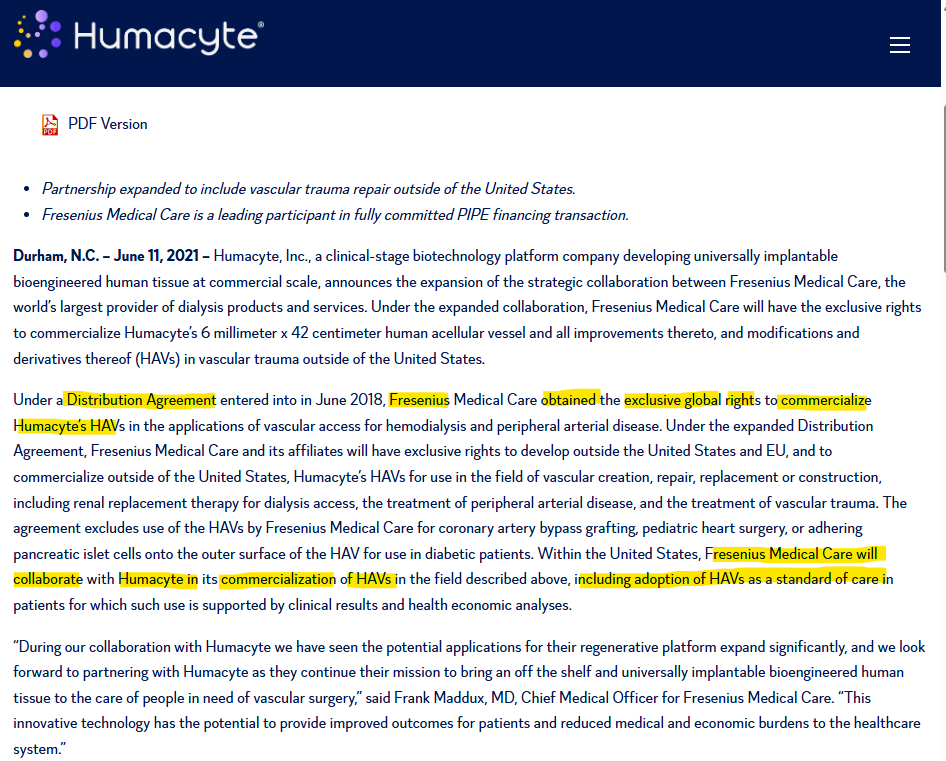
The Fresenius - Humacyte relationship is governed by a distribution agreement. Fresenius is contractually obligated to adopt Symvess as SoC for patients where clinical data supports its use.
As I've said in my above comment, Fresenius is one of the two largest dialysis clinic operators in the US, if Fresenius institutes a clinical protocol stating that certain patient profiles should receive a Humacyte ATEV to lower infection rates and eliminate catheter time (which they contractually have to), its clinical network will refer those patients to surgeons with instructions to use an ATEV.
Any hospital VAC and vascular surgeons will approve and adopt a device if a dominant provider network like Fresenius is aggressively feeding them patients specifically marked for that technology.
Given the potential of the $HUMA's ATEV, it would be stupid for Fresenius not to offer their ATEV's, mainly because $HUMA has potential to surpass Fresenius market cap, and a 8% incentivises Fresenius to adopt ATEV's asap.
Maybe you should start reading press releases...
2
2
6
571
Jun 13
RT @humacyte: Join us at the Hands-On Simulation lab!
The Humacyte® team is proud to host a Hands‑on SIM Lab featuring Symvess® acellular…
3