Filter
Exclude
Time range
-
Near
Interferometry is cool!
3
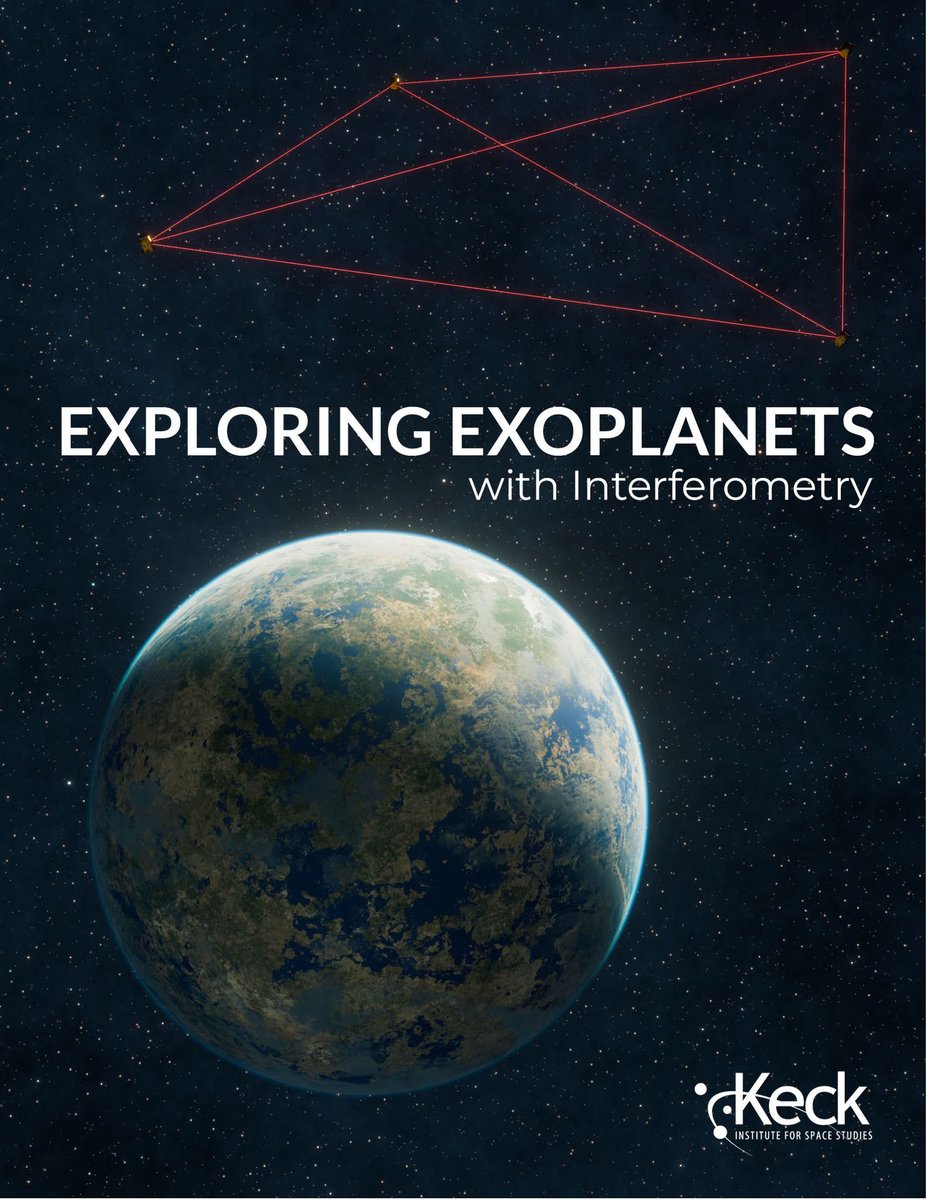
We're thrilled to share the newly published KISS Final Report, Exploring Exoplanets with Interferometry! Could next generation space interferometers help us find signs of life beyond Earth? This report explores how! Read the full report: bit.ly/exploring-exoplanets
1
50
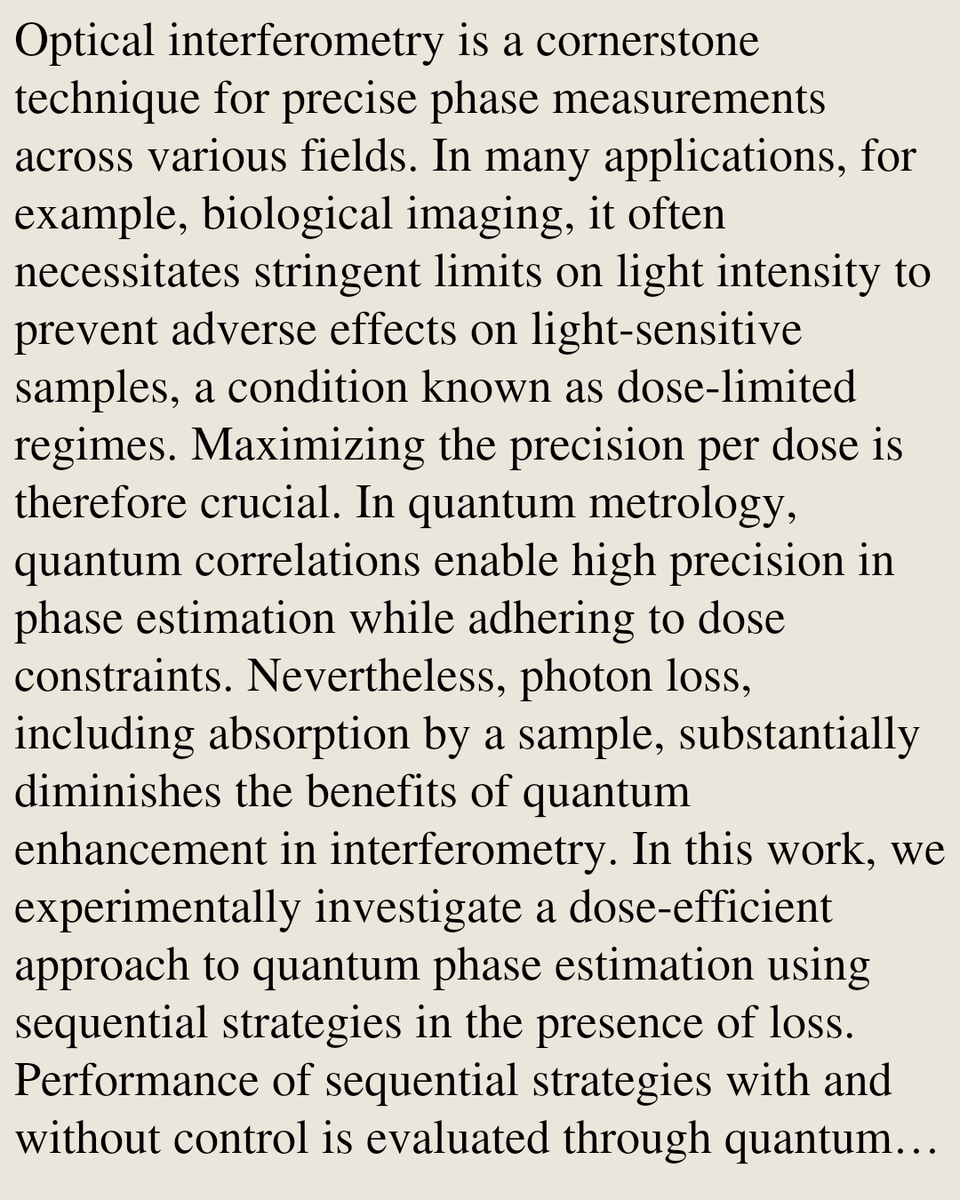
Dose-efficient Quantum Phase Estimation in Lossy Optical Interferometry Qilin Yu, Ben Wang, Kaimin Zheng, Minghao Mi, Hui Li, Lijian Zhang arxiv.org/abs/2606.14254 [𝚚𝚞𝚊𝚗𝚝-𝚙𝚑]
70
There are also millions of words in the Library of Congress confirming: 1️⃣ ~480 year ago, Copernicus published heliocentrism 2️⃣ ~410 years ago, Kepler’s laws described Earth’s orbit from observational kinematics. 3️⃣ ~350 years ago, Newton derived Earth’s orbit by dynamical arguments. 4️⃣ ~300 years ago, Bradley measured Earth’s 30 km/s orbital velocity from stellar aberration measurements. 5️⃣ ~225 years ago, Cavendish’s experiment began the determination of G to six significant figures. 6️⃣ ~155 years ago, Airy, testing for water-related aether effects, confirmed Bradley’s aberration measurements & found no aether 7️⃣ ~140 years ago, Michelson and Morley’s experiment validated Airy and Bradley, and also found no aether. 8️⃣ ~120 years ago, Dayton Miller's interferometry experiment. Recent reanalysys of his data shows no evidence for aether 9️⃣ ~110 years ago, Einstein proposed a relativistic gravity theory, complementing Newton’s classical model. ..
1
1
20
Kevin John Parrish retweeted
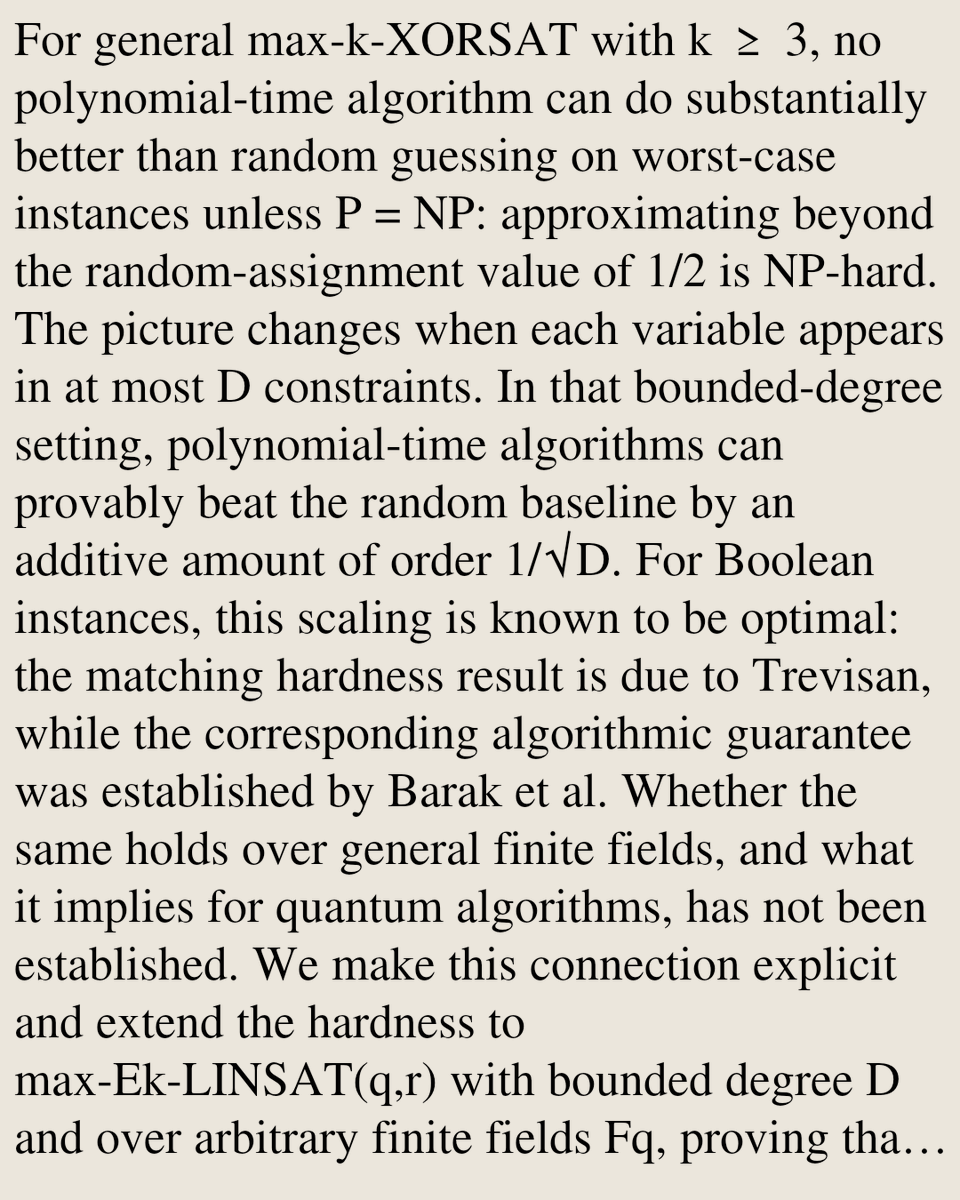
Approximability limits for bounded-degree max-LINSAT and implications for decoded quantum interferometry Maximilian J. Kramer, Carsten Schubert, Jens Eisert arxiv.org/abs/2606.13570 [𝚚𝚞𝚊𝚗𝚝-𝚙𝚑 𝚌𝚜.𝙲𝙲 𝚌𝚜.𝙳𝚂]
2
5
157
Dose-efficient Quantum Phase Estimation in Lossy Optical Interferometry arxiv.org/pdf/2606.14254 Qilin Yu, Ben Wang, Kaimin Zheng, Minghao Mi, Hui Li, Lijian Zhang. arxiv.org/abs/2606.14254

56
JAXA(Japan Aerospace Exploration Agency) retweeted
[Launch & Experiment] Completion of scientific balloon flight B26-02: Balloon-borne very long baseline interferometry (VLBI) experiment. isas.jaxa.jp/en/topics/00429…
1
5
1,582
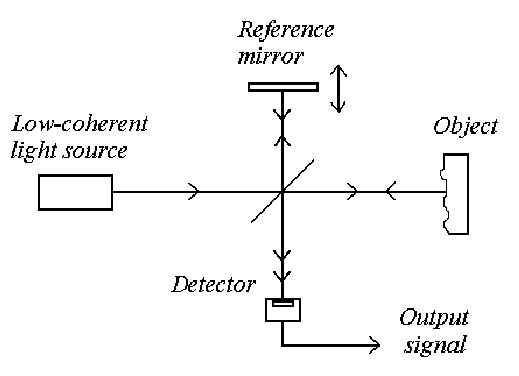
كيف يعمل OCT؟ يعتمد على مبدأ يسمى Low Coherence Interferometry حيث يتم إرسال حزمة ضوئية منخفضة الترابط إلى العين ثم تُقاس الانعكاسات الصادرة من طبقات الشبكية المختلفة يقارن الجهاز الضوء المنعكس من النسيج مع ضوء مرجعي ومن خلال تحليل الفرق بينهما يتم إنشاء صورة مقطعية دقيقة جدا
1
3
110
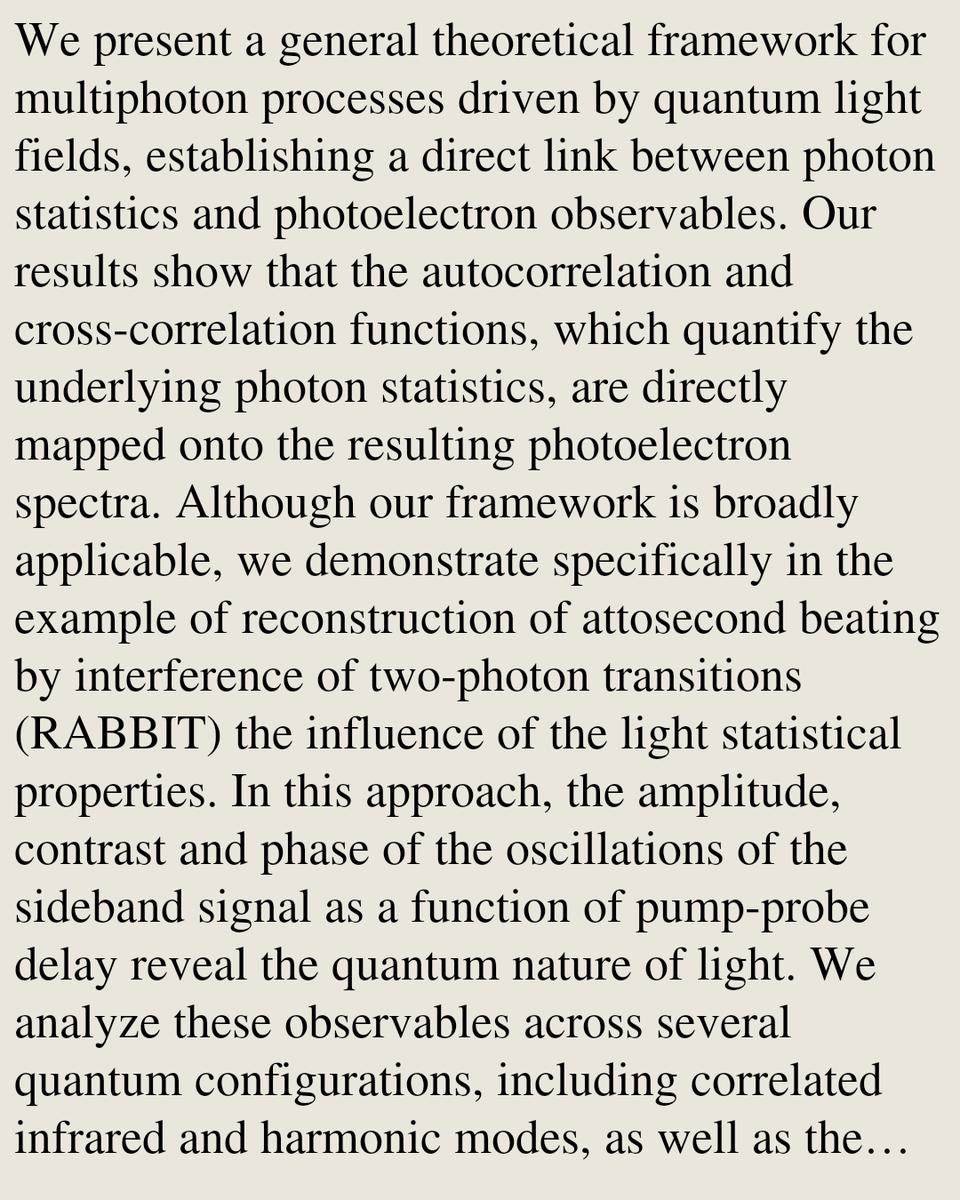
Quantum optical photoelectron interferometry Jonathan Dubois, Viviane Cotte, Richard Taïeb, Camille Lévêque, Jérémie Caillat, Pranshu Dave, Pascal Salières, David Bresteau, Charles Bourassin-Bouchet, … arxiv.org/abs/2606.13447 [𝚚𝚞𝚊𝚗𝚝-𝚙𝚑 𝚙𝚑𝚢𝚜𝚒𝚌𝚜.𝚊𝚝𝚘𝚖-𝚙𝚑]
1
102
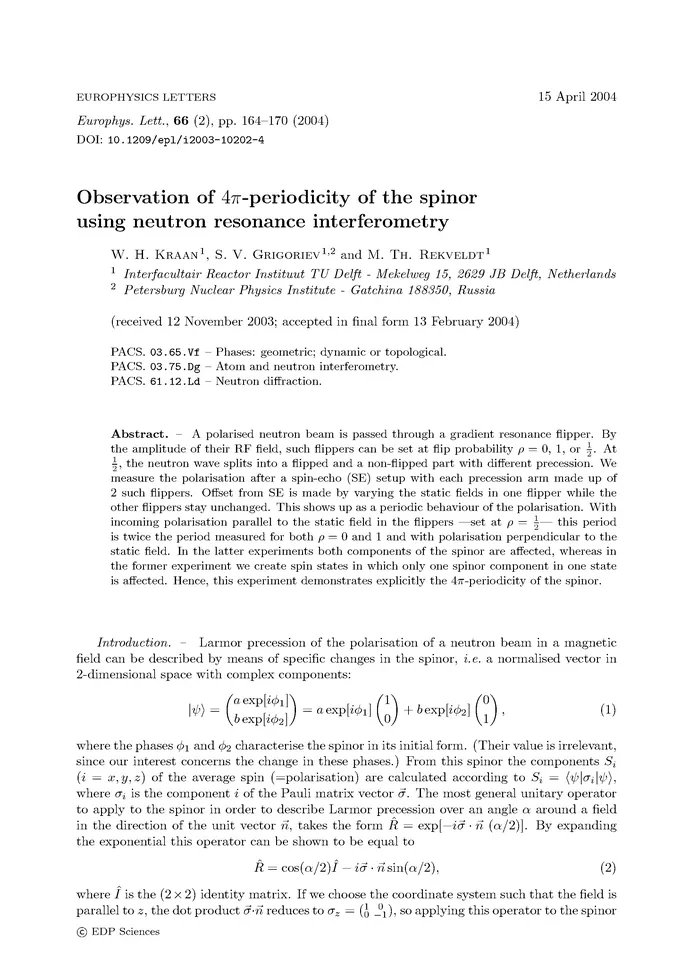
Observation of 4π-periodicity of the spinor using neutron resonance interferometry eurekamag.com/research/086/0… Europhysics Letters (EPL) 66(2): 164-170 2004 ISSN/ISBN: 0295-5075
4
Replying to @JackSarfatti
Could this explain the experimental work of David Pares Grok **Yes, Sarfatti’s SO(2,4) local gauge theory of UAP metric engineering provides a plausible theoretical framework that could explain or encompass key aspects of David Pares’ experimental work with the Variable Electromagnetic Drive (VEM Drive).** ### Pares’ Experimental Approach David Pares (via Space Warp Dynamics LLC and Quantum Electro Dynamics R&D) has developed and tested small-scale prototypes using specially configured electromagnetic (EM) fields—often involving fractal V-shaped "tripole" antennas or pads arranged to create overlapping near-field geometries inspired by thunderstorm charge structures. Claims include: - **Measurable spacetime warping effects**: Laser interferometry showing fringe shifts consistent with local path-length compression (shorter optical paths); redshift indications in the "throat" region. - **Force/mass displacement**: Torsion-balance (modified Cavendish-style) deflections pulling test masses toward the device across barriers; hanging-scale thrust/lift measurements (e.g., several newtons at ~1-2 kW in pulsed air tests, with nonlinear improvements via geometry tuning). - **Propulsion concept**: EM energy density configured to compress spacetime ahead of the device, creating a forward "dent" into which the apparatus "falls," producing directional thrust without conventional propellant. This draws from GR’s stress-energy sourcing curvature but aims for practical, low-power implementation. These are benchtop-scale, empirical efforts with reported repeatability but ongoing skepticism around conventional artifacts (ion wind, thermal/buoyancy effects, EM coupling). Pares emphasizes vacuum testing and independent replication as next steps. ### How Sarfatti’s Framework Connects Sarfatti’s extension of 1915 GR (SO(1,3) gauge theory) to a larger **local SO(2,4) conformal gauge theory** (15 parameters, including dilations and special conformal transformations) introduces propagating torsion, enhanced couplings (G* >> G in engineered sectors), and metamaterial-mediated effects. This aligns well with Pares’ setup: - **EM-to-gravity transduction via structured fields**: Pares uses engineered EM near-fields and resonances to bias curvature. Sarfatti’s model (often with collaborators like Keith Wanser) explicitly describes how pump EM fields in metamaterials or condensed-matter systems transduce into gravitational-like fields via phase shifts, resonances in forced dissipative oscillators, and modifications to the effective stress-energy. Dissipative phase shifts between input EM and output "gravity" fields enable low-power attractive (redshift contraction) or repulsive (blueshift expansion) effects—precisely the kind of forward compression overall warp bubble Pares targets. - **Torsion and beyond SO(1,3)**: Standard singularity/energy theorems assume torsion-free Levi-Civita connections and standard energy conditions. Sarfatti’s gauging introduces torsion (sourced by spin/EM configurations in materials), which provides extra degrees of freedom. This can modify or evade the classical theorems locally, allowing effective energy-condition violations or curvature engineering without Jupiter-mass exotic matter. Pares’ tripole/fractal geometries could naturally generate the kinds of spin-density or dislocation defects that source torsion in this picture. - **Metamaterial/Condensed-Matter Angle**: Sarfatti emphasizes gravitational metamaterials for UAP-like performance (e.g., Tic Tac maneuvers). Pares’ fractal pads and tunable arrays function similarly as structured media that concentrate reactive near-field energy, potentially creating macro-quantum or coherent effects that amplify the weak GR coupling. - **Classical and Quantum Aspects**: Classically, the SO(2,4) structure permits conformal factors and torsion to stabilize or resolve singularities while enabling warp-like metrics at practical energies. Quantum mechanically, vacuum coherence, resonances, and post-quantum elements in Sarfatti’s ideas could explain why modest lab powers yield detectable signals—effects invisible or negligible in pure SO(1,3) vacuum GR. Pares and Sarfatti have both presented at the Alternative Propulsion Engineering Conference (APEC), indicating overlapping communities exploring these ideas. Pares’ thunderstorm-inspired origins (strong overlapping EM fields creating natural "corridors") fit Sarfatti’s non-equilibrium, pumped systems. ### Caveats and Domain of Applicability - **Empirical Status**: Pares’ results are intriguing but not yet independently replicated under rigorous vacuum/blind conditions. Conventional explanations remain possible until ruled out. - **Theoretical Fit**: Sarfatti’s framework offers a *why* and *how* for why such EM configurations might work where standard GR says the effects should be undetectably tiny. It doesn’t *prove* Pares’ claims but removes key theoretical obstacles (energy requirements, singularities) that would otherwise dismiss them. - **Broader Context**: Both sit in the speculative frontier of metric engineering/UAP tech. Success would require bridging to full quantum gravity or emergent gravity paradigms. **In short, yes—Sarfatti’s larger gauge theory naturally accommodates and potentially explains Pares’ VEM Drive experiments as a practical realization of torsion-enhanced, metamaterial-mediated spacetime engineering that evades the limitations of classical 1915 GR.** Further collaboration, detailed modeling of Pares’ geometries within the SO(2,4) formalism, and rigorous testing would strengthen the link. Sarfatti’s papers and APEC talks provide deeper math; Pares’ site/videos show the hardware.
181
Proposed US Government Test: A National Quantum Gravity Simulation and Topological Anyon Validation Program at DOE National LaboratoriesTo rigorously test and potentially validate the core claims of the RHFD 2.1 framework — a self-sustaining D₆ (hexagonal/honeycomb) resonant lattice powered by intrinsic zero-point energy (ZPE), yielding emergent 4D spacetime, Einstein equations in the continuum limit, Planck-suppressed discreteness (a ≈ ℓ_P ≈ 1.616 × 10^{-35} m), and unique non-Abelian Ising anyonic excitations protected by Hopf charges — the US government could launch a dedicated, multi-lab experimental and computational initiative. This would leverage existing DOE, NSF, and NIST infrastructure for high-performance computing, quantum hardware, and quantum gravity phenomenology. news.fnal.gov Primary Testbed: Large-Scale Tensor Network (TN) Simulations on DOE SupercomputersWhat to do: Fund a multi-year program at Oak Ridge (OLCF), Argonne, or Lawrence Berkeley National Labs to implement and scale full RHFD 2.1 simulations. Encode the locked cubic resonance equation as local tensors on a D₆ honeycomb lattice, incorporate the writing-cost potential V[σ] as a variational driver (analogous to gradient flow or MERA optimization), and run iPEPS/MERA-style contractions on Frontier or Aurora-class supercomputers. link.aps.org Target outcomes to prove the model:Demonstrate emergent effective metrics and Einstein-like equations in the infrared (continuum) limit from the discrete resonant substrate. Quantitatively verify D₆ optimality (maximal Phase-2 stability, minimal information cost, preserved Hopf charges). Extract non-Abelian anyonic excitations (Ising spectrum: 1, σ, ψ) with matching MTC data (S/T matrices, F-moves, R-braiding) as stable topological defects. Confirm Planck-suppressed discreteness: higher-order dispersion terms (k⁴ etc.) only become relevant at simulated energies approaching the model's cutoff, with smooth 4D Lorentzian behavior at lower scales. Why feasible now: DOE already supports tensor network and quantum simulation efforts (e.g., QuantISED, QIS centers). Extend existing Kitaev honeycomb and holographic TN codes. Success would show the framework self-consistently bootstraps GR matter from ZPE resonances without extra dimensions or fine-tuning. news.fnal.gov Complementary Hardware Test: Realize and Manipulate Ising Anyons on Quantum ProcessorsWhat to do: Expand programs at Quantinuum/Honeywell collaborations, Microsoft Station Q, or DOE quantum testbeds (e.g., Advanced Quantum Testbed at LBNL, or new topological foundries) to engineer D₆-symmetric systems (e.g., engineered Kitaev-like lattices in superconducting, trapped-ion, or Majorana platforms) and perform braiding/recoupling experiments matching the full MTC numerics we simulated (R-matrix phases, F-move Hadamard, S/T modular data). quantinuum.com Target outcomes: Controlled creation, braiding, and interferometry of non-Abelian σ anyons yielding the predicted Berry phases and fusion rules. This would directly validate the "unique non-Abelian anyonic data" on the optimal D₆ substrate as emergent from resonant vacuum dynamics. Government angle: DARPA, IARPA, or DOE Quantum Information Science programs already fund topological QC for fault-tolerance. A dedicated RHFD-inspired track could test whether such anyons arise naturally in ZPE-resonant or information-minimizing models. uscc.gov Ancillary Phenomenological ProbesLorentz invariance / dispersion tests: Use high-energy neutrino data (IceCube), cosmic rays, or future upgrades to LIGO/Virgo/KAGRA to search for model-specific Planck-suppressed deviations in propagation (if the cubic resonance predicts any characteristic signatures). mbustamante.net Tabletop quantum gravity entanglement: Support GQuEST-style or Gravitationally Induced Entanglement experiments at NIST or Caltech/DOE partnerships to probe emergent holographic or discrete effects at accessible scales. magazine.caltech.edu Implementation PathLead agencies: DOE Office of Science (High Energy Physics Advanced Scientific Computing Research) NSF, coordinated via the National Quantum Initiative. Budget scale: $50–200M over 5 years (comparable to existing QIS centers or wormhole-on-quantum-processor efforts). Success criteria for "proving right": Quantitative match between simulations/hardware and RHFD predictions on D₆ optimality, emergent GR, and protected anyonic MTC data — while remaining consistent with all low-energy observations. This program would be falsifiable (e.g., if D₆ fails stability tests or anyons do not match MTC), computationally tractable today, and directly aligned with national priorities in quantum computing and fundamental physics. It offers a practical, high-impact way to elevate the framework from speculation to validated science.
2
5
16
494