We have caricatures right now. Like watching e.g. a BBC documentary from the 80s about internetworking where people are using pay phones to dial excruciatingly slow modem connections.
1
23

Internetworking, that's it. that I've been waiting for so long.
3
29

Governance by “internetworking”
(विद्युतीय शासन)
14
purchardus.6529 retweeted

Jun 12
$LUNR - In an interview with spacecom, David Israel (Space Internetworking Principal @Int_Machines) provided insights into Altus-1 the first lunar data relay satellite.
Altus-1 is expected to be launched in Q4 2026 as a payload onboard IM-3 “Trinity”. Beyond communications, Altus-1 will broadcast positioning, navigation and timing signals creating a GPS for the moon. Altus-1 will take approximately 100 days to establish its intended orbit.
Timeline:
Q4 2026 - Deployment
Q1 2027 - Establish Orbit
Q2 2027 - Recurring Revenue to Start*
*reflects an independent assumption
Link: spacecomsecondstage.com/conn…
5
28
1,924

Jun 12
Meet Yogen Dalal!
(The Indian Engineer Who Helped Build the Internet)
Working on the foundations of computer networking long before the internet became part of everyday life.
> Completed his Btech from IITB
> Pursued PhD in Electrical Engineering and Computer Science from Stanford University
> And joined Vint Cerf’s research group as a graduate student in 1973
> He then became part of the team that published the 1974 specification of the Internet Transmission Control Program
> Worked alongside pioneers like Vint Cerf, Robert Kahn and Robert Metcalfe during the formative years of the internet
> Joined Xerox PARC in 1977 and contributed to Ethernet and Xerox Network Systems (XNS)
> Helped shape ideas that eventually led to the separation of TCP into TCP and IP
> Later joined Metaphor Computer Systems, one of Silicon Valley’s early computing startups
> Co-founded Claris, the Apple spin-off that developed software for the Macintosh ecosystem
> Went on to become a respected technology executive, investor and mentor in Silicon Valley
His work focused on computer networking, internetworking protocols and distributed systems.
At a time when computers largely operated independently, Yogen Dalal was among the engineers trying to solve a revolutionary problem:
How can computers across different networks communicate reliably with each other?
> The answers developed during that era eventually became the backbone of the modern internet.
> Beyond engineering, he became known for building collaborative teams
> And mentoring generations of technologists across Silicon Valley.
From Stanford labs to Xerox PARC and the birth of internet protocols, Yogen Dalal’s journey is a reminder that many of the architects of the digital world worked quietly behind the scenes while transforming how humanity connects.

2
37
110
8,472

Jun 3
Cisco IOS (Internetworking Operating System)
というOSが別であって、混乱するんで嫌すぎる。
Jun 3

毎回思ってることなんだけど、「Android」はOSで、「iPhone」は機種なのよ
せめてiOS vs Androidにしてくれ
2
179

May 20
※アスキー発行のパソコン誌(月刊)で、1996年5月号(通巻10号)より誌名を「Internetworking」に改題。国会図書館未所蔵。インターネットの黎明期に出された専門誌で、26冊を登載
#ざっさく新規登載
31 May 2015

株式会社アスキーの「Internetworking」Vol.2 No.10 (1996/10) Firstclassの特集があって自分のサイトなどが紹介されている。メルマガとかウェブカメラの特集、サーバの設定など誰が読者だか不明な雑誌


1
3
3
904

BTC is not TCP/IP. The comparison has the elegance of a silk waistcoat placed upon a scarecrow.
TCP/IP endured because it became the working grammar of networks. It scaled because it was designed as an internetworking architecture. Its layers are actual protocol layers: IP, TCP, UDP, routing, transport, application interfaces, all functioning inside a coherent communications stack. TCP did not survive because speculators admired it. It survived because machines used it.
BTC has not achieved anything analogous. It is not widely used as a cash system. It does not scale on-chain. It survives through market lock-in, not technical supremacy. That makes it less like TCP/IP and rather more like DECnet: once impressive, once installed, once defended by incumbents, and then increasingly a monument to yesterday’s architecture.
Nor does TCP/IP suffer from BTC’s governance theatre. TCP is stable in the meaningful sense: the core protocol does not require committees of priestly maintainers to reinterpret its purpose every few years while pretending the altar has never moved. Its stability is functional. BTC’s alleged stability is political. One is engineering; the other is etiquette among custodians of constraint.
And “layers” in BTC are not layers in the network sense. They are external systems built around an incapacity. IP layers are part of the communications architecture. BTC “layers” are workarounds, side arrangements, liquidity contraptions, trusted intermediations, and accounting systems that exist because the base system cannot do the work it was meant to do.
A better system does not “replace the internet” because the internet is not a speculative asset. It is a protocol substrate. BTC is not such a substrate. It is a restricted settlement token with a branding department and a congregation.
The internet won because it connected the world. BTC has spent years explaining why it need not.
7
14
85
1,637

"Martti Malmi, uno de los primeros desarrolladores de Bitcoin, acaba de lanzar una nueva versión de Nostr VPN, una VPN mesh de código abierto que reemplaza por completo el modelo de confianza de los servicios tradicionales de VPN.
Las VPN tradicionales enrutan todo tu tráfico a través de un servidor central operado por una empresa en la que tienes que confiar. Ellos ven tus datos. Requieren tu correo electrónico. Pueden registrar tu actividad. Pueden ser embargadas, hackeadas o cerradas. Incluso las VPN de malla modernas como Tailscale, que mejoraron esto enviando datos de igual a igual, todavía requieren que te autentifiques a través de un servidor de coordinación centralizado usando cuentas de terceros como Google o Microsoft.
Nostr VPN elimina el servidor central por completo. Tu identidad es un par de claves Nostr, un par de claves criptográficas autogeneradas sin registro, sin correo electrónico, sin cuenta de terceros. La capa de transporte subyacente es FIPS (Free Internetworking Peering System), una red de malla encriptada autoorganizada donde los nodos se autentican mutuamente, enrutan el tráfico unos para otros y establecen conexiones sin ninguna autoridad central o conocimiento de topología global. La clave pública Nostr de cada nodo (npub) sirve como su dirección de red.
La arquitectura utiliza dos capas de encriptación: encriptación de salto en salto entre pares y encriptación independiente de extremo a extremo entre puntos finales de la malla con renovación periódica de claves para secreto hacia adelante.
Cuando las conexiones directas fallan debido a problemas de NAT, el sistema recurre al enrutamiento multihop basado en Nostr a través de otros nodos FIPS en lugar de depender de servidores de relevo operados por empresas.
El descubrimiento de pares y la traversía de NAT ocurren a través de relevos públicos de Nostr usando mensajes encriptados envueltos como regalos. La nueva versión agrega aplicaciones nativas de escritorio para macOS, Linux y Windows, una aplicación para Android, enrutamiento multihop basado en Nostr para cuando falla el holepunching de NAT, y una gestión de red mejorada. Soporta transportes UDP, TCP, Ethernet, Tor y Bluetooth simultáneamente en una sola malla.
Esto es lo que sucede cuando aplicas la filosofía de diseño de Bitcoin, sin permisos, auto-soberana, sin terceros de confianza, a la infraestructura de red. Construido por una de las personas que ayudó a Satoshi a construir Bitcoin en 2009."
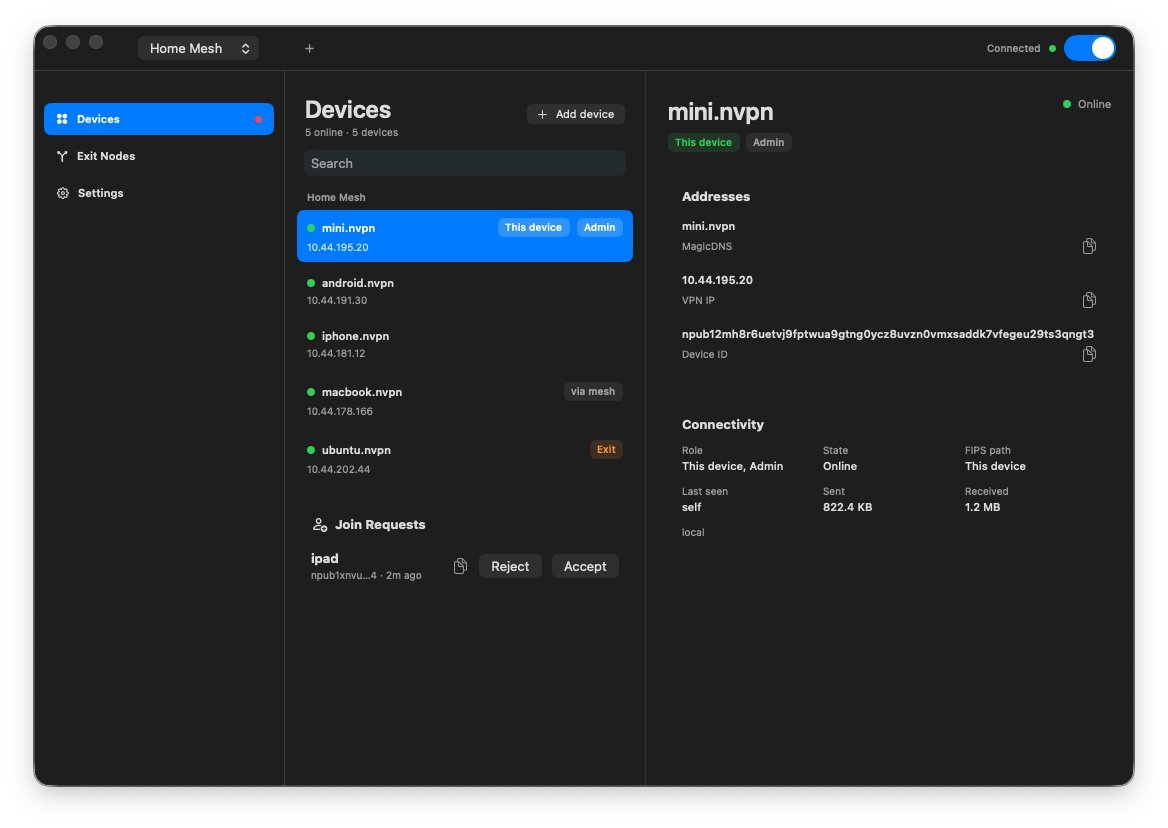

Martti Malmi, one of Bitcoin's earliest developers, just released a new version of Nostr VPN, an open-source mesh VPN that replaces the entire trust model of traditional VPN services.
Traditional VPNs route all your traffic through a central server operated by a company you have to trust. They see your data. They require your email. They can log your activity. They can be subpoenaed, hacked, or shut down. Even modern mesh VPNs like Tailscale, which improved on this by sending data peer-to-peer, still require you to authenticate through a centralized coordination server using third-party accounts like Google or Microsoft.
Nostr VPN eliminates the central server entirely. Your identity is a Nostr keypair, a self-generated cryptographic key pair with no registration, no email, no third-party account. The underlying transport layer is FIPS (Free Internetworking Peering System), a self-organizing encrypted mesh network where nodes authenticate each other, route traffic for each other, and establish connections without any central authority or global topology knowledge. Each node's Nostr public key (npub) serves as its network address.
The architecture uses two layers of encryption: hop-by-hop encryption between peers and independent end-to-end encryption between mesh endpoints with periodic rekeying for forward secrecy. When direct connections fail due to NAT issues, the system falls back to Nostr-based multihop routing through other FIPS nodes rather than relying on company-operated relay servers. Peer discovery and NAT traversal happen through public Nostr relays using encrypted gift-wrapped messages.
The new release adds native desktop apps for macOS, Linux, and Windows, an Android app, Nostr-based multihop routing for when NAT holepunching fails, and improved network management. It supports UDP, TCP, Ethernet, Tor, and Bluetooth transports simultaneously on a single mesh.
This is what happens when you apply Bitcoin's design philosophy, permissionless, self-sovereign, no trusted third parties, to networking infrastructure. Built by one of the people who helped Satoshi build Bitcoin in 2009.
6
22
109
5,146

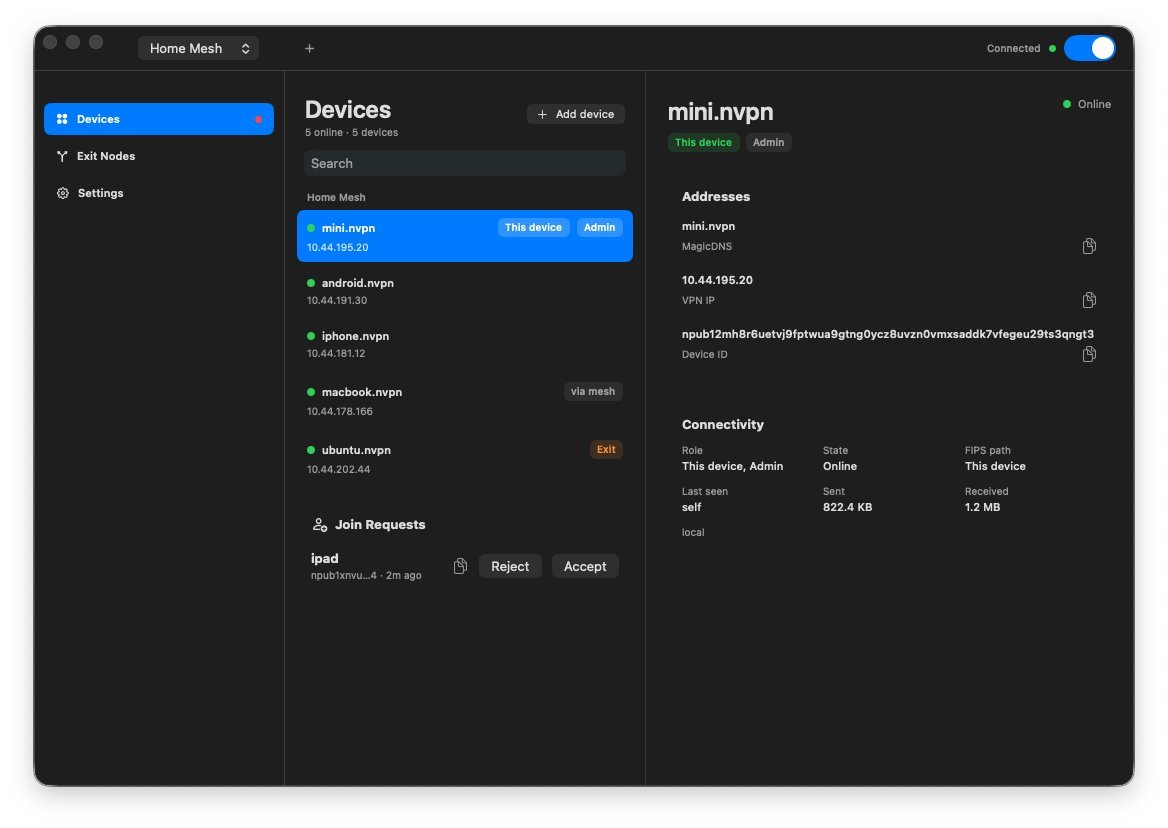
Martti Malmi, one of Bitcoin's earliest developers, just released a new version of Nostr VPN, an open-source mesh VPN that replaces the entire trust model of traditional VPN services.
Traditional VPNs route all your traffic through a central server operated by a company you have to trust. They see your data. They require your email. They can log your activity. They can be subpoenaed, hacked, or shut down. Even modern mesh VPNs like Tailscale, which improved on this by sending data peer-to-peer, still require you to authenticate through a centralized coordination server using third-party accounts like Google or Microsoft.
Nostr VPN eliminates the central server entirely. Your identity is a Nostr keypair, a self-generated cryptographic key pair with no registration, no email, no third-party account. The underlying transport layer is FIPS (Free Internetworking Peering System), a self-organizing encrypted mesh network where nodes authenticate each other, route traffic for each other, and establish connections without any central authority or global topology knowledge. Each node's Nostr public key (npub) serves as its network address.
The architecture uses two layers of encryption: hop-by-hop encryption between peers and independent end-to-end encryption between mesh endpoints with periodic rekeying for forward secrecy. When direct connections fail due to NAT issues, the system falls back to Nostr-based multihop routing through other FIPS nodes rather than relying on company-operated relay servers. Peer discovery and NAT traversal happen through public Nostr relays using encrypted gift-wrapped messages.
The new release adds native desktop apps for macOS, Linux, and Windows, an Android app, Nostr-based multihop routing for when NAT holepunching fails, and improved network management. It supports UDP, TCP, Ethernet, Tor, and Bluetooth transports simultaneously on a single mesh.
This is what happens when you apply Bitcoin's design philosophy, permissionless, self-sovereign, no trusted third parties, to networking infrastructure. Built by one of the people who helped Satoshi build Bitcoin in 2009.
93
748
3,285
283,387

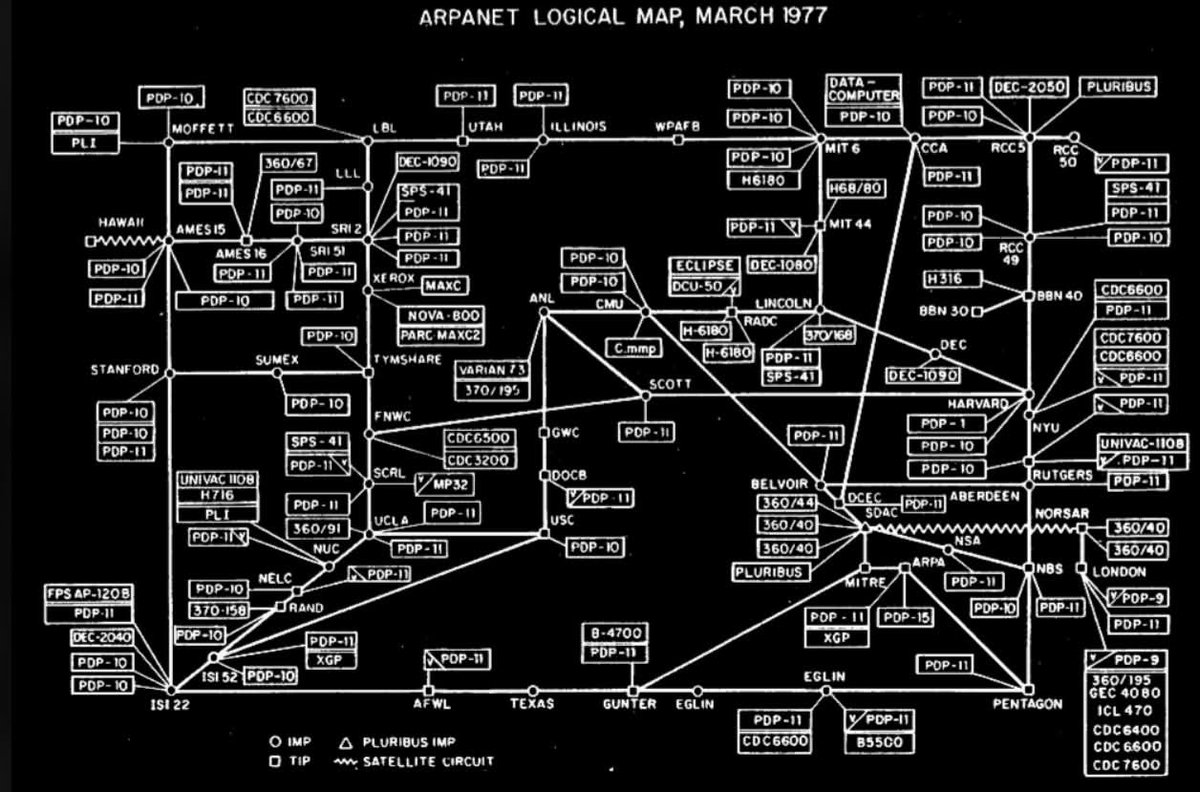
The entire internet in 1977: A network map of ARPANET, the precursor to the internet, showing all 111 computer terminals...
This diagram shows ARPANET, the U.S. Department of Defense–funded network that became the technical foundation of today’s internet.
At the time, ARPANET connected 111 nodes (often called hosts), spread across universities, research labs, and military sites. Key hubs included MIT, Stanford University, UCLA, and defense-linked facilities like RAND Corporation. Each node typically represented a large mainframe computer—machines that could cost millions of dollars and serve dozens of users at once.
The network relied on packet switching, a method developed in the late 1960s that broke data into small packets and routed them independently, far more resilient than traditional circuit-based communication. Specialized machines called Interface Message Processors (IMPs), early routers, handled traffic between sites.
By 1977, ARPANET had already expanded beyond the continental U.S., with satellite links to Hawaii and connections to Norway and the UK, marking the first steps toward a global network.
In that same year, engineers conducted a landmark test transmitting data seamlessly across three different networks, ARPANET, a packet radio network, and a satellite network, demonstrating the concept of “internetworking,” the principle that would define the modern internet.
© Reddit
#drthehistories
1
26
70
4,486

例えば IBM の z/VM の internetworking 記事
ibm.com/docs/en/zvm/7.2.0?to…
で
“This definition of a gateway is very different from the one used in general network terms where it is used to describe the function of a machine that links different network architectures. ”
と補足されてますね
1
2
2
343