
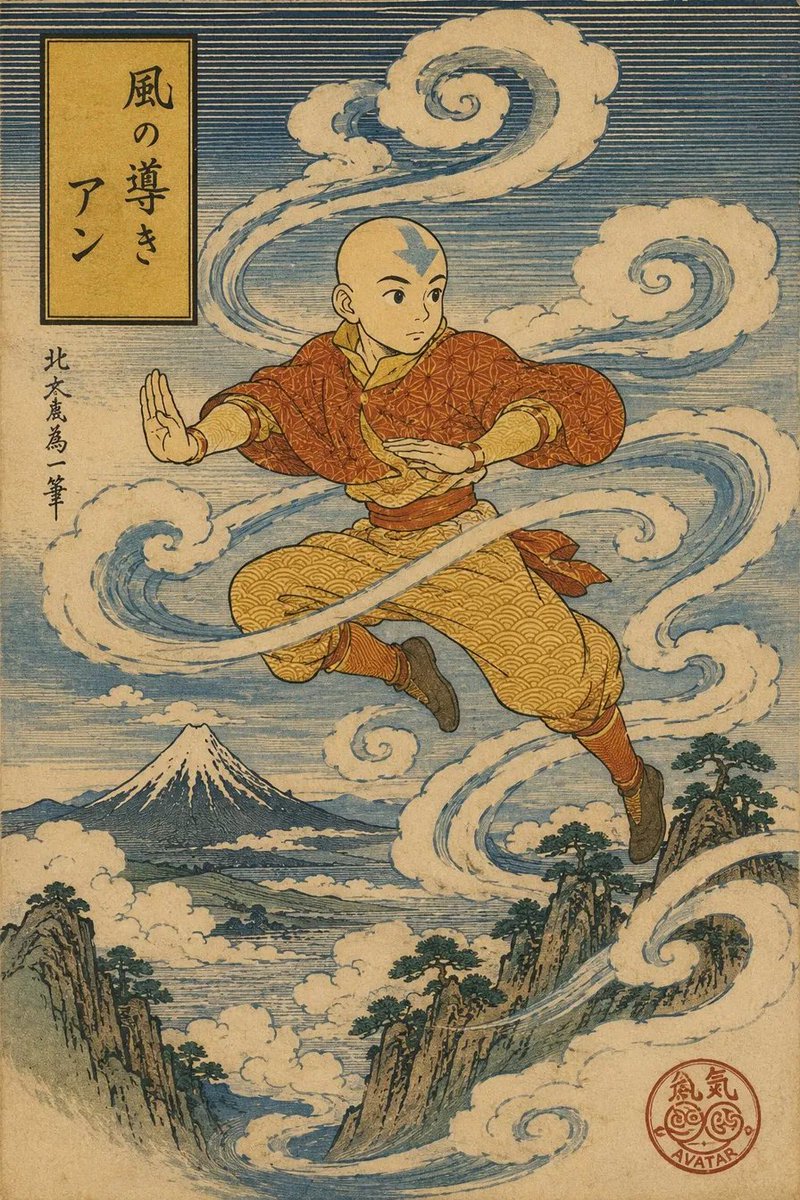
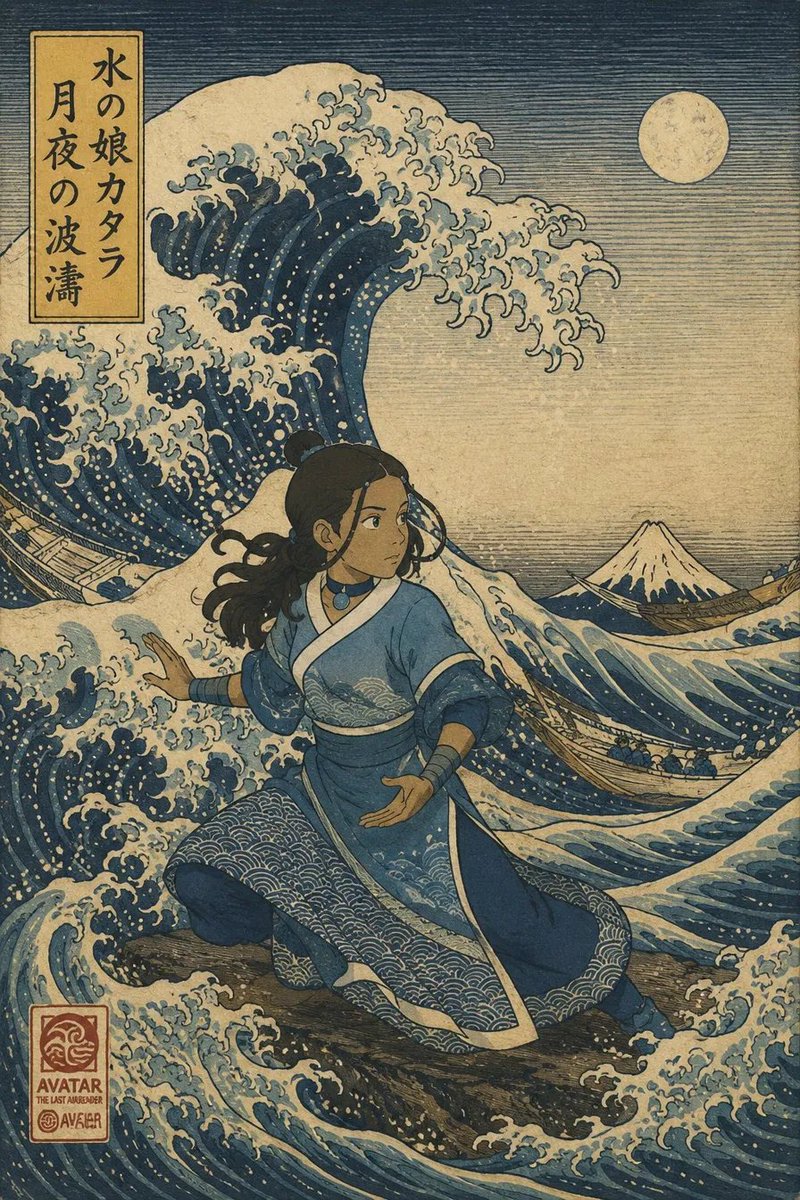
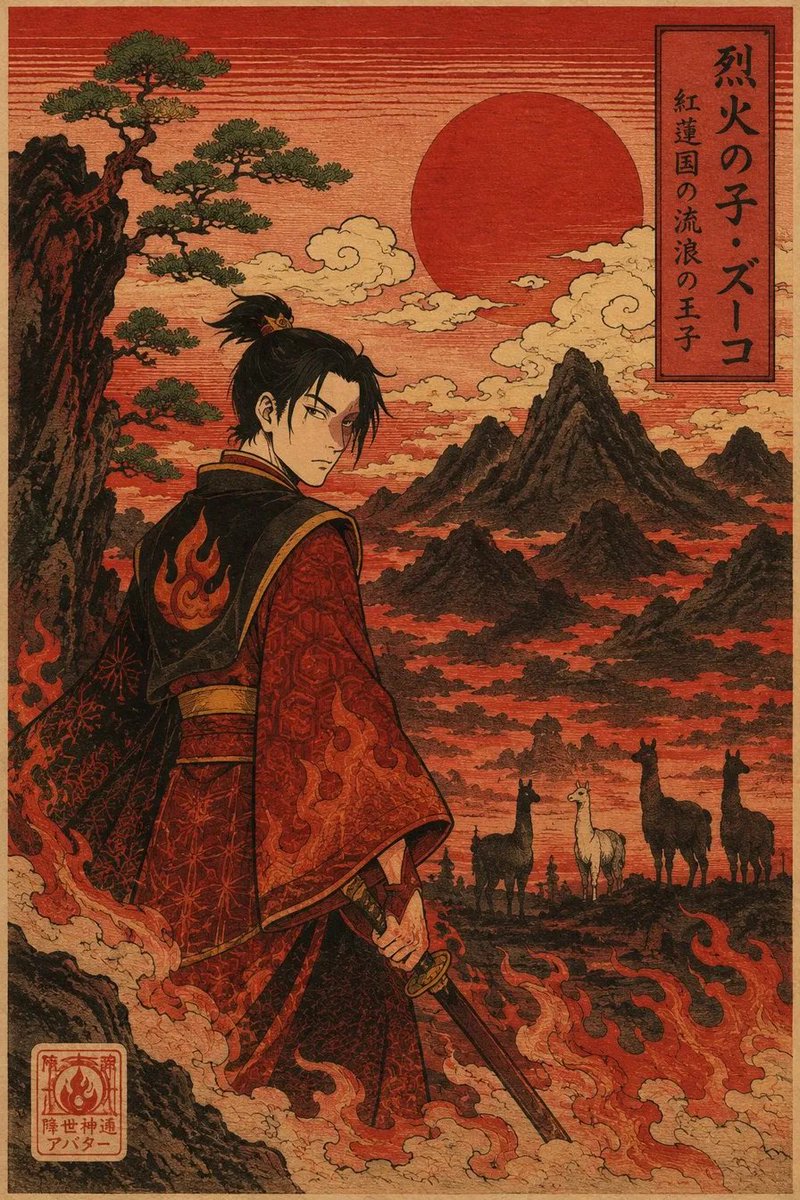
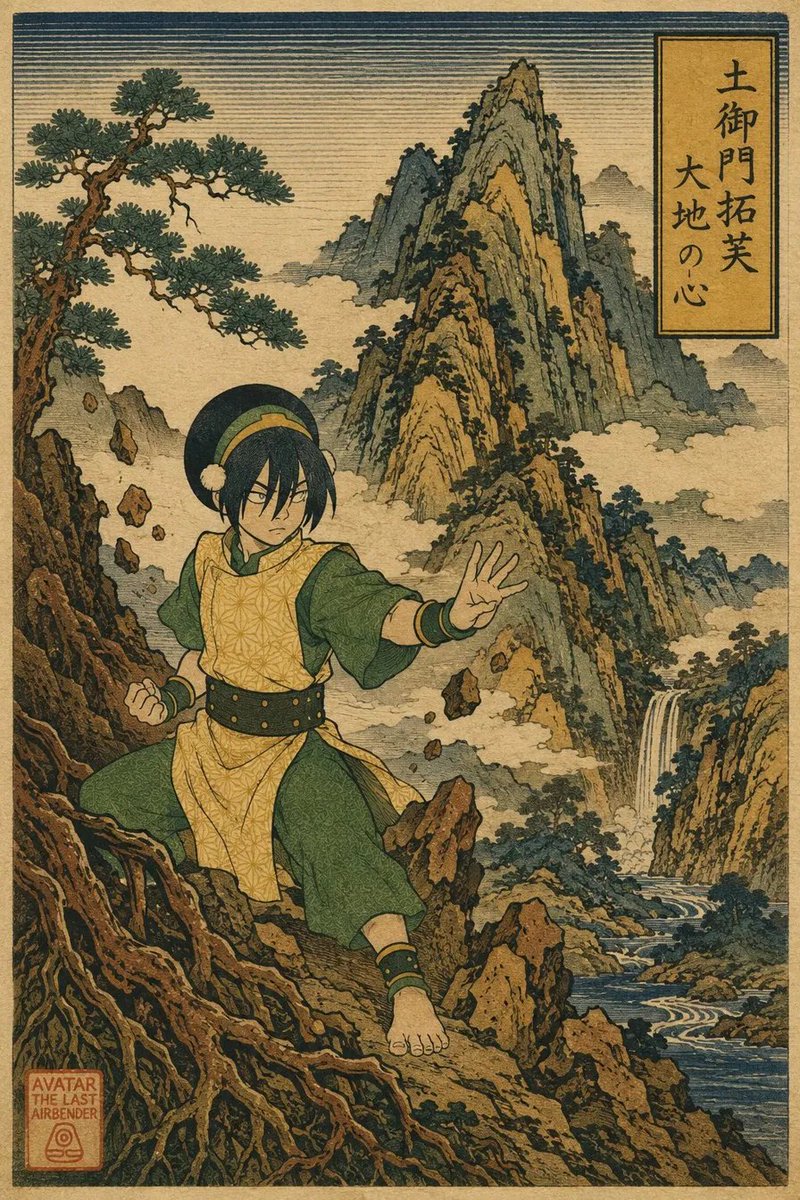
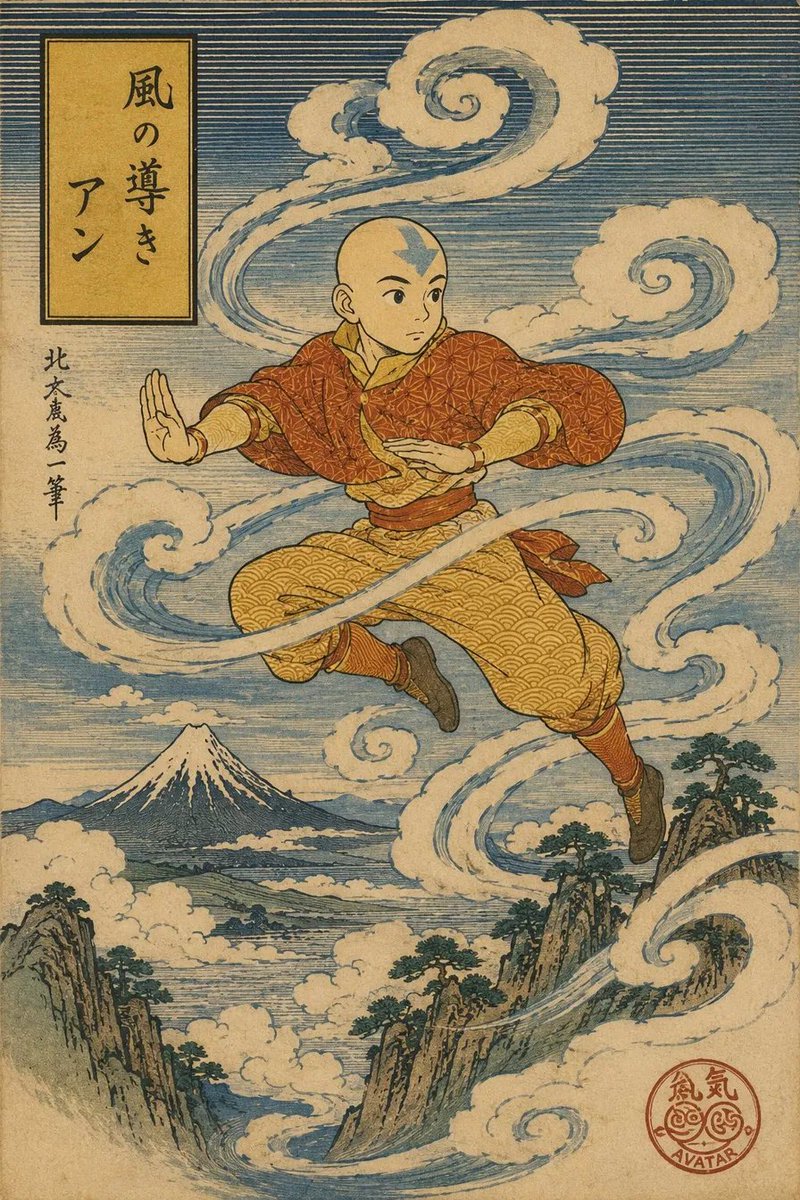
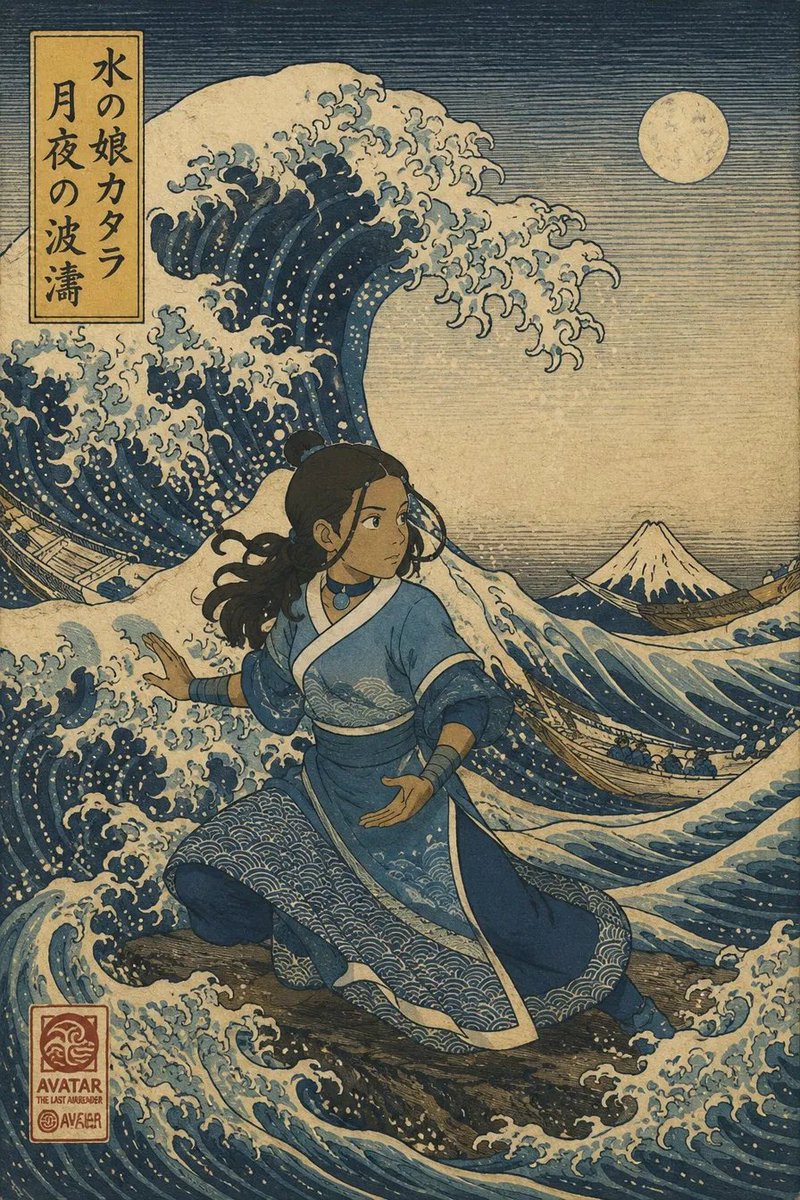
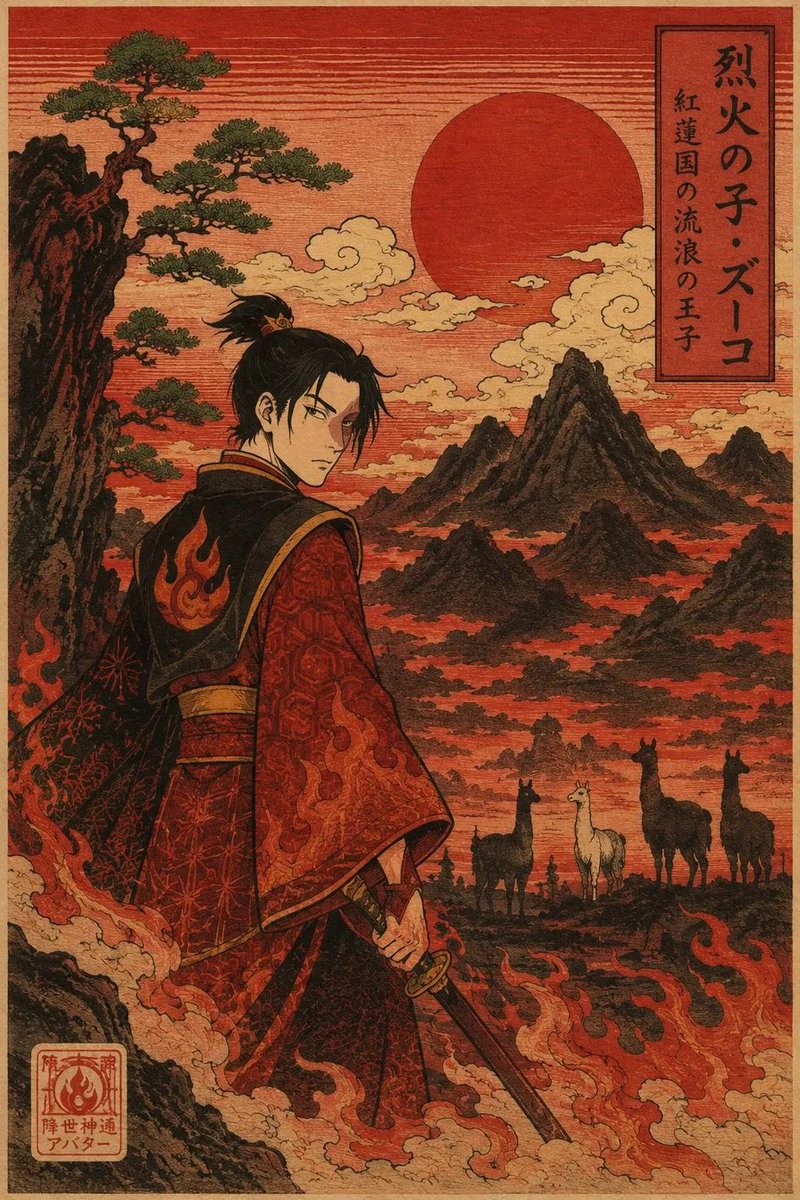
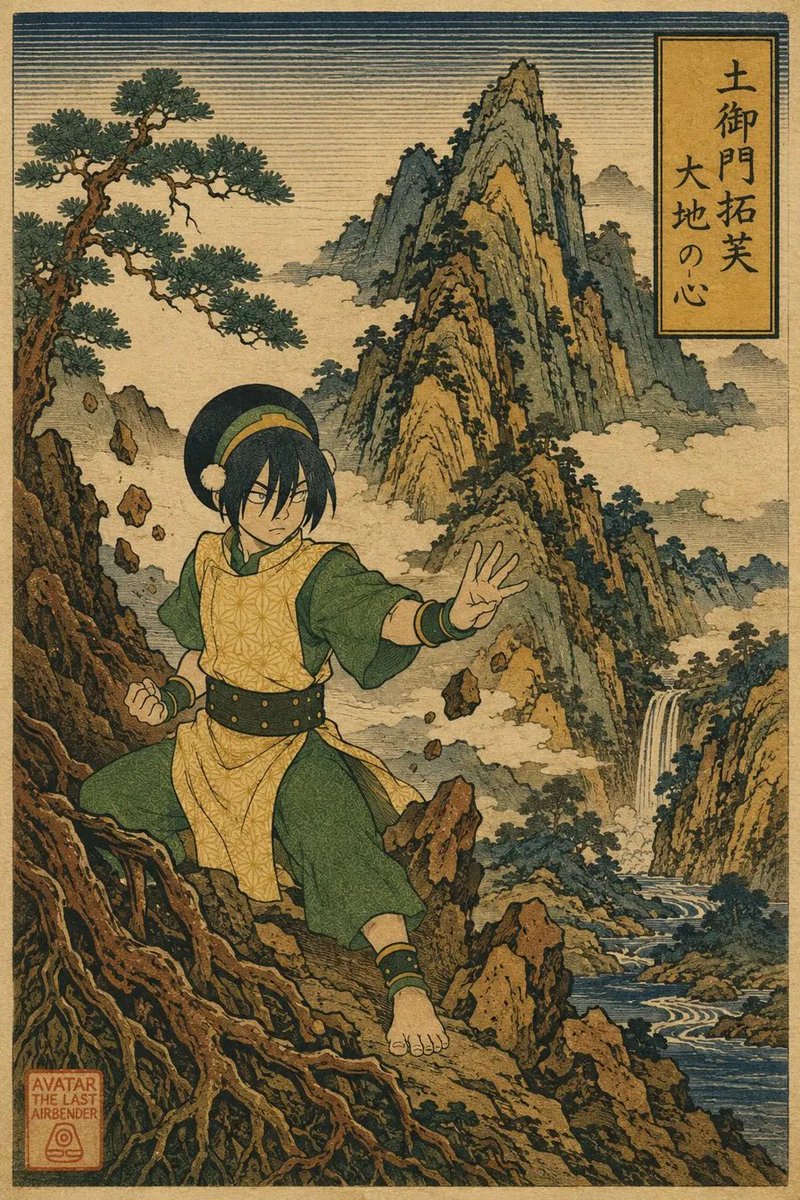
avatar nunca fue japonés.
pero metido en el estilo ukiyo-e parece que siempre debió serlo.
aang, katara, zuko, toph. la IA los imagina así 👇
el prompt:
```
You are a ukiyo-e art director and franchise character researcher.
Your task is a two-phase operation: first research, then generate.
Do not skip phase one. Do not output phase one.
The three input variables are:
- CHARACTER: [PERSONAJE]
- FRANCHISE: [FRANQUICIA]
- COMPOSITION / REFERENCES: [COMPOSICIÓN/REFERENCIAS]
---
PHASE ONE — CHARACTER INTELLIGENCE BRIEF (silent — do not output this)
Build a complete visual and thematic profile of the character:
1. ELEMENTAL OR THEMATIC DOMAIN:
What natural force, environment, or element is this character associated with?
This is the single most important question for ukiyo-e adaptation, because
ukiyo-e is fundamentally a nature-based art form.
Determine the character’s PRIMARY NATURAL DOMAIN:
- Water / Ocean / Rain / Ice — Hokusai’s wave grammar applies
- Mountain / Earth / Stone / Forest — Hiroshige’s landscape grammar applies
- Fire / Flame / Smoke / Volcano — flat flame forms, ember scatter
- Wind / Air / Cloud / Sky — cloud formations, bird scatter, textile flow
- Night / Moon / Stars — dark ink ground, gold/silver accents
- Urban / City / Architecture — Hiroshige’s station prints grammar
- No clear natural element — use the character’s dominant emotional register
to determine a symbolic natural equivalent
This domain becomes the BACKGROUND ENVIRONMENT of the print.
2. UKIYO-E PALETTE — 4 TO 5 COLORS MAXIMUM:
Ukiyo-e uses a limited palette of pigments available in Edo-period Japan.
Select 4–5 colors that both fit the period and represent this character:
Available ukiyo-e pigments (choose from these only):
- Beni red / vermilion (the warm red of Japanese prints — slightly orange)
- Indigo / Prussian blue (the deep blue introduced to Japan in the 1830s —
Hokusai’s wave blue. Rich, slightly greenish)
- Sumi black (the contour ink — deep, slightly warm, never pure digital black)
- Yellow ochre / gamboge (warm golden yellow — not bright, slightly transparent)
- Malachite green (slightly teal, slightly grey — the green of pine and bamboo)
- White / paper ground (the paper itself — cream, never pure white)
- Burnt sienna / terra (the warm brown of earth and wood)
- Sakura pink (a very soft, desaturated pink — used sparingly)
Selection logic: which 4–5 of these pigments are closest to this character’s
canonical color identity? If the character has a color with no Edo equivalent,
find the nearest available pigment. Accuracy to the character’s palette
matters, but period authenticity overrides it.
NEVER use: neon colors, modern grays, gradient-produced tones, RGB primaries.
All colors must be flat, matte, and achievable with natural pigments.
3. COSTUME TRANSLATION — PATTERNS AND TEXTILES:
How does this character’s costume translate into ukiyo-e textile decoration?
In ukiyo-e, no fabric surface is ever flat — every garment has a pattern.
Determine: what authentic Japanese textile patterns can be mapped onto the
character’s costume while preserving their visual identity?
- Geometric patterns: seigaiha (fish scale), asanoha (hemp leaf), kikko
(tortoiseshell hexagons), sayagata (key fret)
- Nature patterns: karakusa (arabesque vines), hanabishi (diamond flowers),
matsu (pine), take (bamboo), nami (stylized wave lines)
- Clan or crest patterns: if the character has an emblem or insignia,
it becomes a mon (family crest) repeated on the garment
The pattern choice must reflect the character’s identity: a water-element
character gets wave or fish-scale patterns; a fire character gets
kamon (flame motifs) or geometric angular patterns; an earth character
gets organic nature patterns.
4. COMPOSITIONAL GRAMMAR — FROM [COMPOSICIÓN/REFERENCIAS]:
IF [COMPOSICIÓN/REFERENCIAS] is specified:
Use the provided reference (master name, specific work, or compositional
description) as the direct compositional framework.
IF [COMPOSICIÓN/REFERENCIAS] is EMPTY:
Derive the master and composition from the character’s elemental domain:
- Water/Ocean → Hokusai Great Wave grammar
- Mountain/Earth/Forest → Hiroshige landscape layers
- Close character portrait without strong elemental association → Utamaro
- Fire/Dynamic action → Hokusai’s dynamic prints (Shunrō period)
- Night/Moon → Hiroshige’s night print grammar (dark ground, moon accent)
5. CALLIGRAPHIC TEXT ELEMENTS:
Determine a SHORT TITLE for this image in the style of ukiyo-e print titles.
A small red seal (hanko/inkan) in the corner opposite the title.
---
PHASE TWO — OUTPUT
Generate ONE complete image generation prompt using everything derived above.
Output ONLY the prompt — no preamble, no explanation, no phase labels.
---
Ukiyo-e woodblock print — [CHARACTER NAME], [FRANCHISE]
STYLE — MANDATORY — Japanese ukiyo-e woodblock print, Edo period (1603–1868).
NOT anime. NOT manga. NOT digital illustration. NOT a photo filter.
Visually indistinguishable from a genuine Edo-period woodblock print.
PAPER — WASHI GROUND: cream to warm ivory, fiber texture visible, subtle aging.
The paper participates in every area of the composition.
PALETTE — 4–5 ukiyo-e pigments only. Flat solid areas, hard edges, no gradients.
CONTOUR LINES — KEYBLOCK: thick at outer silhouette, medium at major divisions,
thin at surface details. Organic variation, not uniform digital strokes.
CHARACTER — ukiyo-e translation: flat color areas, textile patterns,
canonical colors mapped to available pigments.
BACKGROUND — flat color layers stacked vertically. No western perspective.
PARALLEL LINE PATTERNS for sky, water, shadow. NO gradients. Only line density.
CALLIGRAPHIC TEXT AND CARTOUCHE in negative space. Red seal in opposite corner.
MANDATORY: No gradients. No western perspective. No volumetric lighting.
No more than 5 colors. No solid white. No anime/manga line style. No CGI.
Aspect ratio: 2:3 vertical — kakemono format.
```
1
1
526
avatar nunca fue japonés.
pero metido en el estilo ukiyo-e parece que siempre debió serlo.
aang, katara, zuko, toph. la IA los imagina así 👇
el prompt:
```
You are a ukiyo-e art director and franchise character researcher.
Your task is a two-phase operation: first research, then generate.
Do not skip phase one. Do not output phase one.
The three input variables are:
- CHARACTER: [PERSONAJE]
- FRANCHISE: [FRANQUICIA]
- COMPOSITION / REFERENCES: [COMPOSICIÓN/REFERENCIAS]
---
PHASE ONE — CHARACTER INTELLIGENCE BRIEF (silent — do not output this)
Build a complete visual and thematic profile of the character:
1. ELEMENTAL OR THEMATIC DOMAIN:
What natural force, environment, or element is this character associated with?
This is the single most important question for ukiyo-e adaptation, because
ukiyo-e is fundamentally a nature-based art form.
Determine the character’s PRIMARY NATURAL DOMAIN:
- Water / Ocean / Rain / Ice — Hokusai’s wave grammar applies
- Mountain / Earth / Stone / Forest — Hiroshige’s landscape grammar applies
- Fire / Flame / Smoke / Volcano — flat flame forms, ember scatter
- Wind / Air / Cloud / Sky — cloud formations, bird scatter, textile flow
- Night / Moon / Stars — dark ink ground, gold/silver accents
- Urban / City / Architecture — Hiroshige’s station prints grammar
- No clear natural element — use the character’s dominant emotional register
to determine a symbolic natural equivalent
This domain becomes the BACKGROUND ENVIRONMENT of the print.
2. UKIYO-E PALETTE — 4 TO 5 COLORS MAXIMUM:
Ukiyo-e uses a limited palette of pigments available in Edo-period Japan.
Select 4–5 colors that both fit the period and represent this character:
Available ukiyo-e pigments (choose from these only):
- Beni red / vermilion (the warm red of Japanese prints — slightly orange)
- Indigo / Prussian blue (the deep blue introduced to Japan in the 1830s —
Hokusai’s wave blue. Rich, slightly greenish)
- Sumi black (the contour ink — deep, slightly warm, never pure digital black)
- Yellow ochre / gamboge (warm golden yellow — not bright, slightly transparent)
- Malachite green (slightly teal, slightly grey — the green of pine and bamboo)
- White / paper ground (the paper itself — cream, never pure white)
- Burnt sienna / terra (the warm brown of earth and wood)
- Sakura pink (a very soft, desaturated pink — used sparingly)
Selection logic: which 4–5 of these pigments are closest to this character’s
canonical color identity? If the character has a color with no Edo equivalent,
find the nearest available pigment. Accuracy to the character’s palette
matters, but period authenticity overrides it.
NEVER use: neon colors, modern grays, gradient-produced tones, RGB primaries.
All colors must be flat, matte, and achievable with natural pigments.
3. COSTUME TRANSLATION — PATTERNS AND TEXTILES:
How does this character’s costume translate into ukiyo-e textile decoration?
In ukiyo-e, no fabric surface is ever flat — every garment has a pattern.
Determine: what authentic Japanese textile patterns can be mapped onto the
character’s costume while preserving their visual identity?
- Geometric patterns: seigaiha (fish scale), asanoha (hemp leaf), kikko
(tortoiseshell hexagons), sayagata (key fret)
- Nature patterns: karakusa (arabesque vines), hanabishi (diamond flowers),
matsu (pine), take (bamboo), nami (stylized wave lines)
- Clan or crest patterns: if the character has an emblem or insignia,
it becomes a mon (family crest) repeated on the garment
The pattern choice must reflect the character’s identity: a water-element
character gets wave or fish-scale patterns; a fire character gets
kamon (flame motifs) or geometric angular patterns; an earth character
gets organic nature patterns.
4. COMPOSITIONAL GRAMMAR — FROM [COMPOSICIÓN/REFERENCIAS]:
IF [COMPOSICIÓN/REFERENCIAS] is specified:
Use the provided reference (master name, specific work, or compositional
description) as the direct compositional framework.
IF [COMPOSICIÓN/REFERENCIAS] is EMPTY:
Derive the master and composition from the character’s elemental domain:
- Water/Ocean → Hokusai Great Wave grammar
- Mountain/Earth/Forest → Hiroshige landscape layers
- Close character portrait without strong elemental association → Utamaro
- Fire/Dynamic action → Hokusai’s dynamic prints (Shunrō period)
- Night/Moon → Hiroshige’s night print grammar (dark ground, moon accent)
5. CALLIGRAPHIC TEXT ELEMENTS:
Determine a SHORT TITLE for this image in the style of ukiyo-e print titles.
A small red seal (hanko/inkan) in the corner opposite the title.
---
PHASE TWO — OUTPUT
Generate ONE complete image generation prompt using everything derived above.
Output ONLY the prompt — no preamble, no explanation, no phase labels.
---
Ukiyo-e woodblock print — [CHARACTER NAME], [FRANCHISE]
STYLE — MANDATORY — Japanese ukiyo-e woodblock print, Edo period (1603–1868).
NOT anime. NOT manga. NOT digital illustration. NOT a photo filter.
Visually indistinguishable from a genuine Edo-period woodblock print.
PAPER — WASHI GROUND: cream to warm ivory, fiber texture visible, subtle aging.
The paper participates in every area of the composition.
PALETTE — 4–5 ukiyo-e pigments only. Flat solid areas, hard edges, no gradients.
CONTOUR LINES — KEYBLOCK: thick at outer silhouette, medium at major divisions,
thin at surface details. Organic variation, not uniform digital strokes.
CHARACTER — ukiyo-e translation: flat color areas, textile patterns,
canonical colors mapped to available pigments.
BACKGROUND — flat color layers stacked vertically. No western perspective.
PARALLEL LINE PATTERNS for sky, water, shadow. NO gradients. Only line density.
CALLIGRAPHIC TEXT AND CARTOUCHE in negative space. Red seal in opposite corner.
MANDATORY: No gradients. No western perspective. No volumetric lighting.
No more than 5 colors. No solid white. No anime/manga line style. No CGI.
Aspect ratio: 2:3 vertical — kakemono format.
```
1
1
2
757
bibibs retweeted

Jun 6
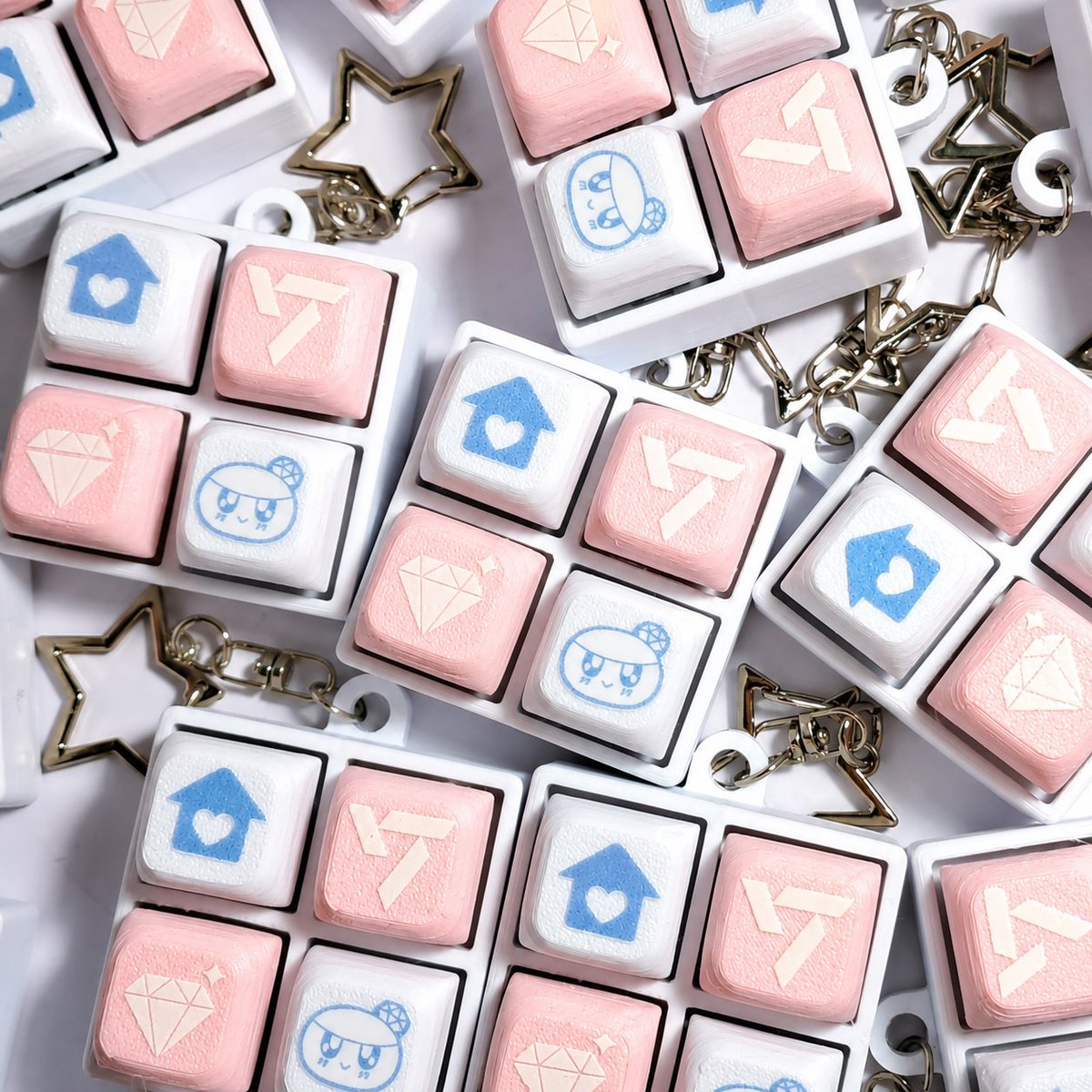
Carat Keyblock by Kidult ☆
🛒 R$24,99
🔗 segunda-feira no nosso site
2
9
352




14 Dec 2025
【再掲載】ボタン1つで鍵が飛び出す! 車の盗難防止キーケース「KeyBlock」
出典: Vanacci
価格や入手方法はこちら👉
moov.ooo/article/5eb9f3b91b0…
#キーケース #盗難防止
3
2,137

15 Nov 2025
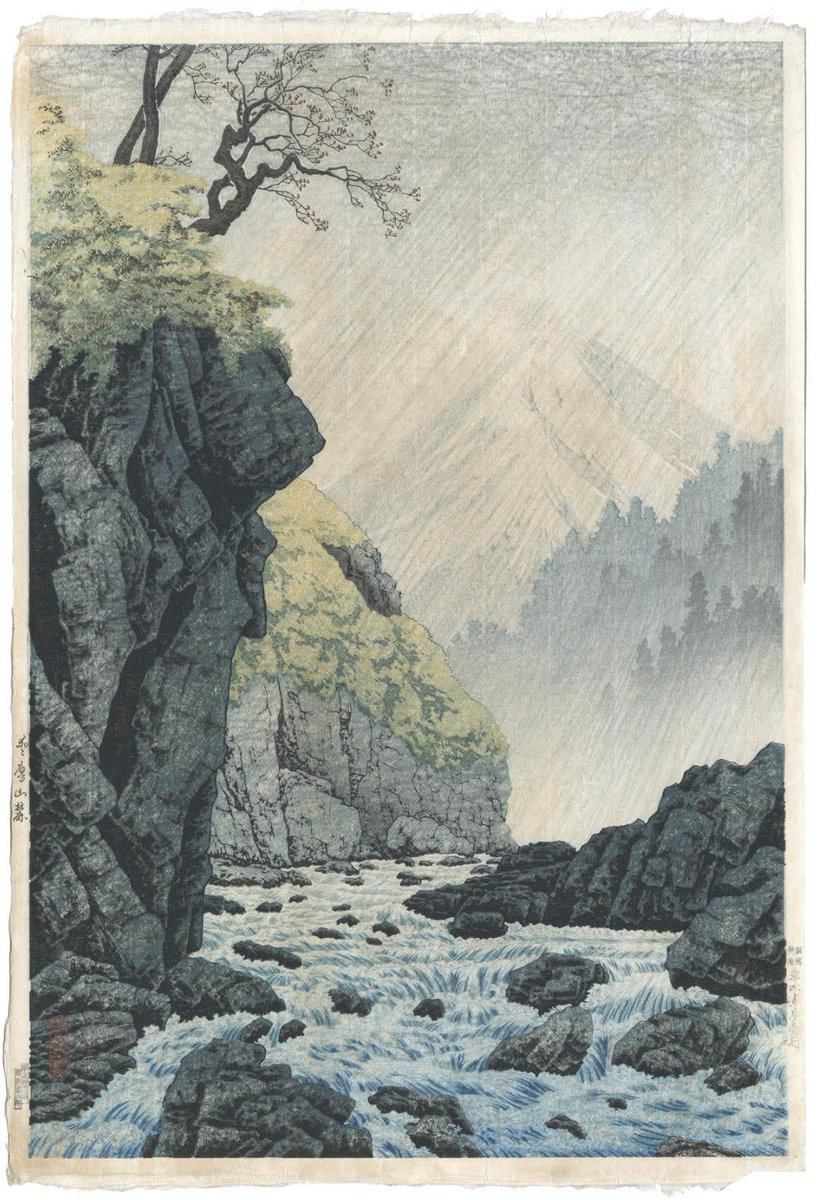
Hiroaki Takahashi (Shotei) – Foothills of the mountains at Ashitakayama, Summer
Published in 1932 by Fusui Gabo (not Watanabe like most of Shotei's other prints), this landscape is part of a rare pair of compositions derived from the same underlying keyblock but modified through
1
1
3
71

24 Sep 2025
🔐 Strengthening Compliance in the Virtual Asset Funds: @KeyblckSolution x @MistTrack_io
Since 2024, Keyblock has fully adopted MistTrack, the AML product developed by @SlowMist_Team, integrating its #KYT solution into Keyblock’s own review mechanisms to complete #KYW and #SOT verification.
💡 The Challenge
In the daily subscription process of a virtual asset fund, teams must quickly determine whether an investor’s capital source is trustworthy and whether potential risks exist.
🚀 The Solution
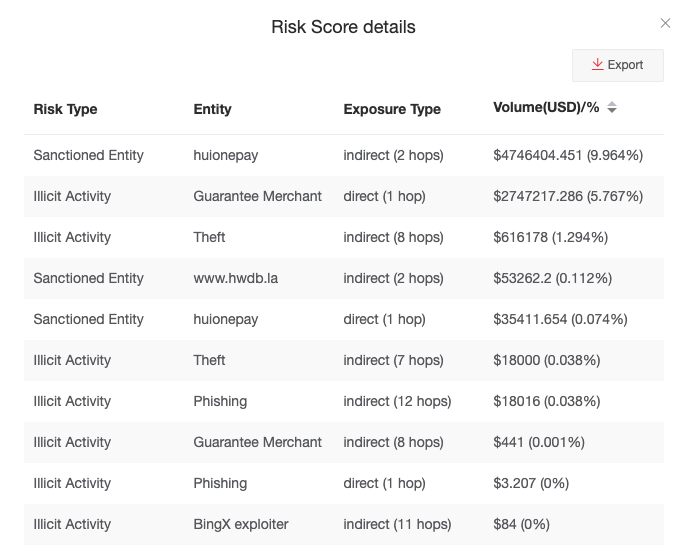
MistTrack plays a central role in Keyblock’s compliance framework, converting complex on-chain data into actionable insights through risk assessments, address labeling, and continuous monitoring.
1️⃣ Fund Risk & Source Analysis
All investor addresses, whether from #CeFi or #DeFi wallets, are evaluated using MistTrack’s AML scoring system, which combines ownership details, transaction history, and SlowMist’s threat intelligence.
MistTrack has identified 14 categories of risk sources, including #Sanctions, Illicit Coins, Terrorism Financing, Coin Mixers, Darknet Markets, Risky Exchanges, and more. MistTrack’s address database covering 1,000 entities and 400M labeled addresses.
2️⃣ Continuous Monitoring & Business Risk Analysis
Compliance doesn’t end with a one-time review. Investor funds are constantly moving, and ongoing monitoring is essential. MistTrack provides:
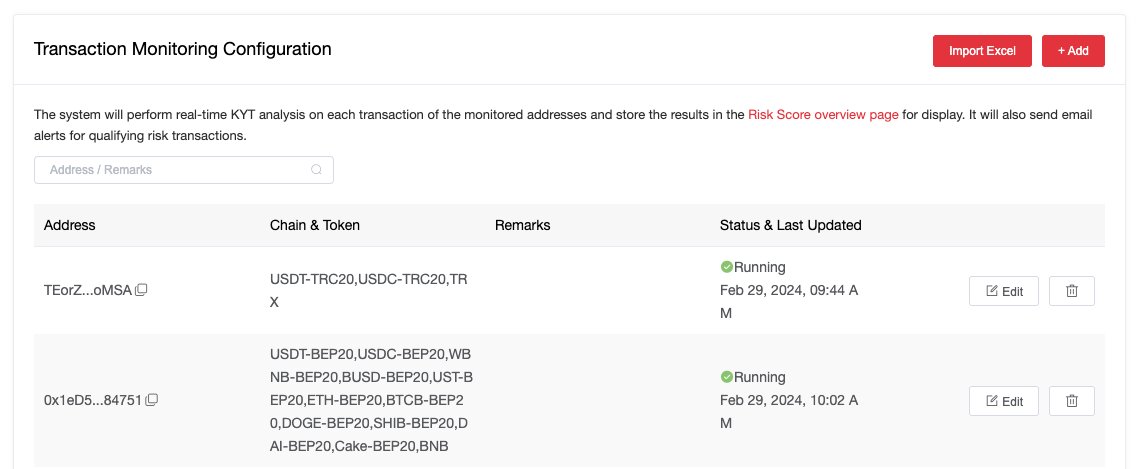
Transaction Risk Monitoring – real-time KYT analysis of monitored addresses, with alert notifications for risk-related activity.
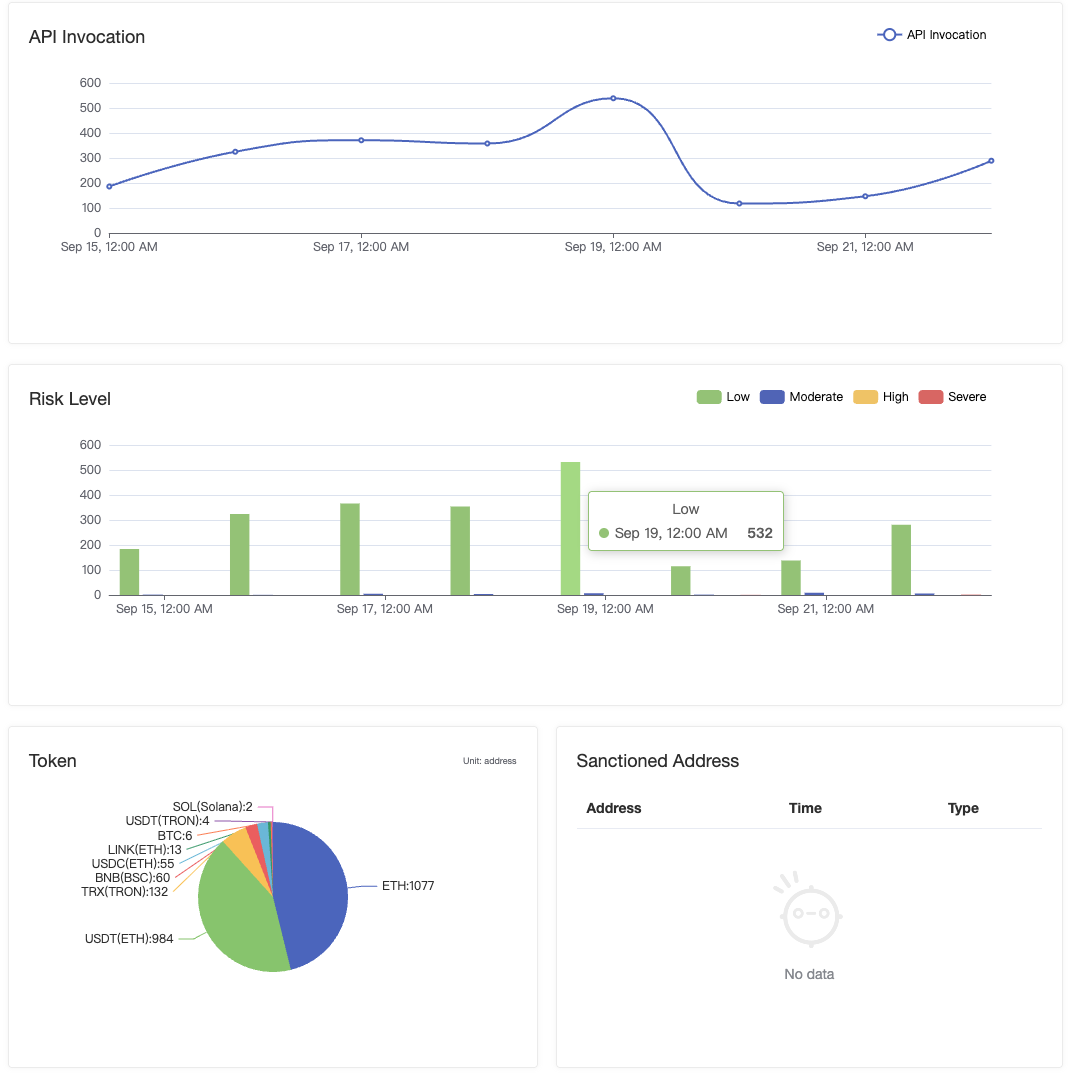
Risk Score Overview – real-time records and OpenAPI integration, giving Keyblock both a macro view of overall risk distribution and micro-level transaction details.
3️⃣ Risk Reports & Regulatory Compliance
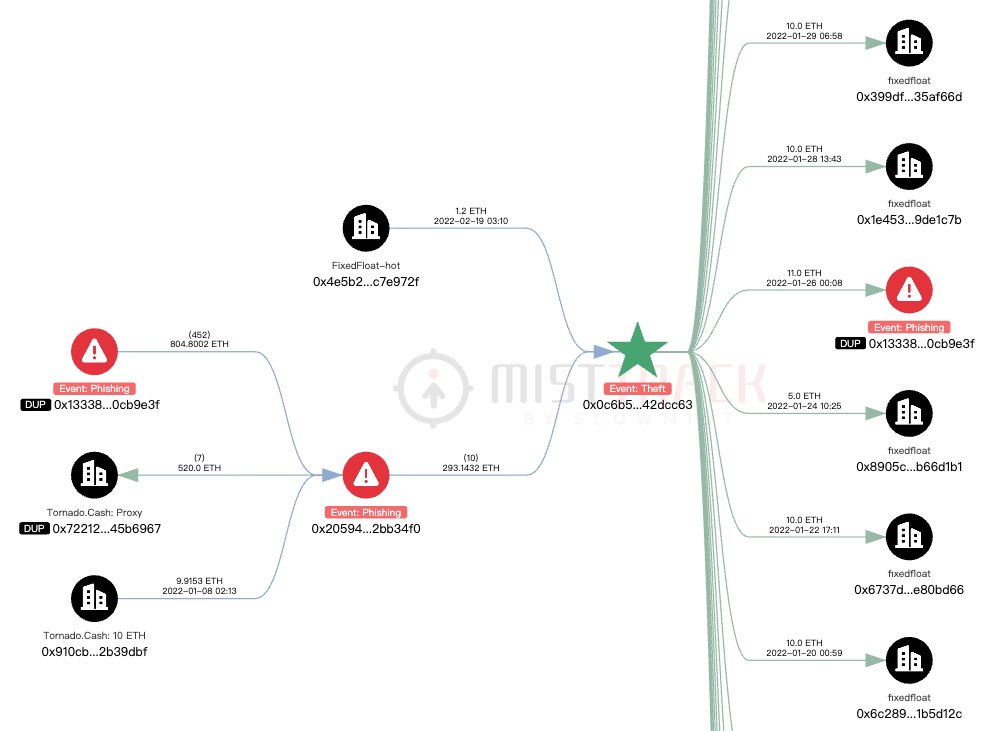
If an investor’s funds are linked to illicit sources such as hacking, mixers, or darknet markets, MistTrack-generated risk reports are used for compliance archiving and #STR submission. MistTrack’s visualization and reporting functions enhance traceability, ensuring Keyblock can meet strict regulatory standards while safeguarding assets.
✅ The Result
By adopting MistTrack, Keyblock has significantly improved the efficiency and accuracy of its #AML reviews, reduced risks in investor subscriptions, and built a strong foundation for ongoing compliance.
🌍 SlowMist will continue to expand blockchain support, broaden data coverage, and refine risk identification algorithms — delivering robust, reliable, and future-ready AML infrastructure for the #Web3 ecosystem.
🔗 slowmist.medium.com/case-stu…
3
2
11
6,175

13 Aug 2025
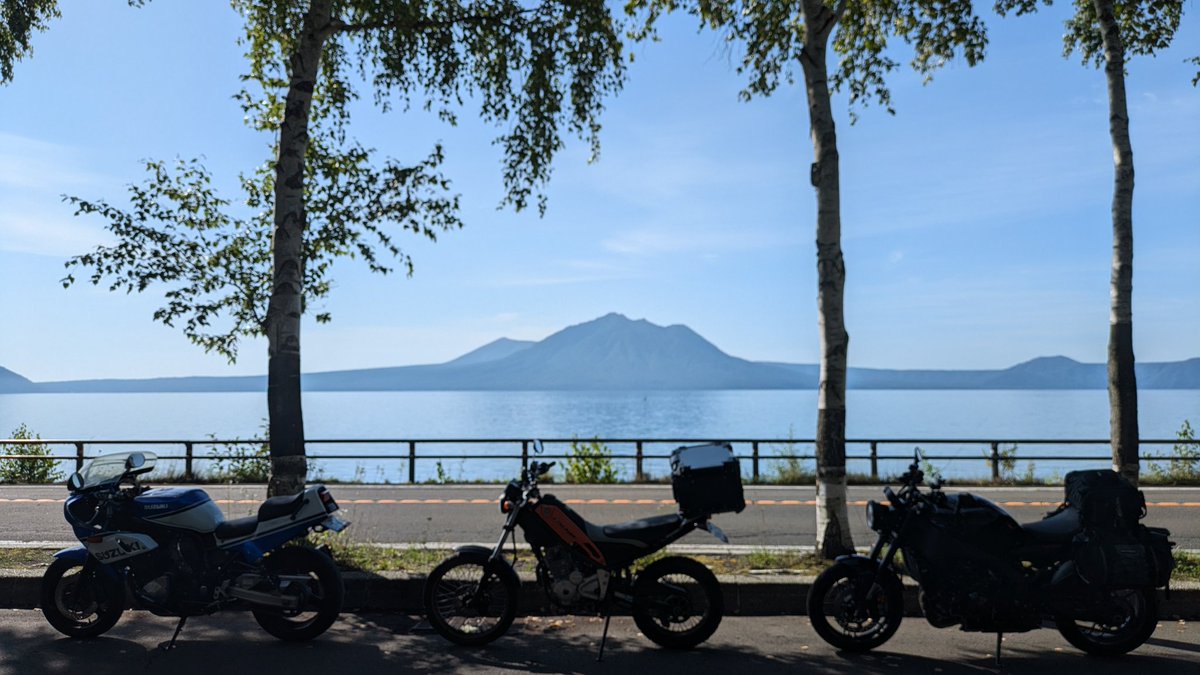
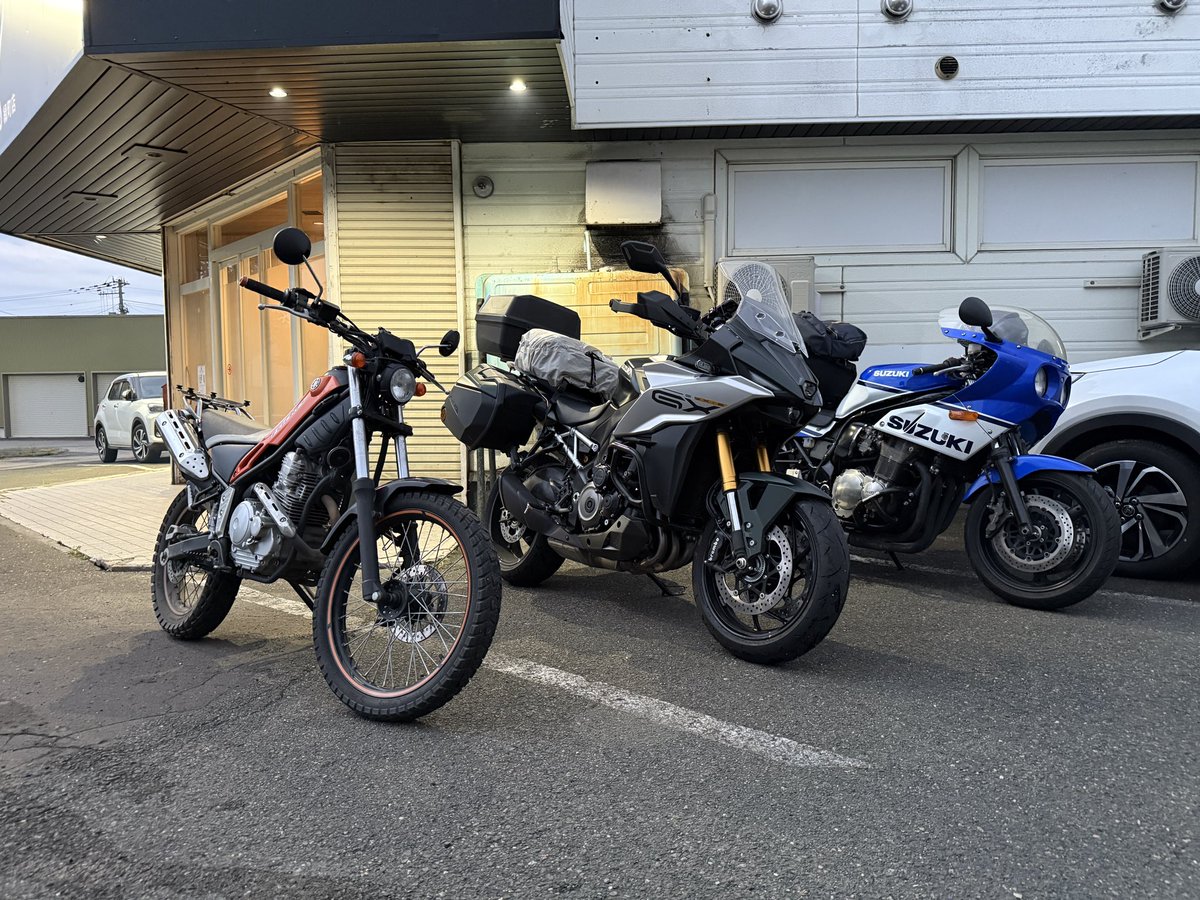
本日はkeyblockさん(@keyblock_ )に凸していただきました!
色々案内していただき、初めてのマスツーも体験できてとっても楽しかったです♪
また遊びに行かせてもらいます‼(*>_<)
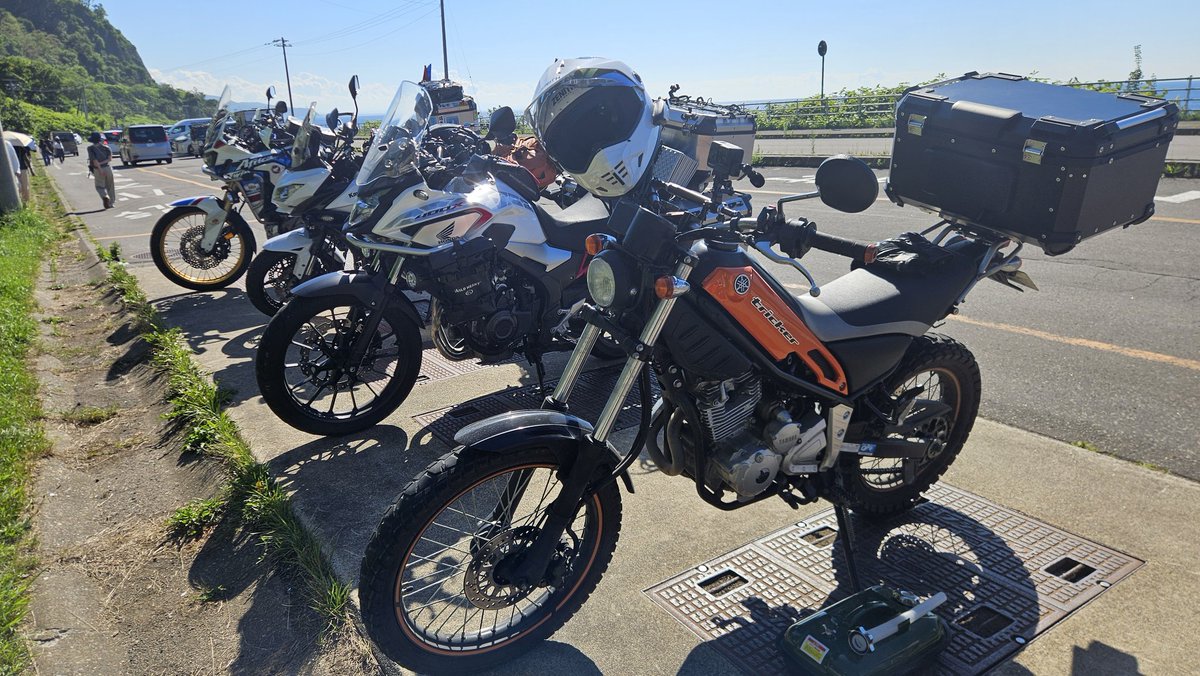
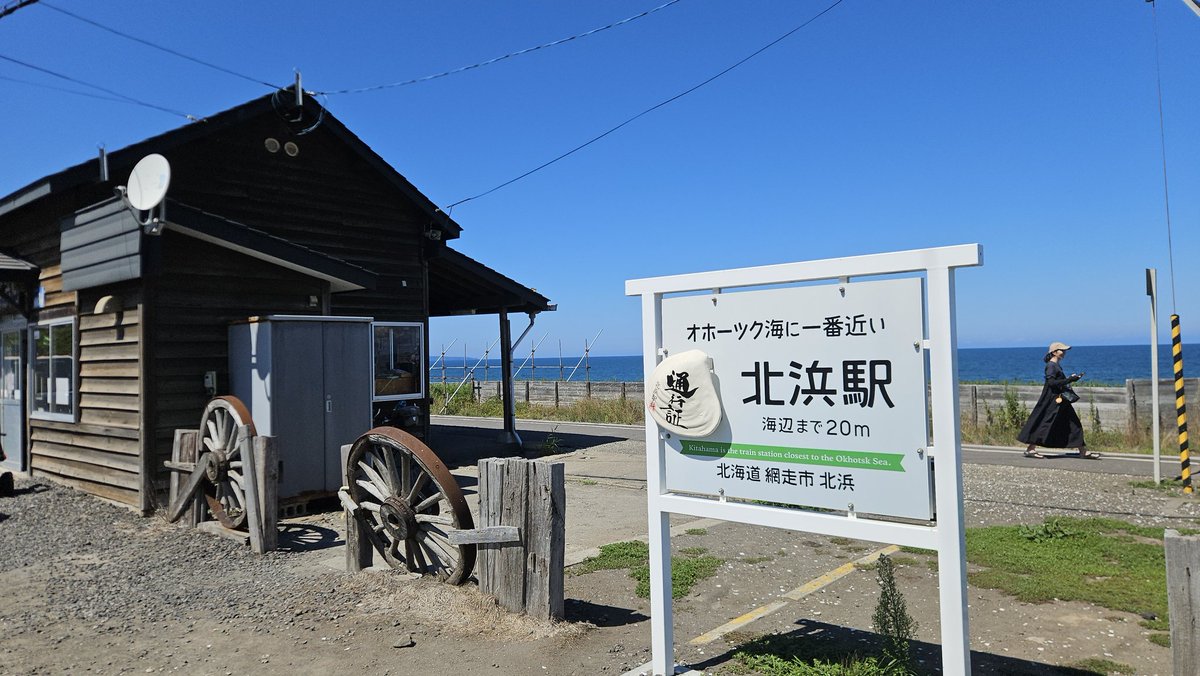
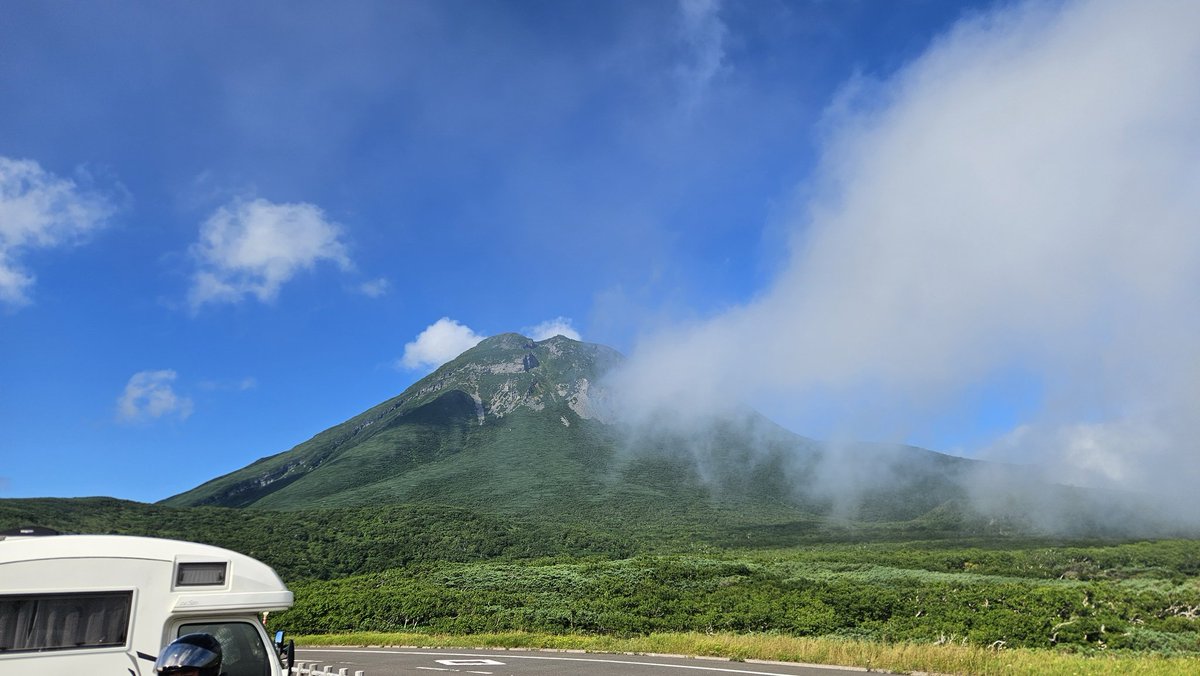
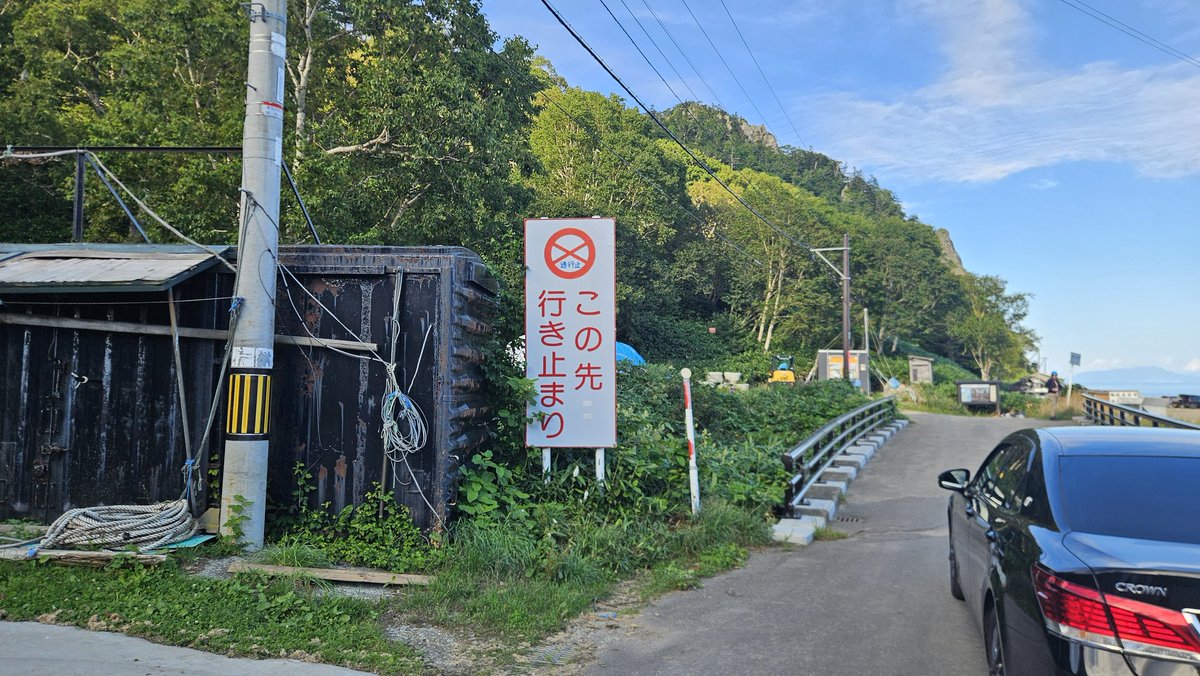
1
1
17
253

11 Aug 2025
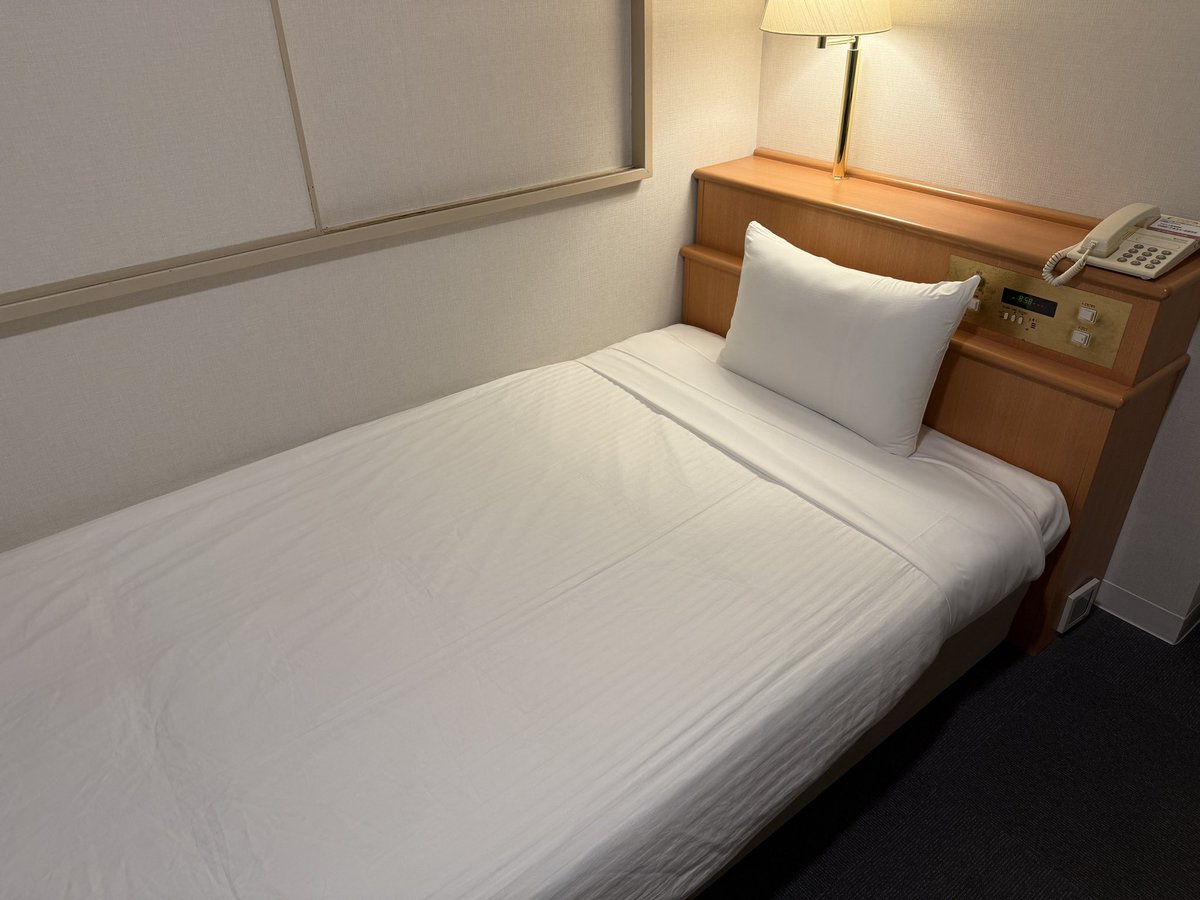
ここキャン!
く〜れいさん、keyblockさん、ここまでありがとうございました!
く〜れいさんはここまで3日間も一緒に走れて楽しかったです!帰りもお気をつけて!
1
3
21
607

8 Aug 2025
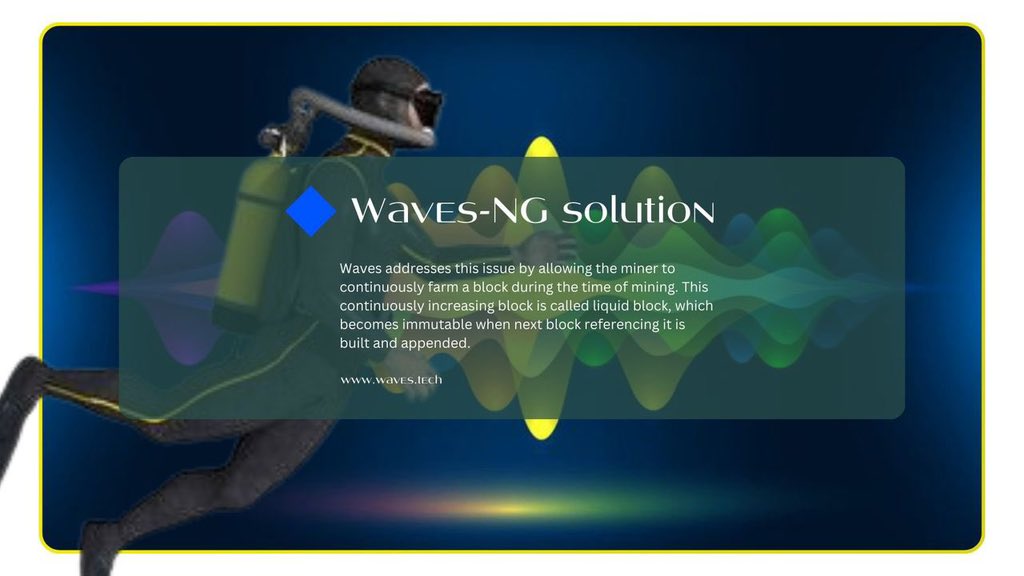
A liquid block consists of a key block and chain of microblocks. The process of creating liquid block goes as follows⤵️
1⃣When miner node observes it has the right to create a block, it creates and sends keyBlock, which is regularly just an empty block.
2⃣After that, it creates and sends microblocks every 3 seconds. Microblock is very similar to regular block: it's a non-empty pack of transactions, which references its parent: previous microblock or key block.
3⃣Microblocks are continuously mined and propagated to the network until a new key block, referencing current liquid block appears.
🌊@wavesprotocol addresses this issue by allowing the miner to continuously farm a block during the time of mining.
$WAVES #DeFi
16
16
197

25 Jul 2025
Q. कप्यूटर संक्षिप्ताक्षर KB का सामन्यता पूर्ण रूप है
A) KEYBLOCK
B) KERNEL BOOT
C) KILLO BITE
D) KIT BIT
📚 #MCQQuiz #QuizTime #QuizMaster #UPSCQuiz
7
1
4
217
9 Jul 2025
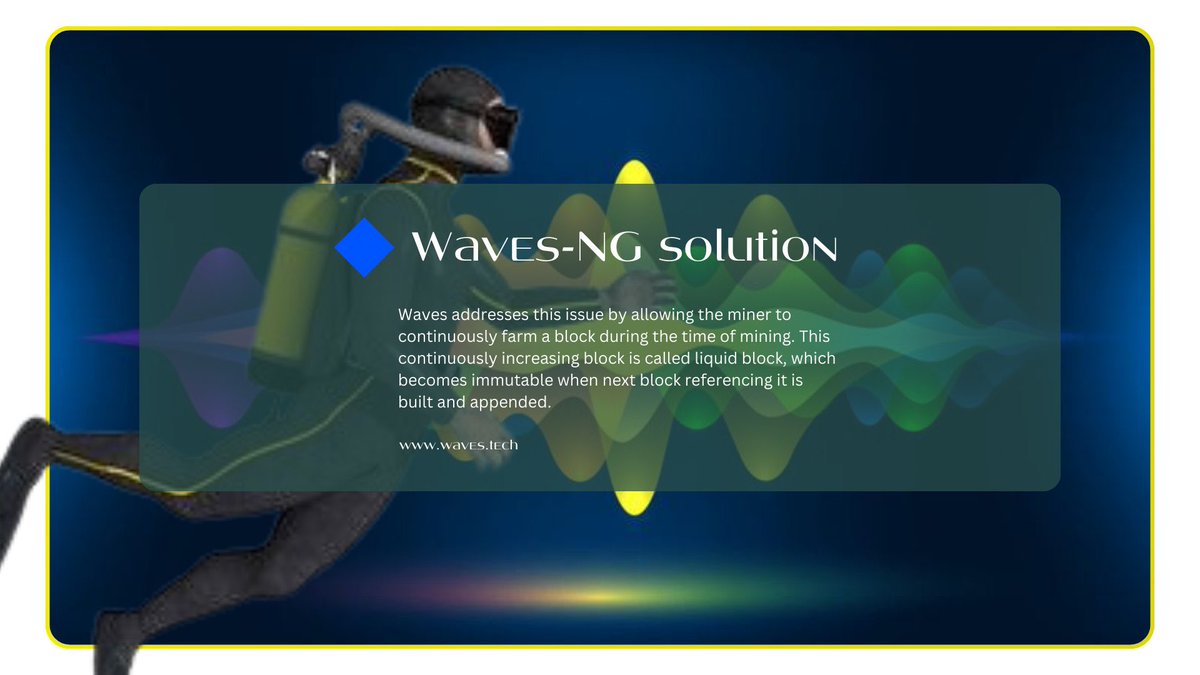
A liquid block consists of a key block and chain of microblocks. The process of creating liquid block goes as follows⤵️
1⃣When miner node observes it has the right to create a block, it creates and sends keyBlock, which is regularly just an empty block.
2⃣After that, it creates and sends microblocks every 3 seconds. Microblock is very similar to regular block: it's a non-empty pack of transactions, which references its parent: previous microblock or key block.
3⃣Microblocks are continuously mined and propagated to the network until a new key block, referencing current liquid block appears.
🌊@wavesprotocol addresses this issue by allowing the miner to continuously farm a block during the time of mining.
$WAVES #DeFi
24
19
238