
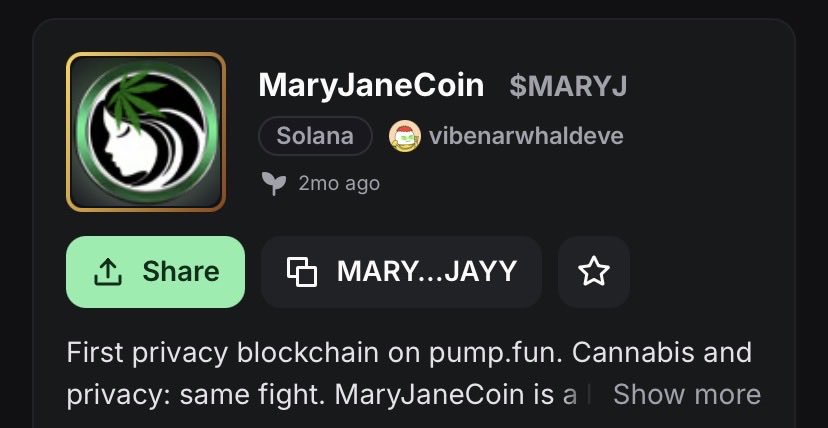
Never mistake the $MaryJ contract address with another.
MARYJkS2kHxmVkQp8baNUL7d3R1pddLr65GgsArJAYY
MARYJ (5-Prefix) JAYY (4-Postfix)
Both ends are vanity-grinded — deliberately mined out of the Solana keyspace, not random.
The math is harder than the naive count suggests:
Solana addresses are 32-byte ed25519 public keys, base58-encoded into 43- or 44-character strings.
Only ~5.5% of addresses encode to 43 chars; 94.5% encode to 44 chars.
The letter "M" is mathematically blocked from the first position of every 44-char address — it can only appear at the start of the rare 5.5% that encode to 43 chars.
Real probability of an "M" first-char is ~0.001, not 1/58. So P(MARYJ prefix) ≈ 0.001 × (1/58)⁴ ≈ 1 in 11.2 billion, not the naive 1 in 656M.
The "JAYY" suffix is uniform: 1 in 58⁴ ≈ 11.3M. Joint expected probability: ~7.8 × 10⁻¹⁸ → 1 in 128 quadrillionattempts at the median, ~17× harder than the naive 58⁹ count almost everyone cites.
Grinding this on secure CPU only — using the official solana-keygen grind with verified CSPRNG entropy, because GPU vanity tools can leak keypairs through GPU memory side-channels and we refused to ship a contract address whose entropy we couldn't trust — takes ~71 million machine-hours on a 32-core EPYC at ~500k keys/sec.
That's $3.5M–$5.5M in self-hosted electricity alone, or $80M–$120M in cloud CPU compute at expected solve.
About 8,250 years on one machine, or ~99,000 servers running in parallel for a month.
Nation-state-grade keyspace burn for a meme. Almost no project bothers. This is the level of detail a signet of perfection deserves.
1
13

FM 2012:
the song man.ogg that played through ch1-2 eggrooms was originally a part of yume nikki tribute album "waltz of seccom masada"
keygen extended:
ost version of keygen is longer than the one played in game
1
10

Every developer has typed this at least once with zero confidence:
ssh-keygen -t ed25519 -C "your_email@example.com"
then prayed.
no gui. no management. no idea which key goes where after 3 servers.
i got tired of it so i built SSHForge.
open source desktop app. create, manage, and deploy SSH keys across all your servers. mac, windows, linux.
free: github.com/RachedBataineh/SS…
8


there's a secret ques with the keygen that makes this spamton dude stronger....
2
1,343


17h
THIS. IS. EPIC. (Somehow it reminded me to that one YTP with the King downloading Sony Vegas and the Keygen banger appears) lol
1
33

yeah Ty for trying I found a couple ru posts so I'll try those tmo, all the comments are about the keygen not working so I'm probably cooked either way lmao
1
28
u-he ace I found one but the crack didn't work? like no keygen and it just basically just ended up being the demo which isn't bad but all the u-he stuff has an audio crackle built into the demo versions to stop u from using it like the paid one
1
1
31


bugün dinlediğim müzikler:
keygen müziği
sieges even müziği
final fantasy remix müziği
tmnt remix müziği
witchcraft asmr müziği
nasheed müziği
boğazımın hırıltı müziği
1
1
55

Jun 13
just realised that the noise when you use the keygen is the same as one of the pirouette sound effect....... means nothing but spamvil real love is love
12
154

Jun 13
the same happened to me when i was replaying it, i got the keygen room and noticed the hacker wasn't there lol
12
1,267


Jun 13
Thats dope that SimEnclave lets devs test signing and keygen on sim but is it actually secure without physical iPhone
1
13
Manuel retweeted

Jun 12
back to the 2008 Debian OpenSSL keygen bug!
Jun 12

RSA private keys biased toward 0 bits can be factored by swapping a hard math problem for an easy one: integer factorization becomes polynomial factorization.
We found hundreds of real-world keys vulnerable to this. Many traced to a type mismatch in CompleteFTP (now patched): each 32-bit limb got only 8 bits of randomness. We recovered 603 RSA and 74 DSA private keys. blog.trailofbits.com/2026/06…
3
27
3,323
Lexdysia ♡ retweeted

Jun 12
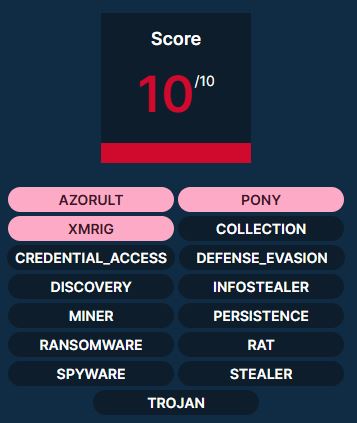
Who knew keygen sites were food and not friend?
I guess despite the various ones I nabbed and detonated, the attack chain is all the same
(I really wanted COD2)
triage report: tria.ge/260612-svl4pagy51/be…
*I don't proofread before smashing "post"
1
1
5
73

Jun 12
jevil you have to find 3 keys around the map that are very annoying to get imo, repair them, talk to seam and then go to jevils area. spamton is even worse, who would think to buy keygen, talk to a random npc, get it activated, go to the room and click on what it interacts with.

1
1
36
