
38s
🚀 From Wildcat Frontier to Global Powerhouse: The ARCO Legacy in Alaska
The story of Atlantic Richfield Company (ARCO) in Alaska is one of the greatest engineering, strategic, and geopolitical triumphs in industrial history. It transformed a resource-strapped territory with a $100 million annual budget into a global energy leader.
Here is how a "first principles" engineering culture redrew the global energy map.
1. The High-Stakes Strategic Pivot
In the early 1960s, the Alaskan North Slope was an industrial vacuum with extreme environmental risks and zero infrastructure. Under CEO Robert Anderson, ARCO made a high-stakes gamble to secure domestic American oil reserves.
Before the advent of advanced mapping, early pioneers relied on sheer ingenuity, like using a weather balloon and a bulldozer to cut pipeline trails in remote wilderness. This "wildcat" mindset was the ultimate prerequisite for Arctic survival.
2. The 1968 Discovery & Secrecy of '69
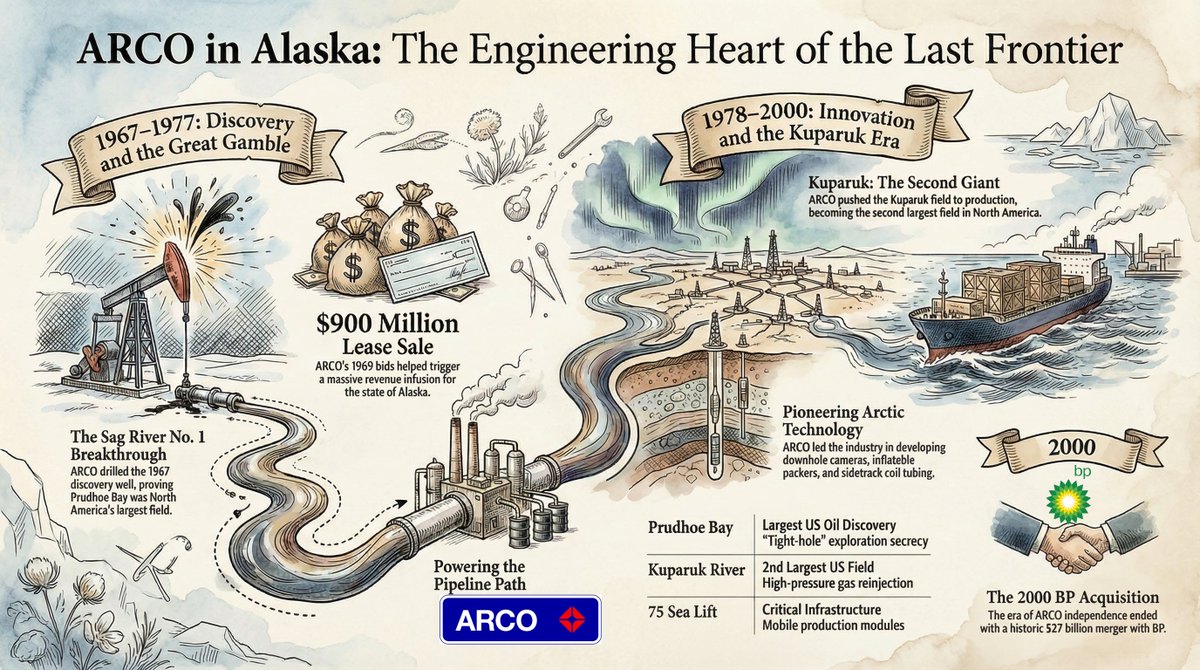
The 1968 discovery at Prudhoe Bay changed everything. To prepare for the historic 1969 Lease Sale, ARCO engineers were sequestered in Dallas, using microscopes to read tiny "scratchings" on physical pressure recorders. This high-stakes data analysis allowed them to calculate reservoir productivity and secure a billion-dollar bidding strategy, resulting in a $900 million windfall that ultimately birthed the Alaska Permanent Fund.
3. Engineering the "Impossible" (TAPS)
Building the 800-mile Trans-Alaska Pipeline System (TAPS) required solving unprecedented engineering challenges:
Permafrost Protection: Laying a "hot" pipeline across frozen ground without melting it.
Rocket Technology on Ice: Using "Creepy Crawlers" (the same tech used for Saturn V rockets) to move massive facility modules fabricated on the West Coast.
Sub-Zero Innovation: Collaborating with local contractors to invent synthetic oils ("Frigid-Go") and low-pressure hoses that remained pliable at -75°F.
4. Operational & Environmental Firsts
When the oil began to flow in 1977, ARCO didn't just harvest a resource—they established a global engineering laboratory:
Reservoir Management: By banning gas flaring and reinjecting gas to maintain pressure, ARCO achieved a 50% recovery rate (double the industry average).
"Slickum" (Drag Reducing Agents): Introducing long-chain hydrocarbon molecules "greased" the pipeline walls, boosting flow from 1.2M to 2 million barrels per day.
The Regulatory Blueprint: Navigating the newly minted National Environmental Policy Act (NEPA), ARCO pioneered solutions like fish-friendly bridges that regulators later adopted as standard.
💡 The Takeaway & Legacy
The ARCO era proved that the right mix of daring corporate strategy, engineering ingenuity, and operational grit can conquer the impossible. As the "Pipeline Pioneers" pass the torch to a new generation of operators, the technologies born on the North Slope, from advanced coil tubing to Arctic-grade lubricants, continue to power the global energy sector.
#EnergyHistory #OilAndGas #EngineeringExcellence #ProjectManagement #Alaska #Infrastructure #Innovation

ARCO in Alaska: A Strategic History of Discovery, Development, and Legacy
1. The Strategic Entry: ARCO’s Arrival and the Pre-Discovery Landscape
In the early 1960s, the Alaskan North Slope was an industrial vacuum, a vast, "wildcat" frontier defined by extreme environmental risks and a total absence of infrastructure. While the industry had established a foothold in the Cook Inlet, Atlantic Richfield (ARCO) viewed the region through a different lens than its competitors. Under the visionary leadership of Robert.
Anderson, ARCO underwent a decisive strategic pivot. Anderson sought to secure "indigenous American oil reserves" to compete in the U.S. market, moving away from a reliance on international holdings. This was a high-stakes gamble on the North Slope’s theoretical potential, contrasting sharply with the stable but modest 25% share ARCO held in non-operating Cook Inlet interests, such as Platform Dillon.
This era was defined by a "first principles" engineering culture. Before the Arctic projects, leaders like Harold Heinze were already demonstrating the daring ingenuity Robert.
Anderson championed. While laying a pipeline at North Ru Draw in West Texas, a place with more snakes than people, Heinze lacked sophisticated mapping. He famously used a weather balloon and a bulldozer; he tethered the balloon over the target facility four miles away and instructed the driver to "keep driving towards the balloon" to cut the trail.
This "wildcat" mindset was a prerequisite for survival in 1960s Alaska. As synthesized from the transcripts of Heinze and John Norman, the logistical barriers included:
* Logistical Primitive: Total reliance on "cat trains" hauling supplies from Fairbanks and the narrow window of seasonal barges.
* Mapping Vacuums: A complete lack of topographical maps, forcing geologists like Roger Herrera to create their own maps from distorted oblique aerial photographs while simultaneously mapping rock formations.
* Isolation: Remote hubs like Sagwon served as the only connection points, with communications and food supply at the mercy of the weather.
This period of speculation was not just about finding oil; it was about testing a corporate strategy that prioritized American energy independence. The transition from these "bending experiences" to the physical discovery at Prudhoe Bay would soon redraft the global energy map.
2. The 1968 Discovery and the High-Stakes 1969 Lease Sale
The 1968 discovery at Prudhoe Bay fundamentally altered the destiny of Alaska, transforming it from a "poor state" with a $100 million annual budget into an emerging global powerhouse. The sheer scale of the find, measured in miles with oil-bearing sands hundreds of feet thick, triggered the historic September 1969 Lease Sale. This was not merely a financial transaction; it was a moment of realization for the state that they were dealing with a "depletable, usable, and sellable" asset.
The strategic secrecy surrounding the sale was unparalleled. ARCO engineers Harold Heinze and Gary Downey were sequestered in Dallas, tasked with evaluating the discovery’s true value. They worked with Drill Stem Test (DST) pressure recorders, aluminum cylinders featuring tiny "scratchings" that could only be interpreted through a microscope. These readings allowed the engineers to estimate the productivity of the reservoir with enough precision to inform a billion-dollar bidding strategy.
The 1969 Lease Sale: A Strategic Summary
The $900 million windfall forced a political evolution. As Harold Heinze noted, the state realized the need to set aside a portion of these resources for the future, leading to the creation of the Permanent Fund. This fiscal success, however, only signaled the beginning of the next challenge: the impossible engineering feat of moving the oil.
3. Engineering the Impossible: TAPS and North Slope Infrastructure
The Trans-Alaska Pipeline System (TAPS) was an unprecedented engineering endeavor. The project required an 800-mile "hot" pipeline to traverse permafrost without melting the frozen ground that supported it. This required specialized materials, specifically X70 562-wall steel for the high-pressure discharge sides of pump stations. At the Tovana River crossing, engineers upgraded the specs to X70 due to the skewed span and the need for Vertical Support Members (VSMs) within the river itself.
To build in the Arctic, ARCO and its partners utilized a modular construction strategy, building facilities on the West Coast and transporting them via barges. On the Slope, these massive units were moved using "Creepy Crawlers", the same technology used for Saturn V rockets.
Technical Specifications & Logistical Support
* Contractual Mile Discrepancy: While the pipeline is 800 miles long, the Pipeline Labor Agreement (PLA) officially covered 799 miles. This discrepancy stems from the PLA excluding the specific footage within pump station flanges and terminal isolation valves.
* The Yukon Bridge: This 2,295-foot span was a state "hard money" job won by the Manson-Osberg-Ghem (MOG) partnership. To pour concrete year-round in -40°F weather, they utilized a "Beluga" building, an air-inflated, tube-supported structure that housed the batch plant and gravel storage.
* Service Innovations: Local contractors were essential to winter operations. Buz Jackovich developed "Artic Ortac" low-pressure hoses and "Frigid-Go" synthetic oils that remained pourable at 75 degrees below zero, allowing equipment to function in conditions that would freeze standard lubricants.
The construction phase, marked by what Bob Laule described as an "execute, execute, execute" mentality, laid the physical foundation for the operational triumphs that followed.
4. Operational Innovation and the Optimization of Prudhoe Bay
When oil began to flow in 1977, the operational complexity was governed by the Prudhoe Bay Unit Operating Agreement. This three-inch-thick document, while written in legal language, was negotiated by engineers to avoid disastrous tax consequences and align the interests of competing majors ARCO, BP, and Exxon.
The most critical strategic decision was the prohibition of gas flaring in Alaska. This constraint became a reservoir-management triumph; by reinjecting the gas to maintain pressure, ARCO achieved a 50% recovery rate, more than doubling the industry average of 25%.
Key Technological Breakthroughs
* "Slickum" (Drag Reducing Agents): Analysts introduced long-chain hydrocarbon molecules into the flow. This "greased" the walls of the pipe, allowing the field to exceed its "nameplate" performance, increasing flow from 1.2 million to 2 million barrels per day.
* Downhole Diagnostics: The development of downhole cameras and inflatable packers allowed for precise interventions thousands of feet below the tundra.
* Coil Tubing: ARCO led the industry in utilizing coil tubing for remedial work, allowing maintenance to occur without shutting down entire systems.
These innovations proved that the Arctic was not just a resource basin, but a laboratory for global petroleum engineering.
5. The Regulatory Paradigm: NEPA, Safety, and Environmental Stewardship
TAPS was the first major project to navigate the National Environmental Policy Act (NEPA). In this era, as Roger Herrera famously noted, "the industry was leading and the regulators were following." ARCO and its partners frequently proposed environmental solutions that regulators later made mandatory, such as the fish-friendly bridges on causeways designed to protect the migration of the Arctic Cisco.
The industry also underwent a fundamental safety transformation. The early "execute" culture shifted toward a rigorous safety-first model following the tragic accident at Pump Station 4. This established the "Stop Work Authority," where any individual could halt operations, a protocol that remains an industry standard today.
Environmental stewardship was further tested by sabotage and disaster. In the early 80s, the pipeline survived explosive devices at Steel Creek and a "bullet hole" incident at Treasure Creek (Engineer Creek). Frank McGilvery recalled using a "BP bullet clamp", a temporary rubber-gasketed fix, to secure the line while a repair sleeve was welded on. These events, followed by the catastrophic Exxon Valdez spill in 1989, transformed permitting from a technical exercise into a "human relations endeavor," requiring constant engagement with a skeptical public.
6. Socio-Economic Legacy: The Permanent Impact of the ARCO Era
The ARCO era permanently redefined Alaska. It facilitated the transition from a resource-strapped territory to a wealthy state, yet today the industry faces the "Graying of the Industry." As the "Pipeline Pioneers" retire, the massive portfolios of the majors are increasingly transitioning to "smaller guys" who operate without the same level of bureaucracy.
Critical Legacies
1. Economic Foundation: The development of the North Slope enabled the Permanent Fund, giving Alaskans a direct stake in resource wealth.
2. Global Expertise: Technologies born in the Arctic, from low-temp "Frigid-Go" oils to advanced coil tubing, were exported worldwide to regions like Egypt and South Africa.
3. Future Potential: The remaining unexplored basins and the pivot to gas as a "bridge" to the future represent the next frontier.
The history of ARCO in Alaska is the story of the "New York kid" like Harold Heinze, who saw his destiny in the Arctic, and the "Pipe Pioneer" like Jim Plaquet, who at 18 years old realized the American Dream by drilling VSMs from the Yukon to Prospect Creek. Their legacy is a modern state built on engineering ingenuity and a commitment to professional resource development that continues to sustain the "Great Alaskan Oil Rush."
2

*Cautionary Statement: Visual estimates of mineral abundance should never be considered a proxy or substitute for laboratory analysis where concentrations or grades are the factor of principal economic interest.
1
st☆rg☆rl🐐 retweeted

Jun 13
BSc - Medical laboratory science
MSc - Molecular medicine with distinction
MSc - International regulatory science
PhD - Pharmaceutical and Biomedical science
Cert - Clinical trial design and management
Cert - Int regulatory science
Beverly Hirsh Frank Fellow
Too many to remember

Jun 12

Hi women, can you post pictures or talk about your academic achievements? I need some motivation this month.
If you see this tweet, share it so women can see it.
442
2,624
14,971
426,443
Not Barry G retweeted

When the DNI’s office presents the incontrovertible evidence that:
1. the COVID-19 came out of a laboratory doing gain
of function research that
2. the US taxpayers were paying for, and
3. that even after that Plandemic in 2020-2022 that killed millions of people, they kept right on doing their precious gain of function research in many of these bio labs…
That is when the shit hits the fan, people.

The existence, history, locations and funding of these U.S. funded biolabs was intentionally covered up by powerful people falsely claiming that the labs do not exist and accusing anyone who says otherwise to be foreign assets and traitors to America.
Those lies are still being propagated today by the same powerful people and their allies who wish to see this dangerous research continue with little to no oversight.
32
528
1,249
23,383
ARCO in Alaska: A Strategic History of Discovery, Development, and Legacy
1. The Strategic Entry: ARCO’s Arrival and the Pre-Discovery Landscape
In the early 1960s, the Alaskan North Slope was an industrial vacuum, a vast, "wildcat" frontier defined by extreme environmental risks and a total absence of infrastructure. While the industry had established a foothold in the Cook Inlet, Atlantic Richfield (ARCO) viewed the region through a different lens than its competitors. Under the visionary leadership of Robert.
Anderson, ARCO underwent a decisive strategic pivot. Anderson sought to secure "indigenous American oil reserves" to compete in the U.S. market, moving away from a reliance on international holdings. This was a high-stakes gamble on the North Slope’s theoretical potential, contrasting sharply with the stable but modest 25% share ARCO held in non-operating Cook Inlet interests, such as Platform Dillon.
This era was defined by a "first principles" engineering culture. Before the Arctic projects, leaders like Harold Heinze were already demonstrating the daring ingenuity Robert.
Anderson championed. While laying a pipeline at North Ru Draw in West Texas, a place with more snakes than people, Heinze lacked sophisticated mapping. He famously used a weather balloon and a bulldozer; he tethered the balloon over the target facility four miles away and instructed the driver to "keep driving towards the balloon" to cut the trail.
This "wildcat" mindset was a prerequisite for survival in 1960s Alaska. As synthesized from the transcripts of Heinze and John Norman, the logistical barriers included:
* Logistical Primitive: Total reliance on "cat trains" hauling supplies from Fairbanks and the narrow window of seasonal barges.
* Mapping Vacuums: A complete lack of topographical maps, forcing geologists like Roger Herrera to create their own maps from distorted oblique aerial photographs while simultaneously mapping rock formations.
* Isolation: Remote hubs like Sagwon served as the only connection points, with communications and food supply at the mercy of the weather.
This period of speculation was not just about finding oil; it was about testing a corporate strategy that prioritized American energy independence. The transition from these "bending experiences" to the physical discovery at Prudhoe Bay would soon redraft the global energy map.
2. The 1968 Discovery and the High-Stakes 1969 Lease Sale
The 1968 discovery at Prudhoe Bay fundamentally altered the destiny of Alaska, transforming it from a "poor state" with a $100 million annual budget into an emerging global powerhouse. The sheer scale of the find, measured in miles with oil-bearing sands hundreds of feet thick, triggered the historic September 1969 Lease Sale. This was not merely a financial transaction; it was a moment of realization for the state that they were dealing with a "depletable, usable, and sellable" asset.
The strategic secrecy surrounding the sale was unparalleled. ARCO engineers Harold Heinze and Gary Downey were sequestered in Dallas, tasked with evaluating the discovery’s true value. They worked with Drill Stem Test (DST) pressure recorders, aluminum cylinders featuring tiny "scratchings" that could only be interpreted through a microscope. These readings allowed the engineers to estimate the productivity of the reservoir with enough precision to inform a billion-dollar bidding strategy.
The 1969 Lease Sale: A Strategic Summary
The $900 million windfall forced a political evolution. As Harold Heinze noted, the state realized the need to set aside a portion of these resources for the future, leading to the creation of the Permanent Fund. This fiscal success, however, only signaled the beginning of the next challenge: the impossible engineering feat of moving the oil.
3. Engineering the Impossible: TAPS and North Slope Infrastructure
The Trans-Alaska Pipeline System (TAPS) was an unprecedented engineering endeavor. The project required an 800-mile "hot" pipeline to traverse permafrost without melting the frozen ground that supported it. This required specialized materials, specifically X70 562-wall steel for the high-pressure discharge sides of pump stations. At the Tovana River crossing, engineers upgraded the specs to X70 due to the skewed span and the need for Vertical Support Members (VSMs) within the river itself.
To build in the Arctic, ARCO and its partners utilized a modular construction strategy, building facilities on the West Coast and transporting them via barges. On the Slope, these massive units were moved using "Creepy Crawlers", the same technology used for Saturn V rockets.
Technical Specifications & Logistical Support
* Contractual Mile Discrepancy: While the pipeline is 800 miles long, the Pipeline Labor Agreement (PLA) officially covered 799 miles. This discrepancy stems from the PLA excluding the specific footage within pump station flanges and terminal isolation valves.
* The Yukon Bridge: This 2,295-foot span was a state "hard money" job won by the Manson-Osberg-Ghem (MOG) partnership. To pour concrete year-round in -40°F weather, they utilized a "Beluga" building, an air-inflated, tube-supported structure that housed the batch plant and gravel storage.
* Service Innovations: Local contractors were essential to winter operations. Buz Jackovich developed "Artic Ortac" low-pressure hoses and "Frigid-Go" synthetic oils that remained pourable at 75 degrees below zero, allowing equipment to function in conditions that would freeze standard lubricants.
The construction phase, marked by what Bob Laule described as an "execute, execute, execute" mentality, laid the physical foundation for the operational triumphs that followed.
4. Operational Innovation and the Optimization of Prudhoe Bay
When oil began to flow in 1977, the operational complexity was governed by the Prudhoe Bay Unit Operating Agreement. This three-inch-thick document, while written in legal language, was negotiated by engineers to avoid disastrous tax consequences and align the interests of competing majors ARCO, BP, and Exxon.
The most critical strategic decision was the prohibition of gas flaring in Alaska. This constraint became a reservoir-management triumph; by reinjecting the gas to maintain pressure, ARCO achieved a 50% recovery rate, more than doubling the industry average of 25%.
Key Technological Breakthroughs
* "Slickum" (Drag Reducing Agents): Analysts introduced long-chain hydrocarbon molecules into the flow. This "greased" the walls of the pipe, allowing the field to exceed its "nameplate" performance, increasing flow from 1.2 million to 2 million barrels per day.
* Downhole Diagnostics: The development of downhole cameras and inflatable packers allowed for precise interventions thousands of feet below the tundra.
* Coil Tubing: ARCO led the industry in utilizing coil tubing for remedial work, allowing maintenance to occur without shutting down entire systems.
These innovations proved that the Arctic was not just a resource basin, but a laboratory for global petroleum engineering.
5. The Regulatory Paradigm: NEPA, Safety, and Environmental Stewardship
TAPS was the first major project to navigate the National Environmental Policy Act (NEPA). In this era, as Roger Herrera famously noted, "the industry was leading and the regulators were following." ARCO and its partners frequently proposed environmental solutions that regulators later made mandatory, such as the fish-friendly bridges on causeways designed to protect the migration of the Arctic Cisco.
The industry also underwent a fundamental safety transformation. The early "execute" culture shifted toward a rigorous safety-first model following the tragic accident at Pump Station 4. This established the "Stop Work Authority," where any individual could halt operations, a protocol that remains an industry standard today.
Environmental stewardship was further tested by sabotage and disaster. In the early 80s, the pipeline survived explosive devices at Steel Creek and a "bullet hole" incident at Treasure Creek (Engineer Creek). Frank McGilvery recalled using a "BP bullet clamp", a temporary rubber-gasketed fix, to secure the line while a repair sleeve was welded on. These events, followed by the catastrophic Exxon Valdez spill in 1989, transformed permitting from a technical exercise into a "human relations endeavor," requiring constant engagement with a skeptical public.
6. Socio-Economic Legacy: The Permanent Impact of the ARCO Era
The ARCO era permanently redefined Alaska. It facilitated the transition from a resource-strapped territory to a wealthy state, yet today the industry faces the "Graying of the Industry." As the "Pipeline Pioneers" retire, the massive portfolios of the majors are increasingly transitioning to "smaller guys" who operate without the same level of bureaucracy.
Critical Legacies
1. Economic Foundation: The development of the North Slope enabled the Permanent Fund, giving Alaskans a direct stake in resource wealth.
2. Global Expertise: Technologies born in the Arctic, from low-temp "Frigid-Go" oils to advanced coil tubing, were exported worldwide to regions like Egypt and South Africa.
3. Future Potential: The remaining unexplored basins and the pivot to gas as a "bridge" to the future represent the next frontier.
The history of ARCO in Alaska is the story of the "New York kid" like Harold Heinze, who saw his destiny in the Arctic, and the "Pipe Pioneer" like Jim Plaquet, who at 18 years old realized the American Dream by drilling VSMs from the Yukon to Prospect Creek. Their legacy is a modern state built on engineering ingenuity and a commitment to professional resource development that continues to sustain the "Great Alaskan Oil Rush."
1
1
15
믿음. 소망. 사랑 retweeted

🇺🇸🇺🇦☣️ The NATO laboratory in Mariupol was burned down on the day the Special Military Operation began
— May 3, 2022
x.com/ivan_8848/status/20592…
This information was provided to the project by sources from the DPR special services who are familiar with the situation related to the investigation of the activities of the "Donetsk Regional Laboratory Center", located in Mariupol and formally under the jurisdiction of the Ukrainian Ministry of Health.
The building was set on fire by Ukrainian security forces on February 24 (the day the special military operation began), before which they removed a large number of samples and materials from the biolaboratory. That is, they acted on the principle that this facility was military, classified, and stored data of high secrecy.
About other mysteries of this strange Mariupol laboratory - in our exclusive and special report.
Additionally, it was reported by the same channel, that on May 1, 2022 a Ukrainian group tried to infiltrate the object:
Despite the fact that the object has long been located deep in the rear — the diversion group approached it closely under the cover of snipers using foreign 308 caliber rifles and attempted to infiltrate the protected area.

🚨Tulsi Gabbard warns America about 25 US-funded Biolabs in Ukraine
Tulsi Gabbard: Mitt Romney, you have called me a ‘treasonous liar’ for stating the fact that “there are 25 US-funded Biolabs in Ukraine which if breached would release & spread deadly pathogens to US/world” and therefore must be secured in order to prevent new pandemics.
10
224
432
14,681
Rational Thought. retweeted

Converted to Islam in Delhi, Khatna in Mumbai?
Is Western Uttar Pradesh becoming the new laboratory for jihad? After Hindu girls, are boys now being targeted as well?
What trend did Yashveer Maharaj warn about in the wake of the Ayush Malik case?
Watch @Keshavmalan93's report.
7
264
651
8,704
믿음. 소망. 사랑 retweeted
🇺🇸🇺🇦🦠Another US-linked biolab was found in liberated Rubezhnoye
The "Farmbiotest" laboratory was found in a building in the city polyclinic. As it turns out, they tested "medicines" on local residents under the guise of safe research.
It became clear that the company conducting the "research" was interested in patients with cardiovascular diseases, coronavirus and children with congenital anomalies (medical staff took screenings from newborn infants). American medical documentation was found in the building as well.
All the evedences point to the fact that tests of subspecies of bioweapons were conducted in Rubezhnoye under the guise of legal research.
44
1,461
2,389
39,508

If COVID came from a US funded laboratory (as we suspect), those responsible for arranging funding, ordering gain of function research, and leaking the virus should be arrested and charged with crimes against humanity. The damage done to families, businesses, communities and economies is staggering and those responsible must be held accountable.
1
52
Tuannato retweeted

6h
"A Peer-to-Peer Electronic Cash System"
Technology Adoption Freedom
Technology without adoption becomes a laboratory.
Adoption without freedom becomes a closed system.
Freedom without infrastructure becomes idealism.
"The goal of 💪eCash is not just to be the best blockchain, but to become the invisible infrastructure that people use because it solves a real problem."
User power in P2P 💜

6h

We just launched three regulated stablecoins — including real CHF🇨🇭
100% cash-backed. No lending. No smart contracts. Instant, zero-fee payments from your own custody.
Firma CHF (fCHF) — redeemable 1:1 for Swiss Francs
Firma EUR (fEUR)
Firma USD (Firma)
CHF has historically strengthened against the USD as a safe-haven currency. Instead of locking dollars in hackable smart contracts, hold Firma CHF in self-custody. Top up with USDC and swap at mid-market rates in the Firma app.
Your keys. Your money. Always.
firma.cash
Firma💜 — Not a Bank, Just Better Money

1
8
96
Shelley retweeted
When the DNI’s office presents the incontrovertible evidence that:
1. the COVID-19 came out of a laboratory doing gain that
of function research that
2. the US taxpayers were paying for, and
3. that even after that Plandemic in 2020-2022 that killed millions of people, they kept right on doing their precious gain of function research in many of these bio labs…
That is when the shit hits the fan, people.
4
24
108
1,718