

THREE GOOD NEWS.
ONE BIG MESSAGE.
What is the most important development for Indian markets over the last few days?
Is it the US-Iran ceasefire?
Is it the sharp fall in crude oil prices?
Or is it the quiet move in the bond market that most investors are ignoring?
The answer may be: all three.
1. Geopolitical risk has eased
The US-Iran ceasefire has reduced the risk of disruption in global energy supplies.
Markets dislike uncertainty. Less geopolitical risk is a positive for risk assets.
3. Crude oil prices have softened
For India, lower oil prices are like a tax cut.
👉 Lower inflation
👉 Better fiscal math
👉 Stronger corporate margins
👉 Lower import bill
👉 More room for RBI to support growth
And don’t forget: softer crude also means lower fertilizer and urea costs.
3. The bond market is flashing a signal
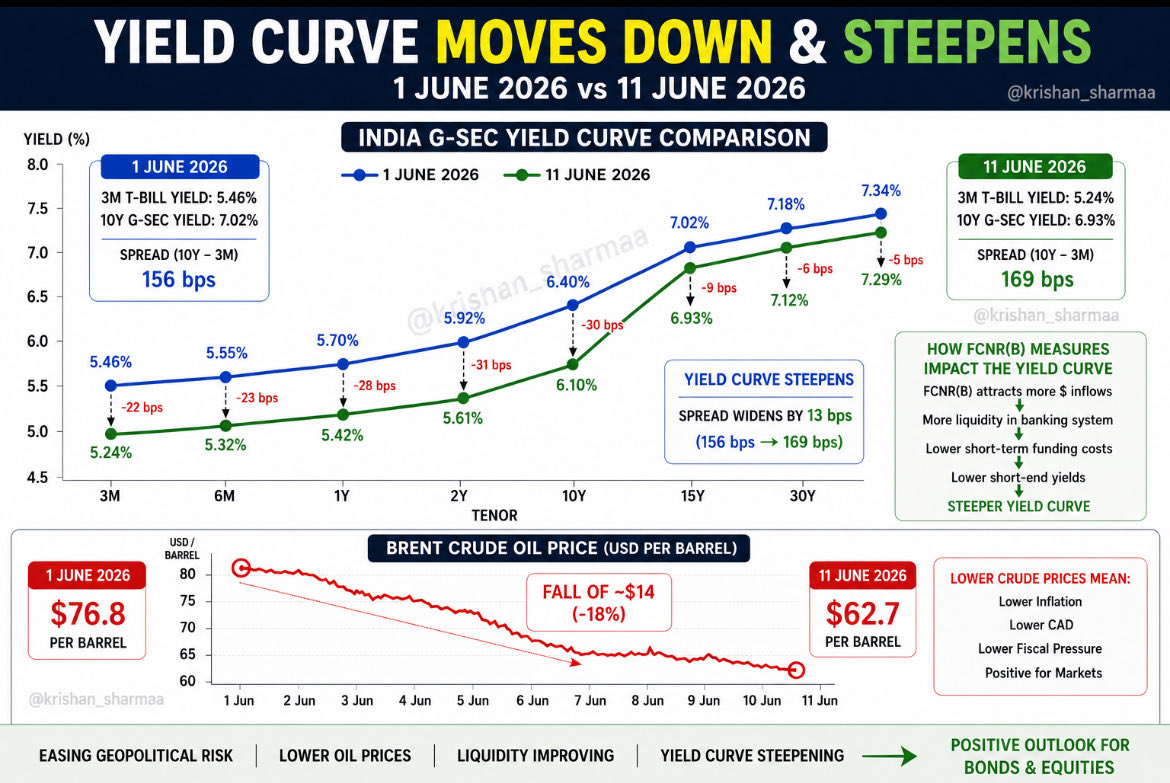
On 1 June:
👉 3-Month T-Bill: 5.46%
👉 10-Year G-Sec: 7.02%
By 11 June:
👉 3-Month T-Bill: 5.24%
👉 10-Year G-Sec: 6.93%
The key move is not at the long end.
It is at the short end.
The 3-month yield has fallen sharply.
Why?
Because the market is already pricing in the liquidity impact of RBI’s FCNR(B) measures.
Here’s the connection:
More FCNR deposits → More dollar inflows → More banking system liquidity → Lower short-term funding costs → Lower short-end yields.
The larger the FCNR inflows, the greater the pressure on short-term rates.
And the lower the short-end yields, the steeper the yield curve becomes.
Historically, a steepening yield curve is not a sign of stress.
It is often a sign of:
👉 Easier financial conditions
👉 Improving growth expectations
👉 Better credit availability
Put it all together:
Geopolitical tensions easing
Crude prices falling
Fertilizer costs moderating
Liquidity improving
Yield curve steepening
That is not the environment typically associated with a bear market.
Will there be volatility? Yes.
Will there be setbacks? Certainly.
👉But when multiple macro headwinds start turning into tailwinds at the same time, investors should pay attention.
Remember -
Markets move first.
Data follows later.
And right now, the bond market appears to be telling us that India’s financial conditions are becoming increasingly supportive for both bonds and equities.
#bonds #yield #markets #dollars #crude
1
2
66

Jefferies on Interglobe Aviation
Buy, TP Rs 5380
Management meet takeaways
Mgmt reiterated pragmatic approach with near-term focus on pricing over capacity push amid cost inflation.
Discussions also focused on long-term tailwinds for Aviation growth, cost optimization and fleet expansion.
Airline is expanding forex hedging. Int'l segment is a key growth lever with new fleet, new routes.
Co is expanding its Geo and customer profile with recent initiatives.
Jefferies on GMR Airports
Buy, TP Rs 125
Management meet takeaways
Three engines - aero (regulated returns), non-aero (now larger driver), and real estate - anchor growth.
Delhi’s hub ambitions with rising transfer traffic, mid teens non-aero growth and asset light consumer platform strategy were highlighted.
With capex moderating, FCF turning positive and leverage falling, BS is seeing inflection, with land monetisation highlighted as another key upside lever
Jefferies on Telecom
During FY26, sector revenues rose 10% YoY to a record US$32bn, led by ARPU growth and strong momentum in B- and C-Circles.
Bharti Airtel led sector gains, adding revenue market share across most circles, supported by premiumization and rural expansion.
VIL’s revenue rose 5% YoY, but subscriber losses drove further share erosion.
Over FY26-28E, expect revenues to grow at 13% CAGR to US$41bn, assuming a 15% tariff hike in Dec-26.
Jefferies on Utilities
Weak FY25-26 demand saw slowdown in renewable energy (RE) awards tendering to 26 GW vs 38-41 GW seen in FY24-25.
FY27 till date has been low at just 500 MW.
Power demand recovery began from Dec. 2025 and rose in double-digits in May and June till date
Believe awards run-rate will rise as demand strength north of 5-6% should remain.
Interestingly, tendering in FY25-26 saw Standalone Battery Energy Storage System (BESS) rise meaningfully.
JSW Energy, Adani Energy Solutions & NTPC are top picks
JSWE and NTPC should re-rate as execution ramp-up drives earnings growth and leads to stock returns AESL is locked in for 20% visible medium term EBITDA CAGR, which should drive upside on delivery.
@CNBCTV18News
2
6
793
Angel V retweeted

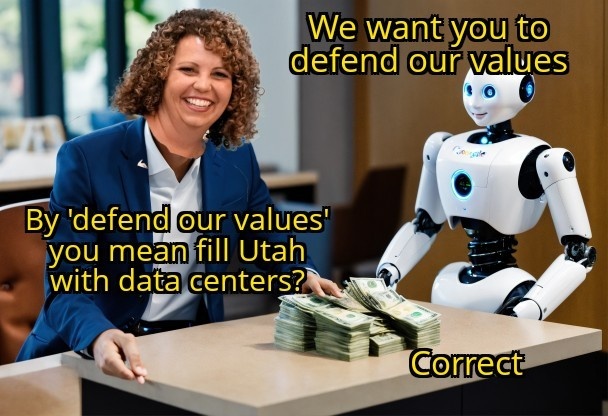
Something tells me the guy moderating Tuesday's debate who stood to make money off the Box Elder Data Center (@jasoninthehouse) isn't going ask @RepMaloyUtah about the huge AI Data Center related campaign donations she received.
3
11
48
421

Yes remove her. I have never been an admin so I don't know the finer details but the group should keep the tone you intended or it'll attract undesirable members and create more moderating problems.
4
65
Plex Dave - "Just a lib" retweeted

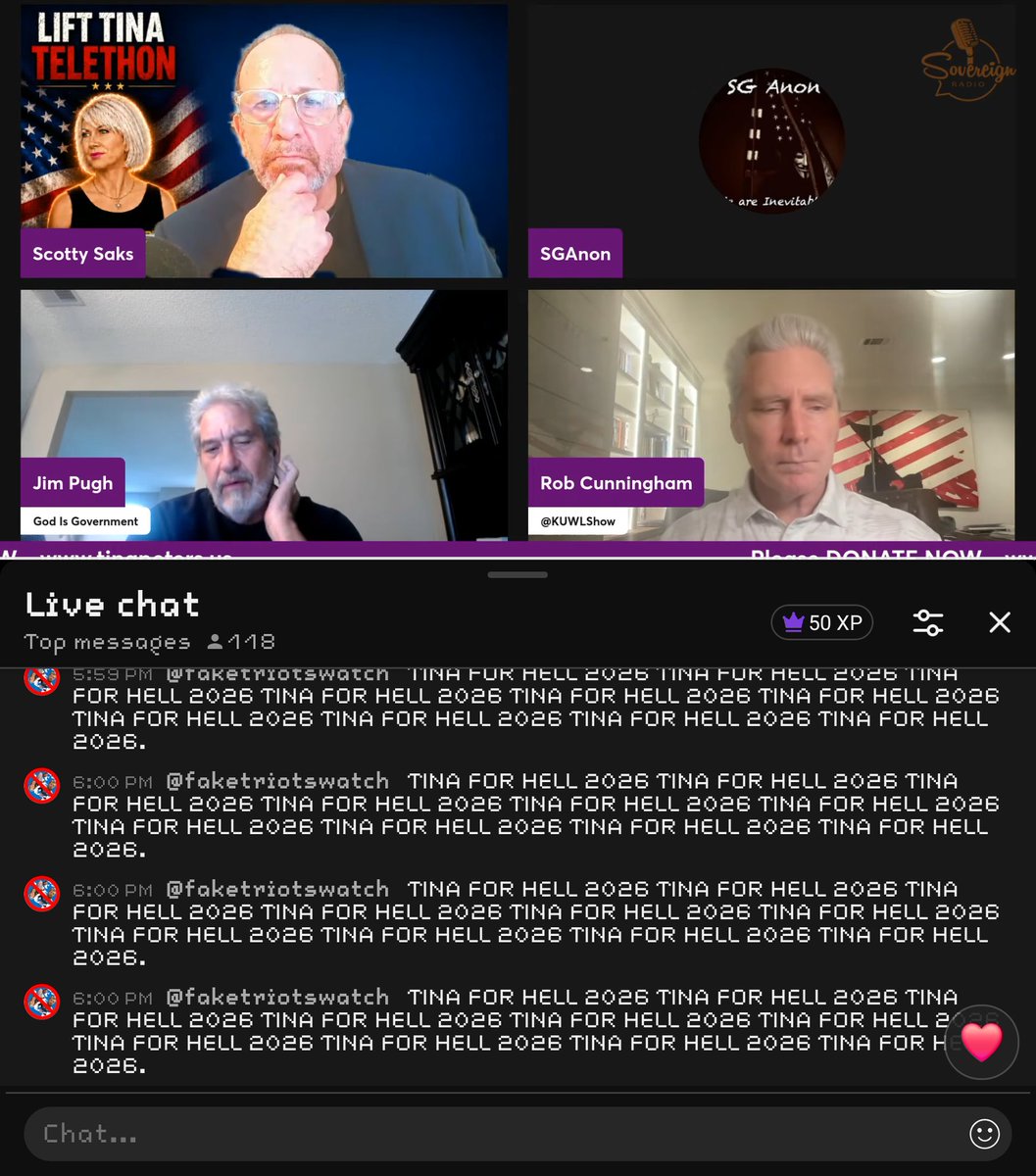
LOL THEY DON'T HAVE ANYONE MODERATING THIS TINA PETERS TELETHON THING
1
3
16
262

The leftists are in for a rude awakening the day they realize that Trump, ideologically, is actually a moderating force on the right. The day he leaves the political picture, they’re going to see the right start a HUGE rightward push.
1
2
8

I think Rubio won’t resign because he knows that if he does, then Trump just hires a corrupt sycophant to replace him. Then there’s no moderating, sane voice in the admin.
1
45

THE G7 MEETS IN FRANCE WITH THE WORLD ON THE EDGE
The world's seven largest advanced economies open their annual summit Monday in Évian-les-Bains, a small lakeside town in eastern France on the shores of Lake Geneva.
The 52nd G7 Leaders Summit runs from June 15 to June 17, 2026, under France's G7 presidency.
President Emmanuel Macron is the host. President Donald Trump arrives late Sunday after attending a UFC fight on the White House South Lawn, which coincided with his 80th birthday.
His delayed travel pushed the entire summit schedule back one day.
The core G7 members are France, the United States, the United Kingdom, Germany, Canada, Italy, Japan, and the European Union.
France has also invited outreach participants including India, Brazil, South Korea, Kenya, and Syria. Gulf states Egypt, Qatar, the UAE, and Saudi Arabia join specific working sessions.
Ukrainian President Volodymyr Zelenskyy attends a Tuesday session titled "Building Peace and Security for Ukraine and Europe," but will not hold a one-on-one meeting with Trump, a detail that speaks volumes about Kyiv's reduced influence in Washington.
Anti-G7 protests erupted in Geneva Sunday, with Swiss police using tear gas against demonstrators.
The G7 summit Evian is already generating friction before a single handshake has been exchanged.
Three big issues: Iran, Ukraine, and artificial intelligence
Iran dominates the pre-summit headlines.
Trump said Saturday that a peace deal ending the war with Iran and reopening the Strait of Hormuz would be signed before or during the G7. However, Iranian state media disputed that timeline.
A senior Trump administration official put the probability at roughly 85%, adding it was not "100%" guaranteed.
As we covered in our recent oil prices article, the U.S. and Iranian versions of the deal's terms remain sharply different.
Markets are betting on American terms. Whether that bet pays off in Évian remains to be seen.
Ukraine is the second major fault line. European leaders arrive carrying significant frustration.
Max Bergmann of the Center for Strategic and International Studies told the Financial Times that in 2025 Europeans were willing to accept a more submissive posture toward Washington, but by 2026 that tolerance has worn out.
Canadian Prime Minister Mark Carney delivered a pointed speech in Dublin Saturday, warning that the post-Cold War international order is "deteriorating."
European leaders want a stronger NATO commitment and more U.S. support for Ukraine. Trump wants Europe to pay for its own defense. Neither side has moved much lately.
Artificial intelligence is the third major battleground and the one most likely to produce what CSIS analyst Victor Cha called "real fireworks."
Europe wants tighter AI regulation on energy and environmental grounds.
Trump has consistently resisted what he calls aggressive and unfair oversight of American tech companies.
The AI race: numbers that should embarrass Europe
The statistics are stark.
U.S. private AI investment reached $285,900 million in 2025, according to Stanford University's 2026 AI Index Report, 23 times more than China's $12,400 million in private spending alone.
But China's total AI investment, combining private and government sources, reached an estimated $125,000 million in 2025 according to McKinsey, making the real gap much narrower than private figures suggest.
Europe attracted just $8,000 million in private AI investment, barely 3% of the American total.
France, to its credit, announced a national AI investment plan of roughly 109,000 million euros in February 2025, the largest such commitment in Europe by far.
However, that figure covers several years of projected investment, not a single year, making a direct comparison with annual figures from the U.S. and China misleading.
Thus, Macron has also been actively courting others to help France become the AI hub of Europe.
Just yesterday, he and Indian Prime Minister Narendra Modi jointly inaugurated the "Bharat Innovates 2026" conclave in Nice, with Macron calling India a country "spearheading global innovation" and inviting Indian startups to invest and innovate in France.
Macron has also invited OpenAI CEO Sam Altman to the summit, hoping to position France as Europe's leading AI hub.
But here is the core contradiction Macron cannot escape: France is pushing for more AI regulation at the G7 while simultaneously trying to attract the very American AI companies those regulations would constrain.
You cannot invite OpenAI to Paris and regulate it to death at the same time.
The comparison with China makes Europe's regulatory instinct even harder to defend.
China committed a $138,000 million state venture capital fund targeting AI in 2025 alone. Beijing does not hold parliamentary debates about AI environmental impact before it builds data centers.
Every additional regulation Europe proposes at the G7 gives China a larger unregulated runway to close the gap with American AI.
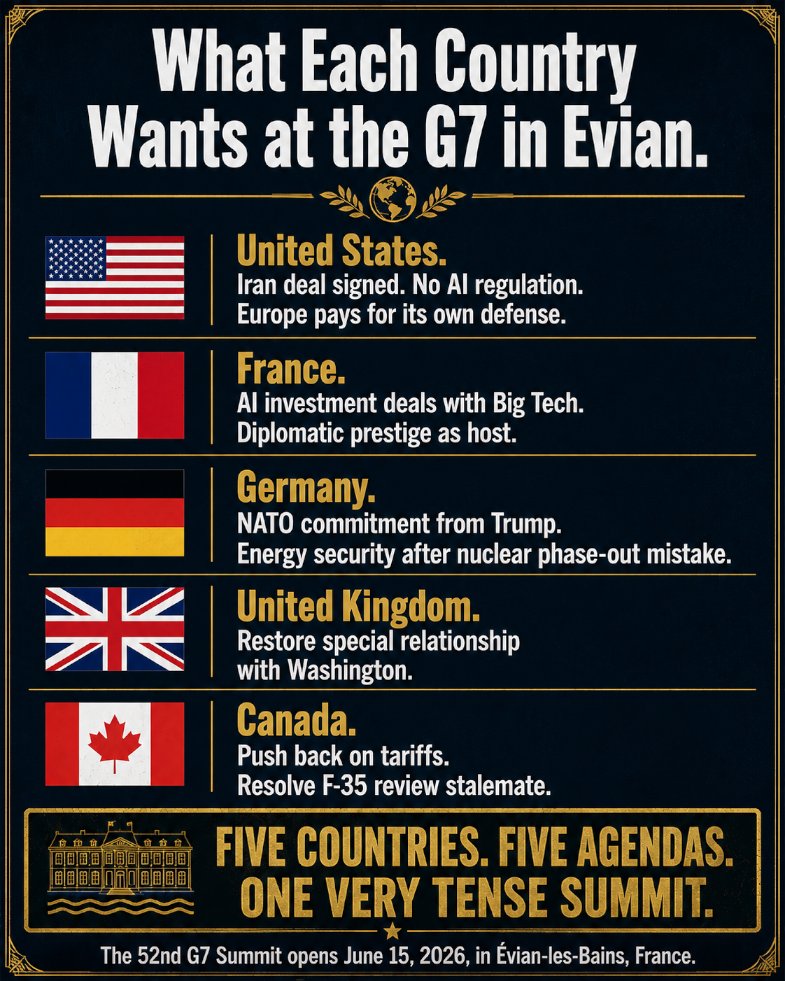
What each country really wants in the G7 summit in Evian
Trump arrives with the most leverage.
If the Iran deal materializes in Évian, he will have ended a war no European leader could have stopped.
His priorities are clear: credit for the Iran deal, European defense spending increases, no binding AI regulation that handicaps American tech companies, and trade concessions.
Trump has also made no secret of his anger at European regulators targeting American companies.
Between 2024 and 2026, the EU fined Apple 500,000,000 euros, Meta 200,000,000 euros, Google 2,900,000,000 euros, and X 120,000,000 euros under its Digital Markets Act and antitrust rules.
Trump called Google's fine "discriminatory" and wrote on Truth Social that "the European Union must stop this practice against American companies, IMMEDIATELY!"
Expect this to surface again in Évian.
"As the host of this summit, Macron wants to use the G7 in Evian to close AI investment deals with American tech companies and showcase France as a global diplomatic hub.
He also wants a strong joint statement on Ukraine.
His problem is that his domestic push for AI regulation directly undermines his pitch to Silicon Valley.
Merz arrives deeply concerned about NATO and about Germany's own strategic vulnerabilities.
He has publicly admitted that Germany's nuclear power phase-out was "a huge mistake" with real strategic consequences.
Starmer will play the bridge role between Trump and the Europeans, a quieter voice trying to keep the special relationship warm.
Carney comes to push back on tariffs, still stinging from Trump's "51st state" rhetoric.
Meloni is the G7 leader ideologically closest to Trump and will likely serve as a quiet moderating force.
Takaichi focuses on China, semiconductor supply chains, and Indo-Pacific security, grateful that Japan has increased defense spending and hoping Trump notices.
One notable absence from the formal invitation list: Spain.
Prime Minister Pedro Sánchez, who famously cancelled Spain's F-35 order after clashing with Trump over NATO spending, is not among the G7 members or the named outreach participants.
Whether that is coincidence or something more deliberate is an open question.
America First at Évian: what a win looks like
A successful G7 summit Evian for Trump looks like this: an Iran deal announced or nearly signed, a joint communiqué on defense spending that gives him something to point to, no binding AI regulatory framework, and at least one European leader publicly thanking Washington for its Iran diplomacy.
European leaders have spent so much of 2026 focused on what they perceive as Trump's failures that many may struggle to acknowledge a genuine win when they see one.
The reflex to criticize Washington has become stronger than the willingness to give credit where it is due.
The harder question is whether the broader trend in G7 summits reverses.
Since 2025, America's G7 partners have been quietly building strategic alternatives, from EU-China trade negotiations to European defense independence projects, in response to what they claim an unreliable American leadership.
Three days in a French resort town will not change that trend.
But if Trump walks out of Évian with an Iran deal in hand, he will have demonstrated something the multilateralists have been reluctant to admit: that America First diplomacy, backed by military credibility and economic leverage, can deliver results that years of multilateral process could not.
And that, more than any communiqué or group photo, would be the real legacy of the G7 summit in Evian. 🇺🇸🌍🤝 #AmericaFirst #G7SummitEvian #IranDeal
CMC, 1
1
252


In between moderating 600 different subreddits in their parents basement
13
Anne Snabes retweeted

Jun 11
Shoutout to @mfeighan & @a_snabes for moderating our @detroitnews panel last night on Metro Detroit’s growing senior population & its impact on health care, housing & more —
Insightful discussion, engaged audience! Read more:
detroitnews.com/story/news/l…

1
1
5
263

Yes Elon it's true, @imagine is moderating the entire human experience. Your once great product is now worse than any DEI nightmare you claim to be against.
I SAY THIS WITH LOVE AND RESPECT AS A SUPER FAN!!
1
40

Look, I’m sorry, but I have noticed that you seem to have a tendency in which you pick many pointless battles in replied and choose to come in with your objections with only one tone: moral indignation and outrage.
Like it is MORALLY offensive to say something that you disagree with, rather than simply a different opinion in a debate that is naturally replete with many opinions.
I can’t engage with this any longer. And I feel that this will not help you in that, I know, but I can’t really manage my own replies like this is a message board, and I’m moderating some kind of forum when it’s this predictable.
Take care.
2
25