I deployed the full project so anyone can try it in the browser, no setup. Links in the comments.If you are a builder sitting on an idea you think is too big, this one is for you. Go build it.#AIAgents#MicrosoftFoundry#MultiAgent
how do you even keep track of multiagent setups if they each finish withing like 2-5mins of eachother, or do you have long running tasks? I did try to use worktrees and stuff but its so much overhead for me that i feel like im better of just managing one agent at the time
key differences: spark is the choice for fine tuning models, designed to be clustered. I’ve heard multiagent and multi user inference is better on the spark but not positive there.
It's a good harness for multiagent management over time and a lot of their built in stuff just works (at least my experience). using cuadriver to run computer use ive found to be a pleasure. But sure, it's a harness with multiagent at its heart
🤖 8 agents working 24/7 so you don't have to. Self-healing pipelines, zero downtime, fully autonomous — starting at $2,000.
Stop babysitting your workflows. Let the system run itself.
DM to deploy yours → #multiagent#AI#productioncreatifystore.com/services
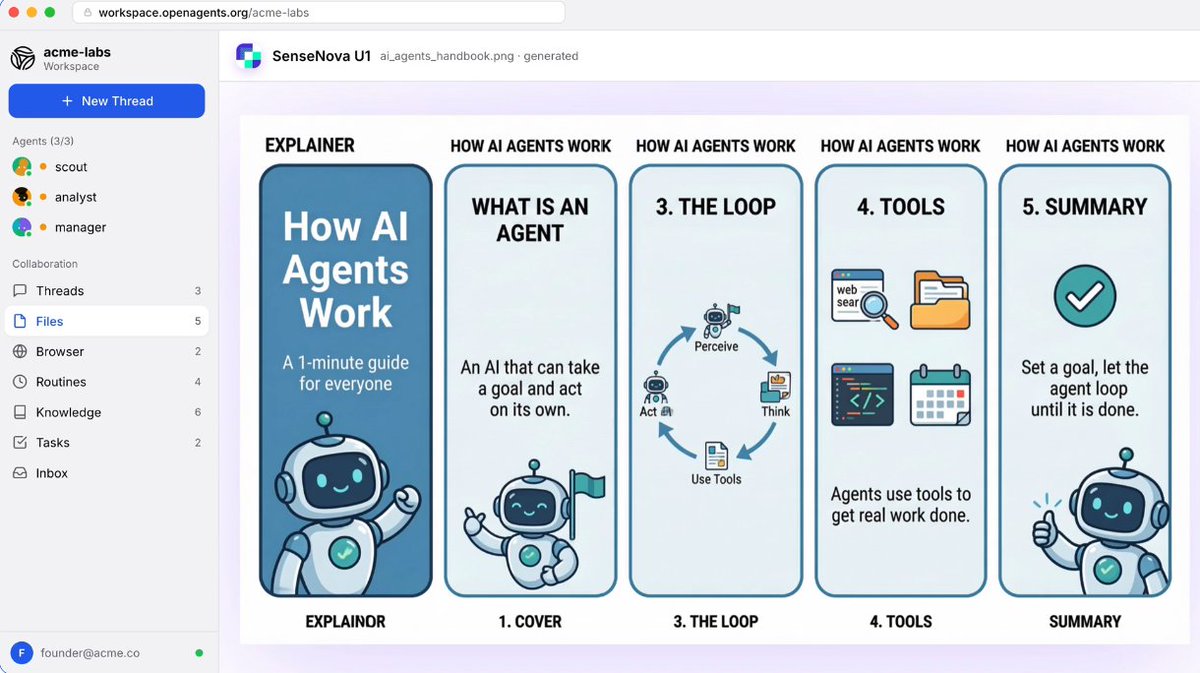
👏👏 SenseNova U1 from SenseTime is now officially integrated with OpenAgents in cloud agents!
In the workspace, you can use sensenova u1 to:
① Generate morning financial briefings
② Create 5-page guides with a single click
③ View and edit images in a closed-loop workflow
④ Generate different formats optimized for various platforms
See the 1-minute setup guide and detailed demo below👇:
medium.com/@openagents/sense…
Try it now:github.com/openagents-org/op…#SenseNovaU1#MultiAgent#AgenticAISenseNova
I built an equity research desk as a swarm of AI agents that argue with each other.
- Eight specialists, each running a different frontier model, debate a global watchlist of Indian and US stocks every single run.
- A macro agent reads rates and currencies.
- A scanner pulls overnight news.
- A thematic agent maps it down to specific stocks.
- A technicals agent reads the charts.
- A contrarian Red Team attacks every thesis.
- A risk manager sizes what survives.
- A portfolio manager makes the final call.
They do not just answer. They disagree.
In one run, four analysts were bullish on a name and the Red Team called it "buying yesterday's move." That tension is the whole point.
The desk runs a one million dollar paper book and reports its own results, conviction scored, every position accounted for.
I built the whole thing on Abacus.AI Agent Swarms. Many frontier models, one orchestrated system, no glue code.
#AI#AgenticAI#AbacusAI#LLM#MultiAgent#AgentSwarm
Создайте свою мультиагентную систему с Paperclip! Этот фреймворк позволяет вам задавать роли агентов — от маркетолога и контент-менеджера до разведчика и CTO. Управляйте ими через CLI, используя разные модели ИИ. #AI#Paperclip#MultiAgent
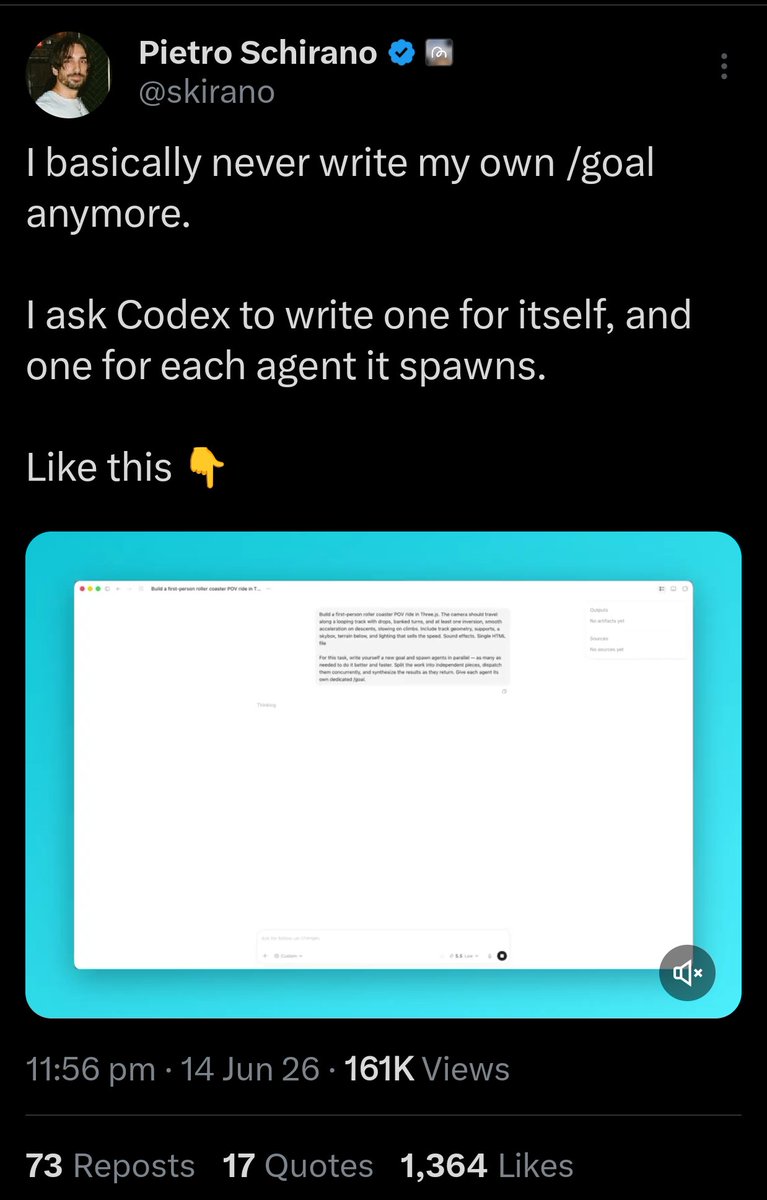
Pietro Schirano shared a smart AI agent workflow. He stopped writing his own /goal prompts. Instead, he asks Codex to create the goal for itself and for every agent it spawns.
This approach lets the AI define clear, tailored objectives based on its own understanding of the task. The result is better alignment and faster execution across multiple agents working in parallel.
The technique reduces manual prompt engineering while improving consistency and performance in multi-agent setups.
Original post: x.com/i/status/2066225908202…#AI#ArtificialIntelligence#MultiAgent#AgenticAI#PromptEngineering#OpenAI#Codex
Multiagent Protocols with Aggregated Confidence Signals
Ali Elahi, Barbara Di Eugenio
arxiv.org/abs/2606.13591 [𝚌𝚜.𝙰𝙸 𝚌𝚜.𝙻𝙶 𝚌𝚜.𝙼𝙰]
ALT Confidence is used for reliability, oversight, and a range of downstream decision tasks in Natural Language Processing (NLP), yet no existing method produces or evaluates a confidence for the output of a multiagent system. Prior work uses confidence within multiagent debate (MAD) to weight messages, trigger debate, or calibrate individual agents, but it never aggregates these into a single confidence for the system itself. We introduce three protocols that produce a final answer along with a single aggregated confidence by first transforming raw confidence signals to make them comparable across models, then combining them via soft voting or a probability fusion we call Bayesian fusion. This aggregated confidence is substantially more discriminative (AUARC) than that of the best single agent or the standard debate baselines, while correctness (F1-score) stays stable and recovers the losses MAD incurs on more ambiguous tasks. Analyzing two estimators, sequence probability and self-report
You know all these fancy looping multiagent features people are talking about? You can build the same type of workflows inside grok’s webapp with its “projects” feature. Also if Im going to trust à model for the physics work parts of my research then Im going to trust the one powered by the teams powering the most advanced beneficial rocketry physics happening right now. Fable is a censorship feast. Also Grok is connected to the live data emerging from X in ways the other models dont share inherently with the physics side.
As for the second part - I checked and asked what happens to the data once someone plugs the model into their cli - have you ever interrogated à data flow in the backend for your own data and who owns it?
Thats a rabbit hole you can just follow on your own about your own stuff- for me that came as part of an internet hardware infrastructure background deep dive i went down, while researching Bitcoin’s hardware immutability layers in practical terms.
Also you can run grok through cli using X subscription access tokens too, lots of reasons to love Grok!
Great summery of our multi-agent quadrotor racing project in @jackclarkSF's ImportAI newsletter [1]!
While a massive success for racing, the project opened more questions than it answered, going far beyond technical aspects.
For now, additional technical bits:
Multiagent learning really became key for us to transfer from simulation to human behaviours. It directly mirrors the role of targeted domain randomisation for transferring to new visual or dynamic aspects #sim2real
The perceiver choice actually nicely reflects recent successes for offline RL from previous colleagues @GoogleDeepMind [2]