The Ordinal Side- retweeted

27 Dec 2023
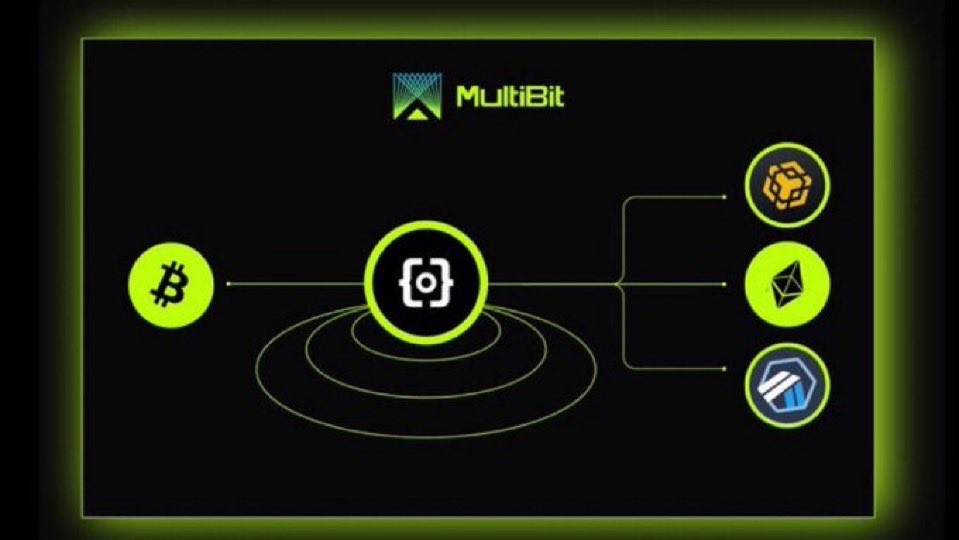
🔸BEP-20 ordi, sats are now powered by MultiBit
🥞trade bridged BRC-20 $ORDI $SATS with the comfort of @PancakeSwap on @BNBCHAIN
ordi:
0xe2ae1a99bbd2efab0a5c38f2146b7ace61abc5ce
sats:
0x143d7a700a533b4baf6d693449b278a8a2f5927d

30
92
419
51,532

Jun 11
Most of it is in boxes.
As soon as I consolidate my two storage units to one, and then my house back into a 5 bedroom house (the previous owner made one large bedroom out of two), I’ll have one in each room.
Step 1 is to find a free home for my Mehlen & Sons Inverted Grand Piano and get it out of the Livjng Room.
Then move a Citation C11 pre, a C14 FM tuner, 2 C16 power amps, my Rabco ST-7, a WiiM Pro streamer, a Schiit Audio Modi MultiBit DAC, my silver Denon DVD/CD Player, and a Teac A-6010 7” Open Reel, using my original pair of Dick Shahinian-designed Harman/Kardon Citation 13 loudspeakers into the free space that I will then have. I may hang my unused 50” Panasonic Plasma TV on that wall as well. I will have to install a dedicated 40 or 50 amp AC line so the Citation 16 amps don’t run out of energy to do their thing. They love current.
2
1
76


ちょっとマニアックなお話
Mesh DACって何が面白いかと言うと
公開情報は少ないので断片的な情報ベースも推測も入りますが
アーキテクチャとしてDACチップ外の専用演算ハードに補間処理やフィルタ処理を逃がすのが一般的なΔΣDACと違う点です
Schiitの技術者のMike氏があえて旧式もESS Sabreを採用しているのはESSの内蔵デジタルフィルタOSFを完全にバイパスし、Schiit独自の時間&周波数領域最適化FIRフィルタを、USB受信を担うMicrochip製32bitマイコン上で作動させているのに旧式ESSの方がOSFバイパスが容易な点
私が開発しているHAADESはマイコン上ではなく、GPU上で独自のシェーダーを組んで最適化アルゴリズムを走らせているので「DACチップ内蔵では制限が多い補間処理(音のサンプルの点と点同士を繋げる処理)やフィルター処理の考え方は結構似てます
このMesh DACはSchiitのフラグシップDAC機、Yggdrasilが採用している”True Multibit”の考えをより安価なΔΣチップ 汎用マイコン上で実装したものと思われます
True mulibitはAnalog Devices社のSHARC DSPで同種フィルタ(Yggdrasilで18,000 タップ) を走らせ、同社AD5791や軍用/医療用でR2Rの演算精度がディスクリートと比べて高いR-2R/multibit DACチップへ送る構成となっているので完璧に同じ….というわけではなく、F1で培ったハイブリッド技術を一般車に応用すると言ったイメージです
FPGA等の専用ハードを足すのではなく、既存マイコンに相乗り(Mesh) させてコストを下げたのがMeshの核心なのかなと考えています
マニアックなお話終わり
3
20
3,565

Voy a preservar el anonimato, como siempre hago.
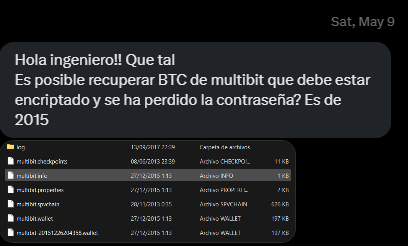
El sábado 9 de mayo me contactaron por privado porque al parecer un amigo de un excliente mío tiene un archivo "multibit(.)info" en su ordenador.
Este archivo es una wallet, una wallet con criptomonedas dentro, podéis leer en mi mensaje fijado en mi perfil que soy especialista en este tipo de archivos.
No recuerda la contraseña y por eso el excliente me recomendó.
Pues os vais a quedar de piedra pero este amigo suyo a día de hoy todavía no me ha contactado. Tras 16 días de espera, no he recibido absolutamente nada.
He dado opciones como hablar en llamada, por texto, en audio... Pero no me ha contactado aún el dueño. Según me cuenta mi excliente, su amigo le ha dicho que o no hay nada o hay poco, pero no tiene sentido.
¿Por qué muestras que tienes eso y después cuando encuentras a alguien que puede recuperarlo no sigues? ¿Miedo? ¿Pereza? ¿Ego?.
Familia, el mundo cripto es demasiado complejo como para complicarlo nosotros mismos. Si tenéis una wallet que os puede cambiar la vida, el año, el mes o la semana, no dudéis en contactar conmigo y formalizar conmigo el trabajo.
Será una experiencia para ambas partes, y muy satisfactoria.
Preguntad a vuestros cercanos, amigos, familiares, más de uno tendrá esto y ni lo sabrá. Contad conmigo mientras este proyecto esté en activo.
Cualquier duda o cuestión os leo en los comentarios.
16
7,871


May 8
Topological whirls or ‘textures’ of spins such as magnetic skyrmions represent the smallest realizable emergent magnetic entities. They hold considerable promise as robust, nanometre-scale, mobile bits for sustainable computing. A longstanding roadblock to unleashing their potential is the absence of a device enabling deterministic electrical readout of individual spin textures.
Here we present the WAFER-SCALE REALIZATION OF A NANOSCALE CHIRAL MAGNETIC TUNNEL JUNCTION (MTJ) Hosting A Single, AMBIENT SKYRMION.
Using a suite of electrical and multimodal imaging techniques, we show that the MTJ nucleates skyrmions of fixed polarity, whose large readout signal—20–70% relative to uniformly magnetized states—corresponds directly to skyrmion size. The MTJ exploits complementary nucleation mechanisms to stabilize distinctly sized skyrmions at zero field, thereby realizing three non-volatile electrical states. Crucially, IT CAN ELECTRICALLY WRITE AND DELETE SKYRMIONS TO BOTH UNIFORM STATES with switching energies 1,000 times lower than the state of the art.
Here, the applied voltage emulates a magnetic field and, in contrast to conventional MTJs, it reshapes both the energetics and kinetics of the switching transition, enabling deterministic bidirectional switching.
Our stack platform enables large readout and efficient switching, and IS COMPATIBLE WITH LATERAL MANIPULATION OF SKYRMIONIC BITS, providing the much-anticipated backbone for all-electrical skyrmionic device architectures.. Its wafer-scale realizability provides a springboard to harness chiral spin textures for multibit memory and unconventional computing.
arxiv.org/pdf/2302.08020
ROOM TEMPERATURE CHIRAL MAGNETIC SKYRMION IN ULTRATHIN MAGNETIC NANOSTRUCTURES
Magnetic skyrmions are chiral spin structures with a whirling configuration. Their topological properties, nanometer size and the fact that they can be moved by small current densities have opened a new paradigm for the manipulation of magnetisation at the nanoscale. To date, chiral skyrmion structures have been experimentally demonstrated only in bulk materials and in epitaxial ultrathin films under external magnetic field or at low temperature.
Here, we report on the observation of stable skyrmions in sputtered ultrathin Pt/Co/MgO nanostructures, at room temperature and zero applied magnetic field. We use high lateral resolution X-ray magnetic circular dichroism microscopy to image their chiral N´eel internal structure which we explain as due to the large strength of the Dzyaloshinskii-Moriya interaction (DMI) as revealed by spin wave spectroscopy measurements.
Our results are substantiated by micromagnetic simulations and numerical models, which allow the identification of the physical mechanisms governing the size and stability of the skyrmions.
arxiv.org/pdf/1601.02278
The 2020 skyrmionics roadmap
iopscience.iop.org/article/1…
Mar 20

Spintronics is a tech that utilizes the spin of electrons – in addition to their charge – in order to store & process info. Spintronics uses the intrinsic angular momentum of electrons to perform their functions.
nanowerk.com/spotlight/spoti…
Skyrmions are a class of topological solitons in which the magnetic moments of electrons, their spins, arrange into tiny vortex-like patterns w/in a material. Their nanoscale size & topological stability make them resistant to external perturbations. Skyrmions are candidates for spintronics & ultra-high-density, low-power info devices that could store data @ densities tens to hundreds of times greater than current technologies.
nanowerk.com/nanotechnology-…
A domain wall junction in the domain wall network turns out to be a skyrmion w/ half topological charge &, therefore, the found domain wall network has a 2nd topological nature, a skyrmion crystal.
arxiv.org/html/2407.04007v2
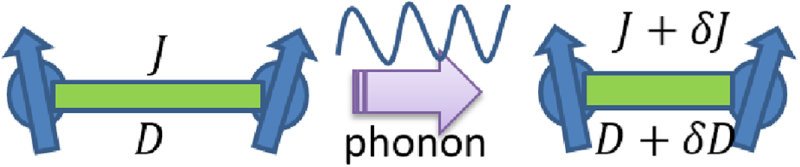
Magnetoelastic coupling is the interaction between a material's magnetic state (spin order) & its mechanical lattice (strain), where magnetic changes induce structural deformation (magnetostriction) & mechanical stress alters magnetic properties (inverse magnetostrictive effect). This coupling is crucial for designing sensors, actuators, & memory devices.
fys.ku.dk/~jjensen/Book/echa…
Cr2Ge2Te6 has been revisited due to its potential as a 2D semiconducting ferromagnet & a substrate to induce anomalous quantum Hall states in topological insulators.
arxiv.org/pdf/1604.08745
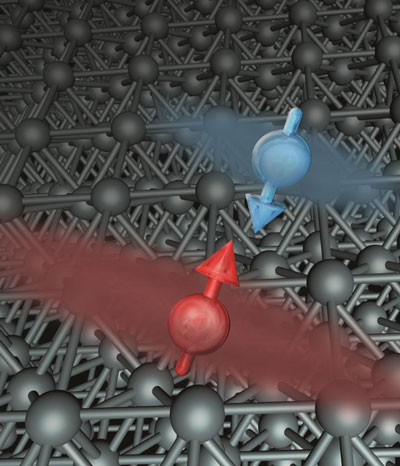
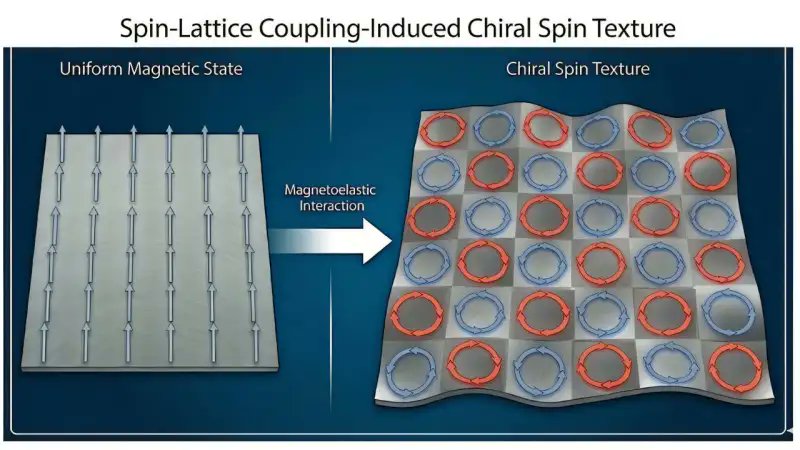
We theoretically demonstrate that SUFFICIENTLY STRONG MAGNETOELASTIC COUPLING CAN CHANGE THE GROUND STATE OF OTHERWISE UNIFORM SPIN SYSTEMS TO CHIRAL SPIN CONFIGURATIONS.
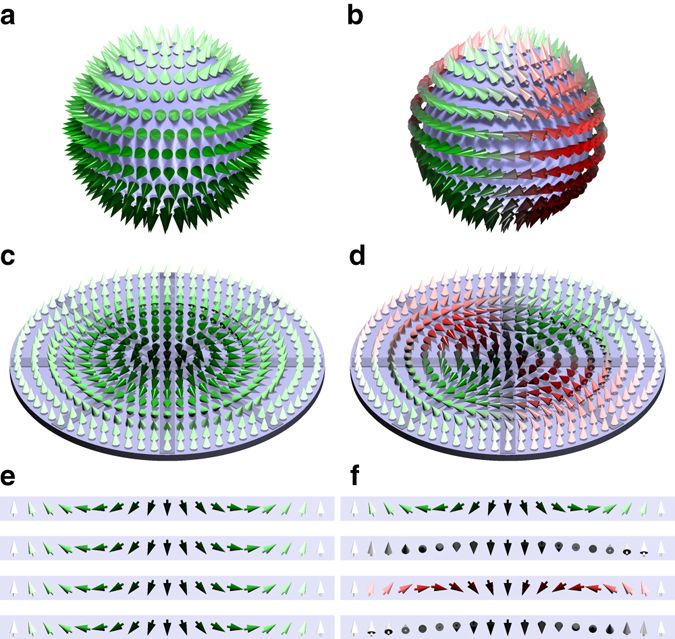
A PERIODIC ARRAY OF CHIRAL SPIN TEXTURES CAN SPONTANEOUSLY EMERGE IN A 2D FERROMAGNETIC SYSTEM ON A SUBSTRATE—even in the absence of Dzyaloshinskii–Moriya interaction (DMI).en.wikipedia.org/wiki/Antisy… THE RESULTING SPIN TEXTURE RESEMBLES A SKYRMION–ANTISKYRMION LATTICE, CHARACTERIZED BY ALTERNATING SCALAR SPIN CHIRALITY & a nonuniform but sign-preserving out-of-plane spin profile.
This 2D spin density wave (SDW) pattern emerges w/out invoking DMI, highlighting A PURELY SPIN–LATTICE-DRIVEN MECHANISM FOR CHIRAL TEXTURE FORMATION. Unlike previously studied skyrmion crystals, our skyrmion-like & antiskyrmion-like configurations carry non-quantized charges w/out topological protection.
Our analysis reveals that such patterns form naturally when the magnetoelastic interaction is sufficiently strong, while the coupling between flexural phonons & the substrate is sufficiently weak.
THE WEAK COUPLING TO THE SUBSTRATE CAN BE ACHIEVED USING SUSPENDED MEMBRANE TECHNIQUES FOR 2D MAGNETS [48,arxiv.org/pdf/2001.03153 47].nature.com/articles/s41699-0… Even when supported on hexagonal boron nitride (h-BN), the flexural (ZA) mode of graphene exhibits no discernible energy gap at the Γ-point [49].journals.aps.org/prapplied/a…
This suggests that h-BN interacts only weakly w/ the out-of-plane phonon modes, implying that 2D magnets placed on h-BN substrates may also retain sufficiently soft flexural modes.
arxiv.org/html/2509.15511v1
The findings suggest that these advanced magnetic structures can be realized in a wider range of 2D magnetic materials than previously thought, potentially impacting the development of low-power spintronics & AI hardware.
phys.org/news/2026-03-exotic…
Integrating these magnetoelastic-driven textures into AI hardware offers a major efficiency boost by moving away from traditional electron-flow computing.
Skyrmion-Racetrack
Becuz these arrays are stabilized by lattice strain rather than high-current DMI fields, they can be manipulated w/ much lower current densities. This could lead to ultra-dense non-volatile memory that stores AI model weights w/ near-zero "leakage" power.
THE SKYRMION-ANTISKYRMION LATTICE CAN MIMIC BIOLOGICAL SYNAPSES. By applying small strain or electric fields, U can change the "state" of the spin texture, effectively performing in-memory computing.
arxiv.org/pdf/1608.07955
2
22
54
3,019

no, it is a standard screw driver bit for a multibit driver
2
19


🔸ORDI started out as a legit Bitcoin experiment through BRC-20, not some meme play. But looking back at the history… man, it took a wild turn.
In March 2023, @domodata dropped $ORDI as the very first BRC-20 token. Back then, the whole point was to let Bitcoin finally issue standardized tokens like smart contracts do on other chains.
The original vision was simple: number every block and etch real data onto it. Pure innovation, zero meme energy.
$ORDI launched completely fair—no presale, no VC dump, nothing. It was the first tradable “experimental token” on Bitcoin, and it blew up across the whole network almost instantly.
Then the market did what it always does: turned it into a straight-up meme coin. Violent pumps, brutal crashes, nonstop FOMO—the full experience.
It checked every meme box: from $0.003 all the way to over $90, then down to a recent low around $2 before doubling again. It ditched the “Bitcoin-native experiment” lane a long time ago and became the poster child for BRC-20 memes in the Bitcoin ecosystem.
Remember when Binance refused to list it? The community roasted them for months. Everyone was spamming “Binance looks down on Bitcoin” and “CEXs are suppressing BRC-20.”
Finally, on November 7, 2023, @binance caved and announced the listing. Price went parabolic. But that same day, Ordinals founder @rodarmor publicly dragged them, demanding they strip any mention tying ORDI to the Ordinals protocol. He made it crystal clear: “ORDI is not the official Ordinals token.”
He never wanted it positioned as the face of BRC-20 or memes, but the market had already decided.
Around that same time OKX @wallet hopped on the BRC-20 wave super early. It was obvious their product was next-level—clean, fast, actually user-friendly. I stuck with it for ages until Binance dropped their alpha wallet. Switched over and never looked back.
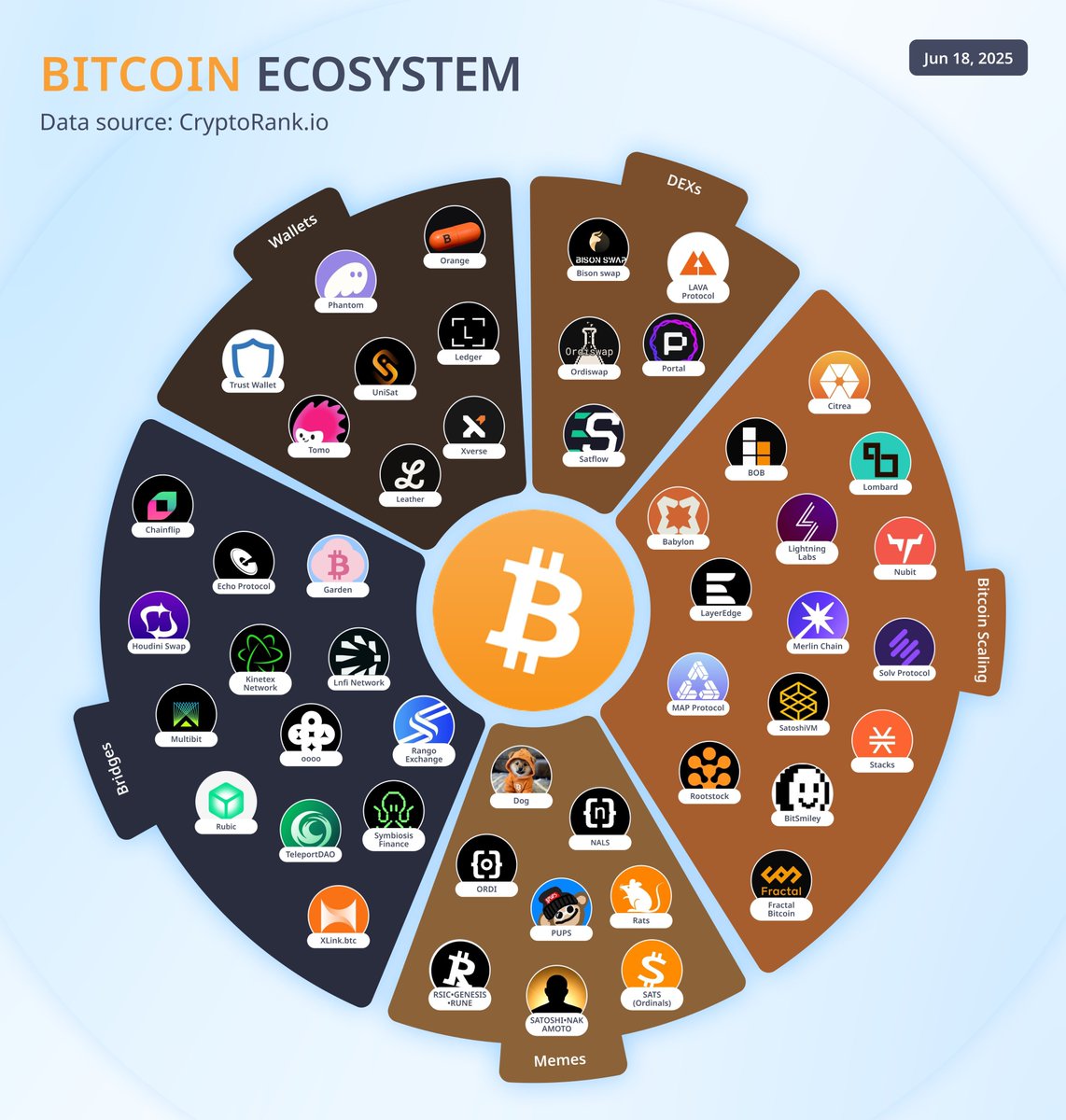
MultiBit launched the first bridge for BRC-20s to EVM chains and @solana and achieved $300 million dollars of bridging volume, the $MUBI token went from $400k market cap to $400 million dollars
The underlying inscriptions protocol is still one of the biggest innovations in Bitcoin history—permanent, immutable data on-chain. But $ORDI the token? It’s fully memed out now.
Even so, it’s not just another random vaporware meme. It’s a living fossil of the entire Bitcoin BRC-20 movement, fair mint for all.
3
13
78
6,841


🔸the largest bridge by volume for BRC-20s
🔸MultiBit $MUBI CA (ETH):
0x38e382F74dfb84608F3C1F10187f6bEf5951DE93

3
5
31
2,285
🔸MultiBit $MUBI CA (SOL):
MUBiMmjf8dYZ7viKYNMcp9perZ9TrgRP8VsGysZvDWh
1
3
19
1,389

I saw it myself and I agree. This one does not disappoint either. Wholeheartedly recommended, especially in view of the multibit thinking.
2
185