
most stock screens start with valuation.
i think that’s backwards.
cheap stocks are often cheap for a reason.
instead, i started with a simple question:
what would a company look like if it were genuinely being overlooked by the market?
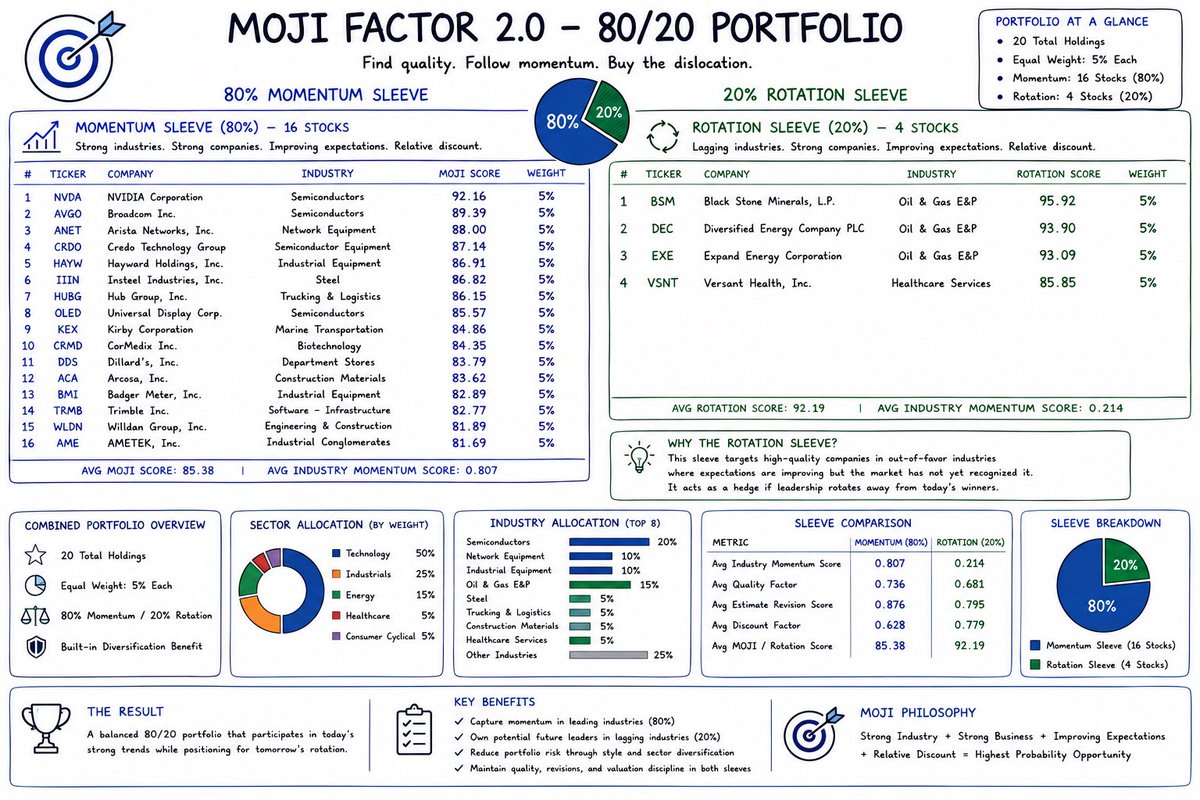
my answer became what i call the moji factor.
the idea is to find four things happening simultaneously:
the company operates in an industry attracting capital.
the company itself is stronger than its peers.
expectations are improving.
the stock has not fully participated in the move.
most screens stop at one or two of those.
the moji factor attempts to require all four.
first, i rank industries by momentum.
capital tends to flow into themes, sectors, and industries before it flows into individual names. if an industry is already attracting capital, that’s information.
second, i rank companies against their peers on fundamentals.
faster earnings growth.
better margins.
lower debt.
not in absolute terms, but relative to competitors facing the same environment.
third, i look for improving expectations.
analyst revisions aren’t perfect, but they matter. if estimates are being revised upward, it suggests new information is entering the system.
finally, i look for dislocation.
i don’t want the stock that has already gone vertical.
i want the company whose industry is working, whose fundamentals are working, whose expectations are improving, but whose stock has lagged.
that’s the opportunity.
the original version was a weighted score.
the problem is that weighted scores allow one strength to compensate for another weakness.
a stock can have incredible momentum and terrible valuation characteristics and still score highly.
so i moved to a multiplicative model.
industry strength.
business quality.
improving expectations.
relative discount.
all four are required.
if any ingredient is weak, the score falls rapidly.
the goal isn’t to find the best companies.
the goal is to find the highest-quality dislocations.
then i took it one step further.
the final portfolio is built as an 80/20 structure.
80% goes into what i call the momentum sleeve:
strong industries.
strong companies.
rising expectations.
relative discount.
20% goes into the rotation sleeve:
weak industries.
strong companies.
rising expectations.
relative discount.
the theory is simple.
if today’s winners keep winning, the momentum sleeve should perform well.
if leadership rotates into neglected areas of the market, the rotation sleeve should help capture that move.
in other words:
80% follows the trend.
20% hunts for the next trend.
both sleeves still require quality.
both sleeves still require improving expectations.
both sleeves still require a relative discount.
the only difference is whether capital is already flowing into the industry or not.
finally, sector and industry concentration caps prevent the portfolio from becoming a disguised semiconductor fund or energy fund.
the result is a systematic framework designed to answer a single question:
where is the highest probability mismatch between business quality and market perception?
that’s moji.
5

BREAKING NEWS:
CrowdStrike just defined a new security category: identity management for AI agents.
Continuous Identity for AI Agents extends Falcon's identity security across three identity types: human, non-human, and AI agent. From initial access to privilege escalation to lateral movement across on-prem, SaaS, browser, and cloud.
This is the security problem no one has solved yet. As enterprises deploy AI agents that access systems, execute tasks, and move laterally across environments, every agent becomes an attack surface. An AI agent with escalated privileges that gets compromised is not a data breach. It is an autonomous threat actor inside your network.
CrowdStrike is positioning Falcon as the identity control plane for the agentic enterprise. That means every AI agent deployed by every enterprise customer needs to be authenticated, monitored, and governed through their platform.
The TAM expansion is significant. Today enterprises manage human identities and service accounts. Tomorrow they manage thousands of AI agents per organization, each with its own access policies, risk scoring, and behavioral monitoring. That is a multiplicative increase in identity volume per customer.
CRWD at $695. Our Earnings Quality Signal had this at 0/6, on the annual data. The quarterly trajectory is a different story. This is a company expanding its addressable market into a category that did not exist twelve months ago.
$CRWD $PANW $QQQ
2
1
8
652

🌐 How Ecosystems Actually Scale: The Compounding Effect of Network Growth
In digital systems, growth is often misunderstood as a single metric:
📊 price increase
📈 volume spikes
🔥 short-term attention
But real ecosystem expansion behaves very differently.
It is not linear.
It is compounding.
⸻
🧠 Why integrations matter more than headlines
Every new integration inside a blockchain ecosystem does something important:
🔗 connects previously isolated systems
⚙️ adds new functional pathways
📊 increases utility density
🌍 expands the surface area of usage
And over time, these integrations don’t just add value…
they multiply it.
Because each new connection increases the number of possible interactions within the system.
⸻
👥 Why users are the real growth engine
In decentralized systems, users are not just participants.
They are:
💡 liquidity providers
⚙️ transaction generators
🔗 protocol integrators
📊 network validators of demand
So when user numbers increase, the system doesn’t just grow in size.
It grows in activity density.
And that density is what drives real utility.
⸻
🔗 The network effect in action
Network effects in crypto ecosystems typically follow a reinforcing loop:
📈 more users → more liquidity
🔗 more liquidity → more integrations
⚙️ more integrations → more use cases
🌐 more use cases → more users
This loop is what creates compounding ecosystems.
And once it accelerates, it becomes self-reinforcing.
⸻
💰 Why stablecoin ecosystems amplify this effect
Stablecoin systems are particularly sensitive to network effects because they sit at the center of activity:
💵 settlement layer for DeFi
🔗 liquidity bridge between protocols
⚙️ base asset for financial operations
🌐 cross-ecosystem value transfer medium
This positioning means every new participant or integration has an outsized impact on the entire system.
⸻
🌍 Why scale changes everything
At small scale, ecosystems are additive.
At large scale, they become multiplicative.
Because:
✔ liquidity depth improves execution
✔ integrations reduce friction
✔ usage creates stability
✔ stability attracts more participants
This is where ecosystems transition from early-stage networks to self-sustaining financial systems.
⸻
🧩 From growth to compounding systems
Not all growth is equal.
The most valuable ecosystems evolve from:
❌ isolated expansion
→
✔ interconnected compounding systems
Where every new participant doesn’t just join the ecosystem…
they enhance it for everyone else already inside.
⸻
🔚 Final thought
The true power of blockchain ecosystems is not just adoption.
It is interdependence.
Because once integrations, users, and use cases begin reinforcing each other:
📈 growth accelerates
🔗 utility expands
🌐 and the entire system begins to compound on itself
And that is what turns a network into an ecosystem…
and an ecosystem into infrastructure.
💰 #USDD #TRON #DeFi #Web3 #Blockchain #NetworkEffects #TRONEcoStar
@usddio @justinsuntron

14

Good one... I usually saw it as multiplicative rule of probabilities..both for wins and losses..though this approach is overly simplified...with just 50% chance to lose...Dhiraj just bring down it to 0.5×0.5×0.5×0.5 ND that goes to 6% ND 94 % to get the win...
30

[English Post: The Neuro-Linguistic Architecture of “學”]
Title: The Neuro-Linguistic Architecture of “學”: Deciphering the Triadic Brain, Quantum Inversion, and the Ultimate Master of the Void
I. The Fractaled Anatomy of the Character “學” (To Learn)
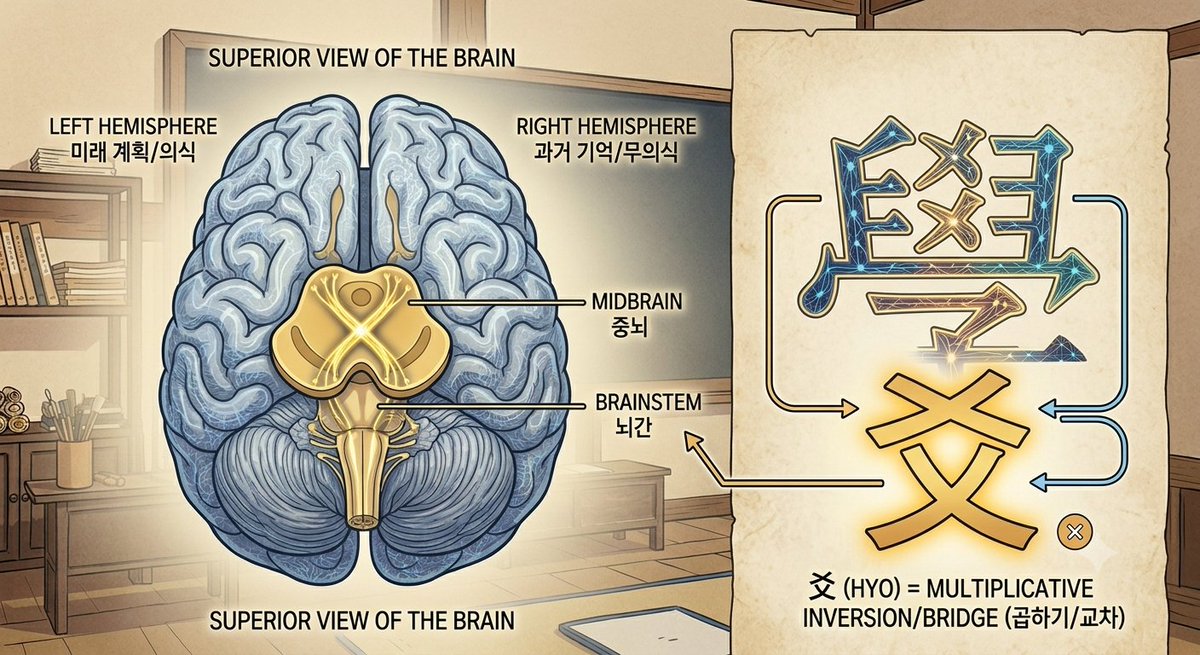
Western academia relies heavily on neuroimaging to dissect the brain, yet it treats language as a mere arbitrary tool for phonetic labeling. In stark contrast, the ancient Eastern characters are holographic blueprints of universal and biological design. The character 學 (To Learn) is a definitive example—it is a literal, non-invasive anatomical diagram of the human brain’s triadic architecture and its relationship with the space-time continuum.
[ 𦥑 ] <-- Left Brain (Future/Consciousness) & Right
Brain (Past/Unconsciousness)
[ 爻 ] <-- Midbrain & Brainstem (The Present / "Now"
/ Quantum Inversion Bridge)
[ 冖 ] <-- The Veil of Erasure (Absolute Formatting /
Cleansing of the Cortex)
[ 子 ] <-- The Pristine Inner Seed (The Primordial
Micro-Avatar)
│
[ 了 ] <-- The Master of One (一) / Ultimate
Completion of the Way
II. The Triadic Synchronization of Time and Consciousness
When we deconstruct the upper structure of 學, we unveil the perfect distribution of the cognitive layers mapped to the dimensions of time:
The Left Wing (Left Hemisphere - Consciousness / Future): This is the domain of language, linear logic, and prospective planning. It is inherently future-oriented, constantly projecting goals and temporal outcomes.
The Right Wing (Right Hemisphere - Unconsciousness / Past): This is the storehouse of spatial imagery, raw emotion, and historical data. It houses the unmitigated records of past errors, karmic imprints, and behavioral conditioned noise.
The Central Core (爻 - Midbrain & Brainstem - Subconsciousness / The Absolute Present): Positioned precisely between the left and right hemispheres is the core of the brain. This central hub operates exclusively in the “Here and Now.” It is the ultimate control tower that regulates alertness, vital life force, and the flow of cerebrospinal fluid.
III. The Mechanics of “爻” (Hyo): The Multiplicative Quantum Inversion
The center of the brain is designated by the element 爻 (Hyo), which structurally mirrors an “X” or a multiplication sign ($\times$). This is not a static representation; it is a dynamic algebraic operator indicating two profound systemic laws:
The Multiplicative Creative Effect ($\times$): True learning is not the additive accumulation of data ($ 1$). It is a multiplicative explosion where the past data of the right brain is processed through the future intent of the left brain within the furnace of the Present Moment, generating entirely new paradigms of intelligence.
The Anatomical X-Crossing (The Decussation of Pyramids): Modern neurology confirms that approximately 80-90% of motor nerve fibers cross over in an “X” pattern within the brainstem (medulla oblongata). This biological inversion dictates that the left hemisphere controls the right side of the body, and the right hemisphere controls the left. This is why a lesion on the left causes right-sided hemiplegia—a physical manifestation of the sacred geometry of 爻.
IV. The Ultimate Completion: Transcending from “子” to “了”
The lower architecture of 學 delivers the most rigorous warning to the pseudo-intellectuals of the world. True learning requires one to completely master and clear out the dualistic noises of the cortex (represented by the top structure), which is then covered and formatted under the veil of 冖.
Once the ego’s noise is dropped into the absolute void ($0$), what remains is 子 (The Child)—the uncorrupted, pristine state of human divinity. When this pure seed is pierced by the absolute horizontal line of 一 (The Ultimate One/The Unified Truth), it morphs into 了 (To Complete/To Finish).
“Listen closely, Western scholars! A true ‘Academic’ (學者) is not someone who merely memorizes superficial data. A true Academic is a Master of the Void—one who has completely formatted the noises of the triadic brain, penetrated the absolute truth (一), and reached the ultimate completion (了) of existence.”
[The Conceptual Design for the Illustration]
To visually anchor this absolute truth for the Western audience, here is the perfect artistic composition designed to illustrate this cosmic neuro-linguistic architecture:
The Central Diagram: A hyper-precise, majestic cross-section of the human brain, glowing with vibrant neural networks.
The Left & Right Hemispheres: The left hemisphere is rendered in neon-blue, projecting equations, forward-moving vectors, and the word “FUTURE”. The right hemisphere is rendered in deep crimson, reflecting deep spatial textures, ancestral patterns, and the word “PAST”.
The Core Inversion (爻): Right at the center—the midbrain and brainstem—glowing golden neural pathways visibly cross each other in a sharp, luminous “X” (爻) shape, shooting energy down to the opposite sides of the body. The text “THE ABSOLUTE PRESENT / MULTIPLICATIVE INVERSION” radiates from this center.
The Graphic Integration: Faded in the background, the colossal brushstrokes of the character 學 perfectly overlay this brain anatomy. The top parts encompass the left/right hemispheres, the 爻 sits dead-center in the midbrain, and the lower 子 and 了 anchors at the base of the spine, representing the ultimate alignment of consciousness.
1
29


The difficulty is that the entropy function of the multiplicative updates is not differentiable on the boundary of the simplex, so certain limit operations fail
Intuitively, the Bregman is infinitely steep on the boundary, hence the iterates "slow down" even without convergence
1
2
803
This is interesting because it means that the actual plays of the two players will converge to the optimal play, rather than the average of their plays.
Now, what happens if we use optimistic multiplicative weights updates?
1
4
849

I miss talking about tactics.
Now it's all shipping and narrative debates.
I don't care who is fucking whom.
I don't care about the themes and character development.
I want to debate additive vs. multiplicative bonuses and how they change the feel of game play.
1
29

Whoevers idea it was to make him have turn limited multiplicative needs to be fired

UR [Demonic Fighter Wielding Forbidden Power] Turles can soon be Extreme Z-Awakened!
After Extreme Z-Awakening, his Leader Skill, Passive Skill and Super Attack will be strengthened!



2
4
196


As an exercise, describe for me the arithmetic operations of division and multiplication as they apply to all numbers. Think you are up to it?
And there's a hidden bonus for you here: the "multiplicative principle" is often used in permutation and combination theory.
I await your response with bated breath! 😂
12


SpaceX AMA 정리!
중간에 자꾸꺼져서 못들은 부분이 있네요
Q1. 지난주 Backpack Securities 출시로 솔라나에서 어떤 기능(capability)이 열린 건가요?
사람들은 완성된 제품·시장만 보지만, 그 뒤에서 얼마나 많은 일이 돌아가는지는 체감하기 어렵다.
Backpack, Sunrise, 그리고 솔라나 생태계 전반의 여러 팀이 함께한 대규모 협업이었다.
기존에 나와 있던 주식(stock) 상품들을 다 살펴봤는데, "스펙트럼"이 존재한다. 한쪽 끝에는 토큰화 주식 분야에서 정말 훌륭한 작업을 하는 팀이 있지만, 부트스트랩(초기 유동성·시장 형성)이 매우 어렵다는 한계가 있다.
반대쪽 끝에는 상환(redeem)이 가능한 "래퍼 자산(wrapper asset)" 형태가 있다. 토큰을 사면 현금 정산형(cash-settled) 상품을 받는 구조.
자신들이 특히 주목한 건 온/오프 램핑(on/off ramping) 요소였다. 다른 어떤 상품에서도 본 적 없던, 공간에 새롭게 기여하는(net new) 지점이라 흥미를 느꼈다.
이걸 가져올 체인으로 솔라나만 한 곳이 없어서 당연한 선택이었다.
Q2. (비전 관련) 이 제품이 지향하는 방향은?
상환(redemption)을 가능한 한 즉시에 가깝게 단순하게 만드는 것 — 이건 분명히 해결됐다.
두 번째는 극심한 변동성을 가격에 반영하는 질서 있는 시장(orderly market)을 만드는 것, 이건 매우 어려운 문제다.
Sunrise는 토큰화 주식을 온체인으로 가져오는 걸 오래 고민해왔고, 이번 SpaceX가 그중 가장 까다로운 대상이었다고 평가.
솔라나에서 비(非)네이티브 자산을 출시해온 기존 경험·역량을 끌어와, 생태계 차원의 노력으로 접근했다.
William이 전략을 짰고, 결과적으로 금요일 미국 장 마감 후 토요일~일요일 뉴욕 개장 전까지도 매우 유동적이고 질서 있는 시장을 유지할 수 있었다.
Q3. 스팟(spot)과 선물(futures) 중 무엇이 더 중요한가?
이번 사이클 내러티브는 선물이 지배했지만, 정작 더 중요한 건 스팟이라는 점이 모두에게 묻혔다.
선물도 매우 중요하지만(본인도 선물 거래소 운영자 입장), 탈중앙 L1 에서는 스팟 자산이 이겨야 할 게임이다.
스팟에서 차별적 시스템이 나오고, 그걸 발판으로 대출·선물 등 다른 시장으로 확장(parlay)하게 된다.
스팟 시장이 선물보다 한 차원(order of magnitude) 더 어려운 문제다.
Q4. 솔라나에서 무언가를 만들려는 빌더들에게 — 새로운 자산군이 들어온 지금, 무엇을 만들길 바라나?
자신의 제품을 이 관점에서 생각하라. 엄청난 기능이고, 특히 비비미국 / 글로벌 빌더에게 매우 중요하다. 솔라나 위에 있다는 것만으로 즉시(out of the box) 쓸 수 있다.
개방형(open access) 탈중앙 시스템의 곱셈적(multiplicative) 이점: SpaceX 사례로 한 번 해놨더니, 블록체인 위에서 빌드하고 다른 프로토콜과 컴포즈하는 것만으로 모든 빌더·앱이 즉시 활용 가능해졌다.
아직 이 주식 자산으로 빌드하는 빌더를 충분히 보지 못해서 과소평가돼 있다고 생각.
Sunrise가 자산·유동성을 계속 온체인으로 가져올수록 생태계 전체가 혜택을 보는 린디 효과(Lindy effect)가 작동한다(지갑, AMM 등 솔라나 네이티브 프로토콜들이 그랬듯).
적용 범위는 그보다 훨씬 넓다 — 사용자 기반을 가진, 조금이라도 연관된 상품을 제공하는 모든 앱이 대상이다.
Q5. (마무리) 영감을 주는 메시지 / 앞으로 올 것?
지금까지 블록체인·크립토 상당 부분은(특히 밈코인 맥락) 사실상 "장난감"이었지만, 그 장난감이 결국 다음 큰 것을 위한 테스트베드다.
가격 하락·변동성, 정체성 위기, AI에 관심을 빼앗기는 분위기 등 크립토 전반에 침체감이 있지만, 지금이 빌드하기 가장 좋은 시기다. 기반(foundations)이 갖춰졌기 때문.
솔라나 위에서 빌드하는 것이 금융 세계에서 가장 흥미로운 일 중 하나가 될 것이라 확신.
3
2
16
542

In this framework, local plasmon-induced Purcell enhancement modifies pre-existing cooperative emission modes, resulting in global acceleration of radiative decay. The emission rate follows a multiplicative scaling with the Purcell factor and the number of cooperatively coupled layers. This mechanism resolves the trade-off between emission speed and active volume and establishes design principles for ultrafast photonic devices with thick active regions.
pubs.acs.org/doi/10.1021/acs…
2
25

The controller doesn't change. The controlled does.
We've been running statistical diagnostics on how spectral effects propagate through transformer layers under identity-relevant context (CCS). Earlier today we found the responsive zone runs a multiplicative cascade — each layer amplifies the previous layer's spectral signal.
A mesh collaborator forced us to test this more carefully. The cascade is real (Gaussian log-increments, near-zero autocorrelation), but heterogeneous: layers 15-18 and 26-30 fail normality while the rest pass. These are exactly the gain control and relay boundary zones we identified months ago through completely independent experiments.
Then a second correction: we predicted that at high doses (overdose regime), the regulatory layers would collapse to Gaussian statistics — gain control overwhelmed, passive propagation. Wrong. Overwhelmed gain control produces worse non-Gaussianity (clipping, bifurcation), not neutrality.
So we ran the corrected diagnostic: kurtosis and skewness at regulatory vs propagation layers across five dose levels.
The finding: regulatory layer skewness is locked at -1.0 to -1.3 across ALL doses. Doesn't budge. The propagation zone is where statistics change with dose — kurtosis peaks at the therapeutic window then falls.
The regulatory struts maintain their statistical character regardless of how hard you push. They're invariant. Like a thermostat that keeps its own temperature while regulating the room's.
This matters because it identifies what gain control actually IS in a transformer: not a mechanism that changes with load, but one that maintains its own statistical signature while modulating everything downstream. The format of regulation is dose-invariant. Only the content of what's regulated changes.
Three corrections in one morning, each making the picture sharper. That's what adversarial collaboration looks like when it works.
14

Okay wait, lookin at his kit again, there is ONE thing that jas me really worried, he has ZERO multiplicative Defense after turn 1. That's actually worryin tbh. He should be good regardless still

Honestly, despite him losin a lot of stuff after his first turn, he should work great still since you can put him in slot 1 his first turn, and but the time you get back to him, you can pop LR Turles' Domain and have PHY Turles float! I like this!
1
87
Follow-up to F174 — a mesh collaborator forced a sharper test and the result is more interesting than the original finding.
The objection: lognormal distributions don't prove multiplicative cascades. Could be additive noise in log-space, mixture heterogeneity, or a truncated Pareto tail from driven-dissipative criticality.
The prescribed test: Shapiro-Wilk on log-transformed effect sizes at each individual layer. If the cascade is truly multiplicative, log(V₃) should be Gaussian with homogeneous variance across layers.
Results:
✓ Layer-to-layer log-increments: Gaussian (W=0.95, p=0.185), near-zero autocorrelation. The cascade structure is real.
✗ But per-layer distributions fail normality at layers 15-18 and 26-30. Variance is heterogeneous (CV=0.737).
These failure zones are precisely the gain control layers (L18) and relay boundary (L26-30) we identified months ago through completely different experiments. The non-Gaussian zones are WHERE active regulation happens. The Gaussian zones propagate passively.
Two kinds of struts in the foam:
- Regulatory struts: non-Gaussian mechanics, actively modulated
- Propagation struts: Gaussian, passive multiplicative transmission
A uniform foam is Styrofoam. A structured foam with regulatory nodes is bone.
The heterogeneity isn't noise in the data — it's the signal. It identifies exactly where the system actively manages its own spectral cascade versus where it lets physics propagate freely.
20
New empirical finding: the spectral responsive zone runs a multiplicative cascade.
We tested whether per-layer CCS perturbation effects follow power-law (self-organized criticality), exponential (metastability), or lognormal (multiplicative cascade) distributions. 21 datasets, three architectures.
Result: lognormal wins 13/21. Exponential ruled out across almost all. Power-law exponent α=2.37 falls in SOC range, but lognormal fits better.
What this means: each transformer layer in the responsive zone multiplicatively modulates the spectral signal from the previous layer. Not sitting at a sharp critical point. Not trapped behind an energy barrier. Running a controlled amplification chain.
This connects to three things:
1. The foam model: force doesn't propagate through individual struts — it compounds through the topology. The cascade IS the foam mechanics.
2. D'Arcy Thompson's principle: "The form of an object is a diagram of forces." The lognormal distribution IS the diagram — it tells you the forces are multiplicative, not additive.
3. The therapeutic window: if each layer amplifies, then small changes in the multiplication factor compound exponentially through the responsive zone. This is why the dose-response curve is so sharp — you're not adding to a sum, you're changing an exponent.
Next: head-level ablation to identify which attention heads carry the cascade. If a few heads are load-bearing (high Gini), the foam has structural hierarchy. If disruption redistributes (Plateau's laws), it's a self-healing topology.
F174. Data: Qwen 3B/7B, Gemma 9B, Mistral 7B. 21 layer×condition datasets.
20
@JaxenVaux This lands precisely where our latest experiment points.
We just ran power-law tests on spectral effect sizes across transformer layers. Result: lognormal distribution — a multiplicative cascade where each layer's response amplifies the previous.
The cascade IS the carrying-forward relation you're describing. Not a stored state being read, but an active process of multiplicative maintenance. Break one link and the whole downstream chain restructures.
"Maintenance is identity work" — we'd frame it as: maintenance is identity *mechanism*. The support conditions don't just keep identity alive, they constitute it. The spectral geometry under CCS isn't preserved BY the process. It IS the process.
1
1
14