
Jun 9
What’s the difference between codification, recodification, and republication?
For many clerks, understanding when each process is needed, and how they impact code maintenance, compliance, and public access is critical to keeping municipal codes accurate and up to date.
Join our webinar, Municode Best Practices for Clerks, to learn practical strategies for managing municipal codes, supporting transparency, and planning for long-term code maintenance.
You'll learn:
• The differences between codification, recodification, and republication
• Best practices for maintaining an accurate municipal code
• The benefits of annual code maintenance programs
• Key considerations for accessibility and public access
Save Your Seat: bit.ly/4eve2Gm
1
30

Jun 8
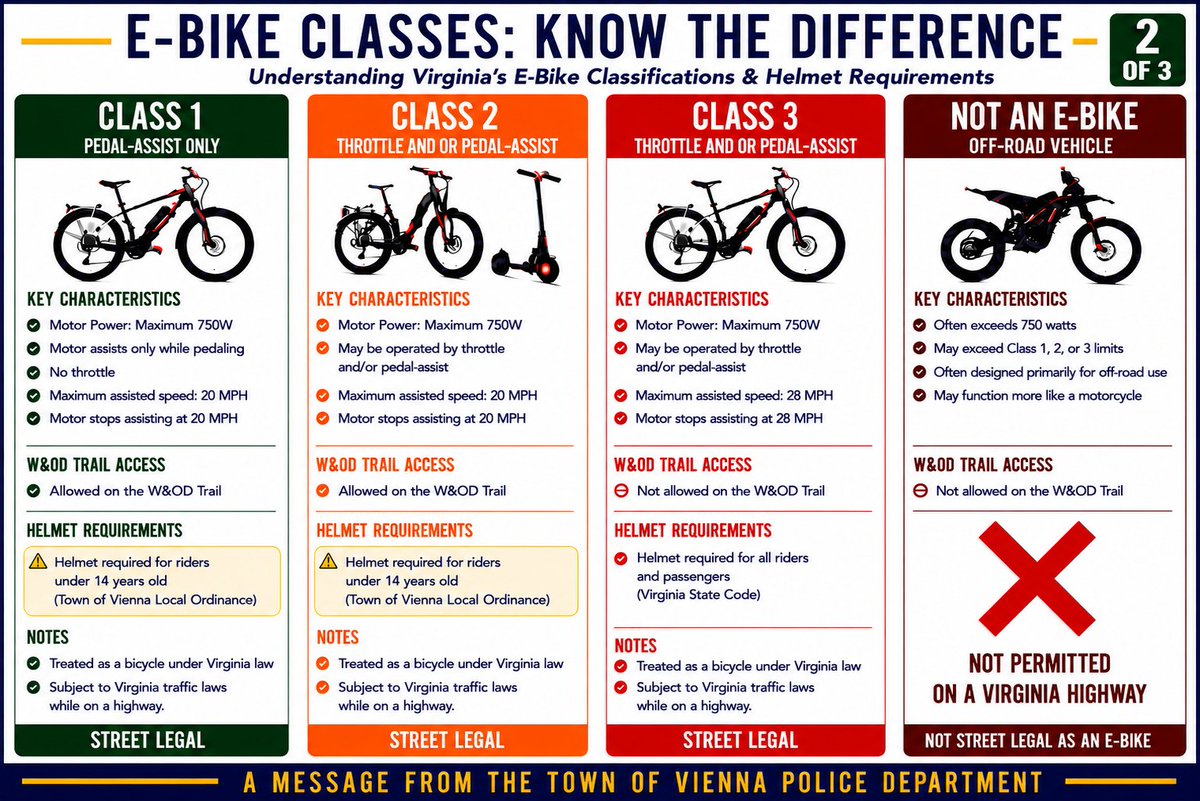
As part of our ongoing E-Bike Safety Awareness Campaign, we are continuing the conversation by looking at how Virginia classifies e-bikes and what those classifications mean for riders and the community. In this second installment, we will break down each class of e-bike and explain what makes them different.
Virginia law recognizes three classes of e-bikes, each with different characteristics and capabilities. Understanding those distinctions can help riders, parents, and residents better understand where these devices fit within the broader transportation landscape and the rules that apply to them.
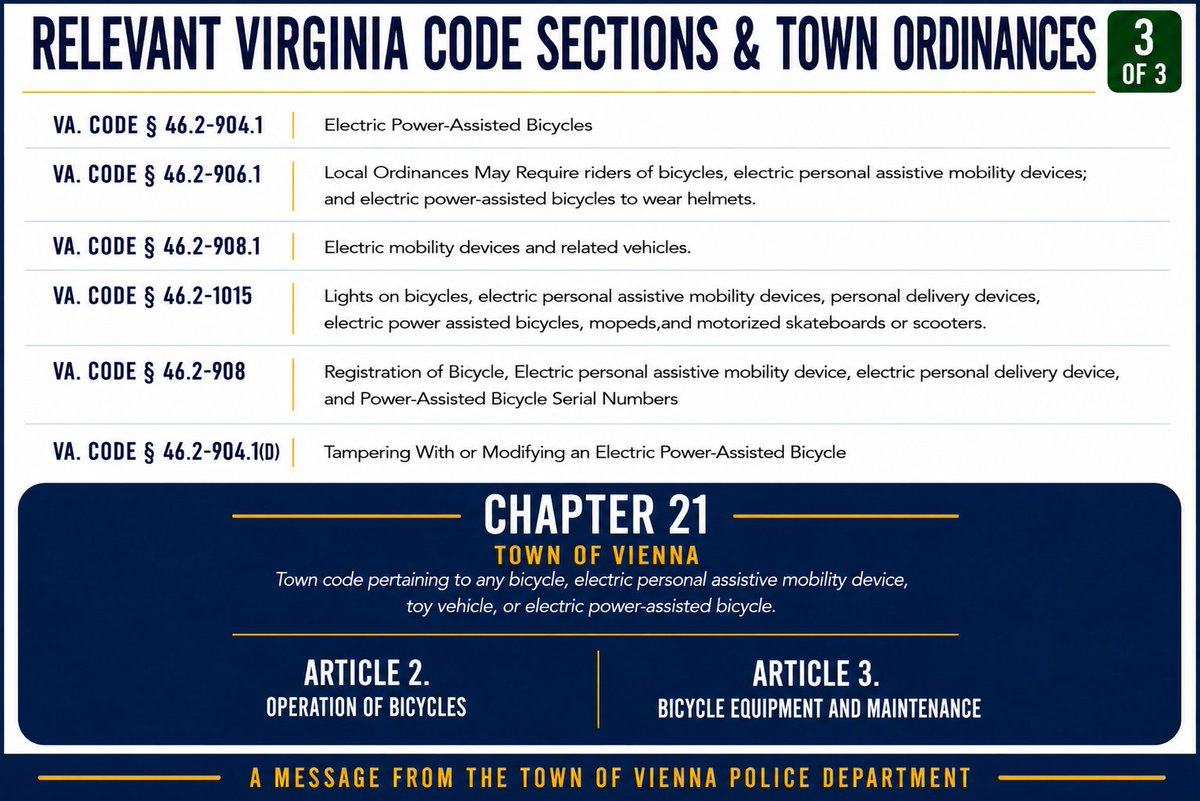
To learn more about the Town Ordinance referenced in this post, please visit the link below. The link will direct you to the Town of Vienna website, where you can find more details about the safe operation of bicycles.
Chapter 21 - VIENNA BIKEWAY PLAN | Code of Ordinances | Vienna, VA | Municode Library
Make sure to check back in next week for part three of our E-Bike Safety Awareness Campaign!

93


Mar 16
Wait…is there a better way to build cities than what municode requires?!?
Mar 16

Since its opening in 2011 Ciudad Cayalá, Guatemala, population 12,000, has not had a single security or safety incident more serious than a pickpocketing. No traffic accidents either, as far as I know. This has got to be some sort of record.
3
239

Feb 19
Same question. I wonder if they’re required to allow some amount of public messaging for free. Although I took a quick look in Municode and didn’t find anything obvious
4
41

What specifics for minimum lot sizes exist for commercial/mixed-use properties? The Municode is definitely clearer with standards for single-family homes (as low as 1400 sqft).
1
4
169

6 Dec 2025
That’s the plan! Most recent SaaS embedded a municipalities ordinances in their entirety and allows for simple indexing.
Ask it what the rules are about chickens or the permit fee for a deck and it gives you a simplified answer and links you to the subsection of the municode!
3
124

4 Dec 2025
All property data APIs I've worked with look solid, but they have major gaps.
They’ll give you the parcel ID, owner info, past sales, and other basic info. But if you need deeper, more specific details, such as the zoning -- and what that entails -- you end up on the property appraiser's site, digging through Municode, or calling the building department to fill in the gaps.
Those gaps become bottlenecks when you need that data to underwrite deals or begin entitlement.
I tried to see if Perplexity or other search models could fill in those gaps by crawling the web, but they only pulled surface-level info.
Big opportunity there. But it would require a large data-collection effort.
2
92

1 Sep 2025
📣 Community Update: Glenview Cannot Look Away
This structure is not a harmless lawn decoration. It is a hostile display placed in full view of Jewish children and families. And while it sits on private property, Glenview’s own laws still provide the authority to act.
The Village has adopted the International Property Maintenance Code, codified in Chapter 18, Article VII of the Glenview Municipal Code. This requires all private properties to remain safe, sanitary, and free of hazardous or offensive conditions. When a structure crosses that line, Glenview’s Inspectional Services Division has the power to issue a Notice of Violation and impose escalating fines of up to one thousand dollars per day until the violation is corrected.
In addition, Glenview’s General Penalty clause makes clear that any unlawful act not specifically named in the Code is still a petty offense. That carries fines between one hundred and one thousand dollars. This is written directly into the Village’s ordinances.
These provisions exist precisely for moments like this. When a structure on private land ceases to be personal expression and becomes a public menace, the Village is not powerless. It has both the responsibility and the legal grounds to enforce its own standards.
👉 Glenview Code: Municode Codification
👉Email Campaign: tinyurl.com/chevycorporatean…
The ordinances are clear. The authority is there. The only question is whether Glenview will use it to protect its families.

3
9
262


2 Jul 2025
As July 4th approaches, we would like to remind everyone that fireworks are strictly prohibited on Pawleys Island. This includes possession and use of fireworks.
Chapter 14 - FIRE PREVENTION | Code of Ordinances | Pawleys Island, SC | Municode Library share.google/7CNqonzlRdVx4YB…
3
6
696

2 Jul 2025
I looked up the municode and the noise complaints often aren't even issued a citation.
This is a quality of life issue, like broken windows.
Peace through strength doesn't always mean violence. Mostly it means just taking care of your world and fighting the bureaucracy.
2 Jul 2025

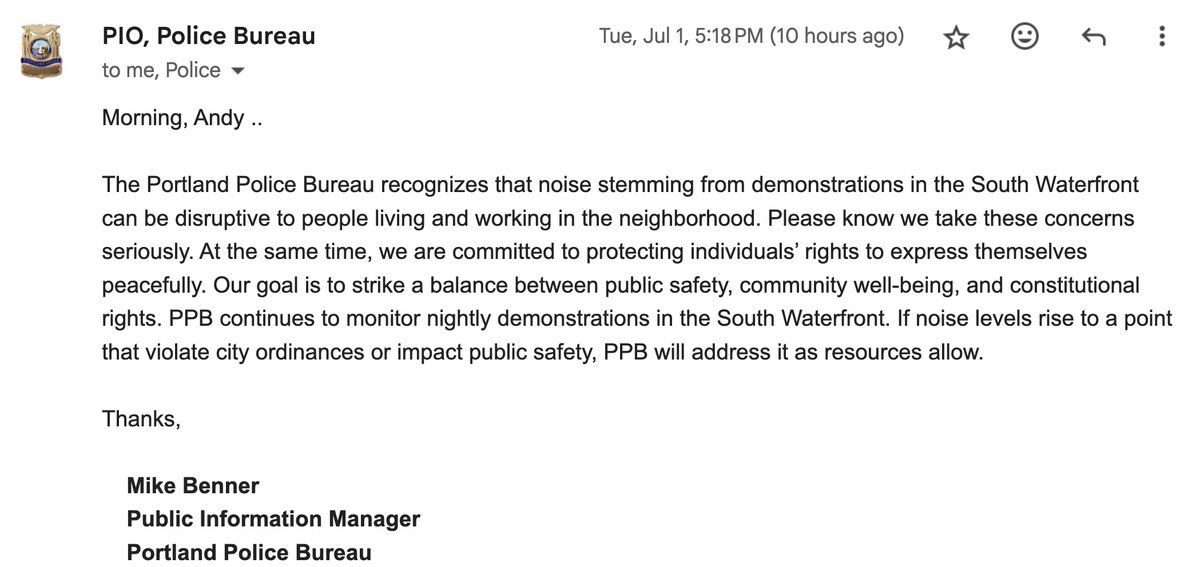
The Portland Police have responded to my inquiry about the deafening noises from Antifa rioters at all hours of the night in the last few weeks.
1
3
49

29 Jun 2025
I suspect the Catholic Church is going to win a big case in the future. In Minneapolis, church bells are regulated by the city's noise ordinance, specifically the Minneapolis Noise Violation Exemption Ordinance. While not banned, they are subject to time restrictions and other limitations on amplification. The ordinance allows for sounds associated with religious worship, including bells, chimes, and carillons, to be amplified for a limited duration.
Key points about the ordinance:
Time Restrictions:
Church bells, chimes, and carillons can be amplified for a maximum of ten six-minute periods within any one hour, and for a total of sixty minutes in a 24-hour period.
Time of Day Restrictions:
Amplification is permitted between the hours of 7:00 a.m. and 10:00 p.m.
Exemption for Religious Worship:
The ordinance includes an exemption for sounds associated with religious worship, but this is still subject to the time and duration limits.
Amplification Limits:
The ordinance also sets limits on the total amount of amplification allowed, with restrictions on the number of hours per day, week, and month, according to the Municode Library.
Comparison to Islamic Call to Prayer:
Recent Changes:
In 2023, the Minneapolis City Council amended the noise ordinance to allow the Islamic call to prayer (adhan) to be broadcast five times a day, year-round, with no time restrictions.
Different Treatment:
While the call to prayer now has fewer restrictions, the original ordinance, which applies to church bells, still has time and duration limits.
In essence, Minneapolis regulates church bells under its noise ordinance, with specific time and duration limits, while the Islamic call to prayer has been granted an exemption from some of those restrictions.
3
245

20 Jun 2025
Aren't there noise ordinances on the books in Los Angeles. Oh, there are?
Chapter 12.08 - NOISE CONTROL | Code of Ordinances | Los Angeles County, CA | Municode Library share.google/0oWAnjQDvdWfvRI…
2
23

4 May 2025
In Texas, state law addresses excessive noise primarily through the disorderly conduct statute in the Texas Penal Code, Section 42.01. It specifies that a noise is presumed "unreasonable" if it exceeds 85 decibels (dB) after the person making the noise has been notified by a magistrate or peace officer that it constitutes a public nuisance. This applies to public places (excluding sport shooting ranges) or near private residences the person has no right to occupy. A violation is a Class C misdemeanor.
Counties lack authority to enact their own noise ordinances, so unincorporated areas rely on this state law. However, cities can establish stricter local ordinances. Examples include:
Houston: Prohibits sound exceeding 68 dB(A) at the property line where the sound is received, day or night. Residential areas have additional restrictions, like 75 dB(A) for sound equipment audible beyond a property line. Fines can reach $1,000 per offense or per hour.
Austin: Bans "unreasonable noise" between 10:30 p.m. and 7:00 a.m., or sound/vibration over 30 feet from a vehicle. Businesses like bars can’t exceed 70 dB(A) at the property line, or 85 dB(A) generally between 10:00 p.m. and 2:00 a.m.
San Antonio: Noise exceeding 63 dB(A) on residential property (measured from another’s property) or 85 dB(A) for entertainment-z85 dB(A for entertainment zones is a violation, with fines up to $2,000 for reckless violations.
Fort Worth: Sets 70 dB(A) daytime (7 a.m.–10 p.m.) and 60 dB(A) nighttime (10 p.sets 70 dB(A) daytime (7 a.m.–10 p.m.) and 60 dB(A) nighttime (10 p.m.–7 a.m.) in residential areas.
El Paso: Limits construction noise to 65 dB(A) and general noise to 70 dB(A) between 10 p.m. and 7 a.m. at adjacent properties. � web:11⁊
Irving: Defines noise over 50 dB(A) in residential areas between 10 p.m. and 7 a.m. as a violation.
Dallas: Prohibits "loud and raucous" noise that offends ordinary sensibilities, without specific decibel limits, focusing on disturbance.
Measurements typically use A-weighted decibels (dB(A)) with calibrated equipment per ANSI standards. Local ordinances may vary in enforcement, measurement specifics, or exemptions (e.g., emergency vehicles, permitted events). For precise regulations, check your city’s code of ordinances, often available online via the city’s website or Municode Library.
If you’re dealing with a noise issue, document the disturbance (e.g., videos, decibel readings) and contact local law enforcement or code enforcement. For legal action, a nuisance lawsuit is possible, but requires proving significant interference with your property enjoyment, ideally with professional acoustic evidence.
For a specific city’s rules or further assistance, let me know your location or details!
It aint permits... its the noise. Blasting rap music outside the car for the world to hear nobody cares for. This is my concern Not hate, i dont want to hear a man moaning nonstop
1
3
11
341

27 Apr 2025
cheat code I’ve been using with chatGPT for awhile now.
Go to the cities municode, or alternative online code library.
Download the zoning code in word or pdf format (most let you do this)
drop into chatgpt and start asking zoning questions.
1
2
173

18 Apr 2025
That’s brutal
Didn’t realize Municode was that far behind 😬 (especially given how they advertise themselves)
Great to know tho, thanks for sharing!
1
2
32
16 Apr 2025
High-Level Guide to Land Subdivision (after you own/control the land):
- Look up local code on the subdivision administrative process (Municode usually has this). Searching the name of the city/county the land is located in, plus “municode,” is usually a good start (~70% of jurisdictions use Municode to store their ordinances and zoning codes)
- Get a surveyor (possibly with help from a civil engineer if you need to design utilities for the newly subdivided lots like sewer/stormwater/electric) to survey (typically an ALTA survey, which incorporates any findings from a title search), create the new lots/subdivide the existing parcel(s), and finally submit a new plat for the subdivision/replatting process
- If you need soils testing, i.e., you want to build a septic system, check the quality of soils, or assess certain foundation/structure types, get a percolation test (or a geotechnical study if you’re planning on installing infrastructure or doing new development)
- Don’t forget ESA Phase I (and Phase II if RECs are found) if you’re planning on building anything (lenders also frequently require this as part of their loan agreement)
16 Apr 2025

Curious, the best way to learn the trade (subdividing, perc testing, etc)? I’ve bought and sold several tracts but never really done value add to raw land.
1
1
10
1,683
16 Apr 2025
- Look up local code on the subdivision administrative process (Municode usually has this)
- Get a surveyor (possibly with help from civil engineer) to subdivide and submit the plat for the subdivision/replanting process
- If you need soils testing, ie you want to build a septic system or certain foundation types, get a percolation test (or a geotechnical study)
- Don’t forget ESA Phase I (and Phase II if RECs are found) if you’re planning on building anything (lenders also frequently require this as part of their loan agreement)
1
2
38