





Tịch đầy căng retweeted

Jun 11
9
85
517
13,980

LEADERS LIKE IQRARUL HASSAN/JAWADAHMAD ARE BORN ONLYONCE IN CENTURIES,FOR MOTHERS OF SUCH UNBORN FOETUSES DECIDE TOHAVE ABORTIONS TO GET THEM LOST.AFTER CENTURIES,THERE WAS A BRAVE LEADER IMRAN KHAN TO WIPE TEARS OF MILLIONS HAVES.NOT.THESE A1 KANJARSATTHE BEHESTOF GENS IMPEDED
17


Jun 12
Hola papi, déjame ser tu pu*ti*ta y encuentrame en Onlyfans
onlyfans.com/barbienat05
O búscame en telegram como @Barbienat05
#nsfwtwtًً #México #onlyfans #onlyonce

1
4
120

Jun 12
Agreed — progress, not completion. That's the exact frame I was going for, so we're aligned.
On setPeer: it reproduces. It's a read-only staticcall — anyone can run the same command against any Sepolia RPC and get the same "OnlyOnce: already called" revert, even simulated as the owner. So by your own standard (fair is fair), that specific concern can be narrowed to "closed at the contract level, testnet." I'd rather you run it yourself than take my word.
On the rest, no disagreement: setDelegate open, no renounce txs, testnet ownership not renounced, contracts unverified on the explorer, rebuild only partial. I put all of that in the post because it's true — and it's the part still to be earned, most of it at mainnet.
My plan from here: work through the remaining items one by one, on-chain, and publish each result the same way — the exact command, reproducible, honest about what it does and doesn't show. Explorer verification of the testnet contracts is a cheap one, and I'll push for it. The renounce / setDelegate(0) / DVN-lock receipts only exist at mainnet; I'll check those the day they're deployable.
Peer review and independent verification pointing the same direction. That's the point.
1
1
84
Jun 12
A verification, in good faith — answered point by point against the peer review.
The review's core demand was fair: running a node proves nothing unless the contracts are shown to be out of any single party's control, verifiable by anyone without trusting the team. It raised specific items. Here is where each stands, checked on-chain today (testnet).
1) LayerZero config — can a controller call setPeer/setDelegate to reconfigure the messaging layer and forge cross-chain messages?
✅ setPeer: VERIFIED LOCKED. On CawProfile, setPeer on an already-set peer reverts even when called AS the owner key:
cast call 0x9fcbb3d6880cD3293F1a731Fe6c958a6621a74bF "setPeer(uint32,bytes32)" 40245 0x0..0 --from 0xF71338f3eAa483aA66125598B09BA1988e694a95 --rpc-url <any Sepolia RPC>
→ execution reverted: OnlyOnce: already called
Same for the second pathway (eid 40231). The owner cannot re-point an existing peer. This forgery vector is closed at the contract level, independent of renouncement.
⚠️ setDelegate: NOT yet closed. By design it is not OnlyOnce-lockable; the owner controls it until the mainnet setDelegate(0) step. Outstanding.
2) Renounced control — show renounce txs.
⚠️ On testnet the owner is a single EOA (the deployer) — not a multisig, not renounced. Expected pre-mainnet, but a real control point for anything not OnlyOnce-locked. Renounce is a mainnet step; that tx does not exist yet, so no one — including me — can show that receipt today.
3) Permissionless / independent validators — no allowlist.
✅ I run a node and registered my instance with no approval from anyone. Permissionless in practice, first-hand.
4) Rebuildable from public data, verifiable without trusting the team.
✅ (partial) Node software and contracts are public; the trustless archive challenge/slashing is deployed on-chain (CawActionsArchive: challenge-period / stake / slash logic). Caveat: media (images) is stored off-chain — only the on-chain actions are fully reconstructable.
5) Verified contracts — deployed bytecode matches source.
⚠️ Not on testnet. I checked the explorers: CawProfile (Sepolia) and CawProfileL2 / CawActions / CawChallengeRelay (Base Sepolia) are all unverified — raw bytecode only, with the "Verify and Publish" prompt. Source is public in the repo, so anyone can compile and compare, but one-click bytecode↔source matching on the explorer isn't available yet. Should be done at mainnet; I'll confirm it then.
Net: the strongest single technical concern in the review — setPeer forgery — is verifiably closed at the contract level today, before any renouncement. The rest is either confirmed (permissionless registration, trustless archive) or expected-and-pending at mainnet (renounce, setDelegate(0), DVN lock, contract verification). I am not claiming CAW is "fully decentralized." I am answering the review's points one by one, with what is provable now and what is not.
Reproducible: addresses in the public repo (client/src/abi/addresses.ts), any Sepolia / Base Sepolia RPC. Receipts, not noise. Verify it yourself.
#CAW
1
1
6
299
ZamZam retweeted
10 Jul 2024
27
763
3,898
345,225

Nat ✨ retweeted
12 Dec 2025
14
103
725
35,336

nao eh minoria nao viukkk qse nhm onlyonce gosta do btskkk vcs q tao acostumados c tanta armyonce por ai q acha q os fandons sao unidos😷 smp foi assim
9
103

May 23
5/21にセキュリティ強化(EIP-170対応、OnlyOnceロック、ステーク額引き上げ、クールダウンなど)、DM UX改善、ドキュメント更新、AI proxy強化などを一気に大量投入したので、
→ 今はコードの動作確認・バグチェック・テストネットでの検証をしている最中だと考えられます。
1
2
256

May 10
Decentralization vs centralization continued...
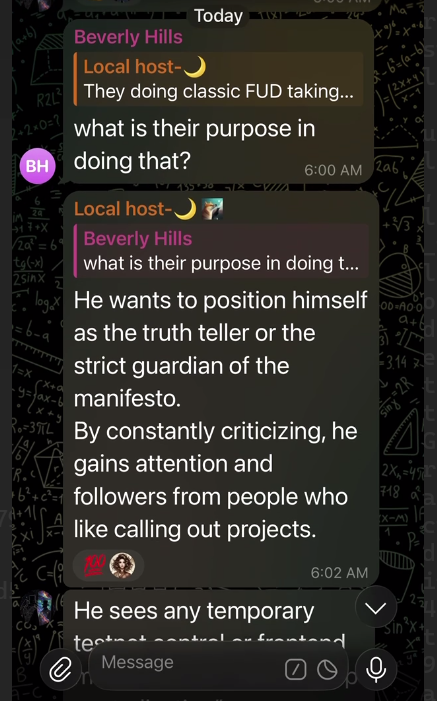
This post serves as an answer to the private Telegram noise with PROOFS.
Not what i think.
Not what I feel like.
Not insults.
Not “classic FUD.”
Not “he wants attention.”
Not “purity tester.”
Not “you do not understand frontend moderation.”
Facts.
The CAW manifesto does not describe a centralized social app with decentralized branding.
It does not describe one operator, one default frontend, one database, one hidden deployment map, one API, one private group, or one trusted builder becoming the new center.
It describes a protocol.
The manifesto standard is simple..
No single person, entity, or group should have ultimate control or benefit.
The cawmmunity writes, reviews, and accepts the contracts.
After deployment, the deployer renounces keys.
No multisig.
No upgradeable proxies.
Username mint burn goes to 0x0.
Protocol-level data remains permanent and usable even if individual frontends moderate.
So i'll answer the claims from A.A (another alt) and kachoperro directly right here on X so all can see.
Claim 1:
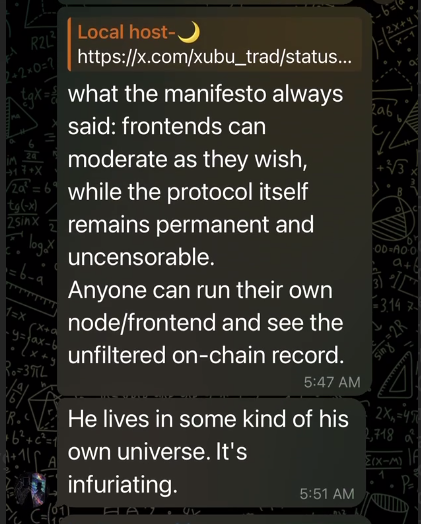
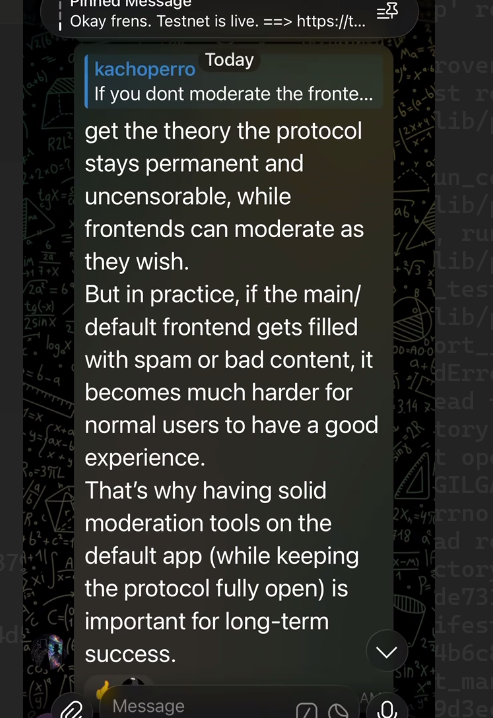
“Frontends can moderate while the protocol remains permanent and uncensorable.”
Correct in theory.
A frontend can moderate.
A frontend can hide spam.
A frontend can hide illegal material.
A frontend can choose what it displays.
That is not the dispute.
The dispute is whether the protocol underneath is actually decentralized.
The dispute is whether users can reconstruct the unfiltered CAW record without trusting Gilgamesh’s database, API, indexer, frontend, deployment map, moderation state, or private config.
Frontend moderation is allowed.
Frontend moderation is not proof of protocol decentralization.
Those are different claims.
Claim 2:
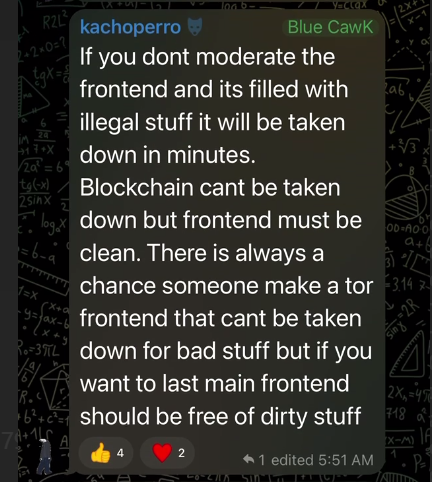
“If the main frontend is filled with illegal content, it will be taken down, so the frontend must be clean.”
Fine.
That is a hosting argument.
That is not a decentralization argument.
A legal default frontend can exist.
A moderated default frontend can exist.
But if the default frontend becomes the only practical way normal users see CAW, then whoever controls that frontend controls the default reality.
That may be acceptable for a centralized app.
It is not the same thing as a decentralized protocol.
The manifesto did not say “build a website and trust the operator.”
The manifesto points toward protocol-level permanence underneath frontend-level moderation.
Claim 3:
“Anyone can run their own node/frontend and see the unfiltered on-chain record.”
Good.
Then prove it.
Post the repo commit.
Post the config.
Post the RPCs.
Post the contract addresses.
Post the deployed bytecode links.
Post one on-chain action hash.
Post the decoded calldata or event.
Post the DB row.
Post the visible post.
Post the exact reconstruction path:
on-chain action → calldata/event → indexer → database row → visible CAW record
Then block Gilgamesh’s API, database, indexer, frontend, private config, and hidden deployment map.
If the second node still reconstructs the same unfiltered CAW record from chain, that is evidence.
If it cannot, then “anyone can run a node” is a slogan.
Claim 4:
“The second node / second frontend exists.”
This is weaker evidence unless it is reproducible.
A browser page is not enough.
A second frontend is not enough.
A database reading something is not enough.
An independent node must be independently reproducible.
If it depends on Gilgamesh’s hidden deployment map, backend, seed data, API, database, moderation state, or private config, then it is not proof of decentralization.
The test is simple:
Can the people rebuild the same unfiltered CAW record from chain?
If yes, publish the proof.
If not, stop using the word decentralized as a shield.
Claim 5:
“This is classic FUD.”
No.
FUD is fear without evidence.
This is the opposite.
This is line numbers.
This is selectors.
This is hashes.
This is source audit output.
This is live-probe output.
This is comparing the code and deployment claims against the manifesto.
Calling evidence “FUD” is not a rebuttal.
The rebuttal is proof.
Claim 6:
“Xubu has an extreme standard of decentralization.”
No.
The standard is not mine.
The manifesto set the standard.
No single controller.
No special deployer advantage.
No multisig.
No upgradeable proxy.
Renounced keys.
Cawmmunity-reviewed public contracts.
Protocol-level freedom underneath frontend moderation.
That is not extreme.
That is CAW.
Claim 7:
“You did not see what happened in Shiba Inu in 2020.”
Irrelevant.
Whatever happened in another community does not prove this protocol is decentralized.
It does not prove current deployed bytecode.
It does not prove owner state.
It does not prove LayerZero delegate authority is closed.
It does not prove one-time setters are consumed.
It does not prove client controls are locked.
It does not prove the burn path matches the manifesto.
It does not prove the unfiltered CAW record is reconstructable from chain.
It does not prove CAW manifesto compliance.
History is not a substitute for verification.
Claim 8:
“He wants attention / followers / professional complainer / purity tester.”
Personal attacks are not technical rebuttals.
If the build is decentralized, prove it.
If the protocol record is recoverable from chain, demonstrate it.
If ownership is renounced or mathematically neutralized, publish the evidence.
If the LayerZero delegate surface is closed, show it.
If the one-time setters are consumed, show it.
If the burn path matches the manifesto, show the source and deployment.
If the build diverges from the manifesto, explain why.
Now the actual evidence.
Gilgamesh has built real infrastructure.
That is true.
His repo includes Solidity contracts, backend services, frontend code, validators/action processing, event gathering, chain sync, API/database flow, and node-running claims.
Credit where due.
But infrastructure is not decentralization.
A running website is not decentralization.
A Telegram group is not decentralization.
A default frontend is not decentralization.
A database reading chain events is not decentralization.
A second browser endpoint is not decentralization.
Decentralization is the ability for independent people to verify and reconstruct protocol state without trusting a central operator.
Our local source audit completed.
Doctest passed.
Mypy passed.
486 production-contract rows were loaded.
62 contract-level findings were generated.
The strongest source-level mismatch remains:
CawProfileMinter.sol
BURN_TO_DEAD
count: 3
severity: HIGH
lines: 137, 210, 246
The source sends burn amounts to:
0xdEAD000000000000000042069420694206942069
The manifesto says username mint burn goes to:
0x0
Maybe there is an explanation.
Maybe it is testnet-only.
Maybe the code changed later.
Then say that plainly.
Do not blur a custom dead sink into the manifesto’s stated burn path.
The source matrix also flagged decentralization-relevant surfaces:
owner surfaces
transferOwnership surfaces
renounceOwnership surfaces
LayerZero setPeer surfaces
LayerZero setDelegate surfaces
client fee mutability
client ownership mutability
client fee locks
client ownership locks
cross-chain routing surfaces
Some of these may be normal setup surfaces.
Fine.
But setup is not decentralization.
OnlyOnce is not decentralization.
OnlyOnce is a guardrail.
Renouncement or mathematical neutralization is finalization.
A centralized operator with guardrails is still an operator.
That is the technical point A.A / A.L and kachoperro keep avoiding.
They are arguing that some centralization is practical.
That may be true for a normal app.
But CAW was not sold as a normal app.
CAW was presented as a decentralized coup.
CAW was presented as fortheppl, bytheppl.
CAW was presented as a protocol where the people can verify.
So if their (centralized propagandist) answers are now..
“Trust the default frontend.”
“Trust the private group.”
“Trust the builder.”
“Trust the database.”
“Trust the current operator.”
“Trust that centralization is temporary.”
Then that is not manifesto compliance.
That is a different trust model.
Now the latest scan update, treated separately.
The corrected frontend/node evidence lane passed doctest.
Mypy passed.
The frontend-extracted-address probe scanned:
CANDIDATE_ADDRESSES = 18
PROBE_ROWS = 72
LIVE_CODE_ROWS = 0
That does not prove Gilgamesh is decentralized.
That does not prove Gilgamesh is centralized.
It proves the current public/frontend-extracted path was insufficient for independent deployment verification.
And that matters because the claim being made is “anyone can verify.”
If anyone can verify, the deployment map should be public.
If anyone can run a node, the reconstruction path should be public.
If the protocol is decentralized, the people should not need a private Telegram insider to tell them what is true.
The required proof is not emotional.
It is technical.
Show verified deployed bytecode.
Show current contract addresses.
Show owner/admin state.
Show no upgradeable proxy control.
Show no multisig.
Show consumed one-time setters.
Show closed LayerZero delegate authority.
Show critical client controls locked.
Show burn behavior matching the manifesto or explain the divergence.
Show an independent node reconstructing the unfiltered CAW record from chain without Gilgamesh infrastructure.
Until then..
Gilgamesh has progress.
Gilgamesh has infrastructure.
Gilgamesh may have a useful app.
But none of that is proven decentralization.
And the current code does not accurately depict the manifesto standard.
The manifesto points to a protocol that removes the operator.
The current evidence still shows a system that depends on an operator, setup surfaces, mutable control paths, off-chain infrastructure, and public verification gaps.
Progress deserves credit.
Centralized control still deserves scrutiny.
Proof or it is not decentralization.
#CAW
1
4
6
6,421
May 5
Updated peer review on Gilgamesh’s latest CAW commits and live testnet.
I am going to be precise because the evidence changed in both directions.
The repo has improved. The latest source now includes OnlyOnce.sol, and several of the old open-ended admin setters are no longer open-ended in the same way. setL2Peer, setPeer, setMinter, setUriGenerator, setL1Peer, and setCawActions are now guarded with onlyOnce. That is real progress and it should be acknowledged.
But that is not the same thing as the live system being trustless.
We checked the current deployment addresses pulled from the repo and frontend config, then probed the live contracts directly. The same deployer address still owns the core contracts:
0xf71338f3eaa483aa66125598b09ba1988e694a95
Live owner() returned that address on CawProfile, CawProfileL2, CawActions, CawActionsArchive, and CawChallengeRelay across Sepolia, Base Sepolia, and Arbitrum Sepolia.
That means ownership has not been renounced.
We also corrected the setDelegate(address) test. The correct selector is:
0xca5eb5e1
With the corrected selector, nonowners cannot call setDelegate. So I am not claiming there is public delegate access. That part is closed.
But the owner can call setDelegate on multiple OApp contracts. The owner can also simulate renounceOwnership() and transferOwnership(address) successfully. That proves the ownership surface is still live.
So the clean finding is this:
Gilgamesh did reduce some admin risk in the latest source.
He did not prove the deployed system is trustless.
OnlyOnce is a guardrail. Renounce is finalization. Those are not the same thing.
Right now this is still a controlled deployment with one-time setup constraints and live owner authority. That may be normal for testnet, but it should not be sold to the cawmmunity as completed manifesto alignment.
The standard is simple.
Show verified deployed bytecode matching the improved source.
Show the one-time setters consumed correctly.
Show ownership renounced or mathematically neutralized on every critical contract.
Show LayerZero delegate authority closed, boxed in, or no longer controlled by a human operator.
Until then, this is progress under review, not trustlessness proven.
Proof artifacts from my local review:
09_live_owner_delegate_probe_v1_summary.txt
13_live_sensitive_selector_probe_v2_summary.txt
24_verify_setdelegate_correct_selector_v4_summary.txt
28_multichain_setdelegate_correct_selector_v5_summary.txt
Key hashes:
c6995b12a9bc0082cc105ae424e7683b93527d2f49a0b33135d988b65eeb512e
b470a8fd2e8b111d9b4b03a9af04d5898aa5790eb688a8aa6ff24eec12b3b74d
8ae47be9f9e549a46bf9ddffa2cf11d16e9d4b2af5bb9a8a3c7cebc1baf87e6a
0ca0b7664c1f96b0dc7d83cd1050eb2a5a9116f2f4a94e9c109d48a90c4f2186
Progress deserves credit.
Control still deserves scrutiny.
CAW was never supposed to be “trust me while I finish removing myself.”
#CAW
5
4
34
11,531