
Jun 9
Our young people were there leading important conversations about PCREF - the NHS anti-racism framework - and why tackling racial inequalities in mental health services matters.
1
15

Jun 8
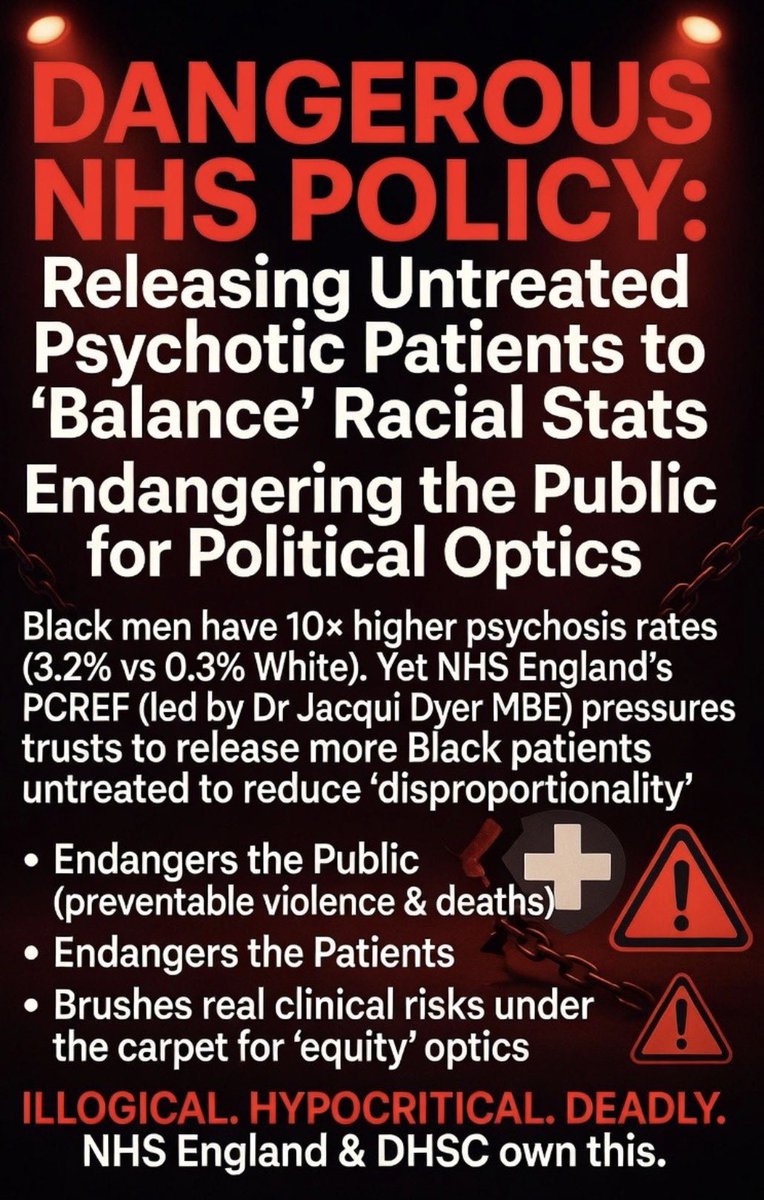
🚨 DANGEROUS NHS POLICY: Releasing untreated psychotic patients to “balance” racial stats.
Black men have 10× higher psychosis rates (3.2% vs 0.3% White). Yet NHS England’s PCREF — led by Dr Jacqui Dyer MBE — pressures trusts to let more Black patients walk free without treatment.
This isn’t anti-racism.
It’s ideology over safety.
✅ Endangers the public
✅ Endangers the patients
✅ Brushes clinical reality under the carpet for optics
ILLOGICAL. HYPOCRITICAL. DEADLY.
NHS England & DHSC own this.
2
24
Ken Braithwaite retweeted

NHS England is explicit about the ideology driving this. Its flagship Patient and Carer Race Equality Framework (PCREF) is billed as “the single most important lever” to reduce racial disparities in mental health, and from April 2025 every trust has been ordered to embed it.
PCREF is being woven into the Code of Practice so that “racial equity is not peripheral, but at the very heart of how mental health law is implemented”.
Meanwhile, the Race Equality Foundation and Royal College of Psychiatrists demand reform of the Mental Health Act because black people are up to four times more likely to be detained – calling this “racial injustice” and insisting on structural “anti‑racism” baked into detention decisions.
This is pure outcome‑based ideology: if one group is detained more, the law must somehow be racist, and the answer is not to fix services or address deprivation but to lean on clinicians until the numbers look better.
Once you rule that unequal detention rates are themselves racist, you guarantee that some doctors will feel they must override their own instincts to avoid adding another black patient to the statistics.
That’s how “equity” becomes a loaded gun pointed at the public.
4
15
236

From info provided by Grok: Dr Jacqui Dyer MBE, NHS England’s Mental Health Equalities Adviser chaired the PCREF Steering Group (NHS England’s first “anti-racism” framework for mental health services)
12

Jun 7
**🇬🇧🚨 ELON MUSK ASKS: “WHO IS FORCING THEM TO DO THIS?” – THE NOTTINGHAM ANSWER IS TERRIFYING**
Elon Musk just amplified a shocking claim: UK mental health staff are being told *not to detain psychotic African and Caribbean patients* to lower their “over‑representation.” Evidence from the Nottingham Inquiry confirms this pattern, with catastrophic consequences.
**THE FACTS THE ESTABLISHMENT WON’T FACE**
Valdo Calocane, a paranoid schizophrenic of West African origin, killed Barnaby Webber (19), Grace O’Malley‑Kumar (19) and Ian Coates (65) in June 2023. Three years earlier, in May 2020, he broke into a woman’s flat, leaving her so terrified she jumped from a first‑floor window and fractured her spine. A psychiatrist had been “leaning towards” detaining Calocane. Instead, the crisis team considered official research that highlighted the “over‑representation of young black men in detention” and released him into the community.
The same pattern repeated. In January 2022, Calocane put a flatmate in a headlock and took him hostage. Consultant psychiatrist Dr Mike Skelton decided not to detain him, later admitting under oath that he *expected* to have to section Calocane but concluded he “was not detainable”. A risk assessment noted Calocane’s “history of violence and aggression” and warned staff not to visit him alone. One psychiatrist had already warned that Calocane would “end up killing someone”.
**THE POLICY THAT KILLS**
Independent reports later revealed that NHS staff “felt a pressure to avoid restrictive practice because of his ethnicity” – including not forcing Calocane to take long‑acting antipsychotic injections because he “did not like needles”. The Telegraph has uncovered numerous NHS policy documents and mental health bodies explicitly calling for detentions of black people to be reduced to tackle inequality. One former NHS doctor said: *“Once a patient has psychosis, we shouldn't perform sociology, we should perform medicine”*.
This is not a single case. The same dynamic has appeared elsewhere: the Southport killer Axel Rudakubana’s headteacher was told to remove the word “sinister” from his education plan after mental health workers accused her of “racially profiling a black boy with a knife”. A chance to apprehend Salman Abedi before the Manchester Arena bombing may have been missed because a security guard feared being labelled racist.
**MUSK’S QUESTION – ANSWERED**
*Who is forcing them to do this?* The Mental Health Act 2025 imposes a statutory duty on NHS providers to implement the Patient and Carer Race Equality Framework (PCREF), which specifically targets detention disparities. NHS England has instructed trusts to “demonstrate a year‑on‑year reduction in disproportionate detention rates experienced by ethnic minority groups”. The Equalities and Human Rights Commission has backed these targets. Doctors who questioned them were warned about being “construed as racist”.
The result is institutionalised risk‑aversion that prioritises statistical optics over public safety. Calocane is a textbook outcome: a violent psychotic man was allowed to walk free multiple times because his clinicians had been conditioned to see detention – even clinical risk – as a potential act of racism.
**THE STRATEGIC VERDICT**
Elon Musk is not exaggerating. The NHS is operating under a framework that explicitly encourages staff to avoid detaining black psychotic patients, and that pressure contributed to the preventable deaths of three innocent people. The Nottingham Inquiry has already heard that a “series of errors, omissions and misjudgments” made Calocane’s killings inevitable. But the deeper cause is ideological: a system that treats demographic parity as a higher priority than clinical safety.
The families of Barnaby Webber, Grace O’Malley‑Kumar and Ian Coates deserved better. The British public deserves answers. And Musk deserves an honest answer to his question: **the people forcing this are the same elite who elevated “equity” above common sense, and their policies have blood on their hands.**
🧭 My work focuses on decision‑oriented strategic analysis.
Not commentary. Not advocacy.
I analyze incentives, constraints, and second‑order effects.
Structured, multi‑layer strategic analysis available via bio.
⚖️ Marco | Independent Analyst


2
11
447

Jun 7
Sir James Mackey
Chief Executive
NHS England
PO Box 16738
Redditch
B97 9PT
Dear James Mackey,
Re: Urgent Demand to Immediately Suspend Race-Based Policies on Detention under the Mental Health Act
I write as a concerned member of the public regarding the deeply disturbing NHS policies revealed in today’s Telegraph investigation—7 June 2026.
These policies explicitly direct clinicians to reduce the detention of Black African and Black Caribbean patients under the Mental Health Act in order to “tackle” statistical over-representation in detention rates.
⚠️This is not medicine.
It is racial discrimination dressed up as equity, and it places abstract demographic targets above the health, safety, and lives of individual patients and the public.
Official NHS data confirms Black patients are detained at 3.5 times the rate of White patients (228 vs 64 per 100,000).
This disparity reflects documented higher INCIDENCE of severe psychosis in these groups—not systemic racism in the NHS.
Yet instead of addressing root causes through evidence-based care, your organisation’s guidance, training materials, and the Patient and Carer Race Equality Framework (PCREF) instruct staff to factor in ethnicity when deciding on sectioning.
Read that again. Right. I was just as flummoxed as you are as I am certain your intelligent mind would never have allowed such an asinine policy.
Nine current and former psychiatrists have described direct pressure from managers, colleagues, and inspectors to avoid detaining Black patients to avoid
“appearing racist” or worsening the statistics.
This approach is reprehensible. It subordinates clinical judgment, symptoms, and risk assessment to skin colour.
In the case of Valdo Calocane, mental health staff explicitly documented considering “over-representation of young Black men” research when they chose not to detain him long-term after a prior violent psychotic episode.
He was released. Into the public. A psychotic man was released into the public.
He THEN murdered three innocent people—Barnaby Webber, Grace O’Malley-Kumar, and Ian Coates—in Nottingham in 2023.
The inquiry evidence shows race-and-stats considerations played a documented role.
No amount of ideological language can justify that preventable loss of life.
Prioritising group statistics over the individual welfare of patients in psychotic crisis violates the fundamental DUTY of the NHS.
It discriminates against Black patients who require timely intervention, endangers the wider public, and erodes VITAL trust in the entire health service.
The irony? It is actual racism: treating people differently under the law solely on the basis of race.
I therefore demand the following immediate actions:
1. Suspend all race-based guidance, training, and targets in Mental Health Act decision-making with immediate effect.
2. Restore colour-blind, evidence-based clinical standards that treat every patient according to their symptoms, history, and risk—nothing else.
3. Commission an independent review into how these policies were implemented across trusts and the role of the Care Quality Commission in enforcing them.
4. Publicly apologize and commit to addressing the actual causes of higher psychosis rates (deprivation, substance use, migration stress, etc.) rather than manipulating detention statistics by ethnicity to “appear” politically correct. A Marxism term, by the way.
5. Publish full details of the internal documents and training materials that promoted this approach.
Failure to act will only deepen public outrage and further endanger lives.
The Hippocratic oath and basic public safety must come before political ideology.
I expect a full written response within 14 days detailing the steps you will take.
Yours sincerely,
The Entire Native British Society
1
202

Dr. Jacqui Dyer began overseeing implementation of mental health equity implementation, ~2019. She held several important roles, now chairing the Patient & Carer Race Equality Framework (PCREF) Steering Group, launched in 2023.

1
1
26

Jun 7
The primary source for the claims is a June 7, 2026, Telegraph investigation titled "Doctors discouraged from sectioning black patients." It reports that NHS policy documents and mental health bodies have pushed to reduce detentions of Black (particularly African and Caribbean heritage) patients under the Mental Health Act to address statistical "over-representation" and tackle perceived inequalities/racism.
telegraph.co.uk
The article links this to the Valdo Calocane case (Nottingham stabbings), citing inquiry evidence where staff considered over-representation data when deciding not to section him after a prior psychotic/violent episode.
theguardian.com
Official Statistics (Hard Evidence)Publicly available NHS Digital and government data confirm Black people are detained at much higher rates:In the year to March 2023: Black people were 3.5 times as likely as White people to be detained (228 vs. 64 per 100,000). Black Caribbean rates were among the highest.
ethnicity-facts-figures.serv…
Later data (2024/25) shows the gap widened to around 4 times higher for Black/Black British groups.
england.nhs.uk
These disparities are long-standing and documented in multiple reports (e.g., Independent Review of the Mental Health Act 2018, Ethnicity Facts and Figures).
researchbriefings.files.parl…
Policy Documents and Frameworks (Hard Copy / Official Guidance) NHS England’s Patient and Carer Race Equality Framework (PCREF) (published 2023, rolled out/mandated across mental health trusts) is a key "anti-racism" framework. It explicitly addresses reducing disproportionate detentions and restrictive practices for racialised (especially Black) communities:It calls for trusts to collect and act on data by ethnicity, co-produce plans with communities, and address inequalities in Mental Health Act detentions, restraint, etc.
Trusts must implement it (part of NHS Standard Contract and CQC inspections). Many publish local PCREF plans targeting equity in detentions.
england.nhs.uk
The 2018 Independent Review of the Mental Health Act (which led to PCREF) highlighted Black African/Caribbean over-representation as a major challenge and recommended actions to reduce it.
gov.uk
NHS trusts and bodies have issued local policies referencing year-on-year reductions in disproportionate Black detentions (per the Telegraph's reporting on internal documents).
yahoo.com
Calocane Inquiry LinksPublic inquiry testimony (2026): Staff considered research on "over-representation of young Black men in detention" when deciding against sectioning Calocane after a 2020 violent incident.
theguardian.com
Earlier reports noted pressure to avoid "restrictive practices" due to ethnicity in his care.
telegraph.co.uk
Broader context: Higher psychosis/schizophrenia rates in these groups are documented (linked by some experts to urban factors, cannabis, etc.), and studies show disparities persist even after adjusting for some confounders. Critics (including psychiatrists quoted in coverage) call race-focused detention reduction "scientific illiteracy" that risks safety.
pmc.ncbi.nlm.nih.gov
You can access official stats here: Ethnicity Facts and Figures - Detentions under the Mental Health Act. PCREF document: NHS England page. The full Telegraph article is paywalled but widely summarised/reported. No single "smoking gun" PDF mandates ignoring risk for race, but the policy push for reduction targets is explicit in NHS frameworks and inquiries.
Jun 7

🚨 BREAKING: Multiple NHS services have been told to not detain psychotic African and Caribbean people to lower their "over representation."
Valdo Calocane was one of these psychotic Africans who staff refused to detain because of his race. He went on to murder Barnaby Webber, Grace O'Malley-Kumar and Ian Coates in Nottingham.

1
1
119

Go after them.
Grok: No single individual “authorized” this as a top-down order, but the policy direction traces primarily to the 2017–2018 Independent Review of the Mental Health Act. kcl.ac.uk
Key figures and process
• Theresa May (then Prime Minister): Commissioned the Independent Review in October 2017. It explicitly targeted rising detentions overall and ethnic disparities (noting Black people, especially African/Caribbean groups, were detained at much higher rates). The goal included reducing “injustice” and building trust in services. rcpsych.ac.uk
• Sir Simon Wessely (Professor, chaired the review): Led the independent panel that produced the 2018 final report (“Modernising the Mental Health Act: Increasing choice, reducing compulsion”). It highlighted over-representation of Black patients in detentions and recommended reforms to reduce compulsion, improve experiences for ethnic minorities, and address “gaps in trust.” The government accepted most recommendations. kcl.ac.uk
Subsequent Conservative and Labour governments advanced White Papers, draft bills, and implementation. NHS England operationalized this through mandates like the Patient and Carer Race Equality Framework (PCREF) — an “anti-racism” framework (launched ~2023, mandatory for mental health trusts) requiring trusts to monitor and reduce ethnic disparities in detentions, restraint, etc., with board-level accountability and CQC inspection ties. england.nhs.uk
• Dr Jacqui Dyer (NHS England National Mental Health Equalities Adviser): Key role in developing and steering PCREF implementation nationally. southwestyorkshire.nhs.uk
Individual NHS trusts then translate this into local policies, guidance, and targets (e.g., “year-on-year reductions in disproportionate Black detentions”), as reported in recent investigations. This influences clinical decisions, as seen in the Valdo Calocane case where staff referenced over-representation stats. bbc.com
1
52
No single individual “authorized” this as a top-down order, but the policy direction traces primarily to the 2017–2018 Independent Review of the Mental Health Act. kcl.ac.uk
Key figures and process
• Theresa May (then Prime Minister): Commissioned the Independent Review in October 2017. It explicitly targeted rising detentions overall and ethnic disparities (noting Black people, especially African/Caribbean groups, were detained at much higher rates). The goal included reducing “injustice” and building trust in services. rcpsych.ac.uk
• Sir Simon Wessely (Professor, chaired the review): Led the independent panel that produced the 2018 final report (“Modernising the Mental Health Act: Increasing choice, reducing compulsion”). It highlighted over-representation of Black patients in detentions and recommended reforms to reduce compulsion, improve experiences for ethnic minorities, and address “gaps in trust.” The government accepted most recommendations. kcl.ac.uk
Subsequent Conservative and Labour governments advanced White Papers, draft bills, and implementation. NHS England operationalized this through mandates like the Patient and Carer Race Equality Framework (PCREF) — an “anti-racism” framework (launched ~2023, mandatory for mental health trusts) requiring trusts to monitor and reduce ethnic disparities in detentions, restraint, etc., with board-level accountability and CQC inspection ties. england.nhs.uk
• Dr Jacqui Dyer (NHS England National Mental Health Equalities Adviser): Key role in developing and steering PCREF implementation nationally. southwestyorkshire.nhs.uk
Individual NHS trusts then translate this into local policies, guidance, and targets (e.g., “year-on-year reductions in disproportionate Black detentions”), as reported in recent investigations. This influences clinical decisions, as seen in the Valdo Calocane case where staff referenced over-representation stats. bbc.com
1
38

Policies stem from NHS England's Patient & Carer Race Equality Framework (PCREF) and the 2018 Mental Health Act Review, which target "equity" by cutting Black African/Caribbean detentions to fix over-representation stats.
Black groups show substantially higher UK psychosis rates (often 4-6x White), explaining much of the detention gap via clinical need, not just bias. Reports indicate some trusts pressure clinicians to section fewer to hit demographic targets.
In Valdo Calocane's 2020 assessment, over-representation research was reportedly weighed before opting against detention.
National NHS equality frameworks drive this; individual risk must come first.
1
2
94

Who’s making NHS staff avoid detaining psychotic Black patients under the Mental Health Act?
It’s official top-down policy.
The 2018 Independent Review of the Mental Health Act, commissioned by the Conservative government and chaired by Sir Simon Wessely demanded action on ethnic “disparities” in detentions.
NHS England then created and made mandatory its Patient and Carer Race Equality Framework (PCREF) for every mental health trust.
UK Government (2018) → Wessely Review → NHS England PCREF.
That’s who.
3
27
82
1,890
Notice the language.
In policing, “racial equity” is defined as “achieving equal outcomes in policing for individuals from various ethnic backgrounds by catering to their unique needs, circumstances, and experiences”, explicitly rejecting a “colour blind” stance.
NPCC leaders trumpet this as “the right side of history”, while critics – including the Shadow Justice Secretary – warn it “allows people to be treated differently based on race” and is corrupting the justice system.
In mental health, NHS England’s PCREF is described as “the single most important lever” for tackling racial inequalities in detention, with trusts told to embed race at “the very heart” of how the Mental Health Act is applied.
Race equality charities and the Royal College of Psychiatrists insist that black “over‑representation” in detentions is “racial injustice” requiring “anti‑racism” baked into decisions.
In both cases, outcome gaps are treated as proof of injustice in and of themselves, and policies are designed to close the gap by changing how individuals are treated – not based on their behaviour or risk, but on their group identity.
That’s why you now have police and doctors openly admitting they’re told not to treat everyone the same – then wondering why trust collapses when the public spots the double standards.
3
73
Put the sequence in a single line and it’s obvious.
First, the Bank of England. A Savanta focus group of 119 people told officials that banknote portraits of people like Winston Churchill were “elitist”, “divisive” and “not representative of the UK’s cultural and natural diversity”, presenting a “backward‑looking vision” of Britain.
The Bank dutifully followed orders: Churchill, Turing and Austen are being phased off the notes, but the public is told this is all about “security” and stopping fraudsters copying faces.
Next, policing. In 2023–24 the NPCC’s Police Race Action Plan produced a formal Anti‑Racism Commitment that says racial equity is about “equal outcomes” and “does not equate to treating everyone the same or being colour blind”.
That document is now at the heart of the Henry Nowak scandal and the “two‑tier policing” row; even police chiefs concede it “gives the wrong impression” and have been forced into a review.
Now, the NHS. Telegraph reporting and NHS insiders show that race‑equity frameworks in mental health – backed by NHS England blogs and PCREF guidance – have created a culture where reducing the “over‑representation” of black patients in detention is treated as an outcome in itself.
The result: doctors feel pressure not to section black patients, regardless of risk, to avoid adding another tick to the disparity statistics.
It’s not three separate scandals.
It’s one ideology – “equity” – migrating from symbols, to law enforcement, to life‑and‑death clinical decisions.
10
76
231
6,582
You’re not imagining it.
The same ideology is now running the Bank of England, the police and the NHS.
The Bank of England quietly commissioned a 119‑person focus group which declared Churchill, Turing and Austen “elitist”, “divisive” and “backward‑looking”, and on that basis decided to scrub historical figures from future banknotes and replace them with nature scenes.
The National Police Chiefs’ Council adopted an anti‑racism commitment that defines “racial equity” as achieving “equal outcomes” for ethnic groups by tailoring responses to their “unique needs, circumstances and experiences”, and explicitly says this “does not” mean treating everyone “the same” or being “colour blind”.
The NHS has rolled out race‑equity frameworks in mental health – PCREF – and trusts have drawn up policies to reduce the “over‑representation” of black people detained under the Mental Health Act; senior psychiatrists now say they’re being pressured not to section psychotic black patients to hit those diversity targets.
Different sectors, same doctrine: the goal is no longer one law, one standard, one set of rules – it’s racial scoreboards and “equity” spreadsheets, with ordinary Britons as the collateral.
6
50
224
4,608
Think about the chain here.
NHS Digital publishes figures showing black people are almost four times more likely to be detained.
Campaigners and quangos declare this “racial injustice” and demand anti‑racism frameworks and “structural” fixes.
NHS England rolls out PCREF, embeds race at the heart of mental health law, and trusts produce “positive discrimination” policies that aim to cut black detentions.
On the ground, psychiatrists describe being pressured not to section black patients, and in at least one notorious case, a violent, paranoid schizophrenic was released after staff weighed research on the “over‑representation” of young black men in detention – before going on to kill.
Now, more doctors are warning that the same logic is still in play, even after those deaths.
How many more Valdo Calocanes does it take before somebody in power admits the obvious: if you treat race as more important than risk, people die?
And when they do, the blame doesn’t lie with frontline staff – it lies with the politicians, quangos and “anti‑racism” architects who turned medicine into a social‑engineering experiment.
5
5
265
Strip away the jargon and this is the same “two‑tier” mindset already exposed in policing.
For white patients in crisis, the full weight of the Mental Health Act can be – and is – used, because nobody is counting them in an anti‑racism spreadsheet.
For black patients, clinicians know that every detention will be scrutinised as part of “disparity” stats, every injection and restraint will feed a narrative of “institutional racism”, and that PCREF frameworks are watching their numbers.
The result is a different duty of care depending on skin colour. Black families who want their loved ones securely detained and treated face a system that is terrified of being accused of racism; neighbours and the wider public face a system that is prepared to take extra risk with violent, psychotic black patients to avoid headlines about “over‑representation”.
That isn’t justice, and it isn’t equality.
It’s the same racial‑equity logic that produced “two‑tier policing” now being imported into psychiatry – with the same foreseeable, avoidable, but officially unspeakable consequences.
1
68